What Are The Keys To Making Lasting Changes In Your Life?

lasting-change.png

Wednesday, 9.09pm

Sheffield, U.K.

Yesterday I was clever, so I wanted to change the world. Today I am wise, so I am changing myself. – Rumi

Management has to be one of the most pointless activities out there.

Who would willingly become a manager?

Become someone who has to watch others doing work and try and get the best out of them?

After all, managing oneself is hard enough without being responsible for other people.

One of the worst ideas in management is that you can’t manage what you can’t measure.

Think of something – anything that is good in the world.

How many of them were “managed” into existence?

Trees? Animals? Your family? Art? Books? Jeans?

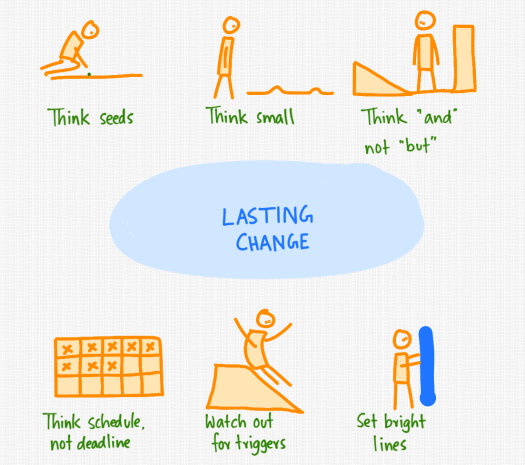
A seed doesn’t need to be managed into existence.

You don’t need to measure and report key performance indicators.

Given the right conditions it just grows.

Wouldn’t you rather find the right person that wants to do work you need to get done and let them get on with doing a good job?

Wouldn’t that be preferable to managing them?

Thinking of life or business like gardening rather than managing may be a good idea.

Your job becomes one of planting seeds and nurturing them, protecting them and letting them grow.

Or, if you’re trying to change, your job is to find the right seed – the right behaviour, approach or strategy that will make a difference.

Then you need to make it ridiculously easy to do – you need to think small.

Big things are too big to keep in your head – too big to fight.

It’s too easy to give up when you have a big challenge.

Like running a marathon when you haven’t jogged in twenty years.

You need to start with something smaller – like walking every day.

And when you change you’re going to fail or not see results as fast as you want.

You could say, “I’ve been training for two weeks but I’m not getting any faster.”

Using the word but stops you in your tracks.

There’s nowhere to go from there.

Or you could say, “I’ve been training for two weeks and I’m not getting any faster.”

Using the word “and” seems unfinished. It feels like the word “yet” is missing from the end of that sentence.

You aren’t faster yet.

But you will be.

As long as you keep showing up.

Thinking is hard work – if you want to change something you have to make it automatic, something you do without thinking.

And the easiest way to do that is put it on a schedule.

If you want to get fit, get your exercise times in the diary.

If you want to create art or write – set time aside every day to do it whether you feel like it or not.

Deadlines are just pressure – they don’t help.

Showing up is what matters.

And then, if you’re trying to change something there is always the risk of sliding back to your old ways.

And it’s easy to do this when you come across an old trigger – something that prompts you to do what you used to do.

For example, if you go shopping hungry you know you’re going to buy some chocolate.

So, watch out – and avoid being in that situation.

Then there are bright line rules – things that are very clear, where there is a yes or no answer.

These are good.

The classic here is dry January – where people decide not to drink all month after the merriment of the month before.

It might not last – but it’s a pretty clear rule.

The thing with change is it’s hard – really hard.

And there isn’t a way to do it without some pain and effort.

But there are ways to make it easier to change something – whether it’s a habit or a process.

But to make it last you need to do it in a way so it doesn’t need ongoing management – so it manages itself.

Because anything that needs to be managed will stop working as soon as that manager stops paying attention.

Cheers,

Karthik Suresh

Why Getting Out Of Your Own Way Is The Key To Creativity

problem-exploring.png

Wrong turns are as important as right turns. More important, sometimes. – Richard Bach

You should never ask someone what they want.

It’s a question you shouldn’t even ask yourself.

Why, you ask?

There are three reasons, wrote Watts S. Humphrey in one of his essays:

First, people find it hard to visualise a solution to their problems, especially if they aren’t professionals in building those kinds of solutions.

Second, they often know how to do their job but not why. So, all they can show you are their existing, often manual, ways of working.

And third, if you do have a solution it could change everything about how they work and mean thinking again about what problem they have.

That’s why most approaches that focus on problem solving end up solving the wrong problem.

It takes multiple attempts to get to something that actually works for you.

As a professional, you come at things from a different point of view.

You’ve seen people experience problems that you’ve solved before, so you know what they need – a very different thing from trying to make what they want.

But that only works when you’ve been there and done it before.

When its something new you’re at the same place as everyone else.

And that’s a place filled with insecurity and angst.

Angst because, if you’re like most people, you worry that this time you won’t succeed – you won’t get it right.

And that’s ok – it’s just something that you have to get past.

But you can only do that if you have a way – a strategy ready for when that happens.

One approach that has had almost no traction is called Literate Programming.

It’s not the easiest thing to explain – but in essence its inventor, the legendary Donald Knuth, said you should first think about what you’re trying to do in plain language and then express it in code.

From that point the whole concept starts going downhill rapidly.

In an attempt to avoid that particular section of slippery slope we should talk about bread.

How would you make a mechanical breadmaker?

You might start by learning how to make bread.

The first time I tried doing that, we were in Italy and I was bored, and making bread seemed like a good idea.

So, I had a go.

It was a fairly angst inducing experience, given that I was guessing that flour and water was involved and had no books or Internet.

I’d forgotten about yeast and a few other ingredients, and the resulting block in the oven felt and tasted like a house brick.

So, I did some research, got a little focused and ended up with an edible loaf.

And it seems to me that any creative endeavour and, let’s face it, everything we do can be creative, needs an approach that lets us explore problems rather than trying to solve them.

If you’re writing a book or a program it makes sense to start by thinking and writing about your hopes and fears and expectations of what the thing will do.

Then you can come back and refine your thoughts, focus your attention and come up with a plan.

The book or program should then almost write itself – the result emerging from the cocoon of thought you’ve built up around it.

It feels sometimes that people are too eager to get to the end – without checking if the end they get to is the one they need to reach.

A little thinking might help – but it’s hard work.

Mainly because we need to admit that we’re unsure and need to look around, ask questions and experience things before coming up with a solution.

But if we do that maybe the result we get will be the one we need.

Cheers,

Karthik Suresh

What Is The Most Useful Way To Think About Your Marketing Tactics?

parthenon.png

Monday, 9.14pm

Sheffield, U.K.

One gets paid only for strengths; one does not get paid for weaknesses. – Peter Drucker

I’ve been thinking about a particular business and its marketing strategy for a few weeks now.

If you’re running something today you’re probably trying to win new customers.

And that needs them to know who you are – for them to be aware of you.

It’s the first part of any marketing formula, after all.

It’s also the part that takes time and effort and no small amount of self confidence or, at least, the effort to overcome a lack of it.

What does good look like when it comes to modern marketing?

Well, you’re probably all over social media.

Perhaps you have a video blog.

Maybe a regular one as well.

And of course you can’t forget offline networking and groups and all that stuff as well.

Clearly, doing nothing or just one thing isn’t going to work.

Publishing one article or running one ad may, like a one-legged stool, let you sit for a while but you’ll always be off balance and making quite some effort to stay put.

Having a few is better – certainly in the sense of giving you some stability.

But the real benefits come from having a number of effective tactics in play, something Jay Abraham calls the Parthenon strategy.

The idea is simple – the more pillars you have supporting the growth of your business the more likely you are to grow and the less likely you are to suffer a setback you can’t recover from.

So that’s obvious, I suppose.

What’s less obvious is that selecting which pillars to erect is a crucial task.

And the way to get started is by reading.

LinkedIn, for example, has a useful guide on how to use the platform well.

And it reinforces the basics.

People do business with people so your profile needs to be credible and give a good first impression.

People buy from you because of your approach to solving their problems.

So share information that keeps them informed about what’s going on, and what good looks like for them.

None of this is stuff I do particularly well.

And, if you’re like me, the chances are that you’re slightly suspicious of people who do it too well.

What are the sayings that come to mind?

  • All hat and no cattle.
  • All mouth and no action
  • All fur coat and no knickers

and many others…

Someone who has a lot of time to spend on sales must have less time to spend on doing the work.

Or is that just bitter and cynical?

Maybe they’re focused on getting the right message to the right people and see that as just as important as working on their product.

And they would be right.

For those of us, however, with less shine and polish there’s nothing stopping us from improving a little bit at a time.

What we need to believe is that persistence pays off.

What did Coolidge say?

Nothing in this world can take the place of persistence. Talent will not: nothing is more common than unsuccessful men with talent. Genius will not; unrewarded genius is almost a proverb. Education will not: the world is full of educated derelicts. Persistence and determination alone are omnipotent.

The most dangerous thing is to think there’s some kind of silver bullet that will solve our problems.

But if we put the effort in day after day we should end up with a business built on marketing tactics that are solid and stable.

And perhaps even refined and polished.

Here’s hoping.

Cheers,

Karthik Suresh

Can We Get Past The Fear Of Losing Control Of Our Future?

outsource.png

Sunday, 8.45pm

Sheffield, U.K.

I have a very strict gun control policy: if there’s a gun around, I want to be in control of it. – Clint Eastwood

I came across a piece of writing by a writer that I hadn’t read for a number of years titled Why Every Business Is A Software Business.

That writer was Watts S. Humphrey, who died in 2010, and was called The father of software quality,

I read his book on the Personal Software Process when on a work placement during my degree and the ideas in there stuck with me.

In particular the concept that you could catch more bugs by reading your code before trying to run it.

But in other ways his approach was hard to use.

But before we get to that it’s interesting to look at the idea of all businesses being software businesses and why that creates new problems as well.

The first thing is that everyone uses software to some extent.

Increasingly the thing that sets you apart is how you use the software you have.

Two companies, for example, could have Microsoft Excel but use them in very different ways.

What you’re trying to do is be unique in some way – be the only fish in your pond rather than a small one in a crowded one.

But that unique thing comes from having an asset – an oil well, a gold mine or, increasingly, software.

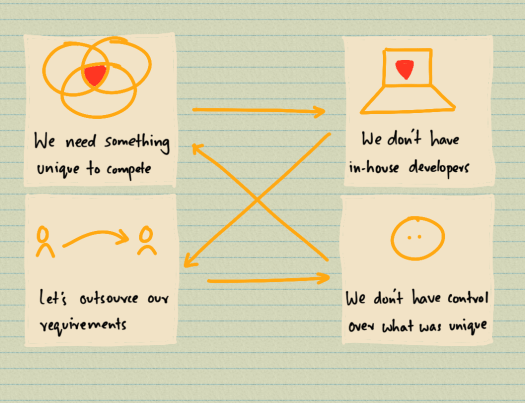
But what if you can’t develop that yourself – you haven’t got the skills or the team you need?

Should you outsource your requirements?

Humphrey argues that you shouldn’t – because you’ll lose control of what makes you unique – you hand your future over to someone else.

And that’s something that I’ve seen happen in a number of cases.

And that’s also what stops many people from investing in software – the fear that they’ll lose control over the core bit of their business – the thing that makes them unique in the first place.

Now, if you have money the answer is to hire someone and keep at the problem until you have something that works.

It may be rubbish to start with but eventually you’ll have something that works for you and maybe even something that you can sell to others.

So one of the issues to deal with is control.

The big thing for Humphrey, however, was quality.

And quality, in his view, was something that came from measurements and statistics and studying how you were doing.

And this is where I have some difficulty.

And that’s because while the output from software development might be lines of code the question for us is which lines matter.

We know that the more we write the more mistakes we make.

So it makes sense to write programs that are as short as possible.

Which means choosing higher level languages and writing programs that create programs – removing the possibility of error.

There’s also all that work that goes into intellectual effort – the angst, the self-doubt, the stuff that we might not want to measure precisely.

Plus measuring everything is very boring.

Maybe it needs automating.

None of that, of course, invalidates Humphrey’s views on how to create software – it’s just that making it too mechanistic doesn’t work for me.

But the control point has a very simple answer.

If you can write your own software then you’re in control anyway.

If you can’t and need to hire someone and you have the money then you’re fine as well.

But for all the people out there who need applications developing but can’t afford to get it wrong they should ask and developers should offer open source solutions.

That way, I pay you to write code and if we decide not to work together I can still take that code and develop it further.

Even better, if you can take something that’s already open sourced and use it you reduce risk even more.

It may seem paradoxical but in today’s world the way to be in control may come from being completely open.

Which seems contradictory – how can you be unique when everyone has access to what you have?

But thinking that way may be to confuse being unique and being in control.

When you’re in control the customer has to work with you because you control their future.

When you’re unique the customer wants to work with you because of who you are.

Because they can see a future where you two work together.

And that seems a nicer way to be.

Cheers,

Karthik Suresh

How To Escape The Lowest Common Denominator Problem In Business

value-at-risk.png

Friday, 9.44pm

Sheffield, U.K.

The thing that makes the thing is more interesting than the thing. – Casey Reas

I’ve been reminded today just why I dislike Microsoft tools quite so much.

I was trying to make something quite dry more interesting.

Let’s see what you think.

Say you want to buy something – oil, gold, bitcoin, shares – you’ll probably want to know what the prospects are for that thing.

So, you’ll look at its price history – that’s the blue line.

That tells you that prices sometimes go up and sometimes they go down – and most people stop there.

But you could, if you were so inclined, work out what prices could do after a particular day if they carried on acting the way they had so far.

What’s the high case and what’s the low case – within a certain level of confidence, of course, say 95%.

Still with me?

Now when the price actually starts moving past the day on which you did your analysis you could spot the point at which prices went below what was a normal range – suggesting that perhaps you should jump into the market and buy some of that thing.

Or not if it went the other way.

Anyway, like I said, not the most interesting thing in the world – forecasting financial time series.

So – perhaps animating this would make it more interesting.

After a couple of hours on Powerpoint – I was starting to regret the whole idea.

The problem is that most of the world runs on Microsoft tools – and while they help lots of people get things done they’re just not interesting.

What they give you is a pencil – but not a good one.

The kind of pencil you get in kids’ birthday bags, all colourful and smiley but with a harsh and gritty line.

But they’re cheap and so everyone gets one and gets on with using it.

And that’s what happens – millions of people using Excel and Powerpoint in business – and that’s just the way it is.

And if you want to fit in you need to do that as well.

It’s the lowest common denominator problem – the thing that unites everyone but it’s also not where excellence or greatness or anything interesting happens to be.

For that you need to look elsewhere.

Which led me to the work of Ben Fry and Casey Reas who have created a language for drawing things.

Things much cooler than a line chart.

Like simulating flocking, something quite interesting when you think about how complex behaviour emerges from simple rules.

There’s no real point in asking why we don’t use tools like this in the workplace.

It’s because there is a learning curve – and even small learning curves can stop things being used.

And that’s why so much effort goes into making things simple to use.

The fact is that Excel and Powerpoint and Apple rule because they make things simple to do.

And sometimes you can even do complex things.

But we’re also starting to see the emergence of a new art form – one that’s moving away from the tyranny of the simple to something more interesting.

Take McKinsey’s Global Energy Perspective 2019, for example.

I look to McKinsey as the reference on using Powerpoint in business.

Their ideas on structure and communication through decks has permeated the consulting industry.

But they’re now moving to interactive charts and javascript and css.

And that’s engaging and interesting and dynamic.

The challenge for us in the world of work is trying to take the labour out of what we do, giving that to computers and spending our time being creative.

And we’re very fortunate to live in a world that has people working to share knowledge openly and make things more inclusive.

And taking that opportunity to learn and develop our skills is the only way we’ll escape that lowest common denominator trap.

Cheers,

Karthik Suresh

How To Analyse A Network For Fun And Profit

networks.png

Thursday 9.21pm

Sheffield, U.K.

Social networks do best when they tap into one of the seven deadly sins. Facebook is ego. Zynga is sloth. LinkedIn is greed. – Reid Hoffman

In a previous post I looked at which marketing model might be most useful when planning a campaign.

The basic idea is to do more than the competition.

That sounds simple, but how do you actually go about doing that?

It comes down to analysis – analysing what they’re doing and figuring out where you can get an edge.

So let’s say you start with what comes up on Google – that’s one source of data for your search term.

But then you have LinkedIn and Twitter and all the social networks.

You’ve got offline events – training sessions and affiliate programs.

How can you pull all this together in some kind of coherent way.

It turns out that this is an established branch of sociology called Social Network Analysis.

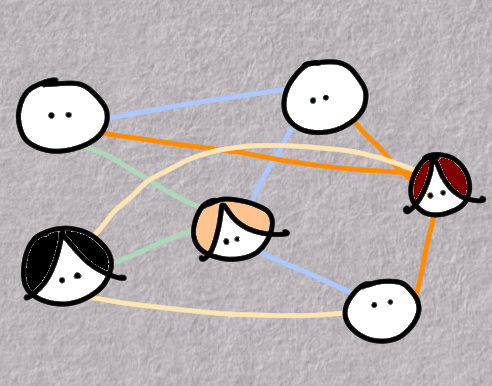
And it comes down to nodes and links.

Nodes are individuals or organisations and they are connected by links.

These links can be relationships, common interests, shared values or content that they are exposed to on different platforms.

As you can imagine, the number of different types of links can increase quite quickly.

You can’t analyse these in your head or on a spreadsheet – usually you need software to help with doing that.

Software like Social Network Visualizer.

Now, when you read the documentation for these tools it gets complex pretty quickly.

There’s lots of talk about adjacency matrices, cohesion measures, centrality and prestige and community detection.

Which basically means the number of things you’re keeping track of, whether if I link to you, you link back to me and who the super important people are in a group – and if there are cliques and subgroups.

Okay – can we apply any of this to our market research efforts?

Well… before that let’s look at something which, depending on your point of view, might make you a little nervous.

The UK police have a guide on how to use social network analysis to combat gang crime.

Clearly the police have a reason to gather intelligence on the bad guys – and they collect information on them and their links with others.

There’s a useful table that shows you how many criminal links there can be between individuals and how to code these links.

All that data can be quite hard to understand if set out in a table but when you visualise it you can imagine how the people at the centre – the ones with influence and reach show up as larger nodes.

So, in theory, you could use a similar approach to understand how your market operates.

Clearly you’ve got to be sensible about doing this.

Recently many data mining organisations have changed their tune when it comes to the ethical use of data.

They say that each piece of data is not like gold or oil – a commodity you can exploit.

Instead, it’s a piece of someone’s life – and you need to respect that and treat it with care.

So creating your own intelligence file on people in organisations is probably not the most ethical way to do things.

But that doesn’t stop you from perfectly legitimate things like mapping organisations and their links to each other.

If you have a competitor that is so entrenched with the public sector bodies, key decision making centres and other institutions isn’t it better to know that rather than trying to fight them on an uneven playing field?

Or if you’re an activist organisation you can map those organisations that are going to be receptive to your message and work with you.

The thing with tools like these is that there’s little or no information on how to use them effectively to solve real business problems.

Which is why the police example is actually quite a useful one of how such technology can be applied to a situation.

It’s a tool that appears to be underutilised and maybe it can help you with market research.

It’s probably sensible to suggest that you use it with care.

Cheers,

Karthik Suresh

Which Mental Model Is Most Useful When Planning A Marketing Campaign?

bear.png

Wednesday, 9.32pm

Sheffield, U.K

In tennis, you strike a ball just after the rebound for the fastest return. It’s the same with investment. – Masayoshi Son

Let’s say you run an IT business.

You want to talk to people about cybersecurity.

That’s a big thing right now – so where would you start?

You might begin by typing words into Google – an initial search – to see what else is out there.

In 2019, you’ll get around 110 million results.

Limiting it to your city will drop that to around half a million.

Now what?

I keep returning to a course on content strategy and then drifting away.

It has hard truths that I struggle with.

For example, it argues that you must have a clear idea of who your customer is and have a strategy to deliver content that that customer can be inspired by, identify with and find useful enough to share.

I just want to write about stuff I find interesting.

But let’s say you wanted to do this properly, where should you start?

Probably with reading.

What is everyone else doing out there?

You know the old story of the two guys who come across a bear in the woods.

One of them bends down and starts putting on his running shoes.

The other says, “Are you crazy? You can’t outrun a bear.”

The first one says, “I don’t need to outrun the bear. I just need to outrun you.”

So let’s say you read the first 20 results.

Or, if you’re lazy, like me, put some code together to get you the first hundred results in a text file for easy reading.

And then you start reading.

You discard the job adverts, see the usual ones from Universities offering courses and you’re left with a few associations, government organisations and a small number of competitors.

Now, what are they doing?

Some offer services – pretty straightforward descriptions of what they do.

Others offer articles – ones that seem to be written to order, in some cases.

Is that enough reading?

Probably not.

Maybe we should look at interviews or posts by people who have experienced ransomware attacks.

Read about exactly how common attacks start and work.

You could quite easily pull together a book on all the information someone might need.

Or you could curate information – point to stuff that is good.

Is all this going to help?

It may, if it helps you be found more quickly than the competition.

You won’t find out until you try.

That’s the thing with content marketing.

If you have content then anyone coming across it has a reaction – a good or bad one depending on your point of view.

If they see all the stuff you have and are put off by the effort of competing with you then you’ve just given them a content shock.

It’s like the advice that the best way to win a war is to persuade the other side not to fight.

I think the most useful model to keep in mind when starting is the idea of outrunning the competition, not the bear.

Do more than everyone else.

Create more content, be in more places and reach customers earlier.

It’s very hard to persuade someone to do something because it avoids a bad outcome.

When something bad happens, however, people will spend any amount of money to fix the problem.

The trick is being there to get the ball on the rebound – when the thing happens that makes your customer think they need what you do.

How you do that is about tactics and resources.

And focus.

All the things that the academics say you should do.

And which I still need to learn.

Cheers,

Karthik Suresh

How Do You Get A Large Group To Change Direction?

herds.png

Monday, 9.02pm

Sheffield, U.K.

Not everything that can be counted counts, and not everything that counts can be counted – William Bruce Cameron

Should we panic about the state of the world or not?

Take climate change, for example.

Are we doing enough about the problem or should everybody be doing more?

There’s a problem with the question in the first place – because it assumes that action takes place en masse.

It assumes that we collectively take action to change things.

But is that really the case?

After all, there are lots of schemes and rules and attempts to get people and organisations to reduce their impact on the environment.

Are they making a difference?

How can we tell?

The thing about social behaviour is that it’s can’t be easily reduced to an algorithm.

But maybe an algorithmic approach can help us understand what counts.

The problem of getting lots of people to change the way they act is like getting a large herd of cattle to change direction.

If you try to simulate such behaviour – the flocking, schooling and herding you see birds, fish and animals do – you find it’s possible to do it with quite simple rules.

The basic idea is that each member of the flock has to stay close to others in the flock without bumping into them or into obstacles in the environment.

When you program a herd of simulated creatures to act in this way the group moves together – wheeling and turning with no central control.

The movement emerges as those simple rules are followed by each member.

From that observation of physical movement it’s a small step to wonder if a change in hearts and minds is also an emergent property – something that happens when the rules individuals follow change, rather than the whole group learning new rules.

For example, when solar panels first came out they were expensive.

Few people had them and they needed subsidies to get installed – subsidies that are being phased out now.

Every new build these days, however, is going to have solar panels built in.

So what’s changed?

Is it the law, the business case or what people want?

And did they change at once or did the pressure to change build and build until the whole group changed direction?

The point, I suppose is that, if you want to have big change you first need to start with small ones.

That’s obvious, you say.

But what’s not obvious is whether or not we’re heading for disaster while we’re waiting for individual change to happen.

It’s tempting to assume that everything will go bad if we don’t try and change it in a big way.

But are all those large companies really trying their best to ruin the world we live in?

Or are they full of people who are trying to do the right thing but who are also looking around them trying to do what others are doing, worried about doing something too different in case they get left behind as the flock moves on?

I think if you assume that people are fundamentally good and try to do the right thing then the starting point is to focus on individual change rather than group change.

But we can’t change too much – so much that the group just sees us as outliers.

We have to move gradually in the direction we want – at a speed that matches what the herd is doing.

That’s the thing about changing direction – it doesn’t just happen all at once.

And it’s hard to escape the fact that it probably starts with you and with me.

Cheers,

Karthik Suresh

How To Find Focus When You’re Distracted By Lots Of Things

interesting-things.png

Saturday, 10.04pm

Sheffield, U.K.

The only thing that can grow is the thing you give energy to. – Ralph Waldo Emerson

There are far too many interesting things in this world.

Ideas, opportunities, developments and paradigm shifts.

And cat videos.

For example, I was listening to someone talk about what they do the other day and thinking – heck, I could totally do that.

In fact, I have done it.

And it’s got lots of potential for making money.

And then I remember that it’s also very, very boring.

We each have around 30,000 days that we can use, if we’re lucky and go the distance.

When you’re more than half-way through you start to wonder whether you’re using them well.

Should we be focusing on the really important things?

If so, what are they?

You’ve probably heard that life is like juggling balls – trying to keep them all in the air.

The balls have labels – work, money, family, friends, health.

Some of the balls are made of rubber. If they fall and hit the ground they’ll just bounce and you can always pick them up again.

Others are made of glass and if you let them drop they’ll get scratched, cracked and maybe even broken.

But then let’s think about what you do and how focus affects that.

Say you have a business – should you do one thing really well or be able to do a number of things?

The answer, probably, is going to be a variant of “It depends.”

For some businesses that do a lot of low-margin business it might seem sensible to ditch those and stick with the ones that make money.

But some of the low-margin things might be what brings in customers that eventually buy the other stuff you have.

As an individual should you try and become the best at whatever you’re doing or have a mix of skills and try to learn new ones when you can?

I was speaking with a builder who said that there are now robot bricklaying machines.

You could be the best bricklayer around but the machine is going to be better.

What happens then?

Maybe the idea of focus is less to do with state of mind and more to do with an act of convenience.

After all, where does the term come from?

The dictionary defines focus as “the centre of interest or activity – an act of focusing on something”.

Which makes it temporary.

You don’t need to focus on something permanently.

You just need to do it as long as you need to.

Which makes things a little easier.

Let’s say you are interested in a number of things – wood-working, renewable energy, writing fiction, drawing cartoons, among others.

And maybe you’re torn between a few of those as possible business ideas.

Perhaps you want to do woodworking and draw cartoons.

There’s nothing wrong with you wanting to do both and making plans to do both.

You might need to think about timing – do you do one before the other?

You need to think about your audience – pitch wood to interior designers and send your cartoons to newspapers.

You are still focusing – but first on one and then the other.

And that’s ok.

The point is that you only have so much energy to give.

But the good thing about working on things you love is that you seem to end up with more energy in the end.

When you’re working on things that drain you no amount of money can replace that lost energy.

The thing about distractions, then, is you need to find ways to handle them – to address them in order and be ok about dropping the ones that are less important.

And with what’s left, if you’re lucky, you’ll have some that you find interesting.

With the others – you just have to think about the money and get on with it.

Cheers,

Karthik Suresh

Imagine A World With More People Well Off But Fewer Millionaires

service-businesses.png

Friday, 10.11pm

Sheffield, U.K.

I suppose it is tempting, if the only tool you have is a hammer, to treat everything as if it were a nail. – Abraham Maslow, Toward a Psychology of Being

How many software programmers are there in the world today?

In 2019 – maybe around 26 million or so.

A post – I think on LinkedIn – suggested that was a small number.

It’s a small group of people that build and control a lot of the stuff that we depend on these days.

But all that stuff must be making our lives better, right?

Right?

One of the things you see is that people spend a lot of time solving the same problems again and again.

And that’s because there are lots of simple problems that need solving whenever you try and do something.

Take building an extension, for example.

You’ll need to manage a contact database, make calls, keep notes, follow up, put a project plan together, follow that plan, fill out paperwork, comply with health and safety rules and a whole lot of other things.

The chances are many people will manage with paper and notes.

Some will use a spreadsheet.

A few will use project management software.

There is an inverse relationship between complexity and the number of users here.

The more complex the tool the more complex the job has to be to justify learning and using it.

Now, one of the things about complexity is that it’s often a substitute for control.

Take Customer Relationship Management (CRM) Software, for example.

The standard reason for using a CRM is so you can keep better records of what you’re doing with customers and so serve them better.

The real reason you use a CRM is so you can keep an eye on what your employees are doing.

Or maybe that’s unfair.

You’re just tired of information being all over the place and a CRM looks like a way to bring everything into one place and manage it well.

How has that worked out for you?

If you’re the go-getting sales manager who believes in the power of CRM systems you’ll probably say it works great.

The chances are, however, it’s working because of you and your interest and sheer will power in getting everyone else to do things your way.

Left alone, things degenerate.

It’s the law of entropy.

If you didn’t check the CRM every day then pretty soon people start putting less in and it slowly goes out of date.

You’re probably wondering what the title of the post has to do with anything I’ve written so far.

Patience. It may make happen.

No promises, though.

There’s another line – I think from Clay Shirky – but I’m struggling to get the reference that says people who make encyclopedias have always known that trying to put structure around information is a thankless job.

The minute you try and create a form or a rule or a framework to hold information stuff starts to leak and get messy and not fit properly.

What you can do is make it easy to get information out and try to keep people honest with what information they put in.

So, the point is that software is not easy to use to make your business better.

And that’s because of this relationship between how hard the task is, how complex the software needs to be and how much control you want.

So that brings us to service businesses.

All businesses, some people say, are now service businesses.

I’m not sure how true that is.

There’s often a product hidden somewhere. As they say about social media, the reason that product is free is because the real product is not the software platform but you.

You’re the product and the thing they’re selling to others.

Service businesses, on the other hand, rely on people doing something.

Eric S. Raymond, an open source advocate, says that service firms can’t be made bigger by investing capital.

What happens is that money pays for people and stuff and makes fixed costs go up – and then they run out of money.

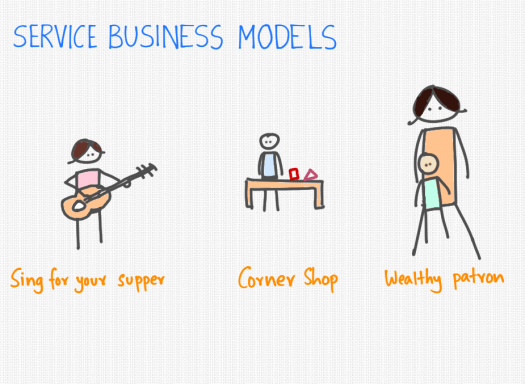
He says three models work:

  1. Singing for your supper: tip money
  2. A corner shop: stay small and keep overheads low
  3. A wealthy patron: find someone to support you

Raymond’s argument is that people won’t fund software startups because as service businesses they won’t scale.

He predicts you’ll end up with better off workers but fewer businesses owned by investors who take most of the money.

So… people with more money but fewer super rich folks.

That doesn’t seem to be putting people off.

People are funding software businesses.

And some are going on to become very large.

Of course, many more fail.

The thing is these days we are offered a very large selection of hammers.

There are lots of tools that help us do simple things well.

Some help us do things we want but, like Apple, demand our freedom in exchange.

You want an Apple product – you need to sign up to their ecosystem which is increasingly dictatorial – it seems.

You’ll need more than hammers in your toolbox to solve complex problems.

And those tools – it sometimes seems – are hidden in plain sight.

Tools that can help us solve complex business problems – but they are hard to learn and the people that learn them don’t always work in businesses.

So, until they get their act together, much of our time is still going to be spent wishing we weren’t wasting time in the ways we do now.

Cheers,

Karthik Suresh