
Monday, 9.58pm
Sheffield, U.K.
The point of human evolution is adapting to circumstance. Not letting go of the old, but adapting it, is necessary. – Sonali Bendre
What do you do when the machines are better than you?
I had a meeting today where I took notes – the usual kind – sketchnotes. A messy mix of stuff.
This is the kind of thing where a rich picture helps – a drawing of the things and connections so you can get a sense of the whole, so you can see what’s going on.
It takes time to draw a rich picture so I talked to Copilot. I described the conversation from my notes and asked it to create a rich picture that had the elements we discussed.
And then I opened my drawing software and started making my own.
When I checked what was on the picture I was taken aback.
… No spelling mistakes.
… All the points I asked for.
… A good layout.
A visualisation of something I described exactly the way I had pictured it in my mind.
It was astonishingly good
So, what are you going to do if a machine does something faster and better than you.
There are two choices.
- You can watch TV
- You can figure out what to do next.
But what if the “figuring” step is happening outside your brain?
The Extended Mind hypothesis by Andy Clark and David Chalmers explored this idea back in 1998.
We don’t just think in our heads. We use paper and tools to think.
In a way, this extends our mind outside the physical confines of the body.
While this sounds strange think about it for a minute – how many things can you do without reaching for help – for a book, for a YouTube video.
Our heads don’t have much of the information needed to operate effectively in the world.
And LLMs will make that worse
A key part of making sense of the world is building connections between ideas.
But how important is it that you build the connections. What if a model does that for you – does that help?
I’m trying an experiment at the moment – seeing if an LLM can make sense of a bunch of notes I have in text files and create a wiki – a knowledge repository from them.
The code to set this up? Google’s AI told me how to do that. Does it work? I’ll let you know later.
But it gave me a creepy feeling
We think that we’re using these tools.
But actually, what if they’re using us?
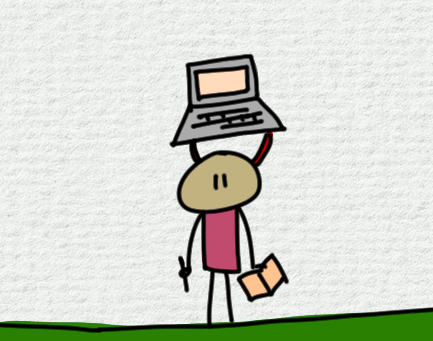
Once the task of identifying ideas and making connections moves out of our brains and into these models – then surely we’re just extensions of the model copying and pasting instructions.
They’re plugged into us, and in using us they take away our ability to think – not intentionally but because they can do it for us, we don’t try as much – and that part of our ability withers away.
When there’s no reason to draw, no reason to write, no reason to think – the only reason left to do something is because you really want to.
Cheers,
Karthik Suresh
 Handcrafted insight