Does A Leader Lead From The Front Or Push From The Back

leading-front-or-back.png

Tuesday, 7.41am

Sheffield, U.K.

An executive picked up one of his employees in a new sports car. “This is an amazing automobile,” the employee remarked. “It is nice”, the executive replied, “And if you set your goals high and work hard I can get an even better one next quarter.”Provided by James R. Martin

What comes to mind when you think of a leader – as someone who is going to take charge and sort it all out? What kind of models do we have and what is it that happens around us that we take for granted? I’m doing a course in Leadership at the moment and have been introduced to a few models – so perhaps I should start by taking a critical look at them and seeing if they describe what I see around me.

But first let’s start with an example. A few posts ago I mentioned that I was looking at music again – after decades without any interest. You’ve probably heard of the reticular activating system – when you start paying attention to something you start to notice it everywhere. And so I started watching “Mozart in the jungle” on Prime – a story about an orchestra and a story riddled with the challenges of leadership.

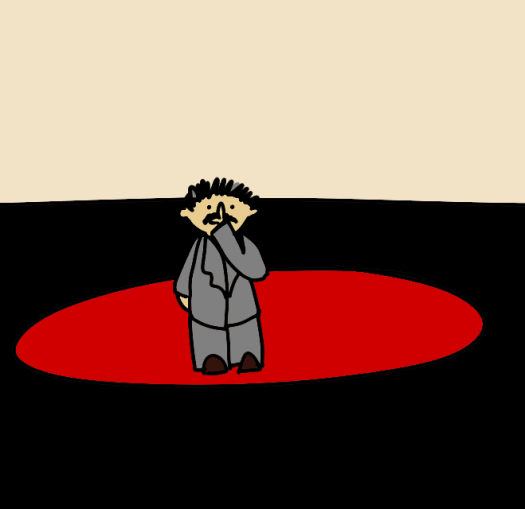
Imagine the leader of an orchestra, the conductor, the person in charge. Our image of that person is staid, dignified, controlled. And the story breaks that, introducing a conductor who is different, out of control, passionate about the music who wants musicians who “play with blood”. One conductor is past his prime, respected and liked but no longer perfect. The other is driven, intense, at the top of his game, able to pick out every error. The orchestra has slowly deteriorated under the first conductor, looking a bit worn, fraying at the edges – no longer the best. What does the new conductor need to do to get them back up again, get them performing and being the best?

One leadership model that’s introduced here is the idea of the relationship between the leader and the led as being a “mothering” one, where the leader looks after their brood, holding their hands while they try and walk. A variant of this idea is the leader as a coach, someone who is able to act as a critical friend and tell you what is going wrong, the things that others won’t tell you and will hold you to account for improving them.

When I read these approaches I am reminded of Ernesto Sirolli’s observation that people who try and help others are often patronizing or paternalistic. The “mothering” approach fits into the paternalistic criteria – I know more than you and so I’m going to treat you like a little child and help you learn and grow and be there for you. But you have to follow my rules in my house and do as I say or be punished. The patronizing approach comes with a view that says I know more than you, so just be quiet and listen, I’ll tell you what to do. I have to say I’m very guilty of both these approaches – after all, I use GNU/Linux and, as Scott Adams writes, “If you have any trouble sounding condescending, find a Unix user to show you how it’s done.”

We have two things with the conductor story that we need to see. The first is whether the leader is better than everyone else or whether the leader is best at getting the best out of everyone else – and those two things are not the same. And then there is the relationship between the conductor and the band – if it’s too close and you’re seen as one of the gang you can no longer make the hard decisions and you run the risk of being seen to have favorites and being partial. How much distance is the right distance to keep from those you lead?

A different model of leadership comes from the military, or at least the British military mindset from the last century. This is one that has been transmitted through the culture I have been exposed to and from what I’ve read and basically comes down to something like this. You have people who do work – the ones with the brawn and the expertise to work a piece of kit to perfection. And then you have people who make decisions – the ones with the brains and the ability to work out what should be done. That’s why the army has a soldier track and an officer track and experienced soldiers are often led by much younger, inexperienced officers who, over time, get better at making the calls. The same model extends to healthcare. You have nurses and doctors and, if you’ve ever seen Scrubs, there’s a scene where a young doctor talks about how, in the beginning the nurses know how to do everything and mother the doctor but after a while the training kicks in and the doctor knows more about the medication and doses and what needs to be done next than the nurses do – whose role is now to follow the doctor’s orders.

Set against these models is a post-modern approach based on a flat hierarchy made of networks, people of capability coming together to create something greater than they could individually. This is something that Transactional Analysis (TA) captures as it talks about everyone having a Parent, Adult and Child inside them. We can all play these roles in various situations but what we’re aiming for is an Adult-Adult relationship. As a leader, you want to have adult conversations with those around you about what your purpose is, what approach to take and what needs to happen next.

Unfortunately, there are many things that stand in the way of being able to have truly adult conversations, not the least of which is we have very few models of what good looks like. That’s perhaps where therapy comes in – instead of leadership training we should perhaps first go through a course of therapy, learning how to let go of the assumptions and fears that we’ve been exposed to and learning how to say what we think in a way that helps to start and move a conversation along – which ends with a better understanding of each other.

But what stops us from being able to have these conversations in the first place? It’s probably our history, what we’ve learned about the way communication works in society. Every family has experience of the tensions and challenges that come with thinking something and saying it. Do you have that relative who explodes with anger if you ever say anything critical about something? Do you have that person who gets upset about what you meant? The difficult is that we all learn how to speak but few of us learn to communicate – and it all starts with the first group we are part of – our family and our kin.

We should look at those dynamics a bit more in the next post.

Cheers,

Karthik Suresh

What Kind Of Community Would You Like To Live In?

society-and-variety.png

Monday, 7.26am

Sheffield, U.K.

In the final analysis, entropy always wins.one-liners collection

The simplest things to represent are static but everything we see is dynamic, shifting, ever-changing and we find it hard to look at these and make sense of what is going on with one using the other.

For one reason or the other I’ve been looking at a lot of creative, art related material recently – and there’s something that goes on, something at the heart of creativity that is a deeper connection, an insight that comes not from logic and order but from a thought that crystallizes in the middle of the night, something that you just have to express and create. This is not the experience most of us have, as we step through lives of schedule and order. It takes a certain courage, a willingness to step away from the lit center and into the dark unexplored – or perhaps it needs resources and support. Either way it’s off the normal path and the way you do things now will never lead you there.

The question I asked in yesterday’s post was what kind of company would you want to join if you didn’t know what role you would have in it. That question immediately makes you think in static and dynamic terms. The static elements have to do with roles, function, responsibilities and the dynamic ones have to do with flow, relationships, learning and change. What sort of environment do you think would work best for you in this day and age?

For me, I think the first thing would be that you’re led by someone who knows more and is willing to teach others. Good leaders are not ones that make plans and give orders. Good leaders are people who coach and develop others, helping them learn and grow. In any group there will be someone who will take on a leadership role because they know what needs to be done or someone will take on the role as a learning opportunity – a chance to practice being a leader.

When it comes to the allocation of resources I lean in the direction of having a market that matches supply and demand. This kind of thing comes down to decisions like whether you should pay everyone the same amount or pay at set bands or pay at the rate set by the market or pay based on individual value generated. I’m not an expert on this but your compensation should be connected to the value you create – not on the fact that you exist in a role. This gets hard quickly of course, because what if you created value in the past or your value will be seen in the future. It depends on whether you’re trying to be fair or trying to optimize and you’ll probably never get it quite right. On the whole, however, current ways of doing things are probably heading in the right direction – increasing transparency, fair treatment and open competition at least give you a chance to go for any role. And if the organization doesn’t follow those approaches then you probably wouldn’t want to work for them anyway.

Now, you’ll do better in a competitive market when you have what is needed to compete – which comes down to the resources you already had. And that means what your parents had. If someone doesn’t have the resources that give them an advantage then society has a responsibility to try and balance that out. Perhaps organizations do too. It’s easy to ignore the world out there and only take on the best people but perhaps organizations should give less fortunate people a chance – even if that has to do with a few months of work experience. I learned almost everything that I’ve found professionally useful in three months of a real work placement. It was a struggle to get it but I was lucky I did and it made a huge difference.

One of the basic rules of life is that entropy always increases. If you’re not sure what entropy is a good visual is that of a cigarette. As it burns, the smoke floats away – the order of the cigarette form loses order as it turns to ash and smoke. Disorder and randomness always increase. Now couple the rises in entropy with the questions of static and dynamic activity and you have an idea of the challenges faced by any organization. What we’re trying to do in most cases is create static structures that will respond to dynamic circumstances and keep them functioning in the face of advancing entropy. A high-functioning organization is an anomaly, a weird unexpected thing in the universe. After all, think about it. Isn’t life itself an anomaly, the fact that we live on this planet with a bewildering diversity of organisms, that breathe and move and have brains – for all we know alone in an universe of uniformly dead rocks and dust?

Pure order is also dead – the crystalline structure of carbon is locked in place in a diamond which, while pretty, is of no consequence in a world where no mind exists to see it and think, “Ooh that’s pretty.” Everything that matters to us as humans exists in that narrow space between dead order and total chaos. And we’ve been grappling with how to deal with that for generations, evolving and developing ways of functioning that, on the whole, seem to be working now. For those of us lucky enough to have access to them, that is. There are the unfortunate, the unlucky, the ones born to the wrong parents in the wrong places in the wrong time. I don’t know what you can do other than to have the services in place to support and help them to market what they can do.

Perhaps one of the biggest problems out there is that we don’t actually value what is done enough. The clearest example of this in history is the value of work done by women at home – the vast majority of housework is done by women. And they should be paid for doing this – not by the state but by the other person in the house. Or, of course, the work could be shared equally. Taking another example, we know that medical care is expensive for physical injuries. But you have mental injuries too, we all probably have them just from the experiences we had growing up. A friend says that all grown-ups would benefit from therapy, especially before having children but that’s expensive. Should care work be adequately compensated – medical and mental care is, for those that can afford it. Menial and manual care is also expensive these days, which is why people are building devices and robots to help.

When I try and answer this question about the kind of group I would like to be part of, what seems to emerge is varying ideas that circle around fairness. Fairness of opportunity, fairness of treatment regardless of background, a fair community – but fairness backed by a need to contribute, to participate, to learn and grow and develop. And such organizations don’t emerge naturally – because what is natural is total disorder and what is natural is an extreme reaction to disorder by the imposition of total order. What is difficult is balance and fairness and the ability to do that comes down to leadership.

So let’s explore some of those ideas next.

Cheers,

Karthik Suresh

How Does A Self-Organized Community Work?

self-organised-team.png

Sunday, 8.05am

Sheffield, U.K.

Mack: Look at this announcement for a meeting of the International Chair Haters Club. How ridiculous. Zack: What’s so ridiculous? I’m a member in good standing – Workman Publishing

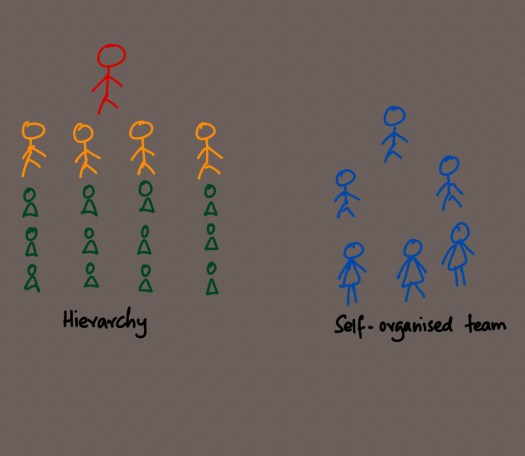
What are the models we carry in our heads about how to work together? How would you characterise the inbuilt, assumed, “natural” ways we have to organize ourselves and get things done?

The most basic one, you could argue, is getting ourselves organized for defence – as a village or tribe against animals or other tribes. That means setting up basic perimeter defences and having roles for people. This progressively escalates to developing war fighting capability and modern militaries have developed sophisticated and powerful processes and methods for carrying out operations.

But fighting a battle, while complicated, is not a complex task. Yes you have to get personnel and machinery and ideally have longer-range guns than your opponent and you’re onto a winner. In essence, if you can stand back and hit the enemy while they can’t reach you, you have an advantage. And if you have to go in on the ground you want every advantage you can get – using technology and firepower. It all ends, though, when one side is finished. It’s probably a generally accepted fact that the US Military could secure any battle zone in the world in a matter of days. It’s a complicated job but they will do it very well even if there is nothing left standing at the end.

The complex task, however, and one that every military has faced in the past and probably will do in the future, is keeping hold of that zone over the long term. That’s the hard work of changing minds and getting people to adopt new ways. The fighting was the easiest bit and then everything that’s actually hard comes afterwards.

So, when you’re trying to plan for the long term, perhaps going on military doctrine isn’t the best way to get started. It works very well in a limited situation but you’re looking at engaging with people over the long term and that needs an understanding of the more complex nature of that situation. So where do we go from here?

Modern capitalism is, I think, the natural transfer of that military mentality into the sphere of social relations. Think back to how it all started. Millions of mostly men coming back in their uniforms from war and starting back in civilian life. They wore uniforms and transitioned naturally into suits – the uniforms of commercial battle. The structures of the corporate world mirror that of military hierarchy, with chiefs and sergeants and troops. Isn’t that the way most people think – in terms of who’s the boss and who’s the employee? And isn’t your entire purpose in the corporate world to climb the ladder, to be promoted into a position where you can lead others – where you have more control? Where the person at the top has the most control?

Of course, we don’t like having kings or queens with untrammelled power so we set up counterbalances. Like a Board of Directors who are, in theory, supposed to act as a check on a CEO. But, as I learned early on, having a position is not the same as having power. In the Indian constitution, for example, you have a President and a Prime Minister. I thought the President had the power to take a stand until my dad reminded me that the Prime Minister effectively appointed the President – and that told you where the real power lay. There are many Boards today that will not make a stand against a powerful CEO because they have no power. And the thing with checks and balances is that while they may work in the long term they don’t stop excesses happening here and now. You only have to look at what’s happening in two major economies at the moment to see the consequences of handing power to individuals who believe they are above the rest of us.

In the world of business and capitalism, then, I think you have a military mentality centered around control that has been transposed into the world of commerce. But what else is there that changes the dynamics of what’s going on?

It’s the concept of ownership.

What is embedded in our minds is that you have people who own the land and people who work the land. The former are rentiers, they live off the toil of others benefiting from their ability to own things. But perhaps we don’t have the picture entirely clear all the time. There are few Chief Executives who actually own large companies. If companies are listed, you have millions of shareholders who benefit from their ownership interest as the businesses grow. The businesses benefit because they can raise capital from these millions of shareholders. When ownership is distributed then the checks and balances become more important so that one group cannot leech off the resources of a larger, less involved group. The Board and Executives cannot manage the company for their benefit alone. But, of course, having control has its benefits. When you can appoint the committee that sets your pay, you have a good chance of getting a good payout.

If you start a business now you probably think in terms of these models. You’re a 100% owner and then you sell bits of the business to raise money and you give a part of the business to employees and all this helps you to grow and eventually you sell the whole thing and cash out, rich and happy. This is your basic venture capital backed business model and it has a very low chance of success, but it’s the strategy everyone wants to follow. That’s why venture capitalists follow a portfolio approach – they invest in ten, twenty businesses knowing that most will fail but one will perform and make them rich. But if you’re a business owner in that equation what are your chances? It’s not rocket science, is it? Your chances are 5-10%.

So, what can you do to increase your chances of success? Well, if you’re the kind of business that could be a superstar then maybe stick with the existing model. But what’s the most important thing you need to do if you want to succeed? Bill Gross argues that the single biggest thing for startup success is getting the timing right. That’s a sobering thought, isn’t it? You could have a great idea but if you don’t have it at the right time you won’t win.

An alternative approach is to look at cooperative models – models where you re-look at the two fundamental ideas of control and ownership. Where you create controls based on more egalitarian, inclusive principles and where ownership is replaced by a return based on contribution.

This is not straightforward at all, mainly because these approaches are not seen as relevant or practical – or perhaps you’re even a bit suspicious of anything that doesn’t look like traditional capitalism. But the thing with capitalism is that we sometimes confuse capitalism with feudalism. Capitalism is based on private ownership of stuff and how you use it to make a profit. Communism, on the other hand, is based on common ownership of the means of production. Socialism is based on cooperative ownership of the means of production. And these three violently disagree about what exactly each of those things mean and each approach has led into extremes of violence and stagnation and oppression.

But what would you do – what kind of society would you want to be born into if you didn’t know what role you would have in it? That’s the question posed by John Rawls. Let’s change it a little and ask what kind of company would you like to join tomorrow if you didn’t know what role you would have in it? How would you organize and design such a company?

Let’s look at that in the next post.

Cheers,

Karthik Suresh
Why Do Groups Splinter And Fight Each Other?

resouces-conflict.png

Saturday, 8.15am

Sheffield, U.K.

Where there’s a will – there’s a relative – Ricky Gervais

The answer to this question is short, it seems. Groups fight over access to resources. And that’s it.

It turns out that I had answered this question a few posts ago when speculating about genocide. Apes are the only creatures, it seems, that will wipe out all members of another tribe. And they usually come into conflict in the wild when they are competing for control of territory, at which point they first try and intimidate the other group and then fight and the winners finish the job.

This happens with humans as well and was demonstrated experimentally using a famous study called the “Robbers Cave Experiment” from the 1950s, which has its problems, but is seen a seminal piece of research into “realistic conflict theory”. In this experiment boys were put into two groups and competed against each other in tasks and games, effectively trying to get resources and eventually ended up conflicting with each other. When the groups were mixed and had to work together the conflict reduced. It’s a sort of real life “Lord of the Flies” story, but the research is flawed and the researchers tried to manipulate the situation and they hadn’t quite invented ethics yet.

But in addition to the research you have history and how groups have treated each other. In every nation, every continent, there are stories of oppression and conflict and violence and retaliation and it still goes on now. You just have to open the newspaper or look at any news outlet’s home page. When you realize this fact you start to see it everywhere.

It seems hard wired into us as apes. You’ll get it at home as your children go to war over the last sausage. The tears, the protestations.

Competition over scarce resources seems straightforward enough through this lens. Control over land and minerals and water – that sort of stuff comes down to pretty binary choices. I have it or you have it and if you have it and I want it then I have to fight you and win. This mentality is our evolutionary heritage, part of the writing of our brain, burned into our neural channels. But is it still relevant – is it the way we should think about the things we have?

Well, that’s clearly not the case if you give it a minute’s consideration. We’ve created an economic system where we’ve replaced real scarcity with artificial scarcity in many situations. Take diamonds, for example. Real diamonds are not scarce, but the people who control the diamond mines, I understand, lock them away so that there is a market for expensive shiny rocks. Shiny rocks that, by the way, you can now make in a lab.

There is an inherent conflict between the genetic or biological way we think and the reality of the world around us and the possibilities we can open up by using those same biological brains. Take farming, for example. Good quality growing land is clearly an asset – the more land you have the more you can farm, right? So you would go to war over farmland, no? Well, not any more because we first know how to produce more food than ever out of the same amount of land and because farming is changing and you have things like vertical farms. If we don’t go back to work in office buildings you could convert those into vertical farms and end up having city centres converted into food production centres.

The thing that resolves most conflict around resources has been the creation of a market system. Things are priced to match buyers and sellers and you find that the things you think will give you control end up being a commodity and producers of a commodity actually end up having very little control over anything. The market system is probably the one thing that has really defused global conflict. Take power, for example. Having electric power literally meant having power – but I’ve been close to power markets for a long time and I can tell you that it’s the market that has the power, not the producer or the consumer. James Carville, a democratic political advisor once said, “I used to think that if there was reincarnation, I wanted to come back as the president or the pope or as a .400 baseball hitter. But now I would like to come back as the bond market. You can intimidate everybody.” And what is the market but the combined decisions of many people deciding whether to buy or sell?

So, if you want to resolve conflict around scarce resources at any level create a market, create something that enables you to work out an exchange of value and you will find that many problems can be resolved without resorting to conflict.

Then there’s the other big category of invented conflict around intellectual property. Intellectual property is a construct, a creation that puts a fence around something there is not much point in fencing. Copyright laws and other such things. The point is to create a market but these resources are not scarce in the sense that lithium is scarce. These words I’m writing, for example, are copyrighted the instant I fix them in a medium. While they are ideas in my head they have no value but once this sentence is written in this form you can’t copy it without breaking the law. But, of course, unlike a kilo of lithium that you can have or I can have, you can read these words I’ve written and I’ve lost nothing – I still have them as well.

Now, if you take my words and post them on your blog or publish them as your own, if you sell them and make money – then I have a variety of means to do something about that. Because, after all, what’s the point in doing something if you don’t benefit from it in some way or someone else steals everything you have?

Now this setup creates conflict because that barrier around something that’s so easy to copy and steal leads to the owners of IP fighting those people who can copy and share very easily. And you can see that with the music, software, book and film industries – all those organisations that have an interest in the manufacture, distribution and control of intellectual property. The conflict there is being addressed in two ways – ever stronger controls over material through things like DRM and streaming sites and a response by creators to move to a Pay What You Can (PWYC) model. Increasing numbers of authors simply release their material on all the platforms out there, free and non-free and people choose what they want. Increasingly you have the choice to read something and then buy it if you want to have a copy. And that’s perhaps the way that works best for creators – to have a dedicated fan base that supports them but of course the armies of helpers and distributors and the machinery that operated to keep the old system in place is no longer needed.

So, if you’re trying to build a modern community what should you do to reduce conflict?

The first thing, I think, is to share everything without restriction. The philosophies of the Free Software Foundation, do this in a legal way, and they protect your freedoms to use software, as do variations like Creative Commons. These CopyLeft provisions allow you to remove scarcity and groups that want control can fork material, take it and do it their way and that’s their right. This deals with intellectual property and I think it’s a scary thing for companies. Companies still imagine that you hire people and they make something and then you own that thing. But these days you really should think of a company simply as a way to channel value to a customer in a way the individuals involved couldn’t do by themselves. If they could they would without bothering with the whole company as an intermediary. So, you need to make it worthwhile for those individuals to participate by making the group a welcoming and inclusive place. That means you should perhaps think more about cooperatives and shared ownership structures rather than control of resource structures. After all, you can’t take it with you so wouldn’t it be better to spend your life working with people you “like, admire and trust?”

The second thing is that when it comes to physical resources create an internal market. Not where resources are allocated based on power and favour but on a market system where there is the possibility to match buyers and sellers and let people make their own decisions.

I think we’ll explore some of these ideas in the next post.

Cheers,

Karthik Suresh

What Does The Future Of Work And Business Look Like For You?

business-flows.png

Thursday, 8.38pm

Sheffield, U.K.

The factory of the future will have only two employees, a man and a dog. The man will be there to feed the dog. The dog will be there to keep the man from touching the equipment. – Warren Bennis

I’ve had a few days where my routine has been knocked about a bit. In case you’ve forgotten I’ve been trying work through a book project called “Community” and I’ve found this one hard going from the start. And I wasn’t sure exactly why but I wonder if I’ve found something recently that may help explain what’s going on.

Here’s the thing. What do you think of when I talk to you about community? I think there’s a confusing mix of ideas that come up for me. There’s the memory of community, the places I grew up in and the experiences I had. There’s the reality of community now, the threads that connect me to where I live and what we do as a family. There is the online world and its strange creation of connections across space. And there’s what we imagine community to be in all these spaces and online and in the future – and it gets very difficult to figure out exactly what we’re talking about.

So I thought I’d just take a step back and look at this again – look at what exactly I’m trying to approach with this project. After all, I’m 42,000 words into something, around halfway through my stack of slips of paper that are supposed to be an outline and I feel like I have no idea what I’m talking about or how to pull it all together. But that’s ok, I’ll keep telling myself, and soldier on.

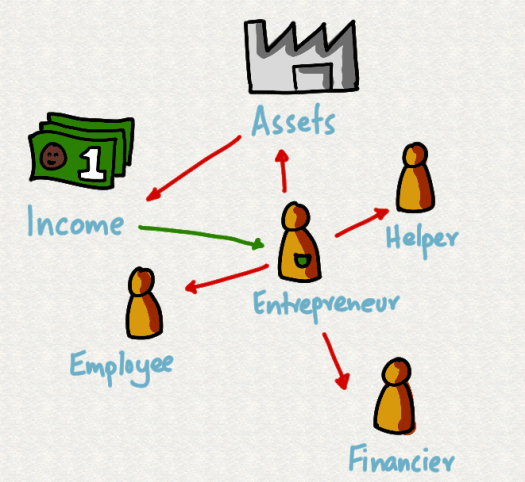
Let’s start with you and what you do. The system we live in looks something like this. You have an entrepreneur who raises money from a financier to invest in assets. The entrepreneur gets help from lots of people, from advisers to salespeople to use those assets to create revenue. The helpers get a cut of the action in commissions and the entrepreneur pays employees to work and the financier a return on the money. The government takes a cut and the entrepreneur puts what’s left in their pocket. They get paid last, but if they create value can be the ones who get paid the most. Or nothing. It depends on how things work out.

Now, which role do you have right now? Are you an employee, entrepreneur, helper or financier? And what’s going to happen to those roles in the future? Will they exist in the same way they do now or will they change dramatically, be completely different and result in a new and different kind of society?

Let’s look at one approach that’s gaining currency. In this new world robots will do all the hard work and humans will have very little to do. They can spend the time freed up to do creative and fun things but they probably won’t be paid and so you’ll need to give them a minimum income to buy food and pay rent and all that kind of thing. Now that’s not actually what the approach says – you also have the issue of ending up with two kinds of people – ones that can work and ones that can’t. Some people will be bright and clever and build the robots or do heart surgery working with robots, or they’ll do complicated manual work that robots can’t do like cleaning the insides of cars and wiping old people’s bottoms. And then there will be people with no skills who will end up fighting each other and going to jail.

The alternative view is that this is simply creative destruction and it’s always happened like this where new technology comes along and everyone’s worried about losing jobs and new ones come along and what you need to do is help the people left behind transition but eventually they do – or their kids do anyway and then life goes on until it changes dramatically again. I have some sympathy with this second approach because it’s what I see happening around me. There are some people who are doing well as the world changes around us and they seem to be predominantly people who work well with machines – whether that’s behind a desk or using a chain saw. Labour – the pure stuff of your hands and sweat is less and less useful but augmented labour, labour with an exoskeleton – now that’s still worth something.

What do I mean by that? Well, the person who does my tree and bush trimming comes along with a suit of armour and a machine, the joiner and sander have tools and extraction units – technology is everywhere and people who know how to use it do better and faster jobs and get paid to do what they do. And if you do it manually there’s still some room for you, but you will probably be paid less and let go pretty quickly if you aren’t good or don’t get on with people.

This is not new. Robert Pirsig talks about this in Zen and the art of motorcycle maintenance – about how his city friends seem somewhat afraid of technology while the hick farmers they look down on are talking about their cool new tractors and have the tools and know-how to fix something when it goes wrong.

What it comes down to then is know-how – knowing what you need to know to be able to contribute in society now and society as it changes in the future. Education is designed to turn out clerks and labourers and that’s actually ok then, as the world changes. If we have people who can program computers and people who can work with machines we still have a future filled with opportunities to do productive work. Some things change, perhaps everything changes, but I don’t see our need to do something going away. But you have to know what to do.

That leads to another thing – we live in a world where it is easier than ever to learn something new. We have unparalleled opportunities to discover and learn and create and do – as long as you want to do it. For example, I’ve never really learned music. I did lessons for nine years, going to a class weekly and apparently being taught how to play drums but clearly something went wrong because I didn’t learn anything. That’s 48 days I spent doing something, but what exactly?

I was walking back the other day and listening to a person talk about their history and the fact that they started learning how to play the violin at age 2. I’m never going to get that time back so what do I do? Accept that I’m never going to learn music – that it’s too late for me? That I’m obsolete?

Well, this was a long walk and what I realized was that while I’m probably too old to learn an instrument what I do know how to use is a computer. So I looked at how people use computers to create music, preferably using open source tools and came across a few articles and the idea of a tracker – something from the 90s. This is a tool where you lay out music and play it. And so I decided to have a go. Apparently the learning curve is a steep at the start but that makes it interesting and after a day of watching YouTube tutorials and messing with the system I had my first tune.

Here it is.

A first tune

Not impressive at all, is it?

But here’s the thing. It’s a start. It’s me augmenting my limited physical skills with technology to do something I didn’t do when I was young, even though I had years. And now I don’t have years – just like you don’t – but we have options and resources that generations before us couldn’t even imagine existing.

So, what does the future look like?

It’s one where you can learn almost anything, from someone who is uniquely qualified, probably for free. That’s not the future really, it’s the present – it’s already here.

It’s just that people don’t quite know what they have access to sometimes, or they’re scared to try or worried about having a go.

After a few years of writing this blog that’s probably the one thing I’ve really learned. Don’t worry about what other people think. In fact most people are too busy to even look in your direction. And that lack of interest, that anonymity is good because it gives you time to practice and get better and get good and find what you want to do, whatever stage in life you’re in.

The only suggestion I have is that you start doing that as soon as possible. Because the future isn’t going to wait for you.

Now… I think this post is a little departure and at the end of it I think the conclusion I’m heading towards is that society will still exist, people will still come together in communities… so it’s still worth going through the elements of that I had on my list.

And the next thing I had was to look at what happens when you have splinters and factions in a community.

Let’s have a go at that next.

Cheers,

Karthik Suresh

How To Find Out What Really Needs To Be Done

shut-up-and-listen.png

Tuesday, 7.54pm

Sheffield, U.K.

We spend the first twelve months of our children’s lives teaching them to walk and talk and the next twelve telling them to sit down and shut up.

– Phyllis Diller

What do you do when you need to do something? Anything? Are you the kind of person that says, “We need a plan,” and goes and gets a piece of paper and starts writing things down? Do you believe in goals and objectives and strategies and tactics and action?

Many of us are taught to think this way – it comes from what we’ve learned over the last century – that organized, directed action wins wars. The job is to win and that means doing the analysis, having the plan and getting things done. That’s why the Germans won the war, after all, they had the Schlieffen Plan, a “blueprint for victory” devised by Field Marshal Alfred von Schlieffen, which set out how to quickly get troops to wherever they were needed. Oh, actually they didn’t, which supports the other army saying about plans and their survival when they come into contact with the enemy. And the other saying about plans being useless but planning being essential.

Planning is woven into every aspect of our society but why is that? Is it because plans work or because having a plan lets you off the hook – you can always point to the plan and say, “Well, I followed the plan.” Why do you write a business plan – isn’t it obvious whether a business is going to work or not? Why do you need a plan to get government funding? Is it because having a plan makes it more likely you’ll succeed or is it because governments need to show that they have followed some kind of process before they give you money?

plan-A-B.png

Perhaps it’s because we think of a plan as a sort of roadmap, like physical directions from A to B. If you were given directions to go from one city to another then there is a decent chance you’ll get to your destination if the directions are right. Yes there are loads of ways you could go but if you’re given a route – either using a map, or from someone else or using a maps application – it’s very unlikely that you’ll set off and accidentally find yourself in a different country.

plan-possible-futures.png

But real life isn’t like that. Rather than a clear destination what you have are possible futures and options you can take. For example, if you wanted to become the President of the United States that would count as an objective, a goal. But if you aren’t an American citizen then that isn’t an option for you – unless you can persuade legislators to change the laws that stop you from achieving your goal. A more realistic goal is to become the President of your own country – there is a route to getting there but what are your options? If you’re 90 and live in a care home then can you really achieve that goal?

The point I’m making is that where you end up depends entirely on where you start and whether there are routes from one to the other. But it’s rarely as simple as a single route. What you have, instead, are options – options you can take now and options that emerge based on the options you take now. For example, if you choose to go to Law school rather than Plumbing school your chances of becoming a legislator go up. This is because the chances of a politician hiring you as an aide are probably higher if you understand how the system works than a tradesperson. That isn’t to say that a tradesperson cannot become a politician – it’s just that the route is different. That person might need to become the leader of a union and get involved in politics and eventually get into a position where they could run for election.

Now, what I was actually going to talk about in this post before I got sidetracked about planning was Ernesto Sirolli and his TED talks. Sirolli is an entertaining speaker and the creator of Enterprise Facilitation. He argues that people, especially Westerners, go into places with an attitude that is either patronizing or paternalistic – looking to do good in one way or another. They come with ideas and technology and money and believe they can solve everything and it rarely works.

Sirolli’s method, on the other hand, is based on going in empty – with no infrastructure, preconceptions or agendas. He goes in and listens, finds out what people are passionate about because, he argues, the one thing that is common to all people is the desire to improve themselves. So find out what people love to do, what they know to do – and then help them do more of it and get the resources they need to make something of themselves. And if they don’t want your help, go away. Find someone else to help.

And I think this has quite a few implications for the world we live in now. The strategies and tactics we use are always designed to fight the last war, deal with the last thing that went wrong. We’ve spent a decade worrying about the global financial system and will probably spend the next decade worrying about pandemics and contagion. None of the planning people did in the last ten years will have really helped deal with the shutdown the world has experienced – no business plan or risk strategy would have seriously considered this option or been ready to deal with it. But now we will create reams of paper, terabytes of digital content on managing pandemics while the next thing will be something completely different.

But how do you deal with a world that could be very different from the images you have in your mind now? The answer is that you don’t. You look at what you have to do next. If you run a hospitality business, for example, the last year has been extremely difficult. And it wasn’t your fault. Governments realized that and gave you help. Now what have you done since then? At the very least, hopefully, you’ve considered your options. You’ve looked at diversification, takeaways, food deliveries – repositioning your business to deal with the changed realities around us. Did any of that really require a detailed plan or was it pretty obvious that you had to do certain things or go out of business?

If you want to do something – like creating a business – then actually it’s pretty simple and I like Sirolli’s model. Ask yourself – can you make something, can you sell it and can you manage the finances? The chances are that you can’t do all three just by yourself so the one additional question is, do you have a partner, a co-founder who has the skills you lack?

If you’re trying to help someone else – it’s the same questions – with one difference. As you listen to what they say and what they’re trying to do you will discover if they need your help or not. And if they don’t need your help, then don’t try and force them to take it because of what’s in it for you. That’s what most people do – and it doesn’t work. As Warren Buffett says, if it’s not worth doing, then it’s not worth doing at all.

Try and develop your eye to see what actually needs doing and you may end up leaving the world a little better than you found it.

Cheers,

Karthik Suresh

How Do Organizations Hold Orderly Meetings And Communicate Information?

communication-methods.png

Saturday, 7.51pm

Sheffield, U.K.

As a leader, you must consistently drive effective communication. Meetings must be deliberate and intentional – your organizational rhythm should value purpose over habit and effectiveness over efficiency. – Chris Fussell

If you have ever watched “Yes Prime Minister” you will know how governments really work, how the engines of administration move the machinery of democracy along. These systems have worked for a long time so it’s worth having a look at why and how they evolved. In fact, everything starts to make a bit more sense when you look at things through the lens of how people have settled on ways to agree what to do next.

Let’s start with a thought experiment. You’d like to start a business and retain 100% of control – be dependent on no one else for anything. That sounds quite appealing, doesn’t it, you’re your own boss, you don’t report to anyone and you don’t need to care what anyone else thinks. This is freedom – liberty.

Now, if everyone thinks like that you’re going to have to live in shells – self-contained units that have everything and need nothing, only going out to forage for stuff, or grabbing what floats by. That’s not much of an existence, and the creatures that do it to a high standard spend their lives not really doing anything much. Your hero is probably something like a clam.

As humans, we don’t live like that. But what kind of society would you live in if you had a choice. This is the question that exercised John Rawls, a liberal American moral and political philosopher, who suggested that you should think about what kind of society you would go for if you didn’t know what position you would have in that society. For example, would you opt for a society that had slavery if you didn’t know whether you would be born a slave or a master? His approach boils down to justice as fairness – is what goes on in a society fair?

One of the most fundamental ways to judge fairness is by evaluating the quality of access to information available to people in a community or society. Information is power and the people to control access to information have the power.

In “Yes Minister”, this point is made very early on. Once people realized that it was much easier to win what you wanted by writing a document than by pulling out swords and going to war – people started to use it to get their own way. “He who drafts the document wins the day”, writes Jim Hacker. This is the reason the civil service in Yes Minister write the minutes of meetings before they have been held to make sure that the right things have been decided regardless of what was said on the day. The purpose of minutes, the believe, is to present a point of view that the person in charge would have liked to emerge.

In real life, this is also a problem. People who know how the system works have an information advantage over people who don’t and they can use this to win. You think of them as wily political operators and they were around then and are around now. In the film “Vice”, you see how Dick Cheney tried to redefine what was legal in terms of what the President did. If the President did it then it was legal – and the effects of that kind of thinking are pernicious and rot away at the foundations of a society.

But, if you were trying to do it right you would do it in a way that was fair. It’s not fair just to go with a vote when there is a minority that will be negatively affected. You should try for consensus and hear all points of view. You should go for a vote reluctantly, when it’s clear that there are differences that cannot be resolved. These approaches are part of what is called deliberative democracy – which tries to make sure decisions are taken after deliberation rather than for convenience or power. Many civic institutions and governments aim for this kind of deliberative structure but of course the quality of outcome depends on the quality of people that are involved. And we’re going through a populist phase around the world where leaders are focusing on self-interest rather than group benefits and process changes alone won’t solve that.

If you did want to understand process, however, then something like Robert’s Rules of Order are worth knowing. These rules set out procedures, rights and how to make decisions. But what’s important is having time to debate before putting a matter to a vote and announcing the results. These are useful if you’re doing something at a local level rather than professional politics.

The background information here is useful because you can then look at the ways we have to get together – to assemble these days. In addition to face to face you can do this through journals and professional magazines – physical forms of communication. You can do it through email groups and a primarily textual approach. And you can do it using social media. The places where people can assemble has exploded but our ability to carry out good quality deliberative decision making has not kept pace with the changes in spaces. To some extent these new spaces are probably akin to the ungoverned cities of a few hundred years ago. And that can’t continue – you can’t have a situation where people have the liberty to do anything online without the equality that is created by fairness. It’s unfair that one group can troll or terrorize. But how can you bring fairness and deliberation back into online spaces?

One way is to choose fair spaces and step away from ones that do not make the effort. That’s perhaps the main reason why the large platforms are starting to look at content – through the impact it has on user behaviour. And, of course, society can choose what kind of society it wants to live in and make decisions that try for a fairer outcome.

What we have now is not fair and it’s not right. And that will change, over time.

But I’m not really worried about the system as a whole. I want to look at fairness in small groups, small communities, ones where we work together and I want to think about what that looks like in today’s mixed media world, online and offline.

So let’s get into that next.

Cheers,

Karthik Suresh

Looking At Facilitation As A Model For Community Engagement

facilitation.png

Friday, 6.01am

Sheffield, U.K.

Once I got into pop songwriting, I was kind of just ready to help other people tell their stories… I’m here to facilitate and structure and grow and make things a little more fabulous and a little more urgent. – Justin Tranter

In my last post I wrote about having to give up power to take people with you – and wondered what that might look like.

Let’s look at how learning has changed over the years, for example. I come from a culture of “Guru-ship”, where knowledge was passed down by rote from generation to generation. While the religions practices that led to that are now done by a small minority the overall approach still lingers. I spent the majority of my education memorising and regurgitating. I think I can safely say that nothing from the first seventeen years of my formal education covering school and two degrees has been of any use to me.

The first thing I took away from that period was an interest in reading – but you don’t need to go to school to learn to read – that happens if you have books at home and get the bug early. The second thing was getting a computer and eventually discovering GNU/Linux and Free Software. A three-month placement at a company during my degree and a few months spent learning how to repair electronics were perhaps the most useful things I learned – but these were more about workplace learning rather than school learning.

So, does that mean going to school is a waste of time and you should go and get a job? No, that’s not what I mean at all, in fact far from it. Education is vital, but what happened to me in school was not an education. It was really the first step in a learning journey and for some reason the system is designed to get you onto the first step and then stop there. The full journey is described in Bloom’s taxonomy, and what should happen is you start by getting instruction in the basics – things you need to remember. You are helped to understand and apply this learning. Eventually you are able to analyse what you’re doing and evaluate it. And it’s really at the application stage that you first start to get the point. But the education system as it’s designed gets you to the first stage – remembering things – tests that you remember and then sends you out into the world.

The world, quite frankly, is not much better. But instead of sitting and listening you’ll be given a job and told to get on with it. And so you’ll have to figure stuff out, learn what you need to learn and try and apply it and that creates your own learning journey, a self-managed one. That’s why it seems like getting a job teaches you much more than going to school. I remember going to an event where two people spoke, one who had been through an apprenticeship and another through university – both quite young. The apprentice was polished, professionally put together, articulate and professional. The university student was a shambles, inarticulate and unprepared. But the apprentice was on her way to getting locked into a profession, a trade – while the university graduate had a wide open field in front of her. And you don’t know how things will turn out.

The point I am not getting to is that our systems of education should be trying to facilitate learning instead of forcing information down us that is then regurgitated on a test. But that requires a different way of thinking, a facilitative mindset rather than a lecturing mindset. And that doesn’t exist, really – it’s just not something that people know how to do. When I went back to university and did my next degree the methods of instruction hadn’t change – you had a lecture and information and very little application. But I had changed, and I ignored everything that was being said and used what I saw as a structure, a window to a world and I used my time to learn everything I wanted and apply it in the way I felt would be useful to me. I facilitated my own learning. For example, in my economics course I did a study on a business that I was thinking about buying – and that made the paper I wrote much more relevant and personal than something that you’d write just because you had to.

The problem is not with teachers, of course. Most teachers really want to help their students learn. The problem is usually with the system – the one that requires students to demonstrate their learning by passing tests. And that’s the wrong approach. What students should do is at least learn enough to apply their learning – to remember, understand and apply. The pandemic reminded me that I was no better as a teacher – when I had to teach my children at home I reverted to trying to lecture and found that didn’t work at all. So, I looked into it and discovered things like Flipped Learning and, in particular, the work of Dr. Lodge McCammon and I used that with my children – creating videos that explained concepts and then helping them to apply that learning through practice. And I think it really helped.

What I think should be happening is that we need to get better at facilitating learning – get better at creating and nurturing the conditions that enable people to learn. Think of any group of people as a community – whether it’s a community of children in a class, a community of team members in a company or a community of people spread out across the world connected through the Internet – all of them have something in common and would love to connect and work and share and build a community together. But these things don’t happen by magic, you need some glue to facilitate that. For example, on social media sites, you can create new groups very easily. But what makes some groups a community and others ghost towns? What facilitates community engagement and participation?

Well, the short answer is that you do it by getting them actively engaged. In this video by Lodge McCammon he really lays out a model that seems to work. In a 2-hour session he “shares stories, references research and models teaching and learning strategies that any educator can use tomorrow to create efficient and active learning environments.” He delivers the core content using short, one-take videos that are “60-80% shorter than live lectures” and uses the time saved to “challenge participants to collaborate and discuss the content”. He also likes to get people up and moving and active. Finally, he gets people to collaborate and re-teach the content. That’s the “best way to know if they learned what he wanted them to learn”.

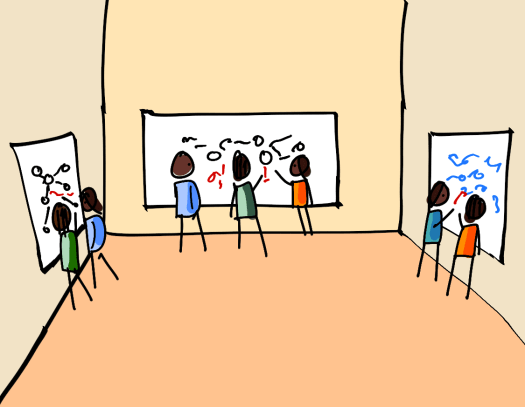
As a facilitator, you have to think about a lot of things. It’s not just about getting up in front of the room and being an entertainer. Your job really is to create the conditions for collaboration. And there are models out there that work in certain situations for certain people and what you have to figure out is what your situation is and how you can adapt those methods to what you’re trying to do. What are the tools, methods and processes that will help your audience to engage and get involved?

Perhaps I need to start working through some ideas here next.

Cheers,

Karthik Suresh

Do You Know What Kind Of Organization You Work For?

organisation-structures.png

Tuesday, 10.05pm

Sheffield, U.K.

Politics is about the participation and engagement of the wider citizenry – to miss that point would doom us to irrelevance. – David Blunkett

In my last post I said I wanted to look at examples of participation – what really engages and excites people in a group. But before we get into that perhaps we should take a quick look at the nature of groups and of society – because the structure of the group will surely have some influence on the kind of things that happen.

Think about the social situations in which you find yourself. There’s work, probably. Home and family life. And then there are the various institutions that you participate in voluntarily and the society you live in by dint of where you are geographically.

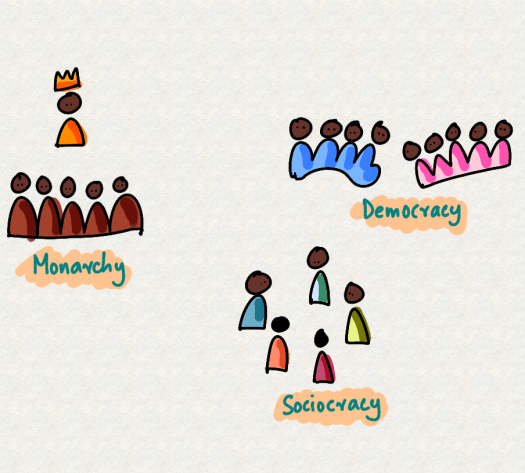
Work, for many people in the private sector is really a form of monarchy, isn’t it? You have a ruler at the top and layers of enforcers – a hierarchy of one kind or another. Of course, the monarch no longer has untrammelled power but the vestiges of ownership, the feudal echoes of the people that own the land and the people that work the land are still there. Everyone between the ruler and the tiller of the land is there to make sure that the ruler’s wishes get done through the administrative machinery of the kingdom.

If you’re lucky you live in a democracy where the voices of the majority decide what is to be done. It’s not a perfect system but its better than the alternatives. But do you practice democracy anywhere else – at work or at home? Do you have a democratic system where your children have an equal say and you go with the majority? Or are you autocratic – enforcing the rules as you see fit?

And then there is this thing called a sociocracy – a body of people that have social relationships and have a way of self-organizing, deciding between themselves what to do rather than being organized – and told what to do. There’s a description of what this looks like in Buck and Endenburg (2012) and it essentially comes down to a few elements.

  • People are equal
  • Decisions require consent
  • Leaders are elected
  • Hierarchies are representative

Let’s imagine a meeting, a session where a group comes together. This is easy to do, just recall any boardroom scene from any film. The imperious boss strides to the head of the table and asks for a report. A halting and fearful employee makes their statement – is harangued in front of everyone, possibly fired, and then the boss moves on to the next victim.

Now imagine a board meeting, a collection of equals, the Executive Leadership. The atmosphere here is openly collegial, and, under the surface, bitterly political. But these are gentlepeople and they read their papers, listen to the proposals and decide on motions with a vote. Democracy in action, greased by favours and backhanders.

Power only defers to power, those without power are irrelevant, their opinions carry little weight. After all, the vote used to be restricted to people who owned land – no one else had any right to have a say in how things were done.

It is naive to assume that any other system is “natural” to the way we are as humans. A dominance hierarchy is built into our DNA – it’s in our bones. Our animal ancestors settled their differences on the basis of who was more powerful and that continues with us today. Our most basic instinct is to seek and get and hold and consolidate our power. It takes all our humanity to act in any other way.

And to act in any other way is the defining benefit of being human. It’s unfair, of course, to characterize most human excesses as animal instinct – no animal could behave in the way humans do. Or perhaps they could – I haven’t looked into it. Is genocide a trait of any animal? Apparently humans share this trait with chimpanzees and it comes down to competition for resources, with the chimps anyway. But it’s not, it would seem, something animals in general do. But humans are also capable of overriding that part of us through choice, by the choices we make about how to live and work and be together.

It’s not going to far, I think, to say that both a monarchy and a democracy are based on violence towards others. Is that too strong a word? Is violence – the extent to which apes can wreak havoc on others in a competition for resources – not something we see all the time? And aren’t the social institutions we have – the police, the courts, the media, the politics – tools and processes for avoiding the manifestation of that violence? And when we feel that things have gone to far don’t we take action, which ends up being violent? Isn’t that clear from the fact that you have to make it clear that you are going to protest using non-violent direct action?

Now, if you look at this from a systems point of view – perhaps using Deming’s formulation – you’d say that most of the problems have to do with the system rather than the people. In a monarchy you end up with people saying what the ruler wants them to say to avoid getting into trouble. In a democracy you end up speaking only to your own people and anyone on the fence because your only job is to get enough people on your side to win. The objective for all players is to gain power. Once you have power, you can decide what to do next.

If you truly want participation – if you truly want to exercise the extent of your humanity – you have to come to terms with the extent to which you are willing to cede your power. And this is a tremendously difficult thing to do. Think about it – are there any circumstances in your life where you are not in a position where you have power or where you don’t have power? You have power over your young children and your manager has power over you. Have you ever had that feeling when your child first rebels, refuses to acknowledge your power and starts to assert their own. Isn’t almost all of being a parent a power struggle with a few cuddles and love left over? Are you ready to give your young child the power to make their own decisions? Will you ever be ready?

If you are, then maybe you can be the change the world needs. It can be done. Remember the words from the film Gandhi?

Edward R. Murrow: [at Gandhi’s funeral] The object of this massive tribute died as he had always lived – a private man without wealth, without property, without official title or office. Mahatma Gandhi was not a commander of great armies nor ruler of vast lands. He could boast no scientific achievements or artistic gift. Yet men, governments and dignitaries from all over the world have joined hands today to pay homage to this little brown man in the loincloth who led his country to freedom. Pope Pius, the Archbishop of Canterbury, President Truman, Chiang Kai-shek, The Foreign Minister of Russia, the President of France… are among the millions here and abroad who have lamented his passing. In the words of General George C. Marshall, the American Secretary of State, “Mahatma Gandhi had become the spokesman for the conscience of mankind, a man who made humility and simple truth more powerful than empires.” And Albert Einstein added, “Generations to come will scarce believe that such a one as this ever in flesh and blood walked upon this earth.”

If you want to take people with you then you have to start by being willing to give up power. What happens when you do that?

Let’s look at that in the next post.

Cheers,

Karthik Suresh
References

John A. Buck and Gerard Endenburg, The Creative Forces of Self‐Organization (2012).

How Can You Help People To Get Along?

doing-low-barrier-activities.png

Monday, 9.34pm

Sheffield, U.K.

I used to teach improv courses in Amsterdam where we would do team-building exercises, and they can go south very quickly. – Ike Barinholtz

I’ve been watching TED talks while putting the kids to bed again and I’ve been searching for something in particular – about drawing and it’s potential to draw out what’s hidden inside us. The things that get overlaid with the detritus and crud of life until we forget they exist.

I started with Ursus Wehrli and his talk Tidying up art. It’s funny because he takes modern art and rearranges it to make sense. And he’s serious because he’s taken out a patent and he gets the point because he is taking art and making art.

Ursus Wehrli’s talk led to one by Ze Frank called Nerdcode comedy which is again sarcastic and funny and serious and eye-opening. Around 14 minutes into the talk he talks about creating online spaces where people who don’t think of themselves as artists can come together and share the feeling of creation – of making things. He talks of living in a “culture of guru-ship” and that has only become more the case now. Every person you see, every video, everything that’s brought to you by the algorithms is polished perfection, experts telling you their expert stuff, perfect people with perfect bodies showing you how they live perfect lives.

That’s not participative or expressive so Ze talks about creating “meaningful environments for people to express themselves”, creating silly, fun things to do like competitions for photos of “When Office Supplies Attack” or “Toilet Paper fashion”. And then, in an offhand comment that is almost certainly perfectly rehearsed he says, “But it’s peripheral activities like these that allow people to get together, doing fun things. They actually get to know each other, and it’s sort of like low-threshold peripheral activities that I think are the key to bringing up some of our bonding social capital that we’re lacking. ”

Now that’s insight and I’ll tell you why.

I have, like you, attended lots of webinars and sessions where people tell you stuff, throw stuff at you. I’ve also attended workshop sessions and team building exercises and almost certainly hated all of them. I’ve developed my own approach for running certain sessions and I think people like them because what I do is ask them to talk and I ask questions and listen and try to understand and people seem to like that. But that’s not group work, not in the least.

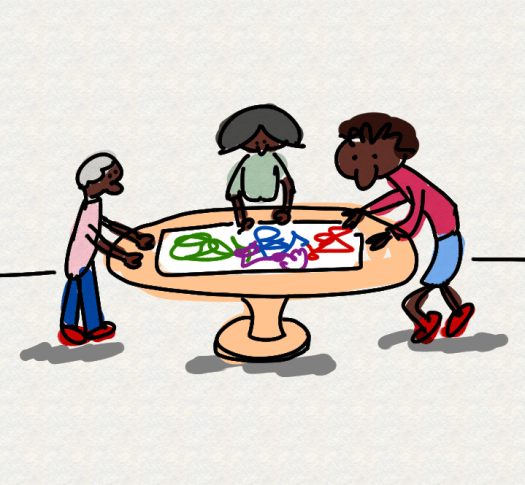
So, I attended a session sometime back where we got put in small groups and had to work on a task together and I loved that, because I was doing something that wasn’t hard to do – I kind of knew it – and I was working with other people and we were creating something together – and that experience of making – in a small group – made that session memorable and exciting and something I’m writing about weeks later. So what made the difference? I think it was this peripheral activity, where we did something fun and got to know each other and that created social bonds.

Now yes, those bonds are built quickly and often short lived. We’ve all been to events where we do something together, learn more about each other and then go back to work and everything goes back to the mean, reverts to what was happening before and you might as well not have bothered with all that activity stuff.

But at least we have a model – an insight into how things work that we can use. And that is this – the peripheral activities are simply a way to loosen up, to get your head in the game and start to get to know and like the people you are with. Eventually, whether you succeed or fail depends on how the team works on a real project. And I remember a session with these dynamics as well – the first session went well because we worked as a team. The next, we changed partners and it all went south mainly because of one, rather domineering person who tried to control everything.

These activities won’t fix a team with the wrong people – but if you have the right ones and you get them to work together then you’ve got a chance of creating something good. But, how do you tell a good team from one that simply says all the right things and doesn’t really work well under the surface?

Eventually, it will show up in the results. We can go back to Warren Buffett, who said that the value of a business in the long term depends on how its earnings grow. A real team will eventually show real results – as long as it’s in a good business.

We’ve digressed a bit but that’s ok. The thing is that getting people to engage is hard – and we try and do it by getting them all in a room together. Maybe one of the benefits of the pandemic is that we will try and do more of these remotely and that means we need to figure out how to make shared experiences work online. There are lots of tools and I don’t know how well they work, maybe that’s something to explore actually. Get away from the stuff that’s in your face with Twitter and LinkedIn and go find the other stuff that actually works for real people.

Ze talks about online drawing, which was hard then, and is still not that easy now, although we are getting there. And an easier project called the “Fiction Project” where you can do collaborative fiction writing. That could be interesting for group “futuring” or planning exercises.

The thing that most experiments struggle with – in the social space anyway – is keeping things going. When does an exercise turn into a habit or create real change?

Maybe I need to go in search of these – get off the beaten track a bit and find examples of online community that are just plain different.

Any suggestions?

If not, I’ll start looking for the next post.

Cheers,

Karthik Suresh