December Update On Cryptocurrency Trading Performance

dec18-crypto-update.png

Monday, 5.46am

Sheffield, U.K.

The market can remain irrational much longer than you can remain solvent – A. Gary Shilling

December tends to be the time when we look back at the year and see how things have gone.

And one of the things that has not gone the way people thought it would is the whole crypto-currency space.

I first wrote about blockchain in March 2017 – the year Bitcoin exploded in value. By the end of that year, it was trading at $16,000 and, at the start of 2018, we were asking whether traditional investments were dead and it was time for alternatives to take over.

Which reminds me of what happened in 2008 to oil prices. They shot up, rocketing through $100 a barrel, heading towards $200 a barrel.

Goldman Sachs, a firm that you would think knew what it was doing, mused about the possibility of oil at $200 a barrel.

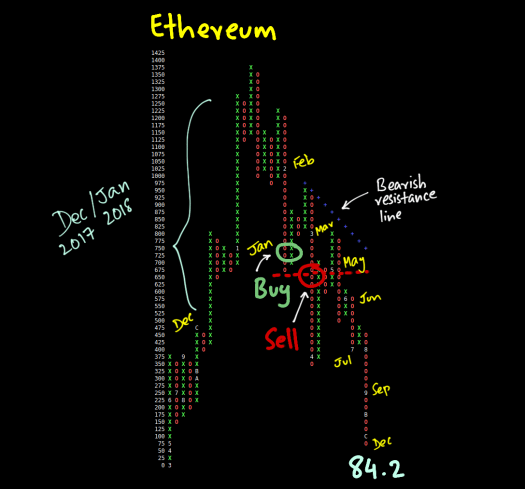
My flirtation with crypto lasted all of three months. At the start of this year I bought Ethereum in January at $725 and sold at $650 in March, a loss of 10.3%.

I explained why in that post – setting out how my trading system worked.

Before I put any money into the market I created a trading system based on Point and Figure charts.

This method helps to find the signal in market noise and, importantly, gives you a way to know when to pull out of your trade.

In essence, when I bought, I set a stop loss figure – a value below which I would close out my position.

That line was at 650 – the red line in the chart – and when I went through it, it was time to sell.

I also needed a way to look at whether I should enter the market again.

I’d only do that when it was clear that the market had turned – which would happen when prices went through the bearish resistance line, a roof of numbers that the price would have to push through.

It hasn’t done that this year – the price has come close but not close enough.

And, as the year has drawn on, the price has continued to fall.

Ethereum is at around $85, Bitcoin at $3,200.

Bitcoin has dropped by 80% this year. If I had stayed in Ethereum, my losses would have been over 88% rather than 10%.

So, with the benefit of hindsight, I’m glad I got out when I did.

But what’s clear is that at the time no one had any idea what was going to happen.

And that’s one of the things that we need to get our heads around.

There are an infinite number of possible futures – and we’re never going to be able to tell which one is going to happen.

That makes decision making hard because you don’t know whether you’re taking a gamble or not.

If you buy something because you expect its price to rise then you’re speculating.

Whether it’s houses, stocks or currencies, we’re buying hopes and dreams.

And that’s dangerous.

Crypto is a pure sentiment play – it’s worth what someone else is willing to pay for it.

Period.

And right now, fear is in charge.

There is no reason why the market cannot go down further.

It’s been a year of devastation, after all.

But, things can change – things go in cycles.

Less than a year after Goldman Sachs did its piece about oil the price fell to under $30 a barrel.

There is a point where enough people think the price is low and come into buy – starting that process of supporting and pushing prices higher.

Maybe next year – maybe in a couple of years. All we can do is watch and wait, and be ready to act.

At these times we would do well to remember the Scout motto Be Prepared.

Cheers,

Karthik Suresh

What Do You Need To Do To Get Buyers To Trust You Enough To Buy?

lemons.png

Sunday, 8.48pm

Sheffield, U.K.

Content builds relationships. Relationships are built on trust. Trust drives revenue. — Andrew Davis

There’s been something missing from the last few books I’ve been reading and trying to use in day to day situations.

It started with an increasing tension between strategy and tactics.

Strategy is a having an idea of where you want to end up.

Tactics are about having approaches that will get you there.

So far, so good.

The problem is that it isn’t clear what comes first.

For example, do strategic studies describe what you should do in the future or do they describe what has happened in the past.

And do you hear of tactics that were successful because the people and companies that used them prospered – but don’t know about the people who used the same tactics and failed?

From one point of view strategy and tactics are stories – stories that help us think about the situations we are in and perhaps help us come up with ideas and approaches we can test.

Is there anything a little more durable? Something that we can use in a more robust way?

How about economics?

The problem with economics the way it is taught in schools is that it has lots of maths and complicated words.

When it comes down to it, however, the best definition I read was by Steven Landsburg who writes in his book The Armchair Economist Most of economics can be summarized in four words: “People respond to incentives.” The rest is commentary.

So that takes us to tactics and strategies that we need to use to get ahead in this modern world.

Most people would agree that digital marketing is an essential part of what anyone needs to do now to survive in business.

High streets are being decimated – we use stores as places to browse while we check prices on Amazon or Ebay while taking pictures of products to remind ourselves of what we might like.

The effort that goes into curating products, selling shelf space and staffing those stores is something we are no longer willing to pay for.

When many of us starting making a shift to online marketing we need to develop content.

Content is the stuff that sells for us and the way in which we create and use content is going to make the difference between succeeding and failing.

Why is that?

Economics has a simple answer.

The biggest problem that exists in the real world between buyers and sellers has to do with the amount of information each has about the product.

Old world economics assumed that information was perfect – everyone knew everything and so the price was all that mattered to match supply and demand.

But then why is it that you hesitate to buy a used car?

It’s the lemon problem.

You could be about to buy a lemon. The salesperson knows it’s a lemon. You don’t.

So, what can a salesperson do to help you out?

Well, what they used to do was try and pressure you into buying.

I had that recently with a car purchase. They did all the things – started off saying everything was in my budget then coming out with a price twice as much.

Trying to get me to agree that I would make a decision that very day.

Trying to be my friend.

But you can’t really be pressured in the same way online – which is why so many of us prefer to be there.

So… the skills we need to develop are really the ones that help us figure out what kind of content is going to help sell our product.

What’s the economist’s answer?

Information.

We need to use information to show what we have – to describe it and show it being used and help customers see it for themselves.

We’re all very sensitive to hyperbole.

When a film’s blurb tells you that something is a fantastically told story you’re ready not to believe them. If it was really that good the reviews would tell you that.

That’s an example of not having enough information. Too much information is also a bad thing.

Including every detail that matters to you might well turn people off.

The optimal amount of information shows people what you have and tells them what they would ask if they were in front of you.

A friend of mine points out that selling on Ebay is common sense. Make descriptions clear, use terms that people would use when searching, show the thing from lots of angles – all these things help reduce people’s fears that they are about to buy a lemon.

We are, still, in the very early days of the Intenet.

Everything seems to be about glitz and glamour and look and feel but under it all the only measure of success you need to have is what kind of sales you’re making.

And if you’re not making enough sales it’s probably because you haven’t convinced enough people that what you have isn’t a lemon.

Cheers,

Karthik Suresh

What’s In A Name?

names.png

Saturday, 7.39am

Sheffield, U.K.

Pen names are masks that allow us to unmask ourselves. – Terri Guillemets

Doing stuff is easy.

If you’re like most people the work comes naturally.

You can draw or write or file paperwork with the best of them.

So, let’s say you’re looking for a new job, starting a business or creating a new product line – what’s the first thing you should do?

Some people start with the function – the features of what they have to offer.

With you, that might be your qualifications, experience and achievements.

With a product, it might be what it does, the technology it uses and the team behind it.

I normally stumble around in that sort of space for a while trying to work out what it is that I’m trying to say.

Until I worked with a professor who took a very different approach.

She listened to my pitch for a while then leaned forward and said “Okay, so what do we call this?”

I wasn’t sure yet.

So, we sat and talked about possible names, things that this product could be and as we did that, the concept became more real and concrete and tangible.

Names have the power to do that.

In a sense, naming something makes it real.

It’s no longer a hazy idea but a fully formed concept held in words.

Which then leads you to thinking about how to choose a name that works.

Much advice is generic and obvious.

Choose names that people can say, words that are easy to read, unique, memorable, with feeling, energy and the right kind of sound.

Some advice is extensive and almost overwhelming.

In this blog post Nick Kolenda, the author of Methods of Persuasion details how to construct names for whatever you want to do.

It’s going to take a few reads before it sinks in.

Many founders start with ideas for names and the first thing they do is see if the domain names are available.

Both Dropbox and Uber started without owning the dot com domains for their names.

During their funding rounds they bought the names for what seems like a lot – around $300,000 and $1m or so each.

The equivalent value now would be hundreds of millions of dollars.

I suppose to start with there are a few things to work through.

Is your business very specific – like Kate’s Carpet Cleaners or an industry group like General Motors?

Does your brand evoke a promise like McKinsey or make you feel like you own something exceptional like Apple?

The thing that Nick’s article makes clear is that names have shape and sound and colour and feeling and size and gender and more.

Selecting a name may be less about inspiration and more about discarding ones that don’t work.

But there’s one more thing about names that may be helpful to us.

By naming something we give it an identity that starts to separate it from us.

It’s like having kids.

At first, they’re attached to you – a part of you, without a name.

Choosing that name for them is so important when they come out because we’re worried about how they will be treated.

Will their name help them or will they be teased for it?

Also, when we name them we recognise that they are separate from us, independent human beings.

And I suppose that’s what a name does with our creations as well.

Whether its a business, a product or simply a new process, naming it creates a separation from us and we can look at it more objectively.

Many founders can’t get over that feeling of personal attachment to their product and so can’t listen to advice that suggests their baby is not perfectly formed.

Maybe naming the thing we have made is the way we need to let go and let it become the best it can be.

Cheers,

Karthik Suresh

How To Design Habits To Change Your Life

habits.png

Friday, 6.02am

Sheffield, U.K.

We are what we repeatedly do. Excellence, then, is not an act, but a habit. – Aristotle

How should you spend your time?

When at work, should you only work?

Should you start at the first thing on your list and keep going until you’re done?

Charles Duhigg’s book The Power Of Habit: Why we do what we do and how to change uses lots of examples to illustrate a simple model.

We do things, he says, in a loop.

First, some kind of event sets you off.

He calls this a cue.

For example, your phone buzzing with a notification is a cue.

A cue can also feel like a trap. For example, if you’re hungry and you go to the supermarket seeing the chocolate aisle is like falling over a tripwire.

The cue triggers the start of a routine – actions you take one after another.

If the routine ends up giving you a pleasant rush, giving you a high, then the next time you encounter the cue that started it all you’ll start the same routine.

And that’s Duhigg’s habit loop.

When you get your head around this you start seeing examples everywhere.

If, when I drive back from work, I stop to fill the car with fuel the cue or trap is going into the shop to pay and seeing lots of chocolate.

The first trap is that buying some chocolate seems cheap when compared to the cost of fuel.

For example, if you’ve put 60 pounds in the tank what’s an extra pound for a bar?

Now, you might say just use your willpower and resist buying that chocolate.

But, when you’re tired or hungry late in the day, your willpower is exhausted and you can’t trust yourself.

Now, the trap is sprung. You fill up, pick up some chocolate and get a sugar rush.

And the next time you fill up it’s more than likely that you’ll do it again.

So, how do you escape from this habit?

In this example, what I do is avoid the trap in the first place.

I try not to fill up in the evenings when I’m tired and hungry but in the mornings when I’ve just had breakfast and my willpower reserves are full.

Avoidance or abstinence is a good rule for this kind of trap.

If you haven’t got it you can’t have it.

The next thing you can do is address the routine.

If you keep the cue the same and the reward the same but adjust what you do in the middle you can create good habits or break bad ones.

Take a simple act like planning what you’re going to do tomorrow at the end of today.

You could use the five minutes before closing time to jot down the top things you want to get done or keep a pad somewhere you know you’ll see it before turning in for the night.

The trick is finding what you can do that will give you a reward you know you like.

For example, you probably feel good after you’ve done some exercise.

If you go for a run first thing in the morning before you do anything else or change into your gym clothes at the same time each evening you can use a timing cue to kick start a routine.

You just need to experiment and figure out what works for you. Keep trying out things and you’ll find a look you can stick with and form a habit.

The last thing you can play with is the reward itself.

Normally, you’ll try and do something that gives you a pleasant feeling.

Some approaches, however, try and use negative feelings.

Some hypnosis approaches try and associate a cue with revulsion to stop habits like overeating or smoking.

At a more extreme level you might wear a device that gives you a mild shock when you see the cue.

Someone was trying to raise money to build that kind of device on Kickstarter and the is apparently quite effective.

If you get a shock when you reach for chocolate your brain learns very quickly to avoid and get away from that situation.

Maybe that’s a little extreme but the point is that there isn’t really that much we are trying to get right.

Health is probably top of the list, complemented by eating right. Doing meaningful work and spending our time with people we care about.

It’s so easy to get into bad habits, even simple ones like spending too much time watching TV or getting irritable with others.

Changing a habit, on the other hand, can be hard.

Duhigg’s model gives us an approach that might make it easier.

Cheers,

Karthik Suresh

So What Is It You Do Around Here?

jobs-to-be-done.png

Thursday, 8.32pm

Sheffield, U.K

Where there’s muck there’s brass. – Yorkshire expression

I’ve been finding it hard to work out what strategy you should use to try and make a career change.

Or, for that matter, a change in strategic direction, a change in your product mix or a change in marketing strategy.

Here’s the problem…

You’ve spent many years getting good at doing something – marketing, computing, accounting.

Now let’s say you want to start a business but are not sure exactly what to do.

Should you do something that you already know?

Or should you try something completely different?

If you’re selling a particular product or service should you try to branch out and add more things to your portfolio?

On the one hand, you know what needs doing, you know your market and you should be able to go out there and talk to the right people about what you do.

But, if you enter a different market maybe what you know will give you an edge and you could do really well there.

What to do?

The first thing is to stop thinking in terms of you and what you can do.

Clayton Christensen, a professor at Harvard Business School, has come up with a theory called Jobs To Be Done.

The idea here is that when we have a problem we reach out and find something that will help us solve that problem.

In essence, we hire people and things to help us with the problem we have.

You hire a computer to help you get work done.

You hire shoes so you can walk around.

If your computer or shoes are rubbish you fire them and go look for something else.

So this theory says that everyone and every business has Jobs To Be Done and if you can figure those out then you can sell to them.

Is this a useful model?

I’m not sure yet.

Is there something more behind the fairly obvious bit that people and businesses have things they need to do?

The more I think about this the less useful it seems as a general principle.

As always, everything depends on the specifics – on context.

Many years ago, I was sat on the floor of a room surrounded by invoices.

Hundreds of them.

I was trying to get them organised for some kind of report and as I sat, in a sea of paper, it became clear we needed a system.

So we looked at our options and bought the cheapest one that seemed to do what we wanted.

We had a job to do but, more importantly, the job was mucky and hard the way we were doing it now.

That’s why we hired the system.

Not to do a job but because we were tired of shovelling shit.

The theory also struggles to explain what happens at holidays.

You could argue that one of your jobs is to turn the little people in your house into insatiable consumers of mass produced goods.

Or… in reality lots of people look at something and go “ooooh… shiny…..” and buy it.

Maybe the job they have to get done is get a dopamine rush.

Then there’s the sensible approach where you actually save someone time or money so they buy your stuff.

So, coming around to change…

  1. Do you create attractive, shiny things?
  2. Do you save people time and money?
  3. Do you do a hard mucky job that no one else really wants to do?

If you do 1, then you’re probably in control.

People like J.K Rowling or Kardashian variants don’t sell on reason but on desire.

The second option sounds plausible but it’s actually really hard to sell savings to people.

It might seem like a no-brainer but most people have the brains to realise that a no-win no-fee deal is probably for suckers.

As Warren Buffett says if you don’t know in the first ten minutes who the patsy is then you’re the patsy.

And then for the rest of us… we get paid for shovelling up the muck.

Cheers,

Karthik Suresh

What Can We Learn From The Possibility Of Losing Everything?

loss.png

Wednesday, 6.05am

Sheffield, U.K

If it can be solved, there’s no need to worry, and if it can’t be solved, worry is of no use. – Dalai Lama

I managed to screw up my computer yesterday. Quite creatively, by deleting half the operating system while trying to make a program work.

Anyway.

In these days when everything we do is backed up on Dropbox and emails are on services in the cloud that’s not the end of the world.

It did get me thinking, however, about what matters.

An opportunity to start again doesn’t come around that often.

We usually spend our time accumulating things. In fact, we don’t do it consciously. Things just gradually build up over time.

Take emails, for example. Once upon a time we probably had a computer that held our email and if we lost that machine we lost all our stuff.

Then Gmail came out with what seemed like endless storage. But after ten years or so I was surprised to find that I’m getting close to the limits.

Years of personal emails, attachments, newsletters, solicitations and junk over the years have built up to a data mountain – invisible but present.

At the other extreme I watched an animated programme the other day which had a monk in it who casually mentioned to his disciple that their job was begging.

Religious begging has been practised by many faiths. Zen calls it Takuhatsu and it has many purposes.

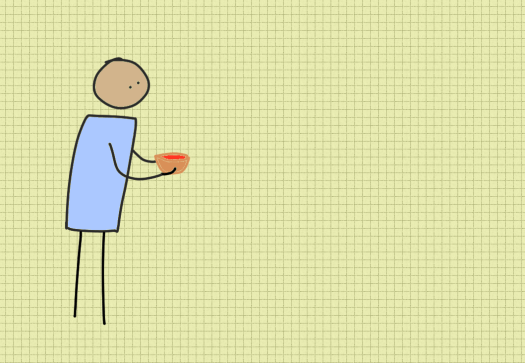
The acts of having nothing, going out with just a begging bowl and being dependent on others to survive is meant to help the monk develop humility, modesty and escape from ego.

Most of us are never going to do that, experience the feeling of having nothing and being totally dependent on the kindness of strangers.

But, is there anything we can learn from the possibility of that experience?

Can poverty be a good thing?

I heard recently the phrase resources versus resourcefulness.

This is the power that comes from having less.

Stuff can be lost, taken from you or destroyed in an accident.

How long would it take for you to get back up and running if that happened?

Probably less time than you think.

There’s a story about a store in Sheffield that was bombed during the Second World War.

Its accounting records were destroyed and so it could no longer bill customers. But almost everyone paid what they were supposed to and the store is still standing now.

I suppose the point of all this is that bad things happen sometimes.

The more things you have that matter to you then the more you have to replace.

If you had nothing, it wouldn’t matter.

Somewhere between those two extremes is where you want to be.

But, the harder you try to have less, to do more with less, the easier it is to be free from worry.

Cheers,

Karthik Suresh

How To Use Questions To Discover Possible Answers

hypothetical-questions.png

Tuesday, 5.42am

Sheffield, U.K

To ask the ‘right’ question is far more important than to receive the answer. The solution of a problem lies in the understanding of the problem; the answer is not outside the problem, it is in the problem. – J. Krishnamurti

Sometimes, when we’re stuck, it can seem like there is no way out.

The big trap of modern life is this: when you’re young you can do anything but know nothing. As you get older you know more but can do less because of your commitments and responsibilities.

So, how can you reconcile these differences?

Probably by trying to think differently.

All change, after all, must first start in your mind.

And the way to get your mind to help is by asking questions.

For example, how can you discover what you really want out of life? What is it you were born to do?

Well, you can look at your life now, look back on the decisions and choices that led you here and draw a conclusion.

Perhaps you chose to live in a particular city because you had friends there. Maybe you started a job as a temp and now you’re in a decent position after ten years.

Looking back, however, only tells you what you did. For many of us, that is not the same as what we wanted to do.

But, over time, we’ve forgotten what that was.

To discover that again, one way is to ask yourself what your perfect day looks like.

What would a perfect day be like for you?

Where would you wake up? Who would be with you? What would be the first thing you did? What would you have for breakfast? Where would you go? How would you spend each moment of your day?

If you write out in detail exactly what your perfect day looks like – work through it as if you could do anything, have anything you wanted and live like anyone – you’ll end up with a narrative of what your ideal future would be.

So now you have a vision that you can compare to your current reality and see what kind of gap is there between your today and your tomorrow.

And asking that question and seeing that gap can help you ask more questions about how you can bridge that gap.

For example, if you aspire to be a successful writer but don’t spend a minute writing in your perfect day then you either need to start to write or think about how you really want to spend your time.

Many problems can be overwhelming if you try and approach them all at once.

Take marketing, for example.

If you work in a small business then you’re probably looking at the marketing options you have.

Digital is big. Everyone else is on social media, sending out updates to their huge mailing lists.

How can you compete with that?

What kind of question can you ask yourself that will help you figure out what to do?

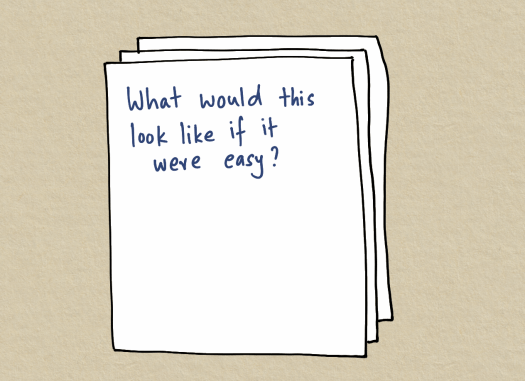
The writer Tim Ferriss has one question that he says helps him answer many others:

What would this look like if it were easy?

All too often we do things because it feels like we should.

For example, if you decide to send out a customer newsletter the temptation is to pack it with all kinds of information.

You want to be helpful but you also want to show how much you know and think that will happen if you put lots in.

But, does that help your customer.

The French mathematician Blaise Pascal once apologised to a friend for writing a long letter because he didn’t have the time to write a short one.

The ideal message to anyone is one that is written just for them and tells them exactly what they need to know.

So, if you’re trying to maintain a relationship with your customer, what would that look like if it were easy?

Well, perhaps you wouldn’t use an email newsletter to try and maintain your relationship.

Instead, you’d make sure you kept them informed about the work you were doing for them.

Maybe that’s enough.

Or you’d make the time to talk and meet with them regularly.

Or maybe you’d spend the time to create very personalised messages.

You can probably think of many areas where you’d like to make improvements – from your sales process to operations – or your personal life.

What questions should you ask if you want to discover new ways of doing things?

Cheers,

Karthik Suresh

How To Make Big Changes In Your Career And Business

portfolio.png

Monday, 5.54am

Sheffield, U.K.

To know and not to do is not yet to know. – Zen proverb

Change is hard.

If you you disagree with someone else’s beliefs what do you do?

Do you try and persuade them to change?

And, if you have tried that, how did it turn out?

In my experience, people attach themselves to views and find it very hard to loosen themselves without feeling like they are losing face.

Without feeling embarrassed.

And that makes sense, because that’s how many of us feel in the same position.

Making changes at a larger scale is even more difficult. Getting people to act and do something in a different way.

It comes down to something very basic.

Fear.

We’re afraid of what will happen if we do something different.

If we leave our job, will we ever find another one?

If we try and pursue what we think we love, will we find that we aren’t as good as we think?

What if no one comes to see what we do, or buy what we make?

So, what do you do with fear? That thing sitting in your way blocking your path, stopping you from moving forward?

And there is no right answer.

There is doing, and seeing, and learning, and doing again.

For example, many people are looking at developing portfolio careers.

This is when you do a number of jobs rather than one main one.

For many people, such portfolios of jobs are more flexible and rewarding and a better fit with their lifestyle and responsibilities.

So, if you want to move from where you are now to somewhere else, how do you start?

Slowly

You can’t do anything other than start slowly.

You’re slow because you don’t know everything yet, you don’t have the relationships and connections to help you get things done and you might not be sure what the right way is anyway.

Slow is ok. Slow is good.

Slow is better than stuck.

For example, with that fear blocking the road, what could you do to try and edge past it?

You might start by volunteering – helping out at an organisation that does the kinds of things you want to do.

Once you’ve readied yourself to do something new then you’ll start to see opportunities when they come in front of you.

Maybe you can take some of them.

You might be an analyst in your day job. But that doesn’t stop you doing some search engine optimisation consulting for small businesses near you.

You might take pictures on weekends – and could submit them to magazines.

Or perhaps the flexibility of being an Uber driver might work for you.

The last few drivers I’ve met have all chosen to drive – perhaps while starting their businesses, or winding down to retirement, or because it fits their lifestyle.

The idea is to try things – have a go at different options and see what happens.

If something works then you have validation – you have proof that your idea might work and you should put more effort into it.

Then again, being slow might simply be an excuse to not do anything.

In that case, do you jump?

Do you quit what you’re doing now and try and make it in a new career?

The advice would normally be no – but it really depends on what happens if things don’t go as planned.

If you have enough savings for a month’s worth of expenses then taking a leap is probably not a good idea.

If you assume that it will take between two and ten years of trying to get back to what you’re making now, then you need to be clear on whether you’re in a position to do that.

Can you go a year without income?

If you can – then jumping may be an option. And sometimes that’s the way to really do it – commit and leap.

To change you must first get past the fear of what might happen if you change.

You can try and sneak past it, trying experiments and side hustles and second jobs.

You can try and push past it, reducing your hours at your job and taking on other projects.

Or you can run straight through it.

But to change anything, you have to do something.

Anything.

In the end, what you’re defeating is yourself.

Your fear.

Cheers,

Karthik Suresh

How To Become a Professional At Whatever You Care About

Sunday, 5.30am

Sheffield, U.K.

apprenticeship.png

You can observe a lot just watching – Yogi Berra

We live in a world where there is a shortage of teachers and mentors and, at the same time, unlimited opportunities to get better.

Once upon a time, if you wanted to learn a trade, you found someone who needed an apprentice and worked under them.

That teacher-student relationship was the main way new talent was developed for generations.

Now, we have courses for everything. You can learn to code in a weekend. Write, make pots or learn business studies.

So, what happens then?

The movies and success manuals would have you believe that if you’re hungry, always looking for new opportunities and pushing for those big chances you’re going to do well.

And that may be true.

But, is it good?

Will it make you a professional?

We know that there are no shortcuts to excellence in any field of work.

The 10,000 hour rule is about time – time spent doing deliberate practice. Practice that stretches and challenges you.

Take writing, for example. You’re often told that you’ll throw away your first million words.

That seems like a lot but, if you write 500 words a day, two hundred days a year, that will take you exactly ten years.

That ten-year period seems to be needed whatever you do.

It takes ten years to integrate into a new society as an immigrant.

Getting the hang of running a business seems to take that amount of time.

Becoming a musician or artist or craftsperson takes that amount of time.

And that’s time spent learning.

I’m fascinated by approaches to learning.

I read a quote the other day, browsing in a bookshop, while waiting for a train.

No thief, however skillful can rob one of knowledge, and that is why knowledge is the best and safest treasure to acquire.’ – L. Frank Baum.

If you are fortunate enough to be apprenticed to someone then you have an opportunity to learn that few others have.

The Japanese have words to describe this process that are worth reading.

Minarai, for example, means “learning by looking”.

The idea is that a master does not “teach”. Instead, the apprentice, “steals the art” – works out what works over time.

An article by Dick Lehman gives us an insight into this process.

What is the teacher’s most important lesson?

An apprentice’s answer: “Your lesson to us is that we are to express ourselves as fully as possible – with all our might and strength; to be ourselves, and to work within the limitations that greet us; but, through our works, to express our spirit, mind and heart, as best we can.”

But what if you don’t have a master?

That’s where the Internet comes in.

There is an Indian story about a boy called Ekalavya who wanted to learn archery under the renowned teacher Drona.

He was rejected from the school so made a statue of Drona using mud and practised in front of it until his skills were better than Drona’s best students.

These days, the Internet gives us masters to watch on tap.

You can get everything from the words of Warren Buffett to interviews with artists who will show you what they do.

I think when you’re starting out it’s okay to think that you need to be shown what to do.

Very quickly, however, the most important thing becomes whether you spend your time watching, trying and learning.

Because it’s one thing to take a course.

It’s something else to walk the road towards being a professional.

Cheers,

Karthik Suresh

What Would You Suggest Your Kids Should Do For Work?

addingvalue.png

Thursday, 9.30pm

Sheffield, U.K.

There’s more than one way to do it. – Perl motto

I’ve been thinking a bit about where one really adds value.

The late Felix Dennis wrote a book called How To Get Rich where he said that there is one talent you must have.

And what is that?

The talent to spot talent in others. To recruit that talent and nurture it.

But what if you’re that talent… how are things going to work out for you? Or for your kids?

Felix has a lesson later on. As talent gets older, he says, it gets expensive. Young talent can be underpaid if the work is challenging. Then, it’s paid at the market rate. Finally, it’s paid for what it did in the past, and that’s when you part ways with it.

And really, that’s an important lesson. In a traditional career path we climb a ladder. The idea is that we get on the ladder because of what we do and then we climb it because of what we can get others to do.

Its the whole making versus managing thing.

But really, what is a manager other than an intermediary between an owner and the customer?

When you look around you at people and what they do you start to see that programming is increasingly at the heart of everything.

If you work in an office you probably spend a lot of time doing stuff using Excel. That’s programming.

If you’re creating music, or art, or architecture you’re still probably using a computer.

Even if you do something that is a craft, like designing and building wooden stools or jigsaws, you’re probably going to use a computer to help you.

Telling a computer what to do is programming.

Okay – so that’s obvious you say – clearly the world is heading that way. What’s the insight here?

Well, the point is that there is a period of transition.

A period of pain for those who don’t get it.

And a period when they have to make choices.

The kinds of jobs where we add value really fall into two areas.

Either we make something that people will buy.

Or we sell something that people will buy.

Anything else really is a cost – and costs are things that you really want to get rid of.

If you’re doing something that gets you labelled as a cost then you’re going to have a rather fear-filled working life.

I think kids need to get this straight.

Either they’re good with people and can build relationships with them.

That’s worth a lot.

Typically between 10 and 60% of the value of a product.

For example, wouldn’t any of us pay 20% of the price of our product if someone else brought in the customers?

The remaining 40-90% goes to the owners after they pay their staff – the ones that make stuff, and the other ones.

I’d tell my kids to make sure that they’re making something.

And that making is the same as programming – programming an app, automating something, creating music or creating a product.

And if they don’t like that then just go out and learn how to sell.

I suppose you might, at this point, point to the public sector.

Well… that’s where you need to ask how much value is being added by some of the things that happen over there…

Brexit anyone?

Cheers,

Karthik Suresh