
Arthur Schopenhauer, as an old man, was asked what he thought about his life’s work on philosophy being ignored, and replied that he didn’t care at all. “They will find me”, he said.
This extract is at the end of a Peter Checkland (1992) paper I was reading, and so, of course, I looked up Schopenhauer.
I’ve recently been studying “explanation” as a sense-making device, in the context of strategy making by organisations.
In essence, this is the idea that structure is not something external to people but something that they construct based on how they explain the way in which they see the world.
In practical terms, this makes the difference between arguing for investing in sustainable technology or waiting, between starting a war or compromising to keep the peace. Explanations that make or break the future.
So what are we trying to explain?
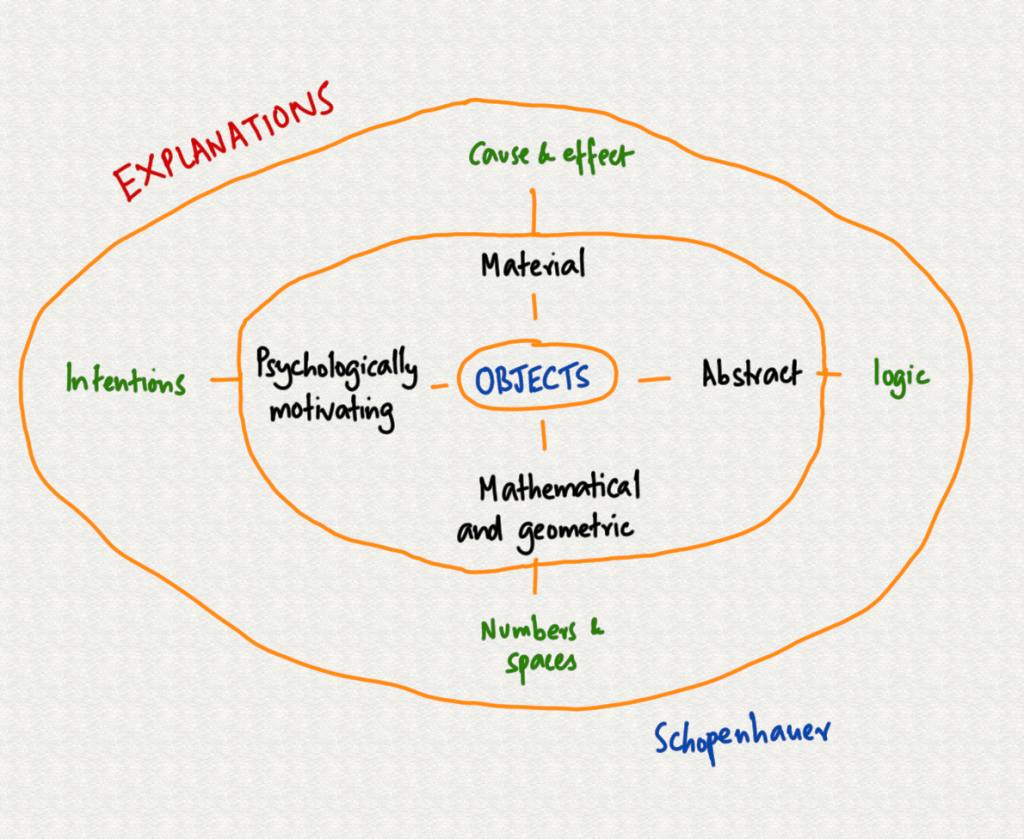
Schopenhaur argued that there are four kinds of objects and four corresponding types of explanations.
- Material objects, explained with cause and effect reasoning
- Abstract objects, explained with logic.
- Mathematical and geometrical objects, explained with numbers and spaces.
- Psychologically motivating objects, explained by motivation or moral reasoning.
Problems arise when we try and apply one style of explanation to a different type of object.
I see this problem all the time in my consulting practice.
Here’s an example. You have a leadership team that wants to build a decarbonized company. Should you therefore replace your gas boiler with an air-source heat pump?
The first problem is one of motivation. Do leadership believe in the case for decarbonisation? Are they forced to do it by supplier pressure? By regulation? What motivates them?
The second is a cause and effect problem. Will the ASHP meet heating demand in all situations? Are operating costs equivalent?
It’s when we mix modes of explanation that we end up with circular and stalled thinking.
Progress becomes easier when we use the right kind of explanation to match the problem we’re facing.
A good reminder when working on strategy.
 Handcrafted insight