In 2026 You Need To Know What You Want Out Of Time

2026-08-22_time.png

The value of craft is in the struggle

Many years ago I went to a talk by a philosopher about the meaning of work.

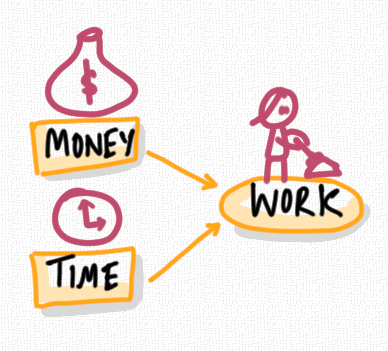
After much research she had concluded, she said, that work was a task you wouldn’t do unless you were paid.

If you wanted to know what you want out of work, she argued, you first had to know what you wanted out of money.

I’m not sure that view translates to knowledge work.

Learning how to do something. Figuring it out. Finding a way. Struggling with the problem.

It’s closer to being a craft.

One that involves technology. We used to reach for Google to find information. Now we reach for an AI to give us the answer.

We’ve outsourced our memories. And now it’s very tempting to outsource our thinking.

But what we’re really doing is outsourcing the struggle.

The question isn’t whether AI can do the work.

It’s whether you want to.

It’s about the way in which you spend your days.

In 2026, if you want to know what you want out of work, you first need to know what you want out of time.

Understand First. Then Act.

2026-08-15_preparation.png

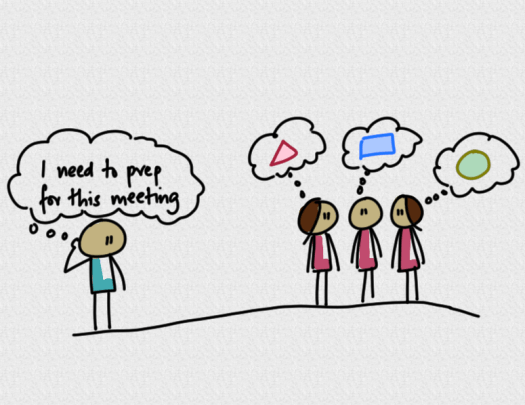
At the start of my career we prepped hard before every meeting.

We were ready. At the meeting we could talk for ages about what we did and the problems we solved.

We were the experts in the room.

But something was off. Prospects nodded in agreement and then went silent when chased.

It took me a while to learn that the problem was us – we were talking too much.

**The world isn’t full of clean, well defined problems waiting for your solution.**

Instead it’s full of messy situations that people find problematic.

Take something like working out a company’s carbon emissions. That should be straightforward, right?

Well, not quite.

… one company has a system but is struggling to use it.

… another is a large global enterprise, but is structured in a complicated way.

… another has changed methods three times and now needs to stick to one.

We can’t just rush into these situations and start offering solutions.

You have to first understand what’s going on.

So we slowed down. Listened more. Took notes. Asked questions. Drew what was going on. Checked that we understood what was in people’s minds.

What works? What doesn’t? What needs fixing?

Expertise helps us build solutions.

Understanding helps us build the right solutions.

Building Systems Bottom Up Rather Than Top Down Works

2026-07-25_mess.png

The cardinal sin in operations is to do the wrong thing the right way

I’m reminded of this every time I work with a client to organise their sustainability data.

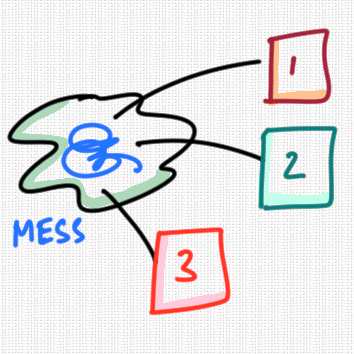
Real organisations have messy, complicated systems. They’re built over time. They’re acquired with new companies. They’re replaced, extended and modified over time.

All this is normal. It’s organic change, Small decisions made over time.

The problem happens when you try and take that mess and fit it into a preconceived system.

We know that any system has to match the complexity of the situation it’s trying to control.

Most don’t do that. Their world model just isn’t able to capture every permutation and combination of the real world.

So what works?

Building bottom up works.

Starting with the systems and data as they are, understanding what is where, and then pulling out chunks of data that can be organised.

That’s a flexible, extensible system that can adapt and grow as the organisation changes.

Because there’s one thing systems people have learned from bitter experience.

As soon as you get your system working, what it needs to do is going to change again.

Strategic Value Comes From Owning Context, Power, Or Both

2026-07-23_context-power.png

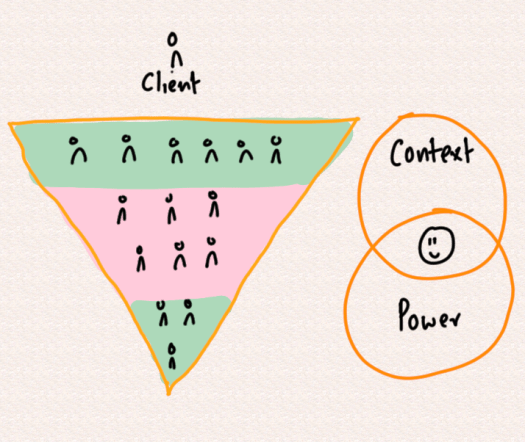
In an AI-first firm safe roles either own context, or power, or both. All others are at risk.

We’re building a new consultancy from scratch, and my experience is very different from the businesses we’ve built before.

For example, you probably know which people in your firm do the actual work – the ones closest to the frontline.

In an information business, these people are the ones that own context – they know the client’s situation and what they need.

This used to be the preserve of less-experienced staff. That’s changing. Senior people are rolling their sleeves up and getting the work done because AI tools help them leverage their knowledge and dramatically reduce bureaucracy.

Leading from the back are people who are in charge of the business. They have power, either through ownership or because of the particular roles they hold.

They’re also relatively safe, because they make the decisions.

It’s the roles in the midde that will start to disapper, the ones that don’t own context and that don’t have power. The ones that can’t clearly articulate the strategic value they add.

A boutique firm hits the sweet spot. Small enough so the owners do the work. They own both power and context.

And the only thing that they now sell is value. Not time.

Context Engineering Is The New Paradigm

2026-07-15_context.png

It’s time for prompt engineers to step aside. Context engineers are taking over.

Big consultancies have stopped talking about model options and now talk about the importance of judgment, defining workflows, and making activities predictable.

The technology at the centre will do what it is told.

But that’s not enough.

To do the right things it needs more information.

Is the solution just more contextual information – policies, guidance, guidelines and guardrails – or is there still a role for humans in an AI-driven workflow?

I think there is, because the real context is rarely explicitly written down

Instead it is constantly constructed, reconstructured and negotiated by the people who are involved in a situation.

If we don’t know what people want and need we won’t know what to ask the machines to make.

Humans are needed, first to understand the situation

Then to get machines to take the right actions.

Why I Reach For Rich Notes To Understand A Situation

2026-07-14_fog.png

It took me years to realize that what we see is not all there is.

As an engineer I was taught that all you needed was a goal or objective – you could then build a solution to meet that goal.

That may be the case if the goal is simple – like losing weight.

But many people know that the process of losing weight is complex and problematic – we experience a fog of opinion, misunderstanding and cycles of success and failure.

Success depends on how you walk into the fog and find your way out again.

Now, the method I reach for, when trying to understand a situation, is to draw it – using rich pictures from soft systems methodology and rich notes from my own research.

Listening, talking and drawing together helps us explore the situation, peer through the fog, and understand what types of actions are possible given the constraints and limitations around us.

Navigating complexity becomes much easier if you can make unsaid and invisible factors explicit and visible.

Explore first. Then act.

Making Is Easy. Understanding What To Make Is The Hard Bit.

2026-07-11_understanding.png

Making a thing is easy. Making it useful is hard.

The big AI vendors appear to have realised this too.

Microsoft has announced its own version of Palantir’s forward deployed engineers – the Microsoft Frontier Company – saying that it will have thousands of people go out and help companies deploy AI.

The difference? Rather than selling AI as a product, firms are trying to sell outcomes and drive adoption.

It’s not easy to make the switch.

Organisations in the real world are not machines – you can’t just go in and engineer new systems and make everything work.

They are actually an intertwined mess of complexity and confusion as seen through the eyes of the people involved.

We need to engage with that confusion and have tools to explore and understand what is going on before we decide what to do.

That takes more time in the short run.

But it leads to better solutions and outcomes in the long run.

Information Systems – A Bridge Between Strategy And Projects

2026-07-09_information-systems.gif

Between the creation of a strategy and a pipeline of projects is a chasm where opportunities go to die.

When we talk to managers they tell us that they have a strategy – they know their direction of travel.

They also know what needs to be done operationally. There is a pipeline of projects sat in various stages of approval.

Projects get stuck because things that makes sense to engineering don’t make sense to finance. Approval processes that meet risk requirements make it impossible to select a fully compliant solution. Procurement looks for innovation, but legal focuses on the risks and liabilities.

So decision makers push back – they ask for more data.

But what they really need is information, not data.

Data is the raw material – it needs to be collected, cleaned, processed and readied.

But for it to make sense – for it to turn into information – managers need to have the time and headspace to understand the data and figure out what it means for the organisation.

A good information system does two things: it makes it easy and quick to collect quality data; and it makes it easy for you to put what you’ve collected on the table and make sense of it.

Your data is like a pile of bricks.

Your information system is the bridge you build to go from strategy to operational delivery.

Choosing An AI Model Is A Political Act

2026-07-08_power.png

Choosing an AI today is a political decision, not just a technical one.

I asked three open weights models – Meta’s Llama 3.2, DeepSeek’s R1 and Alibaba’s Qwen – to tell me about Taiwan.

Llama provided an overview of the general position from a Western perspective. The two others responded with a version of the official position of the Chinese government.

The politics of the situation are deeply baked into the weights of the models.

They do not represent the world’s information neutrally but instead construct a very specific world model that they want you to believe.

That shouldn’t surprise any of us.

With a technology this disruptive it’s not surprising that governments will try and control how it’s used.

That’s why sovreignty is an issue at a national level.

And at a company level, we must select models and how we use them with an eye on what happens if someone decides to turn off the AI tap.

Information is power.

Who will you trust with the switch?

Human Advantage In An AI Age

2026-07-06_value.png

Humans are not obsolete. But we do need to adapt – once again.

A hundred years ago, we sold our labour.

The last fifty saw a move to services.

We saw that shift in the economy, as strong machines were succeeded by smart machines.

And now we have intelligent machines – another technological revolution.

What do humans add in this environment?

I’d argue that there are two essential skills: design and value.

Design thinking helps us create “things” that other people want.

Value creation is doing “something” that helps other people.

What’s central to being successful is not the machine you use.

It’s putting the people you help – your clients – at the centre of your work.

Human advantage in the AI era comes from design and value anchored in human needs.