Reflecting On The Process Of Writing A First Draft Of A Book

reflective-practice.png

Friday, 5.46am

Sheffield, U.K.

We do not learn from experience… we learn from reflecting on experience – John Dewey

On the 26th of May 2020 I set out my intention to rough out a first draft of a book in blog posts over the next sixty to eighty days.

On the 6th of August I wrote the final post.

I now have a body of work, 60 posts exactly with 69,979 words written over 72 days.

At this point, it makes sense to stand back and reflect on the process I’ve followed, what’s gone well, what’s gone badly and what would I do differently the next time.

Having a plan makes it much easier

I have always struggled with structure and outlines – I find that having to do something in a certain order is constricting and takes the joy out of just writing.

But if you just sit and write then you struggle with focus and what you come up with ranges all over the place – it’s like shooting in the dark.

In the days before I started writing I wrote about slips of paper, and I started working on the book by jotting down topics on these slips.

A typical non-fiction book runs to 45-50,000 words and might have 30 odd chapters, so I needed at least 30 slips to tell a story.

I’ve done this using a mind map or made lists on a single sheet of paper before but those ideas didn’t really go anywhere after that, they remained locked on that sheet of paper.

But having them on separate pieces meant I could just put things down as they came to me.

Once I had a pile of slips it was pretty easy to put them in order – you pick up two slips and ask which comes first, following the advice of Pirsig in Lila, and the answer is usually obvious.

And then you pick up the next slip and compare again and pretty soon you have it all organised.

Writing down the slips took a couple of days at most and I used a cut up cereal box to keep them in, as you can see in the picture below, which also has one of the first slips I wrote about.

getting-started-box.JPG

Having this box of slips definitely made it easier to write – all I had to do was pick up a new slip every day and sit down to write.

Writing at the same time every day works

I used to write in the mornings, then I switched to the evenings and then switched back to the mornings.

For three years I’ve tried to write a blog post every day – and the only that’s been possible is to have a routine.

My routine is quite simple, I start with freewriting – three paragraphs of anything to warm up – and then I start the main piece.

I did wonder whether I should use a different time to write and keep the blog time to do the kind of thing I’d been writing so far – but I don’t have that much time so I decided to go with the blog posts.

It does seem like it’s made it harder for some readers – the posts are longer, and perhaps less interesting in themselves because they fit into this overall book structure rather than being self-contained pieces.

Still, this is something I’ve had to do, work I needed to get done so I decided to do it this way.

And it works, day after day you move forward slip by slip.

The early days seem slower and there is a lot to go through but steadily, inexorably, relentlessly, you can move from start to finish and end up writing the first draft you wanted.

That is perhaps the biggest benefit from having the structure and box of slips – it takes much longer to write than to think – and if you get some of the thinking out of the way you can just get on and do the work.

It’s when you have to think and write at the same time that it gets exhausting – and I didn’t find that with my writing.

It helps that I gave myself three years to practice writing and find some kind of voice – find a way of writing that was natural and flowed rather than something that was stilted and flowery – where you write because it’s the way you think you should write rather than writing the way that you actually think and feel.

The other thing with a first draft is just to write – when you’re stuck write about feeling stuck and eventually you’ll get past that and get to the good stuff.

Later, in the edit, you can simply delete the stuff you don’t want to keep from the beginning.

But is it any good?

Every creative person, every writer, feels like what they’ve done is rubbish.

When I talk to friends about the book and they ask if they can just read the posts – well, of course they can, it’s all online.

But I feel the need to explain the book, apologise for the content.

And that’s natural.

But here’s the thing – the content needs to stand on its own, I can’t always be there protecting it from the world.

Everything that needs to be said needs to be in the book – and that’s what the editing process is for.

In fact, all the problems with your first draft are things that you can address in the edit.

I don’t feel like there is enough research, enough stories, I’m concerned about the structure, whether the chunks of information are right, whether there is enough detail or too much detail.

Writing in a blog format is different from a book – you tend to use sentences like individual bullets in a blog rather than a coordinated burst as a paragraph in a book.

Should I have edited as I went along?

I now have a file with nearly 70,000 words that I need to cut down to a normal book size.

Should I have edited as I went along – would that have made life easier?

I’m not sure about that – the structure of the book hasn’t changed much from first structure that went into that box of slips.

But I have gone back and looked at how the topics relate to each other, building up models of the content.

The models I’m talking about are conceptual ones – this paper on reflective practice has more details on the approach I take.

It’s hard to do that without having enough content there.

What I did do is write some programs to help with the editing process.

We’ll see how that goes but that’s for the next time.

What would I have done differently?

The first thing to do is take better notes when I read – follow the ideas that you will find if you look at things like commonplace books and zettelkasten.

This is the idea that as you read you pick out the best bits and save them for later use – which is really all about getting better at organising the research and ideas you find so you can better use them in your work.

The other thing that I would do is to perhaps think harder about what goes on each slip of paper.

For example, a single sentence might get you to write a thousand words – but they might not quite hang together.

There is a reason why you have things like a beginning, middle and end – the structure helps the reader get through the material and get something of it.

That thing they get – the outcome – could be clearer in each slip, and so make it easier to write in a way that helps that outcome to happen.

Then again, this is something you can fix in edit – as you go through the material and see if all fits together, taking out stuff that doesn’t and patching in stuff that’s needed.

Which is why it perhaps does make sense to get the first draft out, put it aside for a while, and then come back to it.

It’s giving yourself some time and space so that when you next read the material it’s like reading someone else’s work and your job is now to edit and improve it, not to defend it.

Final thoughts

If I were to write a first draft again, which is going to happen because I plan to do this for the next few decades, what are the steps I would take?

  1. Take good notes – get better at collecting and organising research
  2. Use slips of paper to plan and structure the book
  3. Write at the same time every day
  4. Look at the structure and how the ideas are related as you go along, but don’t edit for content yet.
  5. Keep writing, even if you feel it’s rubbish. It’s a first draft, it doesn’t have to be perfect or good – it just needs to come into existence.

Cheers,

Karthik Suresh

What Does James Patterson Have To Tell Us About Writing And Business?

james-patterson.png

Monday, 9.19pm

Sheffield, U.K.

I’m very conscious that I’m an entertainer. Something like 73 percent of my readers are college graduates, so you can’t condescend to people. You’ve got to tell them a story that they will be willing to pay money to read. – James Patterson

If you read my last post you may have noticed that I got a little carried away on the subject of pencils.

James Patterson writes with a pencil.

That made me like him again – because last summer, as I sat in a field in France reading one of his books, I was a little put out when I found that he doesn’t write most of them himself.

And it turns out there is a reason for that – a very good one.

Patterson, in case you didn’t know, is a prolific and wealthy author.

But, what caught my eye as I read about him was a question in an interview that asked him whether his advertising background made him a better writer.

He said, “The most valuable part of the advertising process was understanding that there’s an audience. I write commercially, commercial fiction, and there’s an audience, and I like the audience. I don’t condescend to them.”

That’s something most of us don’t get – the fact that if you do something as a business then there’s an audience.

If you haven’t got an audience you haven’t got a business – you have a hobby or a passion, but not a business.

And this comes across in the quote above.

Patterson doesn’t call himself a writer – he thinks of himself as an entertainer.

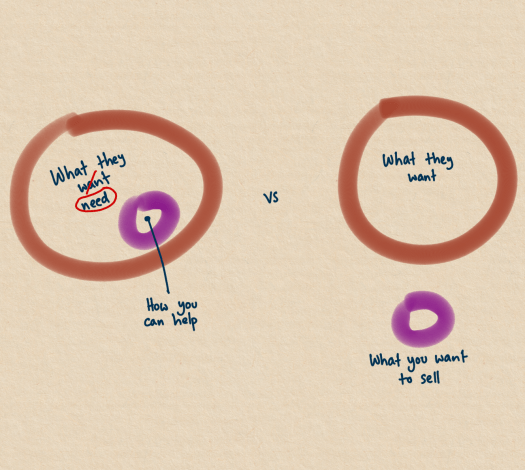
This is the difference between thinking in terms of what you do and What you do for someone else.

What you do is a feature, what you do for someone else is a benefit.

This is worth keeping in mind whatever it is you do – and trying to articulate clearly.

For example, if you’re a management consultant – that’s what you do.

What do you do for someone else?

What’s the equivalent of “entertainment” in your business – is it “problem solving”, “cost cutting”, “revenue generating”?

And, quite importantly, is that something people get – are they willing to pay money for that thing?

It’s quite possible that what people get from you is different depending on the situation they find themselves in.

But I do think that this simple approach helps us understand whether what we are doing is commercial or not.

Is it something we do because we want to – because it’s interesting to us and we enjoy doing it?

Or do we do it because there is a need – people willing to part with money in exchange for this thing.

Or, happily, is it both?

People buy Patterson’s books because he promises them a particular kind of reading experience.

So what if he hires people to help him get down the words – you still get a Patterson novel – and he handles quality control.

That way you get more to read than he could write himself and everyone’s happy.

Aren’t they?

Now, after the commercial discussion, the rest of Patterson’s suggestions are easier to grasp.

Routine matters – write at the same time in the same place every day.

Do more – write as much as you can, figure out plots and outlines before you go deep into something, try and get better at seeing the big picture and doing the detailed work.

Stay busy – work on multiple projects and make sure there is something you can turn to rather than just finding yourself blocked on the first page or at a particular point in your work.

The interesting thing about these four points is that you can start anywhere.

Pick up a pencil now and start doodling, writing – and you will have started the creative process.

Get up early tomorrow morning, or work late tonight – and start the first day of the routine you will keep for the rest of your life.

Look through your list of things you want to do and set up project folders – create the space and the system to manage your creative output.

Or spend some time studying your audience – the people who buy the thing you are selling – get into their heads and listen to what they’re saying so you can create a product they want to buy.

You can start anywhere – but to build your career or your business, you will need to master all four elements.

And a few others, probably.

But you can start by picking up a pencil and getting to work.

Cheers,

Karthik Suresh