How Do You Tell When Something Is Good?

critical-thinking.png

Friday, 9.06pm

Sheffield, U.K.

There is nothing new under the sun but there are lots of old things we don’t know. – Ambrose Bierce

Do you think we live in a world where what we see and read is better than ever before?

There is clearly more stuff. More people are writing and creating words, music and video. They are coming up with games and apps and platforms.

All shiny and new.

So, what makes one creation better than another? Why do you sit and watch one box set, unable to turn away, for week after week while others you abandon after the first ten minutes?

One test – much loved by the analytics folk – is to look at what people do. If they can watch your behaviour, see how you vote with your mouse and remote and money, then they can figure out what you like and give you more of it.

The thing with analysis is that it looks back at what has happened. You can try and do more of what worked in the past but, as the financial folk keep reminding us, past performance is no guarantee of future results.

Also, this whole thinking in aggregate, in big numbers, in terms of markets is applying statistics to people. And no one really wants to be a statistic.

Take consumer behaviour, for example. In his book Buy.ology, Martin Lindstrom writes about Socrates and how he told his students to think about a mind like a block of wax. If an image is pressed into the wax and stays there, then we remember it. If not, it’s like it was never there. In other words, it leaves an impression.

Lindstrom goes on to describe how the things that leave an impression on us, from touching a hot stove to being embarrassed when we told someone how we felt about them, shape the way we start to respond to things.

But, while we share many of these things none of us have exactly the same. Imagine all these experiences like strands hanging down in front of you. You pick and weave your experiences into your own unique sense of identity.

So, while a statistical approach can be approximately right the ideal approach is one that is made just for you. Not one that is designed to make you feel special but one that actually is special.

John McPhee is an American non-fiction writer. I heard about him in a podcast and was interested enough to take a look at the cover of his latest book, Draft No. 4: On The Writing Process, but not interested enough to buy it.

Until I read this review by Michael Dirda on the Washington Post that had these lines:

“However, its opening two chapters, in which McPhee presents his various systems for structuring articles, do require a bit of perseverance. There are graph-like illustrations, circles, arrows, number lines, maps and even an irrelevant excursus about an outmoded text editor called Kedit. The upshot of it all is simply: Take time to plan your piece so that it does what you want.”

There are two points that the writer makes: drawing pictures is a waste of time; and text editors are irrelevant.

Well, if you have read this blog for a while, you’ll know that drawings are a big part of how I write. And I write with a text editor, possibly one even older than the outmoded one that the writer of the Post excoriates.

So, of course, I had to buy the book. Because now I desperately needed to read those two chapters.

And that’s the funny thing about people. They don’t act in the way you want them to. Just because you think things should be one way doesn’t mean everyone is going to agree.

So, that takes us back to asking how we know when something is good. And one answer is that it’s good if it’s been around a while.

Like pencils.

Pencils?

If you’re a writer, you know how to use a pencil.

What’s newer than a pencil?

Pens, text editors, Microsoft Word, some kind of SAAS program?

If you write with a pencil your words will still be legible a few hundred years from now.

Penned words may start to fade.

Plain text will be readable as long as we have computers.

Your Word documents from even ten years ago are probably lost.

And that SAAS company went bust not long from now.

In other words, choose things that have some history because they have shown they can last.

Cheers,

Karthik Suresh
What Approach Should You Take If You Want To Succeed?

agincourt.png

Thursday, 9.01pm

Sheffield, U.K.

All things are ready, if our mind be so. – William Shakespeare, Henry V

The English insult is different from that commonly seen in much of the world.

Instead of a middle finger raised aloft, they hold up the index and the middle, palm facing inward.

This custom, apparently, comes from days when the longbow was used in battle and the French would threaten to cut off those two fingers of any prisoners to ensure they never drew a bow again.

And so, in battle, the longbowmen held up those fingers to tell the other side what they thought of them.

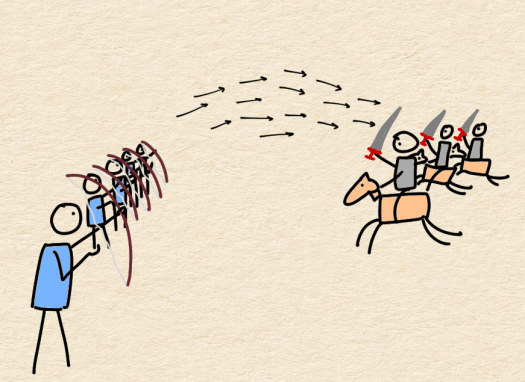
The longbow, apparently, came into its own at Agincourt in 1415. 8,500 English soldiers, 7,000 of which were longbowmen faced around 50,000 French troops.

They won – helped by their arrows – which travelled towards the enemy faster than they could run and walk towards them.

But, what does this have to do with business or sales and marketing?

It’s a story that can be used to look at the same situation from different points of view.

Let’s look at tactics, for example.

The losing side were just as brave as the winning side. If anything, they might have been braver, trusting in their armour to protect them from those pesky arrows.

They had a plan, to head towards the other side and so that’s what they did.

That’s a little like having an army of salespeople taught to smile and dial. They hit the phones, make the calls, make their numbers and succeed.

Is that approach, that works like a cavalry charge, all might and muscle and fury, going to work?

Increasingly, it seems to me, it doesn’t. A cold approach, whether on the phone, email, snail mail, is easily stopped, ignored or turned away.

The arrows, on the other hand, are multiple points of contact. Some might miss, some might hit, and the ones that hit may make a difference.

So, the way I think about this is to imagine that you want to build a pipeline of business. You could reach out to people directly or you could send a shower of arrows their way.

You could advertise where they are going to see it, you could engage with them in the places they are going to be, you could work with them on things that they feel are important and you could get introduced to them by people they already trust.

Is that going to increase your chances of success?

Possibly. Even probably.

I guess it simply comes down to this.

There are lot of things you could do.

You could focus on just one of those things – something you’re strong at, and just do that thing.

Or you could do as many of those things as you can at the same time.

For some people the focused approach will work. For others, the wider one.

Unfortunately, there is no right answer.

There is just what happens when you finally join battle.

Cheers,

Karthik Suresh

Why It’s Important To Really Understand What Free As In Freedom Means Today

small-big.png

Monday, 9.04pm

Sheffield, U.K.

Don’t think free as in free beer; think free as in free speech. – Richard Stallman

IBM has bought Red Hat for $34 billion.

Things have come a long way…

Twenty years ago, on a machine that I can’t remember, I started up a CD of Red Hat and went through the installation process.

Red Hat wasn’t my first try at GNU/Linux.

That was Slackware, on 3.5 inch disks, but it was the first distro that I can remember using properly.

I’ve often wondered why I was drawn to GNU/Linux, why Windows seemed quite so undesirable, even all that time ago.

Why choose something so small and fragile instead of a dominant operating system?

I think it might have been because of my dog.

Years before that install, I went out and chose a puppy. A Pointer – black and white, with floppy ears, a wobbly walk. It was the one that came over and said hello so, of course, I had to have it.

It was an age when computers were coming into our lives. And my dad suggested we name the puppy Unix. So, Unix he became. And I wonder sometimes whether the draw that GNU/Linux, a Unix like system, has for me is because of that connection.

But there is more than that.

When you come from a country that has a history when it was colonised by those with superior technology you learn that you need to have your own if you are not going to be controlled once again.

So, self reliance is important. It’s good to be reluctant to give up freedom, even when it seems convenient.

The last twenty years, for me, longer for others that started before I was born, have seen people working on a strange concept. The idea that programs and computers should work to serve society, not to control them.

The common connection these people have, is their desire for freedom. The desire to be able to use their machines without being controlled by someone else.

A few centuries ago, many monasteries were among the richest organisations around. How did that happen, when the monks were committed to a life of prayer and meditation? It was because of the power of volunteering. The power when people come together, to work for a goal bigger than themselves.

So, it’s strange and reassuring, to see that power is still capable of taking on the strongest in society and winning.

Richard Stallman wrote as far back as 1996 that it was just fine to charge to distribute free software. You could charge nothing, a penny, a dollar or a billion dollars. He didn’t think you would get a billion, however.

Red Hat got 34 of them, just 22 years later.

Freedom looks to be winning.

Cheers,

Karthik Suresh

How Are You Going To Compete Against All The Cheap Substitutes?

made-in-sheffield.png

Sunday, 7.56pm

Sheffield, U.K.

Goodwill is the one and only asset that competition cannot undersell or destroy – Marshall Field

How often do you look around you and wonder if you’ll ever make it in business?

Take business shows, for example. If you attend one you’ll see a plethora of small businesses, from florists to gyms. And lots of marketing and IT firms.

What’s going to make one succeed and another fail? And how will any of them compete with local and global competitors?

The first thing to see is that at least all of them have started something. You can’t succeed unless you start. That’s a basic rule.

Once you get past that, however, you start to see some basic truths.

Many businesses have a natural ceiling. A restaurant, for example, can only serve a certain number of meals every day. They can raise their income by maximising the flow through their restaurant and by raising prices.

At some point, they’ll reach a peak and they can’t go past that without raising their ceiling somehow. That probably means starting more restaurants or serving faster food.

Now, whatever they do, they are still anchored by the economic structure of their businesses. The question to ask yourself is what that means for you.

And there is no better place to start than Warren Buffett, and what he had to say in his 1983 letter to shareholders about goodwill.

Goodwill in this sense has nothing to do with emotions – to how someone feels about you – and in a sense it has.

Confusing? Perhaps.

Let’s say you’re starting a restaurant. I looked at one a number of years ago – a family business came up for sale for around 30,000 pounds.

We’d eaten at this place a number of times. It served good home-cooked food and we probably spent around 40 pounds for a meal for four, or 10 pounds each.

They probably served around 20 people for a sitting. Maybe they had two sittings a day and were full mostly on Friday, Saturday and Sunday.

So let’s say they made around 20x2x10x3x48 = 57,600 a year. After salary costs, perhaps they had a profit of nearly 10k.

So, if I invested 30k I’d make my money back in three years. A good rate of return?

Now, this place got taken over a few years ago, and the food went from simple home-cooked to a gourmet experience with a well known chef. The price for a table of four ended up being more like 160 pounds. On the same math, this results in a turnover of 230,400. The profit, rockets from 10k to more like 180,000.

My payback can be counted in months.

That gap – that’s what shows there is goodwill.

And what creates that gap?

One word. Reputation.

I was watching a documentary about Sheffield and its steel-making history. Why is Sheffield Steel so well known? Was it because the city made shoddy stuff? Or because it made some of the best quality steel in the world from the start?

No one can compete with factories staffed with cheap labour that make commodities. In the early part of the century British factories dominated global markets for textiles, helped by laws that undermined local competition.

In India, Gandhi took a stand and asked people to use locally made goods. He started by weaving his own garments.

What he made wasn’t better quality than machine made stuff. But his voice made a difference – his reputation led a country to boycott foreign goods and buy local instead.

These days it’s the West that looks anxiously at the great factories of China and wonders how it can compete with a tidal wave of cheap product.

And the answer is that you don’t. You don’t compete on price. You don’t even compete on quality.

There is space for cheap products. And there is also space for the products you make.

The question is, what kind of reputation do you have?

That’s what you compete on.

Cheers,

Karthik Suresh

How People Actually End Up Buying What You Have To Sell

justifications.png

Saturday, 8.39pm

Sheffield, U.K.

All I’ve ever wanted was an honest week’s pay for an honest day’s work. – Sergeant Ernest Bilko

I’ve met more people than usual the last few weeks.

As an introvert who enjoys writing and coding more than going out and socialising, that can be both tiring and eye opening.

Think about why we spend so much time thinking about digital marketing. It’s probably down to two reasons.

The first is that we imagine we’ll save money. After all, if we send out a bunch of emails or pay for ads then we’ll only have to talk to prospects that are interested – because they’ll show their interest by responding.

That’s a qualified list right there isn’t it?

The second reason is that we don’t want to talk to people we don’t know. It’s scary, perhaps rude. Maybe they’ll be mean to us. Maybe by spamming them they’ll start to like us.

The funny thing is that when you do meet someone, under the right conditions, something happens. Being together in the same space, being able to see and hear each other, lets you have a much richer conversation.

So, you get much better communication as a result.

I was going to talk about how to create those conditions when I started this post, but then I got distracted by all the “C”s.

Have you noticed just how many “C”s come up when you think about this kind of thing. Just look at the last few sentences.

So, let’s assume you’re talking to someone, trying to explain what you do and see if there is a fit. In other words, you’re selling them.

You’ve heard the old saying – people buy on emotion and justify with logic. What does that logical justification look like?

Well, it’s full of words that start with C.

Take competence, for example. Clearly you have to know how to do your thing. If your business is making square boxes, then you had better be good at making square boxes. That’s the first thing the buyer is going to check.

Then there is credibility. How many boxes have you made? Who have you made them for? Did they like your boxes?

Close on the heels of credibility is capability. Ok so you can make boxes. Can you do them in different colours? Sizes? Are you a one box pony or do you have the ability to branch out.

Then what is their experience of working with you? Is there camaraderie between you? Mutual trust and friendship?

Warren Buffett says you should aim to work with people you like, admire and trust.

Now, if you’re good at what you do, then you’ll probably start filling up with business. Or, if you haven’t invested in your business, you’ll start running out of resources.

A wise buyer will want to check that you have capacity – that you can give them the resources they need. After all, there’s nothing worse than giving someone your business and finding they don’t deliver.

They’re not going to come back. Remember, fool me once, shame on you. Fool me twice, shame on me.

Then there is probably one of the most important things of all. Character. We don’t like sleazy, fly-by-night, manipulating, conniving, two-faced sharks.

Although, that is probably a point of view at the end of the day. Something seen as cheating by one person is probably seen as shrewd business by another.

You’ll always be best off following the platinum rule, however. Do unto others as you would have them do unto you.

As someone said, the best system is one that you would accept if you didn’t know how much power you would have.

All those choices come down to character. In practice, it probably comes down to your credit score…

So, anyway, it’s interesting, just how many words that start with C are worth remembering and checking off if you have to do a complex sale.

The six in the picture, especially, will probably be part of your buyer’s checklist.

The one thing is that it’s hard to remember all these Cs. A 6C mnemonic doesn’t really jog your memory.

Maybe thinking in terms of square boxes will…

Cheers,

Karthik Suresh

How Would You Feel If You Spent The Rest Of Your Life Doing Something You Hate?

tennis-ball.png

Friday, 6.51pm

Sheffield, U.K.

I do not believe a man can ever leave his business. He ought to think of it by day and dream of it by night. – Henry Ford

I was listening to Drew Houston, the billionaire founder of Dropbox, being interviewed on the Tim Ferris show and talking about a tennis ball.

And then there is the tour guide on a Copenhagen boat who drily said that she chose to be poor when she chose to study history.

The two of them have something in common – and something different from many of us.

If you’re from a country like India, you are taught that you need to study so that you can make a living from what you learn. So, you’re told, you can be an engineer, doctor or lawyer. Your parents believe you have a choice because you can choose what kind of engineer, doctor or lawyer you want to be.

What about the tennis ball?

Well, Drew had a dog – a Labrador – that usually did very little. But, when a tennis ball came out she got very excited and chased after it – she was completely obsessed with the tennis ball.

People who study something because they love the subject start life chasing their tennis ball from the start. Presumably that is a good thing.

Then again, it might not be. If you really love doing something – writing, music, art – what happens when you start doing it for money?

Sheffield, it turns out, has a good claim for having the first football club in the world, inventing many of the elements of the modern game. The game was played mostly by people with money – playing as amateurs – but things were going to change. Martyn Westby writes about the tensions that erupted when the sport went from being an amateur one to a professional one.

An amateur is someone who does something without being paid. Someone who does something for the love of it.

An amateur is also someone who is rather fortunate in not needing the money. Or wanting it. And the amateurs were very unhappy about professionals coming into their sport.

The professionals won, however. We now have professional sports – that’s the stuff you see on TV. And you see a much higher quality of sport than might have happened if amateurs were the only ones who did it.

The point here is that if you love doing something, then getting money for it may make it a job and less of a labour of love. If you get paid for each word you write then you will probably start resenting each word for the time it takes away from you.

On the other hand, if you do something you dislike, then you are exchanging your time for money and it’s going to eat away at you.

But… what if you do something for long enough? Will you start to get better at it and perhaps even start to like it? Can you act yourself into changing your mind about what you’re doing?

There’s no real right answer to this. If you are obsessed by something and it’s something that other people will give you money for, then you’ve got something that could make you a living.

The one thing to avoid is piece work. Try and separate the money from the work. I think it was a Kahneman finding about motivation – if activity and reward are closely linked then you’ll stop acting when the reward stops. If they are further apart in time, your mind doesn’t connect them in the same way.

In reality, I suspect few people would carry on doing something they hate, if they feel they have a choice.

It’s probably really a dislike, or distaste or aversion.

In fact, the thing that probably stops you changing is less to do with what’s outside and everything to do with what’s inside.

After all, if you’re in a situation you dislike you can do one of two things.

You can change your situation.

Or you can change your mind.

Cheers,

Karthik Suresh

There’s More Than One Way To Do It – A Good Saying To Live By

more-than-one-way.png

Monday, 8.41pm

Sheffield, U.K.

The essential thing “in heaven and earth” is . . . that there should be long obedience in the same direction; there thereby results, and has always resulted in the long run, something which has made life worth living. – Friedrich Nietzsche

If you’ve been glancing at recent blog posts, you’ll notice they are about selling. Consultative selling, to be precise. I figured I’d try and write a book on the topic – and focusing on it for a few months seemed a good way to pull together a first draft.

Why? I’m not a salesperson. I’m not particularly good at the sales process, prospecting, keeping records, following up, closing. It’s also pretty dull really.

I’m not sure many people are great at being salespeople. We used to say about a product that we bought it inspite of the salesperson, not because of him. We could see it would do what we wanted. And I’ve not really seen a situation where a pure salesperson brought in more money during his or her employment than they cost.

But, sales and marketing is not something you can simply hand off to someone else either. It doesn’t matter what you do – you are going to survive by earning a commission on the value you create. Very few people get away with having to do nothing of value.

A job, for example, is a commission only role where you get a third of what you make the company. That’s a basic rule of thumb – you need to bring in around three times what an employee costs you to make it worth employing them.

The better you sell yourself, the more likely it is that you’ll get a good job – or grow your business – or excel in your profession.

Marketing and sales, then, is something everyone has to do. So, it makes sense to figure out how to do it less badly. Not do it well necessarily – not to superstar levels where you can get your own TV channel and sell lots of books – but to the point where you don’t make simple mistakes that cost you business.

And that really comes down to learning how to play nicely with the other children.

Which brings us to an essay by Larry Wall, the creator of Perl, that touches on the issue.

If you’re a doer – someone who does a creative job – then you probably have certain character traits. These are impatience, laziness and hubris.

I find this easiest to explain in the context of computer programming. There are lots of people right now in the world that go to work every day and use spreadsheets. They spend their time working through and checking the data, copying and pasting stuff and checking their work and colour coding it and checking their work.

Most people use spreadsheets like a … well, you can think of an analogy. The point is that it’s flexible enough for anyone to open up a new sheet and put in something and do some calculations. So they do that. Usually badly.

Spreadsheets are easy to use. But they are also a hugely powerful programming languages that you can use to make your life a lot easier. If you want to hire someone to do Excel, give them simple problem that involves VLOOKUP. Let them use the Internet to look for answers. If they can use that function correctly, you can hire them.

Someone who has learned that is on their way to being a programmer. And programmers are lazy. They don’t want to do the same thing twice. So, if they have to, they write code to make their lives easier.

They are also impatient. They don’t want to wait. So they’ll work on how to make things work faster or talk to each other better or share information more effectively.

They are also comfortable with hubris. No sooner have they created a solution that they think of all the things they would chance and get busy creating the next version that will make the old one obsolete.

If you’re a company founder, you probably think the same way. You’re creating a new business because you’re impatient with the way things are now. You’re probably too lazy to struggle on with the hard road when you can build a better one. And you’ll start over if you have to – from scratch because it’s so much easier to build from scratch than fix something that is stuck and broken.

As Wall writes, these three characteristics are individual ones and they give us drive and passion and help us be unreasonable and change things.

But… they don’t help us change the world.

For that, we need to work with others. And others are difficult to work with. They don’t think like us.

I found that when I had to do something on my own it was easy. I had an idea and did it.

When there were more people involved, sometimes we agreed on what to do and actually managed to do it.

With even more people… life turned into a slog through chest high mud. You couldn’t get anything done because other people needed to be involved, to give input, to be mollified and pacified and socialised.

But that’s the price you have to pay if you want to be a part of society.

So, the mirror image, the flip side to laziness, hubris and impatience are the virtues that are needed if you want to be more than just yourself. To be a part of your community.

And those are patience, humility and diligence.

You need to be patient with those who disagree with you or cannot keep up with you. You need to be humble so that you don’t think your way is the only way. And you need to be diligent – to keep working on something until you do something worth doing.

Not understanding that we need to be able to hold and apply these opposing concepts at the same time is at the root of much of the failure we see in the world today.

What’s the point in being a successful business person if you’ve lost your family and relationships in the process?

What’s the point of creating a hugely profitable company if everyone that works for you hates your guts?

What’s the point of being a lone voice speaking of a better way to do things if no one else will engage with you?

The point that Wall makes is that it’s okay to have either or both or a different way altogether. The virtues described in the two triangles are not opposites – they just are.

There are many ways to become successful – to reach whatever goals you define as success for you.

But… if you want to succeed as a person and as a part of society… you would do well to keep these two sets of words in mind.

They may help choose the right action – as you and as us. Then you’ll do something new and cool and play nicely with everyone else and hopefully end up having a good time.

Cheers,

Karthik Suresh

How To Think About The Future Of Sales And Marketing Content

content-requirements.png

Sunday, 9.32pm

Sheffield, U.K.

The single biggest problem in communication is the illusion that it has taken place – George Bernard Shaw

What kind of notebook do you use?

If you are at all interested in stationery that question could start a conversation that lasts several hours. Or you could spend several hours reading what people have written about it on the Internet. I confess, I have.

We’re still in the early days of understanding how to use content for good. Or for selling. Most of us, I suspect, find it harder work than we’d like.

Part of the blame for this, perhaps, lies with technology. Once upon a time, if you wanted to write, you picked up a pen and some paper and had a go.

Cutting and pasting was something you literally did with scissors and paste. Darwin and the Bronte sisters probably wrote that way.

In business we now create huge quantities of material. Most of this is in software like Microsoft Word, locked into place – not technically – just with the tedium and hassle of learning how to do things differently. We write stuff in word, pdf it and then send it out into the world.

That’s just normal, really.

But is it efficient? And is the Internet changing things?

I suspect not, because the level of technical literacy is probably not changing fundamentally beyond the what you see is what you get (WYSISYG) method in Word. If you have a blog, you probably use WordPress. That has a built in editor where you can compose and add material and publish.

It’s the same on LinkedIn or Medium or all the other places you put content. As workflows go, it’s not too different from doing things in Word. And those platforms have an interest in getting you using their platform – the easier they make it the more likely you’ll stay. The more you have on there, the more likely it is that you’ll stay.

So what, you might think, what’s the point you’re making here?

The point is that there is more and more content coming online all the time. Forget the ridiculous amounts of multimedia – just focus on old fashioned written content, the kind that you need to get leads and make sales. You know there’s more of it around. So how do you stand out?

Make it personal

The easiest way is to make it personal. The more specific your content, the more likely it will help you make a sale.

Designing your content for personalisation means thinking about how you can merge standard content and specific content from the start.

For example, let’s say you’re sending out an email message – it would make sense to include a line that talks about what you’re doing in the city your recipient lives in. If they’re in London, they probably don’t care what happens in Aberdeen. If you’re in Aberdeen, however, what’s happening near you will probably get your interest far more quickly than any London issue.

One way some people achieve personalisation is by simply sprinkling the name of the prospect company all the way through the copy. I’m not sure that’s a great idea – you increase your chances of leaving in a stray name the next time you reuse the content and it’s not really personalisation. Personalisation is when you can show that you’ve taken the trouble to understand the business of the person reading it.

Make it readable

This should be obvious, but it’s often not. How many times have you worked on a document without knowing who it was for and what they were expecting?

How many documents have you read that are so abstruse and unreadable that you just don’t get what their point is?

Take the recent IPCC report on climate change. The news reports said that the report was a stark warning that we weren’t going to keep global temperatures in check. We’re going to destroy the planet. That was hard to get out of the report itself – the language was technical and hard to understand – and this is an important issue after all.

Many business leaders get this – that’s why you get a one page executive summary – mostly with bullets. You’ve got to make your stuff readable. And that’s harder than it looks.

As the saying goes – easy writing, hard reading. Hard writing, easy reading.

Make it findable

This really has to do with the ability of search engines to find your stuff. Big ones – on the internet, or small ones, inside your company. Or even the human search engines that are your colleagues that have to hunt through folders for what you’ve written.

I don’t really know how hard it is to do SEO. At one point perhaps you could fool the tech into giving you a higher ranking. It’s cleverer now. Perhaps the best strategy there is first – put it out there so it can be found – and second – write good stuff.

Make it work on different channels

The problem with locking something into a pdf is that it can only be viewed with a pdf viewer. If it’s formatted in A4 it’s harder to read on a phone. And so on.

It’s worth thinking about a workflow that takes the elements of your content – headlines, subheads, copy, images, captions, references – and converts them to a whole bunch of formats – html for the web, pdfs for printing and so on.

The easier it is to put your content places, the more likely it is that people will engage with it.

With sales, you’re going to spend time creating material in the format asked for by the prospect anyway. But you can see that as just one channel for the content. The same stuff should be capable of going through any channel that could turn out to be profitable for you.

Make it reusable

Creating content takes time. It costs you – and should be treated as an asset. As an asset, you want to get the most out of it, and that means using it wherever you can – sweating it.

If you’re working in a business, you’re going to spend a huge amount of time creating stuff. Very few places, however, have any real controls over how things are created, modified, updated and maintained. It’s something quite common in the software world – the idea of version control and releases – but content management in general could do with that kind of disciplined approach.

The good news is that there is still time. Most businesses still live in a world of brochures and presentations and salespeople.

If you start to think a little more like a software developer or publisher and try to create personal, reusable content that can be found in different places you’ll start to stand out from everyone else – as long as what you create is readable.

Cheers,

Karthik Suresh

How A Little Design Knowledge Can Help Your Presentations Stand Out

design-essentials.png

Friday, 9.03pm

Sheffield, U.K.

Making every page or screen self-evident is like having good lighting in a store: it just makes everything seem better. – Steve Krug

How often have you sat through a presentation and wished to god you were somewhere else? One filled with relentless bullet points and long words – made worse by the presenter reading them to you?

I used to think all that mattered was the work. As an engineer, if I got the figures right or the model working, it didn’t really matter what the end result looked like.

The typical workflow started by spending time on a model, getting the numbers working right, making it easier to get information into the model and update it and getting rid of all the bugs.

Finally, it was time to either pdf the document or copy and paste the results into a powerpoint and the job was done. It was time to go and see the client.

I’m not sure if they looked perplexed when being taken through the presentation. They probably did – they were probably too polite to stop and say they didn’t get it.

Then I went back to business school and realized that getting the numbers and analysis right is only one part of what needs to be done.

The bigger part is getting people to do what you want. It doesn’t matter how good your analysis is if you can’t persuade the people listening to you to take the next step, whatever it is.

This is a mistake many of us have made. And a big part of it is because we’ve never been taught how to design presentations that work.

There’s two parts to a presentation that works – the story you tell and the way it looks.

In a previous post I wrote about how to create a story for your presentation. Now it’s time to think about how to design your presentation.

A great book to get started is Robin Williams The Non-Designer’s Design Book. She writes that most people can look at a page and know they don’t like it. What they don’t know is how to fix it.

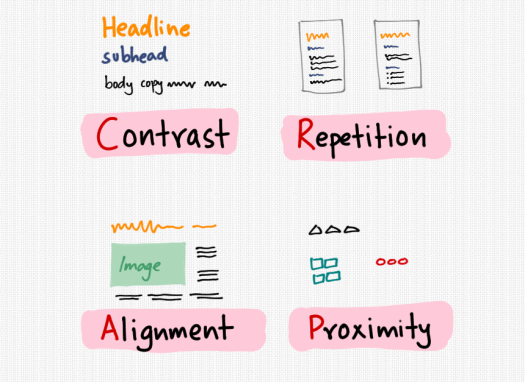
The secret is to learn four key design concepts and, if you get them, you can make every presentation looks much more professional and impressive.

First – understand how to use contrast

You are probably fairly comfortable with the default presentation templates in software like Powerpoint. You have a headline and body text. You might have images. You may put in some smart art or text boxes or diagrams.

In other words, you have lots of elements on your page. What should you do with them?

Imagine having a document set entirely in capital letters in the same font and text size. That’s going to be painful to read.

What you should do is make each element on the page distinctive. Headlines should be bigger than subheads, which in turn are bigger than body text.

Images should be clear and stand out from the page background. Having a busy background will make it harder to see an image or annotation.

If you make things that are different look different, you can draw attention to what you want. For example, you might have a table with lots of numbers, but you can make the result you want to draw attention to stand out by increasing its size or colour.

Next – use repetition to set expectations

Your audience or readers will look for clues to tell them what things mean. If you have a headline in orange in one page and then use the same colour and size for body copy or an image caption, you’re going to confuse and anger them.

Keep things consistent. Use the same fonts and sizes for similar pieces of content across different pages. If you use a quote or highlight something in a box, make sure the same kind of box is shown on other pages – because you’ve trained your audience to expect something specific the first few times the box came up.

The beauty of using elements that repeat is that as people get used to your material, they’ll fill in the blanks for you. If they know that you make a statement followed by an example, they’ll start to wait for your example before they make a decision on your statement.

Alignment just makes everything look better

The simplest secret of graphic designers that we all miss is that they make things look good just by lining everything up nicely.

It’s like going into a supermarket. If you look at a shelf and everything is neat and tidy it looks good. If you’re at the sale section and everything that’s going off has simply been dumped on the shelves it looks like it is – cheap and out of date.

You can get this effect simply by aligning your text and images so that the line up. You know this is happening when it looks like there is a box around your content. Take the example in the picture above – just by aligning the image on the left and the text on the right with the width of the headline, it looks neater and more consistent.

Finally use proximity to keep related things together

This simply means that if you have items that are similar, keep them together and separate from other elements. For example, if you have input parameters, analysis and results in a spreadsheet, chunk them up and show them separately. That way your audience can take each one in turn rather than having to figure out what is what.

A good example of this is how you set out features, proof and a call to action on a page. You might have a bulleted list of features, a case study with a photo of someone who has used your services and information on how to get in touch with you.

You’ll get a much better response if you make it clear which is which.

Design doesn’t replace content – but it can help get your message across

Something that is pretty but empty isn’t going to help you sell. The chances are, however, that you know your stuff inside out. You can make a pretty good case for why your prospect should buy from you.

If your presentation looks sloppy, however, that’s going to work against you. Using these simple design rules, which can be remembered pretty easily if you create an acronym using their first letters, everything you create will look better.

And you’ll probably find that you have more prospects nodding in agreement with what you’re saying.

Cheers,

Karthik Suresh

How To Think About Making The First Approach

monkeys-paw.png

You read a book from beginning to end. You run a business the opposite way. You start with the end, and then you do everything you must to reach it. – Harold Geneen

Thursday, 9.54pm

Sheffield, U.K.

It’s been a day of writing. Perhaps too much writing. Still, there’s not much point in setting out to write every day if you don’t give it a shot.

That’s where a monkey’s paw comes into play.

It turns out that you can’t just drive a ship upto a dock and park it. Ships don’t work like cars. They need an approach that’s altogether more nuanced.

A ship is tied up with a big heavy rope. You can’t just throw it to someone on shore – it’s far too heavy for that.

So what you do instead is take a tennis ball and thread a string through it. You then throw the tennis ball to the person on shore who catches it. They pull in the string, which is attached to your big heavy rope. They then pull the big heavy rope in and help your ship get in place and tie it up.

I know there’s a proper way to say all this with the right nautical terms… but you get the point.

First the tennis ball, then the small rope, then the big rope and then the ship.

The tennis ball is your monkey’s paw – the first small thing that lets you get to all the big stuff that sits behind it.

And that’s a useful model to keep in mind always – it helps in all kinds of situations – not just when you need to get a ship parked. Or moored. Whatever.

Take sales, for example. If you don’t know someone and you come in hard and fast with your sales pitch, you’re going to get told to leave. Perhaps politely, perhaps aggressively. These days, you probably don’t even bother to listen to a cold caller. The minute they speak you know what they are and cut them off.

What you need is a way to get started, a way to open with something small that builds up to more later.

Take the first email you send, for example. You could send a long one, describing everything you do. Or you could send a short one, asking if the person you are getting in touch with is the right one to speak with.

In the first instance, you’re inviting rejection because you’ve pitched before being asked to do so.

In the second, one of three things will happen.

  • You’ll be ignored.
  • You’ll get a positive response saying that they are the right person.
  • You’ll get a negative response saying they’re not.

All three responses allow you to follow up – to ask if they got your email, ask permission to tell them more about you, or ask who the right person might be.

In a sales presentation, you can lead with your entire presentation. Or you can stop after you set out the agenda and ask if that works for the audience and if they have any specific issues they’d like to add.

If they come up with a problem that clearly matters to them, that is clearly an expensive issue that they want fixed, then you might want to abandon your entire presentation and focus just on exploring that problem.

After all, the purpose of your meeting is not so you can do a presentation. It’s so you can find something that you can work on for the prospect.

Then there is the process of getting someone to buy.

There’s a mathematical way to work out the best price for your product. Work out the price at which everyone you could possibly sell to will buy. And then work out the price at which every single on of them will walk away. For many products, that’s going to give you a range between ten dollars and a few hundred thousand dollars.

You pricing point should be where changing it up or down results in a worse outcome. If you drop the price, you get more customers, but what they give you is less than before. If you increase the price, you get more for each sale – but the number of customers you lose means you get less than before.

That’s the optimal pricing point – and when you work it you’ll probably get a number that looks like $30,000.

So, if you want to build a sustainable business, one based on knowledge work and consultative selling, your ideal average sale need to be around the $30k mark.

Are you going to sell one of those at your first meeting?

Or are you more likely to sell a free account review? A ten dollar report? A hundred dollar standard piece of work? A $2,000 piece of consulting before you end up landing the $30k annual contract?

Of course, it depends on your business, but having a strategy that starts small and leads up to bigger things just makes sense. It maximises the lifetime value of your customer. You should be willing to spend all your profit on the first sale to get that sale. Everything that is a bonus, and it’s the bonus that’s going to make you rich.

The monkey’s paw approach is powerful – if you can see how to use it.

Take writing, for example. It’s well known that the first few paragraphs of what you write will be rubbish. You’re just warming up during those paragraphs, getting your hands moving and jolting your brain into action.

So why keep those paragraphs? Use them as a monkey’s paw. I write three paragraphs – just freewriting anything – to get the words on screen. After that I start with the real work. And when that’s still hard, like today, a monkey’s paw still comes in handy. The first sentence of this post adds little of value – it’s a throw-away sentence that could just be removed.

It did, however, get enough down on the screen to allow the rest of the post to get pulled out behind it.

Try it sometime. Pick a task – a big one. Then ignore it and start on a very small part of it. Something easy. Perhaps even something completely unrelated.

Once you get started, you might find it easier to work around to that big thing you need to do.

And just maybe, you’ll even get it done.

Cheers,

Karthik Suresh