How to tell whether you act like a startup or a big business

startup-vs-corporate.png

What is the difference between a startup and an established business? Is a startup simply a small company – a small version of a big company or are they fundamentally different?

Steve Blank thinks so.

Steve is the author of Four steps to the epiphany and writes extensively about startups, their characteristics and the strategies they follow.

Among these characteristics are three crucial ones – and successful startups do these very differently from big companies.

The first characteristic has to do with what they do.

Big companies are good at execution.

They create a vision, agree a mission, set goals and targets, allocate resources and set the machine in motion.

All the parts of the company work in a hierarchy, following what they are programmed to do to head towards the targets they have set.

A startup, on the other hand, searches for opportunities.

It has its eyes wide open, scanning the environment for signs that something is missing, someplace where it can add value through innovating, adapting and creating something new and different.

The second characteristic has to do with how companies do what they do.

The purpose of a company, according to Drucker, is to create a customer.

Big companies already have customers or believe they know what a customer wants – either because they know the market or because they have done studies of some kind.

This means that they can sit at their desks and get on with creating product following their usual process, which is some form of plan-do.

A plan-do approach means that we follow a structured approach to developing a product – starting with understanding requirements, gathering information, developing the product and finally shipping it to customers.

Startups recognise that no plan survives first contact with the enemy.

Instead, they follow a test-learn approach.

This means getting out of the building, going and finding potential customers and talking to them about what they need and testing whether what they say they need matches what our product does.

This matching exercise – sometimes called validation – tells us if we are on the right track or whether we need to change something.

As Gary Halbert wrote, what we need to succeed is a starving crowd – a group of people that are desperate, starving for a particular product or service.

Lastly, the two approach who they recruit differently.

Big companies have lots of roles that they fill with specialists.

A specialist is someone who is good at one thing – sales, marketing, operations.

They do what they do well and competently, but they often don’t have the capacity or ability to do more than they can with their two hands.

Startups need generalists, people comfortable with doing everything and with the ability to do much much more with very little.

Startups eventually want to become big companies, so will recruit specialists, but only later on when the product is more mature and its time to scale up.

In summary, the way to tell whether we act like a startup or an established corporate is to look hard at what we do, how we do it and who we recruit.

Why we need to have a story

narrative.png

Stories are how we make sense of things.

Whether we are coming up with a personal narrative or working on a company brand, we use stories to show and tell other people what we are all about.

Sequence is key to a story.

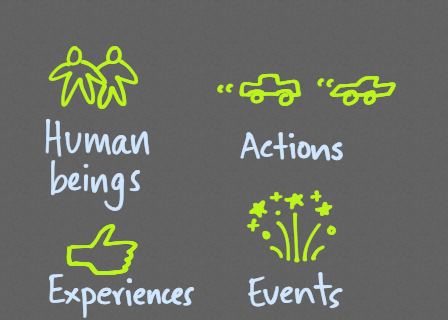
We link together human beings, actions, events and experiences to create a narrative that has a beginning, a middle and an end.

This is something we do all the time. To some extent, we don’t remember the past so much as recreate it through the lens of story.

We pick the events, actions and experiences that support and confirm what we want to believe, welding them together and trying out story arcs until we find one that fits.

Herminia Ibarra, in her book Working Identity: Unconventional strategies for reinventing your career, writes about this as putting a frame around experience – looking at what is happening now and what happened in the past and linking the two through story.

But it’s important to recognise that the things happening now and the things in the past are both being interpreted and reinterpreted – history is written by the victors.

I’ve written here about the kinds of stories we tell, and how we can structure success and failure stories.

Why is it important to have a story – whether personal or for a business?

Ibarra writes that it is only through a story that we can really get to know someone.

The story – the narrative – gives unity, purpose and meaning to their lives.

Whether we are trying to understand ourselves, someone else or an organisation, the stories we hear and tell bring things alive and create a sense of connection that it’s impossible to get in any other way.

Stories also help us step back and see the bigger picture.

As we tell and retell them, picking out events and experiences to recite, we start to create a narrative that seems more real and robust over time, until the story we tell is how it happened.

Which is why the reaction to many a fantastical story is often “Is it true?”.

Things happen.

When we’re in the middle of things, we look for a defining moment, a period where everything becomes clear and comes into focus.

All too often, however, we recreate that moment as we look back at the past and realize that it was one – the turning point of the story we are telling – and how it fits into our lives so far.

And so, to explain who and what we are, we need to have a story.

Is what we do good or bad and how can we tell?

bad-theories.png

There’s a video floating around on Twitter that shows Elon Musk and other technology leaders slamming MBAs and saying that they don’t hire them.

Do they have a point?

Sumantra Ghoshal, in a paper titled Bad management theories are destroying good management practices, sets out an argument that business schools are doing more bad than good when it comes to teaching their students about how organisations should work in the real world.

Then again, practical people who think that they are different from academics in their ivory towers need to remember the words of Keynes, who wrote Practical men, who believe themselves to be quite exempt from any intellectual influences are usually the slaves of some defunct economist.

Ideas and theory have more power than many realise.

Ghoshal argues that academics working in management suffer from physics envy.

The physical sciences have been able to come up with theories that explain how things work around us very well.

When can all roll a ball down an inclined plane and see how its speed increases over time to understand the principles behind acceleration.

Social scientists, looking over the fence, have tried to come up with similar principles to explain human behaviour.

So, for example, they come up with assumptions like the only purpose of a business is to make as much profit for their shareholders as possible and that people will only work when supervised.

Ghoshal calls these assumptions gloomy – and points out that they lead to claims pretending to be truth based on selective analysis.

In physics just claiming that something works in a particular way doesn’t make it true.

In social systems it can – the feedback between ideas, practice and reinforcement can make a bad idea real enough to believe as truth.

Take, for example, the idea that people will only work in their own interests – managers are agents in the principal-agent theory.

This means that to get managers to behave there must be more independent directors on boards, power sharing between a CEO and chair and stock-option based compensation.

But Ghoshal points to studies that show that none of these seem to have any correlation with corporate performance, yet we continue to believe they will have an effect.

There are many examples of where management theory leads to flawed practice – we only need to read Warren Buffett’s letters to find examples.

Running a business is more like being a detective than being a scientist.

We have to look for clues to see what’s going on.

How to become better at innovative problem solving

triz-analysis.png

Brian Tracy, in one of his talks to a small audience, begins by saying that he took the time before he came in to read a brief biography of everyone in the room and memorize their photos and job titles.

He looks around and people start to shift in their seats nervously. He points to a person and says, “Your title is Problem Solver”. Another is Chief Problem Solver. Yet another is a Vice President of Problem Solving.

Everyone’s job is to solve problems – the things that turn up day after day and cause big and little issues.

So, how do we normally approach problem solving and how can we get better at it?

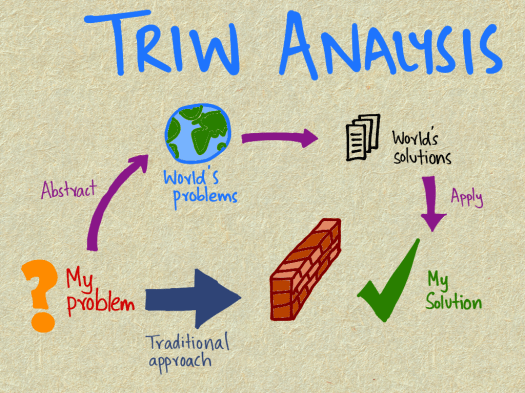
The traditional approach when we have a problem is to treat it as something that is just our own – it’s my problem.

We get started working on it and face a brick wall. All the issues, complexities, computations and knowledge gaps emerge.

Eventually, we keep working on it and break through to a solution. Our solution.

That didn’t seem like a sensible approach to the Soviet inventor Genrich Altshuller, who came up with a theory of inventive problem solving, abbreviated as TRIZ.

Altshuller reviewed a number of patents and identified ideas that popped up again and again in innovations and found that around 40 principles could account for nearly all inventive ideas.

Take, for example, flexible films, foils and membranes. These approaches underpin relatively recent innovations such as solar PV coatings, energy generating floor tiles and a coating that makes objects super strong.

TRIZ’s starting point was to solve physical challenges. For example, there are often physical contradictions that limit systems.

These can be resolved by applying principles such as:

  • Time: Schedule differently
  • Space: Separate them
  • Condition: Have the system meet requirements under different conditions
  • Alternative/Structure: Spread contradictions across the structure

The TRIZ approach is little known – it’s not mentioned in the standard textbooks at an MBA level – perhaps because of its origins and issues with translations.

The Internet makes it easy to find this stuff now though. The TRIZ journal has a useful summary of the method, including an example, and says there are over 2 million analyses backing the method spanning fields from aerospace to human resources.

TRIZ is a simple but potentially transformative approach to problem solving.

All too often, we think that we need to start from scratch and work something out.

A systematic approach to using the world’s knowledge could be much more effective, especially now that we have the Internet.

Using it effectively just means that we need to start by retraining ourselves to follow the less traditional route.

How economics explains success in the modern world

modern-economics.png

Steven Landsburg introduced his book “The armchair economist” with the words Most of economics can be summarized in four words: “People respond to incentives.” The rest is commentary.

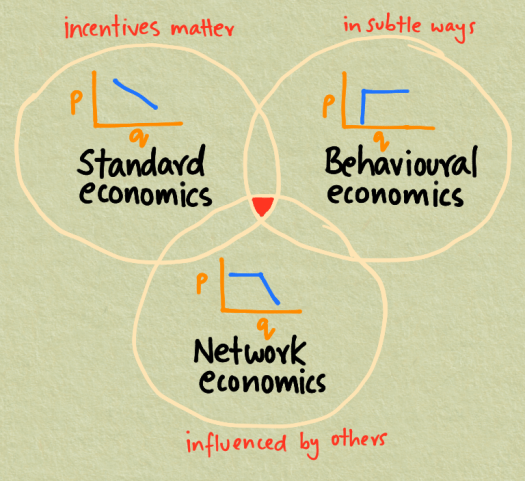
That is the start of economic analysis. Supply and demand curves. p is for supply, q is for demand and they have a linear relationship.

In standard economics, demand (q) rises as price (p) decreases – and that is one of the first charts we learn in an economics class.

This assumes that people are rational, evaluating the costs and benefits of options in a logical way and taking actions that maximise their profit or utility – the satisfaction we get from a purchase.

But people aren’t rational. In reality, we are driven by emotion and our animal brains and this is where behavioural economics comes in.

For example, under pressure, we go into flight or fight mode and make decisions based on gut instinct – and that is what has kept our species alive.

Another way in which people aren’t rational is how they react to an unfair deal.

Take, for example, a game where people get a sum of money. One person gets to decide the share of the prize – and the other can accept or reject the offer.

In theory, any amount more than zero should be accepted by the rational recipient. In practice, many don’t accept anything less than a share closer to a fair one – a 50/50 split.

Shown as a chart, this might mean that demand is fixed at a range of prices, but over a particular level it increases.

The factors affecting the shift in mentality are more subtle – they are affected by the emotional processing that goes on inside our heads.

Then we have network economics. In this view, what we do depends on what others do – we watch and copy behaviour.

This is most visible in online behaviour. The top three results on Google get virtually all the traffic. There can be huge differences in views for very similar videos.

So, in network economics, price has little effect until we reach a tipping point, after which demand increases rapidly – but the tipping point is determined by the network effect.

The charts in the picture may not describe the situation accurately – real life is more complex than we can show in this way – but the interesting point is the impact it has for the choices we make as producers and consumers.

As producers, we can’t simply make better mousetraps cheaper and expect people to buy them.

Instead, we need to create cheaper products, think about how people will react emotionally to what we are selling and leverage the economics of networks to get our products to scale.

As consumers, we need to be mindful that price is no longer representative of value in many cases – so we need to be wary of using that as a heuristic or rule of thumb.

We also need to realize that producers use increasingly sophisticated techniques to appeal to our emotions, from subtle emotional cues to overt use of celebrity endorsements.

Finally, by copying what everyone else is doing, we may be missing out much that has real value and settling for the fads of the moment.

But, the changing world also offers unparalleled opportunities for those who are positioned where the three economic approaches overlap.

In the middle there, with a little bit of luck, new superstars emerge.

What day is it?

every-day-is-day-one.png

Jeff Bezos of Amazon has a philosphy that he shares with the Securities and Exchange Commission (SEC), and his shareholders.

Every day is Day 1

In his 1997 letter to shareholders, Bezos wrote that this is Day 1 for the Internet, adding that Amazon’s hopes were to create an enduring franchise, extend its market leadership position and take decisions to create long-term shareholder value.

In 2016, the Day 1 message remains unchanged.

Day 2 is statis, he writes, followed by irrelevance, decline and death.

So, what does staying in Day 1 mean?

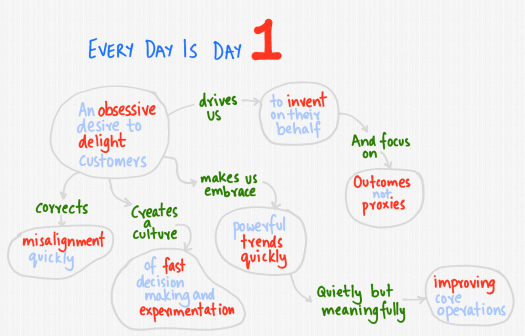
The picture is a model of Bezos’ 2016 letter which sets out a starter pack of essentials to stave off Day 2.

It starts with an obsessive desire to delight customers, which leads us to try and make things better for them.

This drives us to invent new capabilities and functions on their behalf to make things quicker and easier for them.

Companies that have this kind of focus rely on outcomes – do customers love this and does that show up in market share growth – rather than proxies such as focus groups that show a mild preference between options.

In Day 2 companies, the process is more important than the outcome – everyone is crouching below the parapet.

Powerful trends are sweeping along the corridors of industry.

From artificial intelligence (AI) to nanotechnology, the way in which we do things will be changed by new technology.

Amazon is embracing trends such as AI and machine intelligence to deploy algorithms that make its supply chain and customer experience systems more effective.

Much of this is invisible and quietly but meaningfully improves core operations.

Things just work – and customers are happy.

Many companies, even large, established ones, do not know which strategy will work out of a number of options.

Many companies default to the opinion of the highest paid person – which is okay in some cases, but most of the time we are better off taking decisions fast and experimenting.

Bezos’ uses the term disagree and commit – when we’re not sure give people permission to have a go rather than shutting down an approach just because we think it won’t work.

Finally, and this is something we must have all experienced, it’s easy for approaches to get misaligned.

If groups of people have fundamentally differing views, for example making a choice between doing a service in-house or outsourcing it, then no amount of arguing can resolve this.

It needs to be kicked upstairs, escalated to a team that can make the decision and make it stick, correcting misalignment quickly.

The Day 1 approach appears to have kept Amazon lean and focused despite now being a huge and dominant player.

It also worked for them when they were starting up and small – and perhaps it’s a model that many other firms can use as well.

Time to take a step back from Day 2 to Day 1, in that case.

Do you want to know everything before making a decision?

optimal-complexity.png

How much does having information help when making an important decision – when buying a house, choosing a partner or making a deal?

The hedgehog theory of behaviour helps us out. Archilocos, the ancient Greek poet, wrote a fox knows many things, but a hedgehog one important thing.

Edward L. Walker, in his book Psychological Complexity and Preference : a hedgehog theory of behavior said that one thing explained all behavioursubjective complexity determines preference.

Unpacking that statement – preference is the reaction we have – pleasure or pain. The zero point is where we feel neither pleasure nor pain, a neutral reaction.

So, what drives us in the direction of pleasure or pain?

If things are too simple, then they get boring and no fun. Imagine having to hole punch 5,000 sheets of paper and file them.

If things are too complex, it feels chaotic and turbulent and out of control. Imagine trying to rescue your daughter from the path of a tornado.

Daniel Levitin, in his book The Organized Mind, describes an experiment where participants had to play a strategy game where they received two,five, eight, ten, twelve, fifteen or twenty-five pieces of information in 30 minutes.

They performed best with around ten to twelve pieces of information – that was the optimal complexity level for the game.

In real life, the number ten is closer to the maximum we can operate at, and the level that is closer to the number of things we can effectively hold in our minds and process is five.

If we need to consider twenty factors when buying a house, the chances are that we’re going to find it very hard to make a good decision.

The same problem affects people in a world where online dating sites let people look at hundreds of possible partners.

When one has the whole world out there it makes it much harder to decide than when you met potential partners at the village dance.

All this, however, has to do with how much information is given to us.

Levitin points to research by Dan Ariely showing that we make better decisions when we can control what information we get.

So, for example, imagine we’re shopping for a new car,

If we get information on the things we care about – for example, whether it can hold four kids and two dogs, fits into the neighbourhood and comes in black – we’ll make a better decision than if the salesman harps on about engine capacity and trim options.

A very real problem – Levitin writes pointing to Kahneman and Tversky of Thinking Fast and Slow – is that we can’t ignore information once it’s in front of us. We’re burning brain fuel just looking at it.

In a nutshell, then, to make better decisions and feel good we should focus on the five or so pieces of information that are most important to us in a situation requiring an opinion or decision from us.

And then get on to the next thing.

What is a good foundation for career satisfaction?

humanity-pyramid.png

John Hagel, an author, Silcon Valley veteran and management consultant with some very well known names, writes about the learning pyramid in an article on his blog.

The idea in his post is that we spend too much time focusing on the skills needed to survive in a world where artificial intelligence (AI) takes on more and more jobs.

Instead, we need to think about how we can learn faster to learn what is needed at the moment – and the learning pyramid model helps with that.

Looking for a source for the learning pyramid model, however, tends to bring up a model of how different activities influence learning – and focuses on the narrow question of how to learn something new.

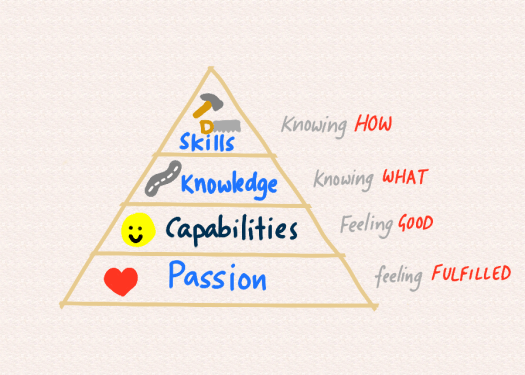
Looking at Hagel’s learning pyramid through a different lens might help us approach the AI vs human question asking what makes us human – perhaps it should be a humanity pyramid that we use to ask questions about whether the work we do is sufficiently human.

At the top of the pyramid sit Skills. A skill is knowing how to something – wield an axe, write a piece of news copy, manage an unhappy customer over the phone.

We need to hone our skills throughout our career and quite often we do this just by doing what we do. A craftsperson gets better the longer he or she works at a task.

Early in our careers, we need to focus on acquiring skills – reading, writing and arithmetic among others such as drawing, woodwork and martial arts.

But these are the areas where technology and AI will also look at first – text processing, robot news writers, Excel spreadsheets, computer controlled laser cutters and drones will do more of the reading, writing, arithmetic, machining and defence we need.

I’ve written here about the skills that are more likely to stay in demand but in essence they are the more human ones of empathy and social engagement and the practical ones of dexterity and manual manipulation.

Going down the humanity pyramid brings us to knowledge, knowing what to do.

That comes with experience and learning – as we do more, reflect on what we do, learn from the successes and failures of others – we develop models of what might work and when that we can use to make judgements.

Knowledge is a collection of mental models about different situations.

These two, knowledge and skills, will take us a long way in a career.

In the early days, to some extent, which skills we focus on matters less than whether they are going to clothe, feed and house us.

Eventually we’re going to want more about life and work, and that’s when we start questioning whether what we’re doing is aligned with our capabilities – the next level down on the pyramid.

Do we feel good about going to work? Are we working on something that engages us and gets us into flow?

If we are in a fairly secure position, but dislike what we do – then this is the point where we need to question and change things, perhaps get a side hustle or a hobby that gets us to use our natural capabilities more.

Finally, at the base of the pyramid, Hagel puts Passion.

That’s a difficult word – sometimes tortured in general usage – a little like authenticity. Can you really feel passionate about customer service? Some people say they do, and who are we to argue…

In the context of work and life, however, I take this more as feeling fulfilled – experiencing peace of mind, as in Zen and the Art of Motorcycle Maintenance by Robert Pirsig.

So, in summary, the learning pyramid or humanity pyramid, is a useful structure through which we can view the work and career choices we have made so far, and question whether we have our skills, knowledge, capabilities and passion aligned.

And if not, what can we do about it?

Sometimes the right way is to take the wrong one

B-to-A-via-Z.png

Have we been trained to focus – to set a destination and make our way there?

As the saying goes, if you don’t know where you’re going, how will you know when you get there?

Does that mean that successful people and organisations have the equivalent of a success satnav – they program in where they want to go, and that’s just where they end up.

Rod Judkins, in his book The Art of Creative Thinking, writes about how we get so used to routines that we get stuck.

We develop habits, ways of moving and working, of getting from A to B, that mean we start to act automatically and stop being aware of what we are doing.

A tactic to to jolt us out is to do things that disrupt the everyday normal habits we have – what Guy Debord termed psychogeography.

For example, we could take the same route as we normally would to get into town, but try doing it carrying a sofa.

Would we have a different experience? Would some people help us? Would we have interactions we would never have had normally?

Judkins calls this going from A to B via Z.

Somehow, when I looked at this line, I read it completely wrong.

What I saw, and what stayed with me as an image, was to go from B to A via Z.

And this results in a different approach.

We’ve heard of the saying fake it till you make it.

Any startup founder will always say yes when asked if they can do something. They know that if we sign the contract, they’ll figure out a way to deliver.

There’s an infinite number of ways we can go from here.

There are usually only a few ways that end at a particular place.

For example, let’s say we’re doing a presentation about something we know a lot about.

We could talk for a long time and elaborate on every nuance of the situation.

And put our audience to sleep.

Or, we could focus on just the things that matter to them and bring out the main information, the key aspects of the situation that help them understand and clarify what they need to do.

And that would be a technically competent presentation.

Or, we could focus on the things that matter to them but take them first on a different path – perhaps something they didn’t expect to see, which wakes them up and gets them to become more aware and pay more attention to our message.

And that would be a great presentation.

Boiled down, that might mean starting with what the audience wants and needs to know, opening and setting the scene in a surprising way, and then delivering the information that will help them understand what needs to be done and take action – and that’s what many TED speakers do.

Or, expressed as a formula, B to A via Z.

How to do A/B testing

AB-testing.png

What do we do when there are multiple opinions on the best approach to use to tackle a particular problem?

Quite often, we end up going with the HiPPO – the Highest Paid Person’s Opinion, as described in Richard Nisbett’s book Mindware.

But a better way is to use a data-driven approach to testing options and selecting the one that works best.

A/B testing is one of the simplest and oldest methods around.

It’s also called bucket testing or split-run testing, and has been around for a long time.

In essence, it has 5 steps we need to go through.

We start by selecting a situation – we may need to solve a new problem or improve an existing situation.

Take, for example, the issue of GDPR compliance.

Many companies are sending out emails to their lists asking them to confirm if they want to stay on the list and what they want to receive.

What should it say? Perhaps we should come up with a base layout.

Maybe we can start with one that explains GDPR in detail and then asks people to update their details. This is the control.

Should we just send out one email?

That’s not something that can be answered easily because we don’t have any data – do we just need to get a decision from someone?

Or can we run a test?

Say we have a database of a thousand people.

We might create variations of the base layout – instead of explaining GDPR we write one that simply says this email is being sent to comply with the GDPR, perhaps linking to a site that explains what it is, and stresses the benefits of staying in the list and what they will get for most of the copy.

We wouldn’t run the test on the entire database. Instead, we select a sample, perhaps 100 users picked at random out of the list.

Then, we assign users randomly. Of the 100 users in the test sample, 50 will get the control version of the email, and the rest the variation.

Then we look at the responses and analyse results.

This might require some familiarity with statistics and the ability to interpret what a statistically significant difference is and if the variations has performed better than the control.

If the variation performs better than the control, we run with it and send it to the entire list.

In theory, this should produce a better outcome. By testing and selecting options based on how well they have performed according to the data, we should boost results.

We need to remember to retest on a regular basis. Some of our results may be false positives, so we need to watch out for errors or more general changes in the environment.

It’s important to recognise that the aim of this approach is to select the one that gives the user clearer information and a better experience.

It’s also a defensible approach that takes away much of the arguing and opinions that often accompanies choices that involve strategies or the wording of copy.

Instead, we can just offer to run an A/B test and go with the evidence.