What does it mean to be generous?

art-on-the-wall.png

Luc Tuymans is an influential Belgian artist known for his haunting, figurative paintings. In an interview with Apollo he said, “Without generosity there is no art. I am convinced of that.”

There has always been an uneasy tension between commerce and creativity. Most artists would probably like to make money, preferably a lot of it.

What is more likely to drive them, however, is a desire to create and share what they do.

Luc Tuymans, for example, insists that a third of his paintings are kept with public organisations and museums so that people can view them without having to buy them.

It turns out that giving makes us happy – and this starts young. Children seem to be happiest when they share what they have, especially when those things are their own rather than those that have been given to them.

At the other end of the scale, Bill and Melinda Gates have found that working to give away their Microsoft wealth is the most satisfying thing they have done.

The economy we have now is changing – it’s based increasingly on connections. And in such a world, as Seth Godin writes, why would anyone want to connect to a selfish organisation?

Some of the new giants of the online world are based on giving things away. There is no charge to search Google, no fee to join Facebook. Yet they are multi-billion dollar organisations.

The free software movement is based on making it possible to study, distribute, create and modify software – allowing many more people to get involved in technology than before and creating options for millions that are priced out of commercial software models.

Freemium software models are based on you getting some functionality for free, and then giving you the option to upgrade to get more. This is becoming a basic model for the Software as a Service (SaaS) world.

But this approach also makes other, perhaps more important things possible. In India, the Aravind Eye Care system provides free or subsidized treatment for the poor while charging the well-off and as a result provides a vital service while staying profitable.

These examples are commercial – but also generous, and businesses that are pulling away from the rest are finding ways to reconcile the two approaches.

In today’s world, creating a business model with generosity built in may be essential to surviving.
Is IT your friend?

it-costs.png

In an article that was first published in the Harvard Business Review in 2003, Nicholas Carr argued that cheaper and more available technology has meant that IT has become essential, but invisible.

In essence, it’s a commodity, like electricity. You notice when it goes off, but the rest of the time, it’s just part of the infrastructure of daily life and work.

The article received much criticism, especially from technology evangelists and vendors who argued that IT provides competitive advantage and strategic value to businesses that adopt it early and use it effectively.

This is probably wrong.

Businesses rarely benefit in monetary terms from adopting new technology or processes.

There is a cost to adopting new things, and the cost savings are usually passed through to consumers in the form of lower prices.

Quite often, it seems that businesses need to invest in systems not to increase margins, but in order to retain customers and provide more cost-effective services.

That’s partly because if there is an effective way to reduce costs in an operation, the vendors will supply that to all the companies that could benefit – reducing costs overall, but providing no comparative or competitive advantage.

You would think that if you created something unique – a system that no one else had, then that would allow you to lock in value and charge a premium – a bit like having a patent.

That is what many large companies do – they collect patents in order to protect their competitive position. The intellectual property system now seems broken – it’s less about creating new things and more about a system that allows entrenched interests to retain power.

The problem with this approach is that IT is ubiquitous and what you have needs to play nicely with everything else.

There isn’t much point having one type of electricity for you and another for me – we need to have interoperable standards to make the system work.

Proprietary applications are hard to sell into organisations that don’t want to be locked into a particular way of doing things.

So – what does this mean for the future of IT?

The focus for most people should probably move from technology to information. If IT is like electricity, an information system is like the house you live in.

How you arrange your things, where you put different items and how you move through it will determine the quality of your day.

Businesses and their employees will increasingly find themselves living in a world filled with information. Most of it will be useless, much will be distracting and for a lot of the time we will be struggling with just making it work.

The challenge is how to focus on the information that matters and makes a difference and fight off the rest of the rubbish that simply clutters your day.

Why does the rabbit run faster than the fox?

rabbit-fox2.png

If your business is based on you beating the competition, life is going to get very tiring.

A perfectly competitive market is one where there are a large number of players in the market, the product is no different from others, it’s easy to enter the market and everyone has all the information they need.

Examples of these kinds of businesses exist everywhere. In knowledge work, web-design could be seen as a modern example. Most websites will be built using WordPress, there are any number of people that can design acceptable websites and it costs virtually nothing to get started in the business.

If your web-design business does what most other web-design businesses do, then you will experience the side-effects of perfect competition.

In a perfectly competitive market, the price at which you sell the product tends towards the cost of production.

In other words, you make hardly any money selling it and profits are low to non-existent.

There are few perfectly competitive markets, however, and the traditional ones try and create systems to prevent side effects. In commodity markets such as oil you see the emergence of cartels like Opec that try to control supply so that they can affect the price.

At the other end of the spectrum is a market where one company has a monopoly. No one else does what they do, the product is unique, it’s near-impossible for new companies to enter the market and information is protected or secret.

That’s quite a nice situation for a business to be in – except that comfort and complacency leads to sloth and poor service and eventually governments have step in to break up monopolies.

The ideal place is to be somewhere in between.

There will always be someone who is willing to get up earlier, work harder, spend more time away from home selling, and who can hire workers that are paid less than you can.

If you compete on their terms, you will lose.

The strategy that is going to work is to position yourself and your business so that you have few direct competitors, what you do is different and unique, your competitors cannot easily enter your market and where information needed to do the work is protected – perhaps because it costs something.

If you had to pick just one thing out of the list, Bruce Greenwald and Judd Kahn in their book Competition Demystified suggest focusing on barriers to entry.

If it’s hard for others to enter your market, then you have the potential to earn above average profits.

If that isn’t the case, then you could spend the rest of your time running just to stay in the same place. And who wins then?

The answer to that is the same as the answer to the question in the title.

The rabbit runs faster because the rabbit is running for his life, while the fox is running for her dinner.

How to close the gap between knowledge and action

academic-practitioner-distance.png

How do you know what you know?

You’ve probably been working for a while, and by now have a number of views on how things should be done.

You know the right order, the correct approach or the most effective way to do things.

You might feel that what you learn and figure out on the job – the practical stuff you do there – is where real work is done, and academics in their ivory towers have nothing much to add to how you do things.

Or, you might be an academic, engrossed in research and evidence. You might know the ways that work across organizations from your research and know the precise way in which to articulate an idea so that it expresses a contingent truth.

Except, you lose most listeners at the word “contingent”.

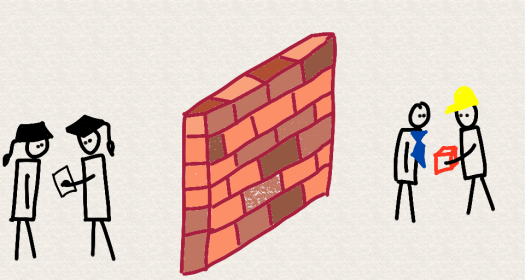
This creates a barrier between the people who create new knowledge and the people that do work. It’s probably no exaggeration to say that most work done in organizations is based on ten to twenty year old research and methods and very few organizations are really at the cutting edge of what they do.

As John Maynard Keynes said, “Practical men who believe themselves to be quite exempt from any intellectual influence, are usually the slaves of some defunct economist.”

Except today he would probably say practical people.

Writing in the Oxford Review blog, David Wilkinson outlines three main reasons for the gulf between knowers and doers.

1. Most people can’t get to the research or understand it when they do

Academics write for each other in peer-reviewed journals locked away behind paywalls in precise, terse and technical language.

Most people don’t get this language and what it means for them.

The Nobel prize winning physicist Richard Feynman gave a beautiful example of this. Look at the sentence “The radioactive phosphorus content of the cerebrum of the rat decreases to one-half in a period of two weeks.”

What does this mean?

What this sentence means is that the atoms in the rat’s brain, and your brain disappear and are replaced all the time – the very fabric of your body, the atoms that make you up are no longer the same as they were before.

The mind you have now is no longer the one you had a year ago – all its bits have been replaced. But you’re still here, thinking and feeling and with memories.

Your consciousness and feelings and emotions come out from arrangements of atoms – a dancing pattern of atoms if you will – and are not the unchanging fixed entity that you think you are. Instead the “you” that you are emerges from this pattern of atoms.

It takes time and reflection and discussion to take apart and understand these concepts – time that people outside of academic rarely have.

2. People who do are busy and need to get things done now

People who do things need to worry about clients, deadlines, office politics and the need to ship and invoice now.

What they need are solutions that are practical, tested and effective. They haven’t got the time to discuss elaborate theories or ideas that apply only in very specific cases.

They also expect a healthy dose of “common sense”.

They way in which academic knowledge comes across doesn’t easily fit these requirements – it needs to be translated and explained and there often just isn’t the time, resource or appetite to do this properly.

This also means that many decisions and actions taken by organisations are based on gut-instinct, hunches and methods that have worked in the past rather than based on evidence and data, which is how academics would prefer that they did things.

3. Knowers and Doers simply have different objectives

An academic needs to do research and get published. That is their main objective and they get funding and support to create new knowledge, not to make it easier to access or more practical to apply.

A manager or worker in an organisation needs to get things done. Their main objective is to satisfy a customer.

The two are looking in completely different directions, and when they do come together the work they do needs to meet these dual aims of being applicable and practical while at the same time being novel and publishable.

These are not easy aims to reconcile.

Are consultants the answer?

Perhaps this is why consultants that are able to bridge the gap between research and action are so useful in organisations.

Well trained workers that have done a research based degree or have continuing links with academia can bring new ideas, approaches and methods into organisations that are tested and evidence-based.

Much of the ways in which organizations work – from operations to risk management to sales and marketing has been exhaustively researched and are well understood.

The challenge is to get and use this knowledge more effectively on a day-to-day basis.

What’s the least you can do?

scientist-with-pipette.png

There just isn’t time to do everything.

How do you know what you are doing is having an impact? And then, how do you know when you have done enough.

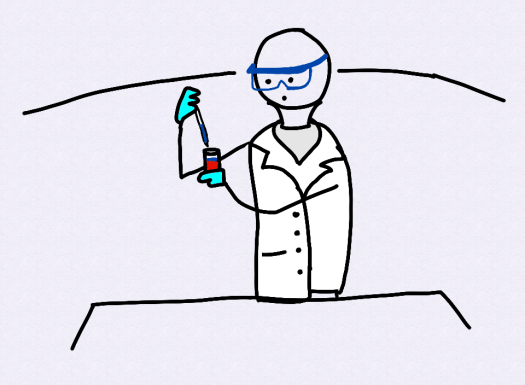
A model from pharmacology may help.

The concept of an effective dose (ED) is a measure of the smallest amount of a drug to produce a desired response in a patient.

Anything more than the ED does not help – having 3 painkillers when one is enough is probably not going reduce your pain by three times.

Much more than the ED can be harmful – that’s why you aren’t sold massive packets of painkillers in supermarkets.

So, there are three things to figure out when thinking about what needs to be done:

  1. What’s the baseline – the normal level or business as usual?
  2. What’s the least required to produce a required result?
  3. At what point should you stop?

It’s very easy to do a lot and look very busy, but it’s more interesting and useful to be effective.

And being effective means doing just enough – not too much. Doing too much is a waste of resources.

In the startup world, this model is referred to as a Minumum Viable Product (MVP).

The MVP is a product that has the least amount of features that make it viable and usable by a customer.

Once you have that, find a customer, get them to use it and use their feedback to improve and make the product better.

Many companies spend too much time and money building a perfect product, only to run out of both just at the point when they are ready to ship.

Take another example – one that many of us face – how to change a behaviour?

Whether it is exercising more, eating better or doing something more, just how long does it take to create a new habit?

First – its obvious that if you select too punishing an exercise regime or too strict a diet, the chances of you giving up increase. The right behaviour is one that you can sustain over a long enough period.

Then if you do that minimum daily behaviour every day it turns out that it takes between 18 and 254 days to make that a habit.

That’s quite a wide range. If you’re at the top end of that range, the less you have to do and the easier you make it on yourself, the more likely it is that you will be able to stick it out.

Once you start to look around, you can see applications of this approach everywhere.

Do you really need to check your phone 46 times a day to stay informed? How much news do you really need to watch every day to know what is going on? How much time every day do you need to spend checking out markets to be aware of trends?

Paradoxically, by doing less you may find you have the time to do much more.

As Antoine de Saint Exupéry, the French aviator and author of the Little Prince wrote, “It seems that perfection is attained, not when there is nothing more to add, but when there is nothing more to take away.”

Do you have what it takes to live on Mars?

living-on-mars.png

The best way to prepare and plan for life on Mars is to try living like you are already there.

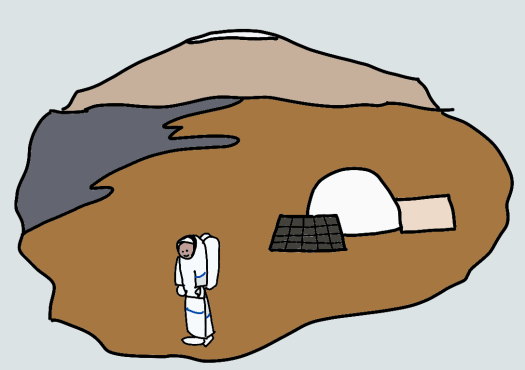
That is what they do at HI-SEAS, the Hawai’i Space Exloration Analog and Simulation habitat, on the slopes of the largest volcano on earth, Mauna Loa on the Big Island of Hawaii.

Teams of volunteers, selected for their astronaut-like capabilities are selected from hundreds of applicants and spend four to eight months in a small solar-powered dome that can house six people.

The domes have a living room, sleeping quarters, kitchen, bathroom, laboratory, simulated airlocks and “dirty” work areas. Team members spend the time in close proximity and can only go outside wearing a space suit.

The team can communicate and access the internet, but with a 20 minute delay to simulate how communication will work between Mars and the Earth. Communication with mission control is only through email and posts – not real time.

So, is this your idea of heaven or hell? Being cooped up with five other people living and working in close proximity and little privacy and alone time.

The researchers have learned a few things about managing such a social environment over the different experiments they have run.

Boredom is the enemy. You need to have something to work on and occupy you. Lots of books help.

The mix of the crew is crucial. You need a balance between introverts and extroverts. Distasteful jobs, like cleaning out the toilets, earn rewards like extra time in the shower.

Experiments like these are a hot-bed of innovation. For example, the mission to get us to the moon resulted in inventions such the CAT scanner, cordless tools and scratch resistant glasses.

The Mars experiments may lead to a better understanding of what we need to live in low-power, off-grid environments without sacrificing comfort entirely.

If nothing else, it will make camping with the kids a lot more interesting if you can pretend you are living on Mars.

How to create innovation using teamnets

teamnets.png

The challenge for many organizations is how to move from managing people to managing knowledge.

Countries from the UK to India see services as a crucial part of their economy.

Managing services, especially services based on knowledge work, requires a different approach from managing organizations based on machine and physical labour.

In particular, when it comes to innovation, what an organization is capable of doing depends on what the individuals in it have learned over time, the know-how they have developed, and the extent to which they have the ability to understand what they are doing.

“Understanding”, the ability to be reflective, creating meaning and sense, is crucial for innovation, because that is what enables the framework for new insights, creativity and change.

Managing knowledge is different from managing information. Just writing down everything that needs to be done may capture information – but that is not enough.

Managing knowledge is more about creating the right conditions, an environment that encourages people to create, show, share and collaborate to provide better services to their customers.

In addition, any single organization may not have all the knowledge required to meet the needs of a customer.

Jessica Lipnak and Jeffrey Stamps used the term “teamnets” to describe clusters of organisations that work together to serve customers better.

Teamnets are formed of groups of individuals that come together, share knowledge and create new and better organizational capabilities.

This can be done even more effectively with virtual teams that are made up of people in different time zones, geographical locations, distances and cross over organizational boundaries.

The term “teamnet” was coined in 1993. Twenty four years later, we have the internet and an array of tools to help us collaborate and work together better.

Many organizations, however, still trap people in organizational silos with management controls based on hierarchy and authority with inflexible systems and hidebound communications.

That needs to change before they can become more innovative.

How renewable heating can be used for industrial processes

solar-energy-for-factories.png

Most people are aware of the potential for electricity generation from renewable sources such as wind and solar and how they can be integrated into buildings.

It seems natural to collect renewable energy, convert it into electricity, perhaps store that energy in batteries and then use the energy to do useful work.

But there are other areas to consider as well.

Most of our energy requirements, however, are in the form of heat, making up two-thirds to three-quarters of industrial energy demand.

Of this, around 57% needs temperatures of less than 400 degrees C and 30% is at temperatures of 100 degrees C or less. In addition, most facilities require space heating and hot water.

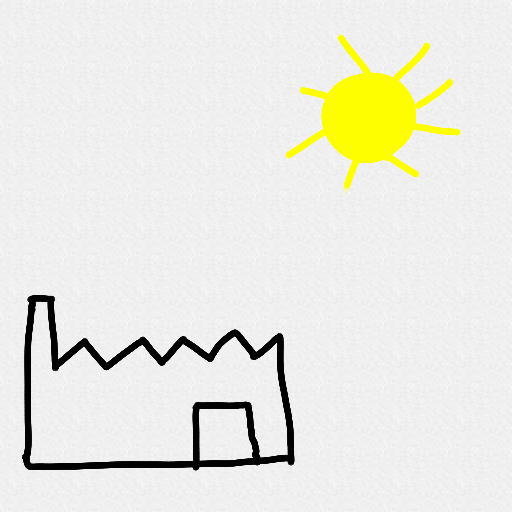
Using renewable heat directly, for example by installing advanced thermal solar systems, could provide up to half the heat demand in the industrial sector.

Simple off-the-shelf systems can provide low temperature heat at less than 80 degrees C while more complex solar concentrator systems can generate compressed steam at 400 degrees C.

Countries with high sun hours such as India, Mexico and parts of the Middle East are seen as key growth markets.

India, for example, has some of the world’s largest solar kitchens for community cooking, designed to feed tens of thousands of people at religious centres every day.

Over 80% of primary energy demand in industrial processes is currently met using fossil fuels.

A significant proportion of this could be displaced using renewable energy sources but there are problems.

Three quarters of the total heat demand is concentrated in a small number of energy intensive plants – around 30 -60,000 with existing industrial processes, temperature requirements and application areas. They would need to develop new expertise and compatible processes.

Costs for installing systems can be high up-front, even if the total lifecycle costs of operating are lower.

Despite this, there are an increasing number of installations worldwide and the Solar Heat for Industrial Processes (SHIP) database is a useful resource to get an idea of what is going on.

While such systems are unlikely to completely replace existing systems for creating heat in the near future, they will form an important component of hybrid systems that use renewable sources of energy primarily and call on fossil fuel based energy as a last resort.

It’s not personal, it’s just programming

robot-doing-interview.png

We could be hearing this title line from the film Tomorrowland a lot more in the future.

Much of what we do is increasingly determined by robots.

It used to be determined by people in power.

The phrase “Nothing personal, it’s just business” is familiar to most people, and was apparently coined by organized crime, a group that rely on the application of power. The saying even made its way into the film Godfather.

So where do we see this happening?

The most visible application is in the recruitment business.

Everyone who has applied for a job and had to go through a screening process has experienced this.

From a recruiter’s perspective, sifting through a pile of applications can be the most time consuming activity in the recruitment process.

Surely it makes sense and is fair to get applicants to log into a portal, complete a set of questions that measure their match for the role and interview only the ones that score the best?

But hiring technology company HireVue takes this a few steps further. Their homepage looks like something out of the series Lie to Me, where an expert studies facial expressions to get to the truth.

The company provides the techology to carry out unmanned video interviews where candidates record their responses to questions and the software analyses their emotions and facial expressions, speech patterns and language patterns, integrating all that information to presumably provide recruiters with more insight into candidates.

It sounds like something the CIA would find useful.

Then there is the news, something which dominates our perception of what is happening in the world.

Is the information we are getting the “real” thing or are we being fed a diet of processed news by robots?

The Associated Press began using robots in 2015 to generate automated news stories based on fairly standard styles and outlines.

The idea was that the day-to-day standard news reports can be automated and free up humans for complex, nuanced stories.

In the UK, Google is funding a project where robots will write local news. They will take data feeds and create local versions so that you will be able get news customised to your location and criteria.

This activity also carries dangers. When it is quick and easy to take and rework and republish stories, the chances are that fake news can spread just as quickly as real news.

The checks provided by experienced, sceptical journalists that look to verify assertions may be lost in the process, resulting in an avalanche of incorrect information that can be impossible to reverse.

There is no doubt that the robots are here to stay, and as we use them more we will learn better how to use artificial intelligence, machine learning and algorithms to make better decisions about everything from which route to take to whom to marry.

If you’re on the wrong side of the table, however, life could get more bewildering.

What does it take to be a genius?

picasso-portrait.png

If you know exactly what you are going to do, what’s the good in doing it? – Pablo Picasso

Picasso was one of the most prolific artists of the twentieth century, creating over 50,000 works of art from paintings to sculptures.

His style is instantly recognizable, especially the pieces that defy convention, with surreal images and bold colours.

What does it take to be Picasso, or write like Hemmingway or be Woody Allen?

Do you need have something special – to be able recognize that idea or creative thought that will change the world, or at least the way the world sees you?

Or do you just need to work on something every day?

That is what Mason Currey examines in his book Daily Rituals, which pulls together routines of 161 creative geniuses from household names like Picasso to less well known but prolific performance artists like Twyla Tharp.

Obviously, as Currey writes, there is no ONE way to work, but each genius has THEIR way.

There are, however, things they have in common.

The most important thing seems to be to show up each day. Charles Darwin, for example, had a routine that started at 8 in the morning with a work session and then followed the same pattern of work and rest for 40 years, more or less.

They didn’t work all the time though. Consistency was important, but three to four hours of creative effort at most a day seemed the norm.

Some had to work in cracks of time during the pressures of normal living. Toni Morrison rose every day at 5am so she could write before her 9-5 job while raising two sons as a single parent.

A balanced schedule was important. Many protected their time to create, but also spent time doing a variety of things, including spending time with friends and family.

It is easy to assume that older artists had more time to structure their days without the distractions of a modern, technological society.

But people haven’t changed all that much. In 1912, Kafka complained of the obstacles in his way that he had to contend with to get on with his work.

As Siobhan Phillips astutely observes in her review of the book, “good ideas or great art are the unpredictable outcomes of a predictable regimen.”

Ultimately, it seems that few people know they are geniuses while they are doing their work.

They spend their time in something that absorbs them and work hard on things that are new and challenging to them.

Eventually, they may be recognized for their genius. Or not, as the case may be.

They would still have spent their time well.