Why You Should Manage Your Energy, Not Your Time

adherence.png

Wednesday, 7.29pm

Sheffield, U.K.

Your best strategy is to manage your creativity, not your time. People who manage their creativity get happy and rich. People who manage their time get tired. – Scott Adams

Every year or so, it seems, I go back to the quote that starts this post. And it often starts when I notice someone making the fundamental attribution error.

This mistake in thinking, if you’re not familiar with it, comes from thinking that that the reason things are going wrong is because someone is stupid or lazy or ignorant. Why didn’t that task get done? Because your direct report is incompetent. Why did we fail to negotiate the deal? Because our lawyer was a fool.

You will have your own examples of this – situations where you see incompetence over and over again. Why is this – why aren’t people better at doing their jobs?

If you find yourself thinking this way you’re making the fundamental attribution error – thinking that it’s someone’s fault and making things personal rather than looking at the situation and trying to understand what’s going on.

The reason I thought about this issue again was because I was leafing through a psychology magazine that made the argument that people who fail to comply with COVID-19 restrictions are called all kinds of names. I don’t need to provide examples but recent protests come to mind. The attitude of governments is that people are breaking the rules – but they see it only from their point of view. The magazine argued that quite often it’s the people without the resources to cope with the impact of the pandemic that have to break the rules. In the case of protesters – it’s because their voice has been taken away.

The fact is that people will work within the circumstances they find themselves. And if you constrict them within rules that don’t serve them properly – then some people will decide that the rules are not good rules and should not be followed. And we should have sympathy with this – if you don’t want to create this outcome then people with power need to change the situation,

For example, let’s say you have a group that is protesting an issue and wants to do it in public – perhaps what we should do is make it possible for them to make their point – work with them to create the conditions where things can be done safely. People who are in charge will probably argue that they did that and everything still went wrong – but we’re not really interested in the specifics. What’s important is the principle that it’s usually the situation that’s the main factor rather than the people.

What this means for us is that we’re better off focusing on having the resources to do something rather than relying on willpower. If you want to eat less sugar, shop after you’ve eaten and don’t buy chocolate. If you want to encourage people to change their behaviour, work with them to enable the conditions that encourage people to change. Rules are complex things – it’s like the scene in Deadpool, where he says “Rules are meant to be broken” and the other guy says something like, “That’s the exact opposite of what rules are for.” It all depends on who’s making the rules.

This makes a lot of sense for us as well as we try and get on with doing whatever we’re doing. You need energy and you need to allocate it to the right things. If you want to really do something – don’t rely on working hard. Instead, make it easy to do.

Cheers,

Karthik Suresh
The End Of One Thing And The Beginning Of Another

end-of-series.png

Sunday, 8.22pm

Sheffield, U.K.

If you want a happy ending, that depends, of course, on where you stop your story. – Orson Welles

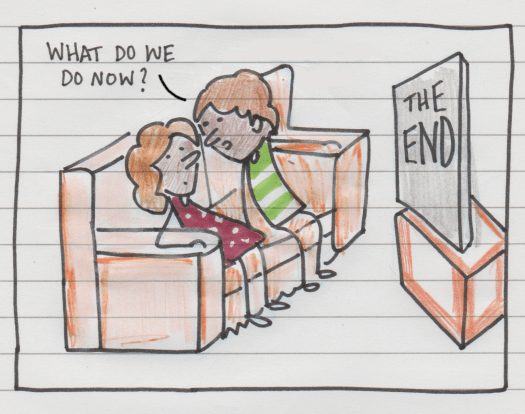
You know that feeling of despondency that comes over you when you reach the end of a series. It happens every so many weeks as you binge watch and then, the final season arrives, and you work through the episodes and then there is the final end, it’s done, the colour is drained from your life and there is a certain emptiness to the world out there.

It got me thinking about stories and how we crave them, however old we get. And the formulas work because they keep us hooked in. We watch and wait, knowing that things will work out but wondering if, just this time, they won’t. And they almost always will because the writers know that if the story goes the wrong way they have to be very careful, because if it doesn’t work out we, the audience, will get really quite unhappy.

Stories are interesting things when you contrast them to life. How do you build a story? You do it by causing conflict, putting things in the way of people, tripping them up, causing problems until, eventually, they make it through.

Life isn’t like that or, at least, it shouldn’t be like that. Life should be easy, the path of least resistance – the way of flow. In life you should study what you like, get good at something that comes naturally to you and spend your time engaged in making yourself useful to others. If you do that things will work out.

Perhaps we’re so used to story, however, that we think that drama is something that happens in real life as well. It shouldn’t though, should it? In real life we should be able to talk things through, work out our differences, express how we feel and have others give us the space to be heard.

Now, of course, when you look around the real world you don’t see that happening – because much of what we see is still filtered through the lens of story. What’s the news other than “stories”? If it’s not entertaining it’s not news, is it?

You might say stories don’t have to be entertaining. They can be a narrative, a bald one. A telling of the facts. But, of course, any narrative has a narrator and the person who tells you the story is going to be constructing a narrative. So that makes things a little complicated – because now everything you hear is a story. And sometimes you’re the narrator and the story you’re spinning is one you’re telling yourself.

It’s hard these days, but perhaps sometimes we should stop for a while, shut off all the stories and experience the world as it is. Or, we could get used to the world as it is – as a world of stories – and get better at spotting the difference between entertaining stories and telling ones.

Cheers.

Karthik Suresh

Here Are Some Of My Favourite Thinking And Productivity Tools

school.png

Saturday, 8.14pm

Sheffield, U.K.

Productivity is never an accident. It is always the result of a commitment to excellence, intelligent planning, and focused effort. – Paul J. Meyer

I know the pandemic has been hard for lots of people but for many of us the opportunity of being locked indoors with nothing to do except sort out the filing has meant that we have, after a decade or so, sorted out the filing.

One of the reasons I had a go was because of home schooling. I never realised just how much paper schools still use. And I also never realised just how much less productive we have become as a society and as individuals over the last decade or so as the creeping influence of technology has taken paper away from the workplace as a productivity tool. Perhaps it’s just me but I moved away from paper to mostly digital tools over the decade and this last year has been an opportunity to rediscover the magic of paper, if only because I’ve had to print a ream or so a week of schoolwork for the kids.

In this post I’m going to spend a few minutes trying to find the approaches that I used way back when – and that I have rediscovered and re-implemented now.

Let’s start with Tufte and his forums. There used to be a discussion where Martin Ternouth described his system for managing projects using a paper based system. The forum seems to no longer exist but a copy is preserved here and I’ve saved a pdf for future reference.

In essence, this approach manages projects using a folder system. You take notes, slip them into folders and that’s about it. When you need to work on something you take out the folder with the stuff, pull everything in it out on your desk and you’re working with that one project. Everything else is out of sight and in the filing system – which can be a pile of folders in a tray or, my preference these days, filed in a lever arch file.

Now – why is this system better than todo lists or a Getting Things Done approach? Well, it’s because the best “reminder” you can have is the thing itself. If you have a folder that has what you need to do on a particular task – then you can pick that up and get on with the work. For example, we had to sort out a change of energy supplier and it was a matter of seconds to find the folder with the paperwork and get on with the task. Now, you could have a todo list with the item “change supplier” on it but without the filing system that lets you get to the information fast it all to easy to just put off sorting things out.

I don’t use a system just as Ternouth described – I’ve got a few tweaks that make it my own but the main point is that after ten years I’ve simply started to reuse the system that let me, in the old days, manage hundreds of projects without getting overwhelmed. And it works just as well now.

The other things that I have started to use have actually been learned from watching the kids and the way in which teachers teach now. For example, they are really very organised. It’s not about textbooks any more. You have material that’s customised for the learner, a clear idea of what’s going on and lots of scaffolding in the form of graphic organisers and reinforcing material. And they use lots of colours because kids like to draw.

And all that is so much nicer than doing everything electronically. I’m rediscovering the pleasure of making something by hand, colouring it in with bold colours and childish abandon. Not worrying about getting it perfect but just getting on with it and enjoying the act of creation. Of course I worry that it’s rubbish but that’s the point of school – not to be perfect but to learn new things and practice, trying to improve every day.

Sometimes I feel that we spend a lot of time and energy trying to work out new ways to do things that work just fine as they are. And then I remember that finding a new way to do something doesn’t always invalidate the old way – it just means you have one more way that may be useful in certain situations. I couldn’t do a lot of what I do now without technology but I do wonder we understand when technology works and when it doesn’t work. But that’s something for another day.

I suppose for many of us the one thing the pandemic has done for us is make us realise just how much we can do virtually. As we move increasingly to screens, however, perhaps we’re also starting to realise just how much we like to do physically.

Cheers,

Karthik Suresh

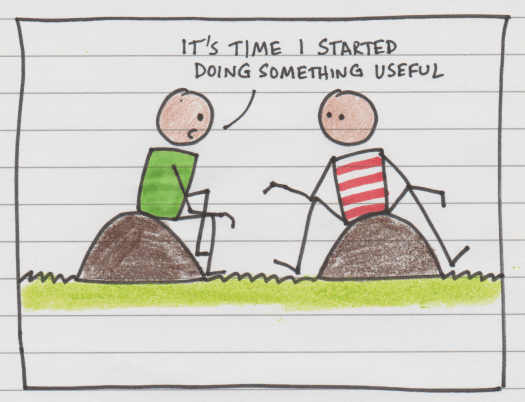
Are You Doing Something Useful?

start-to-do.png

Friday, 8.48pm

Sheffield, U.K.

Without reflection, we go blindly on our way, creating more unintended consequences, and failing to achieve anything useful. – Margaret J. Wheatley

I sometimes wonder what the point of it all is – why do we do what we do, do we need to do anything at all and would it make a difference if we did anything else?

There’s a lot I don’t know about the world and it often feels like others know a lot more about what works and what doesn’t work. For example, what is it about economics and policy that means people can make big decisions that affect the lives of millions of others? How do they know that what they’re doing is right?

Well, it turns out that they don’t know. This paper points to literature arguing that all interventions based on policy are kind of experimental – the results aren’t known in advance so you have to try it out and see what happens. Now, this is interesting and can be generalised to argue that almost any intervention is an experiment if you don’t know how it’s going to turn out – and which pretty much makes every human thing we do a study into what might happen.

What this means practically is that your attempt at generating a business strategy is an experiment and, for that matter, your attempt to do something with your life is also an experiment. Maybe you’re doing what you’re doing because of a number of things that chanced to happen and if the dice had rolled a different number you might be somewhere else, and might be better off or worse off – you just can’t tell.

Now, you might argue, not everything is an experiment. If you work hard and stick to it you’ll get your just rewards. Then again, just reading that don’t you find yourself disbelieving it a little? Yes you can work hard – but that doesn’t mean you’ll get rewarded necessarily – that also comes down to luck. How lucky are you at choosing your sector, your role, your contribution? How lucky were you that someone saw what you did? Chance plays a bigger role in everything than we might like to admit.

Then again, while the future is uncertain the past is sort of known. One might think that you know the past precisely – but while you know what happened your interpretation of the past is what matters – how you see what’s happened to you and the way you feel it’s affected you. For example, I had a number of experiences that I was irritated by, didn’t like, was annoyed at. Then, when I studied the area a bit more and was introduced to models that helped explain what was going on I found myself looking at things very differently. If you understand why something happens then you seem to be able to deal with the feelings better because you know that it wasn’t your fault or their fault but that it was just the way things were.

So, what connection does this have to being useful. I suppose it’s this. Life is an experiment – one that you’re running all the time, every day. You’re making decisions and looking to see how they turn out. But it’s also not entirely about experiments and waiting. Once you’ve run at least a few experiments you should start to theorise – start to predict what’s going to happen.

For example, when I started this post I didn’t really feel like I had much to write. I wasn’t sure how useful what I wrote was to anyone – including myself. But I could predict that if I just started writing, started doing the routine that I’ve been doing for four years things would work out, the words would appear – almost by magic drawn out keyboard press by keyboard press. And there was a chance I’d find them useful.

When it comes down to it, you are where you are. And there are good reasons for why you are there. But you have to find them – and you do that by reflecting, by looking and seeing and feeling and thinking. And if you don’t know why you feel the way you do – it helps to find some theory, a few models that help get you started. If you’re not happy with your career, for example, I’d start with this one.

Cheers,

Karthik Suresh

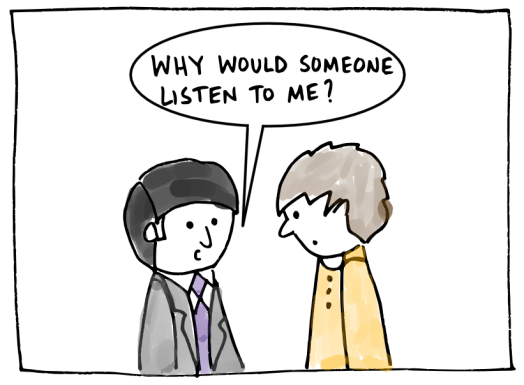
Do You Have Anything To Say?

talking-panel.png

Thursday, 7.43pm

Sheffield, U.K.

In an effort to create a culture within my classroom where students feel safe sharing the intimacies of their own silences, I have four core principles posted on the board that sits in the front of my class, which every student signs at the beginning of the year: read critically, write consciously, speak clearly, tell your truth. – Clint Smith

I’ve been musing about this idea that people’s voices need to be heard – that you have to get a diverse set of views and input from people to make the right kind of difference.

In that case, do you think your voice matters. Do you think you get heard? Or are the voices that speak the loudest the ones that get the attention? Or is it the ones that are lucky? What creates the mix that we listen to?

The fact is that we have a limited rate of information transfer – we can only take in so much and have to divide our attention between the things we deem most important. I, for example, will either read or watch a programme I like and that’s the source of the material that I learn or enjoy any given day. That’s a quiet way of doing things. I write – about whatever is on my mind – but I don’t expect write it for a reader. What I’m doing is making thinking visible to myself, to start with.

I learned recently that what we think of as “thinking” is really an inner conversation, a dialogue we have with ourselves. Try this – think of a concept. If it’s a thing – like a pink elephant – you’ll have an image come to mind. If it’s “thinking” – like thinking back to how your day went – don’t you find yourself talking it out in your head – verbalising it?

This ability to verbalise, then, is at the heart of the thinking process and it’s also the way we get what we think across to everyone else. That’s obvious, you say – that’s what talk is all about – but how many of us think one thing with words in our head and say something completely different with the words that come out? Do you find yourself as fluent in actual speech as you are with the thoughts that always circulate in your head?

I think this matters because increasingly what we need in the world is the truth – the straightforward, no-nonsense stating of things as they are. But, of course, there isn’t one version of the truth – there is instead the straightforward, no-nonsense stating of your point of view. Which someone else might disagree with.

So, what are you left with?

Well, if you don’t put your point of view across you’re letting the ones that are willing to say what they think be the only ones that are heard. Fortunately, I suppose, there is no shortage of people on every side of any issue who want to get up and speak. And there are people who don’t want to speak but will do it because someone has to do it – and there is no one else but them.

Now, here’s the thing. Just because some people do it one way doesn’t mean you have to do that as well. Some people are brilliant on video. Some people like writing. Some make cartoons. What you have to find is the way you like to speak – and then you’ll find that saying your thing is easier to do. But, of course, people have to find your work.

For example, I was thinking about a bird name from decades ago – a bulbul is a songbird that I used to see in the forests around me growing up. But Bulbul is also a cartoonist with a style and a voice and a point of view that I discovered by accident but will read with interest.

The good news for us is that if you do want to say something it’s easier than ever to do so. The bad news, of course, is that no one might be around to listen. But that isn’t why you’re doing it anyway, is it?

Cheers,

Karthik Suresh

How Would You Look At Investing In 2021?

finding-value.png

Wednesday, 7.44pm

Sheffield, U.K.

The stock market is a giant distraction from the business of investing. – John C. Bogle

If you’re a Deliveroo customer you probably got an email about their IPO. And that got me thinking about investing once again – something I haven’t written about in a while.

I read an article by John Kay recently that argued that the function of stock markets has gone for a place where companies raised money to do business to a place where business founders go to make money for themselves. And that’s because fewer and fewer businesses need outside money to operate. Now, that’s probably not entirely true but the high growth tech stocks that we all see have perhaps created that reputation.

So, should I invest in something like Deliveroo’s IPO? The argument is that they’re creating a platform, something that’s going to be around for a while. Just Eat, its rival’s value has increased by something like 6 times since its IPO. Growth and revenue are what matter.

When it doubt it makes good sense to read Warren Buffett. In his 2020 letter he reminds us that fishing in a pool of mediocre businesses is not a good idea. When you have competition over poor quality you get vastly inflated prices – and the way to deal with that is to manufacture poor quality businesses of your own that you then unload to get the money you need to buy the other businesses you want.

The thing you have to realise is that everyone loves magic – promoters like pulling the crowds in and charging for tickets, the public likes stories and the chance of winning the lottery and illusions about money can go on for a very long time. And, of course, we’ve now established a precedent that you can get away with almost anything as long as the market increases but if it crashes you’ll get helped out by taxpayers. To modify that old adage, when you own a stock it’s your problem. When a group of large players manufacture a stock it’s the taxpayer’s problem.

So, how do you invest your money?

Well, the starting point is to make sure it’s in the market – and a low cost tracker is the way to manage the bulk of the stuff you have. Check – that’s that done.

If you want to invest what’s left in individual businesses pick ones that have a durable competitive advantage, capable management with character and buy at a sensible price. Buffett reminds us that in business there are no points for “degree of difficulty”. If it looks like it’s too much work it’s probably not going to work.

What will work is being patient and letting time work for you. And reducing expenses – that’s the biggest problem for most people, not picking winners but stopping your pocket from being picked by helpers.

So, what should you invest in this year? Bitcoin? Tesla?

Whatever it is, it should probably be something in America.

Cheers,

Karthik Suresh

When Do You Think You Can No Longer Carry The Load?

carry-sun.png

Tuesday, 7.55pm

Sheffield, U.K.

Nobody grows old merely by living a number of years. We grow old by deserting our ideals. Years may wrinkle the skin, but to give up enthusiasm wrinkles the soul. – Samuel Ullman

I’ve been wondering for a bit about transitions – what happens at various stages of your career. Is it a gradual slide into irrelevance or is it a cliff edge? Do you get better as you get older or do you become that person that has outstayed their welcome. Is it possible that we get too old to be useful?

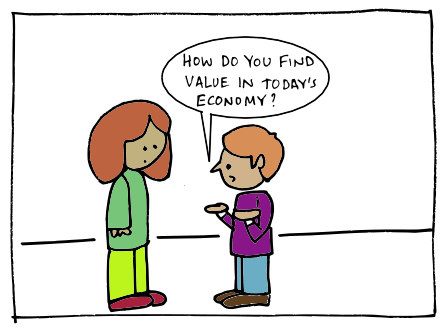
Hopefully, the answer to such questions is no, but we should still ask them. And perhaps the starting point, if you’re wondering about this issue, is to ask yourself what value looks like. What do you do that has value or that creates value?

In business, that comes down to two things – according to Peter Drucker. You need to focus on marketing and innovation. These are the two things that add value. Everything else adds costs.

I think Drucker’s quote, while sensible, is perhaps off the mark in today’s world. A better one to keep in mind comes from Ycombinator’s startup advice, which is that the two things you should do at an early stage company is write code and talk to users. I think you might say that’s the same thing Drucker said – but I think marketing and talking to users are different in the image they conjure up about what the task is that you’re doing. You can have someone do the marketing for you – but you have to go out and talk to customers if you want to build something that’s going to be useful for them. And it’s not just for early stage companies – great companies do it as well.

What does this mean in terms of an age-stage process. Perhaps when you’re young you have more time to code and perhaps when you’re older you’re a little better at talking to customers. Or perhaps you’re young and amazing and can do both those things. Whatever stage you’re at, though, if you’re doing at least these two things – then you’re probably in a good position because you’re creating value.

Cheers,

Karthik Suresh

Why The Point Of View You Take Matters

frames.png

Monday, 7.09pm

Sheffield, U.K.

The greatest tragedy for any human being is going through their entire lives believing the only perspective that matters is their own. – Doug Baldwin

We’ve been watching the program “The Bold Type”. I relate to almost nothing in there but it’s about publishing and writing and that’s cool but it’s also about people’s voices and that’s interesting.

There’s this idea that everyone’s point of view matters and it’s important to get the voices of marginalised people heard alongside the mainstream ones that tend to dominate the conversation. The mainstream tends to think that because it’s everywhere it’s also right. And then you have the counterpoint that the mainstream, is oppressive because it’s so dominant – nothing gets through it without being filtered through its requirements.

Anyway, what this comes down to is problematic – because logically there is no “right” way to look at these issues. Logically, might can be right and equality can be right – it all depends on the system of logic you use and the way in which you interpret things. Or that’s what I’m led to believe from reading “Zen and the art of motorcycle maintenance”, which argues that your morality is often a matter of convenience.

Is this helping – probably not.

Let’s talk frames instead.

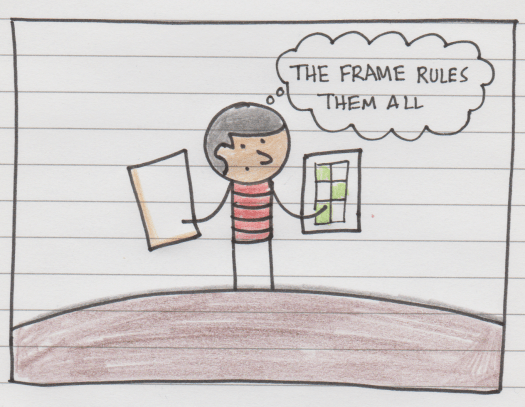
Lynda Barry talks about starting your drawing with a frame. Everything inside the frame matters. Everything outside doesn’t. Your story takes place inside the frame – except when you lean against the frame or break through it. There are always exceptions to rules.

A frame is still a good place to start. Try and understand the frame through which someone else sees something and you start to understand what they’re interpreting from what they see. If you have a point of view and I have a point of view and we’re both looking the same way then we must be looking at the same view. The only thing that’s different is how we interpret what we’re seeing. And that’s the importance of the frame. It’s the frame that makes you a conservative interpreter or a liberal one. The frame is it.

The simplest way to make a difference to you and others is recognise the existence of a frame and its relationship with the reality in front of you.

Don’t let your frame become you – it’s a tool to help you think and not the way you think. The more frames you have the better you will be – as a thinker and as a person.

Cheers,

Karthik

Where You Should Start When You Want To Make A Difference

stairs.png

Sunday, 8.51pm

Sheffield, U.K

Leadership is solving problems. The day soldiers stop bringing you their problems is the day you have stopped leading them. They have either lost confidence that you can help or concluded you do not care. Either case is a failure of leadership. – Colin Powell

A short one today – inspired by a comment on LinkedIn.

I don’t know how you good you are at cleaning the house. It’s something that has to be done and quite frankly, I’d rather someone else did it. But – since we have to do it every once in a while I’ve had to get used to the idea.

I’ve always found stairs fiddly and difficult. The vacuum cleaner doesn’t sit right on the stairs and the hose isn’t quite right and it’s all a bit of an effort. Until I discovered that the place to start was at the top. If you begin at the top of the stairs and work down everything seems to go much more easily. It makes more sense with a broom, I suppose, as you sweep down and out.

Now, the original comment had to do with leadership. If you want to change things, the poster argued, you need to spend less time on the shop floor and more time with the leadership. After all, you can do all the change you want where the work is happening but unless the leadership buy in or accept the big changes, things will probably fail to improve.

And this make sense, doesn’t it? Leaders are the ones with the power to change the system. People lower down the hierarchy can do things to change how they work but they are still constrained by how the system they operate in functions.

This is one reason why things that work at an individual level very rarely also work at a group level. You can, for example, set a goal and go for it, work as hard as you can and do everything to get there. As a group, things get more complicated quickly. What’s the goal, is it the same for everyone, are we all pulling our weight and why are the rewards unequal? All these issues mean that when you go from one person to many people the way you approach things has to change.

At a larger scale individuals can affect very little – unless they are in a position where they can make decisions that result in big changes. And so, thinking about the fact that it’s easier to start at the top of the stairs just reminds us that it’s always easier to start at the top of the hierarchy.

If you want to make a difference, begin at the top.

Cheers,

Karthik Suresh

What Does It Mean To Grow A Business These Days?

grow-business.png

Saturday, 9.05pm

Sheffield, U.K.

The Buddhist point of view takes the function of work to be at least threefold: to give a man a chance to utilise and develop his faculties; to enable him to overcome his egocentredness by joining with other people in a common task; and to bring forth the goods and services needed for a becoming existence. – Ernst F. Schumacher, Small Is Beautiful: A Study of Economics as if People Mattered

What we see has a huge influence on our view of the world – the news, the stories, the myths – all of them create a picture of the way the world works. But what if it’s all wrong? What if the truth is hidden from us – because there’s no profit in making it visible?

Let me explain by starting with Dr Michael Gregor’s books. He’s written How not to die and How not to diet – possibly the most densely researched packed collection of books into nutrition that you could read. His basic thesis is simple – a plant based diet is good for you. You can lose weight on low-fat and low-sugar diets but it tends to come back when you eat normal food – where normal for modern humans means ultraprocessed products.

Now, food is big business. But there’s no profit in selling you the food that’s proven to keep you healthy. The money is in the made up, the creations that blend sugar and fat and salt to send your palate into overdrive. So you don’t see adverts for ginger or apples – but you do see them for fast food and cereals. You’d think from what you see that such food will make you happy – but after that rush of taste what’s left other than regret, served with a side of fat.

There’s very little money to be made in stuff that’s worth doing sometimes. Take YouTube content, for example. I’ve seen some content that’s on DIY film gear, which is interesting and probably usable for most of us – but that doesn’t seem to attract all that much traffic. Then there are the videos that demonstrate hyper-complex setups and cutting-edge gear. These ones do well – because there’s more money to be made in the higher-end products. I think we know that reuse and recycling and repurposing is good – but we’re also seduced easily by the expensive stuff.

Now, I know it’s not as simple as that because if you can make amazing content about recycling you’ll probably get views. The point I’m heading towards is that you don’t know whether the point of something is to sell you product or if the point of something is to help you get better. And some people will argue that it’s the same thing but the money from the product has a way of skewing good intentions. Money corrupts too.

Then again, I haven’t met that many people who do things for money. Those kinds of people you can spot a mile away and they’re usually a little too eager to get you into something, a little too desperate, and I think you’re smart enough to notice and avoid them. Most people want to do something well, developing their own ability and contributing something to society. The rewards really come from what they do.

So, what that means if you want to grow your business is that you need to ask yourself how you help people. If you help a few people and make a small difference, you’ll make a small return. If you help a few people and make a large difference, you’ll make a larger return. If you help many people, you’ll often make the largest return.

It turns out then that the formula for growth is simple.

Go out and help.

Cheers,

Karthik Suresh