What will make your change program succeed?

change-formula.png

Some people want to change the way things are done, some people like things the way they are, and some people aren’t really bothered and are just waiting for the working day to end.

Changing the way things are done is not just about saying that there is a better way and so obviously everyone should do it.

For example, if you want to try and be more energy efficient, you could just set the room temperature controls to 18 degrees C, lock the panel and leave.

You will, however, get complaints. Lots of them. From people that are too warm, too cold or liked having control. Some enterprising ones will work out how to hack your controls or subvert the temperature sensors.

When it comes to small or large programs, whether it is choosing to lose weight or changing your entire IT system, what are the factors that will make your program succeed or fail?

It turns out there is a formula. David Gleicher created the first version and Kathie Dannemiller made it easier to understand and use.

Kathie’s version says that three things must be in place for change to be possible. These are:

  • D: Dissatisfaction with how things are now
  • V: Vision of what is possible
  • F: First, concrete steps that can be taken towards the vision

Working against these factors is R: Resistance to change.

The formula says that D x V x F > R.

Or in words, the product of the three factors needs to be greater than the resistance to make change possible.

It’s a nice formula, but there are a couple of problems with it.

First, can it actually be used like a formula? What units do you use to measure D, V and F, and then what do you actually multiply?

Someone needs to do some dimensional analysis, or in simpler words, work out how to convert the factors to a common unit (like litres or centimetres).

But that would probably be a waste of time. Instead, a more useful representation may be to use a force field framework as shown in the image above. There are driving forces that move you towards a goal and hindering forces that block movement.

If you have more forward forces than backward forces, you are probably going to move towards your change goal.

The second problem with the formula is that it assumes you need to know where you are going and what you should start doing in order to change.

That is not necessarily the case. The only factor that is really necessary is Dissatisfaction with the status quo.

Instead of Vision and First steps you might have options and experiments. Jason Little has an interesting blog post about experiments here.

You might try a number of things out, see which ones face more or less resistance and work towards an approach that makes you happier (or less dissatisfied).

Perhaps we should keep in mind George Bernard Shaw, who wrote “The reasonable man adapts himself to the world; the unreasonable one persists in trying to adapt the world to himself. Therefore all progress depends on the unreasonable man.”

How do you work out what is important?

degrees-of-freedom.png

You usually have many options and lots to consider when approaching a problem.

Most people have experienced meetings where a number of people have opinions, approaches, suggestions and explanations for why you should do something in a particular way.

Quite often, you end up with a set of conclusions pulled together that include things that the group seems to like and things that important members of the group put their support behind.

That’s all good group work and “brainstorming” and does help with creativity and idea generation.

But how do you know which of those conclusions actually matter and are important?

A model from statistics called Degrees of freedom may help us here.

You need information and data in order to estimate a statistical parameter. The degrees of freedom in that estimate are the number of independent pieces of information needed to work it out.

In the picture above, to work out the result, you need four pieces of information: 1, 2, 3 and 4. The intermediate calculation a is from a calculation involving 2 and 3, and so is not independent.

This system has four degrees of freedom.

There are two things that this model helps us see.

The first is that information that does not affect the result should not go into the analytical process. You need to focus on the things that will “move the needle” and eliminate unrelated factors.

The second is that the larger the number of degrees of freedom, the more values the end result can take. In a physical example human upper arms have 7 degrees of freedom and can do a number of movements as a result. The hand has 23 degrees of freedom and can do much more.

The degrees of freedom concept can be generalised to help with general problem solving and business modelling.

You need to figure out which parameters can affect the result you want, and then isolate the parameters that are truly independent.

You then need to work out what a change in each parameter means for your result – you come up with scenarios. You can say things like if the first parameter changes by 10%, this is what it means for the result.

Then, if you want to get a little fancy, you vary all the parameters and come up with a range of results that might happen – modelling it stochastically. This lets you say things like I’m 80% confident that the result will be between X and Y.

In business, what this process lets you end up with are the parameters that matter to you – the ones that are important to monitor if you are going to achieve the necessary result.

These parameters are your Key Performance Indicators (KPIs). Keep an eye on them, make sure that they are within tolerance and doing what they should be doing, and you have a much better chance of getting the result you want.

The next thing then is to make sure that the result you are planning to get is the one you really want.

How has the party been for you over the last 30 years?

ftse-1995-2017.png

If you entered the world of work after 2008, your experience is probably one of sustained growth where things have only gotten better.

Since the financial crisis, which resulted in markets falling to a low in 2009, the world has seemed to be on a path to recovery. Stock markets have risen, houses prices have remained stable and many people are employed.

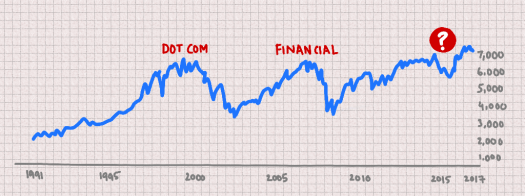
The FTSE, shown in the chart above, has risen from under 4,000 in 2009 to over 7,000 today, an increase of 75%.

But, as Santayana said, those who cannot remember the past are condemned to repeat it.

We live in a world where valuation and value are not the same thing.

The dot com crisis at the start of the millenium resulted from ascribing absurd valuations to companies that were little more than dreams and wishes.

The financial crisis in 2008 happened when complex contracts designed to spread risk turned toxic and concentrated it instead, corroding trust – the grease of modern economies – and bringing the whole financial system to a grinding halt.

And now we come to 2017.

Is the steady rise we have seen over the last seven years because of a real recovery or because of something else?

The internet has grown up after all – it’s now transforming how we live our lives and do things. So perhaps the new digital connected economy is helping economies change and grow?

An alternative explanation is that governments have pumped vast sums of money into the system to keep things working.

This money is injected through financial institutions and has to go somewhere – it has to be “invested”. So the money goes and accumulates in certain places – companies, commodities, bonds that promise returns.

The issue is that there is more money chasing these assets that have returns, and so people are willing to pay more for them, and as a result their valuation increases.

Since BREXIT, the UK index has risen because a weaker pound makes the largest businesses in the UK more competitive globally, increasing expectations that their profits will rise and pushing up their valuations.

Conversely, when the exchange rate drops, the valuation of these businesses falls as well – the FTSE 100 is inversely correlated with interest rates.

So, what should you do now? Should you sell everything and walk away from markets? Should you double down and buy some more?

As Blaise Pascal said (almost), all of humanity’s problems stem a person’s inability to sit quietly in a room alone.

The markets will go up and down. Given where they are, it makes sense to be prepared both psychologically and financially in case they fall once again.

The thing to remember is that percentage changes are not symmetric. A 75% rise only needs a 43% fall to wipe out all your gains.

At this point, it might make sense to invest with a mindset that is prepared to have your investment take over 10 years before it shows a profit.

Can you explain what you do to a rubber duck?

rubber-duck.png

Many people have the experience of being stuck on a problem, or finding that they have to explain what they know or have done to someone else.

You might face this when trying to create some software, work on a business process, repair a leaky pipe or when you’re trying to explain what you do during a sale.

So how can you make this easier to do?

One approach explained in the book “The Pragmatic Programmer: From Journeyman to Master”, by Andrew Hunt and David Thomas is rubber duck debugging.

The method is simple:

  1. Get a rubber duck.
  2. Tell the rubber duck that you need a minute of its time.
  3. Explain to the duck what you’re trying to achieve and then go over your code or problem in detail, line by line.

Somewhere during this process, you’ll realize that what you’re explaining to the duck is not what you are actually doing – and this leads you in the direction of a solution.

Alternatively, as you explain the problem to the duck, the solution will pop into your mind and you will know what to do next to resolve the situation.

It’s quite important, it seems, to talk out loud to the duck. It’s the process of explanation and thinking out loud that gets your mind to loosen up and allows solutions to tumble out.

Of course, you could ask someone else. The only thing is that if it’s someone who knows what they are doing and you haven’t taken the time to formulate your question well, you’ll look stupid and they’ll feel like you’re wasting their time.

You could also ask a co-worker, but the main advantage of a duck is that it sits there, doesn’t talk back to you or judge you or suggest that it has a better solution and is much smarter than you are.

If this approach seems a little silly to you, perhaps you need to consider what it actually makes you do and how it helps you do better work.

  1. Your brain has to stop and switch tracks – from doing something to explaining what you are doing.
  2. You need to slow down – you can’t assume the duck already knows what you know and cannot take things for granted.
  3. You have to go line by line through your program or process, focusing on the details that you might be tempted to otherwise overlook.
  4. It forces you to try and work through and answer your problem or situation yourself, engaging your brain, before asking someone else.

Of course, the duck’s powers are limited. If you have talked to the duck and are still stuck, you should go and talk to a colleague or someone who might know more than you about the problem.

The chances are that you will come up with a much better question for them this time around.

How to create intelligent systems

evolution.png

If you have a complex problem to solve, do you need to build an equally complex system to solve it?

Most people, when they think of systems, visualize technology – robots, artificial intelligence, connected machines and autonomous vehicles.

A more general definition of systems includes the people that use the technology and the processes they follow when using it.

Complex systems include things like governments, religions and companies.

How does a large, complicated company come into existence?

Well – it probably didn’t start out large. It started as a small company once doing something simple. For example, General Electric, one of the largest conglomerates in the world, can be traced back to Edison and his lightbulb.

This idea forms the basis of Gall’s law, a rule of thumb from the book “Systemantics: How systems really work and how they fail” which says “A complex system that works is invariably found to have evolved from a simple system that worked”.

The reverse also appears to happen. A complex system built from scratch never works and cannot be patched up to work. You need to start again with a simple system.

The main problem with building a complex system straight away is that a system is simply someone’s approach to solving a problem – the system itself doesn’t solve the problem.

A complex system built without constantly testing whether it is doing something useful can end up doing hardly anything useful at all.

This is why many modern approaches to programming are “agile”, solving simple problems first and putting out software that people can try out to see whether it is actually useful.

A related observation from the book is that very efficient systems are dangerous. Loose systems, systems that hang together with some slack tend to grow larger and work better. An example of this might be the growth of the world-wide web.

The book is a slightly tongue-in-cheek commentary on systems theory, which has moved from a “hard” systems approach where people believed every situation could be mathematically modelled and solved to “softer” approaches that take into account the reality that people doing what they think is right have the inherent capability to mess up any system designed by a technocrat.

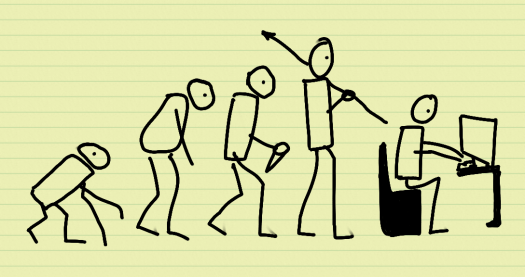
Intelligent behaviour is not something you design into a system but something that emerges from the way in which the system is arranged.

The only approach that has been shown to produce intelligent behaviour so far is evolution, and so it makes sense to prefer it when creating a new system.

Why does the rabbit run faster than the fox?

rabbit-fox2.png

If your business is based on you beating the competition, life is going to get very tiring.

A perfectly competitive market is one where there are a large number of players in the market, the product is no different from others, it’s easy to enter the market and everyone has all the information they need.

Examples of these kinds of businesses exist everywhere. In knowledge work, web-design could be seen as a modern example. Most websites will be built using WordPress, there are any number of people that can design acceptable websites and it costs virtually nothing to get started in the business.

If your web-design business does what most other web-design businesses do, then you will experience the side-effects of perfect competition.

In a perfectly competitive market, the price at which you sell the product tends towards the cost of production.

In other words, you make hardly any money selling it and profits are low to non-existent.

There are few perfectly competitive markets, however, and the traditional ones try and create systems to prevent side effects. In commodity markets such as oil you see the emergence of cartels like Opec that try to control supply so that they can affect the price.

At the other end of the spectrum is a market where one company has a monopoly. No one else does what they do, the product is unique, it’s near-impossible for new companies to enter the market and information is protected or secret.

That’s quite a nice situation for a business to be in – except that comfort and complacency leads to sloth and poor service and eventually governments have step in to break up monopolies.

The ideal place is to be somewhere in between.

There will always be someone who is willing to get up earlier, work harder, spend more time away from home selling, and who can hire workers that are paid less than you can.

If you compete on their terms, you will lose.

The strategy that is going to work is to position yourself and your business so that you have few direct competitors, what you do is different and unique, your competitors cannot easily enter your market and where information needed to do the work is protected – perhaps because it costs something.

If you had to pick just one thing out of the list, Bruce Greenwald and Judd Kahn in their book Competition Demystified suggest focusing on barriers to entry.

If it’s hard for others to enter your market, then you have the potential to earn above average profits.

If that isn’t the case, then you could spend the rest of your time running just to stay in the same place. And who wins then?

The answer to that is the same as the answer to the question in the title.

The rabbit runs faster because the rabbit is running for his life, while the fox is running for her dinner.

The real learning curve

learning-curve.png

How does the process of doing something new work?

Whether it’s learning a new language, picking up a new skill or starting a new business, we all go through a series of stages.

The typical learning curve is shown as learning plotted against time in a so called “S” curve. This shows that learning is low at the start, speeds up and then levels out later on.

The more natural way to think about learning, however, is that it is hard at the beginning, gets easy as you become more familiar with what needs to be done but then it needs a lot more effort to achieve mastery.

The first stage, getting started is often the hardest bit – when you are approaching something new for the first time. Everything is unfamiliar and different.

Take, for example, learning how to model a business case in Excel. At first, if you’re not that familiar with Excel, it takes time to understand the way in which the cells and formulas work.

After some time, you can get pretty competent at building models. This is the second stage.

Perhaps you can even create some very complex models that have lots of variables and connections to other sheets and perhaps use some VBA for automation and programming.

But then it gets hard once again to master the tool in the third stage.

Excel is a very accessible tool, but it is also a powerful programming language. You need to understand a lot more about the process of building a model to move to a stage where your model can be used to generate useful information in the form of scenarios, projections and sensitivities.

Most people don’t ever get beyond a model that gives you one answer. A model that helps you frame and investigate situations is a lot more complicated to think though and build.

Take another example – writing.

Almost everyone can learn to write. It’s hard at the start but most people probably don’t remember the effort they had to put into learning the shapes of letters and spelling out words when they were younger. It’s pretty natural now.

But then why is most business writing hard to read? Is it because you need jargon or complicated words to explain things, or is it because the writer hasn’t yet reached the point where they can express a big idea in small words?

Hemmingway talked about the idea of “one true sentence”. This was a sentence without decoration, without fancy words – just a simple sentence that said something meaningful.

But most business writers haven’t put in the effort that Hemmingway did.

It makes it easier to put in effort over time to learn a new skill once you know how the learning curve works and can see how it relates to how much you are learning.

At the same time, because it takes effort to learn something new, it makes sense to choose what you want to learn carefully.

In knowledge work – reading, writing and arithmetic are still the most useful skills to have.

How do we really make investment decisions?

decisions.png

If you were rational, this is how you might make a decision:

  1. Set out the alternatives – what are the choice you have?
  2. For each choice, what is the payoff – what are you likely to get?
  3. Again, for each choice, what is the probability that it will happen?
  4. What is the expected value of the option (probability x payoff)

With choices that lead to other possible choices, you need a decision tree and the ability to work out sequences of expected value.

You then choose the approach that results in the highest expected value.

This approach, however, is not intuitive, and most people are not wired to approach decision making in this way.

In addition, it’s a little old. The statistical basis for this approach lies in the work of Thomas Bayes in the mid-1700s. Our knowledge of people has moved on a bit since then.

There are two situations people face often when making personal and business decisions.

The first situation is when they know the chances of winning or losing.

For example, lets say you entered a game where you could win £10 or lose £5 on a coin toss. There is a 50% chance of either, and you might be tempted to take a punt at this level.

Most people would not take the bet if the option was between getting £1,000 or losing £500. The fear of losing would overwhelm the prospect of winning.

The other situation is when they don’t know what might happen and the risks that could emerge.

Quite often, the next thing to go wrong is completely different from the ways in which things went wrong before – and all the planning and controls that were in place to avoid the last disaster fail to prevent the next one.

A more human approach to making these decisions is based on Plausibility Theory and in particular the idea that you may take a risk as long as your downside is capped.

In other words, you may be willing to take a decision that you expect to be profitable, as long as the loss if you are wrong is limited to a certain level.

This approach became popular around 15 years ago as the concept of Value-at-Risk (VaR). Using this approach, you put in place a management system that ensures that you limit your loss to a particular level, say 1 or 2% of your portfolio value, and then work to get the most profit out of the opportunity.

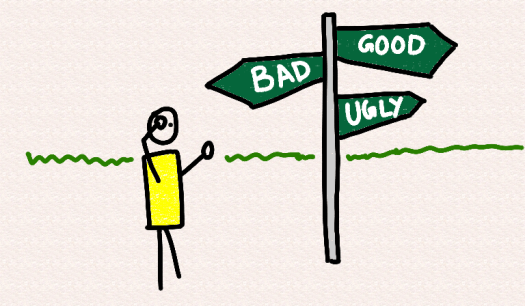
So… you avoid the ugly end result, limit the worst case to a bad result and work on achieving a good result.

But… mathematicians ruin everything.

VaR was quickly adopted in many financial models – from standard portfolio markets to energy, and complex models were used to justify the products that were being introduced. They even formed part of the Basel II rules used to regulate international banking.

Which then failed rather spectacularly to prevent the global financial crisis that kicked off in 2008.

Although arguably that was down to smart people who figured that they could use the methods to try and take greater risks with other people’s money while at the same time reducing their own personal risk to almost nothing.

After all, how many executives of banks have been tried and convicted for their role in the crisis?

So it looks like the people managing your money applied Plausibility Theory rather well, except they did it to benefit themselves rather than you.

The takeaway is perhaps that the next time you make an investment decision, figure out what will happen to you if things go horribly wrong before being enticed by the promises of future returns.

How to close the gap between knowledge and action

academic-practitioner-distance.png

How do you know what you know?

You’ve probably been working for a while, and by now have a number of views on how things should be done.

You know the right order, the correct approach or the most effective way to do things.

You might feel that what you learn and figure out on the job – the practical stuff you do there – is where real work is done, and academics in their ivory towers have nothing much to add to how you do things.

Or, you might be an academic, engrossed in research and evidence. You might know the ways that work across organizations from your research and know the precise way in which to articulate an idea so that it expresses a contingent truth.

Except, you lose most listeners at the word “contingent”.

This creates a barrier between the people who create new knowledge and the people that do work. It’s probably no exaggeration to say that most work done in organizations is based on ten to twenty year old research and methods and very few organizations are really at the cutting edge of what they do.

As John Maynard Keynes said, “Practical men who believe themselves to be quite exempt from any intellectual influence, are usually the slaves of some defunct economist.”

Except today he would probably say practical people.

Writing in the Oxford Review blog, David Wilkinson outlines three main reasons for the gulf between knowers and doers.

1. Most people can’t get to the research or understand it when they do

Academics write for each other in peer-reviewed journals locked away behind paywalls in precise, terse and technical language.

Most people don’t get this language and what it means for them.

The Nobel prize winning physicist Richard Feynman gave a beautiful example of this. Look at the sentence “The radioactive phosphorus content of the cerebrum of the rat decreases to one-half in a period of two weeks.”

What does this mean?

What this sentence means is that the atoms in the rat’s brain, and your brain disappear and are replaced all the time – the very fabric of your body, the atoms that make you up are no longer the same as they were before.

The mind you have now is no longer the one you had a year ago – all its bits have been replaced. But you’re still here, thinking and feeling and with memories.

Your consciousness and feelings and emotions come out from arrangements of atoms – a dancing pattern of atoms if you will – and are not the unchanging fixed entity that you think you are. Instead the “you” that you are emerges from this pattern of atoms.

It takes time and reflection and discussion to take apart and understand these concepts – time that people outside of academic rarely have.

2. People who do are busy and need to get things done now

People who do things need to worry about clients, deadlines, office politics and the need to ship and invoice now.

What they need are solutions that are practical, tested and effective. They haven’t got the time to discuss elaborate theories or ideas that apply only in very specific cases.

They also expect a healthy dose of “common sense”.

They way in which academic knowledge comes across doesn’t easily fit these requirements – it needs to be translated and explained and there often just isn’t the time, resource or appetite to do this properly.

This also means that many decisions and actions taken by organisations are based on gut-instinct, hunches and methods that have worked in the past rather than based on evidence and data, which is how academics would prefer that they did things.

3. Knowers and Doers simply have different objectives

An academic needs to do research and get published. That is their main objective and they get funding and support to create new knowledge, not to make it easier to access or more practical to apply.

A manager or worker in an organisation needs to get things done. Their main objective is to satisfy a customer.

The two are looking in completely different directions, and when they do come together the work they do needs to meet these dual aims of being applicable and practical while at the same time being novel and publishable.

These are not easy aims to reconcile.

Are consultants the answer?

Perhaps this is why consultants that are able to bridge the gap between research and action are so useful in organisations.

Well trained workers that have done a research based degree or have continuing links with academia can bring new ideas, approaches and methods into organisations that are tested and evidence-based.

Much of the ways in which organizations work – from operations to risk management to sales and marketing has been exhaustively researched and are well understood.

The challenge is to get and use this knowledge more effectively on a day-to-day basis.

How to create organic growth in your company

growing-organization.png

How do you grow your company organically in today’s competitive marketplace?

A McKinsey survey looked at approaches used by companies and found that high-performing firms used a combination of three strategies:

  1. They moved investment and money into high-growth activities.
  2. They created new things to sell and new ways of delivering value.
  3. Tney worked on making how they did things internally better.

It appears from the survey that the best performing approach is one where firms focus on creating new products, services and business models, but also ensure that they allocate resources effectively and work on optimizing their own operations.

That sounds easy enough, so what stops organizations from doing this and setting off on a growth track?

There are three reasons, according to another article from McKinsey:

1. Inflexible structures

Your organization needs to have the right structure to enable growth, with the right teams, leadership and strategy in place to effectively serve its target market.

Simply working within an existing structure can mean that ideas and innovation can get lost in the unending stream of existing priorities and concerns.

2. Unscalable processes

A related problem is when existing processes just cannot keep up with new opportunites and demand.

If you have a bottleneck in your organization – perhaps when it comes to pricing, turning proposals around, evaluating opportunities or in your manufacturing systems, that will become an increasingly large problem as you grow.

3. Unprepared people

A growth strategy can come as something of a surprise to people in organizations used to doing things in a certain way.

This can slow growth down considerably – not because people are being difficult, but just because by being cautious and adding what they feel are reasonable checks to the process, they can end up slowing and even derailing the entire initiative.

So, what does this mean for us?

An organic growth strategy takes time, focus and investment.

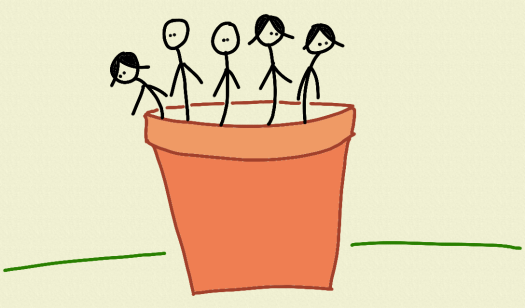
Like growing plants, you need to prepare the ground, seed it, provide them with resources and keep away predators.

And then you need to wait.