Who Is It That You Are Doing Your Work For?

whos-at-the-centre.png

Friday, 9.19pm

Sheffield, U.K.

‘Are you offering to teach me something?’

‘Teach? No,’said Granny. ‘Ain’t got the patience for teaching. But I might let you learn.’ – Maskerade by Terry Pratchett

Who is at the centre of your work – who is it that you do your work for?

This is actually not the easiest thing to figure out, because we have a habit of fooling ourselves.

There are three choices that come to mind.

First, you’re doing what you’re doing for a client, like building a new system.

You might be doing something for yourself, such as creating a work of art.

Or you’re doing something for someone in a position of power – your boss or an official.

And depending on who is at the centre of your endeavour, you’ll create different structures and ways of doing things.

A good example is to look at how schools work.

Are they designed to give kids the education they need?

Or are they a way to give teachers a job?

Or are they a way for the government to demonstrate its investment in education?

It could be any of the three to different people in different situations associated with the delivery of teaching to children.

Now what happens is that you create a structure to make the person at the centre happy.

If the person at the centre is the minister for education who needs statistics on how well all the schools are doing – then you’ll find that managers will focus on metrics that can be measured and ask teachers to teach those things.

The kids might not enjoy those things, but they’re not the ones that matter in this system.

Some teachers will still persist in the belief that their real clients are the kids, but they still have to deal with the metrics and stats if they want to keep their jobs.

So they follow a two track system, teaching to the test and also trying to teach their children something useful.

This is not something new.

I remember a teacher of mine telling a story of a teacher of his decades ago.

Apparently this teacher spent the first few weeks of the term getting the children to copy down everything they needed to pass the tests.

And then he said it was time to get an education, and they started doing useful and interesting stuff that they enjoyed learning.

I suppose the thing is that you always have to look at the incentive, look for who benefits and how to see why things work the way they do.

Most people in businesses are focused on keeping their bosses happy, not their customers.

We write marketing material to keep people inside the business happy rather than for prospects who have questions they want the copy to answer.

Now, when you want to try and change the conversation, you talk about a “something” centered approach.

A client centered approach, a child centered approach.

But how much of that is talk and how much is reality?

Some of it comes down to the difference between learning and teaching.

Teaching is something you do to someone else – it’s probably something you get paid for.

Learning is something people do for themselves, and sometimes they seek out a teacher.

How do you become the kind of teacher people seek out?

Probably the same way you create a service that people seek out, or a business that customers seek out.

By putting them at the centre of your work.

And that is a very hard thing to do.

Cheers,

Karthik Suresh

Why You Have To Understand How Our Models Of Knowledge Have Changed

knowledge.png

Thursday, 7.26pm

Sheffield, U.K.

Postmodernism was a reaction to modernism. Where modernism was about objectivity, postmodernism was about subjectivity. Where modernism sought a singular truth, postmodernism sought the multiplicity of truths. – Miguel Syjuco

How do you sell a pen to someone?

You’ll remember something like this in The Wolf Of Wall Street.

The chap the film is about, Jordan Belfort, built his reputation on his skill at telephone sales back when telephones were a thing.

And he still teaches how to sell these days – it’s the way that the books teach you how to do it and it’s the way many trainers set out their material.

The video I was watching yesterday of Larry McEnerney from the University of Chicago described a few models of knowledge that are worth knowing about.

One form of knowledge is believing that what you know is right.

For example, if you write a business plan or a sales letter – you believe that what’s in there is correct.

If someone doesn’t agree with you, then you feel the need to explain yourself – defend your position.

In this model you’re right because you know what you know.

Maybe you’ve created a new system, a different way to do something, an improvement on a method – this must be good, right?

Well, it is in a positivist system, one where there is objective truth and you’ve just found it.

You’re told by people who think this way that you have to believe in your product – you have to have a kind of missionary zeal.

You must believe, if you are to sell.

Another form of knowledge is believing that you get the big picture – and know you’ve found a gap.

All this stuff exists and you know about it – you know what the problems are and so you can see a space where you can create a product.

But sometimes spaces exist because there is nothing of value in that space.

This kind of thing assumes that knowledge is bounded – you can put a box around it and see what is not there.

Both these approaches are at the heart of the way we’re taught to express ourselves for much of our lives.

You’ve created something new or spotted a gap in the market – well then, you must have a business.

You must have found something useful.

Well… not exactly.

A more current model of knowledge – a post-modern version – is one that’s based around the idea that knowledge is what people who should know agree is knowledge.

Knowledge emerges from the interactions of a community – and sometimes they accept new ideas and sometimes they discard old ones – and all the time they decide what is right and wrong.

That’s right – it’s not objective truth but the subjective views of people that create the truth.

What does that mean in practice?

It means that if you try and sell someone an idea because you think it’s a good, new one, or because you think there is a gap in the market you’ll often find that the majority of people back away from you.

And that’s because their world is created by the voices of their community – the people in the business they work with, the managers, the leaders.

And before you can effectively sell to them you need to know what they are saying.

You have to start by listening – not by selling.

It’s only by listening that you’ll start to see how the people you’re selling to see the world.

And when you do that you can appreciate their point of view – and then add your contribution.

If you acknowledge what they know, show that you have listened and you care – then they might be willing to give you a change and listen to you in turn.

We live in a world that’s increasingly a collection of communities, of tribes, each creating their own knowledge worlds.

If you’re not in that world, you’re a tourist – so don’t expect to be taken seriously until you make an effort to integrate.

And that starts by being willing to listen.

Cheers,

Karthik Suresh

Why Does Your Copy Fail Even If It’s Clear, Organised And Persuasive?

valuable.png

Wednesday, 9.23pm

Sheffield, U.K.

It is my practice to try to understand how valuable something is by trying to imagine myself without it. – Herb Kelleher

I was reminded recently on Twitter about the concept of semantic line feeds, something that I wrote about here some time back.

It’s an almost unknown concept – certainly to people who write using Microsoft Word or any other WYSIWYG tool.

Which got me thinking about tools and their impact on what we do.

Let’s say you’ve spent your life so far working in a certain way using certain tools – it’s hard to imagine any other way of doing things.

It’s the way you’re used to working – it’s familiar.

To someone used to a Windows PC or a Mac – the idea that you could be far more productive using a terminal and command line just sounds weird.

How is that possible – are you talking about that DOS kind of thing?

Surely it’s easier to do things using modern tools?

That “surely” is a trap, as the philosopher Daniel Dennett points out – it tells you someone is trying to slide something past you that they don’t know for certain.

So, I can tell you with certainty that you will be orders of magnitude more productive if you learn to use a command line.

But that isn’t the point of this post.

The point is that I thought I would write about technique – because of how the global lockdown is affecting the way I write.

I’m using paper more, mainly because if I use a screen the small people in the house complain and want their own screen time.

But if you sit down and write using a pencil and paper they go away and hide in case you ask them to do the same.

And I’ve re-realised that doing a first draft on paper and then typing it up seems to result in better prose – the editing process works.

But you knew that.

And so did Google, it appears, because it brought up a video on my YouTube feed of Larry McEnerney from the University of Chicago talking about how to write more effectively.

That’s several hours that I now need to set aside – but from what I’ve seen so far there are a few gems that we would do well to internalise.

Let’s say you’re writing some sales copy – what is it that matters?

Is it that it’s clear? Organised? Persuasive?

“No,” says Larry. It needs to be valuable.

And he has a formula to memorise.

The opposite of valuable is useless. So remember:

  • Clear x Useless = Useless
  • Organised x Useless = Useless
  • Persuasive x Useless = Useless

If something is useless, it acts like a zero in a multiplication.

However good your technique, whether you write on paper or on a computer, on the command line or using Word, with semantic line feeds or plain old paragraphing – if what you’re writing is useless no amount of technique will make it anything else.

What makes something valuable, McEnerney explains, is not what we think.

We might think that value exists in the world out there.

It doesn’t.

You might think value resides in your text.

It doesn’t.

Value exists in the minds of readers.

And this should make you stop and ask, “Which readers?”

Not all readers are going to think what you do is valuable – but you’re writing for the ones who will.

So you should always start by getting a clear idea of your audience – who are you writing for?

Then, if you write poorly, your readers will first slow down and re-read your piece, then start to misunderstand your points and then get frustrated and then stop.

They’ll do all four only if they have to, of course.

If they don’t like what you’re writing and don’t need to read it they’ll jump straight to stopping.

Now, it’s not possible to summarise a whole course in a short post – and I have a lot left to learn.

But here’s the point to take away.

From now on, when you write a piece of copy, come up with a new business idea, hit on a better way to do something – imagine a person you’re trying to sell this idea to.

This person is not interested in why you think what you think.

They don’t want a detailed explanation from you – they don’t want to know what the inside of your head looks like.

What they want to know is: “Why should I think the way you want me to?”

And your response should make them think to themselves: “Because it’s valuable to me!”

Cheers,

Karthik Suresh

How Do You Learn What Is Worth Knowing?

sutra.png

Tuesday, 9.09pm

Sheffield, U.K.

Exclusively of the abstract sciences, the largest and worthiest portion of our knowledge consists of aphorisms: and the greatest and best of men is but an aphorism. – Samuel Taylor Coleridge

I’ve been trying to explore a particular topic and started on a beginner’s textbook on the subject.

And, as I read and took notes, my eyelids started to feel heavy.

Because it was so… boring.

Which reminded me of Robert Pirsig’s Zen and the art of motorcycle maintenance once again.

Specifically the bit where he talks about what a section from a beginner’s textbook on a subject often looks like.

“Dull, awkward and ugly.”

“That is the romantic face of the classic mode.”

It’s the thing you see – ideas chopped up into parts and served on skewers, imprisoned in their little sections and herded together with bullet points.

I’ve also been thinking about ways of taking notes.

In the Western world you have the idea of a commonplace book, a collection built up by individuals who copied out passages from books they read and wanted to keep.

Then you have a research tool called the Zettelkasten, used by Niklas Luhmann to organise what he learned.

Luhmann put down snippets of ideas on index cards and then organised them with a coding system that kept related information together and cross referenced – helping him write around 60 books.

Ryan Holiday and Robert Greene use approaches that have the same principles at their core – an idea or concept on an index card and all the index cards put in order over time to create the structure of a book.

Now, this idea of a small bit of information on small bits of paper dredged up an old memory.

Manuscripts made from palm leaves have been a feature of the Indian subcontinent for a long time.

But before there was writing knowledge was passed on from teacher to student in the form of sutras – short verses that had to be memorised and recited.

This was codified knowledge, a concept compressed into a verse that could be remembered exactly.

And, like poetry, the rhythm and sound of these verses probably helped the students memorise them.

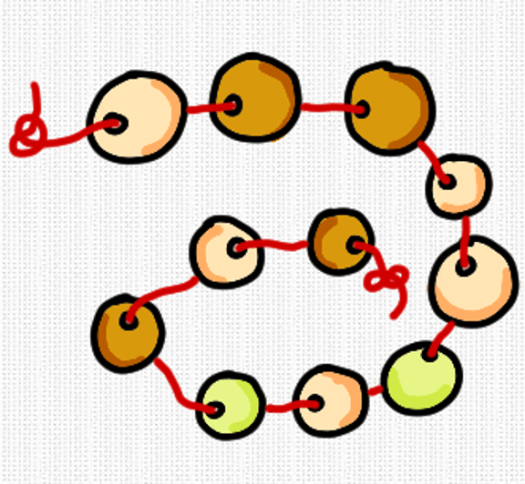
A collection of sutras has the idea, at its root, of a thread – and I like to imagine these as a string of pearls.

There are lots of ideas, some good ones, some great ones, some rubbish ones.

Some ideas are related – and you could pick the best ones and pile them up.

And then you could string them together – and you would have something worth remembering.

I think that is what a good book should do for the reader – show you a string of pearls – a ribbon of ideas that are worth learning and remembering.

And that’s because it’s not the ideas on their own – set out individually that is going to help you.

It’s the story you put together from what you learn, the way in which you practise it for yourself in your own life.

That’s what matters to you.

Now, I suppose it’s asking too much of a textbook to give you that kind of experience.

And, of course, the sutra writers of old got it wrong after a while.

Instead of trying to tell you the great ideas, they focused on getting them shorter and packing more and more in until they ended up as cryptic codes that needed to be explained by someone with more knowledge.

But the idea of a book made from sutras, from aphorisms, is still an appealing one.

It requires a lot more work on the part of the writer to make this happen.

It’s probably easier to get a structure and throw in enough words and then move on to the next project.

But then you get bored readers and how is that a good thing?

Readers read to learn, to understand – and why do they do that?

There is a sutra for that.

“Yogas Chitta Vritti Nirodha” – Yoga is for removing the fluctuations of the mind.

It’s something that’s at the heart of Pirsig’s book too.

We learn for the peace of mind it gives us.

Cheers,

Karthik Suresh

How To Completely Extinguish The Red Heat Of Creativity

ritual.png

Monday, 9.14pm

Sheffield, U.K.

Don’t confuse the teacher with the lesson, the ritual with the ecstasy, the transmitter of the symbol with the symbol itself. – Neil Gaiman, Stardust

What is society?

Ok – that’s a big question – so let’s focus on one aspect of society.

The aspect of contracts.

A contract is an agreement – something that sets out how two people treat each other.

But what’s important about that contract?

Is it the words that are written on the page or is it the intention that is trying to be expressed by those words?

Well, if you’re a lawyer, you’ll probably look at the words to form an opinion but in a court the intent will probably be taken into consideration.

It’s usually not that simple when you look into it – because of all the stuff that builds around the core – two people trying to figure out how to work with each other.

The purpose of this post is not really to talk about contracts but to use a contract as an example of the problem we find again and again whenever we try something new.

At some point, some day, a person has a bright idea.

This idea is forged in the pressurised cubicle of creativity and forms red hot and perfect.

It’s brilliant, it’s new and it works.

The kind of thing, for example, that’s described in this passage in the Hitchhiker’s Guide to the Galaxy:

“And then, one Thursday, nearly two thousand years after one man had been nailed to a tree for saying how great it would be to be nice to people for a change, a girl sitting on her own in a small café in Rickmansworth suddenly realized what it was that had been going wrong all this time, and she finally knew how the world could be made a good and happy place. This time it was right, it would work, and no one would have to get nailed to anything.”

You’ve had this kind of idea, every so often.

Now, you show the idea to a few other people and they love it.

Maybe they ask you to teach it to them.

So you oblige, you run a few workshops, a few classes.

Maybe write a book.

And now this idea is out in the world.

It starts to attract followers, collides with other ideas, creates supporters and detractors.

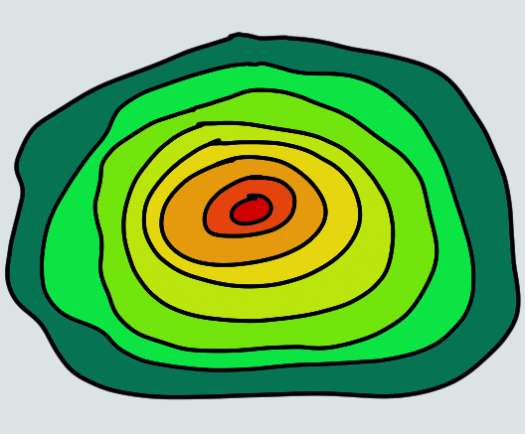
The idea, as it spreads out into the world, starts to change – as it gets further away from the heat of the centre it cools, and is affected by what else is happening around it.

Some people don’t like this and they erect thinking walls around the structure – creating routines and processes and rules.

Rituals.

Rituals are so easy to create – so unavoidable as a result.

Management standards like ISO 9001 are like religious books, the auditors and assessors like priests and acolytes.

Don’t get me wrong – I really like ideas – this website is dedicated to exploring them.

But it’s a very short step from being open to ideas to closing yourself to new ones.

Especially if you start to take your own ideas too seriously.

For example, the other day I was irritated by a professor at a rather good university and his treatment of a subject that I think I understand.

I felt he didn’t get it but he was perfectly happy saying that his alternative method was better.

I’ve just read his piece again and it still annoys me.

But…

What’s also clear is that he doesn’t have direct experience of the concept he is criticising.

So, if you really want to make up your own mind you have to read the core material and then figure out what you want to believe in.

Go to the source, or if you can’t, as close to the source as you can get.

The further away you are the harder it is to get enlightened.

For example, the Nobel prize winning physicist Richard Feynman, once visited a classroom and asked them about how light is polarized when reflected.

They could explain it perfectly.

Something like If light strikes an interface so that there is a 90 angle between the reflected and refracted rays, the reflected light will be linearly polarized.

So he asked them to give him an example – and they couldn’t.

The could recite the mantra – the words that related to the idea.

But what they didn’t realise was that it talked about light reflecting off a surface – like the sea they could see from their classroom window.

Full disclosure – I was one of those kids (not in Feynman’s class – in a different class in a different place) that could recite the words perfectly and miss the point completely.

And this is physics – something that works more or less the same wherever you are.

What hope is there for less defined areas of study?

Which is why we resort to shouting very loudly and hoping people listen or arrange things so that we control what’s happening and they are forced to listen.

Social media and Intellectual Property are built on such methods.

This post is not going to resolve this problem.

At one extreme you have people who say that the truth cannot be taught, you must go to the centre for yourself.

At the other you have the jealous guardians of the way – the way of power for themselves – embodied in rituals and structure and rules and control.

You will have to work out for yourself where you are and which direction you want to go in.

And if you come up with something new…

Try not to become religious about it.

Cheers,

Karthik Suresh

Why You Should Take The Time To Understand The Stories People Tell Themselves

stories.png

Sunday, 9.33pm

Sheffield, U.K.

There’s always a story. It’s all stories, really. The sun coming up every day is a story. Everything’s got a story in it. Change the story, change the world. – Terry Pratchett, A Hat Full of Sky

If you get the chance to watch children think – you will see just how much stories matter to them.

Stories are how they make sense of the world – how it was created, how it works, their role in it.

Today, for example, the little people in my house had a discussion about what created the universe – talking about religious views and the scientific view.

They got the points on both sides pretty quickly – because they were re-telling stories they had heard on both topics.

When we get older we forget that we used to see the world through stories and start to think we see the world as it really is.

But, we’re just fooling ourselves.

The urge to tell a story about what we’re seeing is just as strong whether we’re six or sixty, nine or ninety.

I’d go as far as to say there is no truth – there is only story.

I picked up a book called What is narrative therapy? by Alice Morgan – which is all about helping people use stories to improve their lives.

Morgan talks about stories as events, linked in sequence, across time, according to a plot.

What you do is select from all those things that you’ve seen and that have happened to you the events that stand out in your mind.

You string a thread through those events – linking them together to form a sequence of happenings over time.

And they’re not random – they form in accordance with a plot – the narrative you tell yourself and others.

There is a story you tell yourself about how you got to where you are right now.

I could tell the same kind of story.

If you want to start a new business, you’ll craft a story of what’s going to happen – the events that will take place in the future.

And if you want to make a decision – it will be made on the basis of the story you tell yourself about what’s going to happen when you’ve made that decision.

Stories matter – they are the fundamental, the primary way in which we see the world.

It’s like having story glasses on.

Wearing those glasses, things that don’t matter to your story fade away, are not even seen.

But the things that matter stand out, burn more brightly.

If you have a story about why you were passed over for promotion because of your vindictive boss – the events that help that narrative are the ones you’ll notice and string together and use in your plot.

Now, because stories are so important, you have to learn how to harness them.

Some stories are destructive – they cause you to make poor choices – and you have to rewrite them.

That’s where something like narrative therapy might be useful.

In other cases, you have to understand other people’s stories before you can work with them.

For example, let’s say you want to sell your service or product to someone – how would you go about it?

Most people would tell the prospect their story – all about themselves and why you should buy their stuff.

But what would happen if you listened to the prospect’s story – listened to how they saw the world and what they needed?

And then, if you could give them what they needed with your product or service – show them how you could finish their story.

If not – show them how you can build something that will.

As human beings we crave story – not just on TV or as entertainment – but at the pulsing core of our beings.

Maybe that’s the thing that makes us different from animals – not our ability to calculate or do sums – but our ability to tell stories and re-create reality.

If you can see what is there – well, so can a snail.

If you can imagine the impossible – isn’t that what makes you human?

Isn’t that the story you want to tell about yourself?

Cheers,

Karthik Suresh

This Is The One Principle You Should Always Keep In Mind

pareto-basketball.png

Saturday, 9.18pm

Sheffield, U.K.

When it is useful to them, men can believe a theory of which they know nothing more than its name. – Vilfredo Pareto

You’ve heard of the Pareto Principle, but do you really understand it?

I thought I did but then a video from Miglautsch Marketing popped up on my feed.

It’s a tribute video to a direct marketer called John Wirth, one of whose ideas was around a Bathtub model of customer value.

This bit is interesting because what it reinforces is the Pareto principle in direct marketing.

In any list that you reach out to you’ll get 80% of your results from 20% of the list.

The argument here is that you shouldn’t try and worry about working the tail of the list but instead work on the next one – so you’re always getting 80% of the value and then moving on.

I suppose this sort of idea says worry less about lifetime value – what you get from each person on that list over time – and instead make sure you’ve got hot water coming into the bath and letting cooler, dirty water out.

That way things keep bubbling away nice and warm.

I think that’s the metaphor, anyway.

But the really interesting bit, the one I related to, is later in the video when Miglautsch talks about basketball.

He used to play as a kid, he says, and was pretty good, but he wasn’t good enough to get into the starting five.

He was number 6 or 7, and so he got less time on the court and when he did come in, it wasn’t with the best players on the other side.

And this is the thing you should get.

The main thing that matters is time on court.

Every once in a while I have to watch kids at a sports club – say they’re doing tennis.

There is a game where everyone lines up and then the coach lobs them a ball one at a time.

If they hit it, they get to go back to the end of the line for another go.

If they miss, they have to sit down.

This is the stupidest thing I have ever seen a coach do with kids.

What they’re doing is giving the kids that are already good more chances to get better, and the ones that need the practice less time.

What they should do, if they’re trying to get everyone to the same standard, is get the good ones to sit down so the poorer ones can practise some more.

Or just give everyone the same number of shots.

Anyway, if you’re competitive you probably think this is ok – but then you should be even more worried if you’re the one sat on the bench.

If you’re sat on the bench you’re never going to catch up – those other kids will always get more time and more practice and play against better competition than you will.

All else being equal, that is.

You can do two things to beat this.

You can put in more time on the court.

I once saw a kid do this at school.

We all went home for the holidays and lazed around.

He still went to the school grounds every day and practised his shots.

When the next term started he was sinking every shot he took and suddenly he was always on the starting team.

So, if the competition takes a rest and you keep working then you can get ahead.

The other way is to find something else where you can be in the starting team.

Miglautsch took up skiing and got very good at it.

And that’s something worth looking out for in your own career.

If you try and follow someone else – if you try and become what someone else is – then you’re going to have a difficult path ahead.

Especially if that person also plans to get better.

If, for example, you want to be the next John Grisham or James Patterson, be prepared to wait a while.

But there’s nothing stopping you from being the next you, as long as what you do is valuable and unique.

It’s hard to become a big fish in a pond that’s already full of big fish.

Much better to find your own pond – one where you have no competition and can grow as big as you want.

So, here’s the thing.

If you find yourself in a situation where you are consistently on the bench – stop and look around.

And go find yourself a new game to play.

Cheers,

Karthik Suresh

Why Should Someone Take A Bet On You?

earnout.png

Friday, 7.37pm

Sheffield, U.K.

Once people see you pulling off one role, they think you’re a safe bet to do a similar role. – Margot Robbie

You know when you look at the same thing from a different point of view, you see different things?

For example, you are probably very comfortable with the idea of a payback period.

You put your money into a project and you get it back in three years.

That makes sense – and, depending on the project, more money turns up later.

I was listening to Ryan Holiday, the author of Ego is the enemy among other works being interviewed on the economics of the book business.

And he talked about earnouts.

In essence, if a book publisher wants to buy your book they give you an advance.

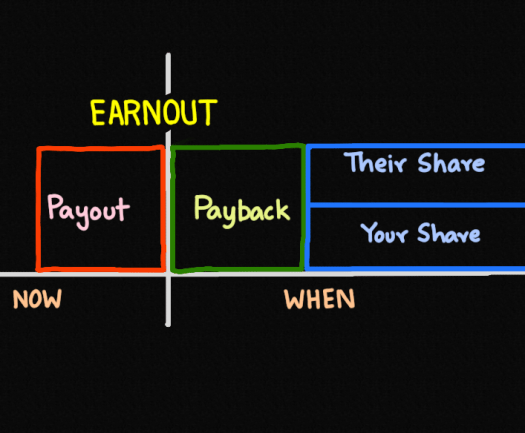
That’s a payout that you get up front – it lets you live and buy noodles while you write.

Then, you write the book and it goes on the shelves and the sales start trickling in.

The first thing that needs to happen is the book needs to earn out – it needs to pay back for the publisher who took that bet on you.

Same thing, different point of view.

Now, imagine what happens when you go for a job interview – how does the boss of the company look at you?

Well, most bosses I suppose, have a role that needs filling – a job that needs to be done.

That calculation is one where they think, “Well, I could be making £50 an hour so I’ll hire someone else to do that job at £10 an hour.”

But really, what you want to have them think is, “Wow, I could sell the skills this person has and make back the money I pay them in six months, and the rest is all profit.”

So, in the book business, the money that comes in first goes to pay off the investment the publisher has made.

And that first part is the same with jobs – where the sales pay for you to be in work in the first place.

And many places actually need a multiple of salary to come in – they might work on two or three times the salary to get to the profit levels they want.

But here’s the thing.

Once you’ve reached a point where your earnout is complete, why should the company get everything else?

In the book trade you start to get a percentage – a bit of those future sales.

And that’s the money that matters – the trickle over time that gives you an income.

I think this whole area is one where people could really do with looking at themselves from an investor’s point of view.

Some people work in jobs where they are cheap – anyone could do that and no one will worry about replacing you and getting someone else in.

Some get paid a lot but deliver just enough to pay their way or not enough to justify keeping them – and eventually that tends to catch up with them.

They might be lovely people – but they’ll still be let go with reluctance.

Some go for the big payout, asking for as much as possible – and they get it while they’re winning, but get thrown out just as fast if they make a wrong move.

But none of this really matters if you’re looking at the long term.

If you look at earnout, the payout you get actually has to last you all the way until the payback has happened – from now to when.

Then you start to get anything else.

But at that point you have to do nothing more as well, the revenues roll in from the product you’ve created, the asset you’ve built.

That asset could be a book, a product or the service you’ve developed.

So, if you’re in a position when you have to ask for money to develop that asset – well, you should be very conscious of the earnout equation.

Because if someone takes a bet on you, and pays you up front, you need that earnout to work out.

Otherwise you might not get a second bet – almost certainly not with the same person.

But all this talk of payout and payback and earnout is simply a way of looking at what’s going on.

It just describes how the bet will pan out as the future does.

The most important thing that needs to happen for any of this to be relevant is that you have to work on producing that asset.

Production is what matters.

If you want someone to bet on you – make sure you’re the kind of person who produces something of value.

Cheers,

Karthik Suresh

Why You Should Be Turning Flywheels, Not Playing On Swings

flywheel.png

Thursday, 7.49pm

Sheffield, U.K.

It takes a long time to get good at something, so it’s important to begin as early as possible so that we can improve and begin to see the compounding benefits of the work over time. – Priscilla Chan

Small things matter over time – often more than big things.

Jim Collins writes about this as the flywheel effect.

A flywheel is a wheel with a very heavy rim, a wheel that’s hard to turn.

If you put your back into it, however, you’ll start to overcome its inertia – the weight keeping it in place.

And then, as you turn it, it will move, first slowly then faster and faster until it starts to be pushed along by its own weight, with only a small bit of additional effort required from you to keep it going.

You now have momentum on your side.

A swing, on the other hand, is quick to get on and start going – and you go quite high and it feels good.

Then, at the end, you go the other way and it feels good.

There is a reason swings are rarely used in machinery and flywheels are.

Collins argues that the metaphor of a flywheel is useful to keep in mind when thinking of what to do with your business.

It’s rarely the big swing, the giant push that gets results.

Instead, it’s the gradual build up of capability and competence and experience that does.

It’s easy to believe that it’s the big hitters that matter – the ones that make the difference in a game.

They may the most visible, the most flamboyant.

And you may think that they make a difference – but that’s because you don’t see all the people who tried ot make a big hit and failed.

But all around you, everywhere you look, you can see people who did something day after day and built their careers and their businesses and their reputations.

The sudden elevation to fortune is a romantic myth – something that we try and bring to life because we love stories.

That’s why shows that have a competition with a winner are so appealing – we want to believe it’s possible to jump the queue and get there faster.

It wouldn’t be much fun watching a show following the twenty-year career of an intern who eventually becomes a CEO.

Sometimes it’s easier to hope than work – to wait for that big change instead of working it out day after day.

But when you do put in the hours, the time – the focused effort to build up your capability – then eventually you’ll find that what you’ve created starts working for you.

As Collins says there isn’t one push that matters – all the ones matter until you reach the point where what you’ve created becomes self-sustaining, reaches a tipping point – where it now pulls you forward with little additional effort.

And that’s a good position to be in.

After all, you could be on a swing where, just as soon as you reach your furthest potential, everything starts to go backwards.

Cheers,

Karthik Suresh

Do You Realise That Where You Start Is Often Where You End?

pleasure-trap.png

Tuesday, 9.09pm

Sheffield, U.K.

Face your life, its pain, its pleasure, leave no path untaken. – Neil Gaiman, The Graveyard Book

I came across at TED talk on the pleasure trap by Douglas Lisle and got hooked instantly.

Lisle is funny and he uses drawings to illustrate complex ideas – so what’s there not to like.

The core concept that you should take away from the talk is that we’re driven by feelings.

That is, when we do things they result in feelings – and those feelings often make us decide what to do next.

They’re like signals that tell us how we’re doing – and they’re often wrong.

They give us bad information – you can’t trust them.

Here’s why.

Let’s say you have a pretty healthy diet right now – the right balance of food groups. and not much salt, sugar or fat.

The kind of thing your parents give you while keeping the treats for themselves, or the kind of food you might eat if you lived somewhere the processed food industry hadn’t found yet.

At that point you eat when you’re hungry, the food is tasty and life is pretty good.

And then you get let out and experience what sugar and fat really taste like.

Your pleasure sensors register levels that go sky high.

I remember this feeling when I first went to a developed country and discovered Coca Cola – this amazing drink that tasted so good.

40 pounds later…

The thing with junk food is that it’s great when you first get it – so much better than fruit or salads.

But after a while you get used to it – the junk food gives you about the same amount of pleasure as the healthy food gave you earlier – you revert to a baseline.

Now, if you go from a diet of takeaways and junk back to a healthy diet – everything tastes dull and boring.

Your pleasure sensors register levels way down low.

Even though you’re moving from a bad situation to a good one, your body is telling you that you hate what’s going on – which makes it very hard to stick it out and not go back to the bad food.

But if you do stick it out, then healthy food starts tasting good again.

And you’re back where you were when you started.

What’s interesting is that when you went from good to bad, the feelings you had were good.

And when you went from bad to good, you registered the opposite – your feelings were bad – of deprivation and loss.

In fact, you would have to overcome your feelings to avoid going for the junk in the first place – and overcome them again if you were trying to get off your addiction.

And this is just food we’re talking about.

When it comes to addictions like smoking and drugs – your feelings are so high and so low that making a change is one of the hardest things you can do.

It would be so much better for you if you never started at all…

Because there is no good news here – it’s going to be hard and painful to get through that trough of whatever is the opposite of pleasure.

You will need help and support and friends and a plan for what you’ll do when you slip back.

When, not if.

Now, if you look at this chart what you’ll see is that normal doesn’t change.

You go back to the baseline – to where you started – whatever you’re doing.

This is the voice of your system.

Willpower is not enough – if you really want to make a change you have to change the system that’s resulting in that graph.

The one thing to remember is that if you’re trying to change something – don’t focus on the people.

People and their willpower abilities are not a good or reliable way to engineer change – they’re swayed by their environment and their feelings far too much.

You have to change the things around them first.

With food, you have to change what you have and how you buy.

You can’t eat junk if it’s not in the house.

With work, you have to change where you are and what’s around you.

If you go to the same place to work every day at the same time – it gets easier to get started.

Change the environment and the physical conditions that you operate in and your feelings will find it harder to drag you back to bad action.

And that way you have a fighting chance to end up somewhere different.

Somewhere you want to be.

Cheers,

Karthik Suresh