Understanding Your Prospects And Customers Using A Sensory Map

sensory-map.png

Wednesday, 5.26am

Sheffield, U.K.

All our knowledge begins with the senses, proceeds then to the understanding, and ends with reason. There is nothing higher than reason. – Immanuel kant, Critique of Pure Reason

In my last post we started looking at how to research your prospects, collect data that you can mine for insights into what they need and how you can help.

We’ll carry on with trying to see their world the way they see it – using a sensory map this time.

All information comes through the senses

One of the biggest mistakes we make as human beings is called the curse of knowledge.

We assume that because we know something that means other people know it as well.

And that just isn’t the case – they have to gather knowledge in their own way and that starts with the senses.

However, you can look at the senses from two levels – one is the immediate surface impressions of what they actually see and then there is the question of what they expect to see – and if what they see is different from what they expected to see, there is a clash – something called cognitive dissonance – which can be good or bad.

Let’s see how this works when it comes to them and you.

What do they see?

When someone looks at you or your product, what do they see?

I had an experience recently where someone connected with me on LinkedIn.

It looked like a sales outreach, but as I didn’t want to turn it down without doing some research I connected with the person – because they seemed to have a product that was relevant to my area of interest.

I asked a question in response to their message – but then I also checked their website.

Which turned out to be a couple of pages – a brief description of products, an odd mix of content promoting two types of services and that ignored conventional principles of formatting.

Everything was written in lower case.

This is what people do – what you do – we can now very quickly research the people who get in touch with us and the first things we see form that initial surface impression.

And when someone looks your way is what they see what they expect to see?

And what do you want them to see?

For example, do you believe that it’s important to dress well – that an expensive suit and car demonstrates how successful you are?

When you look at a video on YouTube do you skip over anything that isn’t in high definition, with perfect lighting and sound?

Or do you think that people should see you are you are – that you should be authentic in the way you present yourself – normal rather than extraordinary?

There are rarely clear cut answers to these things – and often strongly held opinions.

I remember watching a show where entrepreneurs went up in front of investors for money and one of the investors asked why a group were there in jeans and t-shirts rather than in a suit and tie.

The group answered that they spent their days working on their business and they wanted to show themselves as real, hard-working people who could get the job done – and the investor said that was the best answer they could have made to that question.

So think about your customers and what they expect to see – do you think they would prefer the “real” you or do you need to present an “image” that is consistent with what they expect?

What do they hear?

If the first thing we do is see, then the next thing is usually to hear.

What does your prospect expect to hear from you?

Usually it’s one of two things – they expect information or they expect to be entertained.

They don’t want to be given irrelevant information or be bored.

But that’s what happens a lot of the time with the way in which we do things.

No one sets out deliberately to find useless information or waste time – but in business we end up putting prospects through that experience all the time.

So you have to think about what you are going to put out there that they are going to hear.

Is it polished and slick and perfect or is it more simple and real?

Are you going to write in “corporate speak” or in everyday language.

The style you choose for the way you are seen is going to probably influence the way you want to be heard as well.

Which is actually a disadvantage for corporates – they cannot afford to take risks and so they end up looking and sounding dull and predictable.

As an individual or a startup you can afford to be real or dynamic or innovative.

What do they smell?

After the first two senses comes smell.

Smell is an interesting one – you don’t physically have a smell when you’re doing digital products or marketing over the Internet, for example.

But a smell test can also be taken as does you product or business smell right.

Going back to the example of the website I looked at earlier – how many times have you looked at something and thought that something is off here.

This is what you might call a gateway sense – seeing and hearing are about initial impressions, but smell starts to get you involved and you will step forward or back away depending on whether it smells right or not.

What do they touch

The next sense that gets involved is touch.

In real life it’s an examination of the product, but in our digital world it’s an examination of the features and specifications.

Does this thing look like it will do what I need?

Your prospect is now getting involved, they’re look at the details and trying to see if your product or service will work for them.

When it comes to online sales, especially on marketplaces, this is crucial.

You have to get the descriptions right to be in the running, and quite often people will look quickly at the first few results if the price is low.

If it’s expensive they will spend a lot more time doing research.

But in either case touch, or the digital equivalent will come into play as they decide what to do.

What do they taste?

And then, finally, they’ve bought your product or service and it’s time for the last sense.

When they try it do they like it or not?

Satisfied customers come back for more.

Dissatisfied ones leave.

Unhappy ones leave bad reviews.

You need to make sure that you don’t assume people are happy with what you do – most people don’t speak out and tell you what they think.

You have to get it out of them – really look to see if they enjoyed themselves rather than taking the approach of disinterested waiters who come over and ask if your food is all right because that’s what they’ve been trained to do at the ten minute point into your meal.

Put aside what you know, and sense again

Look at the sensory map in the image above and try to put aside everything that you know.

Look again at your product and service, the way someone with no knowledge of you and what you do would do.

What would they see and hear.

When they got closer, what would they smell and touch.

And finally, when they asked you to serve them, what would they taste?

And is the experience they have the one you want them to have?

And if it isn’t, what do you need to change or do differently?

In the next post we’ll carry on with our exploration to map our customer’s worlds.

Cheers,

Karthik Suresh

How To Carry Out Research To Understand Your Prospects And Their Backgrounds

prospect-research-process.png

Sunday, 5.20am

Sheffield, U.K.

Journalism, as concerns collecting information, differs little if at all from intelligence work. In my judgement, a journalist’s job is very interesting. – Vladimir Putin

How can you start to understand how someone else thinks?

These days it’s easier than ever before, because people put so much of themselves out there on the Internet.

You just need to spend the time doing your research.

A good model for how to go about doing this is to think about how a journalist might do a profile for their publication.

So, what would that look like?

Preparation

The most powerful tools in a researcher’s toolbox are a notebook and pen.

Get a reporter’s notebook – one of those small four by six notepads, wire-bound at the top.

Get the cheapest one you can so you’re not worried about getting things perfect – this is a working notebook, a tool to help your process.

And grab a pen – and you’re ready to get started at take some notes.

What can you see

In this post we talked about how you could research where people spent their attention because of the tracking and information we get on the Internet.

This is always a good start – what does the data say?

For example, let’s say you’re interested in a particular field – process engineering.

If you type those words into LinkedIn you’ll get a number of results, including people who work in that industry.

If those people are the kind of people you want to talk to, then you can click on their profiles and look at the kinds of things they post and like.

Take notes on the kind of content they appreciate, the material they share and repost.

Now, imagine you were going to reach out to them.

The easiest thing to do is to simply send them a connection request, with no additional information.

You could add a note that is a generic connection message, something you cut and paste into every message.

Something like, “I’m trying to grow my connections and so I’m connecting with you” – something that says nothing.

Worse, you could follow up with a sales pitch as soon as you’re accepted.

Or, you could send a customised message that’s based on your research – where you point out the interests you have in common and ask if they would like to connect with you.

Then, instead of following up with a sales message, you can share the kind of content you know people like that are interested in, see if you can get them to like and engage with your material.

Which one of these approaches do you think has a higher chance of getting better engagement from the people you’re trying to reach?

What do they write?

Some of the people you want to reach will also put out material about themselves and their businesses.

Read what they write, study how they look at their world and explain their point of view.

The way someone writes can tell you a lot about the way they will respond to others.

It tells you whether they are open and warm, neutral and willing to reserve judgement or cool and reserved.

You can get a sense of whether someone will respond when you reach out or not.

What do they say?

Another very useful source of insight into people is to listen to interviews they’ve done or read the transcripts.

You can get a very good sense of an individual, their personal career journeys and the nature of their industry from interviews they’ve done.

They will talk about what excites them, what they see as the main problems and constraints they face, where the big opportunities are in their field.

That kind of information is hugely valuable for you when you try and construct a pitch or reach out.

If you know that a person cares about a particular topic and you are able to talk about how that topic is related to you and your interests – you’ll increase your chances of getting a positive response.

What do you know?

The last area, and possibly the most dangerous one, is to take notes on what you already know about your prospects.

What insights do you have into the way they think and what they want.

It’s important not to fool yourself, to make sure that what you know is based on facts and evidence – things that you can draw on to support your conclusions.

It shouldn’t be about what you think or believe is the case – you need to be careful not to create an idealized prospect who thinks the way you do about everything.

But, if you truly have an insight into their situation and perspective, draw on that, craft it into your messaging because you know it’s going to interest them.

Go forward based on research and evidence

When you first get started you need to ground yourself in research and evidence – you need to collect data.

This is where your reporter’s notebook has been an invaluable companion in the process, you should now have pages of notes and snippets of conversation that you can draw on.

Just that process of data collection will have been useful in itself.

But you can go further – process this data and really build up your understanding.

Before we do that, however, let’s see if we are in a position to build empathy with your prospect.

Let’s look at that in the next post.

Cheers,

Karthik Suresh

How To Find Out What Is In Someone Else’s Mind

whats-in-the-other-persons-mind.png

Saturday, 4.57am

Sheffield, U.K.

I do not regard advertising as entertainment or an art form, but as a medium of information. – David Ogilvy

In the last couple of posts, which you will find in the Getting Started category, we started looking at how you can figure out who your customer is and how you can serve them.

We’re circling this topic at the moment rather than heading straight for a strategy because while it’s easy to map out a particular method we need to understand whether it will work for you in your particular situation.

We’re looked at why you should focus your efforts on the people who want what you have, even if they don’t know it yet, and understanding how people spend their time.

Today, we need to look at how we can see into their minds.

Research based marketing

Let’s say you run a business that does health and safety consultancy.

This is the kind of expert, professional consultancy that you find many people starting, after ten to fifteen years of corporate experience they can set up a small business and try to build up a clientele.

What happens when you start to market that business?

You probably think of it in a certain way – there is a structure and shape to the way you do your business.

Imagine it’s represented by a pyramid.

Now, you go to someone else and try to pitch your pyramid to them.

What they need, even if they haven’t articulated it yet, is a ball – something that is a different structure and shape to the one you are proposing.

Now, imagine what could happen during this interaction, when you meet your prospect for the first time.

In the vast majority of cases, you take the opportunity to talk about yourself and your pyramid.

The prospect may ask questions about your pyramid – the purpose of which are to see if your pyramid could be used as a ball.

If it can’t, then they’ll probably feel like there isn’t a fit here, and politely turn you down.

Could you have avoided this?

Yes, by following a research based approach, one that tries to work with evidence.

What would that look like?

Get better at interviewing

The first skill you have to develop if you’re getting started on a new project is to learn how to interview people.

Many people see an opportunity to talk to a prospect as one where they can talk about themselves, what they do and how they can help.

No one cares.

What you should do is look at every such opportunity as a way to interview people instead.

When you interview someone you’re trying to see the world from their point of view, by asking questions that explore and illuminate their perspective.

If you see things the way they do, then you start to get a valuable glimpse of what they need.

For example, let’s say you sat down with your prospect and talked through their situation, asking questions that helped you understand what was in their mind.

And it turns out that what they want is a big, green ball.

What you make is a small, blue pyramid.

Knowing what you now know about their needs, would you pitch your small blue pyramid as a solution for their need for a large green ball?

Some people will – and then they will pile on pressure to try and get you to buy.

A switched-on person, on the other hand, will start thinking about how they can make a large green ball.

That’s the first kind of research based marketing approach you should try – go into a meeting thinking like a journalist, armed with your reporter’s pad and paper. determined to learn everything about the other person, to really research their story.

If you can really listen to their story, then you will know what they need and want – and then you have to go away and figure out if you can deliver that.

Taking our health and safety consultancy as an example, you might have learned your skills in a large manufacturing organisation.

Your prospective client, on the other hand, is a retailer.

Will you bring over your manufacturing processes unchanged into this new environment or will you learn and discover what is needed and adapt what you do accordingly.

It seems obvious what the right answer is when you look at it like that.

Most people don’t do the looking bit.

Get better at experimenting

The second approach you can take to gather evidence is to build a stripped down version of your product or service and get people to try it out.

This is commonly used in the technology industry and called a Minimum Viable Prototype or MVP but it’s a principle that can be used in any industry.

It’s much easier for people to have an opinion on things if you make it real for them – something they can see and almost touch.

But you don’t want them to think that you can’t do anything else and walk away as a result.

Which is where putting things forward as an experiment on which you’re looking for feedback is a powerful way of getting started.

For example, let’s say you think you can do a desktop based health and safety audit which will cut costs by getting people to take pictures of their surroundings and analysing the images rather than going there yourself.

You could package this together as a proposition – one that helps your prospect move from a mechanical, scheduled set of audits to a dynamic risk based set of audits that means you focus on the places where it’s clear there are problems.

And maybe you use the pictures to coach and provide feedback to the individuals concerned about how they can improve their premises.

If you can work through the proposition, the benefits and a rationale – then you have something you can put in front of people to get their views.

You don’t say, “I’ve made this, do you want to buy it.”

You say, “We’ve come up with this innovation, we’d love to get your thoughts and feedback on whether it’s useful.”

People love to help, and you will probably find enough people to have a look – and you want people who are not afraid of hurting your feelings.

That’s where online businesses shine – most have built in mechanisms for gathering feedback – such as likes and comments.

And then, based on the results of your experiments you can figure out what to do next.

Preparing the groundwork

The thing with other people’s time is that you don’t want to waste it.

If you go to someone and ask questions without having done any background research, when it’s clear you know nothing about them or their industry, you’re going to get in trouble unless you are extremely good at interviewing.

If you’re great at getting people to just talk – to tell you everything – then that’s ok.

But it’s better to go in prepared, with a knowledge of who they are, what they want and how they think – if you can.

The model to follow here is the one journalists take – how do they prepare for an interview with someone and what can we learn from them?

And, what should we not learn from them – when are their objectives different from ours?

Let’s dig into that next.

Cheers,

Karthik Suresh

Why You Need To Research How People Allocate Their Attention

the-importance-of-attention.png

Friday, 5.16am

Sheffield, U.K.

The world is moving so fast these days that the man who says it can’t be done is generally interrupted by someone doing it. – Elbert Hubbard

In my last post I talked about the importance of studying who you could help so that you could build empathy and understanding with them, which in turn helps you understand what kinds of products and services you can build for them.

Let’s start by studying the things they pay attention to.

Data is everywhere now

One characteristic that you will start to notice if you study what happens on the Internet is that there is a pattern that repeats all the time.

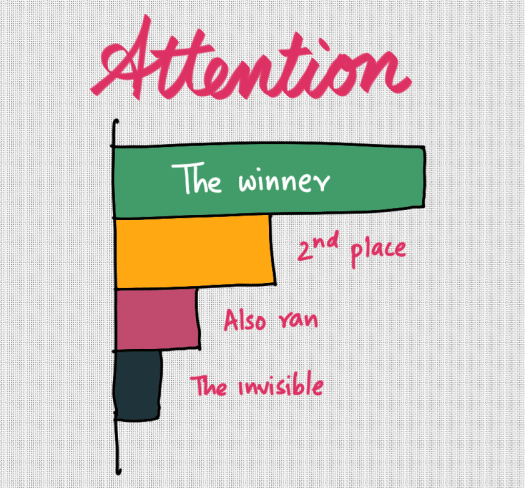
It’s called a power law, and tells you the difference between being number one and anything else.

Let’s say you run a YouTube channel and list out your videos with the number of views each one has had, it’s very likely that one will be the clear winner.

The next one will have half to two-thirds of the views.

The third one will have half to two-thirds of the second’s numbers.

And then you have all the others.

This applies almost everywhere, actually, but it’s most visible on the Internet because the statistics are easy to collect.

For example, the chart below shows the views on my blog for the last month showing the first, second and third page views and then the average views of the next seven pages.

attention-data.png

But, while there is usually a clear winner with this kind of situation, there are two observations you should take away.

The first thing is that you need first place to get attention.

But you will only get first place for one of your pieces of work – and the rest of your list, the backlist, still matters to build your credibility and conversion.

And while the winner brings people in through the door, it’s everything else that will get them to stay and convert them into paying customers.

Again, this is a phenomenon you see all over the place.

In the publishing industry, for example, it’s the initial book sales that makes reputations – as the publicity and attention get people to notice you.

But it’s the sales over time that make you a fortune.

Given that situation, what do we need to look for?

Look for models of how getting attention is done well

As part of this Getting Started book project I’m running experiments that can help support some of the suggestions made in these posts.

For example, one project that you may be considering is whether you should start a YouTube channel.

How would you go about looking for models of how this is done well in your sector – what people have done to get attention from others?

I started by doing a search for a term on Google and comparing the results on the “All” results tab and the “Videos” tab.

You get around 6 million hits for the term on the All page and around 550,000 on the videos page.

This first term is fairly technical so I put in a non-technical but also fairly specific term.

That had 440 million hits on the All page and 2 million hits on videos.

What this tells you is that the more technical the subject the less competition there is.

The richer the content, in terms of adding images, audio and video to text, the less competition there is.

And the more detailed, useful and longer your content, the less competition there is.

When you do this you’ll end up with a much smaller universe of people who you might be in competition with – and then you have to look at what they do well.

And the chances are that they do the basics extremely well – they do the things that make life easier for their viewers and audience.

As you look at each one take notes of the elements that you think they do well, the things you notice.

I like doing this on index cards or slips of paper for the first five or so results, because you notice different things each time you look at a video or page.

If you have notes on separate cards, you can then spread them out and see what elements are common, what are the things these successful pages or videos do well?

And then you have to ask yourself whether this is a space in which you can compete.

If you think you can do something differently, combine your skills to create value in a way that isn’t being done already, then you may have discovered a niche.

If the field is dominated by a small number of very well-known people then you’re going to find it harder to get attention – but if you keep researching and digging you’ll probably eventually find a niche that has space for you.

And then you have to make that niche your own, so that the next time someone comes digging they take a look at what you’ve done and decided there is no point competing with you and go away to find their own niche.

And that’s when you become a model for others.

Why can’t you just make stuff and not bother with research?

I wouldn’t argue with that point of view – I’m in favour of creating without restrictions, without keeping an eye on the market, without looking for an outcome.

But that’s about you – about you doing what you enjoy and creating something that you would make anyway whether people bought it or not.

And the best projects have their inspiration in something you care about, something you like doing.

If you enjoy DIY or writing or technology, then the core of what you do is the work, the thing you do.

And the first element of getting started is just to do more of that thing you want to do.

But we’re talking here about developing a market for what you do – getting other people interested in buying it from you.

In getting them to first give you their attention and later their money in exchange for the things you make.

And that requires a different approach – it requires starting from how they see the world and the kinds of things they need.

Now that you can see the kinds of things they already pay attention to from the research process described in this post, it’s time to start thinking about why they pay that attention – what kind of person are they?

We need to develop empathy with them, so let’s try and do that in the next post.

Cheers,

Karthik Suresh

How To Figure Out Who You Can Help

who-likes-your-work.png

Thursday, 5.21am

Sheffield, U.K.

People in markets find a way of getting down to the essentials of I have, you want; you have, I want. Audre Lorde, Sister Outsider: Essays and Speeches

Let’s talk about circles.

In the last post we looked at how you could create a narrative, a story that explains who you are and what you do.

So far in this book project we’ve looked at where you are right now, because the situation you are in and the constraints you have dictate what you might be able to do, and looked at what you’ve done in the past, because that’s where you’ll find proof to persuade others to believe in you.

Now, you need to find those other people and the next few posts will explore this idea and how it works in these rather interesting times.

How to get your mind set up right

If you’re anything like me, sales and marketing is something that you’re a little afraid of – it’s got to do with putting yourself out there and talking about yourself and learning how to pressure people into buying things they don’t need.

Isn’t it?

Well, not if you look at it from the point of view of a consumer.

Let’s think of the kind of states a consumer can be in, parallelling the famous unknown-unknowns matrix approach.

Think of a two-by-two matrix, labelled “want” and “don’t want” on one axis and labelled “know” and don’t know” on the other.

The four categories in this matrix that consumers can inhabit are then: know they want something, don’t know they want something. know they don’t want something and don’t know that they don’t want something.

The best people to be aware of, ironically, are the ones who know they don’t want what you have to offer.

If you know who those people are then you can ignore them, in terms of what you spend on marketing and in the time you spend on paying attention to them.

The most dangerous category is the one that contains people who don’t know they don’t want what you have to offer.

They will take up your time with enquiries and free consultancy before discovering that you’re not a fit.

The people who should be in your circle, then, are the ones who know they want what you have to offer and the ones who don’t know they want it yet.

These are the people to focus on, the ones you can help

The first thing to do then, to get your mind set up right, is to get clear on who is inside and who is outside that circle – and then work on the approaches that are going to work for you.

Singing on the street versus asking a question

It’s tempting to think of marketing as a predatory activity, dominated with the language of “targets” and “hooks”.

When you use that language then it becomes a mechanical hunting exercise, where you go after creatures of less intelligence armed with the best hunting machinery you can buy.

But, what would your approach be if you treated others as human?

Broadly, there are two main approaches.

You can make yourself visible and discoverable, like positioning yourself on a street and singing.

Or you can try and get their attention, like a person with a clipboard, interrupting them and asking if they’re willing to talk to you.

The terms I’m going to use for these two approaches are “attraction” and “outreach”.

And the people who you’d like to interact with form an audience – that ranges from a small, niche one to a large, diverse one.

The thing you need to figure out is what strategy will work for you in the situation you are in.

The one that most people who are getting started will probably settle on is a balance between attraction marketing and outreach marketing for a niche audience.

Doing your research

They key to understanding the people who live inside the circle – the ones who will want the thing you have to offer – is to do your research.

We live in a time where people are more visible than ever and more open about what they like and dislike than they have ever been in the past.

That makes it hard to stand out from the crowd if you want to get attention for yourself.

But, at the same time, the goal of the algorithms that power the social engines of today is to match users with relevant content based on the preferences they display on their platforms.

And of course, since more than one person can create relevant content, they have a way to jump the queue based on your ability to pay.

But that’s something to think about later – the first thing is to work out what is already working in your space.

The best test of workability is whether people are paying for something or not – with their money or with their time.

If you are working in a field where sales results are easy to get then that’s your starting point.

Books are a good example – what kinds of books are people buying in the genres or categories you’re interested in?

What kinds of videos are getting the most attention on YouTube?

What topics are people talking about and engaging with on social media?

Take notes, collect your research, start by just mining the world around you for information.

That sounds like a big task – surely you have to spend a lot of time or perhaps you should pay someone else to do the research for you, or buy a report?

Unfortunately, there isn’t an easy out here.

You have to take the time to understand the people who live inside your circle – and that means putting in the time to do your research.

What you need to do is a participative ethnographic study – look at the group from the outside as an observer and also look at it from the inside as a participant.

You have to build empathy and understanding with a group of people who may not know each other but are connected by a web of interests.

How can you do that?

Perhaps that’s something we should work through in the next post by looking at how anthropologists work in a digital age.

Cheers,

Karthik Suresh

How To Arrange The Elements Of Your Story

narrative-arc.png

Wednesday, 5.31am

Sheffield, U.K.

Nonfiction is both easier and harder to write than fiction. It’s easier because the facts are already laid out before you, and there is already a narrative arc. What makes it harder is that you are not free to use your imagination and creativity to fill in any missing gaps within the story. – Amy Bloom

Why should we believe you?

Why should we buy into your idea, sign your proposal, invest in your scheme, go with what you say?

In the last few posts on this book project I’ve been discussing ways to look back at your life and get a sense of what you’ve done.

The idea is to look at things from multiple perspectives and, as you do that you will start to notice significant elements, from significant events that influenced you to specific creative opportunities that helped you grow.

We need to capture these memories.

The power of slips of paper

Robert Pirsig’s book Lila describes the way in which the main character, Phaedrus, documents his research on slips of paper.

When you write things down on paper, you freeze them in place.

What we want to do is capture your thoughts but put them into a form that’s flexible and useful for what we want to do next.

Get a stack of index cards or tear up some A4 paper that you need to recycle into 4 parts.

It’s time to mine for memories.

Look back at your past and start to jot down key memories about what you’ve done so far.

On one slip, you might make a note about a school you attended.

On another, a particular class that opened your mind.

Perhaps notes about each of the mentors you had and what you learned from them.

A note about each of the projects you’ve done and what’s significant about them.

These notes don’t need to be long and detailed, a few words will do unless you want to add detail.

Now, you could write about anything and everything, so how do you keep from writing forever?

Perhaps the time to worry about that is after you’ve got a few down – for most people the act of remembering and writing is going to be naturally tiring and you’ll stop after a while.

So perhaps give yourself twenty minutes or so to write as much as possible and then sit back to look at what you’ve done so far.

What is your purpose?

The reason why you are collecting these memories is to support the project that you’re trying to get started on.

For example, let’s say you want to start a business as a consultant, doing something you specialise in like analysis or data management.

You’ve made things a little more challenging by handing in your resignation shortly before the start of a global pandemic and it’s important that you get something in place fairly quickly.

Now, let’s say you are given the opportunity to pitch to a prospect – what are you going to do to get them interested in you?

You could list a series of facts about yourself.

Or you could tell them your story.

What is a story?

A story, your story, is at its simplest a telling of one thing that happened after another.

This happened, and then this happened, and then this happened.

The things are connected in time and you go from start to finish like travelling along a road.

What do you need to keep in mind when making that journey?

The first is to recognise that there is a main path, one that takes you from start to finish.

Other paths and side roads are not relevant to this particular story.

The second is that darting about to different points in the road is probably not the best way to make the journey.

Going from start to finish along the road is the most effective way, unless you find that it’s useful to dart forwards and back, flash forward or back.

The third is that an interesting road is not a straight line from A to B, a narrative arc is more interesting.

So, how do you tell your story?

Arranging the elements of story

Let’s go back to those slips of paper.

The first thing to do is put them in order.

You can do that simply by taking two slips and comparing them.

Does one come before the other in a narrative – did one happen before the other?

If so, arrange them in order.

Then pick up the next slip and compare them with the ones you’ve already ordered.

They will fit in there somewhere.

Repeat until done.

When you’ve finished you will have an ordered pile of slips of paper that set out key memories as they’ve happened over time.

You now have the raw materials for your stories.

Creating a narrative arc

Let’s go back to that example of a consultant and that pitch.

What is it that the prospect wants?

They may have a “presenting problem”, something they say is an issue that they’re looking for help with.

That’s their state at the start of your discussion.

When you’ve finished doing your work you want to have helped them solve that issue, improve their state.

And so the purpose of the stories you tell is to provide proof, a narrative of how you’ve done that before so that they can see that you know what you’re doing and should believe that you have the ability to solve their problem.

Too many people spend these valuable pitch minutes talking about things unrelated to the presenting problem.

Not you, not when you have your slips of paper at the back of your mind.

You can draw on the ones that create a linear narrative that provides proof of what you can do.

And you make it interesting by following an arc – a road or through-line – that connects the elements.

Start with the introduction – I’ve solved this very problem in a few other situations.

Provide a build up – for example, I was in this situation and these were the challenges we were facing.

Rise to the main problem – things came to a head because we had to deliver in two weeks and our systems just couldn’t cope.

Resolve the problem – what I did was create a set of spreadsheets that could work with our systems to deliver the information.

Provide an ending – and so we shipped on time and the client was happy.

That simple narrative is often much more powerful than a list of facts or certificates or courses you’ve taken.

Why does storytelling matter in business?

People don’t care about you and what you’ve done and why you’re so clever.

Not because they’re mean or cantankerous – it’s just they’re busy and they have their own problems.

They care about what you can do for them.

But they won’t just believe you – you have to show them why they should believe in you.

And the best way to do that is to provide proof – evidence that they should believe.

And the best way to present that proof is in the form of stories, narratives that describe how you did this, for whom and when.

And it helps if you can make it interesting.

Now that you know how to mine your memories, record them and select and arrange them to tell a story it’s time to find someone who’s willing to listen to you.

Let’s look at that next.

Cheers,

Karthik Suresh

What Do You Do When You Haven’t Got A Track Record?

best-time-to-plant-a-tree.png

Tuesday, 5.37am

Sheffield, U.K.

The best time to plant a tree was 20 years ago. The second best time is now – Chinese proverb

What if you’re trying to find examples of valuable work you’ve done but nothing comes to mind?

You might have done lots of things – jobs, projects, hobbies – but it’s hard to see how you can use them to explain to someone else why they should work with you.

In this section of the Getting Started book project we’re looking back at your past, mining it for evidence and proof of your capabilities and achievements.

But what if that’s hard to find, especially if you’re looking at entering work for the first time or trying to change your field entirely.

Create a past first

When you haven’t got a track record the first thing to do is get to work creating one.

You need a portfolio of work to show prospective customers and it doesn’t matter whether what you did was paid for or not – what matters is being able to prove that you have done similar work in the past first.

Without that, you’re unlikely to get anyone to accept a proposal from you.

That means spending time working on projects, creating demos, putting together prototypes.

The idea is to show work, not work in progress – complete examples of the kinds of things you do.

Give yourself time

It takes time to create a track record and it’s worth investing the time because you will build on that experience to design the rest of your life.

Clearly, if you haven’t got funding then you need to find something else to do to pay the bills while you develop your experience on the side.

This may be hard to do, so you have to find ways to make it easy.

The simplest way to do this is to give yourself ridiculously easy goals, set very low hurdles, just so you can get started.

It can still take time and you may still find it hard to get started.

For example, back in 2015 I tried to have a go at writing.

Looking back at the entries I lasted for 14 days.

2016 was worse, I made 6 entries.

It wasn’t that I didn’t write at all – I just didn’t write for myself on things that interested me.

In early 2017 I set myself a low target – three paragraphs of anything a day.

I could write whatever I wanted as long as I wrote three paragraphs – around ten lines, around 100 words.

That year I wrote 284 three paragraph sections.

And in the middle of that year I started writing my blog on a regular basis, eventually writing 157 articles.

They weren’t particularly good and it took a couple of years to discover a voice and start writing in a way that felt natural.

Three years later, and half a million words in, I’m still learning and figuring out how to improve and learn – and that will take the rest of my life.

At the same time, I have built a body of work that I can draw on when people ask me what I do or have a question on a topic I’ve discussed here before.

If you’re in a position where you’re starting today, then be kind to yourself, give yourself time to plant a seed and watch it grow.

Plan for longer than you think because then, when things happen faster, you’ll be pleasantly surprised.

Every field is different, and also the same

You may think that your industry is different or that you need something else to break in, some kind of shortcut.

I was trying to teach maths to one of the small people in the house yesterday and it was proving challenging.

The small person couldn’t understand why you couldn’t get from the question to the answer in one step, why you had to mess about with all the intermediate working out that came along with a problem in long division.

“There must be a way to just get to the answer,” the smaller person wailed.

There isn’t.

You have to take it step by step – but eventually you can get pretty far that way.

While it’s tempting to take a huge leap or hitch a ride with someone else – those approaches either take too much energy and carry a high risk of failure or they depend on what other people do.

If you’re starting this project because it means something to you then take the time to build something that you will benefit from over the long term.

Building on your past

You can start to move forward when you have that past in place.

The most important thing you now have is proof – proof that you can do something.

You will have found that even if you had to do your first projects for free, people eventually started to pay you for what you did as long as they received value in exchange.

It might have taken two years, it might have taken five – and you might have had to finance that time through a day job or with freelance or consulting work.

Either way, you’re here now and ready to get started.

What you need to do is draw on this past to build your future.

And that starts with crafting your story.

Let’s look at that in the next post.

Cheers,

Karthik Suresh

When Have You Helped Transform Something Into Something Better

understanding-transformations.png

Monday, 5.27am

Sheffield, U.K.

As Gregor Samsa awoke one morning from uneasy dreams he found himself transformed in his bed into a gigantic insect. – Franz Kafka, The Metamorphosis

Let’s talk about transformation today.

In the last post we looked at a technique to look back at your career in terms of stages.

Along the way you’ve done much, achieved much.

But how have you changed things?

That’s what we need to find out next.

What is a transformation?

The essence of transformation is in taking something in, doing something with it and pushing something out.

You could have a transformation that does nothing – and that could be because of the input what happens in the process of transformation.

For example, if you just pour water through a sieve, nothing happens – the water drains out even through the sieve’s purpose is to hold something back.

But if you use a sieve to drain a saucepan of potatoes you’ve put on the boil you’ve transformed wet potatoes into dry ones.

Transformations are all around us.

Everything we see that’s made by humans has involved taking in raw materials, doing something to them and producing something different.

It’s the most fundamental act of human creativity and every single manufactured thing that you see in front of you right now is an example of how it’s done right – how raw materials turn into a finished product that someone like you is willing to buy.

It’s a concept that’s so ubiquitous that we don’t always recognise that’s it’s happening so it’s worth spending a little time digging into what this means for you.

What have you made today?

Let’s start with something simple.

What did you make today?

What raw materials did you gather and shape into a product that someone else found valuable?

Arguably, everything you do meets that criteria.

As long as you haven’t spent the last eight hours asleep in bed or in front of the TV, you’ve been doing things that involve transformations, even if it’s just for your benefit.

You’ve transformed a sink full of dirty dishes into a sink free of dirty dishes.

You’ve transformed dirty clothes into clean ones.

As I write these words, I’m working on transforming an idea on a slip of paper into a small essay on the subject.

The thing to remember about transformations – the absolutely essential point – is that something has to change.

If something doesn’t change it’s all just talk.

Which transformations matter

If everything humans do is some kind of transformation then which ones matter – which ones create value?

Value is something that is created in the eyes of the person who benefits from the transformation.

The same activity can be classed as a transformation or a waste of time depending on how the observer sees things.

The easiest way to see this is to think about any kind of expert consultancy activity.

The first thing a consultant will do is transform facts into an opinion.

For example, a lawyer may give you an opinion on whether the facts of the situation surrounding your dismissal justify bringing a claim against your employers.

If the opinion favours what you want to do then you might judge it worthwhile.

If it doesn’t, you might judge it worthless.

If you see an opinion that is negative as one that has potentially saved you from spending a lot of money fruitlessly then you might judge it worthwhile.

Value is a layer of perception built on something that passes for an agreed reality.

We agree I have transformed something into something else – for example, an idea into an essay in this post.

You judge if that was worth doing, if it is valuable.

What valuable transformations have you done in the past?

This idea of transformations is something that you need to take a good look at if you want to get started on that new business or project.

It’s not enough to have skills, to say that you can do something and are available for hire.

That’s just a job – one for which you’re either paid a steady salary or an irregular one, depending on how you’re hired.

But it’s not a business.

You have to look back at your career and look for examples of where you helped someone in a situation move to a better situation.

In business, this often comes down to increasing revenues, cutting costs or improving operations.

Preferably all three.

For example, if your marketing services helped a client understand what their customers needed better, created a focused project scope that meant they could make it with fewer resources and associated costs and, in the process, cut down their sales conversion from 12 months to 6 weeks, you have an example of a valuable transformation.

The more experience you have the more of these examples you will have to draw on.

We hope.

Think back over your career and life so far, and list the times when you did something that was transformative and valuable.

These are the examples around which you can build your story.

But what if you don’t have any yet – what if you don’t have anything to talk about?

If you haven’t got a past, you first have to create one before you can move forward.

Let’s talk about that in the next post.

Cheers,

Karthik Suresh

How To Map The Stages Of Your Career To Date And Work Out What’s Next

stages-of-growth.png

Sunday, 5.20am

Sheffield, U.K.

And the day came when the risk to remain tight in a bud was more painful than the risk it took to blossom. – Anais Nin

We’re working through the second act of the Getting Started book project.

This is the last of three techniques to help explore the past and get some perspective on what you have experienced so far.

The first technique, lifelines, let you see the sweep and trend of what’s happened.

The second, defining experiences, asked you to pick out key events that have made you who you are.

And this technique, stages of growth, will ask you to take a hard look at the development of your career to date.

What stage of your career are you in?

This is not, as I have explained elsewhere, a book that promises shortcuts.

Transformation takes time and you should think in terms of decades, not weeks or months or years.

If something is easy to do then it’s as easy for someone else to do – it gives you no competitive edge, no protection, no defensive moat.

Those things come with time, with accumulating experience and creating artefacts and building proof.

And over a period of time, your own career will have developed.

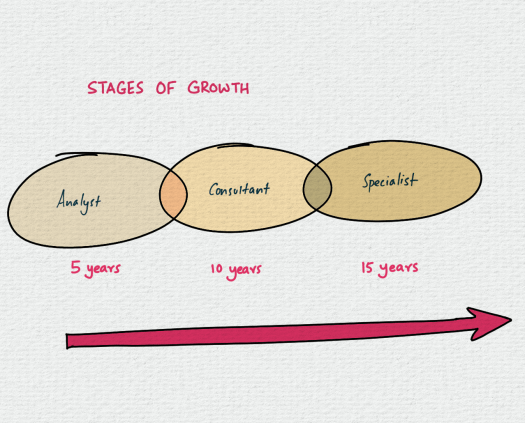
For example, let’s look at a typical knowledge worker’s career over a span of fifteen years..

The first five years are spent in learning about the field and doing analytical work on a customer’s account.

These tasks include carrying out research, documenting findings, creating analyses, creating presentations, dealing with queries and handling administration.

Most of the time you do what you’re told to do and, if you’re lucky, you get the chance to improve systems and processes and demonstrate your competence.

Over the next five years you might progress into the role of a consultant.

You now have the experience and understanding of workflows and how things are done.

Instead of having to be told what to do you can start having conversations about what needs to be done – moving from an task focus to thinking in terms of outcomes.

As a consultant, your focus is on delivering what the client needs, not completing a particular task – and the better you are at understanding their objectives and marshalling resources to deliver what is needed the more likely you are to get given responsibility and oversight.

Then, in the next five years you start to move into the role of a specialist, someone who is an expert in a particular area.

You may have your own team or operate with few resources and bring in others when needed – but you become the “go to” person when there is something that needs to be done related to your field of expertise.

Most people should be able to see themselves somewhere on this continuum, as they look back on their careers.

You can get started at any point

You can start a new project at any time in this timeline – but the way you think about it will be heavily influenced by what you know at the time.

Early in your career you will focus on the tasks you can help with – the specific skills you bring to the project.

The kind of business you may gravitate towards will be a freelancing structure working on a project basis.

Later in your career you will have a better understanding of the landscape and how what you do fits into what the customer does.

This gives you the ability to range more widely, creating value where you think you can.

Still later in your career you will focus on specific value creation, preferably as high as possible, to justify using your experience and higher costs.

But these will be dynamic times, filled with tension and difficult choices.

Early in your career you have less to offer but more flexibility and the ability to learn and change.

Later in your career you have more to offer but may also be getting more rigid in your thinking, less open to change, both professionally and personally.

It’s important to be clear sighted about where you are right now – because there is much still left to do.

Complete the model

Draw this model out for yourself, starting with three overlapping ellipses and adding as many as you need.

Work through your career and label the stages you think you’ve been through – use words that capture the roles and expertise you’ve developed over time.

Try and separate the stages so that they are clear in terms of growth, not title.

Going from a junior analyst to an analyst to a senior analyst may simply mean that you’ve become more competent at doing the same tasks.

Moving from being focused on getting a task done to being focused on what the client needs doing is a significant growth step in any career.

It the first step in moving from being self-centered to being customer-centered.

Getting Started

The important thing to remember the fact that you can get started on a new project at any time – but keep in mind that the next stage is likely to take another five years, regardless of which stage you’re in when you start.

Especially when what you’re trying to do is start a business or create a step change in your career.

That’s because in addition to doing what you do you need to learn how to sell what you do.

And that requires some deep thinking about the way in which you’ve changed people’s lives, which we’ll get into in the next post.

Cheers,

Karthik Suresh

What Do You Remember As The Defining Experiences Of Your Life?

defining-experiences.png

Saturday, 5.18am

Sheffield, U.K.

A little talent is a good thing to have if you want to be a writer. But the only real requirement is the ability to remember every scar. – Stephen King

In my last post we looked at lifelines – following the story of your moments in patterns of pencil.

Along the way we talked about noticing defining moments, events that played a big part in making you who you are now.

Let’s talk about those in more detail.

Think of three defining moments

The purpose of this exercise is to search for cause and effect – the events of the past that make you who you are today.

We’re looking for events that stand out in your memory, perhaps because of how they affected you, perhaps because of how they shaped you and influenced you.

Most of all, we’re looking for the events that have developed the things about you that are at the core of your being, the things that you can form a structure and business around that is centred and stable and ready for the future you want to build.

Get your thoughts down on paper

Start by drawing a simple figure in the middle of the page that represents you.

We tend to think in terms of cause and effect as flowing from left to right, so on the left, list a few things that come to mind.

You just need to jot down a few words that mean something to you.

For example, I’ve put down boarding school, books and unix.

Behind each of these words is a story – one that is important to you.

And each of those stories has led to making you the person you are today.

I Went to boarding school when I was eight years old.

That early experience taught me many things, especially how little actual things matter.

At the start of a term you have to put everything you need into a trunk to go to school and at the end of the term you have to fit the things you want to take home back in the trunk.

You get good at getting rid of things – at being frugal – at only keeping the things that matter to you.

Books have always mattered to me.

I was one of those people who was always reading and had another book in my back pocket.

I have found that books turn up when I need them with answers to the questions that I have.

And that has led to a lifelong interest in writing as a way to make sense of the world.

I don’t write for money or for fame.

I write because I enjoy writing.

My first dog was named unix, after the operating system.

My dad had just bought our first computer, an IBM PC/XT with only a floppy disk drive and no hard drive.

I helped create a database for a conference he was organising using whatever database software came on the disk, using the DOS command prompt.

Someone my parents knew had a dog which gave birth to a litter of dogs and I went to pick out one.

We named the pup, a little pointer, unix – I guess because computers were in the air at the time.

Around ten years later I discovered GNU/Linux and I am writing these words in a unix environment.

And it’s an environment that enables problem solving, where your computer works with you to help you tackle things rather than, as most commercial systems seem to do, prevent you from getting things done.

You will have very different words and very different stories – and you may share some of my interests or have very different ones.

But they will be, they must be your own – because you have to start getting clarity on your own story if you are to build on it.

Why are these stories important to you?

These stories are important because you can go back to them and remind yourself that at your centre is a hard core, formed early in life.

This is a core that has been compressed and hardened a steel ball that you can build around.

These core experiences have defined and set the way you look the world – they are the reason for the perspective you take and the approaches you prefer.

They help you decide whether you should face obstacles head on or whether you should go around them.

And because they are what you’ve lived through it’s hard to see them for what they are – you’re inside them.

Step outside the circle

Take another look at that drawing of you on the page.

You’re looking at yourself from outside, seeing yourself on the page and the experiences that went into you and the characteristics that define you now.

Is this a picture you are pleased with, one that you can live with, one that you can build on?

Or are the experiences negative ones, are the outcomes ones you would rather change?

What next?

The end result of this exercise and all the others in this book is not about getting to some magical end point where you will find riches and contentment.

It’s about getting started on your journey, whether that’s building on the good that has happened so far or picking yourself back up again after the bad.

It about you, where you are and what happens next.

If the person in the centre of that image was a friend, what would you tell them to do?

Nothing yet, perhaps.

We’ve looked at lifelines, and at defining moments.

Let’s try a few more exercises first before we come to any conclusions and the next one to consider is stages of growth.

That’s in the next post.

Cheers,

Karthik Suresh