How To Create Your Unique Business Model By Combining Different, Simple Elements

combine-simple-things-to-make-unique-combinations.png

Tuesday, 5.45am

Sheffield, U.K.

Always remember that you are absolutely unique. Just like everyone else. – Margaret Mead

How do you set yourself apart from others – show how you are different and unique?

Is it about the way you dress, the brand you create, the story you tell?

And how can you select an approach that works for you?

Being unique on the outside

The first way many of us look at differentiating ourselves is by working on what’s on the outside.

This comes down to the saying, “You never get a second chance to make a first impression.”

The idea that what you see first has a huge influence on how you perceive that thing leads to you making certain choices.

Your choice of colour and font, for example, can indicate whether you are playful or serious.

In the comedy series Yes, Prime Minister the characters talk about how if you have nothing to say, as a politician, you should stand in front of an exciting backdrop while if you are announcing a lot of change you should be in front of a staid and traditional backdrop.

You manage the environment and your image to manage you message – and this kind of approach makes up the vast majority of the approaches most people take.

We try and get across how we are unique by trying to show it on the surface.

Most of the time, however, what we end up doing is less about showing how we’re unique but showing what bucket we fit in, what genre we’re in or what style we follow.

Managing image ends up helping the person viewing you make a quick decision about what you are similar to rather than what’s unique about you.

Think about that in the context of clothing, for example.

If you want to look different from anyone else on the street, there are quite a few options to choose from, described by words like goth, hipster and punk.

These are about setting yourself apart from the mainstream but at the same time identifying with a culture – they’re not unique in that sense.

Instead, they’re defining, they tell the world what you are about and what you are not.

That’s a useful start, but you have to go deeper.

Being unique on the inside

While what you show on the outside is more about whether you’re in or out of a particular group, what’s on the inside is unique to you.

It depends on your own journey, your family experience, where and how you grew up, the opportunities and obstacles you had and what you did with them.

We all have a unique path we’ve travelled to get to this point where we have become us.

And that’s a scary thing to reveal and show to the world.

It’s much easier to hide behind a constructed exterior, something that’s what we want the world to think of us rather than open up and show who we really are.

When you do open up, however, and talk about and show your own journey then you have something that is unique, a story that no one else can tell – a story that others can listen to and see you for who you really are.

You have an opportunity to be authentic.

Now, of course, trying to use this as a marketing tactic ruins everything.

You will hear lots of people using their story in a way that appears manipulative.

These days it’s for reasons like trying to skew the algorithms that decide how to monetize content on platforms.

And while your particular journey is unique to you that doesn’t mean it adds value.

Lots of people may have a similar story – a rags to riches journey of their own.

Sometimes you see people apologise because they didn’t have a struggle growing up and life was pretty easy.

So, when you think about it if you grew up in a culture and followed a similar path to most others – yes you had a unique experience but it is something unique that you can offer someone else?

In most cases probably not.

Think about your resume – it lists all the things you’ve done but it’s possible to compare that with the things other people have done and decide who is a better fit.

So your story probably isn’t enough to give you an edge – so what will?

Combining things to create something unique

The two approaches described so far, trying to be unique on the outside or unique on the inside are like trying to pick what colour you are all the way through.

It’s like being a single thread which might be different but not very strong and easy to discard.

Another approach to consider is by looking at the value of combining things to create something unique.

One way to think of this is how you might combine spices.

Simple individual spices create amazing combinations of flavour – something you wouldn’t get from one spice on its own, however wonderful it is.

For example, let’s say you want to start a business in construction.

But you’re a woman.

And from an ethnic minority.

Those three things are just simple facts about you, but when you put them together you get a construction business run by a woman from an ethnic minority background.

In this day and age that’s still unique and something that will get you attention and press coverage and pretty good marketing.

This approach extends to the things you do rather than what you are.

You could be funny, like drawing and understand how engineers think.

Put those together and you have Dilbert, a wildly popular comic strip.

Now, it might take some experimenting to find a combination that works for you.

But, the more you work on this the more likely it is that you’ll come with a combination that’s unique not just in the sense of being different but being unique in the sense of adding value.

Take two photographers, for example.

One takes a range of pictures and is clearly competent at what she does.

The other specialises using drones to take pictures of historic buildings from unusual and eye-catching angles.

You manage a museum and want get some pictures for your marketing.

Which one are you going to choose?

The thing about using combinations to create something unique is that you are going to limit the market for what you do.

At the same time you’ll make it easier for people who need what you provide to make a decision.

And the increased success you have at getting business from a smaller but better defined market can often offset what you might have made by targeting a wider market where there is more competition.

Specialisation is a good thing – it helps attract the right people and makes it easier to convert them from a prospect to a sale.

It still needs to be a large enough market to support you – and finding that balance between the right level of generalisation and the right level of specialisation is something you will do through trial and error in your field.

But when you create combinations it doesn’t mean you can’t do the individual elements – it just means that you can also do something specific better than most other people.

In the photography example above, the specialist photographer can also probably show examples of more general shots, but the generalist will probably have few examples of the eye-catching building pictures the specialist has.

Look for ways in which you can combine what you already do to create a niche for yourself, a space where few others compete.

It’s often easier than you expect – and once you find that space make it your own, occupy it and focus your content and marketing on showing how you can do that better than anyone else.

Often, however, you need to be certain that the niche you’re going to occupy is one that can help make you a living before you commit to it.

This is particularly the case in service businesses, ones that depend on helping others do something they want to do.

You first need to get good at finding out what people want to do – and that starts by talking to them.

We’ll look at the art of doing that in the next post.

Cheers,

Karthik Suresh

How Are You Going To Show The World What You Do Better Than Anyone Else?

content-shock-and-barriers-to-entry.png

Sunday, 6.32am

Sheffield, U.K.

It would be better for everyone if we deleted everything by default and saved the things that are important to us. – Evan Spiegel

In the last post we looked at how you should make it easy for people to do business with you.

One important part of that is how you look when compared to the competition – how easy is it to find someone else who does what you do?

What is your moat?

If you’re going to spend a significant amount of time and money getting started on a new project you want to make sure that you have a sustainable competitive advantage.

That doesn’t mean just being a little bit better or providing the same thing everyone else does.

If what you do can be widely found and easily compared, then you are operating in a commodity market, and price setting is done by the market.

The advantage you have to have in that situation is in your ability to keep costs low and market your product effectively.

Or you can be content with a smaller market share.

For example, if you open a market stall you’ll be in a space competing with other, similar food businesses and your income will depend on the level of demand in any given period.

If you’d like to have more control, however, you need to start building a moat, something that acts as a barrier to entry for other people wanting to compete with you.

That’s why you’d build your castle on top of a big hill, surrounded by defensive walls, with a moat and spikes to greet people.

What you want to do is make them stop and think again, look at what you’ve created and decide that maybe it’s best not to compete with you.

Using content to set yourself apart

Think about your business idea – the thing that you want to do.

What is it that sets you apart these days?

It’s not pricing or service – the world is full of national service providers who can provide anything anywhere faster and cheaper than a startup can.

What they can’t do is provide you – you as an individual.

If you try and compete on the basis of stuff – it’s quite likely that you’ll come up against competitors that have more and better stuff than you.

If you compete on the basis of you – well, that’s unique, there’s only one of you and you have her or him.

So the first thing you have to do is think about how you can make your business about you, about your team.

This can be a difficult concept to accept because most people feel like they would like to separate their business from themselves – as if it could be run and delivered by anyone.

And you can do that – but you won’t have an advantage over the other identical, anonymous services out there.

The kind of advantage you have when you work on building a personal connection with others in your market.

And these days you do that through content, by creating material that shows the world what you do.

And if you create enough of it you start to create your moat – you build this collection of material that showcases how well you do what you do and how you go about doing what you do.

The trick with content is keeping it focused, making it easy for yourself and working in the same space day after day.

Select a format and stick with it.

When I started this blog, for example, I settled on a format that worked for me: a hand-drawn image that captured the essence of the concept, a relevant quote, and then a piece of text that explored the concept further.

The topics have been wide ranging, but within the realm of management and the improvement of situations that people consider problematic – and in my field and for the people I work with, it helps to establish my capability at doing what I do.

When you look around for examples of people who do this, the best ones are not necessarily the most popular content creators.

With popular content, the audience that watches is actually part of the creator’s product – their market is actually the advertisers who want to reach that audience.

The best examples for a business that’s getting started are the ones that create content that is relevant and helpful to their customers and helps them achieve certain outcomes.

But it’s hard to start with what’s in your customer’s minds – so it’s best to start with what’s in yours.

And work out a way to express and publish that.

Selecting where to publish your creative work

There are a bewildering array of choices out there for how to get your content published.

It depends on the nature of your business, your ability to use the technology, your comfort levels with opening up to the outside world.

There is no one best way – there is only the way that works for you.

Ask yourself what you find easy to do that other people find hard.

If you like writing, then long form blog posts may be the way to go.

If you are happier speaking but don’t like being in front of the camera, then try out podcasts, screencasts or narrated presentations.

If you like video, then talk to camera.

The important thing is to pick an approach that works for you, your personality and your ideas, and work on creating content.

You build your defences by first piling up everything you can and then you can build your castle on top.

You can publish on every platform out there or pick a few and let people find you.

In the early stages, treat what you do as a learning opportunity.

You’re learning if you can create content in this way, day after day, without burning out.

You’re learning if you like doing what you’re doing – life is too short to spend doing tasks you hate.

But if you’re creating content on topics that interest you using methods that are easy for you to use – then it’s really simple to accumulate that material you need – the material that will eventually help you stand apart from everyone else.

But it helps if what you do has something unique about it.

And creating something unique is easier to do than you might think.

We’ll look at that next.

Cheers,

Karthik Suresh

Why You Should Make It Very Easy To Do Business With You

make-it-really-easy-to-do-business-with-you.png

Saturday, 5.42am

Sheffield, U.K.

Easy reading is damn hard writing. But if it’s right, it’s easy. It’s the other way round, too. If it’s slovenly written, then it’s hard to read. It doesn’t give the reader what the careful writer can give the reader. – Maya Angelou

When you’re getting started on a new business opportunity, perhaps setting up for the first time, it’s tempting to think about what you’re going to charge, how you’re going to make money.

Here’s the first thing you need to realise.

How much money you can charge isn’t based on what you think – it depends on what the market does.

And what the market does is create demand for what you do – so let’s start with that.

Understanding demand

The word “demand” in a business context means that there are consumers out there who are willing to buy what you are offering and have the ability to pay for it.

The price of your product is one element, but there are other important ones too.

Tastes and preferences matter, budget matters, the prices of alternative products or services matter, expectations of what will happen in the future to prices matter.

You also have to think about how many consumers are out there and how many units of product they want.

For example, let’s say you want to start a social media services company.

The demand for your service will depend on how many consumers are out there that need help with their social media and have a budget for outside support.

There are a number of companies that offer this kind of service, so their tastes and preferences will influence their choice – do they like your work, do they like you personally, do they prefer a local service, is there something unique you do that appeals to them?

Can you supply what they need. For example, if you are a one-person company and they need at least three people working on their account you’ve got an issue.

There are other factors specific to the situation that can also affect demand.

For example, if the weather is hot you’ll sell more ice cream – but you can’t control the weather, you can only respond to it.

Make it easy to service demand

Look at every aspect of your business and see how easy it is for someone to do business with you.

People don’t like taking risks, they’re wary about taking leaps of faith, they’re concerned that they’re being scammed.

So an essential part of your business development strategy is to find ways to put your prospects at ease – show them that you can do what you say you can do.

That means having proof – a portfolio, existing customers, references and examples of completed work.

One of the first challenges someone starting up has is to get over the idea that as the person doing the work they have to be seen as an expert, as someone with trade secrets.

That kind of thinking is around fifty years old.

These days you have to show people everything – be as open as possible with what you do and how you do it.

The more you show about yourself and your process and your approach the more information they have to work with.

And some people won’t like what they see and will walk away and that’s ok – you wouldn’t have worked with them anyway.

But at least you made it easy for them to decide.

Often you have to provide some free consultancy to show that you can do something.

For example, a client may book a free session with you to see what you can do.

If they ask for another one then you might offer that for free if it looks like that’s going to lead to a sale.

If they ask for a third free one, you need to be wary – they’re starting to look like the kind of person that will take what they can and then walk away.

So, tell them there’s going to be a charge, let them walk away if they choose to, and to make it easy for yourself the next time, start by telling people that you do two free sessions and then the next ones are chargeable.

Simple things, like building a portfolio, a library of resources that you can point people to, and doing low risk, low cost sessions that are as much about qualifying if a customer is serious as about doing the work are all part of your strategy to surface demand where it exists.

The only people that matter to you are they people willing to buy what you do – and everything you do should make it as easy as possible for those people to find and trust you.

Go where they are, advertise where they hang out, create offers that will draw them in, show your work and provide as much proof as you can and the demand will inevitably come in – if it exists.

You need to be clear-eyed about this – if there is no demand out there you don’t have a business.

But if it does, make it easy for them to compare you with others, see the value you bring.

Put guarantees in place, money-back offers, no-risk trials.

Create the capability to let your prospects experience what you do at no risk and no up-front cost.

The strategies you use will depend on your field – but content is a big part of that now.

Write, publish, create videos, document what you’re doing and put it online.

They days of experts who hide their knowledge are done.

It’s a little like how the book business is changing.

Once upon a time if you wanted to read a book you had to buy it.

Nowadays, more and more authors put the whole book out there for free in formats that cost them nothing.

And if someone wants to read it in a traditional format, buy a book or support the author in a different way then they can – if they want to.

And that’s the goal you should have for your own business model – create a business where people work with you because they want to – not because you have to push them.

Now, this is not easy for you to do.

The easy thing to do is print out a flyer listing what you do and the prices you charge.

Creating something that makes it easy for your prospect to buy from you is hard, challenging work as you create content and offers.

But that’s the work that will set you apart and help they decide they want to work with you, if they can afford to.

How to set your prices

Once you know there is demand out there you can meet it – at a price.

And pricing is actually quite simple – you start at zero and you keep raising it when you find there is more demand than you can supply with the resources you have.

For example, if you currently have no customers and no portfolio – the only logical thing to do is work for free.

That may seem a difficult thing to do if you have no money and need income to live.

If you’re in that situation then you don’t need to start a business – you need a job and need to work on the business on the side.

For free.

Even if you have no customers.

For example, if you want to start a consultancy business, start writing about your industry, doing small projects for friends or volunteering your time.

Do what needs to be done to build your skills and experience at practising and delivering your service.

Each time you do a project you’ll be adding to your portfolio – making something you can show later as proof of your capability.

Once you’ve done a few of these then people will ask you what you charge – and you charge what the market will bear.

If you have ten slots a month, for example, and you find they’re being filled quickly then raise your prices.

Double them for the next project and see what happens – you can always discount them back to the old price if you find that the buyer starts to squirm.

But if you really understand what they want and what their budget is, you can price the work to fit their budget.

But to do that you need to understand what they want and what their constraints are.

But before we do that let’s look at a few strategies to supercharge how you show your work over the next few posts.

Cheers,

Karthik Suresh

How To Create An Authentic Business Model For Yourself

everything-happens-on-the-surface.png

Friday, 5.48am

Sheffield, U.K.

But above all, in order to be, never try to seem. – Albert Camus, Notebooks, 1935-1951

How do you create a business that is authentic – something that is consistent with your values and approach to life and the world?

This is actually quite a difficult question to answer, because we’re so wrapped up in layers of learning and expectation and beliefs that it’s hard to find anything that’s truly “our view”.

We may have to start by looking at people who live in the way we would like to live – find people to model.

What do we do once we find them?

Acting the life you want to lead

The first step is to recognise just how little we know about everyone else and how little they know about us.

It’s like a sea of darkness, the pitch black of ignorance – of a lack of knowledge.

You start to understand others by what you see and hear on the surface – your senses can only take in surface impressions.

For example, someone may act in a certain way, tell you about themselves, make certain decisions – and you have to infer their motives and capability from these surface impressions.

Are they telling you something because they truly believe it or because they know that’s what you to hear?

How do you tell the difference between someone who is authentic and someone who isn’t, someone who has something of value and someone who is serving reheated, stale ideas?

Telling good from bad

The good news is that you have more information available to you now than there has ever been in the past.

If someone is selling you their programme or course or package you’ll probably have someone, somewhere who’s actually experienced it and can tell you about it.

If you go through enough of their material you can start to tell how much of it is sizzle and how much is steak, what you’re going to get for your money.

And, along the way, you’ll start picking up clues for the options you have to be who you want to be.

For example, at one extreme you might have a pony-tailed, long-bearded academic talking about his research and findings and what they mean.

At the other extreme you might have a well-groomed person in an expensive suit talking about his sales training programme.

You might have a writer talking about her journey and interviewing others on her podcast about their approach to building an independent writing career.

And you could have a presenter, with great stage presence who puts out content that is amplified by her personality and approach and appearance – in particular how attractive she is.

Each individual will have a different approach, one suited to their personality and values and preferred ways of acting.

It’s tempting to think that academic content is more robust than that put out by lay people or practitioners but that isn’t always the case.

Academic content is not always practical and usable and content created by practitioners is not always unsubstantiated “common sense”.

The thing to look for in these various examples is elements that you think will work for you – approaches that fit the way you want to position yourself.

If you believe that lighting, makeup and clothes are critical for the impression you want to make then that needs to be part of the capability you put in place for your business.

If you think that you can go with the content you have and it makes no difference whether you wear a suit or not – then that’s ok too.

The first step to being authentic is acting in a way that is consistent with the kind of values and behaviours you want to model yourself, having seen how others model them.

Choosing an approach that works for you

What’s important is selecting ways to act that are consistent with the way in which you want to come across.

For example, I prefer the kinds of material created by presenters who focus on the content rather than on the packaging.

I have been looking at video production for a few weeks now and trying to work out what kind of approach would work for me.

Is it a screencast, an overhead camera, a mix of direct presentation and cuts to content?

There are many examples, from exquisitely crafted segments with high quality DSLRs and extensive editing to one-take videos where you press record, do your thing, press stop and you’re done.

I’ve tried different approaches and the one that’s resonated with me most strongly is the one-take video strategy.

It’s simple, direct and focuses on the content and message.

It’s consistent with my approach to drawing and writing, which is to keep things simple, direct and frugal.

In that sense, I feel like that approach would be more “authentic” than if I tried to add more complexity or production quality to the content.

That decision will turn off some people and attract others – but you shouldn’t do things just to appeal to a market segment.

You can’t fake emotion or values – you can just use actions to get across your intent and leave it to people to make up their own minds about you and your material.

And the reason you start by finding people to model is not so you can become like them.

You can’t become someone else – you have to build on who you are and what you believe in.

The purpose of finding people to model is to study the different ways in which people act out their values and beliefs and give you ideas for what you can do yourself.

The reflective process

Once you have a go and act the way you think you should – then you have to take time to study and reflect on the result.

For example, if you want to write, then you start by reading a lot, and then sitting down and writing.

Then you look back at what you’ve written, reflecting on what works, what doesn’t work and where you can improve.

That simple process is the key to improving how you do what you do and becoming more authentic in the way you do it.

It’s the same process whether you’re creating a course, video content, a new business model.

Act, reflect, act, reflect.

It’s all about making that surface level visible, making it as easy as possible for someone to look at you, see what you’re about and decide whether to do business with you.

It’s about making it easy for them – and that’s what we’ll cover next.

Cheers,

Karthik Suresh

How To Learn Good Ways Of Doing Things You Need To Do

find-good-people-to-model.png

Thursday, 5.57am

Sheffield, U.K.

Anyone who stops learning is old, whether at twenty or eighty. Anyone who keeps learning stays young. The greatest thing in life is to keep your mind young. – Henry Ford

There will come a point, my dad once said, when you will work for someone younger than you – and how will that make you feel?

The point to ponder, I suppose, is where does your sense of self-worth come from?

Is it from your job, from your role, your title, your seniority, your pay?

All those can be stripped away from you, taken by someone else leaving you with nothing.

What’s left is what’s in your head – the ideas you have stored, and the stuff in your body – the skills you’ve gained over time.

So, how do you make sure you have the right stuff in there?

Select people who model the right things for you

We learn from others and who you choose to learn from is going to make a huge difference to what happens to you over time,

We live in a world where the network effect means that you have a winner take all situation.

What that means is that if someone becomes popular they’re going to become even more well-known as the viral effects of exposure kick in.

It’s easy to assume that because a particular person is popular and visible, that means they’re also right about the things they say.

That’s where you have to be careful and develop the capability to tell who is the right influence for you.

Anyone can sell you an idea.

You, as the buyer, must learn to tell which ones are quality merchandise and which ones are not.

So how do you go about doing that?

What’s on the surface?

If you’re investing your money it’s hard to tell the difference between a bubble and a trend.

They can look the same – a novel proposition, a changing situation, an emerging need.

There might be warning signs along the way.

For example, if you find it increasingly hard to explain why this thing that has an increasing valuation is actually that valuable, then there might be an issue.

Then again, you might just not be as smart as the ones who are piling into the opportunity.

Remember the dot com or the housing bubbles?

People who sell you ideas can be just as hard to figure out.

What you see on social media is an algorithmic assessment of relevance and value – the computer is trying to get you the good stuff based on what it calculates you think good stuff looks like.

So, what you choose to look at matters.

For example, if you watch and entertaining and persuasive speaker’s video all the way through your feed will start to light up with similar stuff.

So, you have to get good at abandoning stuff quickly if you don’t want to be inundated by that kind of material.

And you have to do that, quite often, based on what you see first, on surface impressions.

So how do you go about doing that?

Telling versus showing

One good filter for separating the useful from the rest is to look at what the person is doing with their content.

Some people will tell you what to do – tell you their ideas and why you should believe what they say.

These can be entertaining, inspiring, passionate people who have a message that resonates with you, that feels like it can take you anywhere.

There must be people like this you’ve come across – people like Tony Robbins, Brian Tracey, Gary Vaynerchuck more recently.

The basic message is something on the lines of believe in yourself, work hard, have a vision and goals and you can make anything happen.

Most self-help books come down to some kind of variation on that kind of message.

A different kind of message comes from people who show you what they’ve done, who give you a window into the way in which they think about things and the way in which they go about doing things.

And they do this in a way that shows you how you can do it as well, how you can “model” them – act in the way they act so that you can act yourself into doing the kinds of things they do.

It’s a little ironic that the first kind of message works on your mind to try and make you change what you do while the second method shows you what to do and changes your mind in the process.

The second kind of approach, in my view, is more likely to help you actually change and improve your situation.

But it depends on finding people who are right for you in your situation to model.

And you don’t need to put people into such rigid teach/show baskets – you can still take away useful tips from anyone.

Just make sure that you’re balancing the ones who tell you what to do with the ones that show you how to do it so that you can actually make something happen.

How do you find these people?

We are lucky these days because these people are all around you and their body of work is accessible on the Internet.

I spent years reading Warren Buffett’s work, for example.

His essays are on the Internet, the previous letters he wrote are floating out there somewhere.

You can read the work of a lifetime of investing and travel the path he did, learn the lessons he did.

These days, investment comes down to finding a low-cost tracker and sticking your money in there while you get on with the day job – but learning that can be an expensive process.

Doing the day job well is what you need to learn about now – so who can you find in your industry who does that well?

Who writes well, creates good content, shows good work?

These are probably not the superstars or the viral videos or the things that “blow up” on YouTube.

They’re the thoughtful, reflective pieces that people put out there, showing their real world and real practice.

And what surprises me is how few views they have – but then again I think every one of those views is someone who really wants to learn what’s in that content – rather than the entertainment that you get from something that goes viral.

It actually shouldn’t surprise you that you’re in the minority when you look for content that you can learn from rather than content that tells you something.

Being told is easier, it’s passive, you don’t have to do anything at the end and you can always go back for more when you feel like you aren’t getting anywhere.

Being asked to learn is harder – you can pick up what you need to know pretty quickly – the challenge is taking the time to practise and fail and reflect and try again and learn and go round the loop again.

But if you can do that you will get better – it’s impossible not to, and things will change – it’s impossible for them not to.

They will change because of the actions you are taking and the practise you are doing and the way in which you are learning.

Change needs action.

They won’t change however many videos you watch about how to reprogram your mind.

And action needs you to know what actions are good ones to take.

And you learn that by finding good people to show you how to do it – good people that you can model and learn from.

So spend some time finding people who are right for you in your situation, people who have put their work out there and talked and written about why they do what they do to help others like you learn.

Watch videos, read interviews with successful people in your field, sift through and comb the material for ideas that you can test and practise with and make your own.

Pull out what seem like the main points, the critical success factors and make them part of your own process, your way of thinking and living and acting.

Because any change you make, anything you improve will only come from the actions you take.

And that’s where the profession of acting may have something to teach you.

We’ll look at that in the next post.

Cheers,

Karthik Suresh

What’s The Best And Most Strategic Way To Use Your Time?

strategic-use-of-time.png

Wednesday, 5.52am

Sheffield, U.K.

Your best strategy is to manage your creativity, not your time. People who manage their creativity get happy and rich. People who manage their time get tired. – Scott Adams

Do you feel like there is never enough time to get everything done?

Or do you get the feeling that you’re not being as productive as you could be, guilty for not putting in the hours, worrying about the results you’re getting?

How do you spend your days right now?

All of us have the same twenty four blocks of time a day.

The natural division of the day is probably in three parts.

We should be getting eight hours of sleep.

We have eight hours to eat and exercise and have time with friends and family and do whatever we want to do.

And we have eight hours to work.

In the image above, the red blocks are unavailable – you’re asleep.

The orange blocks are your own time – time which many of us increasingly spend glued to a phone.

And work time is green – a period often dictated by other people – a constant stream of anxiety and frustration.

We repeat this pattern day after day and feel like we’re getting nowhere.

So, what can you do?

What is the one thing you could change?

When we look at this pattern the first thing to recognise is that we can’t change the number of blocks – we can’t create time.

We can steal it from other parts of our life and use it for something else – but doing that often results in causing a different problem further down the line.

For example, you could sleep five hours a night and work more – but you’ll probably find that you start accumulating a sleep debt which has to be paid off at some point.

My approach would be to start by protecting your sleep time and your off time.

Those sixteen hours should be left alone – filled with rest and friendship and family time.

The thing that you can be flexible with is work time – because trying to work harder and longer isn’t really the smart thing to do.

Instead, you have to get strategic with your time – moving from doing work to doing work that’s the best use of your time.

The way you can contribute the most and do the most – but you may have to spend some time discovering exactly what that is.

The strategic use of time

You can think of strategy as your direction of travel – something you’re heading towards.

So think about what you’re heading towards in the work that you’re doing every day.

If you’re employed then your work probably revolves around a set of tasks, something that fits into the overall flow of work for a client or in an organisation.

The work you do fits into someone else’s strategy but what does it do for you?

For example, let’s say you’re a project manager working on making sure several crucial projects are moved forward.

The vast majority of your time is going to be spend coordinating and communicating and expediting activities.

You’re gaining lots of skills at getting things done – but how would you start thinking about making this work for you when you get started on your own project?

You won’t really be able to do that until you put some time aside to actually think strategically – and act in line with that strategy.

You need a couple of hours a day to get started – a couple of blue blocks that you set aside for strategic work.

That’s enough to get started and you will probably achieve more if you commit to spending that time than you will trying to make larger or more dramatic changes like quitting your job to start a business.

What matters first is to set aside and protect some time to work on what really matters for you.

What will you do with that strategic time?

The short answer to how you should spend that time is to work on creative projects.

Creativity is not just about art and inspiration – anything you do can be creative – from getting better at designing spreadsheets to improving a process so you can do things in a tenth of the time.

The form your creative work takes depends on your situation – but there are a few models you will see other people doing.

One approach you will see is people building their profile – spending time on creating a personal brand for themselves.

That can be useful as you grow your connections and try to establish your credentials and capability in a field.

Another approach you will see is people sharing their work – showing you what they are doing, whether it’s their ability to create beautiful objects or their skills at a task.

You’ll see those kinds of things because people put them out into the world for you to stumble across.

But what you do doesn’t have to be shareable in that kind of way.

Your creative time can be spent in just creating, working on your own project, building up a portfolio of examples.

Here’s one way to think about it.

Right now, if someone were to ask you what you do, would you describe your job – the kind of things other people ask you to do?

Or would you point to your body of work, the stuff that exists in the world because of you.

The distinction can be tricky.

Sometimes it’s straightforward – you’re an architect and here are twenty buildings you helped design and that were built.

Sometimes it’s harder – you’re an HR manager and you worked on certain projects or you’re an administrative officer and you had certain tasks.

But if you want to get started what you need to do is spend time building a body of work – and if you’re not sure what that body of work looks like, the first use of that strategic time is to work that out.

It might take weeks or months or years – but if you don’t set the time aside you’ll never get started.

One day at a time

Change doesn’t often happen in big, dramatic leaps.

It’s more likely to happen over time, bit by bit, almost invisibly.

But it will happen if you put in the time – taking small steps day after day.

But what are the steps you should take if you’re unsure about how to get started?

One way of figuring that out is to look at what other people have done along the way.

Let’s look at an approach for doing that in the next post.

Cheers,

Karthik Suresh

Why Would Someone Hire A Professional Like You

fit-for-purpose.png

Tuesday, 5.50am

Sheffield, U.K.

Quality means fitness for purpose. So no matter what you produce – a good or a service – it must be fit for its purpose. To be fit for purpose, every good and service must have the right features to satisfy customer needs and must be delivered with few failures. It must be effective to meet the customer requirements and efficient for superior business performance. – Juran’s Quality Handbook, 6th Edition

Thinking for too long can be a problem.

Sometimes you just have to get out there and find out what people need so that you can build something that they want.

Something that helps them achieve their purpose.

Building something fit for purpose

The idea of quality seems simple but it’s a word that can get complicated very quickly.

After all, what does quality mean to you?

For some of us quality is found in the aesthetics, the design, the look and feel.

I know people who are turned off instantly if what they see is ugly.

Other’s couldn’t care less about the surface impression – they’re interested in the numbers, the detail.

Other’s think about the philosophy, the values, the intent of the producers.

And it can get quite complicated to unravel very quickly.

Take the iPhone, for example.

The iPhone is designed to be beautiful, to be eye catching – to be the best phone, to be a symbol of prestige.

It’s certainly an indicator of wealth.

It turns out that you can map where the rich people are by mapping the density of iPhones – the more iPhones, the wealthier the neighbourhood.

Then again, if you just want a phone, some apps and a camera there are cheaper options, there are second-hand options.

It depends on whether you care about having the latest model.

And then, for me personally, I haven’t bought an iPhone for a while because the philosophy of Apple irritates me – the focus on keeping control and trying to imprison you in their ecosystem.

They make it hard to use their phones with any non-Apple systems and that lack of interoperability just makes it too hard to trust their machines – I’d rather use something else than deal with all that.

The point I’m making is that what is obviously a great quality product to one person may be seen very differently by someone else.

Your job as a professional is to work out what quality looks like to the person you’re trying to provide a product or service to.

And that starts by understanding their purpose – what are they trying to do and what are their constraints.

When you understand that you can build something that helps them achieve their purpose within their constraints.

Something that is fit for purpose.

But first you have to understand what all that looks like from their point of view.

Letting the prospect talk

A good sales process starts not with answers but with questions.

Why does the person need a professional like you, what are they trying to do in the first place?

You’re not going to think your way to the answer there, you need to start listening to what people have to say.

For example, let’s say you have a software development firm and a prospect comes to you – most people will launch into a pitch about what they do and the features and benefits of their product.

Not many will let the prospect talk about their situation, their problems and the reasons why they are looking for a solution.

But that’s where you really should start – by understanding the situation they are in, the problems they are facing and what that means for them – the impact that it has.

And you can’t find out any of that without letting them talk and asking questions that illuminate their situation.

When you do that you start to get a feel for why they are in the market for a product of service.

Are they looking at the value of time – they haven’t got time internally or their time is busy doing other work – so they’re looking to buy some time from someone who can do the work.

Do they realise that they haven’t got the skills they need so they’re looking for someone who can provide those complementary capabilities.

Or perhaps what they need is a restricted capability – something only a lawyer or accountant can provide – or they have to do it in order to comply with a rule or regulation.

Perhaps they don’t know what they’re looking for exactly – but they do know they’re trying to solve a problem that’s been around for a while.

It’s only when they recognise the unique shape and size of what they want and see that there is a need for it that they’re going to take the next step of working with someone like you.

Think of it like a puzzle – one with a strange shape that they don’t yet recognise.

They just know there is a hole.

If you can help them understand and articulate the shape that will fill that space, that’s a start – now they know what they need.

If you can show them that you can do it with quality – build something that’s fit for purpose then you’re in with a good chance of getting that project – now they know they can get it from you.

If you can show them that going with you is the best alternative – because you both now know what needs to be done you can do it at the best possible quality and the lowest possible cost – they now know you’re the best choice.

Bringing it all together

Once you’ve listened to what the prospect has to say and asked questions and helped them to understand what they need and how you can help you now need to put it all together in a proposal they can approve.

That actually becomes quite a simple task.

Because you know what they want you can simply list out what you’re going to do to give them what they want.

One of the things I’ve learned is that short proposals work if you put in the time to understand what people need.

When you don’t know you throw in everything you have – you try and explain everything you do hoping that something will stick and attract their attention and interest.

But if you know what they need you can cut out everything that isn’t relevant – you can create something short and to the point.

Just add costs, preferably costs that you’ve already established work within their budgets and you’re done.

Now, what’s the value you’re brought here?

It’s showing the difference between doing it yourself and hiring a professional.

A professional can help you do a quality job – quality in the sense of doing what’s needed to the standard needed, free of failures.

And you can only be a professional if you can provide a quality service – something which you have spent time developing and which is the best use of your time.

That’s something to explore next.

Cheers,

Karthik Suresh

Why You Need To Find Your Happy Zone And Play Just There

first-rule-of-hitting-get-a-good-ball-to-hit.png

Monday, 5.44am

Sheffield, U.K.

The hardest thing to do in baseball is to hit a round baseball with a round bat, squarely – Ted Williams

Baseball is a game of statistics, one of which is a player’s batting average.

The batting average is the ratio of times a batter hits the ball and gets to at least first base to the number of turns they take batting against a pitcher.

Getting .400 or hitting the ball 40% of the time is considered a standard of excellence and was last reached in 1941 by Ted Williams of the Boston Red Sox who also wrote a book called “The Science of Hitting”.

Warren Buffett is a fan of the book and talks about an image from the book helps him think about investing strategy and the importance of knowing your sweet spot – and how it can work for anything else you do as well.

The science of hitting

Ted Williams writes in his book that his “first rule of hitting was to get a good ball to hit.”

A strike zone is around 7 balls wide and 11 balls tall, giving you a grid of 77 locations.

Some of those locations sit in a happy zone, a sweet spot – a place where you know you can swing and bat .400.

Outside that you’re going to do less well, perhaps hit the ball 30% of the time.

And then there will be an area where your hit rate drops, where you only get a .230 average.

The difference between getting a high average and a low one is knowing when to hit.

Do you swing at everything?

How often have you heard someone try and chase a trend?

They’ve heard about an opportunity that someone else has capitalised on and want some of that for themselves.

It might be a stock, it might be cryptocurrency or it might be a new manufacturing project.

Should you get involved?

Warren Buffett talks about how the problem with baseball is that you do have to swing at something eventually.

You don’t have that problem with business.

You never get sent off for not swinging.

You can wait, pitch after pitch, until the right ball comes along, right in your happy zone, for you to take a swing at.

For example, let’s say you’re a building contractor and have been pretty successful at that, should you diversify into media production?

After all, everyone is making money on YouTube, aren’t they?

It isn’t a yes or no answer – you need to define your own strike zone and see if you’re playing in your happy zone or not.

For example, I’ve seen this done well where a contractor uses YouTube to create content that shows how they work, give a prospective customer a glimpse behind the scenes.

People love this.

Others have created entirely new channels, completely different from their main work and have had thousands of views.

As individuals, they have decided whether they go into an opportunity or not – and know whether the result is good or not – given the standards they have for themselves.

And you do have to try things to see if they work or not, you have to experiment or risk being left behind.

But most of the time you should probably wait to get a good ball to hit.

Learning to say No

Years ago I went to a shop that I used to go to a decade before that – the owner was a friend of the family and his children were now in charge as shop managers.

They were in the clothing business in a small shop in a small town.

I lived in a city and while I Was in the shop my parents asked the managers, jokingly, if they would like to expand and sell their cloth in the city and if I could help.

The manager smiled and nodded yes and said “no.”

That was a little confusing so we asked again and got the same “no.”

No explanation, just a smile and a flat decline.

And looking back at that, it seems like a sensible thing to do – the kind of thing experienced people do who have learned from a young age how to run a business.

Many of us are afraid of coming across as unhelpful, unwilling.

We’re not comfortable saying no to people, but if you want to be successful, if you want to be rich, that’s precisely what you need to learn to do.

You need to say no to everything that isn’t in your happy zone, in that place where you know you can hit hard and hit well.

Most of us would be better off if we stuck to a few things and did them really well rather than dissipating our energy doing lots of things just fine.

It’s good to say yes to the things that you know you can do well, it’s ok to say yes to the things that you can do, or would like to try out.

It’s okay to say no to the things you know you can’t do that well and it’s just fine to turn down everything that’s outside your strike zone.

The wider your zone, the less successful you’ll be – the more chances you give a pitcher to get a bad one past you.

But when you say no to everything except the stuff that you’re good at, then you’re going to be one of the best out there.

And when you’re the best you’re giving people a reason to work with you.

Let’s look at how that works in the next post.

Cheers,

Karthik Suresh

Why You Should Make The Drafts Process Work For You

making-drafts-work-for-you.png

Sunday, 7.43am

Sheffield, U.K.

Fiction, like sculpture or painting, begins with a rough sketch. One gets down the characters and their behavior any way one can, knowing the sentences will have to be revised,knowing the characters’ actions may change. – John Gardner, On Becoming a Novelist

It’s easy to look at a finished piece of work and imagine that it sprang to life, fully formed, in an instant.

But nothing has.

Everything that grows takes time, time before a seed finds fertile soil, time to push through the ground and emerge into sunlight and then more time to fix its roots and grow tall.

I can look out of my window and see three potato plants that went into the ground a few months ago.

One towers over the others, one is a medium size and the last one is struggling to grow at all.

They are within a few feet of each other, in the same ground, but they are growing very differently.

You cannot control the outcome

There are things you can control and things you can not – and wisdom comes from knowing the difference between the two.

If you create a work of art you have control over the material, the subject, the execution, the lines, the colours.

You cannot control how people react to it, whether they like it or not.

If you want them to like it then you may have to first discover what they like and then build that for them.

But even if you build something that’s based on exactly what they said you can’t control how they react.

Sometimes, when people get what they’ve asked for they find that it’s not what they wanted at all.

You can’t control that.

You can control your process

What you can do is work on your art – whatever that art is.

If you treat your career, your business, your product as an art project how would you go about getting started?

It’s too hard to get perfect lines the first time.

Instead, you rough it out – starting with blocks that position the main elements you want, go over it with a light pencil sketching out the lines and then pressing down creating the detail.

Finally, you add colour, ink – finishing it off.

Along the way you might use tools – guide lines, layout principles.

None of the approaches you take or the methods you use are visible to the person who sees the finished product, but without them the product would not exist at all.

And if you want to make something what you have to get control over is that invisible work, the work that makes it possible for your finished work to exist.

Think of it like doing multiple drafts

The romantic idea of a startup founder is that they come up with a new concept – something different.

They raise money, build a product, get a following, make a huge amount of sales and get very rich.

And repeat.

And perhaps that happens sometimes – but more often you find that the path an entrepreneur took was never quite that straightforward.

Take Steve Jobs and the iPad, for example.

When the iPad first came out it seemed like a bold and visionary creation that just emerged from the brilliant minds at Apple.

The idea, however, was something that Jobs had talked about decades ago and which perhaps built on ideas first articulated a decade or more before that.

Many successful businesses have been built over generations as the founders passed on their skills and creations to their children or to successors who went on to develop the business further.

It’s hard to see how anyone could start a project and on their first try create something that’s finished and ready.

It’s more likely that we all need to give ourselves time – time to try and learn and refine and improve.

And over time, we’ll create something that has value.

The challenge is focusing on the right things

When you first get started it’s possible that you have no idea how your project is going to go.

For example, when I first started this blog I didn’t really know what I was going to write about – I just knew I wanted to write and this was a routine I could follow.

When you do that it’s like throwing stones in the dark – you scrabble about find something then launch it.

Not quite sure what will happen.

After a while you start to get a sense of what’s around you – you get a feel for the surroundings.

Then, perhaps there is a glimmer of light on the horizon – the sun starts to come up.

You can see faintly now, there are shapes and shadows and the faintest outline of a target.

Something you can now aim towards, something you can hit.

In my case, that’s something like this Getting Started book project, which takes three years of writing practice and uses structuring methods I’ve learned and rediscovered along the way and has helped me work on a first draft relatively painlessly.

It’s a few months in the writing but years in the making.

And it’s probably the same with your project, with your business.

You work on gathering the capability and skills and connections for years.

And then, when you’re ready, you explode into action – you build and test and refine and improve.

You go from draft to draft until you’re finished.

Well, that’s the theory anyway.

That works if you’re operating in an area you are competent at – something you know, something you’ve taken the time to learn.

When you’re in the zone you can do stuff that looks like magic to others.

But outside that space you’re just as bad as everyone else.

Let’s look at that next before we move on.

Cheers,

Karthik Suresh

How To Make Something Work By Focusing On Flow

give-the-next-person-clean-output.png

Monday, 5.46am

Sheffield, U.K.

Life is a series of natural and spontaneous changes. Don’t resist them – that only creates sorrow. Let reality be reality. Let things flow naturally forward in whatever way they like. – Lao Tzu

As you build your business there is one question you should ask over and over again.

What happens next?

I once came across a concept called the velocity of money, something that people who really understood business seemed to understand instinctively, understand deep inside.

One way to think about this concept is to imagine a stream,

Imagine clear, sparkling water dancing its way along, moving, changing, shimmering.

It’s clean and crisp and refreshing and inviting.

Now, imagine a pool filled with stagnant water, unmoving.

That’s not so inviting, is it? It’s old, stale, dirty, polluted.

Rot starts to set in when something stops moving, when you stop being active and renewing yourself every day.

Staying still atrophies the mind and dulls the senses, just like metal rusts and tools lose their edge, when left alone and untouched.

It’s the same with work as you do it in your business.

Everything you do needs to move your business and your customer’s business on – it needs to work in a flow and it’s when that doesn’t happen that you start to struggle.

When something is finished and is now only fit to be preserved, kept pristine and untouched, we call it art.

Everything else is work in progress – something that fits into a greater purpose – and your job is to figure out how to keep things moving in the service of that purpose.

Which you can do by repeatedly asking, “What happens next?”

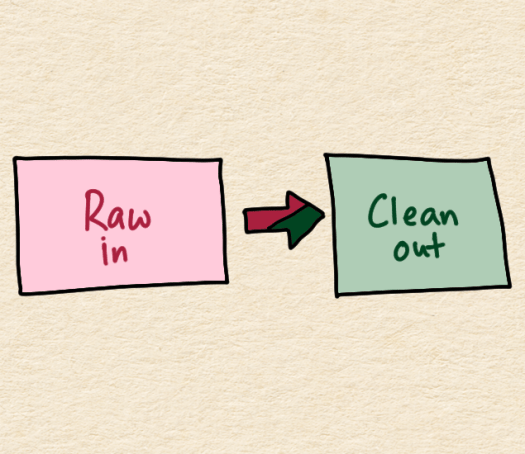
Raw in, clean out

Imagine you run a business that helps other businesses – like a management consultancy.

When you describe what you do to someone who has used consultants before you’ll often notice them wince.

They’ll probably ask you if you do something like come in, have a look around and write a report.

This is a common sales approach that many such consultancy organisations take – they carry out an audit examining the current situation and identify issues and recommend changes.

When this is done well they show the prospective client what needs to be fixed and they talk about how they (the supplier) can fix the issues.

This can lead to a sale.

The problem happen when the report tells the client what they (the client) has to do next – when it’s a prescription rather than a cure.

That kind of report tends to gather dust on a shelf.

And that’s because most people are too busy doing what they need to do.

They haven’t got time to do what you want to do.

If you want to be useful to them you have to fit into their flow – figure out how to insert yourself into their way of working and add value.

And you can do that by showing them what they will get from you that they can use in the next step of their own process.

For example, we recently visited a maze that the farmer creates every year using maize.

She described how she comes up with a design and then an experienced tractor driver plants the crop in rows.

She then plucks out plants to create the design.

When it’s ready she gets a drone operator to take an aerial image which then goes into the marketing literature and the maze is now open for business.

The farmer has a flow – a number of things she has to do over a few months to get this attraction ready for visitors.

Everything she buys in as a service has to help her move towards this outcome – help her achieve this goal.

If you can help her, then you might have an opportunity.

But you have to provide something that is clean, something that she can use in the next step of her process.

For example, that image from the drone operator is clearly useful for marketing – the picture itself, maybe some video footage, can be used for branding and publicity.

It’s not just a work of art, even if it looks good – it also has purpose and function and fits into a larger whole.

It’s useful.

Get rid of waste in your process

A useful side effect of asking what happens next is that you can identify things that don’t help.

In most cases, trying to track what’s doing on and create reports doesn’t help.

That creates busywork that you don’t really need to do.

Sometimes you have to monitor things to understand what is going on, but it’s not something you have to, or should do all the time.

What matters more is getting what needs to be done done.

Anything that doesn’t contribute to moving you own, to keeping the flow going, should be considered for elimination.

You can’t get things wrong that you don’t do at all.

The best way to improve quality is not to do what you do better – but to do less of everything you do and focus more on the things that matter.

When you stop thinking in terms of time or tasks and focus on flow – on what happens next – you’ll start to develop a feel for the velocity of your business.

The smoother, faster the flow, the more you keep things moving, the cleaner and more efficient you will be.

You’ll also be more effective.

As you design your business keep this principle in mind.

At each stage, provide clean output – something you or your client can use without modification.

Something that fits cleanly into the next step in the process.

But you won’t get this right on your first attempt – you’ll need to work at it to get to that point.

Which is what we’ll cover next.

Cheers,

Karthik Suresh