What do you think of when you hear hoofbeats?

horses-or-zebras.png

What could possibly be the cause of a problem you are facing? How would you diagnose it?

Medical students are taught to be careful about making diagnoses of rare illnesses.

It is easy when you see a patient to remember the unusual illnesses you have encountered that caused the same symptoms as now and jump to the conclusion that your patient has the same disease.

It is likely that there is a simpler reason.

Perhaps this is why many doctors ask you to take a couple of painkillers and come back in two weeks. The chances are that whatever you have isn’t actually that serious.

Dr Theodore Woodward came up with the aphorism “When you hear hoofbeats, think of horses, not zebras” to remind his students to beware of making exotic diagnoses.

But you can use this outside medicine too. Take markets, for example.

Markets are places when buyers and sellers come together. Prices are created through the mechanism of supply and demand and the actions and decisions of participants.

If you want to get a good deal, you need to know what it takes to produce and supply the item you need and calculate its value.

In a one-to-one sale, you may be able to negotiate a good deal. In a financial market, you need to be ready to move when the market price is at a level that is low compared to your calculation of value.

Many things move the market price on a daily basis, but usually a few big things impact how prices work over the longer period – and they boil down to supply and demand.

The trouble most people have with markets is that they feel that they should be active rather than putting a strategy in place and letting it run – the simple passive approach seems too easy, but time after time it produces better results.

In any field, operations, human resources, sales, writing, programming, marketing, research – it is likely that the reasons for a problem are down to common causes.

Before you decide that your phone is knackered or that your computer has been infected with a virus and that’s what is making it slow, you should turn it off and turn it back on again and see if that fixes the problem.

If your marketing isn’t working – the chances are that you are not taking to the right people, or not saying the right things to interest them.

If your writing doesn’t flow, it’s likely that there are four or five main reasons that repeat time after time.

This aphorism also applies when you think about larger issues.

Is it possible that climate change is an elaborate scientific hoax, or is more likely that the current U.S administration’s antipathy towards mitigating climate change is because powerful organizations with a vested interest in the status quo are trying to protect themselves?

That said, context matters.

If you are on safari in the Masai Mara and you hear hoofbeats, you are quite likely to see zebras.

In addition, although you should not reach for an exotic reason immediately, you should also not rule it out until you have evidence to the contrary.

We just need to make an effort to think through the problem as clearly as possible.

Why we should spend more time thinking upside down

person-upside-down.png

How you look at a situation usually defines how you analyze it and the kinds of solutions you come up with as a result.

The problem is that quite often it is only after you have spent some time on the analysis that you find out that the way you were looking at the situation in the first place was wrong.

The maxim “Invert, always invert” was a favourite of the German mathematician Jacobi who believed you could solve many hard problems by thinking about them upside down.

Take a famous example from Edward de Bono about the problems of pollution. Factories along a river were taking in water, using it and putting their polluted water back into the river. The last factory received the most polluted water.

The question asked was how to ensure that factories cleaned their water first before putting it into the river. Did it need a legislative solution? A technical one?

de Bono’s simple idea was to invert the input and output and require all factories on the river to have their water intake pipe downstream of their output. This means that they would be the first to suffer from their own pollution and give them a strong incentive to clean up.

Charlie Munger, the Vice-Chairman of Berkshire Hathaway, has talked about the importance of inversion in making investment decisions.

The secret to being smart, he says, is to avoid doing dumb things.

If you avoid doing dumb things for long enough, like taking drugs and racing trains to the crossing, then eventually the decisions you do take will result in good outcomes, and you will look smart as a result.

Inversion, or upside down thinking, can be applied to many situations in life and business.

If you have a goal you want to reach, thinking about the things that will stop you achieving that goal can help you take the right decisions on what to do and what not to do.

If you are facing a business challenge, re-stating the problem may create new approaches that you hadn’t thought of before.

For example, if your car park is too full, you might consider how to increase its capacity – and that leads to solutions like buying more space, expanding and investing more money.

Instead, asking how you can reduce the number of cars in the car park may result in different solutions – encourage car sharing, moving to other locations or encouraging home working, getting to the same point but with less investment.

In investing, after you have come up with all the reasons why you should buy something, it is a good idea to list out the reasons why it is a bad idea to buy it as well.

Looking at things the wrong way round, or upside down, can expand the way in which we think about problems and create a richer set of solutions for us to pick from – increasing our chances of making good decisions time after time.

Should you get everything done?

person-loaded-with-things.png

You know the old saying – if you want to get something done, give it to a busy person.

But what if you are that busy person, how are things working out for you?

John Cutler takes an interesting approach to this issue, using the word “promise” instead of action to describe what we commit to doing every day.

You probably take down lots of actions every day. Even a few a day quickly mounts up. In a year, you might commit to 600-900 action items.

Even if you get 20% of them done, that still leaves hundreds left incomplete at the end of the year.

This is the problem with productivity systems such as David Allen’s Getting Things Done. You could collect everything that has your attention and get it onto a list and out of your mind. But very quickly, the overhead of collecting and listing and processing can get overwhelming.

When the difficulty of managing the list outweighs the benefit of having it, you have two options. Either abandon the system or get very tired.

This isn’t how things were meant to be.

John Maynard Keynes, writing in 1930, imagined a future where technology would be so advanced that people would have little to do. They might work just because they wanted to, and surely no one would want to work more than three hours a day – and so he projected a 15 hour work week for most of us.

Instead, we now work longer hours than ever. Why is this?

There are two reasons.

First, some jobs don’t pay enough to live. Some people are trapped in low wage jobs where they are paid by the hour and so they have to put in the hours to get enough to get by.

The second is that some jobs pay too much. For many people, being paid a lot per hour makes it hard to give up that hour of work and the associated money that comes with it.

For example, you could perhaps work two days less and live comfortably. If the lost day’s pay is high enough, however, you might be reluctant to lose it and so the amount of money creates a real disincentive to working less.

Going back to John Cutler, one way to manage life better is to be more choosy about the promises you agree to. Make less. Keep more.

A more radical solution is Rutger Bregman’s proposal to give everyone a minimum basic income and change the rules to a 15 hour working week and open borders and let anyone move anywhere.

You may instinctively shy away from such ideas, especially the part about open borders. But many people, including Elon Musk, support initiatives like a minimum basic income and it is being trialled in places.

The thing to notice is that the way we live and what we do is results from choices we make as individuals and societies.

You can choose what to get done.

Do you have what it takes to live on Mars?

living-on-mars.png

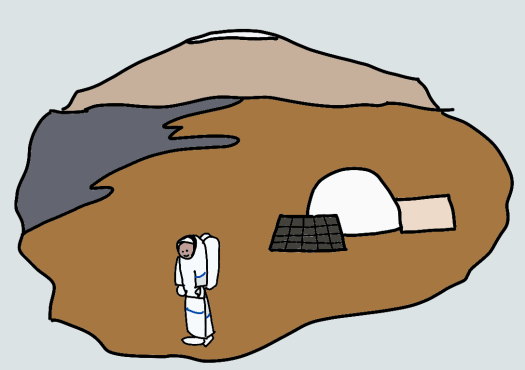
The best way to prepare and plan for life on Mars is to try living like you are already there.

That is what they do at HI-SEAS, the Hawai’i Space Exloration Analog and Simulation habitat, on the slopes of the largest volcano on earth, Mauna Loa on the Big Island of Hawaii.

Teams of volunteers, selected for their astronaut-like capabilities are selected from hundreds of applicants and spend four to eight months in a small solar-powered dome that can house six people.

The domes have a living room, sleeping quarters, kitchen, bathroom, laboratory, simulated airlocks and “dirty” work areas. Team members spend the time in close proximity and can only go outside wearing a space suit.

The team can communicate and access the internet, but with a 20 minute delay to simulate how communication will work between Mars and the Earth. Communication with mission control is only through email and posts – not real time.

So, is this your idea of heaven or hell? Being cooped up with five other people living and working in close proximity and little privacy and alone time.

The researchers have learned a few things about managing such a social environment over the different experiments they have run.

Boredom is the enemy. You need to have something to work on and occupy you. Lots of books help.

The mix of the crew is crucial. You need a balance between introverts and extroverts. Distasteful jobs, like cleaning out the toilets, earn rewards like extra time in the shower.

Experiments like these are a hot-bed of innovation. For example, the mission to get us to the moon resulted in inventions such the CAT scanner, cordless tools and scratch resistant glasses.

The Mars experiments may lead to a better understanding of what we need to live in low-power, off-grid environments without sacrificing comfort entirely.

If nothing else, it will make camping with the kids a lot more interesting if you can pretend you are living on Mars.

How to avoid the success trap

the-success-trap.png

Did you know that the chances of your company still being successful in 50 years is probably just 10 to 15%?

Just over 12% of companies that made up the Fortune 500 list of America’s largest corporatations in 1955 were still around in 2014.

A staggering 88% had failed, merged or fallen from fortune, without enough revenue to be listed.

This is the impact of the “success trap” that lies in wait for strong and profitable companies that dominate their markets, like dinosaurs lumbering towards a tar pit.

Bill Gates once said that “Success is a lousy teacher. It seduces smart people into thinking they can’t lose”.

And from Robert Kiyosaki, “The biggest trap, the biggest dungeon in life is isn’t laziness or bad luck, it’s comfort.”

Great companies got there by doing something different. Ford Motors is named after a man who changed the entire structure of transportation using new techniques of mass production and creating a practical affordable car for the masses.

He didn’t get there by listening to his customers. If you had asked them what they wanted, they would probably have said “a faster horse”.

By creating something completely different in the mass-produced car and making it possible for many people to afford it, Ford sounded the death knell for horse-drawn carriages, stagecoaches and buggies.

Yet now, a hundred years later (the Model T came out in 1908), an upstart electric car manufacturer that should not need naming is valued at more than the venerable automaker.

The main problem is that successful companies got there by being good at doing something new. So, they focus and improve those aspects of their business until it becomes business as usual.

They are also under pressure to deliver results, so they focus on the decisions that will produce immediate and visible returns.

In doing so, they forget that what made them successful were the innovative things they did in the past. If they stop innovating, then someone else will come along and do that instead.

When that happens, the market changes around the company, even though it still looks like it’s doing just fine. But eventually, things have changed so much that the company just becomes irrelevant.

So, how do you deal with the success trap?

First, if you are already in it and want to get out, you have a job ahead of you. You need to transform your company, cutting costs and pruning back heavily to the core of your capability. Then you need to invest in the future, innovating and exploring.

It’s not easy, but you can do it. Lego went from being a moribund toy producer in 2003 to taking significant portions of parents’ disposable incomes with its product launches such as Ninjago and tie ups with film franchises such as the Avengers.

To avoid the trap altogether, you may want to reflect on the title of a book written by Andy Grove, a former CEO of Intel, called Only The Paranoid Survive.

How to create innovation using teamnets

teamnets.png

The challenge for many organizations is how to move from managing people to managing knowledge.

Countries from the UK to India see services as a crucial part of their economy.

Managing services, especially services based on knowledge work, requires a different approach from managing organizations based on machine and physical labour.

In particular, when it comes to innovation, what an organization is capable of doing depends on what the individuals in it have learned over time, the know-how they have developed, and the extent to which they have the ability to understand what they are doing.

“Understanding”, the ability to be reflective, creating meaning and sense, is crucial for innovation, because that is what enables the framework for new insights, creativity and change.

Managing knowledge is different from managing information. Just writing down everything that needs to be done may capture information – but that is not enough.

Managing knowledge is more about creating the right conditions, an environment that encourages people to create, show, share and collaborate to provide better services to their customers.

In addition, any single organization may not have all the knowledge required to meet the needs of a customer.

Jessica Lipnak and Jeffrey Stamps used the term “teamnets” to describe clusters of organisations that work together to serve customers better.

Teamnets are formed of groups of individuals that come together, share knowledge and create new and better organizational capabilities.

This can be done even more effectively with virtual teams that are made up of people in different time zones, geographical locations, distances and cross over organizational boundaries.

The term “teamnet” was coined in 1993. Twenty four years later, we have the internet and an array of tools to help us collaborate and work together better.

Many organizations, however, still trap people in organizational silos with management controls based on hierarchy and authority with inflexible systems and hidebound communications.

That needs to change before they can become more innovative.

Should you be a specialist or a generalist?

sharks-vs-sabre-tooth-tigers.png

The way in which modern society is organized tends to drive people and organizations towards specialization.

Our economic system is based on the idea of division of labour. Virtually all the products we use are the result of myriad activities carried out in different parts of the world by different people.

Very few things are made by people completely in isolation from everyone else.

Mathematically, it is more effective to split up work between two parties, even if one of the parties can do everything better than the other.

So, surely specialization is the obvious and good thing to do?

But there are problems with specialization. Charles Roxburgh in this McKinsey article on scenario planning, writes about what he calls the “sabre-toothed tiger” problem.

A sabre-toothed tiger evolved to catch large land animals, able to sink its fangs into creatures like pre-historic horses.

As the climate changed around 12,300 years ago, however, the megafauna of the Americas died out and the sabre-toothed tiger became extinct, its specialist jaws unable to catch the smaller creatures that survived.

Sharks, on the other hand, have been around for over 400 million years and are virtually perfect predators.

Roxburgh argues that the shark evolved to be a generalist killing machine and therefore survived.

So does that mean you should be a generalist?

Specialization in itself is not a bad thing – the challenge is adapting when the environment that fostered that specialization changes.

If you are trained to do one thing well, and that thing you do is no longer needed, then you have a big problem.

You may run a company like Nokia, with a near monopoly on the supply of phones with keypads and what seems to be an impregnable market position.

Then along comes Apple with the iPhone and within a decade, keypads have disappeared, and with them Nokia’s market share.

It may be that the question in the title itself is flawed.

Maybe it’s not about choosing between being specialist or generalist.

It’s about choosing whether to be adaptable or rigid.

One approach will help you evolve with the environment and survive.

The other will leave you behind.

How renewable heating can be used for industrial processes

solar-energy-for-factories.png

Most people are aware of the potential for electricity generation from renewable sources such as wind and solar and how they can be integrated into buildings.

It seems natural to collect renewable energy, convert it into electricity, perhaps store that energy in batteries and then use the energy to do useful work.

But there are other areas to consider as well.

Most of our energy requirements, however, are in the form of heat, making up two-thirds to three-quarters of industrial energy demand.

Of this, around 57% needs temperatures of less than 400 degrees C and 30% is at temperatures of 100 degrees C or less. In addition, most facilities require space heating and hot water.

Using renewable heat directly, for example by installing advanced thermal solar systems, could provide up to half the heat demand in the industrial sector.

Simple off-the-shelf systems can provide low temperature heat at less than 80 degrees C while more complex solar concentrator systems can generate compressed steam at 400 degrees C.

Countries with high sun hours such as India, Mexico and parts of the Middle East are seen as key growth markets.

India, for example, has some of the world’s largest solar kitchens for community cooking, designed to feed tens of thousands of people at religious centres every day.

Over 80% of primary energy demand in industrial processes is currently met using fossil fuels.

A significant proportion of this could be displaced using renewable energy sources but there are problems.

Three quarters of the total heat demand is concentrated in a small number of energy intensive plants – around 30 -60,000 with existing industrial processes, temperature requirements and application areas. They would need to develop new expertise and compatible processes.

Costs for installing systems can be high up-front, even if the total lifecycle costs of operating are lower.

Despite this, there are an increasing number of installations worldwide and the Solar Heat for Industrial Processes (SHIP) database is a useful resource to get an idea of what is going on.

While such systems are unlikely to completely replace existing systems for creating heat in the near future, they will form an important component of hybrid systems that use renewable sources of energy primarily and call on fossil fuel based energy as a last resort.

When should you quit?

when-should-you-quit.png

How do you know when to keep going on a project and when to quit?

You may have spent years and invested large sums on a particular strategy. Can you just walk away or should you just try for a little longer?

One approach put forward by Chase Jarvis, the CEO of Creative Live, is to ask yourself two questions.

  1. Is it working?
  2. Do you still believe in it / does it bring you joy?

The first question seems relatively easy to answer – it should be possible to measure it in many cases.

For example, are prospects interested, are you able to get appointents, are sales growing, are you reducing costs, have you started to do something quicker or is your team happier with the changes you have put in place?

The second question is a little more fuzzy – what does it mean to believe in something?

Soon after Jack Welch became the CEO of General Electric (GE), one of the largest companies in the world (with a history back to Edison, the inventor of the lighbulb), he decided that each of GE’s businesses would either rank number 1 or number 2 in its global market or they would exit it.

Five years later, GE was a more focused group and remains a global powerhouse of a company now.

Could this be stretched to mean that Jack Welch decided to stick with businesses he belived in?

What about hiring? Some top consultancies have policies where they routinely invite the people that rank in the bottom 10% of their performance assessments to leave.

Does this mean that they stick with the people they believe in?

Some might argue that this is a actually an absence of belief – these companies are getting rid of the ones they don’t believe in rather than keeping those they do.

Regardless of the exact meaning you ascribe to the second question, if the answer to both is no, then you should probably quit. And soon.

If the answer to both is yes, then you should probably increase your commitment, double down in betting terms, and put more effort into the project.

When you have a mixed yes/no set of responses, you need to consider things a little more carefully.

If you believe in something but it isn’t working, you need to figure out whether you’re right and everyone else is wrong, or whether the market is right and your approach is flawed.

This is a hard place to be, especially if you are personally invested in an idea.

This is often when you need to “pivot”, the term adopted by Silicon Valley to mean a change of strategy and direction.

Sometimes, pivoting is essential to succeeding. For example, did you know that You Tube was originally a dating site, Nokia was a paper maker and Nintendo made playing cards?

Then finally there is possibly the hardest quadrant, one where things are working but you don’t believe in it.

That is a time for questioning.

If you operate in an environment that is unethical, where you have forms of corruption or where you need to compromise your principles in order to make money, do you carry on because the returns are so good?

Or, in a less malign setting, what if the principles that underpinned your original entry into the project are no longer valid?

It seems like the most powerful use of this framework is when it helps you choose what to retain rather than what to discard.

It may not be easy, but you would think that doing more of what works and what you believe in is the way to maximise your chances of eventual success.

Conversely, changing direction or quitting may be essential before you can move forward once again.

It’s not personal, it’s just programming

robot-doing-interview.png

We could be hearing this title line from the film Tomorrowland a lot more in the future.

Much of what we do is increasingly determined by robots.

It used to be determined by people in power.

The phrase “Nothing personal, it’s just business” is familiar to most people, and was apparently coined by organized crime, a group that rely on the application of power. The saying even made its way into the film Godfather.

So where do we see this happening?

The most visible application is in the recruitment business.

Everyone who has applied for a job and had to go through a screening process has experienced this.

From a recruiter’s perspective, sifting through a pile of applications can be the most time consuming activity in the recruitment process.

Surely it makes sense and is fair to get applicants to log into a portal, complete a set of questions that measure their match for the role and interview only the ones that score the best?

But hiring technology company HireVue takes this a few steps further. Their homepage looks like something out of the series Lie to Me, where an expert studies facial expressions to get to the truth.

The company provides the techology to carry out unmanned video interviews where candidates record their responses to questions and the software analyses their emotions and facial expressions, speech patterns and language patterns, integrating all that information to presumably provide recruiters with more insight into candidates.

It sounds like something the CIA would find useful.

Then there is the news, something which dominates our perception of what is happening in the world.

Is the information we are getting the “real” thing or are we being fed a diet of processed news by robots?

The Associated Press began using robots in 2015 to generate automated news stories based on fairly standard styles and outlines.

The idea was that the day-to-day standard news reports can be automated and free up humans for complex, nuanced stories.

In the UK, Google is funding a project where robots will write local news. They will take data feeds and create local versions so that you will be able get news customised to your location and criteria.

This activity also carries dangers. When it is quick and easy to take and rework and republish stories, the chances are that fake news can spread just as quickly as real news.

The checks provided by experienced, sceptical journalists that look to verify assertions may be lost in the process, resulting in an avalanche of incorrect information that can be impossible to reverse.

There is no doubt that the robots are here to stay, and as we use them more we will learn better how to use artificial intelligence, machine learning and algorithms to make better decisions about everything from which route to take to whom to marry.

If you’re on the wrong side of the table, however, life could get more bewildering.