Why Learning How To Let Go May Be The Most Important Thing You Do

relationships.png

Tuesday, 8.53pm.

Sheffield, U.K.

A thousand details add up to one impression. – John McPhee

I have just finished John McPhee’s Draft No. 4: On the Writing Process. It has had a tough life with me already. Its cover is stained with tea, what seems like an entire mug’s worth.

It’s a book that makes you think, that makes you wonder just how long it takes to get every word just right. To construct sentences and paragraphs that just flow.

A long time, McPhee says. It takes as long as it takes. He’s been lucky, never been in a hurry. He’s been able to take his time.

Then again, a piece of writing is never perfect. That’s the irony, the secret that no one tells us. Joyce Carol Oates, one of America’s literary icons, apparently said “No book is ever finished. It is abandoned.”

When we see something that seems perfect we forget to notice the word “seems”.

For example, think of Steve Jobs. We know of him as a perfectionist, someone who brought us the iPhone. But we shouldn’t forget that each phone that was released was a compromise. The best they could do but probably not as good as Steve wanted. Certainly not perfect.

When you start to see this concept of perfecting something versus abandoning it you start to see it everywhere.

Take any business process. Is it perfect? Or is it good enough?

Perfection takes too long, and costs too much, and probably can’t be achieved anyway.

Is that too defeatist? Or is it being realistic?

Facebook had signs on its walls saying “Move fast and break things” and writes that it wants to “ship early and ship twice as often.”

I learned recently that children that tend to do best at school are the ones that are not afraid of getting it wrong. They are willing to make mistakes, they aren’t scared of making mistakes, and so they learn more and learn faster.

The thing is to get somewhere, you have to get going. And it’s not a one-off thing either. You have to do something day after day.

Those little somethings add up. You might simply be working on what seem like disparate, disconnected dots.

But eventually, you can draw lines between them. Shapes emerge and an impression is made.

Impressions are about details.

That’s the thing with anything, a book, a process, a sale. The things that draw people in, that keep them interested, are the details.

And even with those, it’s best not to get too hung up on perfection.

Take the quote that starts this post, for example. McPhee has it in his book and attributes it to Cary Grant.

So, I started by writing that was so. But then, it felt like something that was worth checking and it’s easy to do that with the Internet.

Well, Cary Grant didn’t say that. It was close, but he talked about 500 details.

Enough of a difference to possibly make it a McPhee adaptation rather than a Grant quote.

So maybe even McPhee can get it wrong. Although it’s possible that he has a much better reference than a single search on the Internet.

The point is this. Whatever we do, whether it’s writing, or business or a profession, we agonise over getting it right.

And that’s a good thing. We don’t want to turn out rubbish.

But we also need to get comfortable at letting go.

Because, we don’t finish things.

We let go of them.

Cheers,

Karthik Suresh

What Should You Do If You Want To Be Free?

minimalism.png

Monday, 9.35pm

Sheffield, U.K.

There are two ways to be rich: One is by acquiring much, and the other is by desiring little. – Jackie French Collar

Sometimes a stray statement, a position taken by someone, can make you wonder whether we’re shackled by anything more than our own thoughts.

Not, of course, if you’re literally in chains but, assuming you live in a free and democratic society, when it comes to everyday living.

There is a famous photo of Steve Jobs taken in 1982 which shows him living in a sparse, unfurnished space despite already being rich.

Some people see that minimalist streak in Jobs brought to life through Apple products, with their emphasis on design, minimal interfaces and intuitive use.

So, when you hear of someone complaining that they don’t have a desk to work at, what do you think? What does that say about how free they are?

There is a story about Amazon, about when they started and needed desks. But desks were expensive and doors weren’t. So they bought some doors, fitted some legs and used them as desks.

Frugality is still a big thing at Amazon, as are desks made from doors, even though they are now one of the most valuable companies on the planet.

If you’re the kind of person that, when you don’t have a desk, can work anywhere else without complaining then you have what it takes to start and run a business.

If you can think of alternatives, come up with suggestions, sit and work on the floor if you need to, then no one can stop you from getting things done.

Because much of business is about being resourceful and inventive, about seeing opportunity where others see nothing. About solving problems, big ones and little ones, day after day.

And there are certain principles that are worth remembering when we try and deal with what comes at us every day.

When you’re selling, for example, after a while you’ll realise that most people you meet have pretty much the same questions about what you have to offer.

There’s also little excuse for not doing your homework before you meet someone. There’s so much information that people put out about themselves and their businesses that you can get a good idea of what they are all about before you meet them.

So, if you know what questions they have and have done some homework on who they are then, really, the main thing you need to do is to listen to what their problems are and see if you have a solution.

Your presentation becomes less about you and more about trying to get them to open up and engage with you. You know it’s working when they start asking questions, ideally ones to which you have the answer on the next slide.

There is a difference between this kind of approach and one that tries to tell your prospect everything about you.

It’s like a child with a box of toys, every one of which is special and important to him, so he wants to talk to you about each and every one.

You listen politely, but really, your mind is somewhere else.

But when that child wants something from you, his tactic changes. Now he is laser-focused on that one thing – that one toy and nothing will divert him from it.

What do these different concepts – minimalism, frugality, focus – have to do with anything?

Well, if you can craft a message that shows your prospect just what is important to them, shows them how you make it for them, at the lowest cost possible, and how it solves a problem that they are focused on, how do you think they will respond?

And I wonder whether if you want to be the kind of person that can pare down a message to just what is important, you also need to be the kind of person that can pare down what you have to just what is important.

Because, of the two ways to get rich quoted at the start, the second is the one more likely to set you free.

Cheers,

Karthik Suresh

Do You Realise How Much What You Do Shapes Who You Are?

tools.png

Sunday, 9.10pm

Sheffield, U.K.

We shape our tools, and thereafter our tools shape us. – Marshall McLuhan

I am not fond of gardening.

Gardens are nice to sit in when everything is tidy and the lawn is cut but, when it’s not, they remind you in silent reproach that it’s all your fault and you should do better.

There is a tree in front of our house, a large ash, and every autumn it deposits all its leaves with no apology on our garden.

Now, I would much rather be curled up with a book or stood at my computer reading or writing than almost anything else.

The keyboard is a tool I’m comfortable with. I know its parameters and its limitations. I learn more every day I write.

A rake, on the other hand, is much more problematic.

So, today I offered one of the small people that lives with us an opportunity to go to the cinema.

He said no.

I tried to bribe him, with popcorn and ice-cream and juice.

He still said no.

Exasperated, I said we couldn’t just sit in the house. If he didn’t want to do anything we’d just have to go out and rake leaves, expecting that the cinema would suddenly become more appealing.

Except it didn’t. He ran excitedly for his wellies and we then spent the next hour raking and sweeping leaves. You’d think it was the best thing he’d done all week.

And then he said ‘when I grow up daddy, I want to be a sweeper, just like you.’

The point, I suppose, is that whatever you do becomes your business.

I was at a networking event a few years ago and the keynote speaker was someone who had built her cleaning business from scratch into an operation now employing hundreds of people.

You could be forgiven for assuming that a rake is less complex than a computer and that one skill is worth more than the other but the fact is you can make money from both.

We know that work in the future that people do will be of two types: creative work, that needs imagination and insight; and dexterous work, making use of our hands to do things robots can’t.

The rest will be done by the machines. Unless, of course, you can’t afford one.

Then again, that might not happen at all.

William Gibson wrote: The future is already here — it’s just not evenly distributed. A quote much loved by the technocrats who’d like to shape us to fit their world.

What happens, however, is that whatever technology you choose then has an impact on what you do.

And, in many parts of the world, it feels like people are turning to technology that helps them be more human, like bicycles and cloth bags and recycling bins.

No one has ever had much luck predicting how the future is going to look.

It could be one where we’re all immersed in augmented reality and the majority of interaction is through a machine, or it could be one where we’re better informed, better connected and better people.

Who still probably have leaves to rake when we’d much rather be writing.

Cheers,

Karthik Suresh

How Do You Tell When Something Is Good?

critical-thinking.png

Friday, 9.06pm

Sheffield, U.K.

There is nothing new under the sun but there are lots of old things we don’t know. – Ambrose Bierce

Do you think we live in a world where what we see and read is better than ever before?

There is clearly more stuff. More people are writing and creating words, music and video. They are coming up with games and apps and platforms.

All shiny and new.

So, what makes one creation better than another? Why do you sit and watch one box set, unable to turn away, for week after week while others you abandon after the first ten minutes?

One test – much loved by the analytics folk – is to look at what people do. If they can watch your behaviour, see how you vote with your mouse and remote and money, then they can figure out what you like and give you more of it.

The thing with analysis is that it looks back at what has happened. You can try and do more of what worked in the past but, as the financial folk keep reminding us, past performance is no guarantee of future results.

Also, this whole thinking in aggregate, in big numbers, in terms of markets is applying statistics to people. And no one really wants to be a statistic.

Take consumer behaviour, for example. In his book Buy.ology, Martin Lindstrom writes about Socrates and how he told his students to think about a mind like a block of wax. If an image is pressed into the wax and stays there, then we remember it. If not, it’s like it was never there. In other words, it leaves an impression.

Lindstrom goes on to describe how the things that leave an impression on us, from touching a hot stove to being embarrassed when we told someone how we felt about them, shape the way we start to respond to things.

But, while we share many of these things none of us have exactly the same. Imagine all these experiences like strands hanging down in front of you. You pick and weave your experiences into your own unique sense of identity.

So, while a statistical approach can be approximately right the ideal approach is one that is made just for you. Not one that is designed to make you feel special but one that actually is special.

John McPhee is an American non-fiction writer. I heard about him in a podcast and was interested enough to take a look at the cover of his latest book, Draft No. 4: On The Writing Process, but not interested enough to buy it.

Until I read this review by Michael Dirda on the Washington Post that had these lines:

“However, its opening two chapters, in which McPhee presents his various systems for structuring articles, do require a bit of perseverance. There are graph-like illustrations, circles, arrows, number lines, maps and even an irrelevant excursus about an outmoded text editor called Kedit. The upshot of it all is simply: Take time to plan your piece so that it does what you want.”

There are two points that the writer makes: drawing pictures is a waste of time; and text editors are irrelevant.

Well, if you have read this blog for a while, you’ll know that drawings are a big part of how I write. And I write with a text editor, possibly one even older than the outmoded one that the writer of the Post excoriates.

So, of course, I had to buy the book. Because now I desperately needed to read those two chapters.

And that’s the funny thing about people. They don’t act in the way you want them to. Just because you think things should be one way doesn’t mean everyone is going to agree.

So, that takes us back to asking how we know when something is good. And one answer is that it’s good if it’s been around a while.

Like pencils.

Pencils?

If you’re a writer, you know how to use a pencil.

What’s newer than a pencil?

Pens, text editors, Microsoft Word, some kind of SAAS program?

If you write with a pencil your words will still be legible a few hundred years from now.

Penned words may start to fade.

Plain text will be readable as long as we have computers.

Your Word documents from even ten years ago are probably lost.

And that SAAS company went bust not long from now.

In other words, choose things that have some history because they have shown they can last.

Cheers,

Karthik Suresh

What Approach Should You Take If You Want To Succeed?

agincourt.png

Thursday, 9.01pm

Sheffield, U.K.

All things are ready, if our mind be so. – William Shakespeare, Henry V

The English insult is different from that commonly seen in much of the world.

Instead of a middle finger raised aloft, they hold up the index and the middle, palm facing inward.

This custom, apparently, comes from days when the longbow was used in battle and the French would threaten to cut off those two fingers of any prisoners to ensure they never drew a bow again.

And so, in battle, the longbowmen held up those fingers to tell the other side what they thought of them.

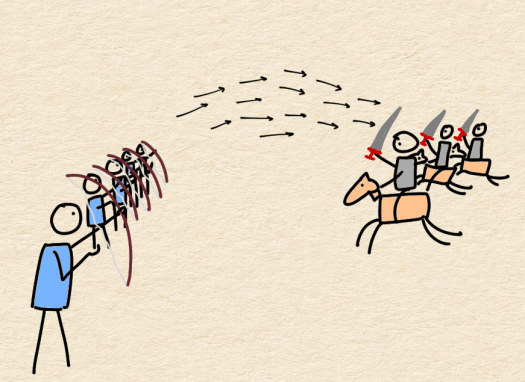
The longbow, apparently, came into its own at Agincourt in 1415. 8,500 English soldiers, 7,000 of which were longbowmen faced around 50,000 French troops.

They won – helped by their arrows – which travelled towards the enemy faster than they could run and walk towards them.

But, what does this have to do with business or sales and marketing?

It’s a story that can be used to look at the same situation from different points of view.

Let’s look at tactics, for example.

The losing side were just as brave as the winning side. If anything, they might have been braver, trusting in their armour to protect them from those pesky arrows.

They had a plan, to head towards the other side and so that’s what they did.

That’s a little like having an army of salespeople taught to smile and dial. They hit the phones, make the calls, make their numbers and succeed.

Is that approach, that works like a cavalry charge, all might and muscle and fury, going to work?

Increasingly, it seems to me, it doesn’t. A cold approach, whether on the phone, email, snail mail, is easily stopped, ignored or turned away.

The arrows, on the other hand, are multiple points of contact. Some might miss, some might hit, and the ones that hit may make a difference.

So, the way I think about this is to imagine that you want to build a pipeline of business. You could reach out to people directly or you could send a shower of arrows their way.

You could advertise where they are going to see it, you could engage with them in the places they are going to be, you could work with them on things that they feel are important and you could get introduced to them by people they already trust.

Is that going to increase your chances of success?

Possibly. Even probably.

I guess it simply comes down to this.

There are lot of things you could do.

You could focus on just one of those things – something you’re strong at, and just do that thing.

Or you could do as many of those things as you can at the same time.

For some people the focused approach will work. For others, the wider one.

Unfortunately, there is no right answer.

There is just what happens when you finally join battle.

Cheers,

Karthik Suresh

Why It’s Important To Really Understand What Free As In Freedom Means Today

small-big.png

Monday, 9.04pm

Sheffield, U.K.

Don’t think free as in free beer; think free as in free speech. – Richard Stallman

IBM has bought Red Hat for $34 billion.

Things have come a long way…

Twenty years ago, on a machine that I can’t remember, I started up a CD of Red Hat and went through the installation process.

Red Hat wasn’t my first try at GNU/Linux.

That was Slackware, on 3.5 inch disks, but it was the first distro that I can remember using properly.

I’ve often wondered why I was drawn to GNU/Linux, why Windows seemed quite so undesirable, even all that time ago.

Why choose something so small and fragile instead of a dominant operating system?

I think it might have been because of my dog.

Years before that install, I went out and chose a puppy. A Pointer – black and white, with floppy ears, a wobbly walk. It was the one that came over and said hello so, of course, I had to have it.

It was an age when computers were coming into our lives. And my dad suggested we name the puppy Unix. So, Unix he became. And I wonder sometimes whether the draw that GNU/Linux, a Unix like system, has for me is because of that connection.

But there is more than that.

When you come from a country that has a history when it was colonised by those with superior technology you learn that you need to have your own if you are not going to be controlled once again.

So, self reliance is important. It’s good to be reluctant to give up freedom, even when it seems convenient.

The last twenty years, for me, longer for others that started before I was born, have seen people working on a strange concept. The idea that programs and computers should work to serve society, not to control them.

The common connection these people have, is their desire for freedom. The desire to be able to use their machines without being controlled by someone else.

A few centuries ago, many monasteries were among the richest organisations around. How did that happen, when the monks were committed to a life of prayer and meditation? It was because of the power of volunteering. The power when people come together, to work for a goal bigger than themselves.

So, it’s strange and reassuring, to see that power is still capable of taking on the strongest in society and winning.

Richard Stallman wrote as far back as 1996 that it was just fine to charge to distribute free software. You could charge nothing, a penny, a dollar or a billion dollars. He didn’t think you would get a billion, however.

Red Hat got 34 of them, just 22 years later.

Freedom looks to be winning.

Cheers,

Karthik Suresh

How Are You Going To Compete Against All The Cheap Substitutes?

made-in-sheffield.png

Sunday, 7.56pm

Sheffield, U.K.

Goodwill is the one and only asset that competition cannot undersell or destroy – Marshall Field

How often do you look around you and wonder if you’ll ever make it in business?

Take business shows, for example. If you attend one you’ll see a plethora of small businesses, from florists to gyms. And lots of marketing and IT firms.

What’s going to make one succeed and another fail? And how will any of them compete with local and global competitors?

The first thing to see is that at least all of them have started something. You can’t succeed unless you start. That’s a basic rule.

Once you get past that, however, you start to see some basic truths.

Many businesses have a natural ceiling. A restaurant, for example, can only serve a certain number of meals every day. They can raise their income by maximising the flow through their restaurant and by raising prices.

At some point, they’ll reach a peak and they can’t go past that without raising their ceiling somehow. That probably means starting more restaurants or serving faster food.

Now, whatever they do, they are still anchored by the economic structure of their businesses. The question to ask yourself is what that means for you.

And there is no better place to start than Warren Buffett, and what he had to say in his 1983 letter to shareholders about goodwill.

Goodwill in this sense has nothing to do with emotions – to how someone feels about you – and in a sense it has.

Confusing? Perhaps.

Let’s say you’re starting a restaurant. I looked at one a number of years ago – a family business came up for sale for around 30,000 pounds.

We’d eaten at this place a number of times. It served good home-cooked food and we probably spent around 40 pounds for a meal for four, or 10 pounds each.

They probably served around 20 people for a sitting. Maybe they had two sittings a day and were full mostly on Friday, Saturday and Sunday.

So let’s say they made around 20x2x10x3x48 = 57,600 a year. After salary costs, perhaps they had a profit of nearly 10k.

So, if I invested 30k I’d make my money back in three years. A good rate of return?

Now, this place got taken over a few years ago, and the food went from simple home-cooked to a gourmet experience with a well known chef. The price for a table of four ended up being more like 160 pounds. On the same math, this results in a turnover of 230,400. The profit, rockets from 10k to more like 180,000.

My payback can be counted in months.

That gap – that’s what shows there is goodwill.

And what creates that gap?

One word. Reputation.

I was watching a documentary about Sheffield and its steel-making history. Why is Sheffield Steel so well known? Was it because the city made shoddy stuff? Or because it made some of the best quality steel in the world from the start?

No one can compete with factories staffed with cheap labour that make commodities. In the early part of the century British factories dominated global markets for textiles, helped by laws that undermined local competition.

In India, Gandhi took a stand and asked people to use locally made goods. He started by weaving his own garments.

What he made wasn’t better quality than machine made stuff. But his voice made a difference – his reputation led a country to boycott foreign goods and buy local instead.

These days it’s the West that looks anxiously at the great factories of China and wonders how it can compete with a tidal wave of cheap product.

And the answer is that you don’t. You don’t compete on price. You don’t even compete on quality.

There is space for cheap products. And there is also space for the products you make.

The question is, what kind of reputation do you have?

That’s what you compete on.

Cheers,

Karthik Suresh

How People Actually End Up Buying What You Have To Sell

justifications.png

Saturday, 8.39pm

Sheffield, U.K.

All I’ve ever wanted was an honest week’s pay for an honest day’s work. – Sergeant Ernest Bilko

I’ve met more people than usual the last few weeks.

As an introvert who enjoys writing and coding more than going out and socialising, that can be both tiring and eye opening.

Think about why we spend so much time thinking about digital marketing. It’s probably down to two reasons.

The first is that we imagine we’ll save money. After all, if we send out a bunch of emails or pay for ads then we’ll only have to talk to prospects that are interested – because they’ll show their interest by responding.

That’s a qualified list right there isn’t it?

The second reason is that we don’t want to talk to people we don’t know. It’s scary, perhaps rude. Maybe they’ll be mean to us. Maybe by spamming them they’ll start to like us.

The funny thing is that when you do meet someone, under the right conditions, something happens. Being together in the same space, being able to see and hear each other, lets you have a much richer conversation.

So, you get much better communication as a result.

I was going to talk about how to create those conditions when I started this post, but then I got distracted by all the “C”s.

Have you noticed just how many “C”s come up when you think about this kind of thing. Just look at the last few sentences.

So, let’s assume you’re talking to someone, trying to explain what you do and see if there is a fit. In other words, you’re selling them.

You’ve heard the old saying – people buy on emotion and justify with logic. What does that logical justification look like?

Well, it’s full of words that start with C.

Take competence, for example. Clearly you have to know how to do your thing. If your business is making square boxes, then you had better be good at making square boxes. That’s the first thing the buyer is going to check.

Then there is credibility. How many boxes have you made? Who have you made them for? Did they like your boxes?

Close on the heels of credibility is capability. Ok so you can make boxes. Can you do them in different colours? Sizes? Are you a one box pony or do you have the ability to branch out.

Then what is their experience of working with you? Is there camaraderie between you? Mutual trust and friendship?

Warren Buffett says you should aim to work with people you like, admire and trust.

Now, if you’re good at what you do, then you’ll probably start filling up with business. Or, if you haven’t invested in your business, you’ll start running out of resources.

A wise buyer will want to check that you have capacity – that you can give them the resources they need. After all, there’s nothing worse than giving someone your business and finding they don’t deliver.

They’re not going to come back. Remember, fool me once, shame on you. Fool me twice, shame on me.

Then there is probably one of the most important things of all. Character. We don’t like sleazy, fly-by-night, manipulating, conniving, two-faced sharks.

Although, that is probably a point of view at the end of the day. Something seen as cheating by one person is probably seen as shrewd business by another.

You’ll always be best off following the platinum rule, however. Do unto others as you would have them do unto you.

As someone said, the best system is one that you would accept if you didn’t know how much power you would have.

All those choices come down to character. In practice, it probably comes down to your credit score…

So, anyway, it’s interesting, just how many words that start with C are worth remembering and checking off if you have to do a complex sale.

The six in the picture, especially, will probably be part of your buyer’s checklist.

The one thing is that it’s hard to remember all these Cs. A 6C mnemonic doesn’t really jog your memory.

Maybe thinking in terms of square boxes will…

Cheers,

Karthik Suresh

How Would You Feel If You Spent The Rest Of Your Life Doing Something You Hate?

tennis-ball.png

Friday, 6.51pm

Sheffield, U.K.

I do not believe a man can ever leave his business. He ought to think of it by day and dream of it by night. – Henry Ford

I was listening to Drew Houston, the billionaire founder of Dropbox, being interviewed on the Tim Ferris show and talking about a tennis ball.

And then there is the tour guide on a Copenhagen boat who drily said that she chose to be poor when she chose to study history.

The two of them have something in common – and something different from many of us.

If you’re from a country like India, you are taught that you need to study so that you can make a living from what you learn. So, you’re told, you can be an engineer, doctor or lawyer. Your parents believe you have a choice because you can choose what kind of engineer, doctor or lawyer you want to be.

What about the tennis ball?

Well, Drew had a dog – a Labrador – that usually did very little. But, when a tennis ball came out she got very excited and chased after it – she was completely obsessed with the tennis ball.

People who study something because they love the subject start life chasing their tennis ball from the start. Presumably that is a good thing.

Then again, it might not be. If you really love doing something – writing, music, art – what happens when you start doing it for money?

Sheffield, it turns out, has a good claim for having the first football club in the world, inventing many of the elements of the modern game. The game was played mostly by people with money – playing as amateurs – but things were going to change. Martyn Westby writes about the tensions that erupted when the sport went from being an amateur one to a professional one.

An amateur is someone who does something without being paid. Someone who does something for the love of it.

An amateur is also someone who is rather fortunate in not needing the money. Or wanting it. And the amateurs were very unhappy about professionals coming into their sport.

The professionals won, however. We now have professional sports – that’s the stuff you see on TV. And you see a much higher quality of sport than might have happened if amateurs were the only ones who did it.

The point here is that if you love doing something, then getting money for it may make it a job and less of a labour of love. If you get paid for each word you write then you will probably start resenting each word for the time it takes away from you.

On the other hand, if you do something you dislike, then you are exchanging your time for money and it’s going to eat away at you.

But… what if you do something for long enough? Will you start to get better at it and perhaps even start to like it? Can you act yourself into changing your mind about what you’re doing?

There’s no real right answer to this. If you are obsessed by something and it’s something that other people will give you money for, then you’ve got something that could make you a living.

The one thing to avoid is piece work. Try and separate the money from the work. I think it was a Kahneman finding about motivation – if activity and reward are closely linked then you’ll stop acting when the reward stops. If they are further apart in time, your mind doesn’t connect them in the same way.

In reality, I suspect few people would carry on doing something they hate, if they feel they have a choice.

It’s probably really a dislike, or distaste or aversion.

In fact, the thing that probably stops you changing is less to do with what’s outside and everything to do with what’s inside.

After all, if you’re in a situation you dislike you can do one of two things.

You can change your situation.

Or you can change your mind.

Cheers,

Karthik Suresh

There’s More Than One Way To Do It – A Good Saying To Live By

more-than-one-way.png

Monday, 8.41pm

Sheffield, U.K.

The essential thing “in heaven and earth” is . . . that there should be long obedience in the same direction; there thereby results, and has always resulted in the long run, something which has made life worth living. – Friedrich Nietzsche

If you’ve been glancing at recent blog posts, you’ll notice they are about selling. Consultative selling, to be precise. I figured I’d try and write a book on the topic – and focusing on it for a few months seemed a good way to pull together a first draft.

Why? I’m not a salesperson. I’m not particularly good at the sales process, prospecting, keeping records, following up, closing. It’s also pretty dull really.

I’m not sure many people are great at being salespeople. We used to say about a product that we bought it inspite of the salesperson, not because of him. We could see it would do what we wanted. And I’ve not really seen a situation where a pure salesperson brought in more money during his or her employment than they cost.

But, sales and marketing is not something you can simply hand off to someone else either. It doesn’t matter what you do – you are going to survive by earning a commission on the value you create. Very few people get away with having to do nothing of value.

A job, for example, is a commission only role where you get a third of what you make the company. That’s a basic rule of thumb – you need to bring in around three times what an employee costs you to make it worth employing them.

The better you sell yourself, the more likely it is that you’ll get a good job – or grow your business – or excel in your profession.

Marketing and sales, then, is something everyone has to do. So, it makes sense to figure out how to do it less badly. Not do it well necessarily – not to superstar levels where you can get your own TV channel and sell lots of books – but to the point where you don’t make simple mistakes that cost you business.

And that really comes down to learning how to play nicely with the other children.

Which brings us to an essay by Larry Wall, the creator of Perl, that touches on the issue.

If you’re a doer – someone who does a creative job – then you probably have certain character traits. These are impatience, laziness and hubris.

I find this easiest to explain in the context of computer programming. There are lots of people right now in the world that go to work every day and use spreadsheets. They spend their time working through and checking the data, copying and pasting stuff and checking their work and colour coding it and checking their work.

Most people use spreadsheets like a … well, you can think of an analogy. The point is that it’s flexible enough for anyone to open up a new sheet and put in something and do some calculations. So they do that. Usually badly.

Spreadsheets are easy to use. But they are also a hugely powerful programming languages that you can use to make your life a lot easier. If you want to hire someone to do Excel, give them simple problem that involves VLOOKUP. Let them use the Internet to look for answers. If they can use that function correctly, you can hire them.

Someone who has learned that is on their way to being a programmer. And programmers are lazy. They don’t want to do the same thing twice. So, if they have to, they write code to make their lives easier.

They are also impatient. They don’t want to wait. So they’ll work on how to make things work faster or talk to each other better or share information more effectively.

They are also comfortable with hubris. No sooner have they created a solution that they think of all the things they would chance and get busy creating the next version that will make the old one obsolete.

If you’re a company founder, you probably think the same way. You’re creating a new business because you’re impatient with the way things are now. You’re probably too lazy to struggle on with the hard road when you can build a better one. And you’ll start over if you have to – from scratch because it’s so much easier to build from scratch than fix something that is stuck and broken.

As Wall writes, these three characteristics are individual ones and they give us drive and passion and help us be unreasonable and change things.

But… they don’t help us change the world.

For that, we need to work with others. And others are difficult to work with. They don’t think like us.

I found that when I had to do something on my own it was easy. I had an idea and did it.

When there were more people involved, sometimes we agreed on what to do and actually managed to do it.

With even more people… life turned into a slog through chest high mud. You couldn’t get anything done because other people needed to be involved, to give input, to be mollified and pacified and socialised.

But that’s the price you have to pay if you want to be a part of society.

So, the mirror image, the flip side to laziness, hubris and impatience are the virtues that are needed if you want to be more than just yourself. To be a part of your community.

And those are patience, humility and diligence.

You need to be patient with those who disagree with you or cannot keep up with you. You need to be humble so that you don’t think your way is the only way. And you need to be diligent – to keep working on something until you do something worth doing.

Not understanding that we need to be able to hold and apply these opposing concepts at the same time is at the root of much of the failure we see in the world today.

What’s the point in being a successful business person if you’ve lost your family and relationships in the process?

What’s the point of creating a hugely profitable company if everyone that works for you hates your guts?

What’s the point of being a lone voice speaking of a better way to do things if no one else will engage with you?

The point that Wall makes is that it’s okay to have either or both or a different way altogether. The virtues described in the two triangles are not opposites – they just are.

There are many ways to become successful – to reach whatever goals you define as success for you.

But… if you want to succeed as a person and as a part of society… you would do well to keep these two sets of words in mind.

They may help choose the right action – as you and as us. Then you’ll do something new and cool and play nicely with everyone else and hopefully end up having a good time.

Cheers,

Karthik Suresh