
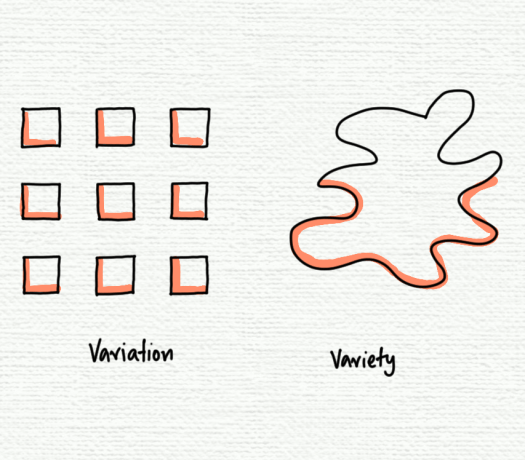
If I had to pick one thing that’s changed the way I work it would be understanding the difference between variation and variety.
I used to believe that the way to do better work was standardisation.
You improved quality and productivity by using tools like 5S – sort, set in order, shine, standardise, sustain.
I’d bet you’ve listened to someone suggest that the answer to a problem was standardisation – we need a standard for this.
And that’s because standardisation works, in a particular context – that of factory work.
If you’re in the business of making cars then you want to have standards – every piece of glass for a particular model of car has to be the same – as close as possible.
You’re trying to make lots of copies of a particular type of thing – you want to remove any variation in the product.
It takes effort to reduce variation. Try drawing nine squares that are exactly the same and you’ll quickly find out how much.
But most of us don’t work in factories. A lot of us are engaged in information work.
And with information work, no two situations are exactly the same.
Trying to use a standardised approach doesn’t work. One approach may work with one client, but the minute you try and apply the same approach with the next one, new and interesting ways to derail your plan come into existence.
But it’s more complicated than that.
As Robert Pirsig said, no two people are in the same situation and have the same problems.
But, in contradiction, in some ways everyone is in the same situation and has identical problems.
What makes the difference is that situations contain variety.
Learning how to deal with variety is the first step to building solutions that work for more than one client.
 Handcrafted insight