
How can we think more clearly about what organisations can get done?
We see so much news on tech firms that it’s easy to forget there’s a real world and many other types of businesses out there.
Hyper growth, big bet, tech bro businesses are at the bleeding edge, using to failing fast, making it big or going home.
A conversation on social media sparked the thought that there’s a spectrum of firms that we need to think about – the difference between the bleeding and leading edge.
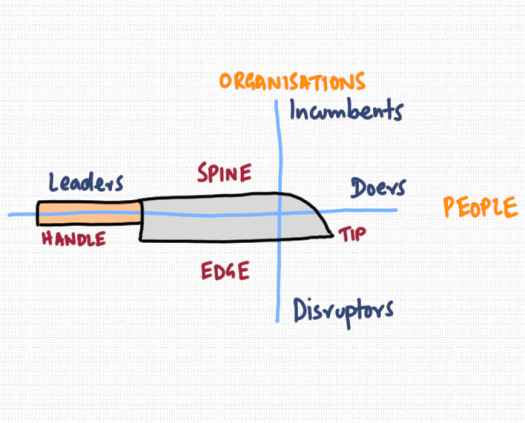
One way to visualise this is to think of the parts of a knife. You have the edge, and some firms live there. They are innovators, disruptors, the new startups.
At the other end you have the spine, the heavy, solid piece that you rely on. The world of incumbents and big caps and quasi-monopolies.
Trying to bring ideas from the edge to the spine can be challenging – especially when you move from bits to atoms.
I remember going to a business startup show 20 years ago. Virtually everyone in the room was a tech firm. There was only one energy-related business.
Where’s the real gap to start something new?
But it’s not easy to transition into the energy space. As one speaker at a conference said, we use everything from the Mark I eyeball to real-time frequency response monitoring in this business.
But of course, while some people talk about how difficult it is to do something, others are busy getting on with making the future happen.
In the UK, Octopus is one of those firms that’s upending the sector.
And that suggests we need to consider the other axis – from the handle to the tip of the blade.
Leaders at the handle, doers at the tip.
It comes down to how your people think about their situation and the action they take to make a difference.
Or thinking of this another way, the edge to the spine are your hard skills, resources and capabilities.
The handle to the tip are the soft skills: leadership, clarity, commitment.
What you do depends on where you’re positioned and how your people think together.
 Handcrafted insight