
All we have to do to succeed is set a goal and head towards it. If only it were that simple.
Anyone with any experience knows that we always start at point A – a place that we’ve arrived at with a history.
Things have happened. They can’t be changed – but the decisions we took and the stories we told ourselves brought us here.
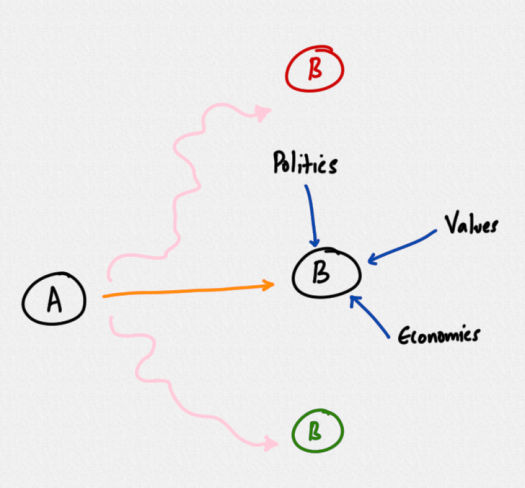
Now the task is to get to B – and there are multiple ways to get there – endless possibilities.
For example, we know that we need to live sustainbly, to use resources in a way that means future generations can also live.
But the solutions aren’t simple. Can we innovate our way to zero carbon materials and living? Can we keep living the way we do and suck carbon out of the air? Do we have to voluntarily use less? Will we be forced to use less because prices will go up?
The end point, B, is not static. It’s a moving target, buffeted by changing politics, values and economics.
Our strategies, therefore, can not be static. We have to tack our way towards B, making improvements and adjustments as we go along, responding and reacting to the environment.
The good news is that we naturally seem to want to make things better. No one sits down to design a worse and more inefficient solution.
The bad news is that we’re going to be uneasy and unhappy about the rate of change and the extent to which we’re progressing. Which is not fast enough.
If we’re too comfortable, that’s a warning sign that we’re getting complacent.
We have to see the possibilities for a better future, otherwise why act at all?
The takeaway: for strategy to be useful it must be dynamic and responsive.
Because things will change along the way.
 Handcrafted insight