
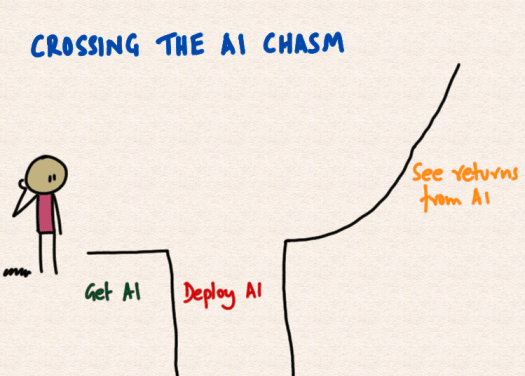
The concept of a chasm that we must cross was introduced by Geoffrey A. Moore in 1991 to explain the adoption challenge faced by people marketing innovative new products.
This may be a useful model to help us figure out how to adopt AI – and maybe make it work.
You might have seen a version of the saying that goes around where a man says to a horse, “A tractor won’t take your job, but a horse using a tractor will.”
I have a feeling that some of us might be horses when it comes to AI.
At the recent EURO conference Nici Zimmerman said that building AI was a computer science problem – deploying it was operational research.
The huge amounts of capital and technical talent poured into the computer science bit means that a huge number of people – billions now – have access to free or low-cost AI.
The next step is deployment – and we’re all figuring out how that’s going to work for us.
Let’s look at three use cases and I’d be interested in your reactions.
- Using AI images and video in posts
As you know, I draw all my blog and LI pictures and write the text myself.
So, I may be biased, but I find myself scanning text and images and if I think they are AI generated I am less likely to click or engage with them.
There’s one or two that stand out – the Schein critique, for example – but on the whole I’m not interested.
- Using AI to create applications or long-form documents
These tools are great at outputting large amounts of content – whether that’s code or text – and it looks like something useful is going on.
There’s another observation going around – if you have 50 lines of code to review, then you’ll probably look at it and have comments. If it’s 5,000 – then meh, it’s probably fine.
Big stuff takes time to proof, and if you don’t know enough to do that or aren’t willing to hire someone to do it then it’s likely that stuff gets shipped that is flawed.
For big projects, I’m currently betting that resource levels don’t go down. Instead they shift from building stuff to shoring up broken stuff and getting increasingly frustrated.
- Professional Services
This is where AI is having an impact, as far as I can see.
You have someone that has to take responsibility – a lawyer, a consultant – and as part of that they need to review and understand material.
AI can help do that. It can take a first pass and help you figure out where to look.
It means that you, as a senior, experienced person, don’t need a junior or assistant any more.
That’s an important distinction. Many people look at jobs and think that they just exist, that’s there’s a fixed stock of jobs out there, something like a fixed stock of gold.
That’s not the case. Jobs are made. That job you’re doing didn’t exist once. Someone created it.
And AI will mean that some jobs are no longer created. They’re just not required any more.
But new ones are.
And the most important one, one Ethan Mollick suggested, is that of “sin eater”.
Someone that takes responsibility to take what AI makes, and make sure it’s usable.
In the age of AI, we’ll have to be more responsible if we want to continue to exist.
 Handcrafted insight