
I was trying out the new Gemini cli coding assistant on the weekend and it feels like something truly new – worryingly so.
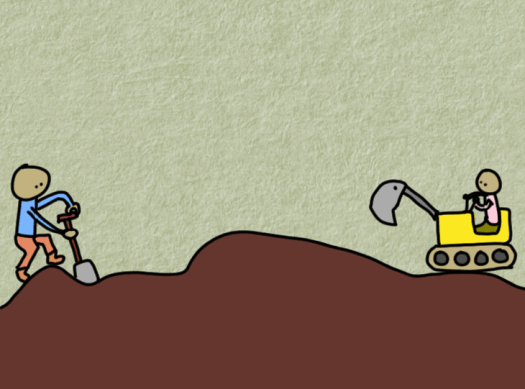
It could be the equivalent of bringing a digger to a spade fight.
We needed our garden doing for years. The space was hard to access and the early quotes we got were astronomical because they involved a couple of folks with spades digging out all the soil for a few days.
So we waited until we were doing larger renovations, and got a digger around, which flattened everything in a few hours.
And that’s the sort of difference I see that working with a coding assistant in the command line can bring.
It’s foundational.
You can ask it to work out a plan for a an application, set out the folders in a modular way, and start creating the skeleton of the application.
It hurries along, setting things up, testing them, seeing there are errors and fixing them.
You get to the point where the workspace is flat and prepped and ready to go pretty quickly.
And that speeds up your ability to create tools that help – and figure out which ones work and which ones don’t.
I could build (or have the AI build for me) a couple of tools that just worked in the time it takes to go and make a cup of tea.
Another attempt at a more complex tool didn’t work out quite like I wanted but it reminded me that I had another approach that worked ok.
For a developer, speeding up the time between idea, code and execution is important.
The sooner you have working code, the sooner you can tell whether you’re on the right track with a solution or not.
I know there’s a massive debate about whether AI is simply doing things that artists should be doing by taking and remixing their work without permission.
But in software development this is starting to feel like an emergent phenomenon, a shift from a coding language to a natural language development pattern, something that is a throw back to the dreams of literate programming.
In this space, anyway, it feels like something new and important is happening.
 Handcrafted insight