
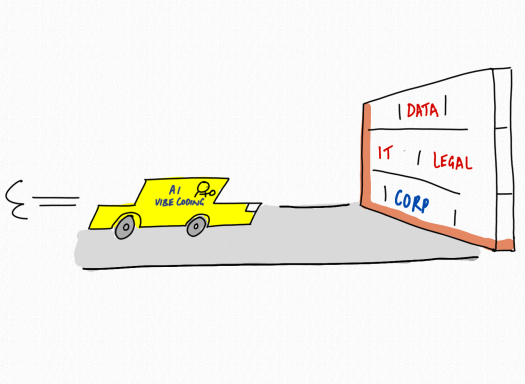
I see at least three sets of stakeholders that we must involve from the start of an AI project if it’s going to work in a large company.
IT evaluates and decides which tools are ok to use and which ones aren’t.
Microsoft has a decided advantage when it comes to large firms because they’re already on every machine and their cloud products are the standard toolkit for the majority of users.
Copilot does a lot, and if your organisation pays for it, you can get access to advanced features.
So that’s usually the place to start for the easiest route for a solution that meets IT requirements.
But there are lots of other tools that do things better than Copilot – ChatGPT, Gemini and Claude all have their own strengths – and wouldn’t it be nice to be able to use them as well?
That’s where Legal comes in. What you’re allowed to use will be determined by what levels of protection are in place. All these tools have enterprise licenses but it’s still all new.
It’s worth having in-house lawyers involved or get in external experts that can provide an opinion on what’s ok and what’s not.
Then there is the question of data.
I think that the code and computational aspects of this whole space are a commodity – you can get what you need from one provider or another, and you can spin up your own infrastructure and private LLM if you want complete control.
The thing that makes a difference is data.
Although ChatGPT and others have made it simple to connect your data sources, such as SharePoint’s, directly to their engines – I’d be surprised if many large organisations are doing this without commitment from the top down in management.
Competitive advantage in this space comes from access and control over curated and specific data that is hard to get in the open market.
It’s probably a good idea to proactively deal with these areas at the same time as you’re exploring and building solutions.
 Handcrafted insight