How To Become Happier By Using Better Mental Tools

tools-for-thinking.png

Sunday, 9.01pm

Sheffield, U.K.

You can’t do much carpentry with your bare hands, and you can’t do much thinking with your bare brain. – Bo Dahlbom

Today I came across a talk by Daniel Dennett for the first time, in which he introduced the quote that starts this post.

The quote resonated with me because much of my work over the last couple of years has been around trying to make sense of things – finding some kind of clarity in the messy real world that we live in.

It feels like different people have approached this in different ways over the years.

At one extreme you have approaches that are rooted in meditation and thought – the kind of thing you imagine Zen Buddhists doing.

It’s a long process of study and practice – at the end of which they achieve enlightenment – which I imagine is making a sort of peace with reality.

Although I did read a quote that said something like if anyone thinks they are enlightened, they should spend a weekend with their family.

At another extreme you have people of certain forms of science who believe that if it cannot be observed and measured it does not exist.

For them it’s about research and measurement and electrical flows and visualisations – about the detail of what’s going on in the physical world.

Now, it feels like there are many extremes as you think through the options.

For example, another extreme is the self-help guru, the person who has come up with a method that has worked for them and which they believe will work for you.

You find these everywhere, because surely if someone has achieved something then doing what they’ve done will work for you.

In Dennett’s talk he says you should install a surely alarm.

Whenever you see the word “surely” in a passage what it means is that the author hopes you’ll accept the point without questioning it.

They’re not totally sure about their point – if they were, they’d simply say that.

So, with the “surely”, they’re often trying to get something they believe to be true past you, hoping you won’t notice.

But you should – and perhaps probe more deeply into what’s going on.

Another extreme is Dennett’s own field – philosophy.

Some people believe that philosophy is the way you understand things – a rigorous way to understand what is true and false.

But really, what you need to understand is that philosophy is a form of logic, much like mathematics.

And Godel proved that even with maths, there are things you need to believe – things that can’t be proven using the system of maths you’re using.

Axioms.

What this means is that pretty much everything is rooted in a belief – and the reason you carry on believing is because nothing absurd results from thinking that way.

So, what I’m saying here is that some people believe that you have to just “get” it for yourself, others that you have to break it down scientifically, others that they have a way that’s worked for them and a few others who say this is the logical way to do things.

And then there are probably a few more ways to go.

What I’m taking from this is that reality is complex and complicated.

There are so many threads of thought, things that happen and what we think about those things happening – so many different ways we could approach the world.

What often matters is finding a way that works for us.

It’s what I’ve thought of as “models” for a while – perhaps what Peter Checkland calls a “holon” – and something that might be captured by Dennett’s concept of an “intuition pump”.

This is something that “focuses the reader’s attention on the ‘important features'” – something perhaps like I do in the model above.

Although what I’ve done is draw some circles around a random bunch of squiggles.

Still, perhaps, looking at those sections of squiggles can help us make some sense of what’s going on.

And I think that’s the point.

We’ve got to a stage in human evolution where just thinking about things isn’t enough.

There are tools that can help – and I suppose we are taught quite a few of these in school.

But many of us then forget these, or don’t go on to learn more tools, and end up trying to get through life on our bare brains alone.

What I see is that approach leads to discontent and worry and stress.

I remember, early in my career, as experiences piled up and I found it harder and harder to get what was happening.

And then I went back to university, did a management degree, and was introduced to models and ways of thinking that helped me make sense of the experiences I had had.

All of a sudden the feelings fell away – having words to describe what was going on meant that I could understand it better, and so there was no more need for feelings of doubt or inadequacy or shame.

Making sense of things matters – but there is no grand “sense” that we all share.

Instead, you have to make your own personal sense of things – but having good mental tools will help.

Some of which I have tried to use as I write this blog – the point of which really is to help me make sense of the world around me.

I hope it helps you as well.

Cheers,

Karthik Suresh

Do You Know This One Secret That Can Improve Your Marketing?

curse-of-knowledge.png

Friday, 9.06pm

Sheffield, U.K.

Euclid taught me that without assumptions there is no proof. Therefore, in any argument, examine the assumptions. – E. T. Bell

Today I learned from Steven Pinker about a thing called the curse of knowledge.

It turns out there is an experiment you can do with a three-year old.

Show a child a box of chocolates and ask them what’s in it.

They will probably say, “Chocolate.”

Now, get them to open the box.

Inside, they’ll find pencils instead of chocolate.

Now, ask them what’s inside the box.

They’ll say, “Pencils.”

Now, bring another child into the room and ask the first child what the second child thinks is inside the box.

The answer is, “Pencils.”

What’s happened is that the first child cannot now “unknow” what’s in the box.

But also, the first child now believes that everyone else also knows what it knows.

This is something many people never grow out of.

We believe that because we know something other people must know it as well.

And that causes us to make mistakes in the messaging we create – the things we write and design to explain what we do and how we work.

You probably see this all the time at work.

If you ask someone to pull together a briefing paper or a presentation on a topic, what you will get is a comprehensive statement of what they know.

There are all these things you have to start with, and we did all this stuff, and carried out these complicated calculations and did all this really detailed things about these really specific elements and so on and on and on.

But, what does this mean for someone who doesn’t know what you know – but who is bright and capable?

How do you get a message across to people like that?

For starters, you think about what they need to know.

Are they interested in the mechanics of cocoa production or are they interested in why your chocolate is different?

Take Tony’s Chocolonely, for example.

I like chocolate, probably too much, but I’ve never given it much thought.

My default has been something in the Cadbury’s or Galaxy line.

I was introduced to Tony’s Chocolonely as a “slave free” chocolate – an ethical brand.

I tried it – it was nice, but expensive.

And then we went to Amsterdam – before the world shut down – and visited the shop where it was made, and that left an impression.

And more recently, when I bought a few bars, I read some words on the marketing that said something like “unequally divided, because the world isn’t fair” – or something on those lines.

You don’t get nice clean squares with this chocolate.

There’s a lot of messaging with this brand – and some of it is clearly getting through, for me, at least.

All these things make the chocolate stand out in a way that’s different from brands that talk about being the finest chocolate, or having master chocolateers or focusing on the colour purple.

By this time, you’re probably thinking about chocolate and I’m losing my train of thought wanting some…

To pull things back.

The hardest thing for us to do is see things from the point of view of someone else who doesn’t yet know all the things we know – or actually someone who doesn’t want to know at all.

When you write or ask someone to write a piece of marketing you should see that as a first draft.

What’s probably going to happen is that first draft puts down everything you know about what you do – it’s a list of features.

What you need to do next is remind yourself of the curse of knowledge – remind yourself that you need to know what you know to be able to understand what you’ve written.

Then you need to sit down and rewrite every sentence in your draft so it make sense to someone coming to it with little or no knowledge – but someone bright enough to get what you’re talking about.

You don’t need to talk down to people or be patronising – you just need to be clear about what this means for them.

I remember, years ago, going to a marketing class where we did just this.

We were asked to write down a few words about what we did for customers.

Two of my examples were “risk management” and “carbon offsets”.

Then we were asked to try and write down what this meant for customers – how did they benefit?

And I suppose I wrote something like “Buy what you need as cheaply as possible” and “do business in a green and sustainable way”.

The second attempt, hopefully, make more sense than the more technical words that make sense to me.

The fact is that writing is bloody hard work – you’re not just going to sit down and dash off a masterpiece of marketing copy or a story or anything like that.

The first draft really is just you telling the story to yourself.

The second, third and fourth drafts are where you start telling the story to someone else – and how you eventually get to something that is so easy to read that people just “get” it.

But it’s not easy – if it reads well it’s because someone worked for a long time writing it.

And maybe that’s the lesson.

You worked really hard to learn what you know.

Now you need to work twice as hard to get other people to see it.

And that’s marketing.

Cheers,

Karthik Suresh

Business Lessons From A Literary Agent And Critic

rejection.png

Thursday, 9.29pm

Sheffield, U.K.

An objection is not a rejection; it is simply a request for more information. – Bo Bennett

At the moment I’m finding a lot of ideas in TEDx talks – the shows that I watch in scattered fragments of time during the day.

The beauty of the TED format is you get a lifetime of experience compressed into fifteen to twenty minutes – and that means the speaker has to create a thought diamond – a flashing stone of inspiration just for you.

One of today’s shows was by Julian Friedmann about storytelling – about what he had learned as an agent working with authors.

The thing that stood out for me was the idea of rejection.

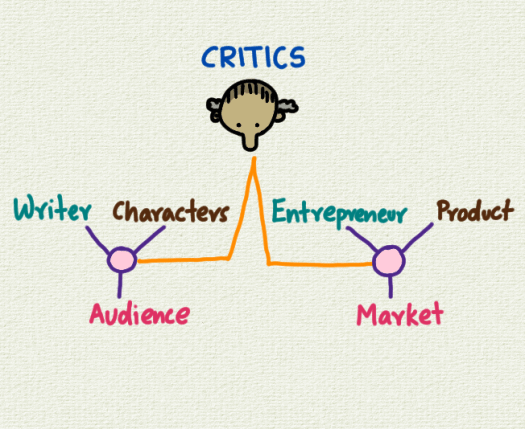
When someone sets out to write something like a novel – a thing that is made for other people to read – there are three elements that are involved.

There is the writer – the person sat in the chair writing day after day.

There are the characters – the people the writer creates and watches and sees doing things day after day.

And then there is the audience, that takes the book and tells themselves the story.

Now, in traditional publishing, to get your book out there you have to get past the gatekeepers.

These are the agents, the editors, the publishers – the ones who can decide whether you as a writer get to make a living or not from doing what you love.

They often have, as Friedmann says, less creativity and talent than you, but they have the power to decide what happens to your work and, by extension, you.

What gives these people the right to do that – how is it that they have that kind of influence over what you do?

Well, increasingly, they don’t – if you want to publish these days, you can.

It might not be any good – but that doesn’t mean you can’t see your name in print.

The point is that if an agent or critic rejects what you’ve produced it’s because they don’t think it will sell – it won’t appeal to the audience out there.

Now, if you look for the analogy of this writing structure in business you get a very similar three part model.

There is an entrepreneur who lavishes time and money in creating a product and then brings it to the attention of a market.

And they come up against the investors and buyers who are the equivalent of critics in the business world – the people with the power to decide what happens to your product and, by extension, you.

Writers fall in love with their creations; entrepreneurs fall in love with their products.

Some fail to realise that their creations and products are just not very good – they’re not what the audience or market is willing to buy.

They react by getting angry, by chasing publishers, by trying hard sell tactics

They believe that eventually the world will realise their brilliance – they just need to push hard enough.

And that may be the case, and they may win.

But in other cases the world is telling them something they should listen to – which is that they need to go back and improve the novel, make a better product.

The feedback might actually be useful – within the rejection you experience may actually be the secret that you need to know for your eventual success.

The next time you pitch your product – the thing you have spent huge amounts of time building with care – just remember that it’s not about you.

It’s about your audience, your market.

It’s about how they take what you’ve created and look at it – what is the story they tell themselves?

How do they see this thing you’ve made from their point of view – how do they use it, why do they need it, what do they do with it?

Their experience of your thing is what matters – that’s the one thing you can’t control.

But you can control yourself and the thing you make – you can change those and then go back and see if you get a different reaction.

Rejection, in this model, is simply the world telling you that you need to do some more work – perhaps slightly smarter, more targeted, better informed work.

That’s all.

Cheers,

Karthik Suresh

How Can Artists Show Us How To Do Better Business?

practical-business.png

Wednesday, 9.33pm

Sheffield, U.K.

Phaedrus read in a scientific way rather than a literary way, testing each sentence as he went along, noting doubts and questions to be resolved later… – Robert Pirsig, Zen and the art of motorcycle maintenance

I picked up Shawn Coyne’s The story grid again today to have another go at wrapping my head around his unique approach to deconstructing a story.

There was a thought I had playing in the back of my mind after listening to an interview with Roald Dahl who said that writing books for children is much harder than writing one for adults.

This is because children, if they like a book, don’t read it just once.

They’ll read it again and again – maybe five times, maybe twenty – until they sometimes know it by heart.

I remember doing this – there was a time when I could simply run through the words of the Hitchhiker’s guide to the galaxy in my mind.

So, when I had to sit down and write about something to do with business I wondered why you would put any less effort into that kind of communication than you would do with a story for children or adults.

In other words, how could you write better for your business?

Now – hopefully that doesn’t seem like an entirely pointless question – a lot of poorly written stuff is put out by businesses.

So, if you want to do better how should you approach the task?

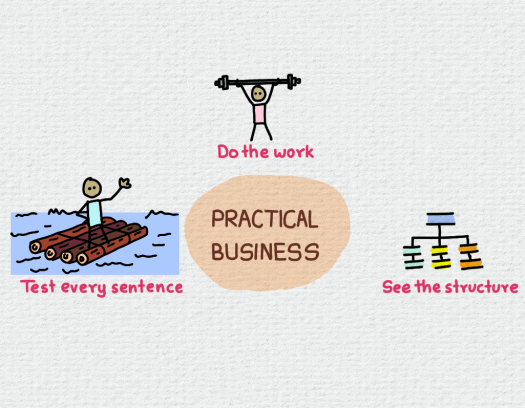
First, do the work

The first thing that Coyne reminds us is that thinking is not the same as doing.

He writes about what he learned at a class called “Practical Aesthetics Workshop” which was all about “de-bullshitting stuff”.

It gave him practical, tangible tools – which came down to this quote.

“If you want to get stronger, you don’t think about the proper way to lift weights. You learn the proper way and then you actually lift weights. Pretty simple.”

This is worth keeping in mind.

All the strategy discussions in the world won’t change a thing if you don’t then do the work.

In fact, you’ll probably make better decisions if you first do the work and then go back and look at what happened and think about what you could do better.

Second, create a structure

The second thing that Coyne points out is that he likes to break things down into their component parts – a practice that comes from his science background.

So, he starts to create a taxonomy – breaking down the big stuff into smaller things and creating a structure that you can go through.

And then he goes on for several pages.

I’ve written previously about why Coyne’s approach is hard for me to follow without wanting to stick pins in my eyes – partly because the whole breaking things into parts is a hard task – and because it’s made worse by having to do it in Excel.

I will have to find a way to do the same thing in text files using something like Niklas Luhmann’s Zettelkasten approach – which is the project that I’m going to give myself over the coming months – probably using some of Terry Pratchett’s books.

But, let me come back to structure.

Structure is something that you have to impose on your work – but also something that can emerge from your work.

For example, let’s say you’re trying to come up with some marketing material.

You could just type stuff straight into the computer – following a structure someone else has given you.

Or you could work through a couple of drafts, trying different things.

Both might work – perhaps differently.

What matters, in the end, is that what you create has a logic to it, a structure that works.

If you get the structure of a message right, then it acts like an internal skeleton, organising information and putting it in front of the reader at the right time so that they “get” it.

The structure is invisible but the impact it has is not – you end up with a satisfied reader.

Third, get rid of the bullshit

The last element is something that really only comes from a way of thinking where it’s important that things work.

In science or technology, for example, something works or doesn’t work – it can be tested.

Balls roll down a plane or a bridge remains standing when put under stress.

But, you also have the same thing when it comes to the arts.

An actor does her lines and the audience likes it or doesn’t – the lines land or don’t.

Yes, it’s a little more subjective and the audience matters – but on the whole you know if something succeeds or fails.

And it usually has something to do with the way the script or the story has been built.

And the way to test this is to check every line – think of it like building a raft.

You don’t want a raft made from a mix of logs and lead – you want the whole thing to float.

And in your business messaging every sentence that doesn’t help you float should be cut.

That includes all the fluff and fancy talk and things that you feel you should say.

Like the quote that starts this post, read each sentence, testing as you go along and note doubts and concerns that need to be resolved.

Then resolve them.

Don’t say that “You’re the best” – explain why, on what basis – go into the detail that justifies why you can say something like that.

And then don’t say it at all – put down all the things that result in the reader saying it for themselves.

It’s the old thing – show, don’t tell.

And it works just as well for business as it does for the arts.

And that’s because, when it comes down to it, business is an art.

Cheers,

Karthik Suresh

How To Tell A Story So People Will Listen

immersive-story.png

Saturday, 9.13pm

Sheffield, U.K.

A good story cannot be devised; it has to be distilled. – Raymond Chandler

Do you ever get the feeling that some things people write are too flat, too thin to really be of any use?

Like management theories, for example.

You can pick up a textbook and see models, two by two matrices favoured by professors and consultants, that try to capture what is going on in the world out there.

But, in reality, they don’t – but why?

Terry Pratchett, in one of his books, talks about some cultures having a view that taking a picture of people was like stealing a bit of their soul.

And he said that if you looked closely at people who had a lot of “exposure”, who had lots of pictures taken of them, they seemed less substantial, less real.

And I think that’s what happens to ideas as well – as they’re passed on and refined and made more general, they lose their substance – they stop being rooted in something real and become fading memories of something someone once understood.

Which is why fiction matters so much – why writers who look again at the reality out there, even if its a reality they construct in their own minds, are much closer to what’s going on than these lofty theoreticians.

And if you want to get a feel for how this plays out you only have to watch a course on Coursera on writing and then watch this TEDx talk by Ryan Gattis.

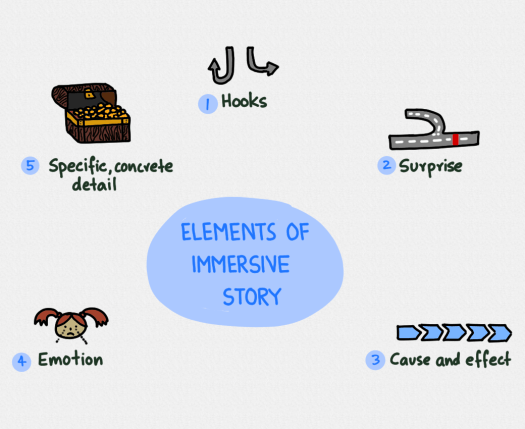
Gattis talks about the elements of immersive story – five things you must have to make a story work.

These five things are the kinds of things you will learn in any introduction to writing class – they’re craft skills that you refine through practice and effort.

You have to start with hooks, things that snag your audience’s attention.

You need a few of these and you might to wait till they take hold before you start to reel in the reader.

Your writing cannot be predictable, be boring – you need to take the reader down one path and then change things around – keeping them guessing and therefore interested.

But you also need to have a chain of events – you need cause and effect if you want to avoid simply having a random series of things happening and confusing your reader.

It’s not enough to be a master at describing what you see out there – the facts of the case.

You also need to connect with your reader on an emotional level – and that means sharing and creating feelings.

And throughout your writing you have to have specific, concrete detail – that’s what makes your story believable.

To see how these elements are used by someone who knows what they’re doing watch Gattis’ presentation – it’s hard to turn off and stop halfway through.

And that’s because anyone can have these elements – but the thing that holds them together, Gattis says, is authenticity – how real you are.

And he has an interesting approach to what it means to be authentic – on the lines of it’s when you show others who you really are rather than what you want to show them or what you believe they should see.

Now, this resonates with something else I was watching which was Brandon Sanderson on plot.

He said that people were sometimes surprised that editors very quickly rejected their work, and he argued that was actually completely understandable.

Bring up a piano, he said, and have someone play who has been learning for a year or so – someone who’s worked hard to improve and practised their stuff.

Then bring up a concert pianist, a professional with a score of years experience, and listen to them play.

How long will it take before you can tell the difference between which one is better?

And it works the same way with a novel – you can tell in the first few pages whether the writer is good or not, experienced or not.

And it works the same way in most places – you can tell people who have business experience, who know their stuff from the people who are new or that are full of hot air.

You have to spend the time working on your craft, whatever that craft is.

When you’ve spent that time then you’re in a position where you can use these elements in an effective manner – when you have the skills to do the basics.

Which is when you can take down your defences, when you can start to let the real you out, the one that people can connect with.

Because it’s one thing to know what these elements are – it’s an entirely different thing to have mastered how to use them.

As a lecturer said to us once when we had completed an MBA course – “You now have a Masters in Business Administration – that doesn’t make you a master of business administration.”

That comes later, with time and practice and perseverance.

Which is why I think that you should take the time to go deep into ideas, into situations – because it’s only when you do that that you will get the really interesting stuff.

The stuff that you can use in a story that people will stop and listen to.

Cheers,

Karthik Suresh

Why You Have To Get Everything Important Right For Things To Work

puppet.png

Friday, 9.53pm

Sheffield, U.K.

In any moment of decision, the best thing you can do is the right thing, the next best thing is the wrong thing, and the worst thing you can do is nothing. – Theodore Roosevelt

A post on social media recently introduced me to the work of Frederic Vester, a German biochemist who did work on networked thinking – combining elements of complexity, systems thinking and cybernetics.

He is not that well known because he published mostly in German and his book The art of interconnected thinking is hard to find.

A summary of the ideas, however, on his website makes for interesting, if not easy, reading.

His basic argument is that we need a new kind of thinking, one that recognises two things.

First, more things are connected to each other than we realise.

Second, the connecting strings between things are more important than the things themselves.

To see how this works look at the puppet in the picture above.

The puppet is made up of things – a head, limbs, a body and so on.

These are connected through links, ball joints and the like.

Now, you can see that the upper arm is connected to the torso, but so is the lower arm – through the first connection.

If you want to make the puppet dance, you attach strings to the things – which gives you the ability to move them.

With this picture it’s clear that the strings are the most important element if you want to make the puppet dance.

The way in which you control and move the strings will govern the kind of result you get from the puppet.

If you pull on just one string – you’ll only get a little movement – no matter how good you are at giving that string the right amount of pull.

You need to pull on all the strings – all the important ones – to get a smooth movement and bring the puppet to life.

Now, that might seem obvious with this example – but we often forget this simple rule when confronted with real life situations – ones that are more complex.

And, as a result, we make mistakes – predictable ones.

Vester draws on the work of Dietrich Dörner who used simulations to come up with common mistakes that experts made in situations.

For example, instead of trying to improve the system as a whole, they tried to solve specific problems as they saw them.

That’s akin to making a leg or arm move better while forgetting about the whole body.

Or they spent too much time collecting lots of data and carrying out endless analysis rather than looking for patterns, for the fundamental character and controls in the situation.

Sometimes they focused on a particular thing and forgot about everything else – they just didn’t notice or became blind to other data or factors.

Because their minds were locked into a particular path they didn’t think about side effects – what other consequences there might be.

If what they tried didn’t work quickly, they tried other, more powerful methods.

But when they realised that the first things they tried took time before they had an effect they stopped things just as fast.

And, when they had the power they used it to force through a particular approach they believed in – but things don’t often happen just because you want them to – however strong your force of will.

These ideas are important and the insights timeless – because we see them happening all the time.

As human beings, we’re designed for short-term, survival based thinking.

That’s what we’re good at – living for another day.

Living better – living in a way that helps our children and grandchildren needs long-term thinking – something that we can do as human beings.

But not something we can do in a hurry or in a panic.

Some of the rest of Vester’s work seems quite complicated – and I don’t know enough to know if it needs to be so complicated.

Maths is of less help in many situations, especially social ones, than you might think.

Understanding people is probably more relevant.

And seeing the strings that pull people perhaps even more so.

But if you can see those strings – then you can get better at pulling them – to improve the situation you’re in.

And that’s when you know that what you’re doing is working.

Cheers,

Karthik Suresh

What Does Maslow Have To Tell Us About Businesses Now?

needs.png

Thursday, 9.30pm

Sheffield, U.K.

First you find out what you have, Dad would say. Then you figure out how to make it work for what you need, ’cause you don’t get what you want. You get just what you have and no more. – Lilith Saintcrow, Betrayals

I was starting to wonder how to approach the world that’s unfolding in front of us now.

Is it too soon to start to examine what’s happening or should we have started to look at this earlier?

A few social media comments by others have, however, led me to think there is value in doing a little analysis, which is what I might do in the next few posts.

Let’s start with Maslow.

Maslow’s hierarchy of needs, as you know, is a theory of human motivation – looking at the things we need as humans.

We start at the bottom with basic physiological needs – food, water, shelter.

Then we need safety, some kind of security – a fixed abode, a trade.

If these are met, then we start looking around for friendships and relationships – for belonging.

And along the way, we look for acceptance and admiration from people – the things that feed our self esteem.

And at the top is self-actualisation – where we add value to ourselves and others in the best way we can.

Maslow saw these criteria as building on each other – you had to complete one level before you could work on the next.

But clearly, when you’re in a crisis, you might drop a level or five depending on what you’re facing.

If you’ve built up a reputation over the years as a pillar of society – meeting your esteem and self-actualisation needs – and then you do something naughty that gets everyone very cross – then you might drop down the love/belonging level and have to make amends and rebuild your life.

Or – something like a virus could come along – and drop you all the way down to the safety and physiological levels.

For many people they’re now wondering about how to meet their basic needs – where will their food come from and will they be able to pay the rent on their homes.

Depending on where you are in the world your experience will vary – and life is no doubt very tough for many people.

If we as individuals are facing life in those bottom two levels, what might a similar hierarchy be for businesses?

I thought I’d take a stab at building up a hierarchy and see if it made sense.

For a business, at the bottom, cash is what matters.

If you’re not bringing in some money then you don’t have the makings of a business – you need cash to cover your costs.

At the next level you have earnings – you’re bringing in more money than you are spending and you have the operating earnings needed to grow the business.

Now, your business is grown up when you start to think of yourself as being part of an industry – where your contribution is recognised as being something people want.

When people get to the point where what they want is you, then you’ve got yourself a name, a brand – you’re a trusted provider of a product of a service.

And right at the top you have a moat – your business is more than just a provider – but it has value that is more than the net assets it has.

Right now businesses and individuals have crashed down to that safety level – and for both, safety now means having earnings or having reserves to draw on.

If you still have a job, or your business is still trading or you get support from the government or you have the money in the bank to cover you for a while, then you’re safe.

If not, you’re in that space where you don’t know where the next meal is coming from – or you’re running out of cash and will go bankrupt.

Warren Buffett wrote “Only when the tide goes out do you discover who’s been swimming naked.”

Many people and businesses have spent their time believing they’re in the top two or three levels of their hierarchy of needs.

They’ve run businesses on thin margins, high leverage and paid out healthy dividends.

And now, they don’t have the resources needed to ride out a storm.

But the way our economies work is that letting such businesses fail would cause so much hardship that it’s better to support them for the sake of everyone else.

Human nature isn’t going to change – there might be a short term increase in the number of people who become more conservative over the next decade or so – but the memory of this will fade.

But principles don’t – and some of us will continue to believe that you can’t get to the top three levels unless you have got the bottom two really sorted.

It’s simple really.

When you live through a season of plenty, put away something for the famine that is to come.

That’s a timeless message if there ever was one.

Cheers,

Karthik Suresh

Do People Really Get How Computers Can Be Useful To Them?

effort.png

Wednesday, 8.44pm

Sheffield, U.K.

Most of the time spent wrestling with technologies that don’t quite work yet is just not worth the effort for end users, however much fun it is for nerds like us. – Douglas Adams

I have spent a lot of time playing with computers – mostly because time has just passed without really taking any notice of my opinion on the matter.

Throughout that time the terminal has been my friend – the command line and plain text – have been all I have needed for my own purposes.

To work with others, however, I’ve had to slow down, to use graphical user interfaces and do things more than once – which if you have spent any time programming is not the kind of thing we like to do.

We’d rather spend three hours coding something that will do something you could do in five minutes manually.

My thoughts on this were sparked by a Twitter comment by Paul Graham, the founder of YCombinator, on the lines of tech people don’t really use that much tech – we only use what’s needed for the problem we’re working on.

And I think that’s true – we have more computational power for the jobs we have to do most of the time.

Problems that really need some heavy duty computational hardware are probably not ones being addressed by the average individual or business.

The problem is that most of those individuals or businesses don’t really get the real power of a computer.

A lot of people use applications that help them do the things they would do using paper pretty much the same way using an application.

And I guess that makes sense – I wrote a few days ago about how tech companies build tools to let people do things the way they do them now – and why should that be different for individuals?

Why wouldn’t you design software that helped people take notes the way they would on paper, or let the write in the way they would longhand?

The point I’m reaching for is that technology builders build things that people can see themselves using – and as a result they don’t really get that much more productive.

And, in real life, they don’t get much faster but they’re also restricted by all kinds of security policies and technology shackles that they end up worse off than before.

There are lots of people out there who have spent much of today in critical roles – jobs that involve protecting and saving lives – trying to make their technology work rather than doing their job.

But one problem is that for many people it’s not worth their time trying to get better at understanding and using the technology – and they’re comfortable doing it the long, hard way.

Now, I don’t know what makes someone go one way or the other – I suppose it has something to do with temperament.

Today, for example, a small person wanted to use a computer.

If you give one of them a regular machine, with a browser and everything else – they’re onto some kind of website with games in a second.

So I fired up one and logged into a terminal.

And the small person was fine, pressing keys and making letters scroll around – and along the way he invented a game – hiding a word inside that random bunch of letters.

It took a while but he did it.

So, the next time round, I got him to write a program – one that generated random strings of a certain length for a certain number of lines – and then replaced a set of characters with the words he wanted to hide.

And I watched his eyes.

They didn’t really tell me anything – he went through the task and then wanted to do something else.

Which was fine.

The thing I was wondering, however, was whether he “got it” – whether he could do something in a few minutes that had previously taken ten or fifteen – whether he could do it again and again in seconds – now that he had created a program that did what he was doing manually.

Because that’s the real power of a computer – not in helping you do the things you can do but in doing things that you can’t.

But I’m not sure people really get that yet.

Cheers,

Karthik Suresh

What To Do To Jumpstart Being Creative Right Now

creative-thinking.png

Monday, 6:00 pm

Sheffield, U.K.

Draw the art you want to see, start the business you want to run, play the music you want to hear, write the books you want to read, build the products you want to use – do the work you want to see done. – Austin Kleon, Steal Like an Artist: 10 Things Nobody Told You About Being Creative

If you are in a difficult place right now then it may be time to start being creative.

But how do you go about doing that – surely only some people are creative and the rest aren’t?

That isn’t the case, according to Edward de Bono – as I dug out his book Serious creativity to remind myself how this works.

I’m not always sure what to make of De Bono’s writings – apparently he’s very clever and he seems to think so.

Lots of people copy his ideas, he says, and he came up with lots of stuff before science caught up.

So, I don’t know – but I watched a video of him talking and drawing once – and well – you might as well listen to his stuff and judge for yourself.

He says that you can deliberately be creative – you don’t need to sit around and wait for inspiration.

What you’ve got to do is get your mind out of the grooves it’s currently rolling along – look at things in a new way.

There are three main approaches he suggests: challenge, alternatives and provocation, along with tools that help you with them.

You’ve probably heard of a few of them – six thinking hats, for example.

But right now I want to look at the top level criteria and see where that takes me.

Take challenge, for starters.

This comes down to looking at everything that is the way it is now – and asking why it is so.

Why do you do things a certain way – why is that process followed – why do you create this document?

In many jobs in many organisations you do not have permission to question what is happening – to question the status quo.

If you do you will probably get told off.

That’s the way we do things around here and all that.

But, you have to give yourself permission to question, to be a pain in the proverbial – if you want to do something different anyway.

Then you have the idea of alternatives.

What else could you do? How else could you get there? What other options are there for the thing you want?

At one time you had to rely on yourself for all this thinking.

These days you have the Internet on your side.

For example, I once wanted to get a microphone holder – but was too cheap to pay.

It turns out that if you bend a coat hanger in the right way you get a very effective, zero cost microphone holder.

And finally you have the idea of provocation – starting with the opposite approach or a confrontational option.

Right now a provocation many are using is “I run my business from home”.

Such a provocation will often result in many thoughts about why it’s not possible – and you have to work through them to get to the new ideas that are possible.

Our way of life as we knew it is being put on pause.

It is time to get creative.

Cheers,

Karthik Suresh

How A Crisis Reboots Our Entire Way Of Thinking – With Stories

bound-by-story.png

Friday, 9.32pm

Sheffield, U.K.

People like to think that stories are shaped by people. In fact, it’s the other way around. Stories exist independently of their players. If you know that, the knowledge is power. – Terry Pratchett, Witches Abroad

You have probably all noticed the scramble for attention online – the rapid repositioning of resources as companies deal with their inability to be in the same space at the same time as others.

Organisations that specialised in face to face services now have to change their models overnight to distance communications and no-contact delivery.

And they’re doing it amazingly well.

Close to us is a sustainable food business that used to be based on group catering that has transitioned to offering delivered meals – a full week’s menu.

Organisations that did conferences have moved to webinars.

Meet ups that required you to go down to a space now have a call in.

So, we’re rapidly reconfiguring the way in which we network with others.

On the one hand this has the effect of a tidal wave swamping our existing communications.

On top of the regular stuff we get there is a lot of additional material as the newly digital promoters tell us what they’re offering.

And maybe things will subside – after all most of these organisations have customers and lists they have built over decades and they are talking to the people who already care about what they offer.

It’s just that the story they’re telling about what’s going on has changed.

Or has it?

Terry Pratchett’s book Witches abroad has the penetrating vision of his other books – as an impossible land filled with impossible characters that play out their impossible lives – while revealing fundamental truths about how we live ours.

We’re surrounded by people, things, events and institutions.

We don’t often question these – wonder how they came into existence.

Most of them seem like they’ve always been there – and they have been – for our lifetimes anyway.

Things like democracy, a parliament, libraries and the NHS.

But what created them in the first place?

What’s there, binding everything together, like an invisible ribbon coiling around the world we think we live in, is a story – many stories.

The stories that have created the way we think now.

What happens in a crisis is that some stories start to fray and rip and others take their place.

We replace stories about how important it is for managers to see what their workers are doing with stories about better remote working and mental health.

We dig out forgotten stories about community and helping others which we didn’t need when we all had cars and supermarkets and could get everything we needed without speaking to a single person.

When you think about it this is something we’ve always known.

Stories are like a programming language for our brains.

We use them to program our children – with language, with ideas, with thoughts, with ways of being, with kindness.

And when we’re older we still crave those stories – although we think that we’re too old for them now.

For a few decades now I’ve read mostly non-fiction – and over the last couple of years I’ve started to realise just how thin and translucent and fragile most non-fiction is.

Fiction, on the other hand, is deceptive – while it seems like a child’s pastime, like something you read on holiday at the beach – it captures the human experience far more completely than any dry analysis of the situation.

With Pratchett, who I rediscovered recently, I started with the book on the left and started moving right.

And then they closed the libraries…

Anyway.

The point I think I’m trying to make is that life is complex and wonderful and deep – but while we’re experiencing it it’s too hard to understand what’s going on.

A fish, for example, probably doesn’t have a word for water – even though it spends its life in the stuff.

A story, on the other hand, picks out a few essential lines from that complex life picture and shows us more with those few lines than we could ever see by living the whole.

And that’s how it shapes how we think.

And that’s why stories have power.

Use them wisely.

Cheers,

Karthik Suresh