Why The Point Of View You Take Matters

frames.png

Monday, 7.09pm

Sheffield, U.K.

The greatest tragedy for any human being is going through their entire lives believing the only perspective that matters is their own. – Doug Baldwin

We’ve been watching the program “The Bold Type”. I relate to almost nothing in there but it’s about publishing and writing and that’s cool but it’s also about people’s voices and that’s interesting.

There’s this idea that everyone’s point of view matters and it’s important to get the voices of marginalised people heard alongside the mainstream ones that tend to dominate the conversation. The mainstream tends to think that because it’s everywhere it’s also right. And then you have the counterpoint that the mainstream, is oppressive because it’s so dominant – nothing gets through it without being filtered through its requirements.

Anyway, what this comes down to is problematic – because logically there is no “right” way to look at these issues. Logically, might can be right and equality can be right – it all depends on the system of logic you use and the way in which you interpret things. Or that’s what I’m led to believe from reading “Zen and the art of motorcycle maintenance”, which argues that your morality is often a matter of convenience.

Is this helping – probably not.

Let’s talk frames instead.

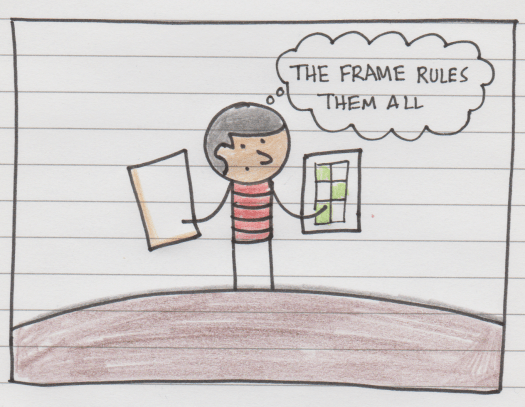
Lynda Barry talks about starting your drawing with a frame. Everything inside the frame matters. Everything outside doesn’t. Your story takes place inside the frame – except when you lean against the frame or break through it. There are always exceptions to rules.

A frame is still a good place to start. Try and understand the frame through which someone else sees something and you start to understand what they’re interpreting from what they see. If you have a point of view and I have a point of view and we’re both looking the same way then we must be looking at the same view. The only thing that’s different is how we interpret what we’re seeing. And that’s the importance of the frame. It’s the frame that makes you a conservative interpreter or a liberal one. The frame is it.

The simplest way to make a difference to you and others is recognise the existence of a frame and its relationship with the reality in front of you.

Don’t let your frame become you – it’s a tool to help you think and not the way you think. The more frames you have the better you will be – as a thinker and as a person.

Cheers,

Karthik

Where You Should Start When You Want To Make A Difference

stairs.png

Sunday, 8.51pm

Sheffield, U.K

Leadership is solving problems. The day soldiers stop bringing you their problems is the day you have stopped leading them. They have either lost confidence that you can help or concluded you do not care. Either case is a failure of leadership. – Colin Powell

A short one today – inspired by a comment on LinkedIn.

I don’t know how you good you are at cleaning the house. It’s something that has to be done and quite frankly, I’d rather someone else did it. But – since we have to do it every once in a while I’ve had to get used to the idea.

I’ve always found stairs fiddly and difficult. The vacuum cleaner doesn’t sit right on the stairs and the hose isn’t quite right and it’s all a bit of an effort. Until I discovered that the place to start was at the top. If you begin at the top of the stairs and work down everything seems to go much more easily. It makes more sense with a broom, I suppose, as you sweep down and out.

Now, the original comment had to do with leadership. If you want to change things, the poster argued, you need to spend less time on the shop floor and more time with the leadership. After all, you can do all the change you want where the work is happening but unless the leadership buy in or accept the big changes, things will probably fail to improve.

And this make sense, doesn’t it? Leaders are the ones with the power to change the system. People lower down the hierarchy can do things to change how they work but they are still constrained by how the system they operate in functions.

This is one reason why things that work at an individual level very rarely also work at a group level. You can, for example, set a goal and go for it, work as hard as you can and do everything to get there. As a group, things get more complicated quickly. What’s the goal, is it the same for everyone, are we all pulling our weight and why are the rewards unequal? All these issues mean that when you go from one person to many people the way you approach things has to change.

At a larger scale individuals can affect very little – unless they are in a position where they can make decisions that result in big changes. And so, thinking about the fact that it’s easier to start at the top of the stairs just reminds us that it’s always easier to start at the top of the hierarchy.

If you want to make a difference, begin at the top.

Cheers,

Karthik Suresh

What Does It Mean To Grow A Business These Days?

grow-business.png

Saturday, 9.05pm

Sheffield, U.K.

The Buddhist point of view takes the function of work to be at least threefold: to give a man a chance to utilise and develop his faculties; to enable him to overcome his egocentredness by joining with other people in a common task; and to bring forth the goods and services needed for a becoming existence. – Ernst F. Schumacher, Small Is Beautiful: A Study of Economics as if People Mattered

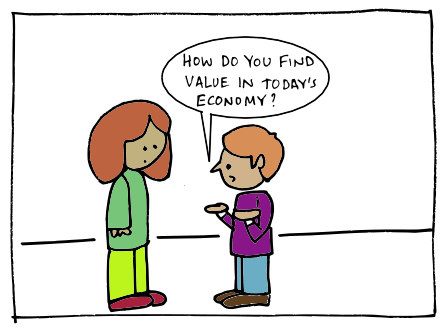
What we see has a huge influence on our view of the world – the news, the stories, the myths – all of them create a picture of the way the world works. But what if it’s all wrong? What if the truth is hidden from us – because there’s no profit in making it visible?

Let me explain by starting with Dr Michael Gregor’s books. He’s written How not to die and How not to diet – possibly the most densely researched packed collection of books into nutrition that you could read. His basic thesis is simple – a plant based diet is good for you. You can lose weight on low-fat and low-sugar diets but it tends to come back when you eat normal food – where normal for modern humans means ultraprocessed products.

Now, food is big business. But there’s no profit in selling you the food that’s proven to keep you healthy. The money is in the made up, the creations that blend sugar and fat and salt to send your palate into overdrive. So you don’t see adverts for ginger or apples – but you do see them for fast food and cereals. You’d think from what you see that such food will make you happy – but after that rush of taste what’s left other than regret, served with a side of fat.

There’s very little money to be made in stuff that’s worth doing sometimes. Take YouTube content, for example. I’ve seen some content that’s on DIY film gear, which is interesting and probably usable for most of us – but that doesn’t seem to attract all that much traffic. Then there are the videos that demonstrate hyper-complex setups and cutting-edge gear. These ones do well – because there’s more money to be made in the higher-end products. I think we know that reuse and recycling and repurposing is good – but we’re also seduced easily by the expensive stuff.

Now, I know it’s not as simple as that because if you can make amazing content about recycling you’ll probably get views. The point I’m heading towards is that you don’t know whether the point of something is to sell you product or if the point of something is to help you get better. And some people will argue that it’s the same thing but the money from the product has a way of skewing good intentions. Money corrupts too.

Then again, I haven’t met that many people who do things for money. Those kinds of people you can spot a mile away and they’re usually a little too eager to get you into something, a little too desperate, and I think you’re smart enough to notice and avoid them. Most people want to do something well, developing their own ability and contributing something to society. The rewards really come from what they do.

So, what that means if you want to grow your business is that you need to ask yourself how you help people. If you help a few people and make a small difference, you’ll make a small return. If you help a few people and make a large difference, you’ll make a larger return. If you help many people, you’ll often make the largest return.

It turns out then that the formula for growth is simple.

Go out and help.

Cheers,

Karthik Suresh

Why You Can’t Wait For Someone Else To Sort Out Your Life For You

do-anyway.png

Thursday, 7.54pm

Sheffield, U.K.

Long-term, we must begin to build our internal strengths. It isn’t just skills like computer technology. It’s the old-fashioned basics of self-reliance, self-motivation, self-reinforcement, self-discipline, self-command. – Steven Pressfield

I’ll be up front with you, I’m a little tired. So tired that I didn’t realise that my previous post was my 1,000th. A nice round number, a little bit of a milestone that should be a cause for celebration. Then again, I have a cultural background that doesn’t really go in for celebrations. But we don’t go in for misery either. It’s more the Kipling lines, “If you can meet with Triumph and Disaster And treat those two impostors just the same;”

I was listening to a very experienced person talk about what they would suggest younger people do – and it really didn’t come down to waiting for someone else to sort out your life for you. If you expect your politicians or your employers or the state to make life better, you’ll be waiting a long time. You need to get off your behind and sort yourself out. And that comes down to learning – training yourself, getting up to speed in the skills that are needed for the world of now. It’s not even really about tomorrow or the day after. Most of the stuff we learned is obsolete – we can’t even use it to cope with the world around us today.

I think of myself as fairly technical but my kids run rings around me when it comes to mobile technology and the games they play on there. Part of me is grumpy and doesn’t really want to learn what this is all about. And part of me hopes that what I know will be relevant when they grow up so that I will still know something. But the chances of that are slim. On the other hand, the technology might change but people will remain the same. If you can understand them and work with them, you’ll have a chance of still being relevant.

Now, to address the question in the picture above – I drew it before I’d realised that I got to the 1,000 post mark – but it’s still relevant. Why spend that time, do all that writing when one could be doing anything else? I’m sure you could think of many more interesting alternatives to sitting at a desk and tapping away at keys. The answer to that is I enjoy doing this. I enjoy learning and writing and reflecting and I write because it’s one way to get these ideas out of my head and into a form that helps me see them for myself. I’m sometimes asked what’s the point, or how you could monetize this. The practice, however, has no point and doesn’t need to make any money. It only needs me to want to do it.

That said, the practice has value for me. How do I know that, you ask? This is an academic question I’m going to have to face in the years to come. How do you know a method works – that something you do has value? It may have intrinsic value – you might enjoy doing it and think that you’re doing it well but how do you really know? The academic answer is that you get feedback – you ask people. But of course, people can’t always be trusted so you analyse what they do and try and get insights from that. You can do a lot of study to see if people value what you do.

Or you can look at the money.

Here’s the thing with an academic definition of value – it’s probably not worth the paper it’s written on. Human beings have figured out how to exchange things of value a while back and they did it my attaching a price to it. As Buffett writes, the price is what you pay. Value is what you get.

This is not a particularly appealing thought but it’s a hard one to ignore. You should do things because you want to. Well – legal things anyway. But if what you do has value a byproduct is that it will also create wealth. But it’s a byproduct, a side effect and you shouldn’t take it seriously because once you start thinking of what you do as a job it will probably take away much of the fun of doing it.

Anyway – to end with the main point from that experienced person again. Keep learning. That’s valuable.

Cheers,

Karthik Suresh

Why You Must Make Technology Your Friend?

getting-there-fast.png

Wednesday, 9.55pm

Sheffield, U.K.

The first rule of any technology used in a business is that automation applied to an efficient operation will magnify the efficiency. The second is that automation applied to an inefficient operation will magnify the inefficiency. – Bill Gates

I’ve always been a little puzzled by the kind of people who want to know everything before they can make a decision. The ones who collect tons of data and try and analyse everything, working out all the stuff you could possibly work out.

What usually happens is that the person doing all this work then has to show it to someone else who doesn’t think that way – and who then makes a decision based on what their gut is telling them. It’s rare that you find anyone actually listening to the analysts.

The pandemic is a rare situation where you can probably see an A/B test taking place across the world. In general, the reaction of people is to ignore, then reluctantly accept, then overreact and look for someone to blame, and then start to do something, and say it was all part of a plan all along. Many countries listened to their scientists, some didn’t. Some had draconian policies, some didn’t.

The quote by Bill Gates is about automation, but it’s really about more than that these days. It’s about the application of knowledge. The challenges we face now are less about machinery and more about how people work with machines and it’s not that clear how you can do this well.

For example, anyone trying to sell a software solution will talk about how it will do everything. Or, more often, how it will help you to do something. Take images, for example. Once upon a time you needed a graphic designer to create attractive templates. Now, you can make things that look pretty good in minutes. Or you can stitch video together and create a clip that explains a particular point. And this is a good thing.

In the relentless quest to make things easier to use, however, we end up often making things that aren’t worth using. But that’s ok as well, isn’t it? We now access information almost exclusively through recommendation algorithms. When was the last time you found something without searching for it? The algorithms do the job of matching us with the “best” stuff out there, helping us avoid the ever-increasing pile of everything else. At the same time some good stuff probably gets missed because it’s not the kind of thing that’s pushed up to the surface by the algorithms.

An article by John Kay in Prospect Magazine makes the argument that business as we knew it is no longer relevant. In the past you had to raise lots of money to do something – build a railroad, start a factory. The big businesses of now, however, don’t need money. They need brains. And technology – mostly computing tech. Stock markets have stopped being a way to raise money for a business and become a way to release money for founders. The number of listed firms you can invest in has been dropping, and the options are increasingly moving towards private ownership – which could actually be a good thing allowing companies to engage in long-term thinking without the burden of quarterly disclosures to a feverish and excitable investor population.

You don’t need much analysis to come to the conclusion that if you want to be recommended you have to be liked – and that’s something that humans do. But you’re probably liked for what you do – and that’s a result of how you use technology. Master the art of technology and the art of being human and you’re probably in a good place for a while.

Cheers,

Karthik Suresh

How To Cope With The Good Times

reduce-scope.png

Tuesday, 9.27pm

Sheffield, U.K.

I’d rather do less work than do bad work. – Sobhita Dhulipala

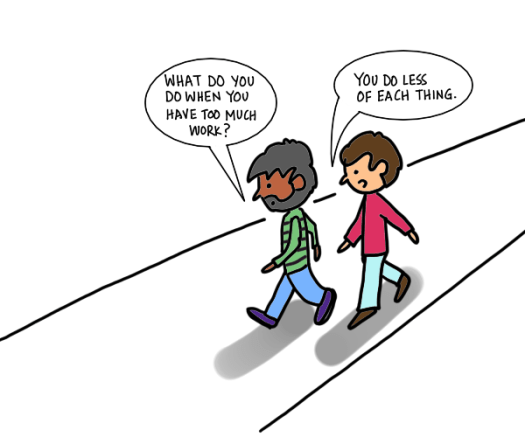
Every once in a while I get to the point where there is too much on, it feels like there are quite a lot of things to do and deliver. And when this happens it’s worth remembering that not everything matters. As Robert Fulghum sort of said, “If it’s not worth doing, it’s not worth doing well.”

You can have too much of a good thing. Overtrading is a thing, where you bring in so much business that you go bust. If everyone wants what you want it can kill your business. Tim Ferriss writes about how he’s careful who he recommends because if he finds someone who sells something good and talks about it on his podcast, his millions of followers try and buy it as well and crash the company’s website as a result.

If you do a great job at work your reward will, most likely, be more work. It’s the same with most things. When you watch people in films they’re driven, competitive, trying to be the best they can be, working all the hours they have. And that looks good but it’s a bad strategy. Research into the way the brain works tells us that you’re better off doing something for half an hour and then waiting a day before trying again than doing it all day, pushing yourself to get better. It’s when you sleep that your brain processes learning and helps strengthen the neural patterns associated with what you’re trying to do or the skill you’re trying to develop.

Okay, now if you’re busy what’s the best way to deal with all the things on your list? This is where the book Algorithms to live by has some suggestions – and it depends on what you’re trying to achieve.

Let’s say you have a list of tasks and you just want to get them done. Well, in that case order is irrelevant. Just do them one after the other until they’re all done.

Now, what if you want to do the biggest number of things – tick off a bunch quickly? Then you order them by the amount of time they take – shortest to longest and blast through them. If you want to get them done so that they’re not late, then do them in order of due date.

An interesting problem comes up when you want to have the least number of people shouting at you. In that case, you start by ordering by the due date and if one task is going to be late you drop that one if you can’t get help and move on to the next. That one task might be very late but the rest will be on time.

If you’ve had a late parcel during the pandemic this is probably why. Bad weather and staffing issues have probably cause a delay. Should the post office deliver delayed packages first and then do the rest or just get on with the newest? Someone told me about the phrase “toss it over the pile” – which is what probably happened. The ones that are late were already late, but if they were delivered first then everyone else’s parcels would be delayed. It’s better to have a small group of furious customers than have the entire population irritated by constant late deliveries. Wouldn’t you make the same choice?

Now, when you’ve scheduled everything and still are struggling, what you have left is the option to do less – to reduce scope. If you normally do ten things can you get away with two? What is essential and can you deliver just that, leaving the rest for later or, even better, never?

When it comes to life the best tasks to do are the ones you don’t have. If you don’t have clutter in your office you don’t have to tidy it away. If you don’t have “stuff” everywhere you don’t need space to put it or have a struggle finding it. The problem many of us have is not one of scarcity but one of abundance. We have too much to deal with. And the way to happiness is to have less and do less – but do it better.

Cheers,

Karthik Suresh

This May Explain Why You’re Working Too Hard

three-levels-of-fix.png

Sunday, 7.45pm

Sheffield, U.K.

A lot of people mistake habit for hard work. Doing something over and over again is not working hard. – Shannon Sharpe

In my last post I looked at twelve common reasons why people make mistakes. There are hundreds more, I’m lead to believe, but we all know things go wrong and people don’t do what they’re supposed to do. Why is that and what can we do to make things better?

I saw a post from an entrepreneur who was talking about how hard they worked. David Allen, the author of Getting Things Done talks about every boss has four times the workload of their direct reports. And then I saw another post about Brian Joiner’s Three Levels of Fix which perhaps explains why this is the case.

Brian Joiner is the author of Fourth Generation Management, which is a few decades old now, and writes about what it really means to fix a problem. Joiner’s work is inspired by that of W. Edwards Deming and you can see that in his Three Levels of Fix method.

Deming wrote that 5% of the problems you see in a business are due to the people and 95% is due to the “system”, the environment they operate in. The only people with power to change the system are the management, the people who make decisions on what to do and what not to do.

I’ve adapted Joiner’s words a bit in the picture above so let’s work through it. Fixing a problem is often the easy bit – a bit like shooting at a target. If there’s a leaking tap or a missing piece of paperwork or a broken part – you can fix it. You probably get this all the time at work – something goes wrong and you have to sort it out. This is just work and people work hard to sort out all the problems that happen every day, just like that entrepreneur above. And at the end of the day you can be happy because you’ve moved 10 or a 100 things on.

But if you’re wondering why you have all those problems the next step is to look at the process that results in the problems. This is a box or a series of boxes that tend to be done by people and somewhere in there something is being done incorrectly. A form isn’t well designed and it’s filled out wrong more often than not. You don’t get the right items in your online shopping order because the staffing rota means that people struggle during changeover times. These kinds of process problems can be fixed by looking at all the steps that happen and focusing on the ones that seem to result in a problem further down the line.

The next level of fix, and this is the one the managers and leaders have to do, is to fix the environment that supported the process that cause the problem. This has to do with fuzzy things like culture and norms and politics and so the container is funny shaped because there isn’t a simple answer most of the time. If you have a boss who is hard to deal with and shouts a lot at everyone then people are scared to speak up. Unless you’re able to change the way in which people are treated, the problems will keep happening and that change might need to start by making the boss more aware of the impact they’re having and helping them to change. And that kind of thing is incredibly hard to do.

Of course, this is where evolution lends a helping hand. Organizations that can learn from their problems and change themselves to avoid those problems in the future will be more likely to survive than ones that don’t. If things work well and you aren’t stressed and people have the right capacities then it’s likely that you’ve got the hard, fuzzy bits right. If you’re maxed out and working very very hard but getting nowhere it’s likely that you’re focusing on targets or on hard edged processes.

The challenge is that this kind of stuff isn’t taught to people in charge. So most people muddle through working hard and wondering why it doesn’t seem to get any better. And that’s because there is no silver bullet, no simple hack, no fast way to fix things.

If you want an easy life you have to be ready to wrestle with the hard questions.

Cheers,

Karthik Suresh

Why Do People Make Mistakes?

dirty-dozen.png

Saturday, 8.26pm

Sheffield, U.K.

We learn from each other. We learn from others’ mistakes, from their experience, their wisdom. It makes it easier for us to come to better decisions in our own lives. – Adrian Grenier

LinkedIn as a social network is turning out to be a good place to learn new things. Perhaps it’s the nature of the network I’ve been connecting with but I’ve been seeing some useful and interesting ideas and concepts surfacing on my timeline.

For example, I recently learned about human reliability – it turns out there is a whole field that studies how much you can depend on people to do things right. And here we were just blaming it on incompetence. But then, you know that old thing about the world being full of bad drivers and on some days you’re the bad driver.

The aircraft industry is one that takes human reliability very seriously and seems to have done a lot of work to reduce the chances of a mistake being made. I remember this from the few flying lessons I did – how we followed a set process to walk around the aircraft and check everything, from the condition of the wings to the colour of the fuel. Then we followed a checklist to go through the steps from starting the engine, taxiing, a full power test and then onto the takeoff.

There are hundreds of reasons why people make mistakes but The Dirty Dozen is a starting point, a distillation of the most common mistakes people make at work. Now, the list is pretty self explanatory as you can see from the image above. If you look at the way in which air accident investigators approach a study of an incident – they start by looking at the facts, they analyse their findings, come to their conclusions and then summarise the causes and contributing factors. Some of these may be technical and require changes to equipment and material. And then there are the contributing human factors, which are often from the dirty dozen list.

Now, if you are a manager and need to get others to do things then it’s interesting looking at this list and asking yourself how aware you are of how your colleagues feel about these factors. Do they feel under pressure, are they struggling with inadequate resources, are they scared to speak up because of the norms and culture in the organisation? Or are you doing really well, scoring highly on all these factors – but does that mean there is a danger that you’re becoming complacent?

The takeaway here is that if something goes wrong, this list may act as a useful checklist to look at contributing human factors. More importantly, however, it also gives you a list of things to look out for and try and head off proactively.

The thing you have to remember is that most employees are in a situation where they may feel these things and find it affects their work. The people with the power to change things, however, are the managers and leaders and if you are one of them it’s up to you to change the conditions people are working in so that the risk of a mistake being made due to one of these factors is reduced. After all, what else are you there for other than to try and get the best out of the people who work with you?

Cheers,

Karthik Suresh

If You Can Make Money Doing What You Do Why Are You Teaching It?

teach-do.png

Wednesday, 8.28pm

Sheffield, U.K.

Those that know, do. Those that understand, teach. – Aristotle

Everything is a business these days. Even things like the business of health and the business of knowledge. And when there is money to be made you get things that look like what you need but are different – that somehow don’t deliver what you’re really looking for. Of course, this isn’t helped by the fact that often we don’t know what we’re looking for or need in the first place.

I feel like a cranky old person, someone who is complaining that the way other people do things is wrong. Is that because I’m envious that they’re doing it and I’m not? Is it because I think they’re wrong and I’m right? Or is it that there is something just not right about the way we make a business of everything?

Maybe it’s a cultural thing. When I first came across the idea of Pay What You Want – that seemed the kind of thing that really gave users a choice. If you felt something had value you felt the obligation to pay for it. And it probably didn’t make anyone a great deal of money but it did give them an income of some kind.

Now, of course, there are arguments that it takes money to make anything and if you don’t treat it like a business then it won’t have any value. But then again, what is a business? The bits that add value are marketing and operations, as I think Drucker said. Everything else is a cost. If you can create a customer then you’re on your way to having a business, or at least something that is value adding.

Here’s the thing. How do you tell a real “business” from something that is simply a transfer of wealth from one person to another? Warren Buffett seems to have the answer to these sorts of questions in his many letters. In one he reminds us that “Price is what you pay. Value is what you get.” In another you have a story of a family – the Gotrocks – who might more accurately be called the Hadrocks. This is because they get hooked into paying for advice on how to handle their money. It’s worth reading the full story but the key takeaway is that the more activity there is the less your return. What you want to do is make a return as efficiently as possible in whatever you do. That’s the goal.

What this means when it comes to a person trying to convince you to learn from them is that if they were so good at doing what they say they do – then why aren’t they making money doing it rather than teaching you how to do it? I remember going to one of those “free” seminars where someone talks to you about Forex trading and how they’ll teach you everything you need to know about trading and making money almost risk free. Well, if it were that easy, surely they should do it and not tell everyone else? Or is it the more likely case that they make more money from your teaching fees than they do making trades with their own money?

The reason I’m wondering about this is that I like the idea of teaching – especially because it helps me learn better. But I don’t like the idea of teaching a secret, proprietary or some made-up method that has no grounding in research or practice. I am irritated by a particular person who has started a line of courses priced in the thousands of dollars that tries to create a certification program to teach something that, from what I have read of the material, is not good. But… if I think I can do better, shouldn’t I be doing that, rather than complaining? Shouldn’t people just make up their own minds?

Anyway….

I suppose when it comes down to it, experience is the best teacher. And then when you understand what your experience has taught you, perhaps then you can actually teach others. Because I think that the best teaching happens when what’s important is what you’re teaching and what the student learns – and it stops being about the teacher at all.

In fact, that makes it very simple to decide what’s good and bad. If you go to something where the teacher is the centre of everything then you’re the product, someone who is just there to pay for a performance. If you go to something where you’re the centre of it and the teacher helps you discover and practice, then there’s a chance that you’ll learn something valuable. And that will only happen when your teacher is confident enough about what they do and have done to put away any ego and focus on helping you become better. If you find one of those kinds of teachers stick with them.

It’ll be worth it.

Cheers,

Karthik Suresh

What Should You Do Or Not Do?

effort-to-do-something.png

Monday, 9.17pm

Sheffield, U.K.

The most general law in nature is equity – the principle of balance and symmetry which guides the growth of forms along the lines of the greatest structural efficiency. – Herbert Read

Do you believe that if you work really hard at something you’ll be recognised and rewarded? That you’ll catch up with those in front of you? Overcome the benefits that people get because they’ve been born into wealthier families in the right parts of the world?

Maybe you will. The first choice you make, after all, is who your parents are and that sets an anchor – a point from where you begin and then you try and go as far as you must. Which for some people isn’t far at all. And for others it’s going to take a few lifetimes to get there.

I think the advice we get on what to do is too general, unrealistic even. Hard work is for suckers and let me explain why.

Work should be easy. If you want to build a house it makes no sense starting with your bare hands. There are tools out there that are better than your fingernails. Use them. In fact, you weren’t considering not using them. The last time you built a structure with your bare hands was probably a den, built from sticks stacked against a tree. But I’m willing to bet you aren’t living there now.

Work should be easy – if you’re spending too long on a spreadsheet, you’re probably doing it inefficiently. Ditto for putting up a stud wall or installing a washing machine or laying bricks. If you know what you’re doing then it’s easy. It takes time and sometimes you have to sweat a bit but if it’s really killing you then you should probably be getting some help.

But, if you want work to be easy you have to spend time learning, which can feel even harder. For a long time my only criteria for hiring analysts was if they could use the Excel function Vlookup – with the help of google and the rest of the Internet. If they could, then they could do pretty much anything. Or, more accurately, they could learn to do anything. The good jobs these days come down to being able to read, write, do arithmetic. Later on in your career it helps if you can speak to others as well.

If you want work to be easy you have to spend time reading and thinking. I learned today that what we call thinking is really just talking to yourself. That’s what I’m doing right now, except you can read that internal monologue as I talk to myself. We have a limited capacity for everything. Our capacity for speech processing, for example, is around two seconds of audio. We’re constantly swapping information in and out of the parts of our brain trying to make sense of things and the harder we make it the longer it takes to get done.

So you make it easy – by working harder on learning how to do that. If you learn your trade and learn it well then the work is easier to do. So maybe it should be learn hard, work easy?

Then again, you should work hard at certain things but not because they’re work. If you want to play an instrument then you need to practice. It’s the same if you want to write or paint or create something. I know a person who spends hours working on detailed art – and that’s because it’s a flow state where time ceases to have meaning and while it looks like hard work it’s something that doesn’t feel like it.

It’s not easy figuring out what to do. But maybe here’s the takeaway.

If you’re finding things hard, maybe you’re doing something wrong? And if that’s the case it’s probably something you can learn to do better.

Cheers,

Karthik Suresh