How to create small changes that make a big difference

EAST-model.png

If we want to change our behaviour or influence the behaviour of a group of people around us for the better, what should we do?

In Inside The Nudge Unit, David Halpern describes how the Behavioural Insights Team in the UK government showed that designing policy using behavioural insights dramatically improves results and outcomes.

If we’re trying to do something – for example encourage more people to use public transport or corporations to invest in energy efficiency – we can use a simple framework developed by the Nudge unit to design a programme.

The framework can be remembered with a mnemonic – EAST – which stands for easy, attract, social and timely.

We need to start by making things Easy.

Just as water flows downhill, people are more likely to do something if it’s simple or the default option.

Anything that adds friction reduces performance – so we can remove friction to make things easier, or add it to make things harder.

For example, supermarkets now keep healthy snacks closer to checkout and sweets further away so that buyers find it easier to choose a healthy option rather than an unhealthy one.

Asking people to turn off the lights or the tap when they leave requires an action from them.

Making it the default through a sensor and switch or taps that open for a preset amount of time makes this easier.

Then we need to get their attention – attract them.

We can do this if we personalise information, make key points obvious, use trusted, authoritative or well-known people to publicise information and create incentives for them to act.

The key thing is getting people to have an emotional connection with the idea.

We are also more likely to do things if we see other people doing them – we are social creatures.

We look around us for guidance and confirmation that what we are doing is the right thing to do.

In many organisations, recycling is now the norm with segregated bins for different kinds of waste.

We need to make use of networks to reach out and use social recognition – awards, committments, promises – as ways to engage and enthuse people.

For example, people are much more likely to recycle when they see other people also doing it. Conversely, if they see others littering, they are more likely to do that too.

Finally, interventions work best when they are timely.

For example, the best time to work with organisations to improve energy efficiency is to engage with them at the point they are making new purchases.

That is when they can compare the purchase costs of different pieces of kit to the lifetime costs of owning and operating the kit.

If they can see that they save money over the long term at that point, then the are more likely to go for the better, more expensive option, rather than going for a cheap thing now that is more expensive and wasteful over the long term.

When we’re planning a change, whether at an individual or organisational level, we need to look at our plans and see how things might work out.

We are much more likely to be successful if we can tick off the four elements of the EAST framework.

What is our first reaction when we see someone or something?

susan-fiske-categorization.png

We have a rapid and largely unconscious way of judging things and people we see for the first time.

Susan Fiske, a Professor of Psychology at Princeton, came up with the Stereotype Content Model (SCM).

This model says that we look at people and things and assess them along two axes.

Along one axis is how warm or cold we feel towards them.

Along the other axis, do they seem competent or less competent.

As the name of the model suggests, it predicts our stereotypical reaction to people, groups and things.

These reactions have developed over time as we evolved – and help us decide whether there is a threat to us or not.

For example, we perceive many social groups as warm and competent – these are friends, friends of friends, people we meet in offices wearing suits giving us presentations and so on.

They are not seen as a threat, and so we have a fairly positive reaction to them.

On the other hand, what if it’s a social community that we don’t know very well but which controls a section of business or trade.

Or perhaps it’s an aloof and wealthy owner of an organisation employing many people.

In those cases, we may respect the community or person as competent, but feel a coolness towards them, driven apart by differences in culture or status.

On the other side, we may feel warmth towards an elderly person but be less convinced about their competence.

The way we feel, however, may mean we help them cross the road, with their luggage or go to their aid when something is wrong.

A cold reaction may kick in and we hurry past if we see a homeless person holding a bottle – that could be seen as a threat and we don’t stop to get involved.

We get the same kinds of feelings when we look at things – like cars, for example.

A Mercedes going past us on the street may seem cold and aloof but a Camper van seems open and welcoming.

So, what does this mean for us?

The first reactions we have are quite likely to affect the way we act.

For example, feeling less positive about a vulnerable group will lessen our willingness to give.

Seeing exercise as something we are less competent at will drain our motivation quickly.

What we want to do is create more associations with things that are warm and competent – if we see them as positive and fulfilling we are likely to engage more and persist longer.

This attitude alone might make the difference between success and failure.

The secret to making money

daily-profits.png

Every real businessperson I have met thinks about money in a certain way.

They break things down into what they cost on a daily or weekly basis and then see how much they need to make every day or week to be in profit.

For example, let’s say we wanted to start a taxi service and bought a car for £10,000 that will be run for 3 years – and it’s going to be worth £3,000 at the end.

A business person will think of that as £7,000 of capital spread over three years to make decisions.

The taxi might be in service 5 days a week, 48 weeks of the year for 3 years – that’s 720 days of operation.

So we need to make at least £10 a day to pay for the car. The stuff on top is profit.

It’s as simple as that – once we are making a profit, however, lots of people will want a bite of it – from the government to helpers.

But the basic principle is still just that simple.

Sometimes the more complex financial calculations that we do – from paybacks to internal rate of return – simply confuse the issue.

Especially when it comes to serious projects that have lots of moving parts.

For example, battery storage plus solar is all the rage now.

Around a year ago I made some notes from a podcast by Barry Cinnamon, who uses exactly this method to evaluate the economics of an battery storage plus solar installation.

It’s from 2016, and prices may have changed, but principles don’t.

We are currently going through an infrastructure upgrade process in the UK that staggering in its scope and scale.

We have ageing networks of wires, pipes, sewers, roads and railways, all of which are being upgraded or replaced.

And there are a myriad projects being chased by developers.

For projects in the energy business – it’s once again pretty simple.

There is a price per kWh of energy – and if we can buy it for less or sell it for more than that we can make a profit.

The problem is when we have very complex financial models that help us buy it for more or sell it for less.

As Theresa May (now probably wishing she hadn’t) said, there is no magic money tree.

But there are many, very real, money pits.

What types of data analysis can we do?

types-of-data-analysis.png

We live in a world where we collect increasing amounts of data – but how many of us do anything with it?

At one extreme, we might do nothing at all, missing out on insights that could make a difference to the way in which we live and work.

At the other, we could create very detailed and sophisticated analyses that either no one understands or work under such specific conditions that they are not terribly useful.

The data out there includes information on customer behaviour, sales activity, operational production, energy use, waste generation – the list seems endless.

So, what can we do about improving the way we go about analysing the data?

An approach summarized by Dr. Jerry A. Smith and attributed to Jeffrey Leek suggests six types of analysis we can do.

We can start by describing the data – finding out more about its shape and characteristics.

How large is the data set? What is the average value? What does the distribution look like? Are there any outliers?

A large number of analyses stop here and go no further.

But what we should do next is explore the data. This means that we look for relationships between variables.

How does one variable correlate with another, or change over time?

For example, a classic use case is to look at energy consumption in relation to the outside air temperature.

Google correlate is an interesting tool that lets us see what kinds of search patterns match real world data.

The warning, as always, is correlation is not causation.

Our next, cautious, step is to see if we can infer something from our analysis to date.

Given what we have learned, can we say something about what might happen more widely?

So given the reactions of a sample of customers, can we be reasonably confident that the wider market will react in a certain way?

The level of certainty we have will make this method flow into the next as we predict what will happen.

At election time, this kind of data analysis always reaches fever pitch. All night analyses, updated with constant data feeds, update and predict the outcome.

Prediction is usually possible over relatively short time scales – we might be able to predict with accuracy the winner of a presidential contest in the next month, but not the winner from a pool of potential candidates five years from now.

Now we have to see if there is a causal relationship between two variables – a change in one will cause a specific change in the other.

This is the kind of analysis that happens in clinical trials. For example, a specific dose of a drug will result in a measurable improvement in a condition.

Finally we can look at a mechanistic analysis or an exact model, where we know what will happen as all the variables change.

This is usually the domain of engineering models – we know that a steam train will operate in a certain way once the water gets up to temperature and pressure and the various mechanical systems start to operate.

In a sense, the various methods of analysis progress from simple to complex.

A complex system – like human beings in a social environment – may only be understood with simpler analyses.

We can predict what someone will do, but we cannot say with certainty that a particular set of input stimuli will cause exactly certain neurons to fire and result in a defined activity.

An exact model may only be possible with engineering systems that operate within clear parameters and tolerances.

Analysing data isn’t something that comes naturally to most people.

We need to work on developing the skills, capabilities and toolkit needed to make sense of data.

And that probably starts with knowing what types of analyses we can do and understanding the situations where we can apply them.

Which business model will catch the next wave?

surfing-model.png

Charlie Munger talked about competitive destruction – the process by which new businesses come along and destroy older ones – often built using new and different technology.

Being one of the first to market can be a good thing in this situation.

Using a surfing model, if a business can get up and catch the wave, they could ride it for a long time, making profits on the way.

Intel did it with microprocessors, Microsoft with desktop operating systems, Apple with smartphones and Google with search.

Products based on artificial intelligence (AI) and machine learning might seem good candidates for the next wave.

Take the way in which we use mobile phones, for instance.

Tools like predictive text have been around for a while – but phones are used for much more than talking or texting.

Navigation systems on them have gone from route planning to real time route optimisation, with suggestions on how to change routes in the middle of a journey based on travel patterns in the area.

Translation is another area being transformed by technology.

For gist translation – where what we need is an understanding of what a document says in a different language – the systems built into browsers and search engines do a remarkable job.

Machine learning may provide the solution to spam emails.

Microsoft Outlook’s clutter service means that virtually all spam type emails are filtered out and never hit the inbox.

Generic newsletter, marketing and sales emails simply can’t interrupt us any more.

Some of us don’t worry about scheduling or planning things – the entries turn up in our diaries and we can rely on our phones to tell us where we are going and when to set off.

These tiny changes to the way in which machines help to organise and optimise our days are happening in a barely recognizable way.

But they are becoming also becoming an inextricable part of how we go about our daily business.

These changes signal a groundswell that is expected to turn into a tidal wave as AI affects everything from law and medicine to transportation and sustainability.

The question that individuals and organisations need to consider is how they will fit into a world where work requires hybrid human-machine skills.

Should we go for the easy option?

one-foot-hurdles.png

Warren Buffett wrote that after many years he and his partner, Charlie Munger, had not learned to solve business problems.

What they had learned to do was to avoid them, by looking for one-foot hurdles they could step over rather than seven-foot ones they needed to clear.

But how can this approach be applied day to day?

Take the emerging field of product management.

Is it better to create a new product and then try and sell it to potential users or to first try and understand the needs of potential users and then try and design an offering around those?

One school of thought argues that customers don’t know what they need before they see the product – if you had asked people what they wanted before the car was invented, they might have said a faster horse.

If the business we’re in is more humdrum – more exposed to competition – what approach can we take?

Let’s say we owned a food business – what advantages would help us beat the competition? Would it be better ingredients, better signage, widespread advertising or more delivery options?

The late Gary Halbert used this example and said people could choose any combination of advantages they wanted and he would still beat them if he had a single advantage – A starving crowd.

The test for any product is not how good it is or how glowing the reviews are – it’s how well it’s doing on gaining market share.

The energy efficiency business, for example, should really be an easy one to operate in.

Who wouldn’t want to cut their energy costs – after all savings go straight to the bottom line and how much product would a company need to sell to get the same result?

But many projects fail to go ahead because they don’t meet a 2-year payback?

But, if project developers thought like product managers, they might think about what the CEO and FD of the company really want to achieve.

If they are like most CEOs and FDs, their focus is on earnings growth and increasing shareholder value.

Payback to them is less important than what the project will contribute to EBITDA during its lifetime.

A McKinsey article shows how a modern approach to a portfolio of projects might evaulate them all, rank them on a risk/reward basis and select the ones close to the efficient frontier – essentially the best ones.

Cherry-picking makes it more likely that investments will return value in the long term.

We are often programmed to believe that anything worth doing must be hard – taking effort and sacrifice.

By going after the easy things, however, we may actually make a difference and create value.

How understanding fractals can help us decide

fractals.png

A fractal is a curious thing.

It is most commonly shown as a pattern, often mathematical, that is similar at different scales.

The Koch snowflake, for instance, is drawn by starting with a line and creating an equilateral triangle by splitting it into three parts.

Then, each segment of the triangle – a line – is turned into another triangle. Then that is repeated again.

What we end up with is similarity at different levels – as we zoom in we see the same pattern repeating itself.

Another fractal that is easier to visualize is a fern, or a lighting bolt.

A mountain is a fractal.

Seen from a distance it has a certain shape. Zoom in and the bumps and ridges are replicated on the surface all the way down to individual rocks and pebbles that show similar shapes under a magnifying glass.

So, what does a fractal have to do with decisions?

There are two ways we often approach decision problems.

One is through fundamental analysis – we look at the long term features of the problem or situation and come up with an approach to deal with it.

In investing, for example, this may involve looking at the stock price, earnings, assets, market sector, historical performance, management team and so on.

Or, in a business, it might involve looking at the accounts or the number of billable hours and making choices on where to invest or how to spend time.

A different approach might be to learn how to recognize patterns.

A price chart often shows similariy at different levels.

Performance during the year, during a month and during a day all show signs of the continuing battle between supply and demand.

Understanding these patterns and working out a logical approach to dealing with them can make the difference between good investment decisions and shooting in the dark.

It might also help us with managing people.

For example, an individuals career often follows a series of ups and downs – starting, learning, growing, plateauing and ending.

A company does the same thing – following a lifecycle.

Whether you look at it over the 40 year life of a company or the 40 year career of an individual, we’ll see similar patterns emerging.

And the way to deal with patterns is to recognize that things happen again and again.

From a decision making point of view, it means that there are very rarely crucial decision points.

We can take it easy – if we miss one opportunity, another will come along in a while.

It’s that whole thing about another door opening when one closes.

The best time to start a new project, for example, is 10 years ago.

The second best time is now.

When should we change lenses?

choice-of-lenses.png

There are at least two problems with how we go about solving problems.

The first is we approach them from our perspective – using the set of strategies, models, expectations, biases, experience and tactics that we have built up over time.

The second is our first attempt to come up with a a solution tends to narrow our thinking very quickly, as we look for patterns, evidence and reasoning to support that solution while forgetting about the rest of the options out there.

It is very hard to stop doing either of these things – it’s an approach we’re comfortable with and when we are faced with a problem – whether it’s doing some DIY or fixing a failing healthcare programme – we tend to fall back on our default programming.

So, can we change this or are we stuck with the way things are?

One technique that may help is problem restatement.

We restate the problem by taking the time to write out the problem again in as many ways as we can think of.

For example, perhaps we have a difference of opinion with someone at work on an issue.

It’s easy to make the fundamental attribution error – saying the problem is that person is rubbish because of who they are as a person rather than the situation they are in at the moment.

But, what if we tried to look differently and restated the problem.

We might be able to use a selection of lenses.

The reverse lens tries to look at the situation from the other person’s point of view.

What would they say about us and the situation and how would they justify their approach – and is there any merit in what they are saying?

The long lens helps us look at things with a longer term perspective.

Will this issue matter in a week, a month or a year?

The wide lens looks that the situation in context.

How does this issue affect everything else?

If it went the wrong way would the consequences be significant or not, and so how important is it in the wider scheme of things?

Restating the problem is one way to increase our chances of getting a good outcome.

As Charles Kettering said – a problem well stated is a problem half solved.

Why we should do more things that give us energy

energy-audit.png

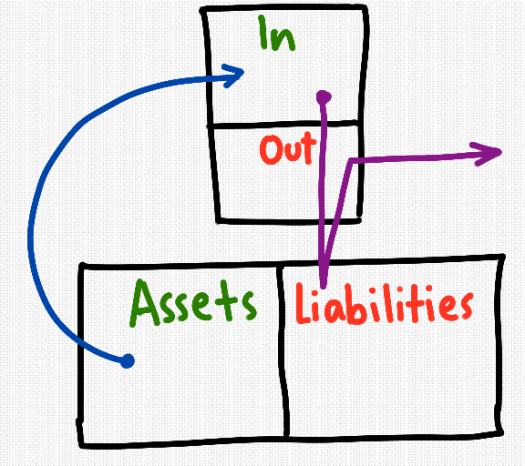
Robert Kiyosaki in his book Rich Dad Poor Dad has an elegant way to define assets and liabilities.

Assets put money in your pocket. Liabilities take money out of your pocket.

This isn’t the way accountants look at things – but it’s a good way for the rest of us to visualize where we should put our money.

Investing in a rental property that gives us income every month is good.

Buying a flash car that costs us hundreds in payments every month is bad.

It’s a clear and simple model that should increase how much money we have if followed.

We can tell what kind of financial health our life is in by looking at the pattern money takes as it flows through our hands.

If, when money comes in, we invest in assets and the money flows back into our pockets, that leaves us with more at the end of the day.

On the other hand if, when money comes in, we have liabilities, then the money flows out to pay for them and we are left with less when done.

And the same model, it turns out, can be used to think about activities that we do every day.

It’s a bit of a cliche – but even the Harvard Business Review is happy to use an article title like Manage your energy, not your time.

Our days are made up of rituals – things that we do from the time we wake up to the time we go to bed.

Some of these things are going to leave us with more energy than we started with.

Others are going to drain us of energy when done.

And, while it’s easy to fall into a victim mentality and argue that what we have to do is driven by the demands of other people like colleagues and bosses, recognizing the patterns that aren’t good for us is still the right starting point.

Like doing an audit.

There are a couple of ways to do this.

One approach is to log what we do over the day and then look back to see how our energy levels have increased or decreased.

Another is to make a simple list of things and give them a score.

Then it’s time to start making changes.

Usually this starts with creating new rituals.

For example, some people find their energy levels go up if they check email an hour after getting into work rather than first thing or in the afternoons.

Or we could do work sprints – 90-120 minutes of focused activity with a 5-minute break every 25 minutes followed by a longer break at the end.

We need to increase the number of rituals we have that are assets, which leave us feeling more energized when we are done doing them.

We might work on liabilities with high energy, but when we are done we’re drained – so we need to keep those to a minimum.

The last word on this goes to Scott Adams, the creator of Dilbert, who says –

Manage your creativity, not your time. People who manage their creativity get happy and rich. People who manage their time get tired.

Which path would you take?

small-steps.png

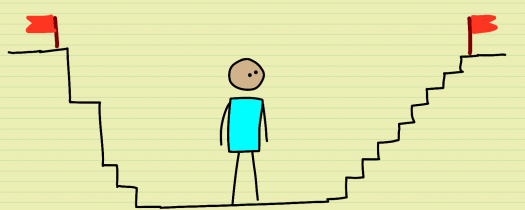
Edward de Bono wrote about a small but significant difference between the way we think about the physical and mental world.

Let’s imagine we had to build a staircase.

Would it look like the one on the left in the picture – or the one on the right?

Most people, in the real world, understand that small steps are the way to go.

But, when it comes to mental work, we try and take shortcuts.

Take investing, for example.

Tom Dorsey wrote about a colleague of his who said – Tom, ain’t but one way to make money in the stock market. Slowly.

Most of the people and businesses that survive compounded their value over time – they didn’t simply skyrocket to fame and fortune.

The recent falls in the value of cryptocurrencies, although there has been a rise again, have left some people feeling elated, and some despondent.

If you bought at $16,000 hoping to hold until it went up, $12,000 is going to keep you nervous for a while.

But, the prices simply reflect supply and demand – and someone who takes a position needs to be aware that buying a currency is not a one-way ticket to riches.

Over the last year, a fairly sensible trading strategy could have resulted in a 6x return on Litecoin. Around 6-7 trades would have turned $20,000 into $122,000.

If you knew how to do it, had the money, were willing to take the risk and had the discipline to monitor markets at least daily that is…

On the other hand, a much easier approach would have been to buy a selection of low cost index funds five years ago and then get on with life.

That would have gained almost 30%. That’s not a bad return either given where interest rates are.

The same principles – going step by step – apply to most of the knowledge work we do now.

People who create anything of value do so piece by piece over time.

It’s tempting to take a shortcut.

But a shortcut may turn out to be the harder path.