How To Turn Your Service Into A Product And Why

product-service-comparison.png

Tuesday, 9.02pm

Sheffield, U.K.

We have our factory, which is called a stage. We make a product, we color it, we title it and we ship it out in cans. – Cary Grant

You learn a lot just by talking to other people.

It’s such a natural thing to do that we often miss just how much is going on.

But there is a lot that goes into sending a message from one person to another and, as a result, a lot that can go wrong.

Which is why selling services is quite a hard thing to do.

When I talk about services I’m thinking particularly of the things that you find hard to explain right now.

And they’re hard to explain because they might be complex or fuzzy.

If you need to take the time to explain it or solve a problem for a client – then you need to bill for that time.

If you need to provide more service you’ll need to add people with the knowledge to provide that service.

That’s the way a law firm works, for example. They are experts in a particular area and you pay for their expertise in a complex area that you couldn’t manage yourself.

But the problem is that most service businesses make for lousy business models, if you think of them on a time and person basis.

And, if you do something that isn’t already a well known profession, you’ll struggle to explain what you do.

Unless you try and turn it into a product.

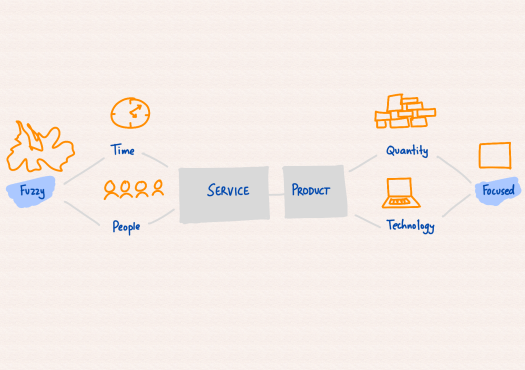
The main difference between a product and a service is that a product comes in a box.

Not literally a box, of course, but one that people can visualise and understand.

Describing what you do is then simply a matter of listing what your customer gets from you.

Take the business of financial modelling, for example.

I could tell you that I can help you automate business processes using Excel.

That’s a service. You could employ me and pay me on an hourly basis to work for you.

Or I could tell you that I have an Excel worksheet for a hundred bucks that will help you produce invoices.

You won’t need to pay ongoing subscription charges and it will save you hundreds in bookkeeping and accounting costs – paying for itself in a couple of months.

One description is fuzzy and the other is focused.

You can clearly make money from both.

The service proposition could make thousands with a client who gets what you’re trying to do.

But so could the product – because you could sell a lot more to clients who needed that product.

So why would you choose one over the other?

As always, there is no one correct answer.

Products are easier to understand and buy – so you have a better chance of making a sale to a new prospect if you offer them a product.

Once they know you and understand that you can solve more problems, then they might want your time and expertise as a service.

The thing is when you sell time you run out of supply pretty quickly and also find yourself resenting the hours you’re having to provide.

So even though you could provide a service focusing on products means that you’re selling quantity rather than time.

But these days the only sensible way to do it is to use technology rather than relying on people.

If your product scales by adding people at some point you’ll run into an overheads problem where you need to bring in so much cash to cover fixed costs that it starts getting pretty stressful.

The main point here is that you need to consider your product/service mix as part of your strategy to develop your business.

If you are too much of one or the other – you need to ask yourself whether that’s working for you.

If it is, then don’t change.

If it isn’t, then it’s worth trying to see if you could do better by marketing yourself in the opposite way.

Or, just being practical, using whichever pitch is the one the person in front of you is responding to best.

Cheers,

Karthik Suresh

How To Think About The Value Different People Bring To A Team

iceberg.png

Monday, 10.50pm

Sheffield, U.K.

If I have seen further, it is by standing on the shoulders of giants. – Isaac Newton

I’ve been watching programmes about Fog Creek Software on Amazon Prime recently – one called Make Better Software and the other called Aardvark’d.

They offer a glimpse into how a real software company works – something that most of us never get a chance to see.

They also led me to the blog of the co-founder, Joel Spolsky, and his thoughts on software development.

It’s not really updated these days but given he started writing in 1999 you can’t really get too upset about that.

Especially when you stumble on some quite interesting ideas pretty quickly.

Take this essay on icebergs, for example.

Most of us know bosses and managers who believe that you must have a specification in place before you do anything.

This point of view is not limited to bosses, however.

Many people also say they can do anything you want as long as you tell them exactly what you want.

The problem is that most people don’t know what they want.

What almost everyone can tell you, on the other hand, is what they don’t want.

It’s funny how the things we want to avoid come to mind so much more easily than the things we want to have.

So the smart person, according to Joel, gets that customers will never know what they want.

Instead, you have to build something that they can look at and tell you what they don’t like about it and what they want changing.

Another insight has to do with people on your team.

It’s tempting to think that everyone around you has to do something technical.

But the reality of most businesses is that only one or two people really need to be that technical.

And that’s because once a problem is solved using software or a system is created for a customer the jobs that are really needed are ones that focus on helping them.

If you’re going to build a company, in the beginning you need people who know stuff and can build stuff.

But pretty soon you need people who can bring in customers and keep them happy.

And that’s actually going to be the bulk of your workforce.

It’s tempting to think that you can make lots of money by outsourcing that work to someone else.

But the chances are that’s a mistake – technically and financially.

It’s not going to save you as much as you think and, if you’re going to be a customer, we already know that you don’t know what you want.

The lesson hidden in all this is really that working for someone else is hard to do.

It’s much easier creating a product and saying do you like this.

And you can do that even if you have a job.

You can wait to be told exactly what to do.

Or you can have a go and create something new and then see what the reaction is.

And if you keep doing that one day you’ll make something that the people who make decisions like and you’re on your way to creating a job or a business where you’re in control.

But it all starts with having a go and building something on spec – with the hope that it will be useful to someone else.

Cheers,

Karthik Suresh

Why What You Think Matters Much Less Than You Think It Does

attention.png

Sunday, 9.08pm

Sheffield, U.K.

We tend to be distracted by the voices in our own heads telling us what the design should look like. – Michael Bierut

Everything is a design problem.

The word “design” brings up different pictures for different people.

For some it’s about fashion, look and feel.

For others it’s about thinking and planning and structure.

But the design thinking approach can be used whether you’re trying to solve a business problem, make a website look good or sort out your LinkedIn profile.

And it starts by realising that no matter how much time you spend looking in the mirror and trying to see how you come across, you won’t get any closer to seeing how your prospective customer sees you without doing some more work.

That work usually takes the form of a conversation – one face to face perhaps, or one that happens using the information and interface you present to your prospects.

Luke Wroblewski, in his book Web form design: Filling in the blanks, calls web forms Brokers, because they talk to customers on your behalf.

You might have thought, until now, that the purpose of a form was to capture information from customers.

It turns out, instead, that they are a way for you to have a conversation without being there – if you design them right.

Wroblewski says that there are principles you should follow.

For example, no one wants to fill in a form, so make it easy to do.

They’re only going to fill it in if it’s worth their time – and it’s up to you to make it completely clear that it is.

And you can only do this well if you really understand what your customer is trying to do.

But at the same time is that actually the case – do you really need to get inside your prospect’s head?

We’re all sold on the idea that Apple devices can just be used – they’re intuitive.

But is anything really intuitive?

Some people argue that when say something is intuitive what we really mean is that it’s familiar – it’s something we know how to do.

So maybe the purpose of design is actually to give people what they expect.

And that gives us a clue as to how the world really works.

For example, the words a prospect uses to search for what you do may not be the same words you use.

So, if you want to be found on LinkedIn, which words should you use?

The answer is pretty obvious, isn’t it?

Some of my friends have learned this lesson better than I have.

They try and understand what the customers they want are looking for and then design their organisation and their communications to be in the right place – to be familiar.

After all, if you are good enough, maybe one day people will find you.

If you go and stand where they go to look you’ll almost certainly be found.

And if you look the part – if you’re familiar – then you’ll probably get the job as well.

You just need to get yourself out of your own way.

Cheers,

Karthik Suresh

What Is The Most Useful Way To Think About Your Marketing Tactics?

parthenon.png

Monday, 9.14pm

Sheffield, U.K.

One gets paid only for strengths; one does not get paid for weaknesses. – Peter Drucker

I’ve been thinking about a particular business and its marketing strategy for a few weeks now.

If you’re running something today you’re probably trying to win new customers.

And that needs them to know who you are – for them to be aware of you.

It’s the first part of any marketing formula, after all.

It’s also the part that takes time and effort and no small amount of self confidence or, at least, the effort to overcome a lack of it.

What does good look like when it comes to modern marketing?

Well, you’re probably all over social media.

Perhaps you have a video blog.

Maybe a regular one as well.

And of course you can’t forget offline networking and groups and all that stuff as well.

Clearly, doing nothing or just one thing isn’t going to work.

Publishing one article or running one ad may, like a one-legged stool, let you sit for a while but you’ll always be off balance and making quite some effort to stay put.

Having a few is better – certainly in the sense of giving you some stability.

But the real benefits come from having a number of effective tactics in play, something Jay Abraham calls the Parthenon strategy.

The idea is simple – the more pillars you have supporting the growth of your business the more likely you are to grow and the less likely you are to suffer a setback you can’t recover from.

So that’s obvious, I suppose.

What’s less obvious is that selecting which pillars to erect is a crucial task.

And the way to get started is by reading.

LinkedIn, for example, has a useful guide on how to use the platform well.

And it reinforces the basics.

People do business with people so your profile needs to be credible and give a good first impression.

People buy from you because of your approach to solving their problems.

So share information that keeps them informed about what’s going on, and what good looks like for them.

None of this is stuff I do particularly well.

And, if you’re like me, the chances are that you’re slightly suspicious of people who do it too well.

What are the sayings that come to mind?

  • All hat and no cattle.
  • All mouth and no action
  • All fur coat and no knickers

and many others…

Someone who has a lot of time to spend on sales must have less time to spend on doing the work.

Or is that just bitter and cynical?

Maybe they’re focused on getting the right message to the right people and see that as just as important as working on their product.

And they would be right.

For those of us, however, with less shine and polish there’s nothing stopping us from improving a little bit at a time.

What we need to believe is that persistence pays off.

What did Coolidge say?

Nothing in this world can take the place of persistence. Talent will not: nothing is more common than unsuccessful men with talent. Genius will not; unrewarded genius is almost a proverb. Education will not: the world is full of educated derelicts. Persistence and determination alone are omnipotent.

The most dangerous thing is to think there’s some kind of silver bullet that will solve our problems.

But if we put the effort in day after day we should end up with a business built on marketing tactics that are solid and stable.

And perhaps even refined and polished.

Here’s hoping.

Cheers,

Karthik Suresh

How To Analyse A Network For Fun And Profit

networks.png

Thursday 9.21pm

Sheffield, U.K.

Social networks do best when they tap into one of the seven deadly sins. Facebook is ego. Zynga is sloth. LinkedIn is greed. – Reid Hoffman

In a previous post I looked at which marketing model might be most useful when planning a campaign.

The basic idea is to do more than the competition.

That sounds simple, but how do you actually go about doing that?

It comes down to analysis – analysing what they’re doing and figuring out where you can get an edge.

So let’s say you start with what comes up on Google – that’s one source of data for your search term.

But then you have LinkedIn and Twitter and all the social networks.

You’ve got offline events – training sessions and affiliate programs.

How can you pull all this together in some kind of coherent way.

It turns out that this is an established branch of sociology called Social Network Analysis.

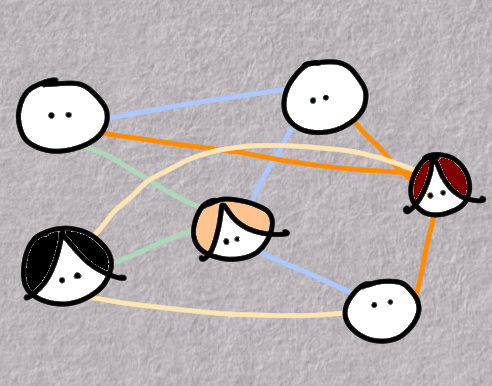
And it comes down to nodes and links.

Nodes are individuals or organisations and they are connected by links.

These links can be relationships, common interests, shared values or content that they are exposed to on different platforms.

As you can imagine, the number of different types of links can increase quite quickly.

You can’t analyse these in your head or on a spreadsheet – usually you need software to help with doing that.

Software like Social Network Visualizer.

Now, when you read the documentation for these tools it gets complex pretty quickly.

There’s lots of talk about adjacency matrices, cohesion measures, centrality and prestige and community detection.

Which basically means the number of things you’re keeping track of, whether if I link to you, you link back to me and who the super important people are in a group – and if there are cliques and subgroups.

Okay – can we apply any of this to our market research efforts?

Well… before that let’s look at something which, depending on your point of view, might make you a little nervous.

The UK police have a guide on how to use social network analysis to combat gang crime.

Clearly the police have a reason to gather intelligence on the bad guys – and they collect information on them and their links with others.

There’s a useful table that shows you how many criminal links there can be between individuals and how to code these links.

All that data can be quite hard to understand if set out in a table but when you visualise it you can imagine how the people at the centre – the ones with influence and reach show up as larger nodes.

So, in theory, you could use a similar approach to understand how your market operates.

Clearly you’ve got to be sensible about doing this.

Recently many data mining organisations have changed their tune when it comes to the ethical use of data.

They say that each piece of data is not like gold or oil – a commodity you can exploit.

Instead, it’s a piece of someone’s life – and you need to respect that and treat it with care.

So creating your own intelligence file on people in organisations is probably not the most ethical way to do things.

But that doesn’t stop you from perfectly legitimate things like mapping organisations and their links to each other.

If you have a competitor that is so entrenched with the public sector bodies, key decision making centres and other institutions isn’t it better to know that rather than trying to fight them on an uneven playing field?

Or if you’re an activist organisation you can map those organisations that are going to be receptive to your message and work with you.

The thing with tools like these is that there’s little or no information on how to use them effectively to solve real business problems.

Which is why the police example is actually quite a useful one of how such technology can be applied to a situation.

It’s a tool that appears to be underutilised and maybe it can help you with market research.

It’s probably sensible to suggest that you use it with care.

Cheers,

Karthik Suresh

Which Mental Model Is Most Useful When Planning A Marketing Campaign?

bear.png

Wednesday, 9.32pm

Sheffield, U.K

In tennis, you strike a ball just after the rebound for the fastest return. It’s the same with investment. – Masayoshi Son

Let’s say you run an IT business.

You want to talk to people about cybersecurity.

That’s a big thing right now – so where would you start?

You might begin by typing words into Google – an initial search – to see what else is out there.

In 2019, you’ll get around 110 million results.

Limiting it to your city will drop that to around half a million.

Now what?

I keep returning to a course on content strategy and then drifting away.

It has hard truths that I struggle with.

For example, it argues that you must have a clear idea of who your customer is and have a strategy to deliver content that that customer can be inspired by, identify with and find useful enough to share.

I just want to write about stuff I find interesting.

But let’s say you wanted to do this properly, where should you start?

Probably with reading.

What is everyone else doing out there?

You know the old story of the two guys who come across a bear in the woods.

One of them bends down and starts putting on his running shoes.

The other says, “Are you crazy? You can’t outrun a bear.”

The first one says, “I don’t need to outrun the bear. I just need to outrun you.”

So let’s say you read the first 20 results.

Or, if you’re lazy, like me, put some code together to get you the first hundred results in a text file for easy reading.

And then you start reading.

You discard the job adverts, see the usual ones from Universities offering courses and you’re left with a few associations, government organisations and a small number of competitors.

Now, what are they doing?

Some offer services – pretty straightforward descriptions of what they do.

Others offer articles – ones that seem to be written to order, in some cases.

Is that enough reading?

Probably not.

Maybe we should look at interviews or posts by people who have experienced ransomware attacks.

Read about exactly how common attacks start and work.

You could quite easily pull together a book on all the information someone might need.

Or you could curate information – point to stuff that is good.

Is all this going to help?

It may, if it helps you be found more quickly than the competition.

You won’t find out until you try.

That’s the thing with content marketing.

If you have content then anyone coming across it has a reaction – a good or bad one depending on your point of view.

If they see all the stuff you have and are put off by the effort of competing with you then you’ve just given them a content shock.

It’s like the advice that the best way to win a war is to persuade the other side not to fight.

I think the most useful model to keep in mind when starting is the idea of outrunning the competition, not the bear.

Do more than everyone else.

Create more content, be in more places and reach customers earlier.

It’s very hard to persuade someone to do something because it avoids a bad outcome.

When something bad happens, however, people will spend any amount of money to fix the problem.

The trick is being there to get the ball on the rebound – when the thing happens that makes your customer think they need what you do.

How you do that is about tactics and resources.

And focus.

All the things that the academics say you should do.

And which I still need to learn.

Cheers,

Karthik Suresh

How Do You Get A Large Group To Change Direction?

herds.png

Monday, 9.02pm

Sheffield, U.K.

Not everything that can be counted counts, and not everything that counts can be counted – William Bruce Cameron

Should we panic about the state of the world or not?

Take climate change, for example.

Are we doing enough about the problem or should everybody be doing more?

There’s a problem with the question in the first place – because it assumes that action takes place en masse.

It assumes that we collectively take action to change things.

But is that really the case?

After all, there are lots of schemes and rules and attempts to get people and organisations to reduce their impact on the environment.

Are they making a difference?

How can we tell?

The thing about social behaviour is that it’s can’t be easily reduced to an algorithm.

But maybe an algorithmic approach can help us understand what counts.

The problem of getting lots of people to change the way they act is like getting a large herd of cattle to change direction.

If you try to simulate such behaviour – the flocking, schooling and herding you see birds, fish and animals do – you find it’s possible to do it with quite simple rules.

The basic idea is that each member of the flock has to stay close to others in the flock without bumping into them or into obstacles in the environment.

When you program a herd of simulated creatures to act in this way the group moves together – wheeling and turning with no central control.

The movement emerges as those simple rules are followed by each member.

From that observation of physical movement it’s a small step to wonder if a change in hearts and minds is also an emergent property – something that happens when the rules individuals follow change, rather than the whole group learning new rules.

For example, when solar panels first came out they were expensive.

Few people had them and they needed subsidies to get installed – subsidies that are being phased out now.

Every new build these days, however, is going to have solar panels built in.

So what’s changed?

Is it the law, the business case or what people want?

And did they change at once or did the pressure to change build and build until the whole group changed direction?

The point, I suppose is that, if you want to have big change you first need to start with small ones.

That’s obvious, you say.

But what’s not obvious is whether or not we’re heading for disaster while we’re waiting for individual change to happen.

It’s tempting to assume that everything will go bad if we don’t try and change it in a big way.

But are all those large companies really trying their best to ruin the world we live in?

Or are they full of people who are trying to do the right thing but who are also looking around them trying to do what others are doing, worried about doing something too different in case they get left behind as the flock moves on?

I think if you assume that people are fundamentally good and try to do the right thing then the starting point is to focus on individual change rather than group change.

But we can’t change too much – so much that the group just sees us as outliers.

We have to move gradually in the direction we want – at a speed that matches what the herd is doing.

That’s the thing about changing direction – it doesn’t just happen all at once.

And it’s hard to escape the fact that it probably starts with you and with me.

Cheers,

Karthik Suresh

How To Find Focus When You’re Distracted By Lots Of Things

interesting-things.png

Saturday, 10.04pm

Sheffield, U.K.

The only thing that can grow is the thing you give energy to. – Ralph Waldo Emerson

There are far too many interesting things in this world.

Ideas, opportunities, developments and paradigm shifts.

And cat videos.

For example, I was listening to someone talk about what they do the other day and thinking – heck, I could totally do that.

In fact, I have done it.

And it’s got lots of potential for making money.

And then I remember that it’s also very, very boring.

We each have around 30,000 days that we can use, if we’re lucky and go the distance.

When you’re more than half-way through you start to wonder whether you’re using them well.

Should we be focusing on the really important things?

If so, what are they?

You’ve probably heard that life is like juggling balls – trying to keep them all in the air.

The balls have labels – work, money, family, friends, health.

Some of the balls are made of rubber. If they fall and hit the ground they’ll just bounce and you can always pick them up again.

Others are made of glass and if you let them drop they’ll get scratched, cracked and maybe even broken.

But then let’s think about what you do and how focus affects that.

Say you have a business – should you do one thing really well or be able to do a number of things?

The answer, probably, is going to be a variant of “It depends.”

For some businesses that do a lot of low-margin business it might seem sensible to ditch those and stick with the ones that make money.

But some of the low-margin things might be what brings in customers that eventually buy the other stuff you have.

As an individual should you try and become the best at whatever you’re doing or have a mix of skills and try to learn new ones when you can?

I was speaking with a builder who said that there are now robot bricklaying machines.

You could be the best bricklayer around but the machine is going to be better.

What happens then?

Maybe the idea of focus is less to do with state of mind and more to do with an act of convenience.

After all, where does the term come from?

The dictionary defines focus as “the centre of interest or activity – an act of focusing on something”.

Which makes it temporary.

You don’t need to focus on something permanently.

You just need to do it as long as you need to.

Which makes things a little easier.

Let’s say you are interested in a number of things – wood-working, renewable energy, writing fiction, drawing cartoons, among others.

And maybe you’re torn between a few of those as possible business ideas.

Perhaps you want to do woodworking and draw cartoons.

There’s nothing wrong with you wanting to do both and making plans to do both.

You might need to think about timing – do you do one before the other?

You need to think about your audience – pitch wood to interior designers and send your cartoons to newspapers.

You are still focusing – but first on one and then the other.

And that’s ok.

The point is that you only have so much energy to give.

But the good thing about working on things you love is that you seem to end up with more energy in the end.

When you’re working on things that drain you no amount of money can replace that lost energy.

The thing about distractions, then, is you need to find ways to handle them – to address them in order and be ok about dropping the ones that are less important.

And with what’s left, if you’re lucky, you’ll have some that you find interesting.

With the others – you just have to think about the money and get on with it.

Cheers,

Karthik Suresh

What Hard Questions Should You Ask About Your Business Idea?

business-model-testing.png

Monday, 9.07pm

Sheffield, U.K.

If debugging is the process of removing bugs, then programming must be the process of putting them in. – Edsger Dijkstra

Someone I know describes herself as a completer-finisher.

This is one of the nine Belbin team roles – a detail oriented person who checks work and makes sure there are no mistakes.

That’s not me.

Checking stuff is dull. It’s much more interesting to think of a new product idea or throw something together that does something that might be useful.

When you do that, however, you might also end up with a pile of half-finished things – the detritus of your inability to stay on track.

Have you ever met one of those people that you just know are going to be successful?

It’s never the flashy ones, the sales stereotypes – the ones with the suits and the patter and the social media exposure.

No. It’s the ones that are quiet. The ones that have an expertise in something boring that you just have to get done if you want to get whatever it is you want.

The ones that have a focus and quiet intensity and know what has to be done to get a result.

Those are the people that you just know have a workable business model.

But how can you figure out if what you have is one of those?

Software developers have this concept of testing their code.

They try and figure out what the correct output would be from a program and then write test suites – code that checks if what comes out is right or not.

It’s too hard to make anything perfect – so this approach tries to check that what’s happening is as right as it can be.

And it’s an approach that we can use to test our product ideas as well.

For example, BCG, The Boston Consulting Group, writes about Business Model Innovation – the idea that “when the game gets tough change the game”.

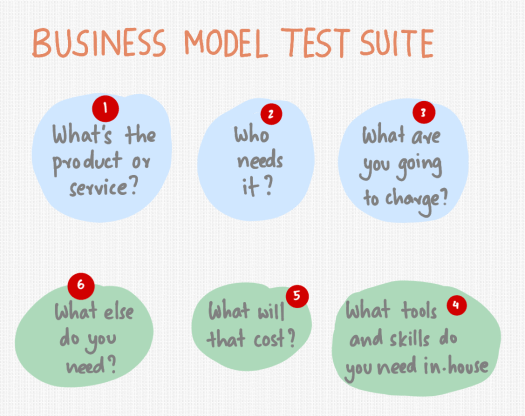
They argue that there are six components to a business model three of which relate to the value proposition and the others to the operating model.

You could have a go at creating a test suite by asking questions that test each component of the business model – as shown in the image above.

Let’s say you need to stand up and deliver a pitch to potential investors – tell them what you do.

Can you answer these questions?

  • What’s your product or service?
  • Who needs it?
  • What do you charge?
  • What tools and skills do you need in house?
  • What’s that going to cost?
  • And what else do you need?

For example, let’s say we were going to offer open source consulting services – we’ve got a product.

Now what?

we think everybody needs it, we’re going to charge $5,000 an hour, we’ve got a ten year old laptop. We’ll do all the work ourselves. There’s no other outlay – other than the mortgage and the kid’s private schools and we don’t know many people in this town.

Now, if those are your answers, you can probably also write down what good answers will look like.

And you could compare the two – test them – and see if your answers pass.

If they don’t – or worse – you haven’t got any answers at all then it’s time to debug your business.

Find out where the flaws are in your logic and thinking and fix them before you run the tests again.

Then again, maybe this is all too hard, and you’re just going to have a go and see what happens.

Well, in that case, it might be wise to keep an eye on those quiet folks with the boring business and the intense focus.

You’ll probably need to ask them for a job one day.

Cheers,

Karthik Suresh

How To Make Something Interesting For Your Audience

interest-venn.png

Sunday, 9.26pm

Sheffield, U.K.

“Simple. I got very bored and depressed, so I went and plugged myself in to its external computer feed. I talked to the computer at great length and explained my view of the Universe to it,” said Marvin. “And what happened?” pressed Ford. “It committed suicide,” said Marvin and stalked off back to the Heart of Gold.” – Douglas Adams, The Hitchhiker’s Guide to the Galaxy

Why do you find one thing interesting and another completely boring?

I find, increasingly, that I have a low tolerance for boring stuff.

People who know me, on the other hand, would suggest that everything I do is catastrophically boring.

Including spending any time researching what makes something boring.

Anyway…

Paul J. Silva has done much of the hard work for us.

He says that coming across something you already know leaves you cold.

Not really that interested.

Sort of like listening to the safety briefing when you fly.

Cabin pressure. Masks. Yours first. Jacket under seat.

You know this stuff.

When you’re already familiar with the material being discussed you’ll simply tune out knowing you aren’t missing much.

Clearly what you know is a subset of the much larger set of things you don’t know.

And this is where things get interesting.

The first part of Silva’s argument is that new stuff is interesting.

So, if you want to make what you’re doing more interesting inject some “newness”.

If you look around a lot of activity is spent in trying to make things new.

Headlines that promise a new insight.

The entire phenomenon of 24-hour news.

A world filled with gossip on social media – fuelled by people wanting to be the first to know.

Some people have become famous mainly because they swear a lot in the stuff they put out and when they started that was new.

But then, new starts to get old.

When everyone’s swearing and copying things that were once new and interesting the magic disappears – it stops working as well.

The winners are the ones who captured the market first.

What’s the point here?

It’s that if you want to be the next Vaynerchuk or Ferris or Jenner you need something new and can’t just copy what they did.

The second part of Silva’s argument is that new is not enough.

It also needs to be understandable.

If you look around you’ll see lots of companies trying to create new ways to do old things.

Take customer relationship management software.

CRMs.

Businesses think they need them.

And others are trying to make new ones all the time – from Salesforce to Zoho.

What makes these interesting to people that want to buy CRMs is that they are understandable.

You get the idea of a web interface, the ability to add accounts and make notes and get reminders and share reports.

It might be new, but it’s understandable.

Now, let’s say I said to you that all you needed was a delimiter separated file and a simple script that let you manage it – the universe of people that will understand that starts to shrink quickly.

It’s new, but probably not understandable to people unfamiliar with the terminology.

Or maybe not – maybe anyone reading this gets it.

It’s hard to tell.

What isn’t hard to get is that if you want to get your message across you need make it new but you also need to deliver it in a way your audience understands.

And that goes back to very simple marketing concepts that most companies get completely wrong.

Like writing things in words your readers know rather than in jargon you do.

It’s not difficult really.

See the world through your audience’s eyes and point them to something new that they’ll understand and enjoy.

Cheers,

Karthik Suresh