How To Optimize Anything In Life And Business

optimize-anything.png

Friday, 2:57pm

Sheffield, U.K.

We all want to be better – spend less time and achieve more.

But many of us find this hard. The pace and responsibilities of modern life, the distractions and the expectations of others all put pressure on us.

In addition, the perfect lives of more organised people showing up on our social media feeds remind us of how we’re not keeping up as they get ahead.

So, what can we do about this? What do we do – and how can we optimize our lives and businesses?

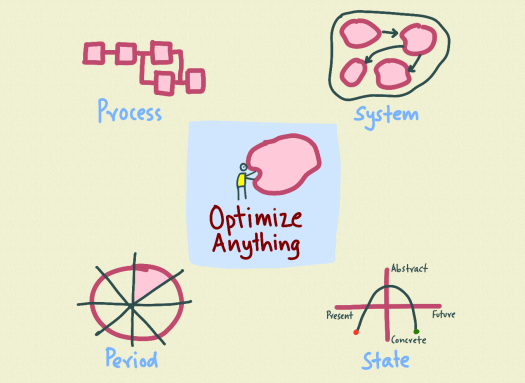
1. The simplest problems can be solved with process solutions

Some of the problems we have can be solved with simple solutions.

That’s usually where most advice on this matter starts. Map out the process and look at where it breaks down or takes too much time.

A manufacturing plant, for example, is usually a fairly simple set of activities.

By mapping the process and identifying bottlenecks, you can figure out where work is piling up and take steps to reduce this.

For example, if it always takes you time to find cereal and feed your kids in the morning while you’re rushing around trying to find clothes to iron – that is a bottleneck.

You could solve this by setting out everything the night before when it’s not a rush and put less pressure on yourself in the morning.

These are the kinds of problems that can be solved by routines, habits, rules and if-then algorithms.

2. More complex problems require a systems approach

Any problem that involves a person other than yourself quickly turns into a systems problem.

You may be perfectly capable of getting ready and out the door in the morning in 20 minutes, but add your other half and the kids into the mix and everything becomes a mess.

At work, the plans and needs of your coworkers and boss will affect your day – as will the availability of materials, resources and how your suppliers and customers act.

These are complex problems – and the ones that involve people, money and stuff are the most complex ones of all.

Here, simple process optimization doesn’t work most of the time.

This is why. Let’s say you set a target that all emails must be answered within 2 minutes.

You’ll find that people will focus on the target, and anything not directly related to the target will be ignored.

Calls will go unanswered. The doorbell will be ignored.

When it comes to targets – especially when they are linked to bonuses – people will do what is necessary to hit the target.

The problem is that the system as a whole may suffer. It will suffer.

A systems approach needs to look at the whole picture, and see how the object of a target is not to meet the target but usually to improve something – probably something related to your happiness or your customer’s happiness.

Have a look here to check how you might look at systems.

3. It’s important to have a clear idea of where you want to end up

I came across the idea of a transition from a present state to a future state here.

This is a nice model – and the idea is that you know where you are right now. You have a concrete picture of your present state.

Now you need to start thinking. Open your mind, brainstorm – go from what you know to exploring new stuff – learn about something new. Engage in abstract thinking.

Then bring it back down to more concrete, future thinking. Get specific about where you want to get to and how.

While the first two approaches – process and system – dealt with improving what is here now – this approach gets you thinking about where you want to be.

Do you want to have more money, more time with the kids, more travel in your life? Do you want to sell your business, grow it, get new partners, pass it to the next generation?

These are questions of strategy, and the state you want to reach in the future.

4. And know when is the best time to do anything

Another way to think about optimization is about timing.

For example, we know that sleep is important. What we don’t realize is that we can optimize sleep in cycles.

Having a nap during the afternoon or late evening can mean that we need less at night – and given how our days are, this can make the difference between performing well or failing.

There is seasonality in many businesses – what you sell during which part of the year. What time of day is best to reach out to people. When you should plan your creative work time and when you should do management and meeting time.

Breaking the day into periods and working on using each period better is a well known tactic – from the Pomodoro method of working in 20 minute chunks to advice from Ingvar Kamprad, the founder of IKEA, who said:

You can do so much in ten minutes’ time. Ten minutes, once gone, are gone for good. Divide your life into 10-minute units and sacrifice as few of them as possible in meaningless activity.

5. Make sure you’re not simply pushing aimlessly

The goal of optimization should be to make things better.

Not just one thing – everything.

For example, there is little point exercising to the point where you permanently damage yourself.

Or take supplements to lose weight that end up destroying your liver.

The problem with most approaches that are prescriptive is that other things happen as a result that we didn’t expect or plan for.

Look at each thing you do as an experiment. You’re trying to make things better, but watching out and trying to avoid screw ups at the same time.

You won’t get it right the first time, but if that happens you’ve learned something for the next experiment.

Above all, optimization is really about trying a new way to do something – and adopting it if it’s better.

Do You Have A Plan For What Happens When You Have Wild Success?

dog-catching-car.png

It’s slow and hard trying to build something.

Whether it’s a career, a business, a side hustle or a project – it can often feel like it takes forever to get anywhere.

Or is that just me?

Others get there much faster – with skill and luck and timing on their side.

Maybe it’s context. If you’re the first on the scene in a hot new market, and you have the skills and sense to see what is going on, you can make it big.

Or, if you’ve come up with a way to transform an existing market, you may find yourself flooded with more business than you ever thought possible.

Many of us know what we’re going to do in the next hour, maybe the rest of the day.

We might have an idea of what’s up tomorrow – perhaps the rest of the week.

We know we’re moving towards something, hopefully.

Perhaps it’s the big three that many dream of – freedom, autonomy and mastery.

For many of us, the perfect role or career or business is one where we are free to set our own hours and work at our own pace, have control over what we do and how we achieve results, and hone our skills and craft at something we like doing.

What most of us think about is what’s happening at the margin.

That means we look at the difference between where we are now and where we are going to be a short time from now.

That dominates most of our waking and thinking time.

What’s the next action, the next meal, the next chore to do.

If we’re busy, we rarely have the time to look around and see what else might be happening.

But perhaps we should prepare for at least one thing.

Imagine wild success.

Imagine that whatever you are doing has succeeded beyond your wildest dreams.

If you have a business, your latest promotion has gone viral and you’ve received thousands of orders.

If you’re raising crowd funding, people have suddenly realised that you’re offering the opportunity of the century at a bargain prices and you’ve got 10,000 emails from people who want to invest.

Like a dog chasing a car – what’s he going to do if he catches it?

It may seem a simple thing – but it takes a different set of skills to keep something than it takes to get it.

Take lottery winners, for example.

You just need to buy a ticket to win millions.

But it seems that many winners spend all the money they get and end up more or less where they were when they started.

They didn’t have a plan for what they would do when they won.

You could win big at any time – so why not think about what you’ll do when that happens.

A 100-Year Old Productivity Hack That Will Change Your Life

ivy-lee-charles-schwab.png

Sunday, 9.10pm

Sheffield, U.K.

I’m reading old sales and marketing books – and one of them is by Frank Bettger called “How I multiplied my income and happiness in selling”.

His writing is to the point – every page has something that you can take away and think about.

For example, he writes about how he was struggling to make it in the life insurance business – after 10 months he was thinking of quitting when he overheard something that had a huge impact on him.

The President of his company said that the business of selling came down to one thing – just one thing. A person of ordinary ability who goes out and earnestly tells their story to four or five people every day just can’t help making good.

Bettger now knew what to do – he had to go out and talk to people.

But that wasn’t enough to keep him going. He was fired up for a while, but then started to get lazy, stop calling – and that showed in his numbers.

Then, he writes, he remembered an article called “A $25,000 idea”.

In the article Ivy Lee, an efficiency expert was trying to sell Charles M. Schwab, the President of Bethlehem Steel Corporation, on how he could teach him to manage better.

Schwab dismissed the idea – he already knew what to do. He didn’t need knowledge but action. What could Lee tell him that would get him and his team to do the things they already knew they ought to do?

Lee gave Schwab a plan.

Start by writing down the six most important tasks you have to do tomorrow.

Now, number them in order of their importance.

Now, first thing tomorrow morning, start on item one and keep working on it till you’re finished.

Then, start on item two the same way, then three.

Keep going until it’s time to quit work.

Here’s the thing – don’t worry if you don’t get finished or do only one or two things.

You’re working on the most important things. The rest can wait.

Do this every day.

If you don’t finish them using this system, you probably won’t with any other system. And without using this method – you probably won’t have decided what is important first anyway.

Now the rest of the story that Bettger recites – which you can read in lots of places – is that the method worked and Schwab gave Lee a big cheque and all was good with the world. Now he knew how to go ahead and be successful.

Except it isn’t the end there really.

There are three more things to think about for you and me to supercharge this system.

The first is that there are things you should always do – every day – that will matter in the long term.

Exercise, for example. Time with your family. Alone time to work on your stuff and projects.

You need to plan those into your day. For the stuff that you need to do on your own, the best time to do them is first thing in the morning and last thing at night – before everyone else is awake and after they’ve gone to sleep.

Next, even though you’re listing the six most important things you need to do tomorrow, there will still be lots of stuff buzzing around in your brain. The 100 other things you need to get done.

Don’t keep them in your brain. Get them on a list – stop what you’re doing if you need to so that you’ve written it down somewhere you know you’ll find it.

Getting it out of your head will let you carry on with the list of important tasks.

And you can get the itty bitty ones done when you’re on a break or need some recharging time.

Finally – most of us have important things to do that are other people’s priorities and important things to do that are our own priorities.

If you have a job – you’re going to have to do things your manager wants you to do. If you have a project, or a side hustle, it’s going to feel like there is never time for that.

Do yourself a favour. Even if items two to six are other people’s priorities, make number one something that is important to you.

It’s like saving. The best way to save is to move the money out of your account as soon as you get paid into a savings account. Then live on what’s left after that.

Pay yourself first.

p.s.

One thing that might have slipped by in the story is that Bettger found out what he had to do (talk to prospects every day) first and then learned from Lee how to do it (make a list and follow it).

It’s important to know what the what is for you.

If you’re a salesperson it’s about making contact with prospects. If you’re a business leader, it’s about managing resources. If you’re an entrepreneur, it’s about innovation and marketing.

If you’re clear on what you should do and how to spend each day – you’re on track for the rest of your life.

Is It Important To Find Your Tribe?

tribes.png

Saturday, 7:01 pm

Sheffield, U.K.

What is a tribe, exactly? Let’s ask the Internet.

a social division in a traditional society consisting of families or communities linked by social, economic, religious, or blood ties, with a common culture and dialect, typically having a recognized leader.

Seth Godin talks a lot about tribes – why they are important, how they form and how you can lead one.

If you really care about something – it’s very like that there are others like you out there.

But, should you give a damn? Or are you better off spending your time working on your own? What is the benefit of belonging to a group?

There seem to be three broad reasons when you look into it.

You can change from what you are now to what you really are

We spend a large part of our lives learning to conform. From being told what to do as kids to signing contracts to do work as adults.

We learn there is a right way to act, to be, to think. The people around us act and behave in this way and anything outside the norm is odd or uncertain.

Along the way, we may have forgotten what we really are at the core.

If you’ve watched Sherlock Holmes, the one with Benedict Cumberbatch, there is a scene where a villain urinates in the fireplace to show that he can ignore any rules that others think is in place.

That’s probably not a wise approach to follow but the principle – one where we start to trust ourselves more and don’t try so hard to fit in – may help us move in the right direction.

And that’s one where you realise that most of the things that stop us from doing things are barriers that we have put up ourselves, barriers in our heads.

We may have stories about why we don’t fit in, why we’re different, why we’re not going to be accepted. We may have issues about gender, race, nationality among others.

But, these are stories we tell ourselves. And, if we want to change, we can find people with similar experiences and stories of change. People like us – and that’s one kind of tribe.

You can be part of a movement for change

If you believe in something – believe enough in it that you’re ready to change the world, then having a tribe will help.

Let’s say you want to stop fracking, change the law on cycling without a helmet or stop parents smacking their children – there is probably a group of people out there working very hard on the issue.

People will have different views – and so you will find multiple groups that will welcome you in. The price of entry, however, is that you have shared values and beliefs.

This kind of tribe is simply an emergent property of human society. It’s not good or bad – it just is.

Climate change activists and far right campaigners are simply different kinds of tribes. Society in general decides whether one tribe is good and another is bad – whether some can be allowed and other s controlled or banned.

If a well-defined tribe doesn’t exist around your area of interest, then you have the chance to be a leader, to bring together scattered people around your vision for a better (in your opinion) future.

You can be part of a group that has a common commercial interest

This final tribe is something that is so common that many of us just don’t realise how important it is.

Business – commerce – is an activity that happens because people trust each other. The easier you make it to trust someone, then more likely it is that your business activity and sector will do well.

That’s why every city has a Chamber of Commerce – a tribe that brings together local businesses. That’s why there are guilds and associations.

Imagine you’re setting up a market – should you put people that do the same thing close together or far away?

Should you group florists, food joints and book sellers close by or mix them up?

It turns out that having your competition close to you is better for customers.

When they can quickly compare between competing offerings, they make decisions more quickly.

When you can see what the competition is doing, you can become better at what you do.

A tribe isn’t a group of people that hang on your every word…

Some people think that finding a tribe is the same as finding a following – a group of people who idolize you and will buy everything you put out.

The people who have that kind of following, however, almost never seem to have set out with that in mind.

It looks like the ones that succeeded cared first – believed first, and the success followed later.

If you want to find your tribe – perhaps you should start by being clear on what you believe in.

What Is The One Thing You Must Wipe Out In Every Sale?

removing-risk.png

Thursday 10:05pm

Sheffield, U.K

Are we in a brave new world where technology is all that matters and classic human skills are not going to be needed any more?

Or is human nature going to prevail – as we obstinately cling to our biological ways of doing things?

Take the success of Amazon, for example. What makes it special? Why has Ebay become so popular?

The most obvious answer is that they timed it well – they had the technology and created the systems and processes – the infrastructure – needed to do business in the world of the Internet.

You could buy books on Amazon and sell your old stuff on Ebay.

But – just because you can do something doesn’t mean you will.

The two internet giants (and others) created new markets that were transparent and that you could trust.

Reviews, Ebay seller ratings, guarantees, escalation processes – all these helped reassure people that their money was safe if they used the platform to make a purchase.

Many of us can still remember a period when we didn’t fully trust things online. We might look it up online, but then go into a store to buy it.

Then we went into stores and checked online to see if we were getting a good price.

Now, we use stores like display cabinets – a place to look at things before we place an order from the cheapest place online.

The thing that Amazon and Ebay got right, eventually, was removing all risks for us as buyers of products.

And this is something Facebook is learning, perhaps painfully.

Facebook enables us to be producers and consumers of information – of stories and pictures and memories.

The problem is that they have also allowed their platform to be a seething quagmire of misinformation, propaganda and sleaze.

We don’t trust them or their platform, or feel it’s a safe place for us and our kids – and now they are having to do something about it.

They’re learning something that great marketers have always known – if you want someone to make a decision, take away every barrier, every risk that they could possibly face.

Let them try it out, pay later, offer a guarantee, let them have their money back at any time if they’re not happy.

Bend over backwards to make sure that they can make a decision and be confident that they can back out if they have even an iota of regret.

Some people are scared of doing this – what if they get taken advantage of?

But – back to human nature – more people will do the right thing. There will be some people who take advantage of you, but that will be a small number that is more than offset by people who decide to take a chance on you because of what you say you’ll do to remove any risk for them.

And, if you have a good product or service, you know they’ll be happy.

If we’re not confident that we have something good – then we need to fix that first.

But after that… you know that it will help the customer.

So… wipe out every last little bit of risk and then let them make the choice that is best for them.

The 7 Basic Fundamentals Of Selling Anything

key-marketing-variables.png

Wednesday, 8:10pm

Sheffield, U.K.

I’m musing about value – and how to get it across to someone else.

It feels like there are lots of people with many ideas.

There probably always were – if someone looked into it, they’ll probably find that the percentage of people with ideas has stayed the same over time.

It’s just that there are more people to start with, and it’s easier to talk about our ideas, what with social media and email and all that kind of stuff.

But most of us have had no real training in telling the difference between a good idea and a bad one, a profitable idea and a money pit, something worth doing well and something not worth doing at all.

Our brain plays tricks on us as well. It’s well known that people fall in love with things they have done themselves – the IKEA effect – where we regard our amateurish creations as at the same level as professionals.

But then – we also need to remember that experts aren’t always right – amateurs often invent things that go on to revolutionise industries.

For example, the Wright Brothers worked with bicycles but built the world’s first successful aeroplane.

But, on a more down to earth basis, what do you need to know in order to sell something?

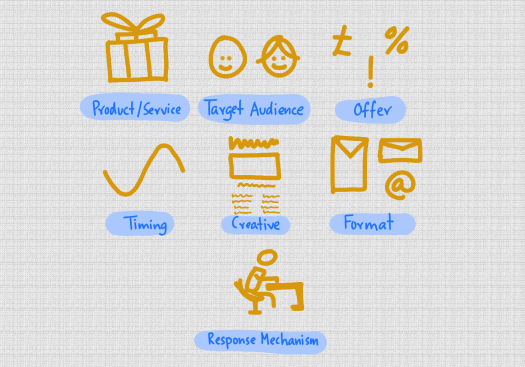
There are seven key factors that, according to the Institute of Direct Marketing (IDM), are key to selling anything.

1. A product or a service

That seems obvious – and you possibly have one already. Whatever it is, you need to be able to talk about its features, advantages and benefits.

What can it do, why is it better and what will it do for your customer.

2. Aimed at a target audience

You can’t sell to everyone. In fact, there will be a small number of people who need what you have, want it more than they want the money in their pocket and actually want to talk and buy from you.

Everyone else is milling around, getting in the way while you get to that core group of people – your customers.

The better we know and understand our target market, the better we will be at…

3. Creating an offer that they find irresistible

You can sell anything. Cow dung is valuable – it’s a heating fuel, organic fertiliser and floor covering…

It comes down to price – how much, discounts – what percentage will you take off, and terms – how quickly, what quality.

Someone will bite – and you just need to make those terms as attractive as you can.

4. You need to think about how they’ll see it

Are you going face to face, sending letters or reaching out electronically.

The format is simply the way in which you put the information in front of someone but…

5. The creative is how it looks when it’s there

Many people think pretty pictures sell – but the mistake is thinking that’s all you need.

You need something your prospect can read easily, understand quickly. The harder you make it, the more people you’ll lose.

Plus – you need different approaches for different people.

6. And they’ll be ready for it at different times

Fashion is the perfect example of seasonal selling – following the weather and what you need – and helping you make impulse decisions.

But there are other things that matter – budget cycles are important, common renewal dates are worth targeting and there is an overall business cycle in many industries.

7. But nothing matters if people don’t come back to you

The final part of the selling puzzle is making it clear how to come back to you.

The other day I nearly walked away from a purchase I had already decided to make because the person I was talking to explained everything about what they were doing, except how to order.

They talked about the website to the point where I thought that was the only way to order.

It was only as I was about to walk away that the point about signing up now came up – and that rescued the sale.

Customers need to be told what to do to order. In detail.

More is nice… but the basics are essential

These seven steps are crucial when trying to sell anything – and I’m going to keep them in mind when assembling any piece of product or service marketing from now on.

How To Stand Out From Your Competition

how-to-stand-out.png

Monday, 9.33pm

Sheffield, U.K.

What is the single biggest problem with looking at what your competitors are doing and trying to emulate them?

For example – if they have a flashy website and spend loads on pay-per-click advertising – do you have to do that as well to compete?

If they attend particular trade shows or go to awards, do you need to have a presence there as well.

Does a me-too strategy work?

The problem is that if you do what everyone else is doing, then what is it that sets you apart? Why should someone choose you over someone else?

This is something that many organisations struggle to get right. The boss looks over at the competition – perhaps she gets an email newsletter – and wants to know why her company isn’t sending out stuff like that.

It’s much easier to mock up a newsletter and start sending it out instead of questioning whether the newsletter adds value and if clients would actually read it.

Competing on such a basis is effectively an arms race, with everyone spending money to keep up with everyone else.

And, because the Internet effectively makes it free to send out stuff, ridiculous amounts of crap floods into our inboxes every day.

There’s a simple principle that we should keep in mind when advertising what we do.

If you are holding a red flag in a sea of blue flags, you’ll stand out from everyone around you.

That doesn’t happen if you’re holding a red flag and are surrounded by others also holding red flags.

If your business is doing what everyone else is doing then you have to come up with something new, something unique – that makes you look different from everyone else.

Many businesses are too scared to appear anything but corporate. They think that by projecting an image of themselves that is all polished wood and starched shirts they will come across as professional and competent.

Fear rules how they make decisions. They don’t want to send out controversial messages that polarise their audience. The words they use are dull and insipid.

It’s not about shocking an audience. Instead it’s about attracting their attention and then getting a message through to them.

And that’s very hard to do with everyone else shouting at the same time – especially on the internet.

Imagine how you would act if it cost you $10 to send each message. You’d be much more careful about who you sent it to, what you said and how you created a deal for them.

This doesn’t mean we should ignore the competition.

You should study them, read every message they put out and learn exactly how they advertise themselves.

Then – figure out what you can say and show that is different.

How To Stay Laser Focused On Your Goals All Year

staying-focused.png

Sunday, 10:13pm

Sheffield, U.K

It’s halfway through the year. July 1st. But you knew that already.

How is it working out for you? Are you on track to achieving what you wanted to do at the start of the year?

Sometimes it feels like we’ve just drifted – that time goes increasingly quickly. Part of that, according to a neuroscientist friend of mine, is how our brain processes time as we age.

So, are you doing ok? And if not, what can you do about it in the next six months? If yes, what can you do better?

Is what you do aligned with your goals?

We build castles and lives with one brick, one action at a time. I get distracted by lots of things – ideas, activities, possibilities. How should you choose what to do at any time?

The answer is probably not to spend time choosing. Instead you should create daily routines, rituals that are aligned with your goals.

That’s age old advice for writers, for example. Write at the same time every day, with the same tools, following the same process.

If you want to get healthy, lose weight, create a ritual that involves going to the gym in the morning. Do a set routine.

Don’t spend time trying to think about what you’re going to do when tired and bleary eyed in the morning. Just get your clothes on and get out the door.

At work, is what you’re doing aligned with what you’ve been asked to do? More importantly, are you working on stuff that makes you better, more valuable?

If so, create a ritual where you spend the hours before lunch working on valuable stuff, and the time after lunch working on administrivia.

Create and follow rituals and you’ll make good progress.

Remove everything that isn’t helping you move in the right direction

I find it very easy to get distracted by a new system, a new way of doing something, nice paper, a software package, something I code myself to do a task.

Sometimes this is good. Sometimes I need to allow myself to do something that doesn’t have a point, just because my brain won’t stop nagging me until I do it.

Checking Facebook or LinkedIn isn’t one of those things.

The problem with having devices that let you look at your digital world anywhere is that you look at your digital world everywhere.

And that’s just not necessary.

We need big blocks of focused time to do good work. The only way to get big blocks is to remove distractions, by reducing what can get into our world in the first place.

Willpower doesn’t work. Think you can avoid reaching for your phone when you take a break? Think you can avoid chocolate?

The only way is to stop having it available at all. If there is no mail on your phone, then you can’t check it. If there is no chocolate in the house, you can’t eat it.

Stay on track by writing layered goals and actions

How do you know you’re doing well? And how can you correct yourself.

The best way to do this is by writing it down. And then writing it down again.

The formal term for this is reflection, or reflective practice – looking back at your own experiences to learn from them.

One tactic that works well is to write layered goals. Start with the year – what are all the things you want to achieve next year.

Then think about the month ahead. What do you want to do next month?

Next plan the week ahead. What are you going to do?

Finally, what are you going to achieve tomorrow?

Finally – make specific plans.

Researchers have shown that we think about lots of goals much of the time. We can hold things we want to do – from sorting out the washing to completing a merger and these thoughts mix and intrude when we’re trying to focus.

In essence, things we haven’t done interfere with what we’re doing right now. So, we need to get specific – which means that we need to say how and when we’re going to do something,

Breaking that down – let’s say you have a list of things you want to do tomorrow. Say you want to clear out the garage. Is it enough to write that down?

Not if you want to get it done. What you want to do is get down to the precise next action and then time-block it.

So, that means getting clear that at 10:15 tomorrow, you’re going to box up all the junk on the left hand side of your garage, put it in the car and take it to the recycling yard.

Or something on those lines.

There’s six months still left to turn things around, so if you aren’t on track already, the best time to start is now.

Key Takeaways From Day 2 Of Blockchain Summit London 2018

blockchain-summit-day-2.png

Thursday, 11:59pm

London

I have 10 pages of notes from today’s session, not counting conversations with the exhibitors. That’s a little too much to condense into one post, but here are some of the highlights.

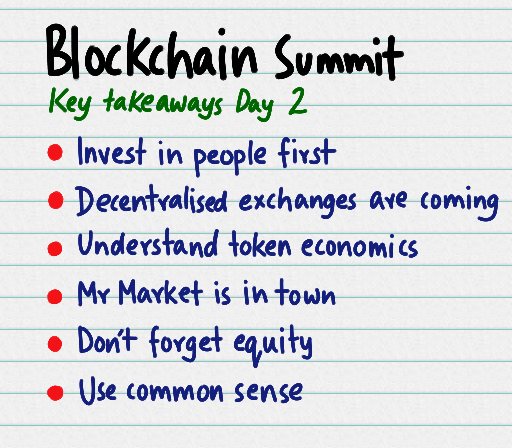
It’s still all about people

If you’ve got some money burning a hole in your pocket – where are you going to put it?

Well, if you’re sensible, not in an investment of any kind if you need it anytime soon. But let’s say you’ve done the basics and are actually in a position to put some money into a market.

Many people will be only too happy to take your money in exchange for a promise.

Some will be charming and personable. Some shy and serious. Some will have a televangelist’s pitch, others a flamboyant show.

We need to look at them carefully – then look into them. Remember that a technology or an application will not in itself take over the world. Behind it is a person, a team that needs to drive it and take it to market – and it is that team you are investing in.

But it’s still too hard to invest with any real confidence

So, we have this new world of distributed ledgers and currencies. But, for most people, the only way we can access them is through an exchange – and these are the things that get hacked.

It also seems counterintuitive – we’re creating a distributed system and then accessing it through an exchange – a middleman – which centralises transactions and control once again. Where is the real peer to peer element in all this?

Distributed exchanges seem to be on their way, where we can actually transact with people we don’t know by creating a market where prices are posted and accepted – leading to transactions and commerce.

That’s quite exciting – it’s having a market that works – with lots of activity that becomes self sustaining and prosperous.

And when you do, understand what you’re getting – read the detail

The new phrase is Token Economics – which I assume is much like ordinary economics…

Basically, you’re giving someone money and they are giving you a piece of paper.

The piece of paper says what you get – is it a stake in the business, is it a share of profits, is it regular interest payments and return of the capital, can you convert your paper into a different kind of paper?

All these rules set out what you get from your investment, and they are likely to be similar to existing options in traditional markets – equity and debt being the main ones, for example.

Seriously… read the detail. In many cases you don’t get a stake in the company. You’re simply lending them money that they don’t have to give back if things go south.

Read Ben Graham, and then read him again

Ben Graham, the father of value investing, had a story about Mr Market – and this should be required reading for all investors.

Prices go up, and they go down. The market is there to guide you – in the short run it’s a voting machine and in the long run it’s a weighing machine.

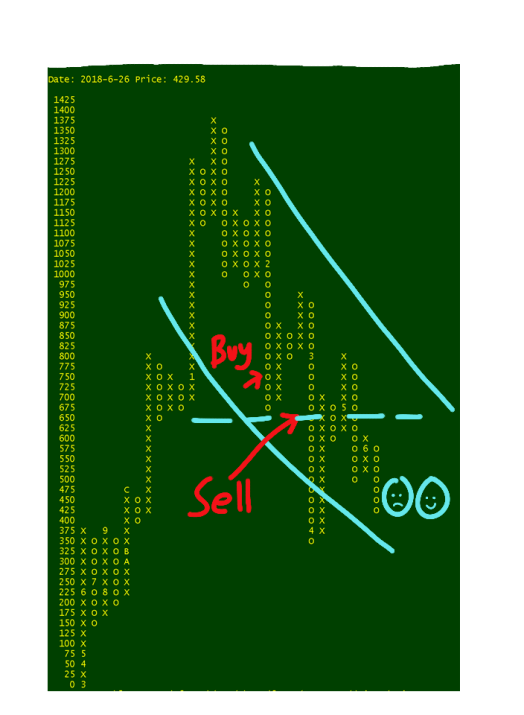
You need to have a strategy. For example, I wrote previously on why I sold my crypto holdings. The updated chart on this is below.

eth-update-june-18.png

Now, I’ve been lazy and not traded this as I could have, but on the whole, the sell still was the right call at the time – but this market is volatile and so at times it looks bad.

The point is that you can make money in an up or down market, if you have a strategy. And, depending on your position, you’re either sad about losing value or excited about buying something cheaper.

And that is basically how markets operate, so get used to the ride.

And, in case I haven’t said it enough, have a strategy before you jump in.

We still need to remember the purpose of the whole thing

The point about decentralised technology was that it could make things more equal, let those who had less also participate in the system.

In network economics with a winner takes all model, it’s easy to lose sight of the equity principle.

I don’t know how this will turn out – whether commerce will win or whether the system will create fairness… let’s wait and see.

Finally… don’t forget common sense,

The best presentation for me was one by Michael Messele of Pillar who not only went through his ICO story but also reminded people again and again to use common sense.

Want to get money? Then think about how you come across to people and pitch in a way that works for them.

Think about design, legals, management. Think about how you will deal with trolls, with your ICO going viral and your brand. Get help from experts. Create ways for people to work with you, in exchange for promises if necessary.

In summary… there is life in this market – and the big businesses are coming

The final takeaway is that this is starting to go mainstream. The big players are involved – the enterprise level players, and blockchain is going from a mathematical curiosity to a commercial proposition that we will see emerging over the coming years.

Any questions or if you’d like to talk more about any of the points here – please get in touch or leave a comment.

Key takeaways from Day 1 of Blockchain Summit London 2018

blockchain-summit-day-1.png

Wednesday 7.10am

London

An interesting day of presentations about Blockchain at Blockchain Summit London from a range of speakers – from large and small organisations.

It appears that Blockchain is moving from the early adopter stage and getting more mainstream interest.

We need to think beyond the technology

The basic idea of distributed ledger technology is what many people are interested in. Raymond Cross of SAP talked about what enterprises look for – and it is much more than technology.

The technology is only one component for enterprises. They also need to think about their existing operations – the scale of them in particular – and how they can move without disruption and risk.

That means that they want to know about standardisation and process and the way in which their business will operate in five or ten years and create a transformation plan that moves them from where they are now to an intelligent enterprise

Regulation is coming

The blockchain space, and most visibly cryptocurrencies and Initial Coin Offerings (ICOs) have been something of a wild west, with regulators and governments scrambling to keep up with the technology and its implications.

KPMG talked about how governments around the world take different views, from acceptance in Gibralter to bans in China. Where you set up matters. Tax is complicated – and where your company is located is one component, but the residency of directors could also affect things.

One thing is clear – governments will want their taxes, and the rules around money laundering, terrorist financing and knowing who your clients are will help enforce this.

There aren’t enough advisors for the need

Many people want to know about how to invest in cryptocurrencies, and traditional advisors are struggling to keep them informed.

Or Barmatz of Crypto Finance said that millenials in particular want to have this as part of their asset mix, but cannot find people who understand and can explain what their options are.

At the same time, funds are starting up that allow a range of investors to add these assets to their portfolio mix, so eventually crypto may become a standard part of portfolios.

Venture Capitalists are adapting

Traditionally startups went to VCs, cap in hand, asking for money.

Now entrepreneurs are starting to question why they need VCs and Silicon Valley at all, when they can go directly to the public and raise staggering amounts of money in minutes.

VCs are adapting, pointing out that it takes $200-300,000 to run a successful ICO – actually the new name is Token Sales, and they can help with that initial funding.

So, they’re setting up accelerators and trying to identify even earlier stage startups to invest in – which vaguely reminds me of the Dilbert cartoon where a VC asks a couple if their unborn child is going to be an engineer and if he can invest something now…

BOTs will be treated like illegal aliens

We’re moving towards a world where bots are everywhere – automated programs that do things for us.

In that world, however, if someone takes control of your bot – say one that you trust to do all your banking – they could steal all your money.

And bad people are working hard to figure out how to do just that.

So, the good guys are probably going to have to come up with a way to register bots – check that they can only do what they are allowed to do, and register them using identity technology.

That could be interesting for governments – now not only do they need to manage people but also the bots living in their jurisdictions.

Peer to peer is the future

My favourite quote of the day is from Associate Professor Alex Nortas who says inefficient coercive pyramids rule society.

He put up an example, with Black Insurance, of how people could collaboratively create and fund products through a platform, without having to go through the traditional structures that exist today.

These models are still developing – but it’s clear that they are coming and are going to change many industries – making them more accessible to more people, freeing up capital and driving down costs as a result.

Which sounds like a good thing – it’s more efficient after all to connect the people with money and the people with an idea directly – and that looks like how things will increasingly happen in the future.