Why Thinking Long-Term Is The Only Thinking Worth Doing

forever.png

Saturday, 9.37pm

Sheffield, U.K.

In every deliberation, we must consider the impact on the seventh generation… even if it requires having skin as thick as the bark of a pine. – Derived from the Constitution of the Iroquois Nation

It’s not possible for long-term thinking to be in fashion. Ever.

Shortcuts, on the other hand, always are. Shortcuts or hacks or tips or timesavers – such things are always of interest.

A few years ago I did a study on change, talking to people involved in trying to make it happen.

And it was telling just how much focus there was on making everything line up with what was perceived as important.

For example, many in politics focus on jobs. Anything that increases jobs is a good thing. So everyone creates a pitch that talks up how many jobs their project will create.

Or take climate change. What we need is a more sustainable society and that is a hard thing to do. It’s easier to build new green power stations than to get people to use less energy.

But societies don’t make decisions.

People do.

So, what kind of decisions should we make?

For example, what should you do if you want to have a good life? What do you really want out of life?

When you’re young the chances are that you want to be rich or famous or both.

But the people who end up having a good life are not the ones with the most money or fame but the ones with good relationships.

Relationships with family and relationships with their community.

Which poses an interesting approach to doing business.

One of the big risks we face in a technological age is how dependent we are on technology we don’t own or control.

A writer, for example, writing with pen and paper is creating something that could live for decades, even centuries.

My grandfather memoirs, written over forty years ago, are still there on crumbling paper.

They have now been transcribed and the challenge is keeping them digitally for future generations.

If you’re a business, however, what sort of time frame should you use to think about what you do?

John McPhee in Draft No. 4: On the Writing Process writes about using the editor KEdit in 1984.

A friend, Howard J. Strauss, created scripts and programs that helped McPhee use KEdit in his writing process.

Howard died in 2005. In 2007, KEdit stopped being updated and its creator, Kevin Kearney, is semi-retired. There aren’t that many users left around.

I hadn’t really processed this message, this idea that a tool will die with its creator and those that use the tool will also slip away.

It only really struck me when I was browsing the website of the sqlite database and read these lines from Hipp, Wyrick & Company, Inc., (Hwaci), who support the software.

Hwaci intends to continue operating in its current form, and at roughly its current size until at least the year 2050. We expect to be here when you need us, even if that need is many years in the future.

Now, that’s long term thinking. Maybe the kind of thinking you should use in your business.

But is it long enough?

I’m writing this in Emacs, the editor created by Richard Stallman. This tool will never die, because Richard has given the world the source code. And it will outlive him as those who use it keep it alive.

But the editor doesn’t matter because the words themselves are in ascii text. Yes they make their way to a website where you can see them but they aren’t held prisoner by that website.

But, why think about all this? What’s the point?

The point is to think about the future. The future that your children and their children and the generations to come will live in.

I’d like future generations to know my grandfather’s experience. Especially because he took the time to write it down.

It’s my responsibility to pass it on. More importantly, it’s my responsibility to pass on that sense of responsibility to future generations.

I think that when you start to think of things that way, think of the long term, it seems obvious that shortcuts aren’t really worth taking.

You see, you’re not really trying to save ten minutes. You’re trying to create a future for children generations down the line.

Cheers,

Karthik Suresh

How Do You Know What Kind Of An Impression You’re Making?

experienced.png

Wednesday, 8.52pm

Sheffield, U.K.

Even if the sun were to rise from the west, the Bodhisattva has only one way. – Shunryu Suzuki

It is difficult, sometimes, to know who you really are.

We lay down layers of personality over time, layers that we use to tell ourselves who we are. Layers that we use to show others what we think we are.

Take jobs, for example.

Most people don’t start off knowing exactly what they want to do. They’re steered by people they trust, when young, and gravitate towards things they are good at, when older.

The chances are that you are where you are right now because of certain choices. Ones you remember clearly, even now. Choices that could just have easily gone another way.

Let’s say you started as an intern, or someone looking for your first role and stumbled into an industry and stayed.

Did you choose the job? Or did the job choose you?

I wonder about things like this because I wonder what’s the point of it all.

There aren’t that many routes people take. Some move from job to job, rising quickly. Other stay in place for a long time, decaying quietly. Yet others stay, learning and growing and turn into bedrock, into people the organisation depends on.

I read a line in a book, now 29 years old, about hiring people. Look around, it said, for people wearing brand new suits. More experienced people wear jeans.

You’ve heard many times, I’m sure, about how clothes matter. How people judge you by what you wear.

So, if you’re in a situation where you’re being judged what kind of position do you want to be in?

If you’re in a suit and you’re trying to impress the other person then they have the upper hand.

If you’re wearing jeans, however, perhaps you’re comfortable that you have something to offer that is more than the clothes you have on display. In that case. do you have the upper hand?

Or does it really have nothing to do with who has what hand at all?

In an ideal world you’ll work with people who value what you do. Not how you look or where you come from.

The thing is that experience will out.

You can tell when someone knows something regardless of what they’re wearing. Just because of the way they talk. The kind of questions they ask, and how quickly they come to a view on what your options are.

It just seems like it would be nice to get to a point where you can dig through those layers and find yourself.

Get to a point where you’re just comfortable in your own jeans.

And to a point where the impression you make is of just who you are.

Where your way is the way.

Cheers,

Karthik Suresh

How Do You Tell When Something Is Good?

critical-thinking.png

Friday, 9.06pm

Sheffield, U.K.

There is nothing new under the sun but there are lots of old things we don’t know. – Ambrose Bierce

Do you think we live in a world where what we see and read is better than ever before?

There is clearly more stuff. More people are writing and creating words, music and video. They are coming up with games and apps and platforms.

All shiny and new.

So, what makes one creation better than another? Why do you sit and watch one box set, unable to turn away, for week after week while others you abandon after the first ten minutes?

One test – much loved by the analytics folk – is to look at what people do. If they can watch your behaviour, see how you vote with your mouse and remote and money, then they can figure out what you like and give you more of it.

The thing with analysis is that it looks back at what has happened. You can try and do more of what worked in the past but, as the financial folk keep reminding us, past performance is no guarantee of future results.

Also, this whole thinking in aggregate, in big numbers, in terms of markets is applying statistics to people. And no one really wants to be a statistic.

Take consumer behaviour, for example. In his book Buy.ology, Martin Lindstrom writes about Socrates and how he told his students to think about a mind like a block of wax. If an image is pressed into the wax and stays there, then we remember it. If not, it’s like it was never there. In other words, it leaves an impression.

Lindstrom goes on to describe how the things that leave an impression on us, from touching a hot stove to being embarrassed when we told someone how we felt about them, shape the way we start to respond to things.

But, while we share many of these things none of us have exactly the same. Imagine all these experiences like strands hanging down in front of you. You pick and weave your experiences into your own unique sense of identity.

So, while a statistical approach can be approximately right the ideal approach is one that is made just for you. Not one that is designed to make you feel special but one that actually is special.

John McPhee is an American non-fiction writer. I heard about him in a podcast and was interested enough to take a look at the cover of his latest book, Draft No. 4: On The Writing Process, but not interested enough to buy it.

Until I read this review by Michael Dirda on the Washington Post that had these lines:

“However, its opening two chapters, in which McPhee presents his various systems for structuring articles, do require a bit of perseverance. There are graph-like illustrations, circles, arrows, number lines, maps and even an irrelevant excursus about an outmoded text editor called Kedit. The upshot of it all is simply: Take time to plan your piece so that it does what you want.”

There are two points that the writer makes: drawing pictures is a waste of time; and text editors are irrelevant.

Well, if you have read this blog for a while, you’ll know that drawings are a big part of how I write. And I write with a text editor, possibly one even older than the outmoded one that the writer of the Post excoriates.

So, of course, I had to buy the book. Because now I desperately needed to read those two chapters.

And that’s the funny thing about people. They don’t act in the way you want them to. Just because you think things should be one way doesn’t mean everyone is going to agree.

So, that takes us back to asking how we know when something is good. And one answer is that it’s good if it’s been around a while.

Like pencils.

Pencils?

If you’re a writer, you know how to use a pencil.

What’s newer than a pencil?

Pens, text editors, Microsoft Word, some kind of SAAS program?

If you write with a pencil your words will still be legible a few hundred years from now.

Penned words may start to fade.

Plain text will be readable as long as we have computers.

Your Word documents from even ten years ago are probably lost.

And that SAAS company went bust not long from now.

In other words, choose things that have some history because they have shown they can last.

Cheers,

Karthik Suresh

What Approach Should You Take If You Want To Succeed?

agincourt.png

Thursday, 9.01pm

Sheffield, U.K.

All things are ready, if our mind be so. – William Shakespeare, Henry V

The English insult is different from that commonly seen in much of the world.

Instead of a middle finger raised aloft, they hold up the index and the middle, palm facing inward.

This custom, apparently, comes from days when the longbow was used in battle and the French would threaten to cut off those two fingers of any prisoners to ensure they never drew a bow again.

And so, in battle, the longbowmen held up those fingers to tell the other side what they thought of them.

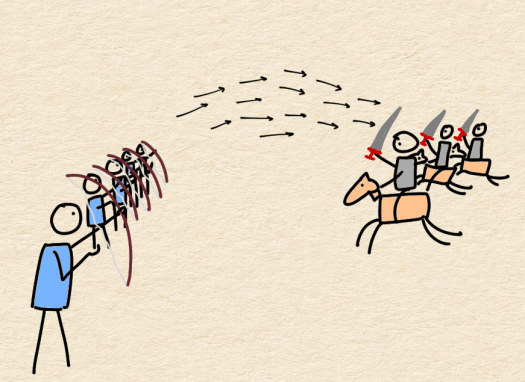
The longbow, apparently, came into its own at Agincourt in 1415. 8,500 English soldiers, 7,000 of which were longbowmen faced around 50,000 French troops.

They won – helped by their arrows – which travelled towards the enemy faster than they could run and walk towards them.

But, what does this have to do with business or sales and marketing?

It’s a story that can be used to look at the same situation from different points of view.

Let’s look at tactics, for example.

The losing side were just as brave as the winning side. If anything, they might have been braver, trusting in their armour to protect them from those pesky arrows.

They had a plan, to head towards the other side and so that’s what they did.

That’s a little like having an army of salespeople taught to smile and dial. They hit the phones, make the calls, make their numbers and succeed.

Is that approach, that works like a cavalry charge, all might and muscle and fury, going to work?

Increasingly, it seems to me, it doesn’t. A cold approach, whether on the phone, email, snail mail, is easily stopped, ignored or turned away.

The arrows, on the other hand, are multiple points of contact. Some might miss, some might hit, and the ones that hit may make a difference.

So, the way I think about this is to imagine that you want to build a pipeline of business. You could reach out to people directly or you could send a shower of arrows their way.

You could advertise where they are going to see it, you could engage with them in the places they are going to be, you could work with them on things that they feel are important and you could get introduced to them by people they already trust.

Is that going to increase your chances of success?

Possibly. Even probably.

I guess it simply comes down to this.

There are lot of things you could do.

You could focus on just one of those things – something you’re strong at, and just do that thing.

Or you could do as many of those things as you can at the same time.

For some people the focused approach will work. For others, the wider one.

Unfortunately, there is no right answer.

There is just what happens when you finally join battle.

Cheers,

Karthik Suresh

Why It’s Important To Really Understand What Free As In Freedom Means Today

small-big.png

Monday, 9.04pm

Sheffield, U.K.

Don’t think free as in free beer; think free as in free speech. – Richard Stallman

IBM has bought Red Hat for $34 billion.

Things have come a long way…

Twenty years ago, on a machine that I can’t remember, I started up a CD of Red Hat and went through the installation process.

Red Hat wasn’t my first try at GNU/Linux.

That was Slackware, on 3.5 inch disks, but it was the first distro that I can remember using properly.

I’ve often wondered why I was drawn to GNU/Linux, why Windows seemed quite so undesirable, even all that time ago.

Why choose something so small and fragile instead of a dominant operating system?

I think it might have been because of my dog.

Years before that install, I went out and chose a puppy. A Pointer – black and white, with floppy ears, a wobbly walk. It was the one that came over and said hello so, of course, I had to have it.

It was an age when computers were coming into our lives. And my dad suggested we name the puppy Unix. So, Unix he became. And I wonder sometimes whether the draw that GNU/Linux, a Unix like system, has for me is because of that connection.

But there is more than that.

When you come from a country that has a history when it was colonised by those with superior technology you learn that you need to have your own if you are not going to be controlled once again.

So, self reliance is important. It’s good to be reluctant to give up freedom, even when it seems convenient.

The last twenty years, for me, longer for others that started before I was born, have seen people working on a strange concept. The idea that programs and computers should work to serve society, not to control them.

The common connection these people have, is their desire for freedom. The desire to be able to use their machines without being controlled by someone else.

A few centuries ago, many monasteries were among the richest organisations around. How did that happen, when the monks were committed to a life of prayer and meditation? It was because of the power of volunteering. The power when people come together, to work for a goal bigger than themselves.

So, it’s strange and reassuring, to see that power is still capable of taking on the strongest in society and winning.

Richard Stallman wrote as far back as 1996 that it was just fine to charge to distribute free software. You could charge nothing, a penny, a dollar or a billion dollars. He didn’t think you would get a billion, however.

Red Hat got 34 of them, just 22 years later.

Freedom looks to be winning.

Cheers,

Karthik Suresh

How Would You Feel If You Spent The Rest Of Your Life Doing Something You Hate?

tennis-ball.png

Friday, 6.51pm

Sheffield, U.K.

I do not believe a man can ever leave his business. He ought to think of it by day and dream of it by night. – Henry Ford

I was listening to Drew Houston, the billionaire founder of Dropbox, being interviewed on the Tim Ferris show and talking about a tennis ball.

And then there is the tour guide on a Copenhagen boat who drily said that she chose to be poor when she chose to study history.

The two of them have something in common – and something different from many of us.

If you’re from a country like India, you are taught that you need to study so that you can make a living from what you learn. So, you’re told, you can be an engineer, doctor or lawyer. Your parents believe you have a choice because you can choose what kind of engineer, doctor or lawyer you want to be.

What about the tennis ball?

Well, Drew had a dog – a Labrador – that usually did very little. But, when a tennis ball came out she got very excited and chased after it – she was completely obsessed with the tennis ball.

People who study something because they love the subject start life chasing their tennis ball from the start. Presumably that is a good thing.

Then again, it might not be. If you really love doing something – writing, music, art – what happens when you start doing it for money?

Sheffield, it turns out, has a good claim for having the first football club in the world, inventing many of the elements of the modern game. The game was played mostly by people with money – playing as amateurs – but things were going to change. Martyn Westby writes about the tensions that erupted when the sport went from being an amateur one to a professional one.

An amateur is someone who does something without being paid. Someone who does something for the love of it.

An amateur is also someone who is rather fortunate in not needing the money. Or wanting it. And the amateurs were very unhappy about professionals coming into their sport.

The professionals won, however. We now have professional sports – that’s the stuff you see on TV. And you see a much higher quality of sport than might have happened if amateurs were the only ones who did it.

The point here is that if you love doing something, then getting money for it may make it a job and less of a labour of love. If you get paid for each word you write then you will probably start resenting each word for the time it takes away from you.

On the other hand, if you do something you dislike, then you are exchanging your time for money and it’s going to eat away at you.

But… what if you do something for long enough? Will you start to get better at it and perhaps even start to like it? Can you act yourself into changing your mind about what you’re doing?

There’s no real right answer to this. If you are obsessed by something and it’s something that other people will give you money for, then you’ve got something that could make you a living.

The one thing to avoid is piece work. Try and separate the money from the work. I think it was a Kahneman finding about motivation – if activity and reward are closely linked then you’ll stop acting when the reward stops. If they are further apart in time, your mind doesn’t connect them in the same way.

In reality, I suspect few people would carry on doing something they hate, if they feel they have a choice.

It’s probably really a dislike, or distaste or aversion.

In fact, the thing that probably stops you changing is less to do with what’s outside and everything to do with what’s inside.

After all, if you’re in a situation you dislike you can do one of two things.

You can change your situation.

Or you can change your mind.

Cheers,

Karthik Suresh

There’s More Than One Way To Do It – A Good Saying To Live By

more-than-one-way.png

Monday, 8.41pm

Sheffield, U.K.

The essential thing “in heaven and earth” is . . . that there should be long obedience in the same direction; there thereby results, and has always resulted in the long run, something which has made life worth living. – Friedrich Nietzsche

If you’ve been glancing at recent blog posts, you’ll notice they are about selling. Consultative selling, to be precise. I figured I’d try and write a book on the topic – and focusing on it for a few months seemed a good way to pull together a first draft.

Why? I’m not a salesperson. I’m not particularly good at the sales process, prospecting, keeping records, following up, closing. It’s also pretty dull really.

I’m not sure many people are great at being salespeople. We used to say about a product that we bought it inspite of the salesperson, not because of him. We could see it would do what we wanted. And I’ve not really seen a situation where a pure salesperson brought in more money during his or her employment than they cost.

But, sales and marketing is not something you can simply hand off to someone else either. It doesn’t matter what you do – you are going to survive by earning a commission on the value you create. Very few people get away with having to do nothing of value.

A job, for example, is a commission only role where you get a third of what you make the company. That’s a basic rule of thumb – you need to bring in around three times what an employee costs you to make it worth employing them.

The better you sell yourself, the more likely it is that you’ll get a good job – or grow your business – or excel in your profession.

Marketing and sales, then, is something everyone has to do. So, it makes sense to figure out how to do it less badly. Not do it well necessarily – not to superstar levels where you can get your own TV channel and sell lots of books – but to the point where you don’t make simple mistakes that cost you business.

And that really comes down to learning how to play nicely with the other children.

Which brings us to an essay by Larry Wall, the creator of Perl, that touches on the issue.

If you’re a doer – someone who does a creative job – then you probably have certain character traits. These are impatience, laziness and hubris.

I find this easiest to explain in the context of computer programming. There are lots of people right now in the world that go to work every day and use spreadsheets. They spend their time working through and checking the data, copying and pasting stuff and checking their work and colour coding it and checking their work.

Most people use spreadsheets like a … well, you can think of an analogy. The point is that it’s flexible enough for anyone to open up a new sheet and put in something and do some calculations. So they do that. Usually badly.

Spreadsheets are easy to use. But they are also a hugely powerful programming languages that you can use to make your life a lot easier. If you want to hire someone to do Excel, give them simple problem that involves VLOOKUP. Let them use the Internet to look for answers. If they can use that function correctly, you can hire them.

Someone who has learned that is on their way to being a programmer. And programmers are lazy. They don’t want to do the same thing twice. So, if they have to, they write code to make their lives easier.

They are also impatient. They don’t want to wait. So they’ll work on how to make things work faster or talk to each other better or share information more effectively.

They are also comfortable with hubris. No sooner have they created a solution that they think of all the things they would chance and get busy creating the next version that will make the old one obsolete.

If you’re a company founder, you probably think the same way. You’re creating a new business because you’re impatient with the way things are now. You’re probably too lazy to struggle on with the hard road when you can build a better one. And you’ll start over if you have to – from scratch because it’s so much easier to build from scratch than fix something that is stuck and broken.

As Wall writes, these three characteristics are individual ones and they give us drive and passion and help us be unreasonable and change things.

But… they don’t help us change the world.

For that, we need to work with others. And others are difficult to work with. They don’t think like us.

I found that when I had to do something on my own it was easy. I had an idea and did it.

When there were more people involved, sometimes we agreed on what to do and actually managed to do it.

With even more people… life turned into a slog through chest high mud. You couldn’t get anything done because other people needed to be involved, to give input, to be mollified and pacified and socialised.

But that’s the price you have to pay if you want to be a part of society.

So, the mirror image, the flip side to laziness, hubris and impatience are the virtues that are needed if you want to be more than just yourself. To be a part of your community.

And those are patience, humility and diligence.

You need to be patient with those who disagree with you or cannot keep up with you. You need to be humble so that you don’t think your way is the only way. And you need to be diligent – to keep working on something until you do something worth doing.

Not understanding that we need to be able to hold and apply these opposing concepts at the same time is at the root of much of the failure we see in the world today.

What’s the point in being a successful business person if you’ve lost your family and relationships in the process?

What’s the point of creating a hugely profitable company if everyone that works for you hates your guts?

What’s the point of being a lone voice speaking of a better way to do things if no one else will engage with you?

The point that Wall makes is that it’s okay to have either or both or a different way altogether. The virtues described in the two triangles are not opposites – they just are.

There are many ways to become successful – to reach whatever goals you define as success for you.

But… if you want to succeed as a person and as a part of society… you would do well to keep these two sets of words in mind.

They may help choose the right action – as you and as us. Then you’ll do something new and cool and play nicely with everyone else and hopefully end up having a good time.

Cheers,

Karthik Suresh

How A Little Design Knowledge Can Help Your Presentations Stand Out

design-essentials.png

Friday, 9.03pm

Sheffield, U.K.

Making every page or screen self-evident is like having good lighting in a store: it just makes everything seem better. – Steve Krug

How often have you sat through a presentation and wished to god you were somewhere else? One filled with relentless bullet points and long words – made worse by the presenter reading them to you?

I used to think all that mattered was the work. As an engineer, if I got the figures right or the model working, it didn’t really matter what the end result looked like.

The typical workflow started by spending time on a model, getting the numbers working right, making it easier to get information into the model and update it and getting rid of all the bugs.

Finally, it was time to either pdf the document or copy and paste the results into a powerpoint and the job was done. It was time to go and see the client.

I’m not sure if they looked perplexed when being taken through the presentation. They probably did – they were probably too polite to stop and say they didn’t get it.

Then I went back to business school and realized that getting the numbers and analysis right is only one part of what needs to be done.

The bigger part is getting people to do what you want. It doesn’t matter how good your analysis is if you can’t persuade the people listening to you to take the next step, whatever it is.

This is a mistake many of us have made. And a big part of it is because we’ve never been taught how to design presentations that work.

There’s two parts to a presentation that works – the story you tell and the way it looks.

In a previous post I wrote about how to create a story for your presentation. Now it’s time to think about how to design your presentation.

A great book to get started is Robin Williams The Non-Designer’s Design Book. She writes that most people can look at a page and know they don’t like it. What they don’t know is how to fix it.

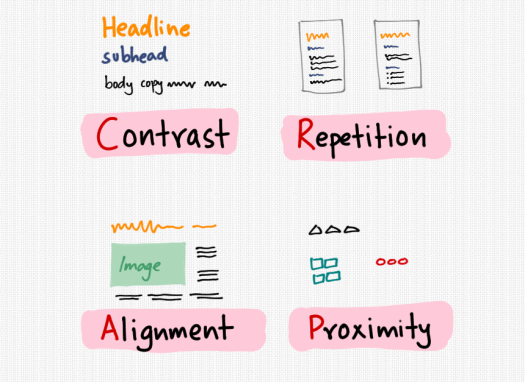
The secret is to learn four key design concepts and, if you get them, you can make every presentation looks much more professional and impressive.

First – understand how to use contrast

You are probably fairly comfortable with the default presentation templates in software like Powerpoint. You have a headline and body text. You might have images. You may put in some smart art or text boxes or diagrams.

In other words, you have lots of elements on your page. What should you do with them?

Imagine having a document set entirely in capital letters in the same font and text size. That’s going to be painful to read.

What you should do is make each element on the page distinctive. Headlines should be bigger than subheads, which in turn are bigger than body text.

Images should be clear and stand out from the page background. Having a busy background will make it harder to see an image or annotation.

If you make things that are different look different, you can draw attention to what you want. For example, you might have a table with lots of numbers, but you can make the result you want to draw attention to stand out by increasing its size or colour.

Next – use repetition to set expectations

Your audience or readers will look for clues to tell them what things mean. If you have a headline in orange in one page and then use the same colour and size for body copy or an image caption, you’re going to confuse and anger them.

Keep things consistent. Use the same fonts and sizes for similar pieces of content across different pages. If you use a quote or highlight something in a box, make sure the same kind of box is shown on other pages – because you’ve trained your audience to expect something specific the first few times the box came up.

The beauty of using elements that repeat is that as people get used to your material, they’ll fill in the blanks for you. If they know that you make a statement followed by an example, they’ll start to wait for your example before they make a decision on your statement.

Alignment just makes everything look better

The simplest secret of graphic designers that we all miss is that they make things look good just by lining everything up nicely.

It’s like going into a supermarket. If you look at a shelf and everything is neat and tidy it looks good. If you’re at the sale section and everything that’s going off has simply been dumped on the shelves it looks like it is – cheap and out of date.

You can get this effect simply by aligning your text and images so that the line up. You know this is happening when it looks like there is a box around your content. Take the example in the picture above – just by aligning the image on the left and the text on the right with the width of the headline, it looks neater and more consistent.

Finally use proximity to keep related things together

This simply means that if you have items that are similar, keep them together and separate from other elements. For example, if you have input parameters, analysis and results in a spreadsheet, chunk them up and show them separately. That way your audience can take each one in turn rather than having to figure out what is what.

A good example of this is how you set out features, proof and a call to action on a page. You might have a bulleted list of features, a case study with a photo of someone who has used your services and information on how to get in touch with you.

You’ll get a much better response if you make it clear which is which.

Design doesn’t replace content – but it can help get your message across

Something that is pretty but empty isn’t going to help you sell. The chances are, however, that you know your stuff inside out. You can make a pretty good case for why your prospect should buy from you.

If your presentation looks sloppy, however, that’s going to work against you. Using these simple design rules, which can be remembered pretty easily if you create an acronym using their first letters, everything you create will look better.

And you’ll probably find that you have more prospects nodding in agreement with what you’re saying.

Cheers,

Karthik Suresh

How Should We Think About The Way In Which We Work?

small-is-beautiful.png

Any intelligent fool can make things bigger, more complex, and more violent. It takes a touch of genius — and a lot of courage to move in the opposite direction. – E.F Schumacher

Wednesday, 9.05pm

Sheffield, U.K.

Do you ever wonder if you have a responsibility – a fiduciary duty of care – to the world around you?

Most people probably do. They’re concerned about their environment, feel sorry for those in more unfortunate situations and try and be good people.

But is that enough?

Take the minimialism movement, for example. Some there would argue that you have a responsibility to live in the smallest house possible.

The smallest one that lets you do what you need.

But we’re not driven by needs. Well, we are to a point. But that point is fairly low – we know that millionaires are not ten times happier than those with a hundred thousand in the bank, who in turn are not twice as happy as those with fifty thousand.

They’re all about the same. Some of us, it could be argued, feel that the more we have the less content we are.

It’s like that saying – first you own stuff, then your stuff owns you.

So, is the right approach to have less stuff? Or less but better stuff?

For example, let’s think of a simple activity like taking notes during a sales meeting.

You need paper. Should you spend a little bit more and get a pad made from recycled paper or spend as little as possible and go for a cheap notebook with low grade paper?

Should you buy a cheap biro, an expensive fountain pen or a silky smooth Japanese 2B pencil?

Which approach do you think will get you the business? What will your prospect think?

It’s hard to tell. I’m told that some people always look at your shoes to tell what kind of person you are. I’d fail on that test.

But then you have a book like The Curmudgeon’s Guide To Practicing Law – which has possibly one of the best chapters I’ve read – Chapter 8 on page 93, to be precise.

It’s titled Dress For Success and all it says is:

I don’t give a damn what you wear. Just make sure the brief is good.

Perhaps you don’t need to worry about this at all. You can try and be something you’re not and sell successfully to people you don’t respect or you can be who you are and work with people you like, admire and trust.

Which brings us to E.F Schumacher and his book Small Is Beautiful: A study of economics as if people mattered.

You don’t really need to read the book. The title alone tells you all you need to know.

Think about what you’re trying to do in a consultative sales process? Are you trying to make a sale? Or are you trying to help someone decide whether what you do is something they need?

Take the words you use to say what you do… Churchill once wrote Short words are best, and old words, when short, are best of all.

Why would you use a long word when you have a short one that does the same job?

Take the design of a web page or a brochure. We think sometimes that our prospects make decisions based on how your stuff looks. For any real purchase of any significant value, however, you can bet they read your stuff before making a decision.

A simple design that helps them get the main points should work just as well as a pretty one.

What about systems? How many steps should your sales process have?

One, if possible. Two, if you can’t have one. Three, if two isn’t possible.

Really, you should have as few things to do as possible.

What about customers? How many should you go after? How wide should your market be?

If you try and sell to everyone, you’ll end up with no one buying from you. If you want to succeed, you need a niche. Successful large businesses are often a collection of niche businesses.

However big your company, these days you’ll probably find that if you want to get something done, it’s down to you. Perhaps with a few colleagues you trust. A small team.

The real point here is that scale and size is an illusion. If you own a very big company employing lots of people, you probably spend most of your time with three or four people. If you’re an entry level employee at the same company, you probably spend most of your time with three or four people.

If you want to get your point across, speak as you would to one person. Keep everything small.

Cheers,

Karthik Suresh

How To Pull Together A Story For A Killer Presentation

problem-resolution-example.png

Thursday, 9.15pm

Sheffield, U.K.

In my previous post I wrote about taking your audience on a journey using a story. How can you use a story to make a more effective presentation?

To start with, what do you think is a good outcome for a presentation that you make?

Is it silence? Is it applause? Is it a barrage of questions?

If it’s silence – perhaps you were completely clear and everyone understood everything. Or perhaps they didn’t but you sounded so confident that they were too intimidated to ask anything in case they looked foolish. Or you were so boring they spent all the time checking their emails under the desk.

If it’s applause – perhaps you came across well. But, what did they remember from your presentation?

If they have lots of questions – is it because they understand what you’re saying well and want to show how clever they are in front of their colleagues? Or is it because you didn’t get the most important points across? Or were you vague and evasive and they’re trying to pin you down?

Going back to Andrew Abela and what he says about – a good outcome for a presentation you do is when your listeners start talking and discussing what you’ve said between themselves – seemingly almost forgetting that you’re in the room.

This is a great point to reach. I’ve seen this. You’ve made your points, and now everyone is nodding and talking and gesticulating. They’re buying into what you’re saying. You’re on your way to making a sale.

How do you do this, what’s the secret?

The problem with most presentations is that they start from the presenter’s point of view and work through the points that the presenter thinks is important.

Usually, this is with an introduction to who they are, some scene setting, then some meandering through whatever seems important, then a discussion about what this means for the audience, then next actions and any other business.

By which time everyone is asleep or bored or zoned out.

Instead, you need to think about your presentation from your audience’s point of view. You need to start by getting their attention.

You’ll do that by saying what they’re going to get or learn or see during your presentation that matters to them. For example, I started this post with the idea that you could use a story format for your presentation. So that’s what you’re expecting to find.

You read articles and ads and flyers because the headline gets your attention. Newspapers have headlines for that reason – so you can find the stuff that interests you quickly. It’s the same with presentations – you need to start by getting their attention.

Let’s say you’re a small business owner and you’re about to sit through a presentation on webinar services. How would you respond to two slide titles below:

  1. Introduction to ABC Webinar Marketing Services
  2. Can a single webinar increase sales by 30% next month?

The first one is the kind you see at the start of presentations all the time. The second is not.

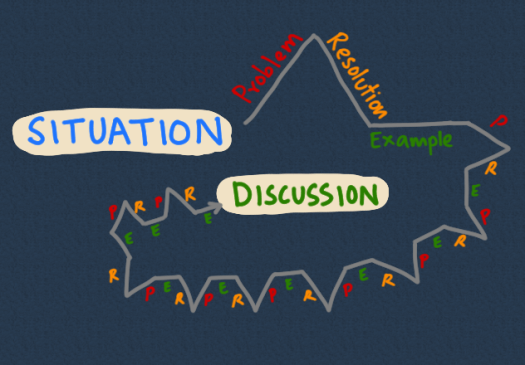
The second gets your attention because that’s something that interests you. So, your first task as a presenter is to set out the situation – the context for what you’re going to do – the promise of what you can deliver to your listener.

You then lead into a story format – which is really quite simple. In most stories, there is a problem and a resolution repeated again and again. You put a man up a tree, throw stones at him and then get him down again.

Watch for this the next time you see a film. The tension in a story is created by putting things in the way of the protagonists. We need them to stumble and fall and then pick themselves up again.

In a consultative sale, the stumbles and stones are objections. They’re the thoughts that come to mind when you are exposed to something. It’s just natural to be sceptical – that’s human nature.

What you need to do is look at your situation and think of the first objection or objections that come to mind.

For example, following the webinar intro slide, perhaps the objection is “We don’t really have these in our industry – the bosses don’t sit at computers and join webinars”.

Rather than waiting for the audience to bring up this problem – address it head on in your next slide title – “Are small business owners too busy to attend webinars?”

Hopefully, you have a good answer to this question. You have a resolution to this problem. Perhaps you have research that says most bosses ask an intern to find out about marketing options, and the interns often jump on webinars for a quick intro.

So, you have a resolution trotted out. But just because you say so doesn’t make it so.

What you need next is an example. Something that shows what you say is real. It can even be an anecdote – it’s surprising how powerful an example can be of even one person that’s experienced what you’re saying can happen.

The example also lets your listener take a breath and process your point. It gives them time to get it. Right – I know the problem, it looks like this person can solve it – and it’s worked somewhere else.

Great. Onto the next problem.

“Aren’t webinars expensive?”

There’s a resolution to that. No – the technology is getting cheaper all the time.

And an example. My last client did six webinars last year and spent less than $5,000.

And on and on. Each objection will naturally lead to another one and another one. You’ll be able to think of them quite organically as you stop focusing on trying to sell what you do and focus instead on the problems people can think up about why it won’t work.

If an objection is particularly hard – if you can’t answer it – you need to stop and work on that until you can. If you can think it up, the audience can.

How many problem-resolution-example sequences do you need? As many as are needed to address all the objections that can come up. Address them yourself, do it before the audience can and you’ll see something wonderful happening in front of your eyes.

You’ll be talking to them, making your first point. You’ll see polite attention, some furrowed eyebrows, some sceptical looks.

Then, you’ll say the objection that they’re thinking out loud and see a flash of recognition in their eyes. They’ll sit forward and start to pay attention as you talk about how you are going to resolve it.

When they hear your example, the cogs in their brains start turning, processing what you’re saying, putting it in their own words.

As you carry on, they’ll get more and more engaged. You’ll be going through all the problems they have and coming up with answers before they can ask questions. They might even smile and say something like “I was just going to ask that…”.

When you’re done, you might get some nods. No questions, probably, if you’ve answered them all. Instead, someone will say something like “We could try this out with the XYZ product line”. And then someone else will join in with a supporting statement.

You’ll lean back, and watch as people start to talk about how they can use what you’ve talked about. All the time you’ve spent addressing objections means that they can now think about how to do things rather than whether they should do things.

That discussion is your goal – your signal that what you said has been processed and internalised and is now part of the way your audience looks at the world. That you’re on your way to making the sale.

Cheers,

Karthik Suresh

ps. As a reminder, this is the thirteenth post in a series that I’m planning on eventually collecting into a book on Consultative Selling. If you are reading this and are interested in this topic, please let me have any feedback, good or bad, so I can make this as useful and easy to read for you as possible.