Why It’s Important To Get Multiple Perspectives On The Same Problem

six-thinking-hats.png

Friday, 10.17pm

Sheffield, U.K.

There are no facts, only interpretations. – Friedrich Nietzsche

I’ve been thinking about perspectives for a while – about how we get locked into points of view without realising it.

It’s the tools that do that to us really.

For example, I’ve started using paper more again because I’m in one place a lot more.

And there are pros and cons to paper – which is why we try digital and find that it doesn’t do everything we want it to do either.

Now, the thing that happens is we find a way that works for us and start using it.

Which then complicates things when we have to work with others who use different approaches.

One way of resolving that tension is through the use of power.

For example, in one of the notes I found as I sorted out my archives was an exhortation never to let anyone use their own notebook.

If you work in an engineering firm your ideas are the property of your employer.

So, you should really keep bound notebooks, with numbered and dated pages so that if you invent something you can prove that you came up with it and own the associated intellectual property.

Well, your company does, anyway.

It’s the same thing with sales.

If your sales people go out and gather intelligence from prospects who should have that information?

The company feels it should be them.

So, a big part of organisational life is about controlling the intellectual contributions of their staff – collecting and filing it in case it’s useful later.

But really, these days what’s the point?

There are a few people out there for whom this kind of approach is justified – people who come up with patents and want a manufacturing monopoly.

For the rest of us, we deal with ideas – and ideas don’t need protection.

If I tell you an idea, I haven’t lost anything and you’ve gained something.

Many people will take the idea and run, but some people will ask you questions, want your time and pay for the things you create – those are your customers and you should focus entirely on them.

And not on anyone else.

Now, the point I’m wandering away from has to do with perspective.

You can look at the world of intellectual property in one way and have a particular point of view.

But, other people in different circumstances will have different points of view.

And you will find that there will be inevitable conflicts.

So, we need ways to switch between perspectives and take multiple points of view.

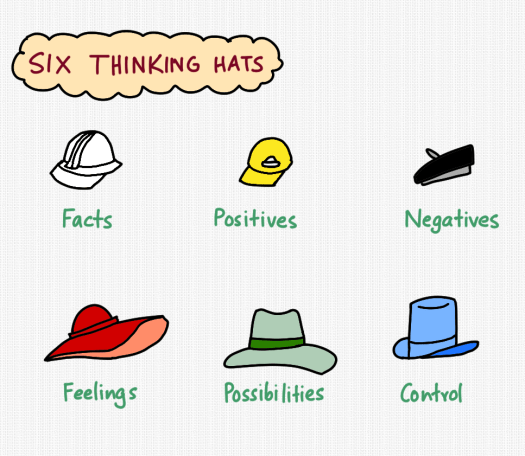
One method, an oldie but probably still a goodie, is Edward de Bono’s Six Thinking Hats.

The idea here is that you give someone the blue hat – that person is in charge of keeping things going and managing a meeting.

That person starts by asking everyone to put on white hats – they’re going to think about the facts in the situation – the hard things that we know to be true.

The hat up there is supposed to be a hard hat, by the way.

Then, you put on your yellow hat, and think about all the positives – the ways this could go well and the benefits you could get.

This hat is a backwards baseball cap, in case you’re wondering.

Hopefully the hats get easier to recognise from now on…

Then, rip the idea to shreds, talk about all the things that can go wrong.

Put on your black beret of defiance, your anti-establishment symbol and find all the ways this can fail.

Then, get the red hat on and talk about feelings, your emotions about the situation.

And then get creative with your green hat – what are all the ways you could adapt, change, innovate to make things happen.

Now, this hat process is a pretty good way to shift perspectives.

I remember doing it years ago, and thought it brought out some good ideas.

That really didn’t go anywhere after that.

That’s one issue with these kinds of facilitation methods – unless you have a “what next?” process that leads on from a session like this, you’ll have a good meeting and feel very enthusiastic, but not much gets done to change things.

But the basic idea is sound.

When you look at the same thing in a different way, you’ll spot new things, things you wouldn’t have seen with the old view.

This is why What You See Is What You Get (WYSIWYG) tools are perhaps bad for creativity.

Maybe it’s a good thing to write a first draft by hand on paper – so that your typewritten copy is a fresh perspective on the same thing.

I like doing stuff on the command line for that reason – there is a difference between what I put down and what emerges – and that is a useful shift in perspective as you go from creative to critical mode.

Like most things in life that are important – this issue of perspectives is something that is not obvious to everyone – perhaps it comes later in life after you’ve had some experience of how the real world works.

But if you ever wonder why people don’t seem to understand you or what you’re trying to say, stop for a bit.

And spend a little time trying to understand their perspective on things.

Cheers,

Karthik Suresh
Have We Made Things Worse By Making Them Better?

refurb-then-recycle.png

Thursday, 9.58pm

Sheffield, U.K.

Reducing and reusing take nothing more than a rethink on the way we shop, and using our imagination with the things that we might once have considered junk. – Sheherazade Goldsmith

You will probably conclude that I have too much time on my hands after reading this.

As you are aware, it’s difficult to go places these days.

So, I spend some time sorting through the piles of paper that have accumulated everywhere.

Most of which have to do with notes that I’ve taken over time.

Over the years I have probably had more than my fair share of time obsessing over note taking.

This could turn into a very long post if we start discussing the merits of bound books versus loose paper.

Pros, cons and angst await us in those debates.

But I had a simpler question.

What was I to do with all this paper?

Do I just throw it out? Put it in the recycling? Shred it?

Here’s the thing, we don’t really think too much about paper, do we?

It’s so easy now to get hold of stuff we want.

Paper comes in reams and books and we fill it and put it in files and piles and pretty soon it’s everywhere.

More comes through the letterbox every day, folded inside other pieces of folded paper.

And we’re too busy to deal with it so it goes onto a surface awaiting dispatch into a recycling bin.

Now the paper that you’ve written on – do you use both sides?

I often write only on one side and lots of printed material also just uses the one side.

And you feel like you should hold onto it – you might need it in the future, and throwing it away seems so final.

What should you do?

Some time back I went to a dinner and met a person who refurbishes computers.

That seems like such a sensible thing to do – many people replace their hardware every three or so years, but there’s still lots of life left in those machines.

I’m writing this on a seven year old machine, I think, and there’s a functioning Macbook in my collection from 2009.

Running GNU/Linux, of course…

Can we refurbish paper?

Well, I am – and here’s how.

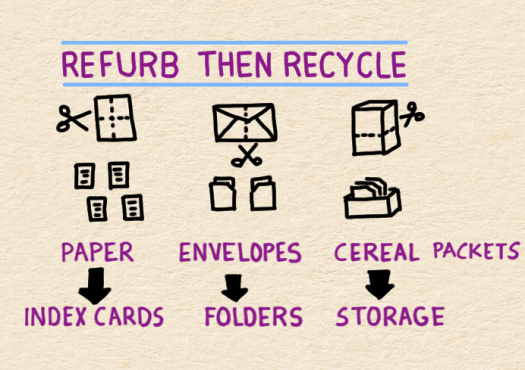
We happen to have one of those paper cutting things – and so all the sheets of paper that I find with one side still usable get cut up into A6 sheets.

All of a sudden you have index cards – for free.

Now, the economics are nothing to sniff at…

An index card costs around 3p.

If you use them a lot – say to write a book, you’ll probably end up using a few thousand cards.

£30, you say, that’s not very much.

But it adds up – and remember, you haven’t had to cut down any more trees.

Then there are the envelopes that come through the door stuffed with bills and junk mail.

I used to just toss these.

Now, I open them carefully and cut them in half.

And you have little folders for your index cards.

Label them, put a few sheets in and you have a nice organisation system building up.

But where do you put those folders?

In the box you get when you trim a cereal packet to size, of course.

Now, you might think that this is all a huge waste of time – but actually there are a few points to consider.

Everything that I’m using has been created for one purpose.

I suppose I’m not really refurbishing them, unless you count erasing marks in pencil, more repurposing them.

But by doing that they are extending their use – and I’m using fewer resources and getting more value out of the junk and packaging that we get anyway.

Now, the point I’m making really, is that we have gone to huge efforts to make things better.

In our efforts to go paperless we use huge amounts of energy to keep data alive in servers forever.

We believe that we’re doing good by recycling everything as fast as possible, when perhaps we could do even more good by reusing them first.

Even junk mail has its uses.

Many paper based systems work pretty well actually – the reason we move them to digital is not to be more effective but to get more control.

That may be a debate for another time…

We have such effective methods of production – everything is just so much better and there’s no shortage of stuff.

But would we be better off if we just used things for longer?

Is there anything you could do to reuse the things around you before you recycle them?

Cheers,

Karthik Suresh

What Should You Focus On When Trying To Get Your Job Done?

doing-a-good-job.png

Wednesday, 9.23pm

Sheffield, U.K.

God grant me the serenity to accept the things I cannot change, courage to change the things I can, and wisdom to know the difference. – the Serenity Prayer, Reinhold Niebuhr

My surprisingly slim copy of A practical handbook for the actor popped through the letterbox today – which I ordered after reading about David Mamet and his technique of Practical Aesthetics.

I’m probably going to write about the technique another day but today I want to focus on the first chapter – the job of the actor.

Now, I’m not an actor and never will be – but it feels like there is a lot to learn from the profession.

You’ve probably heard the quip that goes something like – the hardest thing to achieve is sincerity. Once you can fake that, you’ve got it made.

And an actor has to make you believe that she is really feeling the way she appears – because a good performance makes you believe that it’s real.

Now, if you’re a salesperson, you might think that what this means is that it’s all about the appearance – after all, that’s what you see.

It’s the outer thing that’s on show.

But what the writers in the handbook remind you is that what creates the appearance on the outside is what happens on the inside.

The actor has skills, knowledge – a craft that he develops and hones over time.

And you can only do that by focusing on the things that are in your control.

Say you were to list them out for your profession, what would you have?

Well, you’d probably have tools and materials – paper, a computer, machinery.

And you’d have to spend time practising using those tools.

To get better, you need feedback – you need to reflect on what you’re doing and try and see what’s going well and what’s not.

And where it isn’t going well you need to dig into books and find teachers – learn how to do it better.

All these things are under your control and you can do something about them.

What you can’t do is control how people react.

I saw a news article today about a Chinese artist who makes little sculptures using insect parts.

Grim? Cool? Pointless?

You may have a view.

Sometimes you just can’t avoid bad luck – you might have a good thing but be in the wrong place at the wrong time.

That’s often a fate that inventors have suffered – being too ahead of their time.

There are two more things on my list that may surprise you.

I think you should treat success and failure just the same.

They are emergent outcomes from the things that are in your control.

If you are successful, remember that you could have been lucky.

If you fail, remember that you might have been unlucky.

And get back to work because that is the only truth.

And I think you should pay very little attention to critics and their ratings.

Especially if those critics don’t actually do anything themselves.

You should probably be open to feedback on the lines of, “I didn’t like what you made and I wouldn’t pay for it.”

Okay, but is that person the kind of person you made this thing for?

There is very little point talking to people who think you’re wrong.

Find people who think you’re right and sell to them.

Or find people on the fence and talk to them – see if you can get them over to your side.

Leave the haters alone.

You cannot satisfy everyone. Don’t try.

One thing to note is that I put practising down before reflecting and learning.

Starting with learning is much less useful than you might think.

When you try and do something with little or no knowledge, then you have a beginner’s mind and you can see how things go wrong.

For example, I’ve was thinking about setting up an overhead camera to record videos of work in progress.

I looked at a few examples of what was out there – and was put off by the cost of the specialist tripods you needed and the materials required for a DIY project.

So I mused about it for a while, obsessing a little.

And now I have one built from a Pringles can filled with play sand, some kindling wood, brown wrapping tape and an old cooking scale weight as a counterbalance, some French magnets and a couple of weird bent metal things.

It’s not perfect – but it’s free, built from junk and it does something useful.

You know what – I’m going to show you what it helped me do – just wait while I upload my very first video – a Hello World attempt.

Here you go.

Now, things can only get better if I keep practising, reflecting and learning.

One hopes.

Cheers,

Karthik Suresh

How Do You Tell If What You Do Could Be Useful To Someone Else?

cross-purposes.png

Tuesday, 9.19pm

Sheffield, U.K.

More than 99.99% of facts are not and will never be useful to even a single person. – Mokokoma Mokhonoana

A few days back I wrote about a video by Larry McEnerney from the University of Chicago, in which he also introduced a model about writing which has wide applications for people in business.

If you’re a professional with some experience you have no doubt come across the following situation.

You’re in a meeting or giving a presentation and you give it your all – you talk about your experience and what you’ve learned and really set out a good argument.

And it falls flat.

Your audience sits there, with polite incomprehension – or worse, they misunderstand what you’ve said.

Why does this happen?

You followed the rules – perhaps you had no words on your presentation, only images.

Maybe you made sure everything was 18 point font or greater.

You used short, old words.

You made sure that you didn’t start sentences with “and” or “because”.

And they still didn’t get it.

What comes first, the rule or the result?

Robert Pirsig, in his book Zen and the art of motorcycle maintenance talks about the strange world of critics and rules.

When artists paint, when writers write – do they follow rules, do they remember their grammar?

Or do they write – pour out their passion – and are the rules created afterwards to try and capture what they did?

It’s a strange thing but you can write like Shakespeare and never really be like Shakespeare.

These days if you tried to compose things like a 16th century bard you’d probably be laughed at, or worse, ignored.

Think of a business person you admire – did they become successful by following rules?

Yes, you can see what they achieved and describe what they did – but did they knowingly use those ways when they were busily building their business?

The chances are that they didn’t.

Some people do.

And some of us watch – and paste on the rules later.

Oddly enough, rules can be of very little use in real life.

What is your relationship with the world?

The thing with writers is that we often use writing as a way to think about the world.

Writing is a way for us to work through our own thoughts – a way to find out what we think.

Few people sit down and simply type out a fully formed idea.

Just like few people walk into their office and create a fully formed business.

Let’s say you run a marketing agency – you’re probably thinking every day about how to differentiate yourself, how to stand out, how to show clients how you’re different.

And this takes experimenting – trying out different approaches, partnering with people who have skills you don’t and creating propositions that you can put to prospects.

In a sense, you’re using the container of your business to figure out what niche in the world it can occupy – just like a writer uses the container of text to think about the world.

Imagine all those streams of thought moving in lines away from you, embedding themselves in the world.

Are your consumers thinking the same way?

McEnerney’s point in his video is about how the relationship writers have with the world is very different from the relationship readers have with the world.

At the intersection of the writer and reader is the text – the dots that you’ve created.

At the intersection of the creator and consumer is the business you’ve created.

You’ve used your writing to think about the world.

The reader reads your writing to learn about the world – or perhaps be entertained – maybe both.

Imagine the reader’s desires radiating down towards the world – these are what your text or business have to satisfy.

So, although you’ve created your thing to help you, you need to make it in a way so it helps your consumer.

And this is harder to do than it sounds – because it’s very hard to get out of your own head and see the world from someone else’s point of view.

Are you listening?

And to do that there is one simple thing you have to learn to do – learn to listen.

Many people believe that if they come up with a good idea the market will rise up in applause and give them money.

If you know anything about the future, you know it’s hard to predict.

The one certainty you have is the past – which is why many ancient cultures looked back for wisdom.

The future will arrive… and you will probably be surprised when it does.

After all, how many people predicted we’d have a global lockdown this month?

But if you take the time to listen to your consumer, to ask questions and explore what they have done, then you will learn more about what they will do than you realise.

And that’s because past behaviour is a much more reliable predictor of future behaviour than statements about the future.

If you ask someone if they like your product – it costs them nothing to say yes and avoid hurting your feelings.

If you ask them whether they have bought a product like yours in the past – that tells you a lot more about their willingness to put their hands in their pocket.

If you want to be useful, try to understand what your consumers are in the habit of doing – and then help them do more of that.

If it’s good for them, of course…

Cheers,

Karthik Suresh

How To Design Your Startup For The Lowest Stress Experience

perfect-startup.png

Monday, 9.06pm

Sheffield, U.K.

Our copycats are script kiddie scum who hijack all our keywords with their half functioning monstrosities. — email from a founder somewhat frustrated by knockoffs – Paul Graham on Twitter

I thought I might do a quick post on how startups figure out how to share their equity – but after a very quick search I got bored.

The basic point is that if you need money then you might be in the wrong place.

Let me explain.

There are certain ideas that need money to become real – you need cash to hire people to do the things you don’t know how to do, and then hire more people to sell the thing you haven’t made to people you don’t know and hire even more people to count the money you’re not making because no one wants to pay for the thing the people who gave you money paid to make.

Now, every once in a while a business that follows this model makes a success of it but you’d have to be very talented or lucky to spot them at the beginning.

So, for the rest of us, perhaps it makes sense to be more conservative.

But what would that look like?

First, relieve pain

A good business solves something that a customer needs solving.

Not something that, if solved, would be better for them – but something that actually needs solving.

For example, it’s probably better to be in a situation where you are selling a person with a cut knee a band-aid than the same person hair lotion.

You could argue that the person needs the lotion, although they might have a different view.

But you’ll probably have the same view about the cut and the need to cover it.

I read somewhere that a person found it easier to think about his child’s hurt feelings if he visualised them as a physical injury – a cut – and so respond with compassion.

That visualisation will probably work in business as well – is what you’re solving the equivalent of a cut or the equivalent of a pat on the back?

Find the pain – that’s where the sales are.

Build something with low marginal cost

Every once in a while you’ll come across an opportunity that’s low cost.

Starting a market stall, for example, or selling things online.

The thing that matters, however, is not low cost, but how much more it’s going to cost you.

For example, if you’ve spent £200,000 on your education then building a service around that is pretty low cost – you’ve already invested in the intellectual property that matters.

That’s the reason why lots of manufacturers can make face masks so quickly right now – the cost of repurposing machinery that makes shapes out of plastic is low compared to the initial cost of the machinery in the first place.

When you leverage existing capability – when you build on what you already have then the business creation journey is like a gentle walk uphill rather than a torturous ascent up a steep cliff.

Do something that builds on what you’ve done already.

Focus on making what you do hard to copy

If there is one rule you should follow when creating your service or product – it’s this one.

Make yourself inimitable – hard to imitate.

That’s because if you come up with a great idea that you can’t protect with a patent or copyright – or if you can’t afford to enforce your rights – then people will copy what you do and they’ll do it quickly, especially if it’s selling well.

And on the Internet, it’s hard to keep a secret.

Which is why you have to find a way to make your thing about you, in a very personal, very special way.

And actually this is easier to do than it sounds.

What you’ve got to do is combine things – like Scott Adams says about his creation of Dilbert.

Everyone can write, some people are funny, some people draw, and some people know about engineers and businesses.

But Scott Adams is one of very few people who can combine all those things.

And now anyone else who does it will simply be seen as someone who is copying Adams.

The perfect startup is perfect for You

When it comes down to it, there are lots of ways to make money.

But if you want to go down the route of creating something new, something like a startup, whether inside or outside a business – then what matters is not the share you give, the money you raise, or the product you build.

It’s whether it works for you.

Some people think that creating the next Facebook is the only kind of business model worth pursuing.

Most of those people will fail.

But there are millions of people quietly working away, creating significant businesses that do one simple thing.

Take away your pain.

Cheers,

Karthik Suresh

How To Create A Purpose For Your Content When You Have To

purpose-of-content.png

Saturday, 9.34pm

Sheffield, U.K.

God Almighty first planted a garden. And indeed, it is the purest of human pleasures. – Francis Bacon

When we are busy we miss most of life – and that is probably becoming clearer to us now as we stay home at this unique time.

Like most parents with young children the weekends were filled rushing from class to class – activity to activity.

And now, there is nothing to do.

Over the last four years that rushing, that incessant activity, has been the norm for everything in life.

For example, although I’ve tried to write every day for the last few years and managed to do so for around 250 days a year – doing it has been like looking out of a window on a train.

The landscape moves past and you spot a lake here, a tree there, a bird flashing by – ideas that catch your attention and then they are gone and you wait for the next one.

At some point, though, you start to think about what is the point – why are you doing this?

For me, it’s been about learning and documenting that learning in these posts.

I am my own audience and if what I put down helps someone else that’s good – but it’s not the purpose of why I write.

But what if you want to write for others – if you want to create something that’s of use to others – how should you think?

As I’ve thought about these ideas I’ve looked at how creators who do this well have developed their skills.

We’re incredibly lucky to be able to see the journeys people take over years and catch up with them in hours.

For example, the Verbal to Visual project by Doug Neill has five years of videos that you can go through to see how his skills and focus have developed over the years.

And in one of those videos Doug talked about what you want from your content – and this is a useful model when you want to create material for other people, not just yourself.

There are three things you need to get clear before you start.

The first is the idea – what is it you’re trying to get across?

On LinkedIn I saw a post from a person who sells double glazing – an industry with a reputation for hard sales and sharp practice.

This chap decided he would do things differently – he created videos and talked about the business – trying to shine a light and show how you could do things well.

His audience? Well, presumably they are people with windows – and Windows.

I can’t think of anyone else who has popped up on my LinkedIn feed with that particular business – and I’d probably be tempted to ask for a quote given he’s connected to people I trust.

And that’s the outcome he’d hope for.

I think it’s easy to think that what you do cannot be easily boiled down to these three elements.

For example, if you are a consultant or a designer – it’s tempting to think that everyone could be a customer.

Surely you can help any size of business or create any kind of design material?

But it helps to focus, to be clear on exactly who is going to be interested in what you’re selling – why they need it and what you need to do to get them to buy.

Now, you don’t always have to have a purpose.

Looking for new ideas is as important as developing the ones you have.

It’s a little like gardening.

Today, we looked out of the window and saw that the Forget-me-nots had taken over the garden.

I don’t know how you can forget them – I suppose that’s the point.

So, we pulled out some, enough to give the other plants some room – and now you can see a variety of colours rather than a sea of blue.

When you’re learning you need to be open to as much as possible.

And, at some point, you need to curate that learning, create a garden where you decide what you’re going to have, and where, and why.

Perhaps then, you get to a stage where you create a garden that others can enjoy – a space for them to sit and experience what you’ve designed and brought to life.

I wonder whether it’s only possible to be that way when you slow down and you have the time – the time to get a broom and clear the path, the time to pull out weeds and take out the dead plants and put in new ones.

Being in a hurry, paradoxically, can mean you are too busy to develop a sense of purpose.

If you want to do that you have to slow down, to take care – to take your time.

Give your ideas the time and space to grow – and you might one day create a body of content that has purpose.

Cheers,

Karthik Suresh

Who Is It That You Are Doing Your Work For?

whos-at-the-centre.png

Friday, 9.19pm

Sheffield, U.K.

‘Are you offering to teach me something?’

‘Teach? No,’said Granny. ‘Ain’t got the patience for teaching. But I might let you learn.’ – Maskerade by Terry Pratchett

Who is at the centre of your work – who is it that you do your work for?

This is actually not the easiest thing to figure out, because we have a habit of fooling ourselves.

There are three choices that come to mind.

First, you’re doing what you’re doing for a client, like building a new system.

You might be doing something for yourself, such as creating a work of art.

Or you’re doing something for someone in a position of power – your boss or an official.

And depending on who is at the centre of your endeavour, you’ll create different structures and ways of doing things.

A good example is to look at how schools work.

Are they designed to give kids the education they need?

Or are they a way to give teachers a job?

Or are they a way for the government to demonstrate its investment in education?

It could be any of the three to different people in different situations associated with the delivery of teaching to children.

Now what happens is that you create a structure to make the person at the centre happy.

If the person at the centre is the minister for education who needs statistics on how well all the schools are doing – then you’ll find that managers will focus on metrics that can be measured and ask teachers to teach those things.

The kids might not enjoy those things, but they’re not the ones that matter in this system.

Some teachers will still persist in the belief that their real clients are the kids, but they still have to deal with the metrics and stats if they want to keep their jobs.

So they follow a two track system, teaching to the test and also trying to teach their children something useful.

This is not something new.

I remember a teacher of mine telling a story of a teacher of his decades ago.

Apparently this teacher spent the first few weeks of the term getting the children to copy down everything they needed to pass the tests.

And then he said it was time to get an education, and they started doing useful and interesting stuff that they enjoyed learning.

I suppose the thing is that you always have to look at the incentive, look for who benefits and how to see why things work the way they do.

Most people in businesses are focused on keeping their bosses happy, not their customers.

We write marketing material to keep people inside the business happy rather than for prospects who have questions they want the copy to answer.

Now, when you want to try and change the conversation, you talk about a “something” centered approach.

A client centered approach, a child centered approach.

But how much of that is talk and how much is reality?

Some of it comes down to the difference between learning and teaching.

Teaching is something you do to someone else – it’s probably something you get paid for.

Learning is something people do for themselves, and sometimes they seek out a teacher.

How do you become the kind of teacher people seek out?

Probably the same way you create a service that people seek out, or a business that customers seek out.

By putting them at the centre of your work.

And that is a very hard thing to do.

Cheers,

Karthik Suresh

Why You Have To Understand How Our Models Of Knowledge Have Changed

knowledge.png

Thursday, 7.26pm

Sheffield, U.K.

Postmodernism was a reaction to modernism. Where modernism was about objectivity, postmodernism was about subjectivity. Where modernism sought a singular truth, postmodernism sought the multiplicity of truths. – Miguel Syjuco

How do you sell a pen to someone?

You’ll remember something like this in The Wolf Of Wall Street.

The chap the film is about, Jordan Belfort, built his reputation on his skill at telephone sales back when telephones were a thing.

And he still teaches how to sell these days – it’s the way that the books teach you how to do it and it’s the way many trainers set out their material.

The video I was watching yesterday of Larry McEnerney from the University of Chicago described a few models of knowledge that are worth knowing about.

One form of knowledge is believing that what you know is right.

For example, if you write a business plan or a sales letter – you believe that what’s in there is correct.

If someone doesn’t agree with you, then you feel the need to explain yourself – defend your position.

In this model you’re right because you know what you know.

Maybe you’ve created a new system, a different way to do something, an improvement on a method – this must be good, right?

Well, it is in a positivist system, one where there is objective truth and you’ve just found it.

You’re told by people who think this way that you have to believe in your product – you have to have a kind of missionary zeal.

You must believe, if you are to sell.

Another form of knowledge is believing that you get the big picture – and know you’ve found a gap.

All this stuff exists and you know about it – you know what the problems are and so you can see a space where you can create a product.

But sometimes spaces exist because there is nothing of value in that space.

This kind of thing assumes that knowledge is bounded – you can put a box around it and see what is not there.

Both these approaches are at the heart of the way we’re taught to express ourselves for much of our lives.

You’ve created something new or spotted a gap in the market – well then, you must have a business.

You must have found something useful.

Well… not exactly.

A more current model of knowledge – a post-modern version – is one that’s based around the idea that knowledge is what people who should know agree is knowledge.

Knowledge emerges from the interactions of a community – and sometimes they accept new ideas and sometimes they discard old ones – and all the time they decide what is right and wrong.

That’s right – it’s not objective truth but the subjective views of people that create the truth.

What does that mean in practice?

It means that if you try and sell someone an idea because you think it’s a good, new one, or because you think there is a gap in the market you’ll often find that the majority of people back away from you.

And that’s because their world is created by the voices of their community – the people in the business they work with, the managers, the leaders.

And before you can effectively sell to them you need to know what they are saying.

You have to start by listening – not by selling.

It’s only by listening that you’ll start to see how the people you’re selling to see the world.

And when you do that you can appreciate their point of view – and then add your contribution.

If you acknowledge what they know, show that you have listened and you care – then they might be willing to give you a change and listen to you in turn.

We live in a world that’s increasingly a collection of communities, of tribes, each creating their own knowledge worlds.

If you’re not in that world, you’re a tourist – so don’t expect to be taken seriously until you make an effort to integrate.

And that starts by being willing to listen.

Cheers,

Karthik Suresh

Why Does Your Copy Fail Even If It’s Clear, Organised And Persuasive?

valuable.png

Wednesday, 9.23pm

Sheffield, U.K.

It is my practice to try to understand how valuable something is by trying to imagine myself without it. – Herb Kelleher

I was reminded recently on Twitter about the concept of semantic line feeds, something that I wrote about here some time back.

It’s an almost unknown concept – certainly to people who write using Microsoft Word or any other WYSIWYG tool.

Which got me thinking about tools and their impact on what we do.

Let’s say you’ve spent your life so far working in a certain way using certain tools – it’s hard to imagine any other way of doing things.

It’s the way you’re used to working – it’s familiar.

To someone used to a Windows PC or a Mac – the idea that you could be far more productive using a terminal and command line just sounds weird.

How is that possible – are you talking about that DOS kind of thing?

Surely it’s easier to do things using modern tools?

That “surely” is a trap, as the philosopher Daniel Dennett points out – it tells you someone is trying to slide something past you that they don’t know for certain.

So, I can tell you with certainty that you will be orders of magnitude more productive if you learn to use a command line.

But that isn’t the point of this post.

The point is that I thought I would write about technique – because of how the global lockdown is affecting the way I write.

I’m using paper more, mainly because if I use a screen the small people in the house complain and want their own screen time.

But if you sit down and write using a pencil and paper they go away and hide in case you ask them to do the same.

And I’ve re-realised that doing a first draft on paper and then typing it up seems to result in better prose – the editing process works.

But you knew that.

And so did Google, it appears, because it brought up a video on my YouTube feed of Larry McEnerney from the University of Chicago talking about how to write more effectively.

That’s several hours that I now need to set aside – but from what I’ve seen so far there are a few gems that we would do well to internalise.

Let’s say you’re writing some sales copy – what is it that matters?

Is it that it’s clear? Organised? Persuasive?

“No,” says Larry. It needs to be valuable.

And he has a formula to memorise.

The opposite of valuable is useless. So remember:

  • Clear x Useless = Useless
  • Organised x Useless = Useless
  • Persuasive x Useless = Useless

If something is useless, it acts like a zero in a multiplication.

However good your technique, whether you write on paper or on a computer, on the command line or using Word, with semantic line feeds or plain old paragraphing – if what you’re writing is useless no amount of technique will make it anything else.

What makes something valuable, McEnerney explains, is not what we think.

We might think that value exists in the world out there.

It doesn’t.

You might think value resides in your text.

It doesn’t.

Value exists in the minds of readers.

And this should make you stop and ask, “Which readers?”

Not all readers are going to think what you do is valuable – but you’re writing for the ones who will.

So you should always start by getting a clear idea of your audience – who are you writing for?

Then, if you write poorly, your readers will first slow down and re-read your piece, then start to misunderstand your points and then get frustrated and then stop.

They’ll do all four only if they have to, of course.

If they don’t like what you’re writing and don’t need to read it they’ll jump straight to stopping.

Now, it’s not possible to summarise a whole course in a short post – and I have a lot left to learn.

But here’s the point to take away.

From now on, when you write a piece of copy, come up with a new business idea, hit on a better way to do something – imagine a person you’re trying to sell this idea to.

This person is not interested in why you think what you think.

They don’t want a detailed explanation from you – they don’t want to know what the inside of your head looks like.

What they want to know is: “Why should I think the way you want me to?”

And your response should make them think to themselves: “Because it’s valuable to me!”

Cheers,

Karthik Suresh

How Do You Learn What Is Worth Knowing?

sutra.png

Tuesday, 9.09pm

Sheffield, U.K.

Exclusively of the abstract sciences, the largest and worthiest portion of our knowledge consists of aphorisms: and the greatest and best of men is but an aphorism. – Samuel Taylor Coleridge

I’ve been trying to explore a particular topic and started on a beginner’s textbook on the subject.

And, as I read and took notes, my eyelids started to feel heavy.

Because it was so… boring.

Which reminded me of Robert Pirsig’s Zen and the art of motorcycle maintenance once again.

Specifically the bit where he talks about what a section from a beginner’s textbook on a subject often looks like.

“Dull, awkward and ugly.”

“That is the romantic face of the classic mode.”

It’s the thing you see – ideas chopped up into parts and served on skewers, imprisoned in their little sections and herded together with bullet points.

I’ve also been thinking about ways of taking notes.

In the Western world you have the idea of a commonplace book, a collection built up by individuals who copied out passages from books they read and wanted to keep.

Then you have a research tool called the Zettelkasten, used by Niklas Luhmann to organise what he learned.

Luhmann put down snippets of ideas on index cards and then organised them with a coding system that kept related information together and cross referenced – helping him write around 60 books.

Ryan Holiday and Robert Greene use approaches that have the same principles at their core – an idea or concept on an index card and all the index cards put in order over time to create the structure of a book.

Now, this idea of a small bit of information on small bits of paper dredged up an old memory.

Manuscripts made from palm leaves have been a feature of the Indian subcontinent for a long time.

But before there was writing knowledge was passed on from teacher to student in the form of sutras – short verses that had to be memorised and recited.

This was codified knowledge, a concept compressed into a verse that could be remembered exactly.

And, like poetry, the rhythm and sound of these verses probably helped the students memorise them.

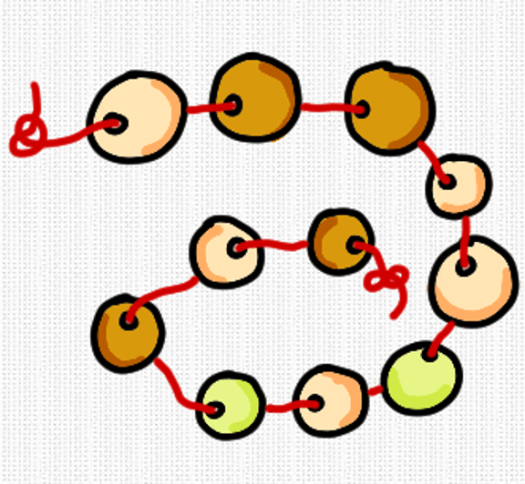
A collection of sutras has the idea, at its root, of a thread – and I like to imagine these as a string of pearls.

There are lots of ideas, some good ones, some great ones, some rubbish ones.

Some ideas are related – and you could pick the best ones and pile them up.

And then you could string them together – and you would have something worth remembering.

I think that is what a good book should do for the reader – show you a string of pearls – a ribbon of ideas that are worth learning and remembering.

And that’s because it’s not the ideas on their own – set out individually that is going to help you.

It’s the story you put together from what you learn, the way in which you practise it for yourself in your own life.

That’s what matters to you.

Now, I suppose it’s asking too much of a textbook to give you that kind of experience.

And, of course, the sutra writers of old got it wrong after a while.

Instead of trying to tell you the great ideas, they focused on getting them shorter and packing more and more in until they ended up as cryptic codes that needed to be explained by someone with more knowledge.

But the idea of a book made from sutras, from aphorisms, is still an appealing one.

It requires a lot more work on the part of the writer to make this happen.

It’s probably easier to get a structure and throw in enough words and then move on to the next project.

But then you get bored readers and how is that a good thing?

Readers read to learn, to understand – and why do they do that?

There is a sutra for that.

“Yogas Chitta Vritti Nirodha” – Yoga is for removing the fluctuations of the mind.

It’s something that’s at the heart of Pirsig’s book too.

We learn for the peace of mind it gives us.

Cheers,

Karthik Suresh