How To Think About Turning What You Do Into A Service

service-model.png

Monday, 8.34pm

Sheffield, U.K.

Yet all really important innovations and changes normally start from tiny minorities of people who do use their creative freedom. – Ernst F. Schumacher, Small Is Beautiful: Economics as if People Mattered

I think the people at McKinsey, the globally renowned management consultancy, often come up with models and ideas worth mulling over.

For example, in a recent article, Oliver Bossert and Driek Desmet explained how tech companies operate.

And that’s worth knowing because your business, whatever it is, will also one day become a tech company.

The energy industry, where I spend most of my time, is not known for the short lifetime of its assets.

Things change slowly, but even here, things are changing.

We have the Internet of Things, real time control and Blockchain all jostling for space alongside venerable fifty-year old wires and meters.

So, how should you prepare for this new tech world – what is the model to try and follow?

The one that’s getting a lot of attention is anything as a service.

Bossert and Desmet explain that tech companies operate platforms.

A platform is a collection of activities and technology that deliver on a business goal.

It’s not enough just to be the expert anymore – you need the tech to help you get the end result.

And you can’t just be a techie with no business or domain experience – you need the business sense to get there too.

So it’s the combination – technology plus people doing activities that get you there.

It doesn’t look like you can get people entirely out of the system – you’ll need some for helping users at least.

The point of a platform is that you can sell that as a service – because what people are paying for is the end result – the business goal that you deliver.

So far so good, but this is where some of us would look down a different path to the one mapped out in the article.

Mainly because it’s geared at big companies that have lots of platforms.

And then the big business mindset kicks in – where you allocate money to the units that do best and you start with big teams and still stay agile.

All of which sounds like really hard work.

If I were you I’d move on at this point and read Getting Real: The smarter, faster, easier way to build a successful web application by the folks at Basecamp.

They argue that you never need more than three people to build the first version of your software.

If you need more then actually what you need is either different people or you need to do less stuff.

And that approach feels much closer to a real lean system to me.

Small groups of people working on things they really care about – something that solves a problem they have right now – those are the people that come up with something useful.

Larger groups tend to come up with something that delivers what you asked for but not what you need.

That’s the thing about business goals.

Many people are very good at shooting their arrow and then drawing the target around where it’s landed.

They’ve hit their goal if you count hitting the bullseye as what you want.

A service, on the other hand, is delivered when the person getting it is happy.

And that is a harder thing to fake.

Cheers,

Karthik Suresh

How Are You Going To Build Your Audience Or Organisation?

social-relations.png

Sunday, 9.14pm

Sheffield, U.K.

We think we are being interesting to others when we are being interesting to ourselves. – Jack Gardner, Words Are Not Things

What makes people use one technology platform and not another?

Why does Wikipedia work while Microsoft Encarta didn’t?

And what can you do to increase the chances of getting people to buy into your ideas?

The common theme behind such questions is our curiosity about other people – about the ways our societies work.

And Clay Shirky, in his book Here comes everybody: How change happens when people come together signposted the work of Alan Page Fiske, who came up with Relational Models Theory – which makes it much easier to think about why people act the way they do.

Once you get past the academic words, that is.

According to Fiske, there are four basic ways in which we relate to others.

The first way has to do with what we share in common.

It’s the shared interest that matters – not the interest itself.

Being someone who likes fine wine and being someone who is racist are the same in this world – where you share those likes with others.

That’s called communal sharing.

Then there’s what we see as normal in the world around us – kings and queens and leaders and dictators.

Whether it’s governments or companies relationships based on hierarchy and authority are all around us.

All that matters is where you are in the pecking order – what’s called authority ranking.

Then there’s another way to be – one where we’re at the same level. Roughly equal, most of the time.

But when somethings gets out of balance we do something to bring things level again – like the relationship you have with your other half or with the kids.

That’s called equality matching.

And finally, you have the market – where what you have is reduced to a share that’s in proportion to what you bring in exchange.

In other words, market pricing.

So, how do these four models help us make sense of things?

Well, you’ll often hear advice about finding your tribe.

Like there are people out there who really like what you like as well and what you need to do is go out there and lead them.

Or make sure that they can find you – make sure everything you do is about making it easier for that group of people to find you and engage with you.

That sounds like communal sharing, at first.

But if you’re trying to lead your tribe – it also sounds like you want to get hold of some authority.

But why would someone support you… unless you were able to redress the balance and give them something they wanted – a helping of equality with a side order of pricing.

So, in reality, these models start to crash together – and it’s likely that there are few “pure” models of any type.

But there are combinations – and that can help you figure out what kind of approach can work for you.

But, at the same time, it’s easier to find examples of how to do this badly.

Take any organisation – and the chances are that you’ll find that the people in charge are really concerned about looking bad.

So concerned, in fact, that they say nothing of any value.

Corporate speak is often devoid of any humanity – excised by lawyers worried about baddies.

But these same organisations want you to share their stories and talk about them and idolise them.

So I suppose you get PR which exists entirely to create stories that no one really cares about.

The real thing that keeps these organisations alive is market pricing – whether they are providing supply to fill demand.

The fact is markets are just about the most effective way to figure out what people want.

And these days what we have is a market for attention – and people pay attention for whatever they find gives them the greatest return on their time – whether it’s cat videos or Latin podcasts.

So when you think about building a community – and an audience or an organisation are really both examples of communities – you need to decide what your social relation mix is going to look like.

Are you going to try and keep control of everything?

Or make it completely free and open – so free that you allow anyone else to take and remix your work for free?

Or, are you going to try and fake it?

Make it look open and communal while keeping all the control?

There are probably examples where all those approaches work – but the last one is perhaps not built on the best foundations.

Take Medium, for example.

Lots of people started writing on Medium because it seemed like they would have larger audiences.

Some have found that that’s not worked out so well – and are moving back to their own platforms because they’ve effectively cannibalised their own traffic.

That’s something you’ll find – once you start giving up control to other people – at some point you’ll find you have no control left.

Paradoxically – that’s when you might also find you’ve got the greatest reach.

The challenge is finding what mix works for the situation you’re in right now.

Cheers,

Karthik Suresh

How Can You Build A Business Model For Intellectual Property?

intellectual-property.png

Saturday, 8.37pm

Sheffield, U.K.

Intellectual property has the shelf life of a banana. – Bill Gates

I’ve been spending more time programming recently – back to the practice of putting code together that does something interesting.

And when you do that you realise just how indispensable the Internet is these days.

Almost every question you ask has been answered by someone who has been there before.

What’s more interesting is that there is little difference between free stuff and the stuff that should be locked away until you pay for it.

Entire textbooks are online – illegally obviously but that doesn’t make them any less there.

Let’s say you’ve gone to the trouble of writing a book – creating all that intellectual property – this is probably not something you want to happen.

One would suppose that the traditional approach is to get very cross about the whole thing and try to stop people pirating your stuff.

After all there are plenty of reports saying that writers don’t make any money and if you want to make a living writing this is not a good thing for you.

At the same time, there’s something else going on.

There’s a lot you can say about the economics of the information business but there’s one thing that stands out.

I can tell you I know a lot about something but there’s no way you can know for sure if I know until I tell you what I know – at which point you know what I know as well so why would you pay me for what I know?

That’s a long sentence but the point is this: knowledge is not like a banana – you can’t look at it and squeeze it and smell it to tell if it’s fresh or rotten.

So this makes it hard to treat intellectual property as the same as something tangible like real estate or gold or oil.

But here’s the thing.

When you’re looking for information you normally go on Amazon and look for reviews – that’s an indicator of whether the thing is good or bad.

But reviews can be bought and lists can be gamed – as every best-selling author on Amazon knows.

And the disappointing thing about many books that are on the lists is what’s in them – they’ve got good ratings but not good content.

There’s a growing movement, however, of people writing books, especially textbooks, and putting them on their sites for free.

That gets rid of the pirates – after all, why would you pirate something that’s already free?

But even with the pirated books the single biggest benefit a reader has is that they can look at the book and judge exactly how good it is – by reading every page.

And then, if you’re like me and you find a good book you want to have it.

Reading the book doesn’t weaken one’s resolve to have access to it and buy it if possible.

Clearly, you’re going to buy the cheapest copy first – possibly second hand for a penny.

And only then head around to the full price version if it’s one of those books that no one wants to part with.

This is still not good news for the authors out there.

They’re not making money from the free copy online or the second hand ones littering the market.

But what they have done is increase their exposure to the market – to people who like what they do enough to support them.

And that’s the thing with intellectual property now.

It’s not enough to claim that the ideas in your head have intrinsic value that deserve payment.

The fact is that by giving it away for free you lose absolutely nothing.

But you gain the interest of people who may start to care about what you do enough to support you not because they have to but because they want to.

And that, perhaps, is the future for the knowledge workers out there.

Cheers,

Karthik Suresh

Where Are We Trying To Position Ourselves In The Market?

good-tech.png

Wednesday, 9.12pm

Sheffield, U.K.

There is nothing either good or bad but thinking makes it so. – William Shakespeare

I’m on a bit of a hunt for blogs that justify my point of view.

Or, better still, blogs that have a point of view I can adopt.

Because the fact is most of us don’t really know what the right thing is to do.

We look to others – searching for clues to the ways in which they approach the world – to see if there are any lessons for us.

And this is an increasingly less diverse process as we are pulled inexorably to the few opinions that surface on Google.

For example, if you’re interested in people who write about technology and marketing in a relatively understandable way you’re pulled pretty quickly in the direction of 37 Signals / Basecamp and Seth Godin.

But then again, you find stuff like the picture above which I’ve adapted from one on Seth’s blog.

Today’s search actually started from a fairly innocuous point – I was wondering about how technology was being used for good.

Unsurprisingly others have thought about that as well – so you get Apps for Good and a grant funding programme called Tech for Good.

Which is perhaps a little too literal interpretation of what I was looking for.

Here’s the thing.

As techies, we get interested in the nuts and bolts of a thing.

Whether it’s useful or not is a side effect of curiosity.

But most people aren’t techies – but they like tasteful things.

For them, what’s important is the Art, with a capital A.

You find Art in good books, fine wines, elegant furniture and inspirational design.

Of course, there is technology in the background, behind the font engines and steam pressed wood, but no one sees it because they are too busy looking at the surface.

But if it isn’t Art – then it’s tacky and that’s junk.

It’s the difference between Lego and something that’s not Lego. It just doesn’t fit.

And of course, a lot of people make a profit by making tech tacky as well.

Think spam and cyber-crime and a bunch of other things the Internet has made it easier to find.

The question we need to ask ourselves, if we sell ourselves on being a business that uses tech, is which side of the tasteful / tacky line we’re on.

You’ve got to think about whether your business model is based on long-term value or short term opportunism.

Because that’s going to drive the way you pitch and present yourself.

You’ll experience this if you have a conversation with a really pushy salesperson who has been taught that the way to win is to keep you on the phone and sell you again and again on what they want regardless of what you say.

If it’s something you really want or need you don’t need the sales call.

You want to buy – and you’ll do it the easiest way you can.

If you don’t then you’re in for a draining conversation.

As someone said, in any sales call, someone ends up selling something.

Either the caller sells you that you need what they want or you sell the caller that you don’t.

In today’s world a pushy sales call is the audio equivalent of spam.

And it’s easy to fall into the trap of doing that because all the models we see of how sales is done emphasise the hard sell.

But the businesses that go the distance are the ones that can do the tasteful sell.

The ones where referrals bring in most of the business because you’ve done the hard work over the years of doing good for your customers.

Because when it comes down to it, we all know what good is.

As Robert M. Pirsig wrote in Zen and the art of motorcycle maintenance “And what is good, Phaedrus, And what is not good – Need we ask anyone to tell us these things?”

Cheers,

Karthik Suresh

How To Turn Your Service Into A Product And Why

product-service-comparison.png

Tuesday, 9.02pm

Sheffield, U.K.

We have our factory, which is called a stage. We make a product, we color it, we title it and we ship it out in cans. – Cary Grant

You learn a lot just by talking to other people.

It’s such a natural thing to do that we often miss just how much is going on.

But there is a lot that goes into sending a message from one person to another and, as a result, a lot that can go wrong.

Which is why selling services is quite a hard thing to do.

When I talk about services I’m thinking particularly of the things that you find hard to explain right now.

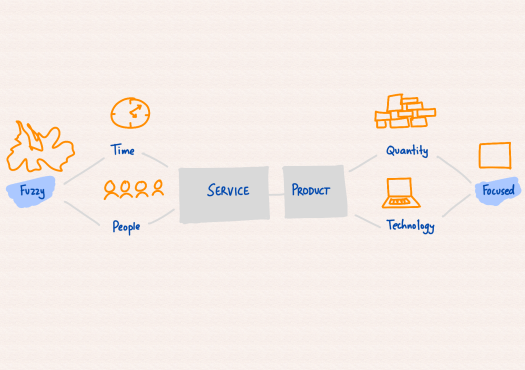
And they’re hard to explain because they might be complex or fuzzy.

If you need to take the time to explain it or solve a problem for a client – then you need to bill for that time.

If you need to provide more service you’ll need to add people with the knowledge to provide that service.

That’s the way a law firm works, for example. They are experts in a particular area and you pay for their expertise in a complex area that you couldn’t manage yourself.

But the problem is that most service businesses make for lousy business models, if you think of them on a time and person basis.

And, if you do something that isn’t already a well known profession, you’ll struggle to explain what you do.

Unless you try and turn it into a product.

The main difference between a product and a service is that a product comes in a box.

Not literally a box, of course, but one that people can visualise and understand.

Describing what you do is then simply a matter of listing what your customer gets from you.

Take the business of financial modelling, for example.

I could tell you that I can help you automate business processes using Excel.

That’s a service. You could employ me and pay me on an hourly basis to work for you.

Or I could tell you that I have an Excel worksheet for a hundred bucks that will help you produce invoices.

You won’t need to pay ongoing subscription charges and it will save you hundreds in bookkeeping and accounting costs – paying for itself in a couple of months.

One description is fuzzy and the other is focused.

You can clearly make money from both.

The service proposition could make thousands with a client who gets what you’re trying to do.

But so could the product – because you could sell a lot more to clients who needed that product.

So why would you choose one over the other?

As always, there is no one correct answer.

Products are easier to understand and buy – so you have a better chance of making a sale to a new prospect if you offer them a product.

Once they know you and understand that you can solve more problems, then they might want your time and expertise as a service.

The thing is when you sell time you run out of supply pretty quickly and also find yourself resenting the hours you’re having to provide.

So even though you could provide a service focusing on products means that you’re selling quantity rather than time.

But these days the only sensible way to do it is to use technology rather than relying on people.

If your product scales by adding people at some point you’ll run into an overheads problem where you need to bring in so much cash to cover fixed costs that it starts getting pretty stressful.

The main point here is that you need to consider your product/service mix as part of your strategy to develop your business.

If you are too much of one or the other – you need to ask yourself whether that’s working for you.

If it is, then don’t change.

If it isn’t, then it’s worth trying to see if you could do better by marketing yourself in the opposite way.

Or, just being practical, using whichever pitch is the one the person in front of you is responding to best.

Cheers,

Karthik Suresh

How To Think About The Value Different People Bring To A Team

iceberg.png

Monday, 10.50pm

Sheffield, U.K.

If I have seen further, it is by standing on the shoulders of giants. – Isaac Newton

I’ve been watching programmes about Fog Creek Software on Amazon Prime recently – one called Make Better Software and the other called Aardvark’d.

They offer a glimpse into how a real software company works – something that most of us never get a chance to see.

They also led me to the blog of the co-founder, Joel Spolsky, and his thoughts on software development.

It’s not really updated these days but given he started writing in 1999 you can’t really get too upset about that.

Especially when you stumble on some quite interesting ideas pretty quickly.

Take this essay on icebergs, for example.

Most of us know bosses and managers who believe that you must have a specification in place before you do anything.

This point of view is not limited to bosses, however.

Many people also say they can do anything you want as long as you tell them exactly what you want.

The problem is that most people don’t know what they want.

What almost everyone can tell you, on the other hand, is what they don’t want.

It’s funny how the things we want to avoid come to mind so much more easily than the things we want to have.

So the smart person, according to Joel, gets that customers will never know what they want.

Instead, you have to build something that they can look at and tell you what they don’t like about it and what they want changing.

Another insight has to do with people on your team.

It’s tempting to think that everyone around you has to do something technical.

But the reality of most businesses is that only one or two people really need to be that technical.

And that’s because once a problem is solved using software or a system is created for a customer the jobs that are really needed are ones that focus on helping them.

If you’re going to build a company, in the beginning you need people who know stuff and can build stuff.

But pretty soon you need people who can bring in customers and keep them happy.

And that’s actually going to be the bulk of your workforce.

It’s tempting to think that you can make lots of money by outsourcing that work to someone else.

But the chances are that’s a mistake – technically and financially.

It’s not going to save you as much as you think and, if you’re going to be a customer, we already know that you don’t know what you want.

The lesson hidden in all this is really that working for someone else is hard to do.

It’s much easier creating a product and saying do you like this.

And you can do that even if you have a job.

You can wait to be told exactly what to do.

Or you can have a go and create something new and then see what the reaction is.

And if you keep doing that one day you’ll make something that the people who make decisions like and you’re on your way to creating a job or a business where you’re in control.

But it all starts with having a go and building something on spec – with the hope that it will be useful to someone else.

Cheers,

Karthik Suresh

Why What You Think Matters Much Less Than You Think It Does

attention.png

Sunday, 9.08pm

Sheffield, U.K.

We tend to be distracted by the voices in our own heads telling us what the design should look like. – Michael Bierut

Everything is a design problem.

The word “design” brings up different pictures for different people.

For some it’s about fashion, look and feel.

For others it’s about thinking and planning and structure.

But the design thinking approach can be used whether you’re trying to solve a business problem, make a website look good or sort out your LinkedIn profile.

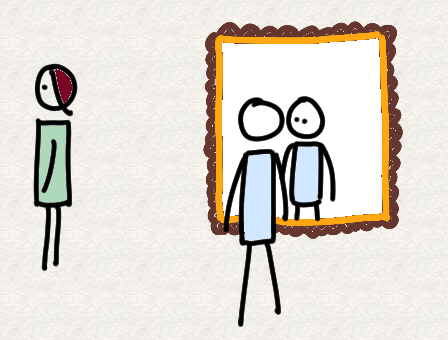
And it starts by realising that no matter how much time you spend looking in the mirror and trying to see how you come across, you won’t get any closer to seeing how your prospective customer sees you without doing some more work.

That work usually takes the form of a conversation – one face to face perhaps, or one that happens using the information and interface you present to your prospects.

Luke Wroblewski, in his book Web form design: Filling in the blanks, calls web forms Brokers, because they talk to customers on your behalf.

You might have thought, until now, that the purpose of a form was to capture information from customers.

It turns out, instead, that they are a way for you to have a conversation without being there – if you design them right.

Wroblewski says that there are principles you should follow.

For example, no one wants to fill in a form, so make it easy to do.

They’re only going to fill it in if it’s worth their time – and it’s up to you to make it completely clear that it is.

And you can only do this well if you really understand what your customer is trying to do.

But at the same time is that actually the case – do you really need to get inside your prospect’s head?

We’re all sold on the idea that Apple devices can just be used – they’re intuitive.

But is anything really intuitive?

Some people argue that when say something is intuitive what we really mean is that it’s familiar – it’s something we know how to do.

So maybe the purpose of design is actually to give people what they expect.

And that gives us a clue as to how the world really works.

For example, the words a prospect uses to search for what you do may not be the same words you use.

So, if you want to be found on LinkedIn, which words should you use?

The answer is pretty obvious, isn’t it?

Some of my friends have learned this lesson better than I have.

They try and understand what the customers they want are looking for and then design their organisation and their communications to be in the right place – to be familiar.

After all, if you are good enough, maybe one day people will find you.

If you go and stand where they go to look you’ll almost certainly be found.

And if you look the part – if you’re familiar – then you’ll probably get the job as well.

You just need to get yourself out of your own way.

Cheers,

Karthik Suresh

How To Use Uncertainty More Effectively In The Real World

uncertainty.png

Progress daily in your own uncertainty. Live in awareness of the questions. – Bremer Acosta, Stoic Practice

Some people are very sure of their place in the world and what they are here to do.

Some of us are less certain.

Certainty is a form of faith – a belief that needs no proof and is just accepted as true.

Which makes it hard to tell whether that faith really is true or if it’s misplaced.

And that makes it uncertain.

You may experience a similar problem when you try and think about how to describe yourself.

Are you where you are right now?

Or are you where you are going?

For example, if you work in an office doing analytical work but you really want to be a musician and spend all your evenings and weekends working on that, are you an analyst or a musician?

The Uncertainty Principle talks about two things – where you are and where you’re going.

And the more you know about one the less you can be certain of the other.

In a quantum world anyway – in a physical sense.

In the real world, the physics stops being an issue but that doesn’t stop us moving the principle into our mental worlds.

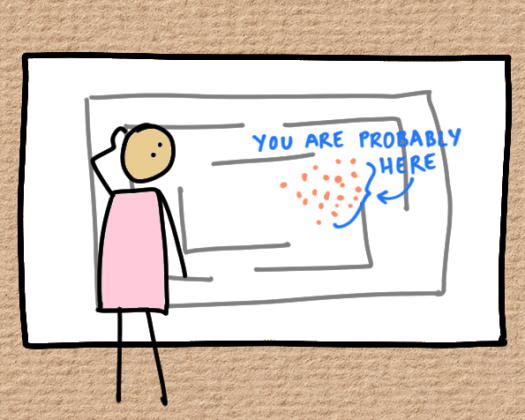
I copied the picture above from a cartoon because it expresses the uncertainty in life pretty well.

We spend most of our days being uncertain.

Uncertain of what customers want, what our partners want and what our pets want.

In business, especially, a lot of work goes into trying to remove uncertainty by making work transactional.

Something transactional can be reduced to the simple act of exchanging something well defined for money – a commodity trade.

And there are good arguments for going that way.

Many markets are opaque, hard to understand and don’t have good information – making it possible for people to take fees for helping you out.

Any market like that is an opportunity for someone who has the ability to open things up by using information.

Of course, that doesn’t remove uncertainty – it just reduces it or, more importantly, reduces the impact it has on you.

Take shopping on Amazon or Ebay for example.

Do you expect to get the best price always?

Or do you stop looking when it appears that what you have is cheap looking at the other options on the screen in front of you?

So what does this mean for you and me – how can you use uncertainty strategically?

First, here’s the bad way.

Many people believe that the way to get ahead is to project an aura of certainty.

That’s a salesperson’s training.

Believe in the product, believe in yourself and the self-talk will make the world bend to your will.

If you’re pitching and someone finds a flaw in your argument plough on regardless – your certainty and determination will get people to buy into you.

The second approach, and perhaps the more strategic one, is to look at the future as a distribution of possibilities.

You are – you have to be uncertain of the outcome.

There’s no other way to exist and be honest about the way things are.

But what you can do is reduce uncertainty – and you do that by combining distributions.

If you’re not into the math that probably doesn’t make any sense but remember what Scott Adams said about why Dilbert, his cartoon series, took off.

He was an average writer, an average artist and knew an average amount about engineering.

A career in each of those fields has a fairly wide probability distribution and his chances of wild success would have been low.

But, when you combined the three, you ended up with a much narrower distribution – how many people write and draw a cartoon strip about engineers?

What he didn’t do was create a niche in writing – for example focusing on science fiction.

He created a category all to himself by combining three normally unrelated things.

And the mathematical term for what this results in is confidence – something that in the real world also works very well.

In a nutshell, making your pitch on your certainty is asking people to believe in you.

Making your pitch on confidence is showing people how you have narrowed the range of possible outcomes.

Which do you think has a better chance of succeeding?

Cheers,

Karthik Suresh

What Are The Keys To Making Lasting Changes In Your Life?

lasting-change.png

Wednesday, 9.09pm

Sheffield, U.K.

Yesterday I was clever, so I wanted to change the world. Today I am wise, so I am changing myself. – Rumi

Management has to be one of the most pointless activities out there.

Who would willingly become a manager?

Become someone who has to watch others doing work and try and get the best out of them?

After all, managing oneself is hard enough without being responsible for other people.

One of the worst ideas in management is that you can’t manage what you can’t measure.

Think of something – anything that is good in the world.

How many of them were “managed” into existence?

Trees? Animals? Your family? Art? Books? Jeans?

A seed doesn’t need to be managed into existence.

You don’t need to measure and report key performance indicators.

Given the right conditions it just grows.

Wouldn’t you rather find the right person that wants to do work you need to get done and let them get on with doing a good job?

Wouldn’t that be preferable to managing them?

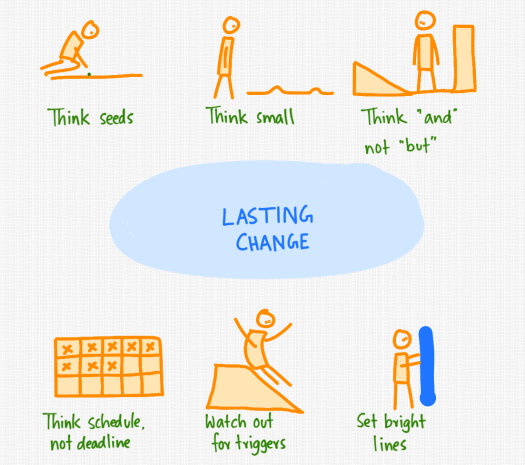
Thinking of life or business like gardening rather than managing may be a good idea.

Your job becomes one of planting seeds and nurturing them, protecting them and letting them grow.

Or, if you’re trying to change, your job is to find the right seed – the right behaviour, approach or strategy that will make a difference.

Then you need to make it ridiculously easy to do – you need to think small.

Big things are too big to keep in your head – too big to fight.

It’s too easy to give up when you have a big challenge.

Like running a marathon when you haven’t jogged in twenty years.

You need to start with something smaller – like walking every day.

And when you change you’re going to fail or not see results as fast as you want.

You could say, “I’ve been training for two weeks but I’m not getting any faster.”

Using the word but stops you in your tracks.

There’s nowhere to go from there.

Or you could say, “I’ve been training for two weeks and I’m not getting any faster.”

Using the word “and” seems unfinished. It feels like the word “yet” is missing from the end of that sentence.

You aren’t faster yet.

But you will be.

As long as you keep showing up.

Thinking is hard work – if you want to change something you have to make it automatic, something you do without thinking.

And the easiest way to do that is put it on a schedule.

If you want to get fit, get your exercise times in the diary.

If you want to create art or write – set time aside every day to do it whether you feel like it or not.

Deadlines are just pressure – they don’t help.

Showing up is what matters.

And then, if you’re trying to change something there is always the risk of sliding back to your old ways.

And it’s easy to do this when you come across an old trigger – something that prompts you to do what you used to do.

For example, if you go shopping hungry you know you’re going to buy some chocolate.

So, watch out – and avoid being in that situation.

Then there are bright line rules – things that are very clear, where there is a yes or no answer.

These are good.

The classic here is dry January – where people decide not to drink all month after the merriment of the month before.

It might not last – but it’s a pretty clear rule.

The thing with change is it’s hard – really hard.

And there isn’t a way to do it without some pain and effort.

But there are ways to make it easier to change something – whether it’s a habit or a process.

But to make it last you need to do it in a way so it doesn’t need ongoing management – so it manages itself.

Because anything that needs to be managed will stop working as soon as that manager stops paying attention.

Cheers,

Karthik Suresh

Why Getting Out Of Your Own Way Is The Key To Creativity

problem-exploring.png

Wrong turns are as important as right turns. More important, sometimes. – Richard Bach

You should never ask someone what they want.

It’s a question you shouldn’t even ask yourself.

Why, you ask?

There are three reasons, wrote Watts S. Humphrey in one of his essays:

First, people find it hard to visualise a solution to their problems, especially if they aren’t professionals in building those kinds of solutions.

Second, they often know how to do their job but not why. So, all they can show you are their existing, often manual, ways of working.

And third, if you do have a solution it could change everything about how they work and mean thinking again about what problem they have.

That’s why most approaches that focus on problem solving end up solving the wrong problem.

It takes multiple attempts to get to something that actually works for you.

As a professional, you come at things from a different point of view.

You’ve seen people experience problems that you’ve solved before, so you know what they need – a very different thing from trying to make what they want.

But that only works when you’ve been there and done it before.

When its something new you’re at the same place as everyone else.

And that’s a place filled with insecurity and angst.

Angst because, if you’re like most people, you worry that this time you won’t succeed – you won’t get it right.

And that’s ok – it’s just something that you have to get past.

But you can only do that if you have a way – a strategy ready for when that happens.

One approach that has had almost no traction is called Literate Programming.

It’s not the easiest thing to explain – but in essence its inventor, the legendary Donald Knuth, said you should first think about what you’re trying to do in plain language and then express it in code.

From that point the whole concept starts going downhill rapidly.

In an attempt to avoid that particular section of slippery slope we should talk about bread.

How would you make a mechanical breadmaker?

You might start by learning how to make bread.

The first time I tried doing that, we were in Italy and I was bored, and making bread seemed like a good idea.

So, I had a go.

It was a fairly angst inducing experience, given that I was guessing that flour and water was involved and had no books or Internet.

I’d forgotten about yeast and a few other ingredients, and the resulting block in the oven felt and tasted like a house brick.

So, I did some research, got a little focused and ended up with an edible loaf.

And it seems to me that any creative endeavour and, let’s face it, everything we do can be creative, needs an approach that lets us explore problems rather than trying to solve them.

If you’re writing a book or a program it makes sense to start by thinking and writing about your hopes and fears and expectations of what the thing will do.

Then you can come back and refine your thoughts, focus your attention and come up with a plan.

The book or program should then almost write itself – the result emerging from the cocoon of thought you’ve built up around it.

It feels sometimes that people are too eager to get to the end – without checking if the end they get to is the one they need to reach.

A little thinking might help – but it’s hard work.

Mainly because we need to admit that we’re unsure and need to look around, ask questions and experience things before coming up with a solution.

But if we do that maybe the result we get will be the one we need.

Cheers,

Karthik Suresh