Old Books And Drawings – Doodles From The Past

manuscript-drawings.png

Artists are just children who refuse to put down their crayons. – Al Hischfeld

Thorpe (2016) is a study of marginal drawings in a special collection of rare books and manuscripts. LJS361 is a 1327 book of tables and sermons that passed from a medieval convent into a place where children had access to it. Drawings in the book, the paper argues, were done by young children – but how can you tell?

It turns out that children draw differently as they get older – something you probably already knew. When little, they draw tadpole figures, a big circle for a head and legs sticking out straight down attached directly to the head. As they get older they start to recognise different body components and draw them separately, so you get a head and a body and arms and legs, possibly stick ones.

As they get older you find an increasing amount of intellectual realism, as they draw features that are detailed and sophisticated, representing elements of what they actually see – resulting in drawings that become visually realistic as well.

Many of us stop drawing too early in life and so we’re stuck at the effective drawing age of 6-10 years. You can tell that your drawing is like this if you struggle to create expressive figures – if your creations are locked into stiff poses. We try and bring out what’s important about the drawing, so we often draw human faces using a frontal view, while we draw horses using a sideways view. With people we like to see expressions but a horse head front on has less information than a sideways representation. Children drawing also like to balance things out, for example in the way they show arms and legs.

There are a number of other specific features discussed in the paper that suggest that drawings were the work of children rather than adults. And it’s a charming look into the play world of children a few hundred years ago – they drew and doodled just like your children do now. The book might have been boring but it was a surface to scribble on and that made the time go by.

Cheers,

Karthik Suresh

References

Thorpe, D.E. (2016), “Young hands, old books: Drawings by children in a fourteenth-century manuscript, LJS MS. 361”, Cogent Arts & Humanities, Vol 3.

What Can Presidential Doodles Tell Us About Republicans And Democrats?

personality.png

Monday, 8.03pm

Sheffield, U.K.

Every now and then, a presidential candidate surprises us with a truly human and honest moment. – Ron Fournier

In the last thirteen or so posts I’ve been looking at people who doodled as they worked. I may have reached the end of this path of enquiry when I stumbled across the book Presidential Doodles by the creators of Cabinet Magazine.

The book had its genesis in an idea to publish doodles by famous people from the 20th century but when found a couple of presidential doodles the compilers couldn’t resist a compilation of the works of “doodlers-in-chiefs”.

The book is amusing, whimsical and has a range of doodles and ways of doodling. It shows how some of the most public people in the world found an outlet for their restless energy while doing a hugely important job. Others were fascinated by the insight these scrawls afforded into the minds of people given the power to make big decisions – and you ended up with a descent into psychography and an attempt to see inside their heads and find “anxieties, issues, neuroses and penchants.”

There is a problem with this, however. It’s just not very interesting. So someone was bored, or listening very carefully – and they let their pen move on the page. Does that tell us anything useful? Did making that scrawl help them in some way – and is there anything we can learn from that?

The one interesting psychological insight on page 204 is that during a meeting a reporter collected doodles made by Republicans and Democrats. All the Republicans had drawn geometric shapes while the Democrats had drawn animals and people’s faces. Does that tell us that conservatives are more likely to be rational and pattern seekers, people that live within rules, while democrats are more empathetic and care about people? Is it possible that asking someone to do a drawing could help you to understand what they’re like – a psychological profile based on the art they make?

I’ve just said the psychology of art is not that interesting, but maybe it is. I do have a book somewhere in my stack about art and therapy. I suppose you’d need to do some research into that – which is something interesting in itself. How could you study something like that?

Now, I do need to step away from this line of enquiry because it isn’t my area of focus or interest. Although it is interesting. I was looking at drawing as an aid to writing and there are fewer examples of people who do that. It looks like there are lots of people who draw to fill the time before writing – but how many use it as a tool – as part of their process? One writer who does in John McPhee and he’s written in Draft No. 4 about how he draws a diagram that captures the structure of the article he’s going to write.

So where should I go from here? I’m going to do one more post on drawings made in old manuscripts and then we’ll change direction and explore a different path.

Not sure which one though.

Cheers,

Karthik Suresh

How To Build And Maintain A New Habit

habit-change.png

Sunday, 7.26pm

Sheffield, U.K.

Sow an act and you reap a habit. Sow a habit and you reap a character. Sow a character and you reap a destiny. – Charles Reade

I was reading Dr Michael Greger’s How not to diet, a big book stuffed with real research insights, and came across a bit on making and keeping habits. The points he makes are so good that I want to record them here to help me remember them later.

We’re getting to that time of year when we look back and reflect on what we’ve done – was it what we planned, was it enough, could we have done more? Should we have done more?

There are a few things that started to converge for me as I read through the literature associated with understanding and insight into situations and what they need. An important theme is the idea of the ledger – the daily record of what has been traded, what has been done or achieved. We can have grand plans but those plans will be achieved or not depending on what we do every day. If you make a profit every day then you can be certain that you will end the year in profit. If you want until the last month to check how you’re doing then you’ll probably be unhappy with what you find.

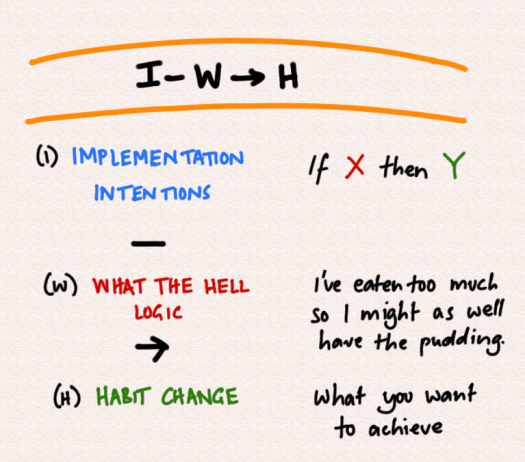
If you want to change something then the first thing to do is decide in advance what you’re going to do when the opportunity to make a choice presents itself. This is called an implementation intention and it’s quite simple. It’s writing down a statement in the form “If this then that.” When I started this blog, for example, my intention was quite simple – to write every day. But life is bigger than one thing. When you focus on one intention others fall by the wayside. While I focused on writing, other things suffered – I spent less time on exercising, eating healthily. A focus on one thing almost always leaves less time for other things.

The way to rebalance is to reset or rewrite your intentions. A way that works for me is to do what is most important first thing in the morning. For years that’s been reading and writing. But some years that was getting exercise. It’s deciding what matters and when you’re going to do it.

The challenge is that it takes a while to rewire yourself – to get a new habit going. Probably a couple of months, if not more. That’s going to be much easier to do if you take the thinking out of it – just create a set of rules that you follow every day.

Which brings us to the second part of the problem – the what the hell theory. This essentially says that once you fail to do something then you tend to give up and don’t see the point in still trying. This is easy to see when it comes to dieting. You may have avoided sugary foods for ages but then you’re in a situation where you just can’t refuse. And once you’ve had more than you should you think, “What the hell…” you’ve already had too much, what difference will a bit more make. So you stuff yourself.

But it does matter – those are still calories you don’t need. The right thing to do is stop but that takes effort.

If you can do these two things – decide in advance how you will act and choose to stop yourself from doubling down when you fail – you’ve got two powerful tools that can help you start and maintain new habits.

Cheers,

Karthik Suresh

Writing As A Way To Work Through Pain

bukowski-style.png

Friday, 8.22pm

Sheffield, U.K.

A book should serve as the ax for the frozen sea within us. – Franz Kafka

I’m writing a set of posts on drawing as a part of writing. A few years ago, at the local library, I picked up a copy of Charles Bukowski on Writing – and it sat on the shelf for a while. I don’t remember much from it but it had doodles – drawings and one of the things I do remember is that Bukowski added drawings to his submissions when he sent it off to attract the attention of the editor.

I looked up Bukowski again for this post and flipped through the first hundred or so pages of Charles Bukowski by Barry Miles. I wish a little that I hadn’t. Bukowski’s early years were grim, an abusive father, an outsider, a child living with daily violence at every place. He was a Nazi sympathizer until war was declared when he got rid of his propaganda. And then life seems to get hard and stay hard, no money, manual work life in low places. Alcoholism. And writing.

Writing is what seems to have saved him or at least sustained him. As a student he turned in 30 stories, all good, when his classmates were asked to turn in two or three. He read everything in the library. He liked Hemingway – and the idea of making something simple, then simpler still, then simpler yet. His writing style was to use simple words, nothing you needed a dictionary to understand, and was all loosely autobiographical.

I flipped through a book and a collection of poems and I find little in there but pain and the process of survival. It’s not a life that anyone should have had but it’s there, it exists, others presumably are living it now. Many years ago I was in a charity bookshop browsing the shelves and a homeless person wandered in. I remember flashes of him now, thick glasses, broken and held together with tape. Cloudy eyes behind them. A dirty green jacket. The smell.

He spoke to me. I wasn’t expecting it but answered and after some chat he pulled out some pages he had been writing and showed them to me. I can’t remember anything about them, not if they were good or bad. But that image, that person without a place with some writing stuffed into his jacket, appears to be the kind of life Bukowski lived and came out from and had some success with later.

The drawing above is in the style of Bukowski – I’ve tried to copy the free flow and sparse lines that he uses. They’re quite similar in look to the drawings of James Thurber and it looks like Bukowski drew hundreds of these but many have been lost over time – he didn’t keep copies of what he mailed out. Drawing for him, it seems, was just as important as writing – perhaps the two worked together.

The one thing to take away from Bukowski’s story is the power of art to free us from our own history.

Cheers,

Karthik Suresh

Sight-Poems As A Genre Of Writing

sight-poem-freedom.png

Tuesday, 7.32pm

Sheffield, U.K.

Only truthful hands write true poems. I cannot see any basic difference between a handshake and a poem. – Paul Celan

I’m reading David Bellos’s book Is that a fish in your ear: The amazing adventure of translation in which he writes (on page 27) about Christian Morgenstern’s German sight-poem “The Fish’s Lullaby”.

This intrigued me – I’d never heard the term “sight-poem” before. So what’s this all about? For starters, here’s the poem.

fishs-lullaby.png

Morgenstern was a German poet (1871-1914) who seems to have written humorous poetry that took aim at mainstream thinking including scholasticism and literary criticism.

The sight-poem seems pretty obvious when you look at it – the title is an important part of appreciating it. It sets an expectation which you bring to your viewing of the marks that follow.

This genre is not, unsurprisingly, a mainstream one. I couldn’t find any papers that talked about “sight-poems” – although I only did a very quick search. This thread has a few mini-essays on the poem and people’s views. These range from thoughts that it’s a gimmick to a radical commentary on what is normal. Maybe it’s something that makes you look from a different point of view.

Albert Waldinger in his 2009 paper “Propositions of wit and memory: ‘Englishing’ Christian Morgenstern (1871-1914) in the light of Paul Kussmaul’s /Kreatives Übersetzen(2000)” talks about the element of humour in Morgenstern’s work, quoting him as saying that its role was to “free man from the hollow and heavy earnestness of a materialistic present.” The “highest wisdom”, Morgenstern says, is the combination of humour and insight.

Over twenty years ago I wrote a poem – I don’t quite remember why. Perhaps it was a way to express what I felt at the time. I can’t remember the words but if I were to create a sight-poem it might look like the one that starts this post. It didn’t feel unnatural and it captures the feeling for me still. For anyone else, of course, it has to be interpreted – either they have to give it meaning or ask for a narrative.

But it does stand on its own as well – sparse marks that show you a story.

Cheers,

Karthik Suresh

Why Doodling During Lessons Is Bad For You

doodling-vs-visual-notes.png

Thursday, 8.25pm

Sheffield, U.K.

I learned how to draw from being bored in school. I would doodle on the margins of my paper. – Kevin Nealon

What is a doodle? According to the OED it’s to “scribble absent-mindedly” and the important part of that is the absence of mind when you’re doodling. But does it help – will you learn better if you doodle in class.

The answer, according to research by Meade, Wammes and Fernandes (2019) is no. If you absent-mindedly draw whatever comes to mind you’ll remember less of whatever you’re supposed to be learning. If you do a structured drawing – something that is like shading a shape – it has no effect. Writing stuff down does help you remember it. Drawing what you’re listening to has a significant effect on memory.

Why does drawing something help us remember it better. Meade et. al. argue that it isn’t fully explained by two theories in use – one that there are Levels of Processing (LOPs) and drawing is at a deeper level, or a Picture Superiority Effect (PSE) which essentially says pictures are better at helping you remember things.

These explanations hang on the idea that you have “attentional resources” – a certain amount of capacity to pay attention to things. If something like drawing random pictures takes up your attention you have less left for the task at hand. If you’re drawing what you’re supposed to be learning in addition to writing about it then you’re concentrating attentional resources – so you should remember it better.

Another explanation is that you’re using more parts of your mind and body when you’re drawing and writing than if you just listened without doing anything. You see, move your hands and draw and get semantic meaning from words – so there’s more going on and that leaves more traces in your brain – sort of like stamping in the idea again and again and again.

If you’re into this world of visual thinking and have read the Sketchnote handbook you’re nodding along and agreeing with this research. An art teacher, Andrew Katz (Katz, 1997), describes how he used to doodle in class and ended up with a bunch of sketches rather than useful notes. He realised that it would make sense to draw what he was listening to instead, killing two birds with one stone. He could enjoy drawing but also get the lesson content in the process. He talked about how this created a shift in his approach to making notes and led to him keeping visual journals.

Now, for a student or a researcher this is interesting stuff. If you haven’t come across this world of visual thinking it may seem strange – why would you put that much effort into drawing and notetaking when you could just read the textbook? The point is that research is showing clear benefits of combining these skills – drawing and writing – for the work we do, whether that’s studying, researching or trying to understand situations in the workplace.

Drawing what you hear can be a learning and productivity superpower. Maybe more people should try it out.

Cheers,

Karthik Suresh

References

Katz, J.A. (1997), “Visual notetaking, drawing on my doodling past”, School Arts, Vol 97, Issue 1.

Meade, M.E., Wammes, D.J., and Fernandes, M.A. (2019), “Comparing the influence of doodling, drawing and writing at encoding on memory”, Canadian Journal of Experimental Psychology, Vol. 73, No. 1, pp 28-36

How Squiggles Can Help You Realize What’s Significant

sqiggle-game-1.png

Wednesday, 7.36pm

Sheffield, U.K.

All psychological research is completely barred by the interpretations of the psychoanalysts. Everything happens in the unconscious, and I don’t know what this unconscious is. – Nathalie Sarraute

Many years ago I read a textbook belonging to a friend that had something to do with psychology or semiotics. As I skimmed through it I experienced some cognitive dissonance – I didn’t understand why all these people kept talking about what other people talked about. There was something like “This person said this, and then this other person said something else, and so this idea was put forward.” For someone trained in the sciences and the idea that you could work things out from first principles this reliance on what people “thought” was bewildering.

Psychoanalysis in this category of study for me because I don’t know anything about it – the Internet tells me it’s a set of theories and techniques that are based on the work of Freud whose big idea was that there’s stuff happening in your unconscious that affects how you feel and act consciously. If you can get at this unconscious material then you can make sense of what’s going on. It sounds like not everyone agrees – but that’s for those experts to consider. I still don’t really get this but I am starting to appreciate that there are things we cannot know through the use of empirical tools, so we need to get better at talking about what we think is going on.

This is what’s interesting about a paper by Lisa Farley (Farley, 2011) where she writes about the work of D.W. Winnicott and the “squiggle game”. The game goes like this. Make a squiggle on a piece of paper and give it to a child and ask them to “make it into anything.” Then do the reverse, get the child to draw something and then make it into something yourself.

Now, I couldn’t resist trying this out so I called over one of the small people in the house, did a squiggle and then handed it over. The small person ignored my drawing and simply drew a smiley face and a house. Fortunately, it sounds like the interpretation of that is he’s happy at home. But what was interesting is that he also insisted that we do the reverse – he drew a picture and had me fill it in. I assume Winnicott also realised that the reciprocity was needed – I’ve done this so now you do it too.

Farley’s argument is that the significance of the doodle game is that it imposes no rules – we don’t start with assumptions or preconditions. The doodle is entirely random. Therefore what the other person superimposes on it is perhaps what’s important to them – something with Farley describes as taking “a detour through the unconscious on the way to becoming significant.” The idea here is that the person’s history is vast and deep but the elements of that history that matter can attach themselves to the squiggle and bring them to the forefront of your attention.

Now – to figure out what it means for someone looking for help is something that you’d need to be a trained professional to do. You can use the picture to have a conversation, maybe it will allow thoughts and ideas that have been repressed to come up so that you can deal with them.

My own interest is in whether these techniques can help us be more creative and innovative – and perhaps that’s something to try out. If you’re stuck in a rut, if you’re trying to figure out a new way to do something and you don’t know where to begin – maybe the thing to do is draw a squiggle. And then make it into something. And do that a few times. The squiggle, Farley argues, is a way of finding “history that eludes intentional or official representation; it is about the complicated relationship between inner and outer realities, between wish and reality…” It’s a way of drawing something out of you that you might not do otherwise.

And that’s a creative tool worth having in your toolbox.

Cheers,

Karthik Suresh

References

Farley, L. (2011), “Squiggle evidence: The child, the canvas, and the ‘Negative Labor’ of history”, History and Memory, Vol. 23, No. 2, pp 5-39.

Rock Art And Telling Your Story

rock-art-and-story.png

Tuesday, 9.04pm

Sheffield, U.K.

All art, from the paintings on the walls of cave dwellers to art created today, is autobiographical because it comes from the secret place in the soul where imagination resides. – Gloria Vanderbilt

We watch a film for an hour and a half and then walk away, often never to watch it again. But we’re missing out on something. It seems that the films of today are a way to explore the history and the future of humanity, but we are going to have to watch them more than once to get the messages in there.

Yuval Noah Harari talks about this in his book 21 lessons for the 21st century. Take the film Inside Out for example. On the surface it’s a story about feelings and how we need all of them to live a full life. But Harari also points out that most people missed the unsettling message at the core of the movie – that we are effectively giant robots that carry out the orders of the emotional signals surging within us.

Recently we saw The Croods and again on the surface it’s a story about a family trying to survive, what they mean to each other and a father trying to stay relevant in a changing world, sticking to what he was taught while slowly coming to terms with the fact that what he knows is not enough for what is happening now.

But you need to watch out for the detail in the film as well. There’s a scene where the father, Grug, scoops up some mud and paints a picture. I’d never really thought about how that was done – I supposed I imagined they used a stick or fashioned a brush of some kind. Ben Watson, in his paper Oodles of doodles? Doodling behaviour and its implications for understanding paleoarts talks about “finger flutings”, art made with fingers and pigment, much like children might do today as finger painting. Grug does just that, using his hands, his fingers, to make images that tell you quickly, instantly, what his family means to him and how he thinks about them. If you look at the picture above you should be able to get it.

When it comes to art from several tens of thousands of years ago we have what has survived but it doesn’t tell us what was made and why it was made. We can assume people made art to pass the time, because they were bored, because it felt good to make marks of some kind. Perhaps they were messages to each other – we’re on the same side. Perhaps they were teaching materials – this is how you hunt a mammoth. But what’s clear is that the urge to make something tangible is an inbuilt part of being human. We are driven to create, and in doing so, think.

Cheers,

Karthik Suresh

Drawing As A Way To Think Into Writing

drawing-into-meaning.png

Monday, 8.59pm

Sheffield, U.K.

While drawing, I discover what I really want to say. – Dario Fo

When we’re young we draw unselfconsciously, making marks and following our pencils. But somehow we grow out of this – as if real grown up work is different and we have to leave behind childish ways. And in doing that we lose something. But what?

Joyce Armstrong Carroll in her paper “Drawing into meaning: A powerful writing tool” (Carroll, 1992) wonders about this – what’s the power that drawing has and why don’t we use it to make our writing better?

Before we can write something we have to find it – uncover it or discover it. An idea in one’s head is invisible, “ethereal”, it has not been brought into existence. Yet. And few of us can reach into our minds and pull out a perfect sentence that expresses exactly what we mean. Sometimes we have to sneak up on it, pouncing when we’re ready. And that process of sneaking, or quietly slipping through the darkness, is something that writers have done for a long time using drawing.

In her doctoral dissertation Ruth S. Hubbard (Hubbard, 1988) selects her title from E.E. Cummings description of himself as “an author of pictures, a draughtsman of words.” Austin Kleon, the author of “Show your work”, a book that led to me starting this blog calls himself “A writer who draws”, borrowing from the self-description of Saul Steinberg. It seems like this is something we all know aged six, but only a few remember it later.

Hubbard quotes a child as saying, “If you do the picture first, then you have something in your mind that you could write. If I do the words first, then I don’t know what to draw. But I think words can tell the story better.” There is deep insight in that statement and it’s supported in Carroll’s paper by her observations and (uncontrolled) experiments. People who draw first and then write seem to find quality and depth that they don’t normally show in their work.

Does it matter what kind of drawing you do – does it have to be good or can it be shaky and unsure? Does it have to be art or can it be a doodle? The only way is to try it out. I’ve run a sort of experiment over the last few years without realizing it. After a thousand posts that start with a doodle and then morph into words I can hardly imagine writing any other way. A blank page is too intimidating and perhaps a drawing or even an outline or framework of some kind is actually scaffolding, a mental model that holds ideas that are not yet ready, not yet formed. Or perhaps it’s like a container or a web, something that holds ideas like a gas or dew – for just long enough for the rest of one’s brain to catch up and paint what it sees in words.

This relationship between pictures and words is important – it’s one that people that prefer one or the other would like to cut, to render unnecessary. It’s perhaps more general than that as well, it’s not just about drawing a “picture” but about the process of picturing – the idea that there is a space and a place for marks in addition to concepts trapped in words.

Carroll has a useful list of authors that use drawings to help their writing including

  • E.B. White
  • E.E. Cummings
  • D.H. Lawrence
  • John Dos Passos
  • William Faulkner
  • S.J. Perelman
  • Gabriel Garcia Marquez
  • Flannery O’Connor
  • John Updike

Looking at this list, it could do with a bit of decolonising but I’m not sure where to start with that. I might wander around the Internet hoping to stumble on some other examples. We’ll see.

Cheers,

Karthik Suresh

References

Carroll, J. (1992), “Drawing into meaning: A powerful writing tool”, The English Journal, Vol 80, No. 6, pp 34-38.

Hubbard, R.S. (1988), “Authors of pictures, draughtsmen of words”, Doctoral dissertations

Why We Need To Rethink What We Recognize As Knowledge

proper-science-vs-real-world-understanding.png

Sunday, 9.12pm

Sheffield, U.K.

We live in a society exquisitely dependent on science and technology, in which hardly anyone knows anything about science and technology. – Carl Sagan

In the hidden moments between the big happenings I’ve found the time to watch The Big Bang Theory – and start again at the beginning. For someone trying to understand the nature of knowledge there’s quite a lot in there to think about.

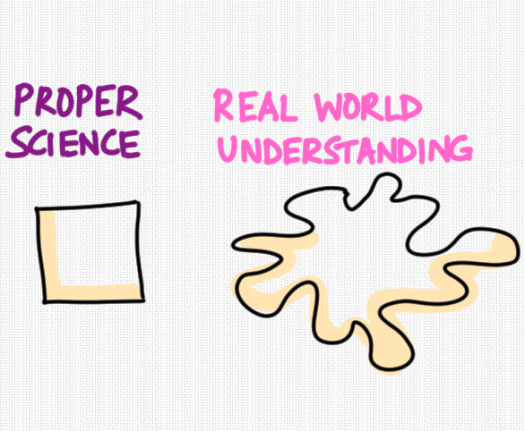
Let’s start with scientific knowledge and the traditional idea of what that is. That view comes down to two things: there are facts, and there are theories that explain those facts. This approach to knowledge creation was a revolution in its time, a reaction to received wisdom as laid down in ancient texts and professed by priests. It said “No!” to assumptions and instead observed, noted, tested, repeated and reflected – creating reliable knowledge that has built the world we have today.

But just because it’s so successful we are now at a point where we try and fit everything into that way of thinking. It reminds me of a conversation I had twenty years ago with a young religious woman who claimed that because certain words in a text said something about the events surrounding the birth of a child they were scientific in their statements. She was wrong – but for centuries that sort of thinking held power over people – it still does now.

The thing with science is that it’s not one thing – instead it’s a state of mind that grapples with reality and, as one of the characters in the series says, “rips the mask off the face of God.” And reality is complex, complex enough to need other sophisticated instruments of science than the ones we are familiar with.

These are the instruments that I’m trying to understand and apply in my own practice. Bargheer (2021), for example, writes about the work of C. Wright Mills who in his book The sociological imagination (1959) railed against the excesses of grand theory and abstracted empiricism. In the former we get lost in theoretical fantasizing and in the latter we only consider questions that can be answered through quantitative survey research. Mills argued for a space for imagination, for creativity and craftsmanship in the construction of knowledge.

It takes careful thinking, however, to set the ground rules for this kind of work. The assertion that “it’s not scientific” can be quickly thrown at anything unusual. But then again knowledge in other cultures is not unusual – it’s different but you have to differentiate between that which is reliable and unreliable knowledge. You have to be careful not to fall into a colonial mindset that assumes that the victors and colonists are the ones that know everything and indigenous knowledge is valueless. Indigenous knowledge doesn’t have to be that held by foreigners – it can be that held by any group of people in any space – the knowledge of the reality of their existence.

This is a vast space, one that can consume you, called “research methods”. One challenge is whether you need to understand them all or whether you need to pick the ones that work for you in your situation.

The thing to understand is that real life is not box shaped. Real life is a funny sort of shape. That’s why many scientists do great work in their fields out don’t have a great impact in the world out there – they don’t realize that their boxes are things that exist in their minds. People who live in the real world, practical folk, don’t question the their funny shaped existence, they get on with living in the space they occupy. And make it work for them.

Cheers,

Karthik Suresh

References

Bargheer, S (2021), “Paper tools and the sociological imagination: How the 2×2 table shaped the work of Mills, Lazarsfeld and Parsons”, The American Sociologist, Vol 52, pp 254-275.