Why do fuel prices go up fast and down slow?

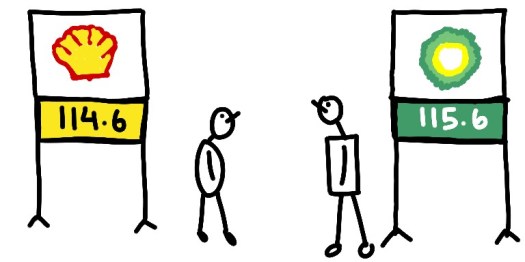
Gas-stations-opposite-each-other.jpg

Households in the UK spend between 12 and 27% of their disposable income on transport, of which a third can go on the cost of fuel.

People spent, on average, £72.70 on transport in 2016 and the cost of petrol and diesel was the biggest contributing factor.

Oil prices went up and down in 2016. At the start of the year, they were low and went lower on abundant supplies, with the spot price of crude oil heading towards $25 a barrel.

In the second and third quarter of 2016, producers responded with spending and production cuts, which helped prices head back towards $50 a barrel.

By the end of the year, OPEC’s decision to curb production and stick to quotas and an agreement from other countries to reduce output sent prices towards $55 a barrel.

So, in a market where global prices can double or halve in a year, why do these increases or decreases not show up in prices at the pump?

A litre of unleaded petrol in the UK went from around 102 pence per litre to 115 pence per litre by the end of the year.

We’ve all seen that when global oil prices fall, the reductions don’t seem to show at the pump. But when they rise, the price at the pump seems to go up straight away.

Why is this?

It’s not just imagination. It turns out there is a phenomenon, described in the industry as “Rockets and Feathers” that takes place.

In a commodity market, where prices are posted daily for all to see, as in the domestic fuel market, retailers know what each other is charging.

If oil prices go up, one retailer can raise prices in the knowledge that others in the area will see the increase, and feel like they can increase their price as well to benefit from the increased margin.

As everyone can see the posted price, this can even act as a signal to other producers – although there is no actual collusion taking place.

On the other hand, when global prices fall, each retailer can wait for someone else to take the first step.

Again, because they can see all the prices, there is no need to drop their price until someone else does first.

So there are different incentives when prices go up compared to when they go down.

This is why price go up fast, as one retailer raises its prices, the others notice and they raise theirs as well. On the way down, everyone waits for someone else to make the first price reduction.

And so, prices rocket up and drift slowly down.
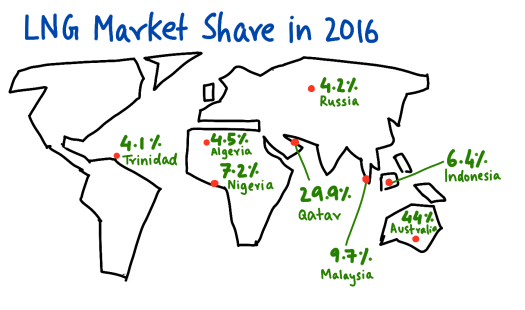
Where does the world’s LNG come from?

world-LNG-supplies-2016.png

Three quarters of the world’s natural gas is used in industrial applications and for power generation.

It burns more cleanly than oil or coal, which means that emissions from natural gas are lower.

As a result, governments around the world have policies that make using natural gas more attractive than the alternatives.

The IEA estimates that global gas consumption will grow from around 120 trillion cubic feet (TCF) in 2012 to 203 TCF by 2040.

So where does this gas come from?

The graphic above shows the top exporters of LNG by market share in 2016 according to the IGU World LNG Report 2017.

Australia now has the largest market share of LNG, going from 12% in 2015 to 44.3% in 2016, a huge increase.

Qatar remains an important source of gas, although the problems it is currently experiencing with its neighbours may have an impact on gas production this year.

Russia, despite its enormous gas reserves, is a relatively small player in the LNG export market.

The one to watch is the United States.

In 2016, the U.S. had a market share of 1.1%, making it the 16th on the list.

Over the next few years, however, it is expected to ramp up exports significantly.

In the next decade, Australia and the United States are expected to be the dominant exporters of LNG to the global market.

Why is UK productivity flatlining?

ProductivityChart.png

The ONS released its quarterly bulletin on labour productivity covering the first quarter of 2017 on 5th July 2017.

The index of productivity, measured by gross value added (GVA) per hour normalised fell from 102.4 to 101.8, a drop of 0.59%.

The BBC’s headline for this was “Today’s productivity figures are bad to the point of shocking.

Really?

It’s worth going over a couple of points from Understanding Variation: The key to managing chaos.

Comparing one number with another for a previous period is often used when reporting figures in the press. If the number is up, great. If it down, the sky is falling.

While this is easy to do, such comparisons are weak and lead to sensationalist headlines with little insight. They are limited because they use less data than there is available and because they don’t take variation that is in real world data into account.

If we look at the underlying data over a slightly longer period a few things jump out at us.

First, gross value added (GVA) seems to increase over time fairly linearly. Apart from a brief hiccup around the time of the financial crisis in 2008 the line pretty much trends upwards.

That takes care of the numerator in the productivity equation.

The denominator seems more complicated. Looking at the ONS data, its hard to find something that is a simple measure of hours worked.

For example, this page has some material, but its hard to work out which particular set or trend should be used.

Looking at a website called trading economics, it looks like average hours worked came down from 1995 to 2010 and then started rising agan.

So, we have two charts. One with steadily rising numbers and another with numbers that first fall, and then start to rise again.

When you put the two together, the impact is a chart that first increases and then flatlines as the rate of change of GVA matches the rate of change of hours worked.

The reasons for this in the press point towards the number and type of jobs in the economy as the problem.

There are more jobs than before, so there are more people working than before. This means that total hours worked is increasing faster than the rate at which output from those hours is increasing because the jobs being worked are not as high value as they were previously.

To change the trend, you need to either increase GVA – do more valuable work, or reduce hours – do the same work with less people.

Simple to say, but not easy to do.

Putting inflation in context – what does 2.9% mean for us?

Inflation2007-2017.png

The Consumer Prices Index (CPI) reached 2.9% in May 2017. This brings inflation back to levels last seen in 2012.

Goods and services have become more expensive in the UK following the BREXIT vote and the start of exit talks.

The pound has weakened and prices have risen.

The ONS points to a rise of 7.7% in electricity prices during the year. Food and alcohol, clothing and footwear, furniture and household goods and recreation and culture are all showing their highest rate of increase for 12 months.

What can inflation tell us about what is ahead for the economy?

Not very much it turns out. Inflation is a lagging indicator of economic activity, and it is only after a trend is underway that it starts to move significantly.

Where it does have value is in telling us where there might be potential hotspots.

For example, imported goods are clearly going to be more expensive because of the weak pound – and the four categories with the highest inflation rate are all dependent on imports or global prices.

That tells us to watch the exchange rate carefully if our business depends on global markets.

Inflation is expected to continue rising for the rest of the year, peaking at over 3%.

As the increase appears to be mostly due to exchange rates it is unlikely that interest rates will be increased in the short term.

What it also means is that households will have less money after they have paid for more expensive goods and services, and this is already showing up in lower levels of household saving.

When is it a good idea to think differently?

ThinkDifferently.png

Two roads diverged in a yellow wood, wrote Robert Frost, and taking the one less travelled by made all the difference.

When is it wise to follow the crowd and when is it not a good idea?

Crowds are good at particular kinds of thinking. In his book The Wisdom of Crowds, New Yorker staff writer James Surowiecki talks about three kinds of problems that crowds are particularly good at solving:

  1. Problems of cognition: These are problems which will have a solution at some point. How many cars will sell next quarter? How likely is it that a new drug will get approved?
  2. Problems of coordination: How should a group of people behave? for example, how do buyers and sellers trade fairly? How should people drive safely in cities?
  3. Problems of cooperation: How is it possible to get people who are focused on their own interests to work together? How can we tackle problems like pollution, climate change or tax policy?

Crowds can also be extremely unwise. This usually happens when the rules they should follow break down, communication fails to moderate behaviour and you get things like a riot or stock market bubble.

Interestingly, a crowd seems to fail when its members start to think the same way. This is the essential cause of stock market bubbles and has been seen over time, from tulips to houses.

When everyone starts to believe that the price of something will always go up, you get irrational exuberance, and a bubble that eventually bursts.

The paradox is that wise crowds integrate individual judgements to produce a group judgement – but in order to reach a good judgement, each member of the group needs to think and act independently.

Organisations that want people to reach better decisions should encourage diverse and independent thought and action.

Individuals who want to make better choices should not be afraid to disagree and contest ideas and options. We think better when we think independently.

What kind of organisation do you work in?

What_kind_of_organisation_are_you.png

An organisation’s success depends on the nature of its relationship with its customers.

How customers view your company is key to how they choose to interact with you.

Thinking of an organisation only in terms of its staff, its products or its processes can hide important strategic aspects from you.

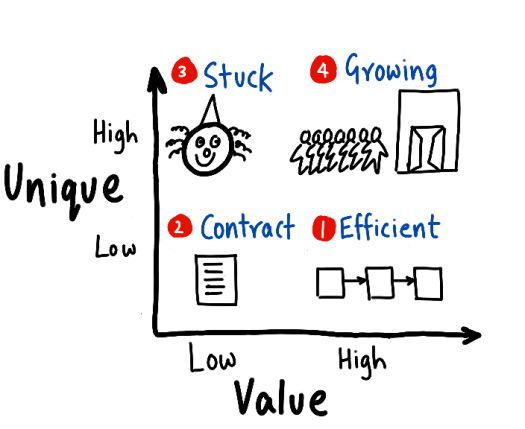
The model in the picture is adapted from this TED talk by Guy Kawasaki and this paper by Lepak and Snell and shows how customers treat organisations based on how they perceive them.

1. Efficient organisations: High Value but not Unique

Organisations that produce something of value are going to have a market for their products.

Their customers, however, have a choice between many suppliers. For example, car insurance is much the same between providers.

Your supermarket shop is going to have more or less the same things between major supermarkets.

In this quadrant, the winners are the ones with the lowest delivered price, which means they are the most efficient and with the lowest costs to deliver their service.

Customers are likely to go through tendering to work with organisations in Quadrant 1 and pick the cheapest one that does all the things they need.

One more thing about this quadrant – if you reduce your costs by becoming more efficient, the customer benefits in the form of lower prices but you don’t keep the savings in the form of higher margins.

This is why textile mills in the developed world went out of business. All the investment they put into reducing costs resulted in lower prices for consumers, but the companies themselves remained low margin and unattractive businesses and eventually closed down.

2. Contract based organisations: Low Value and not unique

If customers think that what you do has little value and is not unique then they have no incentive to work with you on anything other than a contract basis.

For example, many companies think of cleaning services just as something that needs to be done, but there are many companies that can do it.

The chances are that they will agree a contract with a cleaning company. That contract will continue as long as the facilities stay clean and the terms of the contract are fulfilled.

Over-delivering against the contract may not result in anyone noticing, but under-delivering – having facilities that are dirty – will probably result in complaints and having the contract terminated.

3. Stuck organisations: Unique but of low Value

Your organisation may produce something unique, but unless there is a market and customers perceive value in it, you are likely to be stuck with early adopters and find it hard to get more customers.

Many products fall into this category – there are now museums of failure to products such as Harley-Davidson Perfume.

In the city of Ann Arbor, Michigan, GfK Custom Research North America has a storehouse of failed products ranging from microwaveable scrambled eggs and TV dinners sold by Colgate to Clairol’s Yoghurt shampoo.

Many of these products were unique but perceived as having low or poor value and were withdrawn from sale within weeks or months because no one would buy them.

4. Growing organisations: Unique and with high value

Organisations that do something unique and are thought of by customers as delivering value are likely to be able to maintain higher margins than others, invest more into their businesses and attract more customers than their competition.

Apple is probably the poster child for this category. The company is sitting on $250 billion in cash as it brings in profits every quarter of over $10 billion.

This happens becuase its products are unique and it has customers that love what it does and are prepared to pay a premium to buy its stuff.

Warren Buffett has made a career out of buying businesses that have above average earning power – and credits managers with being able to get extraordinary results from ordinary businesses.

Summary

In summary, how your customers see what you do is crucial to getting the relationship right with them.

If you do something that is currently seen as low value and not unique, the only option, if you want to grow, is to work on changing your customer’s perception of what you do.

On the other hand, if you can deliver the best service, at the lowest price, working in a contract based business or in a business where you are the lowest cost provider can still work for you.

The place you don’t want to be is where your ideas are unique but no one wants to buy from you.

How to think outside the box

ThinkingOutsideTheBox.png

What does it mean to think out of the box – to be able to come up with new ideas and be more creative?

In this TED talk Professor Giovanni Corazza, a faculty member of the University of Bologna and founder of the Marconi Institute of Creativity, talks about how you can become more creative.

The key to thinking out of the box is to understand what the box is – in your mind – and what it means to think out of it.

All thinking is in your mind – you can’t think out of your mind.

Instead, what this means is that creative thinking is being able to go from what you know to what you haven’t thought of yet.

Being able to cross from one type of state of mind to the other is the essence of being creative.

How do you go about doing that?

The first thing is to realise that most thinking is convergent – we think about what we know and use existing knowledge and tools to approach situations and problems.

Our brains are designed to jump to conclusions quickly – a good evolutionary survival mechanism. You don’t want to be considering all the facts about whether that is a tiger in those bushes.

We also look for evidence that confirms our initial conclusions. There is a flash of orange, the bushes are moving, it must be a tiger.

We then act based on that evidence – climb a tree, run indoors, get away from that tiger.

The thing with creativity is that you have to remind yourself to go through a process of divergent thinking.

Divergent thinking is a way to be creative by exploring many possible solutions.

It asks you to take a more spontaneous, less rigid approach to the tasks, to play with ideas, to be willing to tolerate the absurd, the illogical, the risky approaches.

Above all, it asks you to be open. It’s only when you are open that you have the freedom of mind to think creatively.

How to make your innovation a success

InnovationCharacteristics.png

How do you know what kind of innovations will succeed and which ones will fail?

This is a question addressed in Stuffocation: Living more with less by James Wallman.

Wallman is a cultural forecaster, and uses five questions to ask whether an innovation is likely to catch on.

1. Is it better?

Is the innovation actually an improvement over what was there before?

For example, was the Walkman let you listen to music on the move. The iPod was a better tool for the same job.

2. Is it simple?

Is it easy to understand the innovation?

Is it clear how you can use it to make things better for you?

3. Is it compatible?

Does the innovation work with the rest of your life?

For example, DVD cases are a different height to CDs cases, typically because the cases used to sit on the same shelf as VHS tapes.

4. Is it easy to use?

Can you actually use the innovation easily.

For example, an electric toothbrush makes the act of brushing much easier. The same goes for washing machines.

5. Is it remarkable?

Is the innovation remarkable in the sense that other people will take note of how it has improved your life?

According to Wallman, if the answer to each of these questions is “yes”, the innovation is more likely to succeed.

There should be a health warning though – there are quite likely to be innovations that were better, simple, compatible, easy and remarkable but they failed to succeed.

This list of criteria could be based on “survivor bias”. We look at things that have succeeded and assume that they have these features in common.

Aiming to create innovations, however, that use this list as a checklist is unlikely to make things worse.

What you also need to succeed is a good dose of luck.

The essence of competitive strategy: build a moat

PlanVsStrategy.png

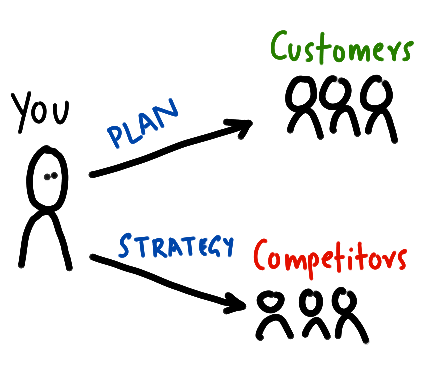
Strategy in business is about focusing on the actions and responses of competitors.

That is what Professor Bruce Greenwald says in his book Competition Demystified. Bruce Greenwald teaches at Columbia Business School and is perhaps the leading academic authority on value investing, the method followed by Warren Buffett and outlined by Benjamin Graham.

The core concept of competitive strategy is based on Michael Porter’s theory that Five Forces tell you how attractive a sector is for business. These are Suppliers, Buyers, Competitors, Substitutes and Potential entrants.

The Five Forces framework makes it easy for business people to spend a lot of time looking at their markets and making plans.

The book says that executives make the mistake of thinking that any plan to get new customers, cut costs or do something that takes time and money is a strategy.

Instead, a strategy should be thought of as only those plans that focus specifically on the actions and responses of competitors.

Why is this important?

It’s because the price at which you sell something tends to head towards cost in a commodity market. If what you do can be done by anyone else, the market price of that thing you do will quickly fall to the cost of doing it, making your margin zero.

The more exposed you are to competition, the easier it is for someone else to start what you do, the fewer the buyers for your service – the more quickly your margin will drop.

The way to maintain a high margin is to focus on how you can create and protect an advantage for your business. As Warren Buffet would say, what is your moat? What is the thing that surrounds and protects your business from competitors who want to take your market share.

Strategy is all about making the playing field less level by doing something your competitors cannot. As a result, strategy is all about your competition – where are they playing, what are they doing, and where should you put your efforts so that you can make it harder for them to replicate what you have and do?

If you can’t protect yourself, then the only thing to do is to be as efficient as possible. Forget the competition and focus on reducing your costs.

If you can, then focus on creating a moat.

The same strategic process applies to individuals. If anyone can do what you can do, your wages will stay low as you can be replaced easily.

If what you do is unique and hard to replicate, you will be more valuable and be paid more.

Why don’t we make rational decisions under pressure?

For a long time we assumed that humans are rational creatures and operate on the basis of rational self interest.

The basis of traditional economics is that people make rational decisons. It assumes that people make a choice that gets them the most benefit and is in their self interest.

Much philosophy is based on logic. The idea is that you can arrive at the truth through logic and dialogue, that the truth is somehow independent of how we think and feel.

These views of human behaviour are changing as we learn more about behavioural psychology.

Logic ran into trouble in 1931 when a mathematician called Godel figured out that you couldn’t prove everything with maths.

In essence a general sense any system based on axioms and deduction, such as arithmetic, would contain within it statements that can “neither be proved nor disproved”.

What this means is that you can’t argue that something is “true” purely using logic and maths because there will always be something within that framework of knowledge that you need to “believe”.

So, logic starts to experience problems when it comes to explaining the complexity of human behaviour. Economic logic has run into that problem – the kind of behaviour predicted by traditional economics is something people just don’t do.

For example, ask people if they would rather be paid £100k and all their friends be paid £200k, or if they would rather be paid £80k and all their friends be paid £60k.

The rational choice, the one that maximises benefit is the first choice. But most people will go for the second choice because they think about what the benefit to them means when compared to what others get. In essence, value is relative and not absolute.

One reason for this is that our brains were not “designed” to be logical. Evolution didn’t design us or decide what attributes to give us.

In Daniel Levitin’s book The Organized Mind he describes how the brain was not engineered. Instead he says that “The brain is more like a big, old house with piecemeal renovations done on every floor, and less like new construction”.

The human brain is a concoction of systems – from the lizard brain that runs away, fights and reproduces to the pre-frontal cortex that allows us to think about the future.

Biology has more to say about why people think and act the way they do these days than does economics and philosophy. We can look inside the brain and understand the structure of memory and decision making better than ever now.

For example, we know that when people are stressed, their brains revert to lizard mode.

Any organisation that wants to make better decisions needs to make sure that their people don’t operate under stress. That is guaranteed to get the lizard brain operating and will result in decisions based on fear or violence (flight or fight).

It’s almost impossible to switch from lizard mode brain into thinking brain when you are under pressure.

The only way to operate is to decide ahead of time what you are going to do and then follow that plan.

We need to work at being rational – it’s not something that comes naturally in all situations. The rational thing to do is assume that we are always going to default to decisions based on fear or aggression and we need to work on improving our decision making.