How to do technical analysis in energy markets

technical-analysis.png

Most of us shouldn’t be doing any technical analysis.

If you are an end-user – someone who actually needs a commodity and uses it in real life, then the maths of markets shouldn’t be the main thing you think about.

Instead, like in any other business, the closer your purchase price is to the cost of production, the better the deal you’re getting.

In a commodity market, like the electricity and gas markets in the UK and Europe, the best strategy is to first work out that number.

Then wait.

When the market price is close to your number – buy.

If you buy too early and the price goes doen – then buy some more and average down.

But – these opportunities only come along once in a while. In the last 15 years, there have been perhaps four occasions when the price was right and it made sense to fill your boots.

So… what do we do if we have missed those opportunities?

At that point, many people fall back on market timing – trying to get a better position by making a call on the whether the market will go up or down from where we are now.

And the tool we use is technical analysis.

The idea is that a combination of indicators can help us come to a view on where the market is headed.

The indicator to start with is the Moving Average. This is the average of a number of days and smooths out the daily variations in prices.

When a 9-day moving average crosses the 20-day moving average, it can be a signal that the market is going to change direction.

Between these, the smoother curves help us form an opinion on the trend.

In commodity markets, the Relative Strength Indicator or RSI is a popular measure.

The RSI is created by adding the number of days the market went up and dividing it by the number of days the market went down and turning it into an index from 0-100.

When the line crosses above 30, it’s a bullish signal and when it crosses below 70 it’s bearish.

Volumes traded in the market also provide an advance signal of changes.

If more people buy, it might push the price up, and as less people engage, the price might go down.

A change in volume levels can be an early sign that the market is changing its mind.

Bollinger Bands are a more complex technical indicator.

We work them out by calculating two standard deviations from a central line, usually the 20-day moving average. The theory is that prices should be within this range most of the time.

If they break out of the bands that could be a signal to buy or sell.

The challenge in energy markets is that as the number of options increases we have more of them to track and take positions on.

There are obviously many more indicators, some fiendishly complicated.

The point is that markets may be closely correlated – but that doesn’t mean just looking at one measure, like an annual contract, is enough these days to pick out a price that is undervalued.

In an ideal world, we would buy at cost-price and not need to do any technical analysis at all.

But – when we do, it’s useful to know how it’s done.

How can you become more profitable?

peter-lynch-5-ways-to-increase-earnings.png

What exactly does it mean to grow a company?

In the age of the internet, it seems that growth means eyeballs. You need to add users, quickly.

It doesn’t matter if those users are unprofitable. The idea is that if you add enough people, then a larger company will buy you just to be able to talk to your customer base and sell them more stuff.

Most businesses, however, don’t work like that.

They have three levers they can push – money, customers and operations.

According to Peter Lynch, the well-known manager of Fidelity Investments’ Magellan Fund until 1990, there are five things companies can do to increase earnings.

An investor would look at which of these options are open to any particular company before investing.

1. You can cut costs

Focusing on costs can be boring, but every penny you save has an immediate impact on profits.

Some costs, like electricity, gas and water, may be small – but their impact on profits can be considerable, especially in a competitive, low margin marketplace.

In an ideal world, you would compare costs against expectations daily, taking action to correct variations as soon as possible.

2. You can raise prices

If you raise prices, you will lose some customers.

That is no reason to keep prices low.

The calculation one needs to make is to work out at what price point a further increase will result in a net loss from customers leaving as a result.

This can be calculated – it requires a pricing model and charting, or if you’re feeling in the mood, differential calculus. Let me know if you’d like more information.

3. You can sell more to old markets

You may have more services that existing customers would take, if they were aware of what you did.

If you already have an existing working relationship with someone and have provided a good service you have an advantage over the competition.

4. You can expand into new markets

Now we’re looking at how you can get new customers.

The easiest place to start is to find customers like the ones you already have.

It’s much easier to have a conversation when you already have similar customers to the one you’re trying to work with.

And those conversations may tell you where the opportunities are for new products and services.

5. You can fix, close or sell a losing operation

If a part of the business is hurting profits, then you need to look at it carefully and work out what your options are.

It’s easy to fall into the sunk cost fallacy, where previous decisions and investments stop you from just stopping.

If you can’t fix it, then you need to close the operation or sell it – and that will have an immediate impact on your profits.

Lynch argues that how a company plans to deal with these five areas is its “story”.

As an investor, a company needs to to have a plausible and preferably compelling story about how it plans to increase profits before you put your money into it.

The rules on energy reporting for large companies

streamlined-energy-and-carbon-reporting.png

The government consultation on a streamlined energy and carbon reporting system is open until 4th January 2018.

Many companies still don’t save as much energy, carbon and cost as they can.

This is partly because decision makers are just not aware of the opportunities that exist across businesses.

Take a large business that operates in a competitive industry. Let’s say that it has a turnover of £40 million and it’s EBITDA margin is around 20%, giving it £8 million in earnings.

The costs of energy might only be around 5% for such a business – at around £2 million.

If it could save 10% through low-cost energy efficiency investments, that would add £200,000 to EBITDA, an increase of 2.5%.

The business would need to increase sales by £1 million to have the same impact on profits as cutting energy costs by 200,000.

And, especially for listed companies, that increase in earnings can directly increase shareholder value through valuation multiples.

But there are problems.

There are too many reporting systems, the obligations are fragmented and the benefits are unclear.

Most companies see it is as just another obligation that needs to be met at the lowest cost rather than a source of opportunities.

The consultation aims to change that.

Under its proposals, existing reporting mechanisms will be streamlined into a simpler reporting framework that will make energy and emissions information more standardised and transparent, increasing awareness among shareholders and senior managers.

It will apply to large companies, whether defined by energy usage, financial strength or company structure. Between 4,000 and 10,000 organisations will need to comply with these proposals.

The reporting will cover energy and transport and potentially also cover other forms of energy such as biofuels – drawing more emissions into the reporting framework.

It is meant to be UK specific, although listed companies will report on global operations.

In addition, there may be a requirement to report against progress on energy efficiency opportunities.

Following the consultation and the governments response, the new rules are likely to be introduced by 2019.

Companies will need to report this information on their annual reports filed with Companies House, and there may be a separate data portal set up to hold and provide this information as well.

So, what should you do now?

Whatever conclusion the government comes to, it’s likely to involve some form of reporting.

So, start collecting your energy data now.

How to pitch your idea

6-pitches.png

The author Dan Pink writes that we are all in the business of moving others now in his book To Sell is Human.

Whether it’s persuading others to back an idea or strategy to what people think of as traditional sales, all of us are increasingly required to pitch our ideas and get support in order to do anything.

The test for whether an idea was clear was the elevator pitch. Could you succinctly sum it up in 30 seconds or less as you went up an elevator with someone important.

But… we rarely share lifts with important people any more. What do you do when you don’t have an elevator available and you want to get their attention and spark interest?

Dan Pink describes six successors to the elevator pitch. It might help to remember them as you look at the symbols on your keyboard that match the ones in the picture.

1. ! The one word pitch

Can you describe your idea in one word?

Pink suggests starting with a short description, say 50 words. Cut it down to 25. Cut again to 10. One of those that is left is the one word that describes what you do.

For example, the website of Patek Philippe, the luxury watch brand, has the word Aesthetic scrolling on its homepage.

In an interesting twist, they have the one word that they feel describes the beauty of their product in several languages.

2. ? The question pitch

If you are sure of your facts and logic, then asking a question is a powerful way to get started.

WaterAid, a charity that helps bring clean water and toilets to people who lack basic sanitary provisons around the world, simply asks Are you ready? on their website.

Then they explain their goals and how you can get involved.

3. = The rhyme pitch

A rhyme sticks in your mind.

Pink says that if you are in competition with others, coming up with a rhyme that summarises what you do will help people remember your firm and potentially give you an advantage.

4. @ The tweet

Can you summarise what you do in less than 140 characters?

Apple is a company that mastered this approach with short, snappy lines under Steve Jobs.

“1,000 songs in your pocket” and “The world’s thinnest notebook” still probably bring to mind the iPod and the Mac Air.

5. _ The subject line

Email is still where most of us live, and where we get the most junk.

To stand out, your email must do at least one of two things, and preferably both, according to Pink.

It must have utility – a clear statement of whats in it for the reader.

It must spark curiosity – a desire to learn more.

6. ” “ The story pitch

The story pitch, also called the Pixar pitch, says that every Pixar pitch has the same formula:

  • Once upon a time…
  • Evey day…
  • One day …
  • Because of that, …
  • Because of that, …
  • Until finally, …

Pink’s site has a few videos that also explain these in more detail – and the book is a pretty good read as well.

The next time you’re stuck for a way to craft your pitch, just look down at your keyboard and remember the six new options you now have.

!?=@_” “

Why do you do something?

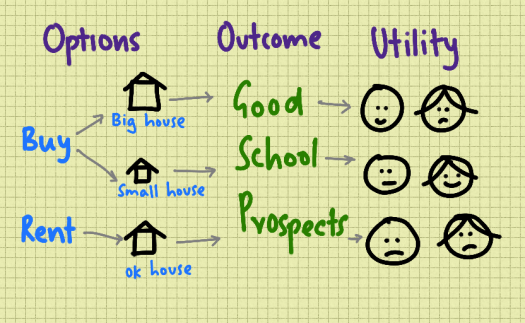
utility-tree.png

People do things for reasons.

The reasons are the benefits you get – the things you have gained, are gaining or expect to gain from taking a particular action.

All these reasons and benefits, the associated hopes, dreams, goals, objective, prizes, are packaged by economists into one, rather dull word – utility.

Utility is what’s in it for you.

Understanding how utility is created is crucial when trying to make a decision, or when getting someone else to make a decision.

One way of doing this is by drawing a utility tree.

For example, around this time of year, many families are thinking about options. They want their kids to go to a good school – but what should they do?

Say they have to move – and they have two options. They can buy a place or rent a place. If they buy, they can buy a big house or a small house. If they rent, they can settle for an OK house.

Whether they buy or rent, as long as the house is in the right area, they are fine for schools – so the outcome is the same in all cases.

What makes the difference when choosing between the options for this family?

Lets say one partner wants a big house. The other, more familiar with their finances, doesn’t want the associated costs because they will stretch them too much.

A smaller house would make one partner happy, and the other could deal with it – but it’s not a preferred option by any means.

Both of them, however, really don’t want to rent again and deal with the issues of agents, commissions and having to have regular inspections.

These reasons are the utilities associated with the situation.

Now, if you keep all this in your head, it’s really hard to have a mature discussion that doesn’t end up in an argument.

Instead, drawing a utility tree helps to make the options, outcomes and utilities involved clearer.

The key thing is to consider each option you have by itself, using the same criteria to evaluate each option and making sure that you look at it from enough points of view to be happy you have thought through it properly.

For example, seeing the tree in the picture above clarifies the situation more than describing each person’s point of view in words.

The point of view someone takes, their perspective, is crucial in being able to understand what will and what won’t move them.

We can often only see things from our point of view.

Making good choices, however, whether in personal situations, when making investments or when persuading someone else to make one, often need you to see things from another person’s perspective.

What this also means, quite often, is that the best solution will need to be a compromise. For example, you might be able to persuade your partner to have a smaller house, as long as you can also have a nicer car.

Understanding utility simply means that you can better understand what people want and what they will do – and that means you are more likely to get what you want as well.

Can you figure out what really gets results?

how-to-measure.png

How do you set things up so that you can get results?

Take an example that many people have to deal with – meeting sales targets for their business unit.

The results are expressed in monetary terms – you want to add X in sales by the end of the year, so what does that break down into by month, by week and by day – depending on how the business you are in makes its money.

If you are in a retail business, with transactions happening every day, then a daily system of monitoring profit and loss may be enough to tell you whether you are in or out of the money. Depending on how far away you are from target, then you can take action to change things.

In this case you are in a business where results can be measured in great detail, so you simply monitor the end of the process.

But what if you operate in a different kind of business – say you sell large and complex systems – power stations, for example, or provide ad-hoc consulting services. The results in such businesses expressed in financial terms may not be as predictable.

So what happens then?

The markets and analysts like companies with smooth lines trending upwards. They don’t like surprises or lumpiness in results. So, the companies give them what they want – managing their reporting so that you get the effect of a smooth line, even if the underlying business is lumpy.

This takes you from monitoring results to manipulating results.

The logical thing to do might be to consider the other end of the process.

If the results are hard to predict – you still need to do something every day to get them.

You need to pick up the phone, engage with someone, create something – the daily activity is what eventually produces those results.

Is it possible that measuring aspects of daily activity that correlate with results can help get results better than measuring the results themselves?

In other words, measured daily activity could lead to results which can then be measured in financial terms.

The point is this – in order to track how you are doing, you need to measure and monitor something every day.

There is no point in measuring something daily that does not lend itself to being broken down into a daily measure.

Instead, find something that you can measure daily that correlates with the result and measure that instead.

How to function in a post-truth world

cherry-picking.png

Post-truth was chosen as the Word of the Year in 2016 by Oxford Dictionaries because it seemed to describe the essence of what happened during BREXIT and the US Presidential election.

People have always cherry-picked – selecting the data or evidence that supports their point of view while discounting or ignoring other information.

The thing that is changing, however, is that in a continuum between what is false and what is true, we are getting much better at using falsehoods to manipulate how people think and respond to messages – and the politicians are the ones doing this best.

For example, which news headlines grab your attention?

The best ones create a visceral, emotional response. Facts are dull. Feelings make you sit up and take notice.

From the £350 million for the NHS claim that Boris Johnson recently repeated to the belief that former U.S President Barack Obama wasn’t born in the U.S, statements that create feelings can ripple through societies, magnified by 24-hour news and social media.

But that’s ok, some people might say. There is no truth, as such. Facts have a lifespan – in science, especially, what we think we know is constantly being overturned by new discoveries and through the application of new technology.

What we have are the facts of the moment – and opinions – and what we do is combine these to create a social understanding of the here and now. Everything is relative and needs to be understood in context. It’s contingent.

The only time we learn really what is true and what is not is when we look back. History tells us how facts were used and what happened as a result.

In real-time, we only have “alternative facts”.

So what do you do about the facts around you? There are two options.

If you want to peddle facts, there are three kinds of people you will face.

  1. Those that agree with you.
  2. Those on the fence.
  3. Those that disagree with you.

You will never get those that disagree to change their minds. The ones that agree with you are already on your side.

Your messages need to speak directly to those who agree with you to make sure that their existing points of view are energized and inflamed – and try to win over those people on the fence.

This is why Trump’s style is so powerful. He speaks directly to his followers through Twitter, and the messages that filter out through the media bring some people to his camp, and he ignores everyone else. And he gets results as a result.

If you are a consumer of facts, there is only one approach you can take – caveat lector.

Reader, beware.

What could opening up access to data do for us?

blinds.png

Governments, organizations and businesses have vast quantities of data they have collected over the years – and continue to generate more daily.

The amount of data out there can overwhelm anyone trying to analyze and make sense of it.

Let’s say you could have access to this data and were able to process and analyze it – what would that help you do?

You could:

  • See how governments spend their money.
  • Look at patterns of energy usage across economies.
  • Study the distribution of wealth and poverty.
  • Improve how we track and predict weather.
  • Monitor fair trading in stock markets.

and much more.

The idea that making data available to people will help with both understanding and accountability, while also increasing innovation is why the UK government has started to publish datasets on data.gov.uk.

Organisations such as the Open Knowledge Foundation and the Open Data Institute are helping to create guidance, tools and networks that make it possible for people to obtain and study data and share their findings.

Why does this matter?

For a start – there is a big market out there for data and analytics. You can now get Data as a Service (DaaS) products, allowing you to analyze everything from electricity and gas prices in Europe to pig futures in Kansas.

Organisations that are able to effectively use data for decision making can improve their processes, reduce prices and stay competitive.

But there are bigger challenges that can also only be achieved through transparency and cross-sector work.

For example, many large organisations are voluntarily taking action to cut their carbon emissions, through participating in programmes like Science Based Targets.

Others aren’t, partly because they haven’t the time, see it as a cost or just don’t know how to get started.

We need to start by making it easier to analyze their data through projects like Frictionless Data that help collect, share and validate data.

If you could see how your retail store portfolio compared with others in terms of carbon emissions per sales, you might be motivated to improve your performance.

Whether the motivation is financial, social, competitive or for research and interest purposes – opening up data is going to have a big impact on making the organizations we interact with more transparent, agile and accountable.

Are you following a Woozle?

woozle.png

It’s hard to be certain of much these days.

Most people look for evidence to support a particular point of view and we usually find such evidence in journal papers, articles and authoritative websites.

The internet, in particular, lets us link to sources of information quickly and easily – giving us an impression of robust research underpinning our conclusions.

But, there are Woozles out there.

In A.A Milne’s book Winnie-the-Pooh, Pooh and Piglet start to follow tracks in the snow, believing that they are on the trail of a Woozle.

They keep going and the tracks keep increasing, until Christopher Robin eventually finds them and explains they have been, in fact, following their own tracks round and round a tree.

The Woozle effect in social science is used to describe a problem that happens when publications cite other publications that don’t have evidence, misleading people into believing that there is proof out there for a point of view – and turn suppositions into facts.

For example, there is the long held myth that 93% of communication is non-verbal.

This has been taken to mean that you don’t really need to know anything about your topic, but as long as you are personable and charming and know how to read and influence body language, you’ll do well. But it’s based on a flawed interpretation of the research.

This effect can influence many lines of research, from human trafficking, violence in society, anxiety levels and so on. You can even find circular citations, where one citation cites another, which in turn cites the first one.

This effect is perhaps even more important with the way in which the news media and the internet helps ideas to flow and multiply.

The viral way in which an idea can now spread means that it is almost impossible to counteract an incorrect version of a story.

For example, apparently the U.S President was nearly hoaxed by a doctored Time Magazine that predicted an ice age in the 1970s. The story is still floating about on the internet, however.

So how do you deal with a world full of Woozles?

One approach is shut out the nonsense – retreat into a world of austere contemplation, cut out the news, ignore the internet and only get your evidence from high-quality, peer reviewed journals.

The other is to fight Woozles with Woozles, which leads to the Heffalump Conjecture, an approach apparently taken by the people that run our countries.

“Politicians, independent of ideology, in the presence of multiple verified facts and one Woozle will seek to fund Woozle related activity where either Woozle or funded activity emotively leads to increased votes and tenure in office.”

Are you approximately right or precisely wrong?

approximately-right.png

Experienced salespeople know that being precise helps if you want to convince someone of something.

For example, talking about how a particular product will save you $252,453.21 can result in more head nodding and acceptance among the audience than saying that it will save more than $250k.

That is partly because the precision of the first number implies that there is a model, analysis and intellectual rigour behind it, while the second is one that you can easily appreciate and potentially evaluate from first principles – thinking through its components and key factors.

Why does this matter to you?

In many aspects of business, the decisions you make will depend on your expectations for the future – and you are expected to model these expectations and analyse what they mean for you.

Software tools today are so advanced and capable of so much precision that they can lull you into a false sense of security.

For example, most people can build a detailed Excel model with several inputs, multiple levels of calculation and come up with very precise forecasts and ideas.

Quite often this leads to a situation where if an answer comes out of the model, it is accepted without question. In fact, in some situations, people are willing to discount reality and go with the model.

The same effect, magnified, can be seen with data analysis and social mining tools. Yes, you can do some very fancy sentiment analysis to take the emotional temperature of a cohort of people.

That can be a very persuasive input into a decision process.

And that is the thing we need to guard against because there are at least two things we can be certain of:

  1. The future is uncertain – a number of things could happen.
  2. There will be bugs – your model/forecast/tool will have errors.

The benefit of a model is that it allows you to express in mathematical form an idea and its key drivers. It allows you to explore a problem space.

That is the main purpose of a model – to help you explore and think more clearly about something. Its purpose is not to give you a definitive answer or to be an exact depiction of reality but instead to clarify what could happen and the range in which you are operating.

Expecting to get the answer exactly right is more likely to result in you being wrong much of the time.