The rise and rise of Bitcoin

bitcoin-2017.png

The price of bitcoin has gone up by over 16 times this year.

At the start of the year, one bitcoin traded at under $1,000. Now it is over $16,000.

What’s going on – and can it continue?

The price of bitcoin is driven, as are most things, by supply and demand.

Supply, in the case of bitcoin, is controlled by an algorithm, and new bitcoins are created by a process called mining.

In theory, the total number of bitcoins will not exceed 21 million by 2040.

According to Bloomberg, around 1,000 people control 40% of the market for bitcoin.

The currency’s elusive founder, Satoshi Nakamoto, is believed to own around 5% of the market, or 1 million bitcoins, worth around $16 billion at current prices.

The price has been driven up by the rest of us, competing to be part of the rise in valuation that has happened over the last year.

A relatively fixed supply and voracious demand are behind the increase.

Bitcoin has no government backing it and has no intrinsic value.

Its valuation is supported purely by the belief its community of users have in it.

That is no different, really, from any other currency though – we have to believe that the country backing it will still be there in the future.

An MIT Technology Review suggests that bitcoin may be at the point where it is as powerful as a government – China’s attempts to ban it have not stopped it.

The main problem at the moment with bitcoin is its volatility and a marketplace for bitcoin futures may help to stabilize its value.

The point is that while the supply of bitcoins is fixed, the supply of crypto-currencies is unlimited – anyone can set up a new one.

And the thing that is drawing people in is not that they really want to hold bitcoins – it’s that they really want to be able to convert the rise in their bitcoins to conventional currencies like the US dollar.

That’s speculation and could be hazardous to your wallet. Or make you very wealthy.

No one really knows.

How can you use analytics to create value?

path-to-analytics-value.png

It’s not clear for many of us exactly how we can use the data we have to help our organisations.

The systems we have are collecting more data than ever before – from customers, operations, sensors – and there is data being collected around us in social media platforms.

Many organisations are good at looking back – they can tell what happened and to some extent why it happened.

Fewer can see what is happening right now and what could happen next and what they should do as a result.

Some organisations use real time data to increase sales

The recommendation engines used by Amazon are designed to increase sales by showing you what else you might like – and the way in which google or Netflix present related information is designed to keep you using their platform.

But, what should the rest of us do to get started?

The advice from an MIT study is a perhaps a good point to begin.

There is more data around than we probably have the resources to deal with, so the starting point is to go after the big problems – the 20% of things that have 80% of the impact or cause the majority of the problems.

It’s hard to get people to give up personal decision making and rely on data.

Linking the analytics work to big, important things in the business and showing how data can help with those decisions has a better change of getting new methods into general use.

Then, it makes sense to start by asking questions instead of getting lost in the detail of analysis.

We can spend so much time getting data and starting to cut and analyse it that, all too often, there is no time left to see where it can help.

If we start with the big things that the company is interested in – often set out in their goals and objectives, we can then ask questions about what information would be useful to reach those goals.

Those questions will then let us explore what we can do to get answers and start to define the kinds of data and analyses we need to carry out.

The things organisations say are most important to them right now are trends, forecasts and standard reports.

The things that are likely to also become important are dashboards, simulation and scenario analyses, business process analytics and advanced statistical techniques.

We should try and make sure that what comes out of the analysis we do is business friendly and can be layered with other pieces of information and intelligence to make decision making easier.

Next – we build on what has been done before.

All too often, vendors are dismissive of spreadsheets.

In any room, however, it is likely that the vast majority have used and are comfortable with spreadsheets while advanced analytics tools have a steep new learning curve.

Good information systems design will keep what works and build more – perhaps with advanced analysis automated as much as possible or centralised within a support unit with experts that can help.

Finally – we should have some kind of a plan when building our information systems.

An information agenda, signed off by management, is a good way to oversee the process of sharing and using data better.

The study says that top performing organisations use analytics five times more than low performers.

For the rest of us, we should begin by understanding how to get started.

How can our information systems help us be more productive?

delone-mclean-is-success-model.png

Productivity is defined as output per hour by workers – and it has flatlined in the UK over the last ten years.

Our output depends on the tools we work with – and information systems are a vital part of that toolkit.

There are some who argue that we have not invested enough in technology while others think that recent technological changes have less potential to transform productivity.

So – how can we select and implement information systems that will improve productivity?

William Delone and Ephraim McLean came up with a model to measure the success of information systems in 1993, which they they revised in 2003, called the D&M IS Success Model.

It remains one of the most influential theories in the field, cited in in thousands of papers, and is a useful one to keep in mind when looking at a new system.

The model has 6 dimensions that are linked together with process flows and feedback loops. They influence each other, and in turn some elements are influenced by others.

The model begins by looking at quality – and sees quality as having three dimensions: information quality, system quality and service quality.

Information quality is all about what the system stores, delivers to the user, and produces for the user.

System quality relates to how the system works – does it do what is needed quickly or not?

Service quality depends on the organisation behind the system – are they helpful and is there guidance that is easy to follow or not?

These dimensions need to be looked at independently to assess quality fully.

The next two dimensions are user based.

First there is the user and the system – and this needs to be looked at from two angles.

How does the user plan or intend to work with the system?

How does the system actually use the system.

The quality of the system directly affects these user choices – we may intend to use a system, but if it is of low quality or the information is not good enough, we probably won’t.

We can measure user satisfaction based on their experience of using the system and their feelings about quality.

The last dimension looks to measure net system benefits.

These need to be some combination of saving money, saving time, increasing productivity and increasing sales.

The D&M IS Success Model seems deceptively simple – but it is a “parsimonious framework” that organizes many of the success metrics from research.

If a system scores well on these six dimensions then it should help us be more productive.

How to avoid being trapped in an echo chamber

echo-chamber.png

The giant corporations that we interact with on the internet are trying to understand what we like so that they can feed us a processed diet of stuff that is similar.

Amazon, for example, suggests other books we might like. Newsfeeds on the iPhone change based on what we click on. Google creates personalised search results based on our search histories.

Mainstream news channels pick stories with an eye to what other news channels are likely to talk about – creating an increasingly homogeneous mix of information and news.

Many people simply choose to ignore stuff they don’t like or don’t agree with on the internet – creating a system where what they see is more of what they already see.

The main danger with this is that we could get trapped in an echo chamber.

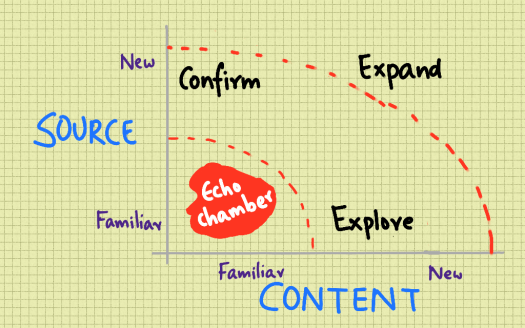
Colin Raney has a nice way to show this in a 2×2 matrix – shown in the picture above.

When we see familiar content from familiar sources – that’s the time to be wary.

If people and sources we know are repeating the same thing it could be true.

Then again, it might simply be an echo, as the same thing bounces off and is repeated and amplified by others in our network.

We may end up with a distorted version of what is happening.

When we see familiar content from new, independent sources that might help confirm a story.

The idea of independence is key. The content needs to have been gathered and checked independently.

If we see new information from familiar sources, especially ones we trust, that might be something to explore further.

We may learn something in these circumstances.

Finally, when we see new content from new sources, we expand our horizons and are exposed to novel concepts, ideas and stories.

The technology and media that surrounds us are trying to understand us better and deliver more tailored content.

Paradoxically, in doing that, they might make it too easy for us to settle into a situation where we believe that what we see is all there is.

Politicians know this.

The strategy all over the world now is to talk only at people that already believe in them or that might be on the fence. The opposition can safely be ignored.

Comfort leads to complacency – instead we might want to be curious, look for facts, be sceptical and look at things from multiple angles.

Do we all need to think like journalists now?

Why science can’t help us to understand ourselves

scientific-method.png

We think we are much better off these days than people that went before us.

And, using virtually every measure that matters, that is the case.

As Steven Levitt and Stephen Dubner write in Superfreakononics, whether it comes to “warfare, crime, income, education, transportation, worker safety, health”, many of us live in the most hospitable of times.

The reason for this is the scientific method and its rational approach to reasoned thought.

Our use of the scientific method has helped us create the modern world through a system of thinking.

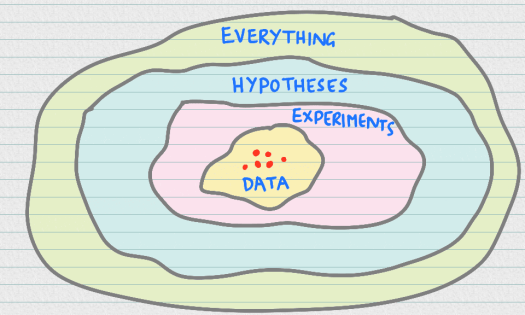
In essence, we look around us at everything and wonder why it is the way it is.

We look for explanations – create hypotheses – guesses at what might be going on.

Perhaps it rains when we do a dance, for example, or that the lines on our palms can tell what is going to happen to us.

Then, and this is the clever bit, we do something else.

We design an experiment to see if our hypothesis is right.

We collect real world data and see if what we predict will happen according to our hypothesis matches what happens in reality.

It seemed obvious for many years that a heavy object would fall faster than a light object when dropped from a height.

It took an experiment – dropping a heavy and light ball from a height and seeing when they hit the ground – to show that they fell at the same speed. Their weight made no difference to the outcome.

The experiment showed the hypothesis was false and so we needed another one.

The problem is that life quickly becomes more complicated from that point.

While the scientific method changed the course of human history and gave us cars, trains, planes, rockets and the rest of the modern world, it also created an illusion that it could explain everything.

And that’s wrong, it seems. The history of science shows that new hypotheses come along with irritating consistency to upend everything we know.

Simple Newtonian physics morphed into relativity and the simply incomprehensible world of quantum mechanics.

The logical end result of all this, as described in Pirsig’s Zen and the art of motorcycle maintenance, is that “The number of hypotheses that can explain any given phenomenon is infinite”.

What this means, in short, is that we think science will help us move towards the truth.

Where it matters, however, science simply increases the number of truths – what we believe to be true might not be true a few years from now.

Truth, rather than being fixed and unchanging, may be something we accept as true for the moment.

The point is that the scientific method has taken taken care of the material needs of many people – food, shelter, clothing.

The mistake we make is when we assume that because it explains so much, it explains everything.

The problem, again from Pirsig, is that the structure of reason based on rationality is “emotionally hollow, aesthetically meaningless and spiritually empty”.

We need to look elsewhere for meaning.

How can you get there faster?

sequencing.png

If you’ve ever been out with kids you will have experienced this.

Let say we set out on a walk someplace.

Everyone sets off at the same time from the same place. All is fine at this point.

Then, inevitably, the older kid starts to pull away from the group, walking faster, with one adult trying to keep up.

The younger one, along with the other adult, goes more slowly.

Within a short amount of time, a gap opens up between the members of the group.

In longer walks or hikes, this can become fairly substantial.

So, how long will it take for the group to reach its destination?

Some of us assume that with such a group, the time that it will take to get where we need to go will be based on the average speed of the individuals in the group.

So, as long as all of us try and keep up, we’ll get there.

This is why, all too often, one of the adults will turn back and shout to the other to keep up, or shout at the kid in front to slow down.

Eliyahu Goldratt in his book The Goal makes the point that averages don’t matter in this kind of situation.

The goal is to get everyone to the finish line. That only happens when the slowest member of the group makes it across.

The time for the group to reach the end, therefore, is the time it takes for the slowest member to reach.

This is something that we see all the time in work.

If there are a number of things that must be done in a sequence to produce a product and different teams do the work involved, the rate at which finished product is created is the same as the work rate of the team that takes the most time to complete its tasks.

Trying to speed up anyone else – or expediting – is a waste of time. Just like shouting in a group, it doesn’t do a single thing to actually improve the process.

The only place where any effort will make a difference is at the bit of the process that is the slowest – the bottleneck.

All too often, we think that if only we all did a better job, the company as a whole would be more productive.

Instead, it turns out, the company will become more productive only if we work on improving the performance of the activity that takes the most time to do.

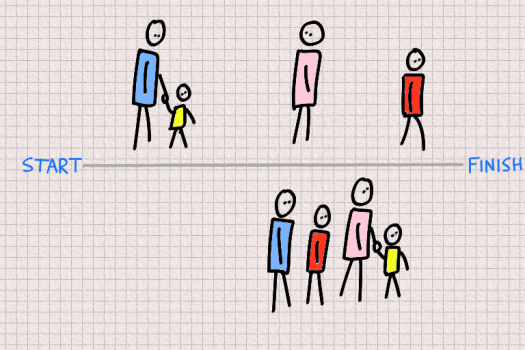
In the example in the picture, the fact is that we can’t increase how fast the smallest kid in the group can walk.

By putting that child in the front, however, the rest of the group will stay close as although they can move faster as individuals, they can’t move past the slowest person in front.

As a result, the group doesn’t spread out and there is no need to shout any more – it makes for a calmer walk, even if it’s no faster for the group as a whole.

Now, in order to improve, we have to improve the performance of the slowest part of the operation.

That’s why, on a family trip out, we end up carrying the youngest kid so often.

How to spot fake news quickly

components-of-fake-news.png

Fake news is not new. What is recent, however, is how quickly it can spread through the internet.

It’s impact is increasing, especially in politics, and may well have influenced BREXIT and the US Presidential election.

So, what can we do to spot such news – quickly?

Most of us scan news fast, and the writers who create such news know how to get our attention and draw us in.

The most important component is the headline.

Many news creators don’t write their own material. Instead, they find the story and create a sensationalised headline.

A sensational headline may:

  • Appeal to our emotions
  • Take a controversial stance
  • Introduce misleading information

The headline pulls us into the story, so we need to be especially wary of it.

The next part to look at is where the story is from – does it have authority?

We need to look at the website and the writer.

We can trust some sources, especially the major news outlets, to do good journalism. They should check their sources and facts before putting something out there for us to read.

There is an industry, however, of organisations that create material and then use social media to get it in front of people, and they can be hard to distinguish from reputable ones.

We don’t need to do it all ourselves though.

The chances are that someone else has already flagged the story as untrue or fake and posted a comment on the post or the site.

Scanning through the comments will give us an idea of whether the story is likely to be true or not.

If we have the time, before we believe something, we should try and look for another independent source that confirms the story.

This is different from stories that reference the same source. The internet is full of circular references where stories cite each other.

We just need to read more carefully before sharing these days.

Why we need to look behind the story

story-factor.png

What are the chances that we’ll make money investing in Initial Public Offerings (IPOs)?

Not that high, it turns out. As a group, IPO performance tends to lag the market for some time.

An IPO is accompanied by lots of excitement and hype. Expectations are high and buyers are worked up into a fever.

The best result for the promotors is that values are pushed up well beyond any rational assessment. This attracts people who believe by buying early, they can profit from a quick rise during trading.

Then, because the price is so high, it takes time for reality to catch up, and the relationship between earnings and price to reassert itself, which often means that the growth rate slows down for a while.

The problem we face is that the story we hear hugely influences how we think about a sitution.

For example, lets say you are given a description of a person as someone who likes solving puzzles, is good at maths and something of an introvert.

Also, you’re told that the description comes from a list of 30 engineers and 70 lawyers.

What is the probability that the person described is an engineer?

If you’re like most people, you probably think there is good chance that the description is of an engineer.

Most of us, in this situation ignore the base rate – the fact that 70% of the list are lawyers and so that we should start with the expectation that there is a 70% chance of an individual selected from that list at random being a lawyer.

And the reason we ignore the base rate is because of the story – the additional information about the person’s personality – the puzzle solving and maths capability sends us in the wrong direction.

Without that information, we would probably have gone with the probabilities as given to us. The addition of a third piece of information changed how we looked at the situation.

We see this effect happening all the time around us.

When something happens we cling to the first story that claims to explain what is happening. This bias is exploited by viral fake news stories.

The challenge these days is that we have so much information and so many stories around us that it’s virtually impossible to have an informed view.

Instead of watching the news, it may be a better idea to study history before handing over your money.

What’s your story?

types-of-growth.png

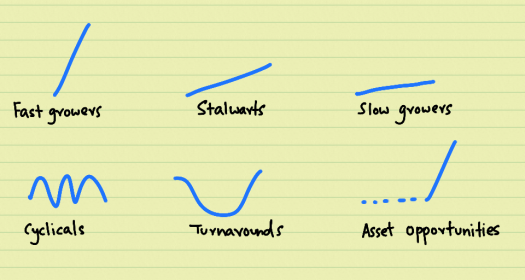
In his book One Up on Wall Street the investor Peter Lynch writes about six stories one can associate with companies.

Every investor wants a ten-bagger, a company that shoots up and multiplies their investment many times over.

Fast growers are usually small or are building a completely new market, which lets them get bigger fast.

They might have the potential to grow 20-25% a year or more for a number of years.

Stalwarts are larger companies, with a profitable market and room to build business.

They might double in a while – say five years.

Slow growers are the established companies that have pretty saturated markets.

They may grow at a little more than the growth rate of the economy as a whole.

Cyclicals experience the ups and downs of business cycles.

Commodities and shipping, for example, tend to go through cycles of oversupply and reduced investment followed by lack of supply and increased investment that makes the price of their products, and therefore their earnings, go up and down.

Turnarounds are opportunities where new management, new owners or a change in the environment make a previously unprofitable or failing company viable.

On the other hand, they might never grow at all – or have to change radically to remain relevant. Textile mills, for example, might move from cotton products to increasingly high-tech fibres now.

Asset opportunities are companies that have value hidden in places the market misses.

If that value then comes to light later, it should result in a rapid increase in valuation for the company.

Peter Lynch came up with these categories a number of years ago and used them mostly to select listed companies for a stock portfolio.

They are, however, fairly universal patterns and can be applied to a number of circumstances.

Take a career or a startup project for example.

Is it slow growing or fast growing? Is someone working on a project that, when realised, will skyrocket their value?

The point is that the story you tell will decide the investment you get.

How to deal with the facts in front of you

beyond-budgeting.png

How do we know what’s round the corner when we’re driving somewhere?

We look in front of us, through the windshield, at the road ahead.

The road behind us, reflected in the rear view mirror, isn’t going to add much to our journey now.

So, why is it that so much of what we do in work resembles driving by looking in a rear view mirror?

Take budgets, for example.

In many businesses these are set at the start of the year. We assume levels of sales and costs and work out what we think will come in that year.

Perhaps we set targets that are higher than we can achieve – as “stretch goals”, with the idea that this might motivate us and drive us to accomplish more.

Then, we tend to forget about them. Perhaps someone looks at them once a month and sends out an update.

Or, take the business of losing weight.

If we’ve put on a couple of stone and decide at the start of the year it’s going to come off – then we’re essentially setting a budget for weight loss.

Perhaps we then check our weight every once in a while and see where we are – and then it all gets a little too de-motivating and we switch off.

Many entrepreneurs seem to have a different approach – both to money and weight loss.

Instead of thinking up a magic number and then looking back each month to see how they are doing when compared to that number, they look forward.

They pick a target – for example the amount of money they need to bring in each week to break even and then watch how they are building up to that number every week.

This is a subtle but important difference.

They don’t ask themselves, “How did I do last month compared to budget”.

They ask, “How far off am I this week from target?”.

They know that if they build up to their target every day, every week, then as the weeks turn into a year, they will arrive at their destination ahead of any budget they might set.

In addition, if they are having trouble getting to the target, they can do something – they can change tactics, commit to doing the basic things they need to better or set a more realistic target.

There are no penalties – just deal with the facts in front of you.

Like driving, if a tractor pulls into the road ahead of you, then you can slow down or change direction.

You can only do this if you are looking forward, not back.