Can You Recognize Things That Have Value?

value-assessment.png

Wednesday, 9.14pm

Sheffield, U.K.

Creativity is the process of having original ideas that have value. It is a process; it’s not random. – Ken Robinson

It’s always a challenge to figure out how you should spend your time – where you’re going to add the most value. And while you’re doing that you need to remember that value is of greatest importance to the person who gets it from you, not to you yourself.

Imagine you have a business. Should you be laser focused on the things that make you money today? Or should you be patient, building and investing for the long term? Short-term rewards can seem the most attractive because they bring in resources now. But how do you know you aren’t throwing away something that could be much more valuable, if only you gave it some time?

I was talking to a friend today about this and how hard it is to decide whether to do a little or a lot. We’re advised to focus, to make it really clear exactly what we do and how we help. But we also try and serve everyone, try and do more than we can. And if you speak with people who know what they’re talking about they’ll be blunt about it. “Figure out where you add value,” they’ll probably say, “And do only that.”

But a focus on just one thing is not good either. I often read about entrepreneurs who have a good idea, raise money to plough ahead with that and then wind up a few years later, finding that there is no market for that thing they’re creating. But you don’t know whether they’ve given up too quickly.

The unhelpful answer, I suspect, is that you have to do both. You have to have a portfolio of investments, some that are mature and produce now and others that are nascent and that need to be tended until it’s clearer whether they have value or not. It’s like being a gardener, and making sure all the plants that you want to keep are fed and watered and the weeds are pulled out.

I think what’s important, however, is making it very clear what you do in each element of your portfolio. You may have a technology portfolio and carry out work in certain areas. Each of those packages of work needs to be clear – a minimum viable package in itself – that does not overlap with other elements but is able to communicate and cooperate with them.

This is not easy to do and there is a question of “how” that should be done. There are answers, of course, but this is not the place to talk about them. The point is that there are many ways to make things worse, but only a few that make things better.

And one very big idea is that the less you do the less you can do wrong.

Cheers,

Karthik Suresh

What Does A Facilitator Do?

roles-people-play.png

Tuesday, 9.47pm

Sheffield, U.K.

If there aren’t roles you want to play, then you’ve kind of got to create them. – Margot Robbie

I’ve had a few days of listening to academic presentations at a conference and am reflecting on how easy it is to fool ourselves and how much effort it takes to avoid doing that.

Take work, for instance. We like to think that things are clear cut, that what you need is a mission and vision and goals and the right person in charge and everything will be well. We like to think of stars and individual performance as things that make a difference. But how do we know that these things work? How can we be sure that success came from doing certain things unless we’re sure that there aren’t organisations and people that have done exactly the same things and failed?

You can get away with such assertions if you’re a salesperson or motivational speaker but if you’re going to be peer-reviewed then you need to put some more effort into being honest. And once you start to penetrate the jargon that suffuses a typical paper you start to see that there is some useful stuff there, even though you have to dig for it.

Take, for example, this paper on facilitators by Lessard et al (2016). I’m interested in this because we’re often in situations where things aren’t working out ok and we want to change things. That means working with others and that’s a challenge. Good change often doesn’t happen by itself, it needs to be facilitated.

So what does facilitation look like and who does it? Facilitation can be a role a person takes on, it can be a process or it can be about helping a group work through something.

The paper argues that if we look at facilitation as a role you end up doing two types of activities: you change how things are done or you help people to work better together. In the first case you’re involved in processes for change or for project management. In the second you’re looking at faciliting meetings between people and supporting them as they do the work of making change happen.

But that’s not really enough to tell you what’s done and that’s where you come across lists in papers. For example, what do external facilitators do in their day to day work. Here’s a list from this one.

  • Train you in skills
  • Help you think critically and ask better questions
  • Know what needs to be done next
  • Evaluating meetings
  • Tailor sessions to meet local needs
  • Plan and generally sort things out
  • Listen, clarify and summarise material
  • Watch how people act
  • Share what others are doing

Internal facilitators, on the other hand:

  • Use stories to make their point
  • Talk about examples and cases
  • Link actions with outcomes

If you’re trying to change things around wherever you are, then these papers give you useful checklists. Do you do some of these things, all of these things? Are there things you should do more of?

I spend a lot of time being unsure about things. That’s probably a good thing because it means you’ll check things out before you decide to believe in them. But when you’re sure you need to make that clear – and that’s a skill I need to develop for myself.

And it’s worth doing because there is no shortage of situations that could do with someone who knows how to change them for the better.

Cheers,

Karthik Suresh

Lessard, S., Bareil, C., Lalonde, L. et al. External facilitators and interprofessional facilitation teams: a qualitative study of their roles in supporting practice change. Implementation Sci 11, 97 (2015). https://doi.org/10.1186/s13012-016-0458-7

What Is The Real Value Of Having A Target

value-of-targets.png

Monday, 6.39pm

Sheffield, U.K.

Fairness is not an attitude. It’s a professional skill that must be developed and exercised. – Brit Hume

My first real understanding of the differences in opportunity people across the world face only came when we were expecting children. We took classes, a free one and one we paid for. And I realized, looking around me, that all the children who were going to be born to parents that had the relatively small amount of money needed to pay for their class would have books and attention and resources. The free session had a different set of parents, ones with more challenges and the children born to them would have less – and that difference, cemented at birth – would only increase until they went to school and then the gap would get increasingly harder to close all their lives, not considering other factors like gender and race.

I have never been a big fan of targets. Maybe it’s a cultural thing – I was brought up to think that the work was what mattered, not the results. If you do what you need to do every day the long-term will look after itself. And if it doesn’t it won’t matter anyway.

But even that ability to “get on with the work” is a privilege. It presupposes that you have the time, knowledge and money to do work. And not everyone has that.

I’m learning, quite late really, about the power of targets to change behaviour. But there’s something else about what’s going on that seems to suggest that targets are a good thing. And it’s the availability of information.

Take investing, for example. Once upon a time you could have an information advantage. If you read the papers and looked for opportunities you might find a bargain. Those days are gone because information is widely available and the ability to profit from an information advantage no longer exist. Now, you’re best off buying the market or buying a great company at a fair price – not looking for an edge.

This “transparency” is what’s making the difference in sector after sector, workplace after workplace. Your reputation is on the Internet, with metric after metric telling the world how you’re doing on financial and non-financial metrics – how you treat your people, what you’re doing to the environment, who you’re paying.

Setting a target does two things: it sets up an evaluation framework and creates an incentive mechanism. For example, if you run a conference these days you’ll be evaluated on how diverse your panels are. If you have a male only panel – a “manel” – people will ask questions that you will find hard to answer. You have an incentive to create a diverse panel if only to avoid the embarrassment of being seen as a unrepresentative and behind the times.

The incentive mechanism spurs you to take action and you can do one of two things. You can create real change and start to transform your operations so that you develop a diverse workforce or you can game the system and make sure that you meet the numbers. But it’s going to be hard to do that over the long term because of the availability of information – it’s certainly harder to do this than it was in the past. Some people perhaps look longingly over at the more authoritarian regimes in the world remembering when they could do the same thing but still claim to be democratic.

Diversity and representation is one very important space where targets seem to be making a difference. Another area where you can see action is when it comes to climate change. Clear targets like the UK’s Net Zero target and the Paris Agreement’s 1.5 degrees science based one are causing companies to make public statements about their commitments – ones that they increasingly feel compelled to do to protect their position in the economy. And that’s a good thing.

Perhaps the biggest benefit of this approach is that it’s a fundamentally fair way of looking at what the economy is meant to do. If the economy is made up of many people but the benefits of their work goes to a few it used to be ok to argue that those few were entitled to more because they worked harder, because they were “better”. And that’s not a bad argument really because you do want people to be the best they can be. But what you also want to do is dismantle the barriers that are in the way of people being the “best” they can be.

Cheers,

Karthik Suresh

What Is The True Value Of Knowledge

value-of-knowledge.png

Friday, 7.47pm

Sheffield, U.K.

Risk comes from not knowing what you’re doing. – Warren Buffett

I sometimes wonder what the value is in what I do in this blog – how reading and writing and thinking help in any way with the practical issues we face day to day. As Robert Kiyosaki trenchantly pointed out, “A students work for C students, and B students work for the government.” It’s easy to wonder whether getting an education is worth it or whether you’d have been better off setting up in business a long time ago.

And then I learned how much of a privilege it is to have the choice to have an education. I was editing my grandfather’s memoirs and reading about his struggles to get an education in the harshest of circumstances. If he hadn’t pushed himself to study, kept trying to better himself, things might have been very different for those of us that came later.

The thing with knowledge is that it’s a weird sort of thing. When you give it away you still have it. If I tell you something I know I don’t lose anything, I still know it too. But whether or not you know it depends on the way in which you get it.

Most education is about information transfer. In an engineering class, for example, you might learn about relays. You’ll learn about different types of relays and the way in which they’re operated and how they can break circuits when overloaded. But it will mean very little to you if you’ve never seen a relay before or a substation or any of the infrastructure that powers everything around us. I nearly failed electrical engineering because I really didn’t know anything about electrical systems.

Later, when I knew what a generator was and how it was connected a network I understood why such knowledge might be useful. I had a real-world example of a situation that I didn’t understand and the knowledge needed to fill that hole in my understanding had value all of a sudden.

Or in a more general example you only know the value of learning to swim when you find yourself unexpectedly in the deep end.

There are some things you can learn “just in time” and there are other things you should learn “just in case” but the biggest thing about learning is that when you know what you’re doing the risks of doing it wrong go down dramatically. As Santayana said, “those who cannot remember the past are condemned to repeat it.” It’s best to learn from other people’s mistakes.

But we don’t always value knowledge, not unless we understand that we really need it. No one wants unsolicited advice. But when they’re in trouble they’re desperate for anything that can help.

And I’ve found that the exercise of writing has helped in unexpected ways. I’ve written about models and approaches that seemed interesting and, all too often, the next day someone will mention a problem where one of these ideas happens to help. In the writing phase it can sometimes seem a waste of time. But then it’s unexpectedly valuable when a problematic situation comes along.

Perhaps the best way to end is with another quote by Warren Buffett.

“If you are investing in your education and you are learning, you should do that as early as you possibly can, because then it will have time to compound over the longest period.

And that the things you do learn and invest in should be knowledge that is cumulative, so that the knowledge builds on itself.

So instead of learning something that might become obsolete tomorrow, like some particular type of software [that no one even uses two years later], choose things that will make you smarter in 10 or 20 years.”

Cheers,

Karthik Suresh

Understanding Sensemaking

sensemaking-weick.png

Tuesday, 9.42pm

Sheffield, U.K.

The Universe is under no obligation to make sense to you. – Neil deGrasse Tyson

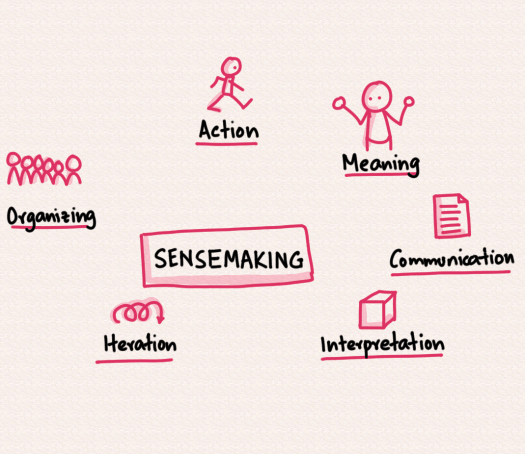
I wanted to understand sensemaking as a concept and came across the work of Karl Weick, an American organizational theorist who started by talking about meaning and then moved onto sense-making (with a hyphen) before finally settling on sensemaking as a way to understand what happens in organizations.

A 2020 paper by Mary Ann Glynn and Lee Watkiss titled Of Organizing and Sensemaking: From Action to Meaning and Back Again in a Half-Century of Weick’s Theorizing introduced me to some of his ideas.

Let’s start with what we think happens in organizations and what actually happens in organizations. We’d like to think that people have a plan – they come together and set goals and then figure out what needs to be done and then execute and it’s all good.

That’s what they’d like you to think.

The reality is that in most organizations there is something else going on. It starts with people doing things – taking action – and then explaining what they’ve done to themselves and others.

Take how governments have dealt with the pandemic as an example. Do you think they had a plan and executed it or do you think they took action based on what they believed was the right thing to do and then looked back on what they did and talked about it as if it was the plan they had all along?

Take this collection of quotes from Dominic Cummings, which includes the following one: “It’s true that I hit the panic button and said we’ve got to ditch the official plan, it’s true that I helped to try to create what an official plan was. I think it’s a disaster that I acted too late. The fundamental reason was that I was really frightened of acting.”

In Weick’s work over a half century he starts with an idea that action leads to meaning and ends up with the idea that the two are interdependent – they both matter for sensemaking, which is how organizing is done.

There are a few terms there that are worth noting. If you and I work together, we engage in organizing. We do that because it makes sense to us. It makes sense because we can look at the actions we have taken and if they were good ones or bad ones – we can ascribe meaning to them, interpreting what’s going on.

The way in which we do all this is through communication. Communication is how we share what we think and what we understand and how we see things. And it’s a continuous, iterative activity that goes on for as long as we’re engaged in any kind of organizing activity.

Why is it useful to consider these things?

Well, for a start, things just seem to happen one after another. The financial crisis, Brexit, Trump, nationalism, Covid. There’s always something new that comes along and which needs to be made sense of.

It’s easy to say that the wrong decisions were made once something goes wrong but there are also lots of wrong decisions that we don’t know about because nothing has happened yet.

But perhaps if we become more aware that we have a tendency to act and then justify what we did even if it turned out wrong then we might try and think a little harder before we made big decisions.

Or, of course, you could not bother and simply run for Prime Minister or President.

And you’d probably win.

That’s what history seems to be teaching us anyway.

Cheers,

Karthik Suresh

How To Scale Your Business

copy-exact.png

Monday, 8.49pm

Sheffield, U.K.

Most mutations involve typos: Something bumps a cell’s elbow as it’s copying DNA, and the wrong letter appears in a triplet – CAG becomes CCG. – Sam Kean

In yesterday’s post I was looking at why it’s hard to copy what someone else does. But what if you want to make it easier to copy what you do?

If you have a process that works really well and you want to scale it then you’re going to have to show others how you do what you do. But what’s the best way to do this? Should you get them to copy exactly what you do or do you adapt what you do to fit the situation you’re in?

Gabriel Szulanski and Robert Jensen’s paper Presumptive adaptation and the effectiveness of knowledge transfer looks at this question and tests it with a franchising business, coming to the conclusion that you should copy things exactly first before you mess around with trying to customise it to your situation.

This can seem strange at first. After all, if you’ve developed a process in one country surely you should adapt it to the culture and preferred ways of working of another one?

It turns out that changing things too quickly means you waste time adapting rather than implementing and that slows you down, and you don’t get the results you should be getting. What you should do is copy the process exactly until you can get the same results as the original model and then start tweaking it to make it even better.

The image above, for example, is Keyhole Ken The cartoonist’s workbook by Robin Hall. If you want to learn how to draw cartoon figures Hall suggests that you should start by drawing page after page of Keyhole Ken, copying the elements that matter. Only start modifying features once you’ve mastered the basics.

The problem we have is impatience. All too often we think that we know better and can improve something without even trying it out first as we’re supposed to. It’s a function of the “Not Invented Here” concept and I know I’m guilty of doing this.

But companies who know what they’re doing, like Intel with a new fabrication facility or Xerox insist on a “copy exact” approach. And I think this has a biological basis too. Organisms replicate themselves. They don’t experiment with huge changes like swapping legs for fins from parent to child. Instead the changes are tiny, one mutation at a time and the ones that improve fit are kept.

Perhaps this is why the apprenticeship model of education works better than more modern alternatives. Apprentices learn how to do things in exactly the way their superior does until they’ve mastered what they need to know. And then, perhaps, they make changes to improve on their ability.

If you want to get better, then, or grow your business or scale a model or roll out a franchise – your starting point should be to figure out how you can replicate your existing working model and make sure that it’s transferred unchanged. That means the people adopting it need to understand that they can’t change it unless they can show that they can perform as well as the existing model does.

I think this has wide applications to almost everything we do. And it comes down to a simple principle.

Build what you already know works.

Cheers,

Karthik Suresh

Why You’re Safer From Being Copied Than You Think

unobservable-elements.png

Sunday, 7.37pm

Sheffield, U.K.

“Tell me, Ms Sumner, what exactly does a behavioural psychologist do?” “Monitor observable behaviour for signs of internal psychology. We read people.” – Johnny English Reborn

A lot of academic reading is about looking at big words and trying to figure out if they say anything new or if they say anything at all.

One of the hallmarks of a good academic is that they can list the essential elements of any concept pretty quickly. What most people do is pick the things they like but it takes some thinking to look at all the elements (or as many as you can) and then decide which ones matter.

It’s also possible that you get concepts that are not well thought through if you are under pressure to publish. And if the way you’re marked is on the quantity of papers you publish rather than the contribution you’re making then you’ll do what counts rather than what matters.

The point I want to make, however, is that it’s hard to tell from the outside what’s going on on the inside. Is this paper you’re looking at – this one in a reputable journal – something that’s going to be useful or something that’s going to be a waste of time?

This question can be generalized to pretty much everything that you face in day to day life. Is that salesperson trustworthy or a shark? Is that product good or a hazard? Is that idea good or a reheated ripoff?

The difficulty we face is that what you see is not what makes it work. For example, you’ve seen big machinery at work digging and excavating and bulldozing stuff. But do you have any idea of what’s involved? Can you just jump in and push earth around or are there questions about the kind of earth or the kind of machine or the gear you should be in? Just because you’ve taken a course and can drive one of these machines doesn’t mean you know what to do.

Realizing that doing something well is more about doing it the way it looks like it’s being done is important – and it’s something that’s easy to forget. For example, people assume that what makes a democracy a democracy is the vote – that every citizen has a vote. But there are lots of countries where citizens have votes and are notionally democracies but somehow people don’t seem to get the benefits that one expects to get from democracy. So what’s going on?

“That’s obvious,” you might say, “There’s more to doing something than what you see on the surface.” And you’d be right – and that’s what one of the papers I’m reading says using much longer words. There’s the stuff you see. And there’s the stuff you don’t. And if you want to do what you’re seeing someone else do you need to be able to do both – but you’ll have to do them your way to be any good.

This is why watching someone’s course or using the same pencil as someone or the same setup will not give you the same results. It’s what you don’t see that makes the difference – the secret sauce that makes something amazing.

The good news for you and me, however, is that it’s this same thing that makes what you do hard to copy. People can do the stuff on the outside but it’s the inside that makes the difference.

Of course, you’re left with the problem of telling the difference. What’s the difference between an expensive cereal and an own brand one? Sometimes there’s nothing. I’ve been in factories where the same product is called high-end in a fancy package and low-end in a cheap cover. But it’s the same thing. In other examples brand matters – you can tell the real deal from a copy.

The question you have to ask is whether what you do is truly different or whether it’s just the same as everyone else.

And if you’re different – you have something that’s valuable.

Cheers,

Karthik Suresh

What Is It That You Really Want To Work On?

keeping-it-simple.png

Thursday, 8.12pm

Sheffield, U.K.

Making the simple complicated is commonplace; making the complicated simple, awesomely simple, that’s creativity. – Charles Mingus

If you could write a letter to anyone in the world, who would it be? And how would you feel if they responded?

On an tangential note I’m looking at my new copy of The Go Programming Language written by Alan Donovan and Brian Kernighan. I’d write to one of them.

In the preface, the authors write, “Only through simplicity of design can a system remain stable, secure and coherent as it grows.”

And I think this is a useful lesson for the rest of life as well.

Take your profession, for instance. How simple is the design for your job, for what you do day to day? Do you things that are necessary, that add value or do you spend most of your time trying to sort out problems?

Sorting out problems looks just like work but it’s really a waste product, like heat. If a machine gets hot that is often a sign that it’s inefficient. When you feel under pressure, is the same thing going on

The difficulty for most of us is twofold. First we have to figure out what’s the way to do what we need to do in the simplest and most effective way possible. Then we have to stop other people from making our lives harder.

And this is not easy.

Not because it’s done intentionally but because of entropy. Everything decays. Everything gets worse over time. Whatever is done becomes encrusted with changes that often make things worse.

It’s like having a house or a car or a briefcase – the longer you use these things the more rubbish accumulates in them and the harder it becomes to sort things out.

The way to keep on top of this is to be ruthless – to keep out anything and everything that does not help move you closer to the objective you’ve set yourself.

For example, I want to write better. So I draw simple pictures that help me think more clearly and I use short words to say what I want to say. And I practice that day after day.

It turns out that I still have much work to do. 36% of my sentences are passive and nearly all of them can be improved.

There is tremendous value in simplicity.

Maybe that’s why it’s so hard to do.

Cheers,

Karthik Suresh

How To Do Hard Things

variation-selection-replication.png

Wednesday, 9.57pm

Sheffield, U.K.

A brand for a company is like a reputation for a person. You earn reputation by trying to do hard things well. – Jeff Bezos

If you’re trying to come up with an idea for an application that will make you rich how should you go about thinking about the problem? What kind of strategy will help you select an approach that has a good chance of working?

The simple answer is to try and give people what they need or want. To make it simpler for them to get what they want done.

When you think in this way you come up with ideas to make life easy – better todo lists, easier document creation, simpler interfaces, and so on.

But when you really think about it when was the last time you used anything other than Word to create a document? How much simpler can you get than the interface on an iPhone?

When you think of some of the applications out there – Google for search, YouTube for video, LinkedIn for business networking – is there really a choice other than the ones we can all think of? Is there any competition in these spaces or are these companies effective monopolies, even though they probably aren’t trying to be?

I think there are two things here and the underlying logic is summed up in a quote from an old newsgroup that says that graphical user interfaces (GUIs) make simple things simple and complex things impossible.

Let me explain.

If you want to go anywhere these days you’ll probably go onto airbnb and have a look. We used this for the first time recently and it was good – we got a room where we needed and life was fine.

Now, the simple thing, from my point of view, was looking for a place to stay. It might have been a hotel in the past, or I might have run an agent. The user interface, in this case, whether a human agent, a hotel website or a rooms aggregator all solve the same problem – which is to find a space for me to stay the night. The interface helped me solve my simple problem.

You may counter that the problem airbnb solves is not simple – it essentially uses clever software to match supply with demand. To which I say that problem was solved a long time back and it’s called a market. Airbnb simply implements a market in its own way. It’s successful because it’s well known like the other big players in this space.

Some years back we wanted to take a trip to Slovakia and decided to go by train. That was a difficult problem. It required taking six trains and booking on a number of websites in different countries and arranging hotel stays in multiple cities on the way back.

This problem is not something that airbnb appears to solve. At the time there was a website that set out the steps to follow and the websites of the train companies with booking instructions. We followed that and it all went fine.

If you can solve really hard problems that the simple solutions people are currently using can’t address then you may have a market for your offering.

The point I’m trying to make is that an application that is designed to make it simple for you to do one thing usually makes it hard for you to do anything else.

If you do make it simple and you are the best known application then you are onto a winner. But everyone else trails far behind – the winner-take-all network economy means that all the simple stuff gets dominated by the company that happens to get the most attention.

But there are still hard problems out there that need to be solved. The Internet addresses a hard problem – the ability to create, curate and share knowledge.

What’s the takeaway here?

You can solve a simple problem with your application – but if you want to win you are going to have to be the best known product in the world.

Or you can solve a hard problem and be useful.

Cheers,

Karthik Suresh

Are You Consistent In The Way You Present Your Business?

advisors.png

Tuesday, 7.33pm

Sheffield, U.K.

When you look at people who are successful, you will find that they aren’t the people who are motivated, but have consistency in their motivation. – Arsene Wenger

When I’m not sure what to think I go back to the words of people that have been consistent in their approach to their field.

I have made the mistake, perhaps, of reopening the social media floodgates. And stuff pours in, stuff that sounds good but which I’m not sure is worth remembering.

For example, one set of posts was all about how sales are important. Another talked about returns on invested capital. A third, well written piece, essentially said that of business was a game you’d have to keep all the pieces of the game in play.

So then I wonder, should I be trying to write like these writers. Is a short, punchy piece that is a list of short sentences the way to go? Or is it a longer piece that tells a story? Is there a “right” way to do this.

The obvious answer is that there isn’t. Warren Buffett, for example, writes a single letter a year to his sisters about what’s happened in the business. Others write powerful passages that tell a story and aim to provide “actionable” and “proven” approaches to the kinds of problems you will face. However they approach the topic, they show consistency in their approach.

One of the things I’m trying to do is figure out what my kind of consistency looks like. It’s not in the graphics and the look – given my interest in hand-drawn images and a forty-year old approach to text processing. It’s not in a persuasive story or emotive message. It’s a sense-making approach that uses models a lot.

For example, I’ve been working on building knowledge graphs recently and the extract below is from one of the papers I’ve been reading.

knowledge-acquisition-range.png

This gets across the dilemma I’ve hinted at so far. If you want to acquire knowledge you have to understand that knowledge can range from natural science to storytelling. Knowledge in the natural sciences has to meet the test of public repeatability so it meets a high standard of truth. Stories, at the other extreme, may only be plausible. And plausibility is a weak thing – it’s not enough to rely on. If you rely on things that are plausible you end up joining mobs storming buildings. Not always, but that seems to be the end result all too often.

Life’s too short to believe in stories. But if you’re going to tell one for your business, make sure it’s one that you can live.

Cheers,

Karthik Suresh