What Is The One Thing To Focus On When Trying To Improve Your Process?

speed.png

Sunday, 8.29pm

Sheffield, U.K.

If everything seems under control, you’re not going fast enough. – Mario Andretti

Every once in a while you come across people who take their time to get things done.

One place you’ll find them is in a public service – where it’s important for your career not to get things wrong.

If you get things right you’ll get more work and fail to be recognised – and your boss will probably take the credit.

If you get it wrong, you might get fired.

So there really is no point in taking a risk, pushing for change, making a noise – unless you’re certain you won’t be criticised.

Then there are others who take their time in the private sector – doing their jobs as set out in their contracts.

But they’re probably not very high up in their business – and if they keep taking their time they’re not going to get any higher.

Perhaps they’re fine with that – but what do you do if you’re not?

What you’ve got to think about is speed – how do you do what needs to be done faster and faster.

Speed matters, because in many cases it provides a competitive advantage that is hard to beat.

Let’s say you’re in the business of delivering a consultancy service.

The way you get business is to go into a prospect’s company and offer a free review – you study what they’re doing and produce a report showing how they could do better – and how hiring you will make them money.

Let’s say you budget for three days to do this – one day to travel to see them and sell them your free review, another day to go down, interview them and look around and one more day to prepare and present your report.

That’s three days of free consultancy.

A consultant usually needs to hit a certain number of paying days to stay in business – typically around a hundred.

If your typical client takes a five day engagement from you, then you need to make twenty sales to hit your number.

And that’s at least 60 days of free consultancy to win those – at three days a pop.

But you don’t win all your pitches – let’s say you get one in three.

That’s 180 days spent pitching to win 100 days of business.

And now you have to work 280 days in a year.

At which point you might decide that it’s all a waste of time and you should go back and get a real job.

So what can you do to improve things?

Well – the first thing is to get faster at every step that’s involved in the process.

Do you have to go and meet people face to face – should you first qualify every prospect with a phone call.

Do you have to do your review on site – can’t you collect material from their website and documentation, or run a session using videoconferencing?

Does your report take a day to create – how much can you automate and speed up what you’re doing?

People sometimes equate time with quality and that’s just not the case.

Or even if it is, there is a problem with that approach.

The question is whether that quality is worth paying for.

Let’s take blogging as an example.

There are lots of people who create their content with care – who spend four or five hours on each post.

They interact with the WordPress editor, curate their images and sort out every last detail perfectly.

And maybe that matters in some sectors, and maybe it doesn’t in others.

For example, I don’t have four or five hours to write my posts.

I give myself an hour to an hour and a half every day to pick a topic, do research, draw a picture and write these words.

It’s not perfect – but it’s a process that works for me – and one that helps me create content most days in a year.

And that helps in other ways – as I learn more about the topics that interest me and get better and elements of the work.

Recently, I thought I’d try my hand at explaining what I do professionally by creating a comic

My first attempt tried to bring together various elements that go into the design of a comic.

One quite important element is the layout of panels – the boxes in which you put your text and images.

Now, you could draw them in a graphics editor using a mouse.

But I am not a big fan of anything that requires manual intervention – so I used the PIC programming language to lay out a set of boxes and create functions that could be called quickly.

It’s geeky – but it means you can create a page of panels set out with the right gaps in a matter of minutes – and that works for me because the one thing I don’t have is lots of time.

And you’ll find areas in your business where the things you take a lot of time doing manually can be done faster – but you might have to learn how.

And the beauty of doing as much of the process as fast as you can is that you then create the time to spend on what you really want to do.

If the small things, the details that take up your time are no longer an issue, you can then focus on using your time to add value – something that makes the most of your knowledge and skills.

The kind of value that is best added when you take your time.

Cheers,

Karthik Suresh

Is This Sales Model One That Could Help You In Your Business?

lat-sales.png

Saturday, 8.33pm

Sheffield, U.K.

Pretend that every single person you meet has a sign around his or her neck that says, ‘Make me feel important.’ Not only will you succeed in sales, you will succeed in life. – Mary Kay Ash

When you think of a “model” what comes to mind?

Is it something like a physical scale model of a building – the kind of thing an architect might build?

Is it a set of equations that describe a relationship between things, maybe even a cause and effect one – the kind of thing you could build in a spreadsheet?

Or perhaps it’s a framework, a matrix of possibilities or a collection of ideas that seem to work well together.

But perhaps what’s more important than what a model “is” is what it helps you to do.

A model should help you look at a situation where there’s a lot going on and focus on the key elements that are important – from that particular point of view.

This is harder than it sounds.

Take the last point – the one about a point of view.

The same situation will be seen differently by an engineer and an accountant, by an employee and her manager, by the shareholders of a company and a group opposed to what the company makes.

There is a tendency in some places to think of sales as an exercise in positioning and pushing product.

Set it up right and then hammer a message home until a buyer gets it.

This approach works in some situations – ones where the product is easy to describe, easy to compare and where there is a market that needs to get it.

Like insurance, for example – getting you to buy insurance now is all about share of mind – you will have certain websites in mind that make it easy for you to check options, select the cheapest and go ahead.

It doesn’t work that well in service businesses that are harder to describe and compare.

In those situations you still need someone doing the selling – and that’s where the LAT sales model comes in.

I’ve made this model up, so I should probably explain why quickly.

Often when I read about a model I’m not sure how it was created.

The chances are that there was some science at work – people like to quantify things.

Maybe they did some surveys, looked at data and came up with correlations – and then put it all together in a neat package and presented it as a model.

But in social situations numbers are not always the most useful way to look at things.

Sometimes you need to actually spend some time in the situation, looking at what is going on, grounding yourself in the reality that is in front of you and then generating theory – which might make its way into a model.

Which is where the LAT model comes from – it’s an attempt to simplify some of the things I’m seeing when doing sales these days.

How would you use this model when thinking through your own sales process?

The first element here is to Listen.

What I mean by that is to shut up and only say something to ask a question or clarify your understanding of a point.

All too often sales people spend their time with a prospect explaining everything about their product.

They might start by asking the customer what he or she needs but as soon as there is some hint that what they’re selling could come in, they jump into the conversation to talk about themselves.

I think that’s an issue.

When you simply listen and ask questions, forcing yourself to stay quiet even when you know exactly how to solve the problem being described, what you’re giving the prospect a chance to do is work through everything that’s in their heads with you.

When they finish doing that – when they’ve said everything they have to say – and look at you to ask what you think – that’s the point where you start to talk about yourself.

What happens if you do this is that you should understand much more about what their problem is and zero in on the areas where you can help.

What you’ve got to do is Agree that you and your prospect have the same problem in mind – the same image of what needs to be done.

All too often salespeople think that you have to change the mind of the prospect with your pitch.

Instead, what you need to do is put yourself in their shoes, look at things from their point of view and see what they’re seeing.

And then you can talk about what you would do to make things better – and you’ll get a more positive response because you’re both talking about the same thing.

At this point there is still one more thing to do.

You both need to Tell a story.

The chances are that you are both now clear on what needs to happen next – but you probably need to get agreement from a larger decision making group.

They don’t need all the detail, all the hard work you’ve done to listen and see things from the prospect’s point of view – the work that’s gone in to making sure you’re aligned.

But they do need to be comfortable with the plan that’s being put forward and to do that you need to tell them the story of why it’s the right thing to do.

You need to take them from being negative or neutral to being positive and supportive – because that’s how you’ll get your contract signed.

And this takes work because you might think that your existing material – the deck you have is just fine – and it may be.

But you’re better off telling a story in a way that will engage an audience rather than describing things from your point of view – which is what most presentations do.

They talk about things that are important to you and the audience dozes off.

Your presentation should be all about them – about what they’re going to get, how they’re going to get it, and how you’re going to take away all the risk because you know exactly what you’re doing.

Now, this is a simple model on the surface but there is a lot of depth to it.

Many salespeople operate using a model that seems to follow a Talk, Pressure, Whine model.

They talk about themselves to a prospect, try to pressure them to make a decision and then whine about how ungrateful the prospect is.

In their minds they’re the most important people in the room.

But you know that person is your prospect.

So start by taking the time to listen to them.

Cheers,

Karthik Suresh

What Are The Steps To Creating Something That Adds Value?

components.png

Thursday, 9.23pm

Sheffield, U.K.

The promises of this world are, for the most part, vain phantoms; and to confide in one’s self, and become something of worth and value is the best and safest course. – Michelangelo

When you know how to do something you start to forget that it was once difficult.

Take reading, for example.

How often do you stop and take a minute to think about what you’re actually doing right now?

How your brain is taking shapes made from light, descended from charcoal on stone walls?

How it turns them into meaning – putting together squiggles in combinations that spell out words and sentences and phrases and help you read someone else’s mind.

If you have children you can see their attempts to get to grips with this astoundingly complex activity.

If you’re unsympathetic or have forgotten what it’s like to start something right from the beginning – you might wonder why they have a problem at all.

But if you’re wise you’ll watch them closely, picking up clues about how you can plan your next learning experiment.

Reading and writing seem easy in comparison to other tasks – but that’s just because we’ve been doing them for a long time.

When we set out to learn something new we start by examining the components of that thing.

Take baking a cake, for example.

I’m not a good baker – I don’t have the patience to follow recipes.

I find that if I throw a bunch of ingredients into a mixer and blend until the resulting mix seems about the right consistency – then something edible sometimes emerges.

Two out of three times, perhaps.

I’m thinking particularly of a banana cake experiment and a spinach based chocolate cake.

My last attempt at creating a flapjack resulted in what tasted like soggy bricks of cold porridge.

And the point I am making, I suppose, is that gaining mastery over the components of a thing matters if you want to do it as a job or profession or business.

I used to think that the thing that differentiates a professional from an amatuer was money – the act of being paid.

But I think actually the thing that makes the difference is the mindset of the person – are they trying to do this once or twice – or just when they need to?

Or are they trying to do it again and again – getting better each time and trying to learn everything they can about wha they do?

You might think of the professions – doctors and lawyers and so on.

But the best doctors and lawyers will spend their time reading and learning about their field.

Others will spend their lives prescribing based on what they have learned so far.

While both are called professionals – only some of them act like professionals.

I was in London the other day and had some time to kill so I wandered over to the treasures room in the British Museum.

There you are confronted with the messy reality of how people once worked.

The piece of paper where Wordsworth wrote out the lines to “I wandered lonely as a cloud” next to the Beatles collection – who appeared to write their lyrics with crayons on brown paper.

If you look at the physical artifact it looks like something anyone could do – something you and I could do.

But we don’t.

And we would be wise to see those marks – marks that we could make – and see how they emerge from a lifetime of work and practice hidden from view.

The point I’m trying to make is this.

A lot of people can read and write – they’ve mastered the components and put them together and can create useful things – emails and documents.

But if you want to be exceptional you have to learn and put together components in a way that other people don’t.

Cartoonists, for example, combine skills with page layout, script writing, fine art and colour to create something that many people would see as simple, maybe even childish.

But could you create one?

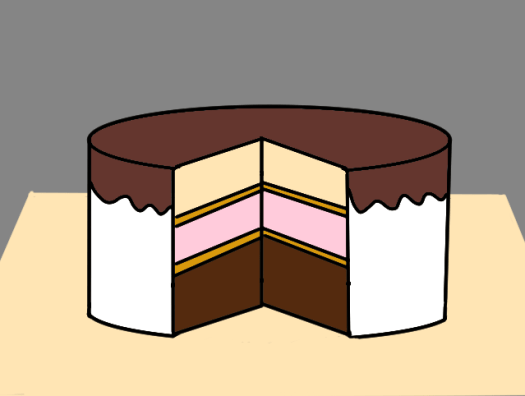
Could you bake a multi-layer cake with a topping and frosting?

I can’t even draw one properly…

But if you knew how to create the components of a normal cake and then you were able to add your spin and twist and design ideas – you might create something that stands out – something that has value for others.

A lot of people think that value is something you have or that you give in exchange for money.

Perhaps we should think of value as something that emerges from how you put together the underlying components.

My one layer banana cake has value – my children will eat it to get sugar fix.

But given a choice they’ll pick the one made by a baker who knows what he or she is doing.

So perhaps if you want to get into the business of creating value – you first need to understand what you need to do to be a professional.

And then get busy working.

Cheers,

Karthik Suresh

Here Are Some Of The Ways You Can Be Wrong About The Future

futurology.png

Monday, 8.22pm

Sheffield, U.K.

The future depends on what you do today. – Mahatma Gandhi

I am reading Bertrand de Jouvenel’s The art of conjecture which looks at how we try and predict what will happen.

How do we forecast possible futures – how do we come up with a vision, a conjecture – and then stop ourselves falling in love with it and believing that it will inevitably come true?

We do this kind of thinking all the time – from figuring out what to do next with our careers, our businesses and our relationships – to how we participate in society and politics based on our beliefs about what is going to happen.

We use lots of methods to do this thinking – many of them so automatically that we don’t question our approach to using them.

It makes sense, then, to spend a little bit of time thinking about how we think before we look at how we might think better – perhaps in the next post, so here are seven ways described by de Jouvenel in the book.

Let’s start with the concept of inertia.

Inertia is the tendency of something to keep doing what it’s doing.

If our local retail business has been growing organically at 3% a year since 2000, we think that is going to continue at about the same rate.

Things will be similar in the future to how they are now because things will keep happening in about the same way.

We’ll always commute to offices to work because that’s what we’ve always done.

Closely related to inertia is our tendency to use an analogy to explain what will happen.

The financial crisis in the 1920s led to a great depression and that’s what some people expected would happen in 2008.

But things didn’t quite work out that way and I suppose it’s too early to say exactly how they are working out.

Then there’s a view of what will happen as something like a journey on a railway track.

This model says that everyone is on a journey, some people are ahead of us but we’ll get there eventually.

That underpins the idea that developing countries, for example, will become as developed as developed countries – in time that’s inevitable.

If you’re running out of ideas, then the if-then approach works well to fill in the blanks.

This has to do with the idea of causality – that there is cause and effect.

If you do the things the same way they were done by someone else you can have the same results.

This is the mantra of the self-help industry. For example, because some people have made lots of money on the Internet, you can too by doing the same things.

Or you can be happy or thin or wealthy – just do what must be done and the result will happen.

At one extreme thinking in terms of cause and effect can take you down an avenue of positive thinking and the Think and grow rich schools of being.

Banish all negativity from your life, don’t listen to critics, believe in yourself.

At the other extreme is the person who believes that things are impossible because they just are, what de Jouvenel calls a priori – something independent of experience.

You believe it to be impossible and therefore it is.

It’s impossible to create a free encyclopedia.

It’s ludicrous to imagine a world without newspapers.

Chasms cannot be leaped – don’t even try.

But then someone builds a bridge and it’s suddenly possible.

A more complex approach looks at the world in terms of systems.

A simple approach is to say that things happen, which cause other things to happen which then affect things that happen.

When something feeds back into something else we get more complex behaviour – sometimes unpredictable behaviour.

You can build system models of lots of things – from the way communism should work to how to combat terrorism.

But somehow these sometimes overly mathematical models have been of little practical use in real situations.

But we like trying to use them anyway.

A final approach brought up in the book is to think in terms of forms.

Forms are about structure and hierarchy – there is natural size for a team, for example, or that the way you set up management depends on the size of your organisation.

All these approaches seem natural and we use them all the time.

It doesn’t take too much thought, however, to think of companies that don’t follow the norm.

Take the car industry, for example.

Who would have thought that the major automakers with their vast factories would be under pressure from lean Japanese producers?

Or that the future of car production seems to belong to Tesla.

It seems impossible to see how we could transition from a fossil fuel based economy to a renewable one – but have we reached a tipping point there?

But at the same time are we seeing the resurgence of a nasty kind of nationalism and despotic leaders – something that hasn’t worked too well before?

These ways of visualising the future come easily to us – and they are probably useful thinking tools.

The problem, sometimes, is that we believe our own stories – we believe that what we believe will come true and so we act as if that is what will happen.

what we should do is study the now – study what people say and what they do.

Because how the future turns out depends entirely on what we do in the present.

So what are you doing?

And is it good?

Cheers,

Karthik Suresh

What Should You Do When You’re Running On Empty?

running-empty.png

Thursday, 9.00pm

Sheffield, U.K.

The first virtue in a soldier is endurance of fatigue; courage is only the second virtue. – Napoleon Bonaparte

What do you do after a tiring day at work, or a few exhausting days out on the road, or at the end of a long shift?

Do you come home and flop on the sofa and get a glass of wine – have you given everything you have and now is it time for a rest?

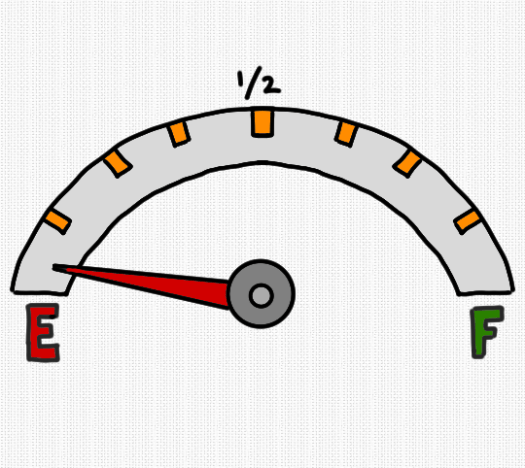
We all probably feel that way sometimes – feel that we’re running out of energy, out of fuel – and the needle is hovering close to empty.

Some people power on, pushing through the tiredness – willing themselves to keep going.

Others stop and rest, perhaps they give up and look for something easier to do.

Others are used to the ride – the roller-coaster of idleness followed by explosive, exhausting action.

Special forces soldiers, for example, eat when they can and take a nap whenever they can – because they know that it might be a long time before they can do those things again when on a mission.

Napoleon’s quote is interesting in that context – if you could choose someone on your team would you pick the most brilliant person – or the one who you knew could go the distance with you?

We all know people who are clever and capable but that are unable to shift their views when needed – they follow a set path and any variation unsettles them.

And then you have those who talk a lot and promise much but usually fail to deliver.

The people who make the cut in elite armed forces are often not the best or sharpest or quickest – but the ones who can plod away, taking step after step until they reach the end.

Being good at plodding matters.

It matters because if you’re the kind of person who needs to be fully rested, fully fed, with all the gear and tools and resources to get things done – then you probably won’t.

That’s often the problem with large organisations – they have the resources but not the people with the will to keep going.

A startup, on the other hand, has few resources and depends on the energy of the team – and not on mercurial, unpredictable energy but the focused, concentrated and undivided attention that comes with working on something you’re really interested in.

If you have tried to cultivate a daily habit – daily exercise, daily writing, daily meditation – you know how there are always forces that are trying to pull you off track.

Not intentionally – but there are fun things to do, people do see, things to watch – and surely you can just put it off for one day and take a break?

And that’s the problem with relying on willpower to get anything done.

Will power needs energy and if you’re tired and have had a long day your willpower is drained and you’re more likely to take the easy choice – order takeout and sprawl on the sofa.

When you’re tired what comes to your aid is not willpower but habit.

If you have created a habit then you’ll be able to get started even when the needle is pointing at zero.

You might have to take a nap but then you can get started.

The ability to endure comes from habit, not from will.

We are weak creatures, we humans – we get excited when things go well and we get down when we don’t.

And we can easily be let astray by the basic forces – just like you see with children all the time.

Tired, hungry, ill or bored – those are the things that get you every time.

If you’re tired, you’ll reach for the chocolate.

If you make a habit of not buying any – then you won’t have it.

Because what you need to get where you want is to know how you’re going to keep moving when you’re completely shattered and on the verge of being wiped out.

Because most of your competition will stop at that point.

You just need to take a few more steps – and you’ll be out there, in front, on your own.

Winning.

Cheers,

Karthik Suresh

Why Life Is Nothing Like Chess

kick-chess.png

Wednesday, 9.45pm

Sheffield, U.K.

Many leaders are tempted to lead like a chess master, striving to control every move, when they should be leading like gardeners, creating and maintaining a viable ecosystem in which the organization operates. – Stanley A. McChrystal

I came across something called Goodhart’s law recently, which says “When a measure becomes a target, it ceases to be a good measure.”

What this basically says is that when you try to engineer a result by creating a target people respond in a predictable way – they try and game your system.

You can see this most clearly in any sales activity.

If you set a target for the number of sales achieved, for example, then salespeople will do whatever they can to make that number – especially if it affects how much money they personally make.

And what you get usually is some kind of miss-selling.

For example, in one kind of industry it’s common for people to call up pretending to be a supplier or claiming that something is wrong and they need information from you to fix it.

They might pressure you into signing something that you don’t fully understand.

Now, if you own the company and have hired those salespeople and put in that kind of measure – then what do you think will happen?

In the short term they’ll hit their targets, you’ll pay their bonuses and they’ll be off.

But when the complaints and claims come in then you’re left to deal with them and pay the costs.

Unless you’re in on the scam as well and have left for another job leaving shareholders to pick up the bill.

Gaming is a completely rational response to managers who think that targets and pressure is the way to get things done.

Which is, oddly, the vast majority of managers.

If you look at governments – they do this kind of thing.

So do company bosses, virtually every network marketing business you can think of and even diet and exercise coaches.

Targets are good, they say, and let’s focus on targets to hit goals.

But, from what I have seen, there are two problems.

The first is that the people setting targets often have their own goals – target setting can be a way to deflect criticism of their leadership and performance.

Political leaders, for example, love to put targets on service delivery – like waiting times in hospitals – because it looks like they’re doing something.

They don’t care that their approach to target setting results in hospitals gaming the numbers to make sure they get their funding – while the actual service that patients get falls apart because everyone is too busy trying to meet numbers instead of doing their jobs.

Or actually – they do care – about getting re-elected.

The second problem is that focusing on one part of the problem almost never results in improving the overall situation.

Systemic improvement does not result from working on parts – it comes from making those parts work better together.

Gardening is a good analogy for this – as you tend weeds and put in plants that work well together – removing waste and improving performance.

Nothing in nature has targets – and it seems to work just fine.

Bees don’t need targets for the amount of honey they collect, for example.

They just work together and get what they need.

The basic mistake managers make is that they think life is like chess – if they put the right systems in place and the right measures – then they’ll get performance.

But actually people don’t do good work when they are afraid, when they are told that if they don’t meet a target they will not get their money.

Money is not a good motivator for anything.

People do good work because they want to.

And if you try and treat them like automatons, like chess pieces in your very clever game, you’ll end up with one very real problem.

You can move your pieces all you want.

A person can simply kick them over.

Cheers,

Karthik Suresh

Do You Have The Right Kind Of Energy In Your Life

suck-energy.png

Tuesday, 7.58pm

Sheffield, U.K.

Haters never win. I just think that’s true about life, because negative energy always costs in the end. – Tom Hiddleston

Many years ago I spoke with a girl who seemed to see things other people didn’t.

Like energy – she said some people sucked energy from you, while other people didn’t.

I didn’t quite know what to make of this at the time and, to some extent, I still don’t.

Do people who need to talk things through with you – the ones who spend hours going through their experiences fall into this category of energy vampires?

Or is it a more insidious thing – are there people who are relentlessly negative? The ones who see the dark side everywhere, the possibilities for failure and who seem to take a perverse delight in seeing others stumble and fall?

There is a line, somewhere between normal conversation and the need to unload one’s feelings, and this other place.

At the extreme is the feeling you might get if you were one of the victims in the picture above – a loose adaptation of a scene from a well-known film still in cinemas at the moment.

I remember being relieved that the girl said I wasn’t in the energy vampire camp – but then I’m not sure that’s a good thing.

For example, I think that my writing is relatively balanced, relatively thoughtful.

It lacks the passion and angst, however, of a more driven person – it lacks the anger and drive of someone who wants to take radical action to change the world around them.

You will know people personally or have watched them – these larger than life people who fill rooms and screens, simply bursting with energy.

They can be glorified or vilified.

The press, in particular, loves the story of a person rising up and then take equal delight in pulling them down – it’s the action and angst that matters not the person.

But there’s a dark side to dynamism, isn’t there?

The same energy that one person harnesses to create a movement and positive change is used by others to create a cult and harmful change.

An uncompromising quest for the good can result in something like the inquisition – where you deal harshly with people who don’t meet your standards of what good looks like.

And negativity is not always bad, is it?

I’m often see conversations where people talk about what to do – what strategy to take.

And one school of thought is to say that no idea is bad – and you can’t win if you aren’t in the game.

But sometimes you know why a particular idea won’t work – should you stay quiet?

Or perhaps you should just say no to everything unless it’s in your sweet spot – you only swing for those shots that you have a good chance of hitting.

Is that being negative or just pragmatic?

And if the game is baseball, something you’ve never played – surely you’d be better off not trying to play and work on a sport you do know instead?

What all this teaches us, I think, is that people lie on a spectrum – from frenzied optimism to relentless pessimism.

One might say that the first thing to achieve is balance – a dynamic equilibrium between the negative and positive – so that you are unaffected by the forces on either side.

That means you don’t rush to criticise but that you also don’t rush in without questioning.

You might also want to spend less time with negative people who do suck the job from your life – but also be wary of charismatic types that draw you into their web of magic and euphoria.

Because when you’re balanced you can choose what to say and when to say it and how to act – you can make choices about how you want to be.

And surely when you have that ability – that energy – you’re going to choose to be positive and optimistic.

Aren’t you?

Cheers,

Karthik Suresh

Where Should You Start When You Want To Create Something New?

arrowhead.png

Monday, 8.38pm

Sheffield, U.K.

If you have built castles in the air, your work need not be lost; that is where they should be. Now put the foundations under them. – Henry David Thoreau, Walden

When you listen to the way in which people go about their business it’s remarkably similar whatever business they’re in.

Take the business of comedy, for example.

Comedy is a business – we spend a lot of our time being entertained – and there are people working very hard to come up with the jokes and gags and plot lines that keep us amused.

A good joke is like a magic trick – it’s best when you don’t know how it’s done – when you experience that sense of surprise when it’s executed perfectly and cannot help but laugh.

So, I was listening to Jerry Corley talk about the comedy writing process and he said a couple of things that made sense in several ways.

One of those things was about how you don’t try and write funny stuff.

Instead, you just write, starting with whatever you have and then you make it funny.

Now, that’s really insightful – and obvious – but mostly insightful.

It got me thinking about arrowheads.

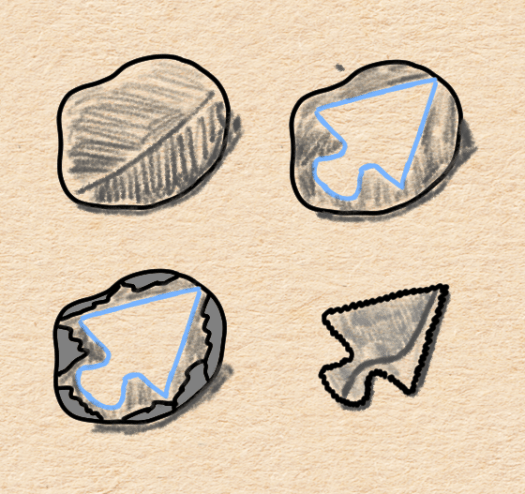
Let’s say you find a rock – perhaps its obsidian or flint – what do you do with it?

You might be tempted to carve a statue, perhaps one of a god, or the successor to Michelangelo’s David.

Except David is over five metres tall and your rock is around three inches across.

Have you ever had a conversation with someone in a pub who’s had a brilliant idea for a “platform”, something that rivals YouTube and Facebook, and they’ve planned out exactly how they’re going to do it?

The only problem is that they aren’t techie and so will need to hire others to do the entire thing on their behalf.

This kind of thing is like sculpting a five metre David from a three-inch piece of rock.

Maybe it’s possible if you have access to a few extra dimensions but your chances aren’t good.

But, on the other hand, if you decide to make an arrowhead, you have a pretty good chance of being successful.

Which is actually the second point I wanted to make.

You have to match your ambitions to your resources – to what you have.

Yes, by all means have dreams, believe that your reach should exceed your grasp, but recognise that you will eventually have to either give up on grabbing a star or find a practical way of making a rocket.

The first, and more important point, is starting with what you have.

Too many people look around at what the market is buying, or what others are doing and think they’ll do that as well.

But that way you’re always chasing the market – and by the time you get to where the market was it’s moved on.

You’re better off starting exactly where you are and then adjusting, chipping away, to fit the needs of the market.

Let’s take that stone again.

Inside that stone lives something like an arrowhead, not a David.

You can chip away at that stone to reveal the shape underneath and if you chip away enough you will get an arrowhead – one that is useful and that will get you dinner.

And the same approach applies to your career, your business or your startup.

Begin with the skills you have, build on what you’ve already done and then tweak, adjust, chip away – until what you have fits what the market needs.

A startup based on something you need and want is going to have a better chance of succeeding than one where you believe that if you build it others will buy.

Belief is a dangerous thing – a double edged sword that cuts both ways.

Knowledge, on the other hand, of yourself, what you do, what your skills are – is something you can use without fear.

Because if you start with what you have you can make a joke – or make a career – or make your business.

And it will be solid.

Cheers,

Karthik Suresh

How Do We Truly Learn To See What Is In Front Of Us?

negative-space.png

Sunday, 9.36pm

Sheffield, U.K.

But in order to survive in this foreign world, I had to teach myself that love was very much like a painting. The negative space between people was just as important as the positive space we occupy. The air between our resting bodies, and the breath in our conversations, were all like the white of the canvas, and the rest our relationship – the laughter and the memories – were the brushstroke applied over time. – Alyson Richman

I’ve been thinking more about drawing the last few weeks – and the way in which drawings can help us see the world around us.

And it’s funny how they can help us see in the way that we want to see – they follow our approach rather than the other way around.

Let me explain.

Most people will appreciate the fact that when they see reality what they see is not reality at all – it’s instead a construction, a hugely effective virtual reality system, that creates a world in our brains using electrical signals generated by our sensory systems.

In reality, this brain of ours, which hides in a cave with no windows fools us into thinking that the movie it’s showing us is the same thing as reality.

The world is an illusion – Maya, as the Indians would say.

And because there is so much data the brain ends up using some data that is real time and a lot of data that is stored and reused.

And that’s why when we look at a house we don’t really see a house – we replace it with a mental model of a house.

Unless there is a reason for us to look more closely – we’re in the market for a house – and then we start to notice many more things about the houses around us.

We look at size, age, driveways or lack thereof, the people, schools feeling.

We’re always positively looking for things – and our brains focus on bringing those to our attention, filling in everything else with stored data.

And this makes sense because if it insisted on processing exabytes of real-time information every time we stepped out of our front doors – it might just burn up – but instead it just uses a quarter of the energy we put into our bodies and does all the work for us.

But the shortcuts it sets up create a problem – we can start thinking of these shortcuts as the same as reality.

For example, if you once dealt with a situation in a particular way it’s hard to stop yourself telling others that the same way will work for them as well.

Or, you might even start telling people how to do things because you think that approach will work – without even really testing it first – the approach taken by many how-to books over there.

Which is why reading Betty Edwards Drawing on the right side of the brain again reminded me of some very important points.

One of which is the idea of negative space.

Let’s say you’re asked to draw a chair.

If you’re like most people your mental model of a chair will intrude forecefully to influence the image you create on paper.

You know how a chair looks, how its legs are connected at right angles, how there is a seat – and this will affect the lines you put down as your mental model of a chair clashes with the particular scene in front of you.

One way of getting around this is to stop looking at what you know and start looking for what is not there.

In the image above I’ve traced the negative spaces that you find looking at a wicker chair.

Look at those weird shapes, the odd angles, the spine and fishlike backbone.

Yes, you could see a picture of the chair, but you would not see what is not there, the thing that is in between what you see.

And that’s important because as long as we look for what we expect our solutions will fall short.

In business the thing that takes you down is rarely the thing you’re looking out for.

Retailers were busy watching footfall – they never thought the Internet would be a thing.

Armies are always training to fight the last war.

The books we read, the subjects we study, the strategies we adopt – these are all things that help us deal with what we see, what’s in front of us, what we expect to find coming down the line.

But it’s the unexpected that gets us every time – governments, companies, empires are overthrown from within again and again – not from without.

And so, it is only by training yourself to look for what is not there will you come up with strategies that have the potential to save you.

What will you do when your job disappears – if you lose it tomorrow.

What will you do if you make a living with your writing and your hands stop working?

Where is the space where there is no one else – the niche that you can fill with your new product?

Space matters – because everything else is already filled with something else.

Learn to see what is not there and you will always have a place to go.

Cheers,

Karthik Suresh

Do You Think That The More You Have The Happier You’ll Be?

baggage.png

Saturday, 8.15pm

Sheffield, U.K.

We humans have millions of years of evolutionary baggage that makes us regard competition in a deadly light. – Vernor Vinge

I’ve been wondering why everyone seems to try so hard to have a perfect life.

For example, why do we make such an effort over birthdays and Christmas and whether our sports teams win?

Why do we worry about bigger houses and better cars and the latest gadgets?

If you are one of the lucky ones – the ones that have a decent job – then the chances are that most of your problems stem from the things you have than from the things you don’t.

If you have food and shelter then pretty much everything else is an optional extra – so why aren’t we more grateful if we are able to close the door to a home every day rather than trying to get comfortable in a doorway, while the rain splashes down a foot away.

It’s like everyone in the world who can is participating in a giant Ponzi scheme – some kind of con – but it only works if everyone plays.

Take basic capitalism, for instance.

From what I can tell, somewhere in the last 200 years, people figured out how to make more stuff than anyone could possibly need.

So, we invented advertising to get you to want the stuff you didn’t need – and that started a cycle – one that you might consider virtuous.

If you had lived life drawing water from a well, then running water was great.

And if you had running water, have an electric kettle was good, and while you were thinking about hot water why not have your own coffee maker.

Capitalism – in the sense of making things that people wanted to buy created wealth and spurred people to create more things that others could buy creating more wealth – and that particular approach made the countries that practised that very rich – much richer than those who tried to share things equally – because those places tried to control stuff and ended up becoming dictators because it turned out that having power was much more fun than helping others.

And really, everyone still seems miserable – the people who have everything and the people who don’t.

And perhaps it does have to do with evolution – most things seem to end up having something to do with what happened before.

Once upon a time, a few hundred thousand years ago, the resources we had were the ones we found.

So, if you found some fruit, it made sense to eat as much as you could, and take as much as you could carry, because you didn’t know when the next bit would come along.

Stuff was good – a good stone for an axe or an arrow; maybe some charcoal to do some drawings; maybe some skins for clothes.

I’m finding it hard to think what else you might need really – perhaps a cave would be nice.

Unhappiness probably stemmed from finding that someone else had a better stone than you had.

Life was, perhaps, nasty, brutish and short, as Thomas Hobbes wrote.

But then again, we don’t know – perhaps most people lived relatively calm lives, disturbed by the odd flood or marauding tribe.

Anyway, the point is that we learned to hold onto stuff in case it didn’t come around again.

And now, when we have everything we could possibly want, we’re perhaps still wired to collect and keep and hoard.

So, in our personal lives, that tendency to collect and hoard is perfectly matched by an industrial capability to produce and produce.

Ironically, it’s industry that realises that it needs to be lean – you’ll find nothing in a modern factory that doesn’t need to be there – everything has its place and is marked out.

And so there is this cycle – perhaps a vicious one – where we have to consume in order to keep economies going – and we have to buy and spend so that there will be companies and jobs so we can pay taxes and create profits and buy more and more.

And you have to look at all that and wonder what on earth is going on – how have we ended up in this kind of place where we have so much stuff we don’t need and we spend all our time moving it around to make space for more stuff – and then we need more and more of it to get the same amount of happiness we might have gotten as a child when we found a particularly flat stone.

What’s with all that?

I guess here’s the thing.

The more stuff you have the more you have to manage that stuff – which leaves less time to do what you want to do.

And doing stuff that you want to do is probably what’s going to make you happy.

Managing all the stuff you have is going to make you tired.

And there’s a balance to be found somewhere.

Most us probably carry far more than we should.

What can you put down?

Cheers,

Karthik Suresh