Can Relationship Counselling Techniques Help Us Create Better Business Relationships?

baucom-framework-of-cognition.png

Saturday, 9.19pm

Sheffield, U.K.

If civilization is to survive, we must cultivate the science of human relationships – the ability of all peoples, of all kinds, to live together, in the same world at peace. – Franklin D. Roosevelt

You know that old saying about how you will spend more time with your colleagues at the office than you will with your partner?

Well, that’s probably not going to be that true any more.

But, you will spend more time working with lots of people, especially if we transition to a world where more people do more remote work.

So you will need more of your staff to be able to understand how other people tick – something which few of us are taught at any point in our lifetimes.

For example, do you know why that person in that department always disagrees with what you say – how they persist in never seeing the insights you’re bringing to the discussion?

You hate them, right?

In a previous post I’ve talked about how, when you’re trying to persuade, you only appeal to those who agree with you and those on the fence.

But it’s harder to do that when you have to work with colleagues, clients and suppliers.

You haven’t got a choice – you can’t ignore them.

Well, I suppose you can.

There is a school of advice that says fire the people who you don’t get on with and focus on the ones that are left.

Maybe that works, but maybe also it’s the easy way out – like getting a divorce when you find it hard to get on with your other half.

If you keep bailing out when the going gets tough – then what guarantee do you have that things will improve with the next partner – the next colleague, client or supplier?

Maybe the problem is you.

How do you tell?

Well, in relationship counselling, you have models of thinking and doing – cognitive behavioural approaches.

One that I came across a number of years ago is Baucom et. al’s five types of cognition, that correspond to the points in the image above.

This material talks about five types of thinking, of cognition, that may help relationships go well or badly.

If you can see this kind of thinking then you might be able to do something about it.

Let’s work through this with an example – say you have a young colleague and you’d like to develop her as a professional, but you’re struggling to get her to see what she needs to do.

Before you get her to do something new you need to understand how she thinks now.

And that starts with the assumptions she has – the basic beliefs about the situation you are in.

Maybe she believes that what’s important is getting her task list done, being polite and working from nine to five as set out in her contract.

The basic beliefs join together to form standards – a mindset – a way of thinking that informs her approach to the world of work.

Perhaps it’s got to do with ideas like she should be paid the same as a man, that work shouldn’t be taken home, and that you should be able to have time off to spend with her family.

That mindset is based on selective perception – a subset of data that underpins her mindset and justifies her thinking.

Maybe that has to do with the long struggle for female equality, with stories of glass ceilings and the anger of those unable to fulfil their potential.

You’ll see beliefs and mindsets and justification combine in creating the attributions she makes – the reasons why she believes others act the way they do now and in the present behaviour that results.

And they also combine to create expectancies – what she thinks people will do in the future.

This whole model is about the way someone thinks – and the way you think.

Conflict can happen in any one of these spaces – in any kind of relationship.

It’s very hard for us to really understand that other people may think differently – because these five types of thinking are invisible to us, we only see the actions that are carried out as a result.

But we don’t see how basic beliefs cause that action, or how expectations about how someone else will act drive us to do something now.

And we’ll never get that understanding unless we stop and start to talk and, more importantly, to listen.

In business being able to understand how other people think should be classed as a superpower.

Some people can do it by being able to empathise – by seeing the world through another’s eyes and feeling what they’re feeling.

Some of us have to observe and ask – and try and tease out an understanding of how people think.

And you can do this for good and bad.

I’m watching a lot of videos at the moment that score quite highly on my scam scale – questionable content and hard sells.

But it’s hard to tell the difference, on the surface, between a scam and a sincere desire to help.

After all, to be taken in by a con needs you to give someone your confidence.

Perhaps this model will help you check whether you have a handle on how the person talking to you is thinking.

And if you don’t, perhaps you should wait till you do before you go into business with them.

Cheers,

Karthik Suresh

How To Use Bloom’s Taxonomy As A Learning Framework In Your Company

blooms-taxonomy-adapted-model.png

Friday, 9.33pm

Sheffield, U.K.

You live and learn. At any rate, you live. – Douglas Adams, Mostly Harmless

Over the last few weeks I’ve discovered that teachers think in a different way to the rest of us.

I never found school that useful – nor university.

I learned the most from doing work – from struggling with a problem and working at it till I found a way to solve it.

The one thing I had learned early on was that what mattered was patience – patience to look at a problem for as long as it took.

Just look at it.

And eventually it will blink – and give way.

Clearly after a while you can’t do that with every problem – you have to get better at telling the important problems from the ones that don’t matter.

Now, what teachers are taught that we don’t know are theories of learning – models of how to help students learn material.

Now, what do you see when someone “learns” something – what does that mean?

It’s important to be clear about that – because you’ll get what you train for.

For example, if you want to train your administrative staff in a particular task – what exactly do you want them to be able to do?

On the other hand if you want to take a promising senior consultant on as a partner, what do you want her to be able to do?

What does a lecturer aiming to become a tenured professor need to be able to do?

The things you want to see are probably somewhere on the continuum proposed by Benjamin Bloom which is a core part of many approaches to learning.

This approach is called Blooms Taxonomy and is often shown as a pyramid of skills.

I’ve shown an adapted model that’s based on the 2001 edition.

The first thing you want people to be able to do is remember – do tasks in a certain way.

Remember, for example, to answer the phone with a standard greeting every time.

The next thing you want them to do is understand – get a handle on the things they need to do and why they need to do it.

So, you explain that they need telephone skills and writing skills and analytical skills.

The next thing you want them to do is apply those skills – get better at having conversations, drafting emails and longer documents and using spreadsheet models.

This is where the vast majority of instruction tends to stop in the vocational space.

This is what you need to get the job done – remember, understand and apply.

But, if you want to climb the management ladder or if you are in a career that requires you to do more than just what’s in the job description, you have to keep going around the taxonomy.

The next thing is being able to analyse – to tease out from the mess that is real life a way to look at it – perhaps a different way.

This is the kind of thing when someone takes a task that they have been given – say update a model in Excel – and says this is stupid and I have a better way to do it.

And they go off and automate the job and now something that used to take a week gets done in 30 seconds.

There’s a lot of that kind of stuff out there in the real world.

But then what happens is people learn different approaches and start to believe in them – like the people who believe in Agile versus the people who believe in Waterfall as software development methodologies.

Belief is the thing that stops you – but the thing that lets you keep going is learning how to evaluate.

The ability to evaluate is the ability to think critically about something – to compare and contrast different approaches.

For example, in the picture above you can see that the learner was taught that squares were the way to do things.

Then, they discovered triangles.

Now triangles are the way – the square is the way of the old and the triangle is the sharp new thing.

Think about squares as currency markets and triangles as cryptocurrency and you’ll see the difference.

If you understand these different approaches then you will be in a position to reconcile them, to innovate on them.

To, in other words, create.

If you look back at the image you’ll see that you learned about a box and applied that to build a house.

It was useful at the time but now, in the create phase, you’ve come up with a better model to represents that house by combining what you learned with what you came up with in the analyse phase.

And now you’re back at the beginning, trying to teach that new model to other people.

And the first thing you will want them to do is remember.

The beauty of this model is that once you know what you want your learners to be able to do once they complete your course – you can pitch it at the right level.

At a level where you will get an outcome that makes them more effective in your business.

Which is good for them – and you.

Cheers,

Karthik Suresh

Should You Be Open About How You Do Things In Your Business?

macqueen-model-of-craft-skill.png

Thursday, 7.20pm

Sheffield, U.K.

Forget about being an expert or a professional, and wear your amateurism (your heart, your love) on your sleeve. Share what you love, and the people who love the same things will find you. – Austin Kleon, Show Your Work

I’m often asked questions about how I do things on this blog – the tools I use to create material.

The first response of most people, I suppose, is going to be one of concern.

If you tell others how you do things won’t that mean they can do what you do now as well?

Surely by being open about what you do and how you do it, you’ll be giving away your knowledge for free?

I don’t know where that thought comes from – perhaps it’s inbuilt from prehistoric times when if you held a little food back you were more likely to survive.

Or perhaps it comes from when we invented the idea of ownership – and property – first physical property and then the products of the mind.

But there are a few things that we should keep in mind.

The first is that ideas are things you can share without losing anything.

If you tell someone else what you know – you both go away richer.

You get a deeper understanding of what you know and they learn something they didn’t know.

When you cling to the idea that the things you have are the things that matter then you confuse the ability to hold a tool and do a manual task with the skills of a craftsperson.

If you’re working at the level of a tool operator – you can be easily replaced.

But what is it about a craft skill that is hard to replace in the same way – what’s the thing that makes it valuable?

A 1951 paper by W.M Macqueen called “What is craft skill?” may help.

Some elements of craft skill are about manual skills – about how you do things.

For example, do you understand your materials and if they are suitable for the job you’re doing?

Just as a woodworker knows what kind of wood to use for a chair and what kind of wood to use for a pipe.

Assuming they are different – I don’t know, after all.

Do you know what techniques work?

If you’re a consultant, for example, do you understand how to do joint work, remote work or group work?

And can you do it well – have you spent the time working on your ability to carry out those tasks.

These three skills are still pretty manual, they’re about time spent on learning your trade.

Macqueen then says craftspeople have a better understanding of non-skill elements.

They know why one approach works while another tends to fail – how to make things happen.

They also look beyond their field – and know how related approaches work.

Doctrinal wars appear to be a standard feature of situations where this is forgotten.

For example, you have people who believe that agile is the only way to go, or you might have lean startup approaches, or various systems approaches.

It’s the mistake we make when we think rituals matter more than the outcome.

And then people dedicated to the craft look beyond themselves – they get involved in the community and industry – as a contributing member rather than someone looking to do the most for themselves.

But after all that, what makes the difference between one person and another?

Warren Buffett, as is often the case, has a quote that sums it up.

Somebody once said that in looking for people to hire, you look for three qualities: integrity, intelligence, and energy. And if you don’t have the first, the other two will kill you. You think about it; it’s true. If you hire somebody without [integrity], you really want them to be dumb and lazy.

The thing that makes the difference is character.

Macqueen has a few more points, but what it comes down to is be a person who can be trusted, who can get things done and someone who can respond intelligently to changing circumstances.

And that’s what makes the difference between you and a tool.

Cheers,

Karthik Suresh

p.s. As a result of this thinking here’s a list of the tools I use.

What Does An Expert Know About A Field That You Don’t?

what-experts-know-that-we-dont.png

Wednesday, 8.56pm

Sheffield, U.K

No one becomes an expert in a new career overnight, even if you are coming from another career where you were established and experienced. – Jack Canfield

Do you ever feel that anyone could do what you do – that you’re just marking time until someone comes along and tells you to move on because they’re going to do what you do better than you ever could?

At the same time you’ve probably developed more skill and expertise than you realise.

Quite often, when you look at what’s on the surface all you see is what’s in front of your eyes.

You see people spending time on tasks, looking relaxed or worried, displaying craft skills of one kind or another.

But is there all there is to getting things done – having a task list and improving your skills.

What’s missing from the picture.

What’s missing, it turns out, is everything under the surface – because the thing you don’t see is depth and complexity.

I came across this term on a website by Ian Byrd that’s about teaching gifted and talented students.

Hopefully some of the ideas will work for the rest of us as well.

But first, there’s clearly something you need to know about the idea – it’s got protections around it.

It seems that it’s important to mention that Dr. Sandra Kaplan and Bette Gould created and own the rights to Depth and Complexity – to the prompts, icons and framework and you can find their material here.

So, don’t take any of this commentary to be a view on the actual framework itself.

Instead, it’s a study of Byrd’s content on Kaplan and Gould’s framework, and how these ideas might be useful to us, perhaps in an adapted form in the learning we are doing.

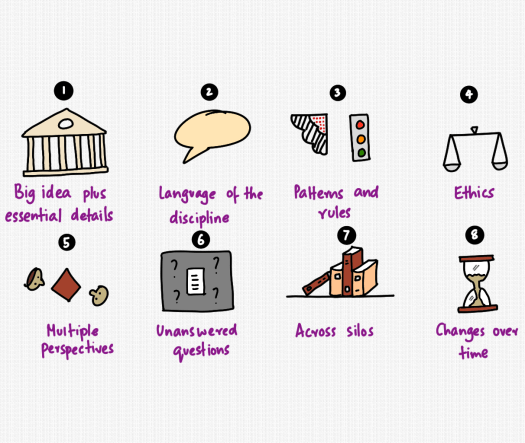
The actual framework has 11 components while Byrd’s commentary is that some of these can be squished together – something that I’ve loosely followed in the image above.

So, what is it that experts in a field get that we don’t?

Let’s take YouTube as an example – if you look at stats it suggests that most people don’t make any money with their content.

But then others do, and the difference appears to be that some run their channels like a business while others put out content and hope for the best.

That’s a big idea right there – run your channel like a business.

And there are a host of essential details that fall out from that big idea – the fact that you should have a theme, a certain standard of production, a schedule and so on.

All the people who do well probably have these elements bottomed out.

And they can talk to you about precisely what they do – they’ve created a shared language about ads and revenues and intros and outros and all the things that go into putting a video together.

If you look closely you’ll see patterns in the way they do things – the way they use lighting, staging – the way they script their material.

And there are rules they follow – no profanity, perhaps to make sure they don’t offend anyone, or perhaps rules on comments.

Clearly some go the other way – and that comes down to the ethics they apply.

Do they believe it’s ok to be a foul talking person who tells the truth.

They can probably see the business from different perspectives – having gone through the pain of starting, the years of producing material while they figured out what they were doing to now, where they have a money making machine that still needs to be fed.

Now, if you’re trying to do what they do, then you are going to have to get better at asking the questions that have been left unsaid and unanswered.

Can you do something, how do you do this other thing – do you have to try it and discover what to do for yourself?

Then there is the issue of reaching across disciplines – not being stuck in ideas of a time and place.

I guess when you get stuck in doing the things you read from a single book – well, people write new books and the ways change and you’re then irrelevant.

So, don’t be that.

Then there is the fact that everything changes – that as Pratchett said, “future pours into the past via the pinch of now”.

When you look at the ideas that Kaplan and Gould came up with you can also see that there’s a lot of stuff there – a lot of stuff that you know that others don’t.

Even if they don’t see it yet.

There are still two challenges, though.

The first is for you to believe in yourself.

And the other is to get others to believe in you.

But that’s a question of marketing.

Cheers,

Karthik Suresh

How To Do Keyword Research For A Service Business

graphic-organizer-for-google-search-keywords.png

Tuesday, 10.15pm

Sheffield, U.K.

Key idea: To write successful ads, imagine what your customer is searching for – Google Learn documentation

I’ve been thinking recently about the stages in the sales process and how it’s important that lead generation and value creation are recognised as two separate parts of a purchase funnel.

The normal picture of a purchase funnel has customers going from awareness through to purchase, and there are modifications and adjustments to break up the steps or create more of a loop.

Lots of tinkering, in other words.

Most funnels assume that customers are in some kind of comparison mode all the time – it’s just a question of when they buy.

This is probably true with products, like bicycles, and straightforward services, like a haircut.

After that, it gets more complicated.

A really good service business has the ability to create value through its interaction with a prospect – value that might not have existed before the conversation.

Quite often people don’t know what they want until you’re able to show them.

I’m going to leave that for another post – what I’m interested here is what happens before you come to the value creation part – the bit about lead generation.

The biggest problem service providers have is seeing things from their customer’s point of view.

If you’ve been in a field for a while and then started off as a consultant, you’re immersed in the detail of what you do.

It’s very hard to take a step back and see things the way a customer does – it’s almost a physical hurdle in your mind.

I see this with relatively early stage practitioners as well, this insistence that what they know is what the world also knows – a kind of cognitive blindness to the world around them.

So, how do you overcome this hurdle in your brain?

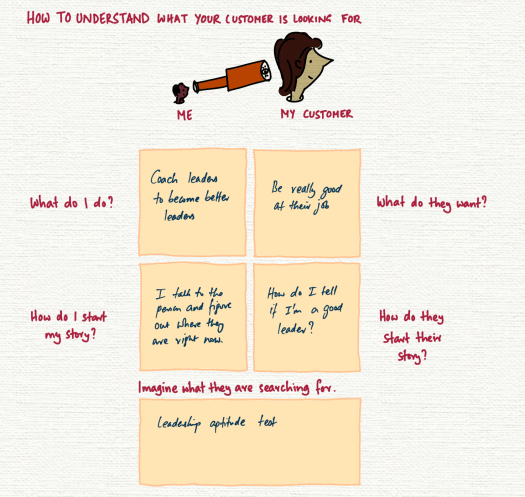
I don’t know – but I thought I’d try and see if developing a graphic organiser might help.

The image above is a first attempt – a simple one that tries to look at things first through your eyes, and then through the customers – to try and see if you can move your point of view.

I ran an example through it – a fictional business coach.

From her point of view, she coaches leaders to become the best leaders they can be.

What does the prospective customer think?

I guessed maybe she wants to be really good at her job.

How does the coach start her story – the thing she tells when she’s asked to talk about how she works.

Well, she probably talks about how she’ll have a session with you and talk about where you are right now – a sort of diagnostic.

How does the prospect start their story?

Perhaps they wonder how they can become a better leader – or even – are they any good right now?

If someone was motivated enough to find out, what would they search for.

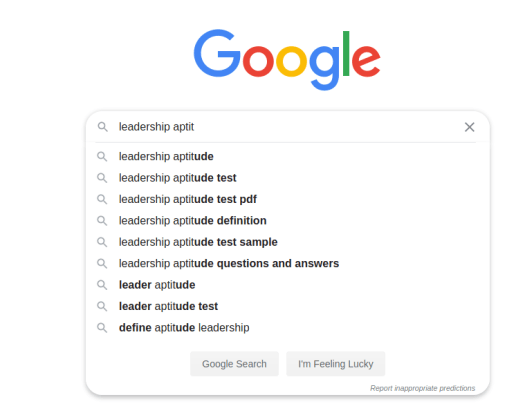
Having written down the four statements, the words “leadership aptitude test” came to mind.

And do people search for that?

It turns out they do.

leadership-aptitude-test.png

Now, I know this may seem very basic – but often breaking things down to this kind of level makes the difference between thinking clearly – and failing to see what’s going on at all.

You could go the other way and bury yourself in keyword research – the technology is out there and I’ve spent hours getting bored stiff doing all that.

Maybe this low-tech way has a few advantages.

If you gently walk yourself across to the customer’s side – if you can coax your brain to make this journey – you might discover that you’ve got something unique that few others have realised that people are asking.

And, of course, if you have a friendly prospect you can ask them to help you fill out the graphic and see if you can work out some keywords together.

I don’t know if this is useful – we’ll see if there is a chance to test it in real life.

But here’s the thing.

What harm can it do to look more closely at the way you think?

Eh?

Cheers,

Karthik Suresh

How Do You Work Out The Best Way To Use Your Unique Talent?

80-20-rule.png

Monday, 9.42pm

Sheffield, U.K.

No one respects a talent that is concealed. – Desiderius Erasmus

I was browsing through a list of books and picked up The 80/20 Individual: How to Build on the 20% of What You Do Best by Richard Koch.

The whole 80/20 thing seems done to death – you will probably be aware of the Pareto principle and that 80% of the output from almost every activity comes from 20% of the input.

A few things matter more than most.

On the whole, the elements of how Koch applies the rule seem predictable.

Do more of the stuff you’re good at would seem to be the main message.

But I suppose, like any superficially simple message, there are things to consider.

Let’s say you’re starting something now – a new business, a new service, a new product – how might you apply this principle?

Let’s take starting a YouTube channel as an example – something that I have no experience in.

One way to do it might be to create a beautifully scripted, filmed and edited piece of content – something that you are really proud of.

Something like that can easily take 4-8 hours of work for a 10-15 minute segment – the kind of ratio that’s normal in good quality video production.

It’s probably not the filming or the script writing that takes the time – it’s the editing.

On the other hand, what would it look like if it were easy?

Well, you’d probably have the biggest impact if you cut the editing time down as much as possible.

How would you do that?

Probably by doing things in such a way that you didn’t have to do all that editing.

The “not doing” element is something we miss in the application of this principle.

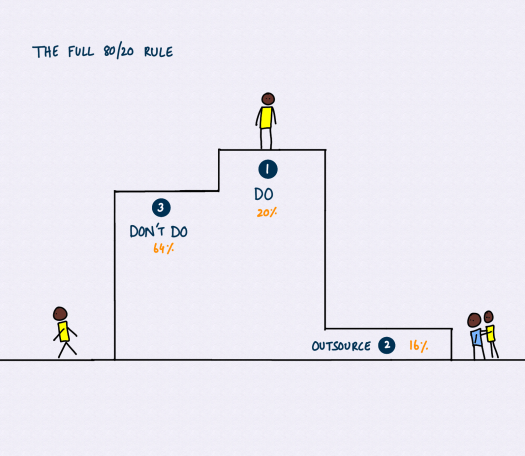
Let’s assume that 20% of the stuff is what you actually have to do.

That’s the scripting and filming – maybe you can make that tighter – but it’s the knowledge you have that creates the value in the script and it’s the filming that collects the raw content for your product.

Now, of the remaining 80%, does it follow that 20% is value adding and the rest not?

Is it the case that 80% of that remaining 80% is not worth doing?

Should your next step, after deciding what you are going to do, to be to figure out the nearly 2/3rds of work that you have to actively choose not to do?

This is really quite hard – because you will probably feel like you’re not doing your best.

Now, I’m no expert at video – but I do know that the prospect of spending hours of work to create a product is not an option – I don’t have hours to spare.

So I need a way to get what I want to do done using the skills I do have – skills at programming and automation.

But if there’s stuff that I can’t do which still has to be done – then I need to outsource that bit.

If I’ve broken my tasks down in the right way – that bit should only be 20% of the 80% – 16% where I have to persuade someone else to do the work for me.

What’s interesting is that the outsourcing and the doing aren’t the things that make the difference.

Together, they account for only 36% of what’s going on.

What makes the biggest impact on your result is what you don’t do.

The not-todo list rather than the todo list.

So maybe here’s the thing.

If you want to be the best version of you – the thing you have to figure out is absolutely, definitely, what you are not going to do any more.

Cheers,

Karthik Suresh

The Problem With Trying To Get What You Want By Giving Someone Else Something They Want

gaming.png

Sunday, 8.24pm

Sheffield, U.K.

Another generalised consequence of incentive-caused bias is that man tends to ‘game’ all human systems, often displaying great ingenuity in wrongly serving himself at the expense of others. Anti-gaming features, therefore, constitute a huge and necessary part of almost all system design. – Charlie Munger

Sport is a rubbish metaphor for life.

But we insist on using it – because it seems like sports is clean and simple – you have teams, there are rules they play, someone wins.

And it’s all good sportsmanship.

Sportspersonship?

But have you noticed that the concept of a fair game seems alien to humans?

If it were natural – if policing our own behaviour to be fair and true were an inherent part of our nature – why would we need referees?

The reality, I think, is that most games bring out the worst in us – we just don’t notice because we’re too busy explaining away our behaviour as justified because it will help us win.

Now, what’s interesting is that behaviour – that tendency to cheat to win – carries over into everything else we do as well.

And it gets harder to resist the urge to cheat when we get rewarded for doing so.

Here’s the thing.

If someone gives you a ball and points to a basket, then it’s clear where they want you to shoot.

If they pay you for every ball you get through the hoop – but aren’t careful to specify how you should do it then what are you going to do?

Some people might stand there and shoot, being rewarded on the basis of their steadily improving skill.

Others will realise that there is a much easier way to get the money and go and find a step ladder.

This is not cynicism – it’s how the world works.

And that’s why incentive systems are so hard to get right.

Sales is probably the best example of where it’s hard to figure out what you should do.

If you pay your sales people a salary, why should they hustle?

If you pay them only on commission, then they need to shift things fast – even if that means pressuring customers and taking liberties with the truth.

But then again, maybe you don’t care as long as the money is coming in – you have your own incentives to act in one way or the other.

Then again, maybe we do have something to learn from sports about this whole thing.

We think that sports is about playing well.

But it’s actually about the way you try and have a good, clean game.

By having rules for how you should play and penalties when you break the rules.

If you really want to understand how to create incentives – study the rules and see how they have been created to deal with something that caused a problem in the past.

“Play the ball, not the man” – probably has something to do with the fact that some bright spark realised that the best way to win was to break the leg of the best player on the opposite team.

If you have to work with someone else – a sales person, a business partner, your children – think of the ways in which they will break the rules.

The first thing to remember is that the easiest rules to break are the ones that aren’t written down.

The next easiest are the ones that can be interpreted differently, depending on the argument you put forward.

A well known form of this is the Protagoras paradox.

Protagoras, a lawyer, took on a student, Euathlus, on the agreement that the student would pay the teacher when he won his first case.

When the student didn’t pay, the lawyer took him to court.

He reasoned that if he lost, the student would have won his first case, and would have to pay. And if he won, the student would still have to pay.

The student reasoned that if he lost the case, he would not have won and so would not have to pay, while if he won he still wouldn’t have to pay.

One way to work is to play with very clear rules and a small chance of loss with people you don’t know.

Make bigger bets only with people you know and trust – while avoiding being sucked into a long con by someone who sounds like they are a friend but is essentially working on getting money out of you.

But I suppose the single best rule before you work with someone else is this.

Make it your business to understand their business before you do any business.

Cheers,

Karthik Suresh

How To Practically Use The Power Of Thinking In Opposites

invert-always-invert.png

Saturday, 9.10pm

Sheffield, U.K.

Invert, always invert: Turn a situation or problem upside down. Look at it backward. What happens if all our plans go wrong? Where don’t we want to go, and how do you get there? Instead of looking for success, make a list of how to fail instead. Tell me where I’m going to die, that is, so I don’t go there. – Charlie Munger

I did a search on Google for “Mental Models” today, little suspecting that would open up a rabbit hole that would suck in the rest of the day.

The results at first looked predictably predictable – lots of pages on lots of models – a few hundred or so that people have collected and put on display.

And then I came across a blog by Cedric or Eli on the second page – no, the third one that talked about how it was a really bad idea.

I have found that if you want to learn something you are probably better off reading what the critics say first.

I think this is because if the critic puts forward a clear argument as to the problems with the idea you are considering – then you can start reading the actual material ready to test whether the critic’s views are justified or not.

And, on Cedric’s blog I found an idea that resonated with me – the idea that it’s not enough to just put an idea out there.

You also need to know how to apply it – how to make it useful for you.

Without that, it’s just something floating out there – something that someone said.

You could memorise a hundred models and they would be of very little use unless you had some experience of real-world situations where you might find them useful.

When I did an MBA, for example, most students in the class talked about what they were going to learn from the MBA that would help them in the future.

For me, the content was most useful in explaining the experiences I had in the past – the theory helped make sense of what had already happened and let me figure out why.

A particular mental model that is often pulled out is in the quote that starts this post – Munger’s exhortation to “Invert, always invert.”

But what does that actually mean?

Cedric’s written a lot of stuff in his various blogs – and there are a lot of ideas that I think are good ones and worth exploring.

But, then I saw him write that “he disliked consulting as a business type”, which led me to his reasons why.

And this was interesting enough to just think about in some more detail – because it’s an important point if you’re thinking of starting a business.

Consultancy is not an inherently bad business model – Paul Graham of Ycombinator suggests that its a low risk way to start a business, especially if you have a mortgage and family.

Cedric’s argument is that certain types of consultancies have characteristics of commodity businesses and lists some of these.

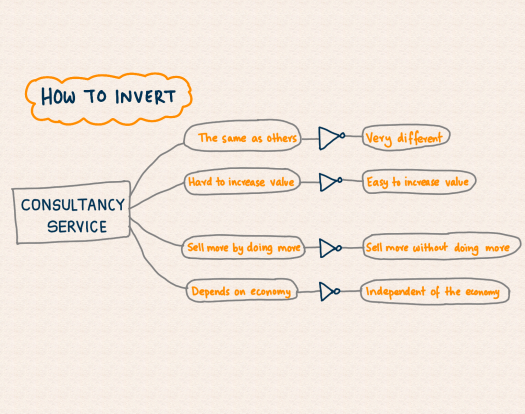
In simple terms, a consultancy that operates like a commodity will offer services that are just the same as others, just like rice and beans are pretty much the same wherever they come from.

In such a business you can’t really increase value – you’re selling time and your income depends on your day rate and you can’t just triple that overnight.

If you want to make more money you have to sell more time – your time or your employee time.

And consultancy is a discretionary spend – it depends on the economy and whether companies have budgets to spend – so you’ll be the first to be cut when things go bad.

Cedric then ends by applying the inversion mental model – how you can build a consultancy “that isn’t a pain to run” by inverting this list.

I’ve adapted his words to do this formally – using a NOT gate: a logic structure that denotes inversion.

I think the graphic is an interesting artefact – because it helps you take a statement and formally invert it.

Basically, it helps you apply Munger’s mental model practically – you can draw out what someone says, draw a NOT gate and work out the opposite.

So, for each statement – if you are the same as others, what if you were very different?

What would it look like if it was easy to increase value?

What if you could sell more without doing more?

And what would it look like if your sales didn’t depend on the economy?

Now, I have some experience of the consulting business – and I can tell you that building a consulting business like this works.

It’s not easy to do and you have to figure out what makes you unique – but you can do it given enough time and effort.

Let me give you a flavour of what this looks like using this blog as an example for a couple of these factors.

Lots of people can write and do fancy presentations – but very few use hand-drawn models in the way you see here.

It meets the test of being different from what’s out there, especially in the sectors where I work.

In many consultancies time is what matters – you have to spend time creating and fine tuning presentations.

That’s pointless if you have any background in programming.

Why not automate everything that can possibly be automated?

If you can do that you can sell more without doing more – you spend your time focusing on clients and get the busywork automated away.

Now, there are lots of ways you can look at this in larger businesses – but everything is context dependent and skill dependent – so I don’t want to give you the impression that it’s easy to do.

It’s not – and that’s why many consultancy owners work very long hours and are quite stressed.

Too busy to find the time to sit down and see if they can use the “Invert, always invert” mental model.

And that’s the point.

Just telling you something isn’t enough.

You have to be able to use it to make a change that works for you.

But if you can do it you may also find that you change your life for the better.

Cheers,

Karthik Suresh

What Kind Of Business Idea Has A Decent Chance Of Succeeding?

ideal-business.png

Friday, 9.40pm

Sheffield, U.K.

Don’t be afraid of missing opportunities. Behind every failure is an opportunity somebody wishes they had missed. – Lily Tomlin

My YouTube suggestion machine came up with a video by Tim Ferriss where he talked through some of his key ideas and the books they came from.

And these ones are useful for someone looking at starting a business or developing a new product or service.

The whole startup thing is the easiest and the hardest thing to do at the same time.

Everyone has ideas – there is no shortage of people with ideas.

Few of those people go on to execute those ideas and create a real business.

And that’s because most things we see are things that are successful – we aren’t exposed to failures.

And really, if we want to succeed, we should study failures – because that’s how we learn to see what bad ideas look like and how to avoid them.

Let’s say we could do that – put on a pair of magic glasses that let us figure out what might fail.

What would a bad idea look like?

Would it be the opposite of a good idea?

One piece of advice you get often is to build something that scratches your own itch.

For example, there was an article on the news some time back about a father who built a hydraulic arm for his son who had his amputated at birth.

This was something big companies had said couldn’t be done – but this dad did it because he wanted his son to be able to hug his brother.

Now, that’s something that is special.

But is it a business?

I spoke to someone on a train who talked about a company that specialises in making prosthetic arms for children inspired by Lego designs.

A child can see a prosthetic arm as a dull, lifeless thing, something that he or she might be teased about at school.

Or it could be an awesomely cool bionic arm – something they could show off and be proud of.

There are so many stories of people creating things that are personal to them – because they were underserved by the existing product machinery that dominates the world.

And this leads to two other characteristics of ideas that have a chance of succeeding.

They can be easily differentiated from whatever else is out there.

And they are easy to explain – you can quickly see why someone would need or want those things you’re planning to make.

But, is that enough to grow – what if everyone simply copies what you do?

Well, that’s where there are benefits to being first to market.

But that’s not always possible, there might already be a market with an existing firm that dominates it.

In which case you shouldn’t try and compete with them.

Instead create a new category which you can dominate.

What does your category need to have?

If you want your business to actually survive and grow you need to have a market.

But you don’t need millions of sales – not for a new business anyway.

What you need are 1,000 true fans – people who will believe in your idea and buy what you create.

So, if you’re thinking of a business idea right now – or you’re thinking about how you can refocus what you’re doing so that it can become a better business – these ideas are probably useful to keep as a checklist.

Are you creating something that you would use yourself?

Is your idea easy to explain?

Can you easily show how you are different?

Are you the only person doing what you do – or demonstrably the best at what you do?

Is your marketing focused only on the people who could become your true fans – the ones who will support you in what you do?

If you get these things right then it will show up in the numbers – in the only number that matters.

The number of customers you have.

Profitable customers.

And your business has a chance of succeeding.

Cheers,

Karthik Suresh

What Do You Need To Do To Be Remarkable?

purple-cow.png

Thursday, 10.32pm

Sheffield, U.K.

If you are too afraid to offend anyone, then I’m afraid you may not be able to do anything remarkable – Bernard Kelvin Clive

Yesterday I picked up The essential Drucker – a distillation of the writings of arguably one of the greatest management theorists of his time.

I particularly liked his idea of management being something that applied to “every human effort” and how its real value lay in its ability to unite technology and society in the service of humanity – arguing that it is a liberal art in the humanities tradition.

All that I liked.

And then it rather went downhill from there, as the text started talking about objectives and missions: things that I am not convinced actually work that well in real life.

The reason for this is that what happens has much less to do with what you want to happen and much more to do with the context in which you operate – the structure is usually responsible for the majority of the results.

Now, this is not easy to always talk through – and a model can help think through those structural issues.

So, I thought I’d pick up Seth Godin’s Purple cow and have a first pass at a model and see if it actually helps.

Godin’s book is about being Remarkable – like a Purple Cow would be if you came across it.

But you can’t just decide that you are going to be Remarkable – set that as an objective.

Well, you could – you could dress provocatively and behave outrageously – but I don’t think that’s the point we’re trying to make here.

The point is being the kind of entity that is remarkable – the “remarkable” bit is an emergent property of the business you create – something that is about the business but that you won’t find in accounting or marketing or sales but in the customer experience as a whole.

Okay, enough technical talk about systems thinking – here’s how to apply this first pass model.

Say you want your business to be remarkable – ask yourself – do you stand out in any way?

Being like everyone else might seem like a safe way to be – but that way your business will never grow beyond a certain point.

And again, it’s not enough to just say you’re different – you actually have to be different.

But how do you do that?

One good way is to identify a niche that you can target and dominate.

For example, if you’re a hair dresser in a salon, you could just cut hair – or you could specialise in a particular hard to do technique that is remarkable.

But how do you find that niche?

You find people who care about something you can do – who care to the point where it’s more than a hobby and less than an obsession.

A kind of feeling captured, Godin says, by the Japanese word otaku.

You learn from these people about what they need – give them that – and because they are early adopters who will talk about you a lot – you’ll find that word of mouth marketing helps you build your business.

But why should they listen to you?

Because you listen to them and give them something that tests the limits – gives them more – better, faster, cheaper, higher quality: something that they will love.

Now, when you get all this right you’ll find that your business takes off – it just explodes.

But nothing goes on forever – eventually that momentum will stop, the market of early adopters will dry up and you may move into a more mainstream world, where not standing out and being safe start being important, and you slow down and earn what you can for the rest of your product’s lifetime.

But that can be left to your managers – you should be working on building your next remarkable venture.

Now, I’m not saying this model is correct or complete.

Always remember that all models are wrong, but some are useful.

The question is whether this model is useful in thinking about whether your business, as it stands right now, is remarkable.

And if it isn’t, does it highlight areas that you could work on?

The thing to note is that this is not a process – not something you can follow.

Every part matters and you need it all to work for that “remarkable” property to emerge eventually.

My feeling is that this kind of model is more useful in helping us ask questions about our businesses than the relatively mechanical task of setting an objective to be remarkable.

If you focus on what’s inside the envelope – the elements of structure – and work to improve them, then what people see will be remarkable.

Cheers,

Karthik Suresh