How Does Your Model Of Reality Work?

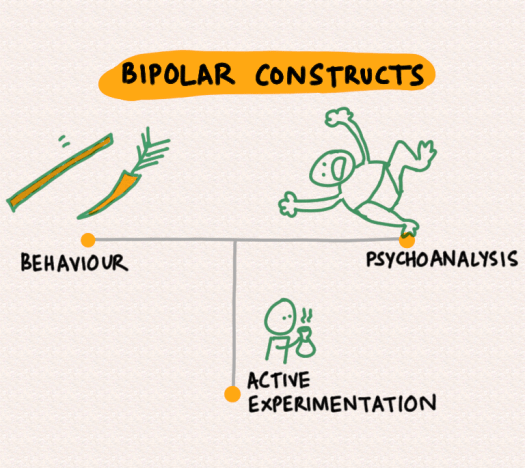
bipolar-construct.png

Wednesday, 9.33pm

Sheffield, U.K.

We know from chaos theory that even if you had a perfect model of the world, you’d need infinite precision in order to predict future events. With sociopolitical or economic phenomena, we don’t have anything like that. – Nassim Nicholas Taleb

Do you know why you think the way you do? Why do you act the way you do? What is it that explains your thoughts and actions and behaviour?

Answers to those questions won’t fit on a postcard – we’re talking about the entire field of psychology here – but there’s one bit that I want to focus on called Personal Construct Theory (PCT). George Kelly developed PCT as a way to help people analyse the way they saw the world. He called this “way they saw the world” a personal construct and suggested it explained quite a lot about the way we dealt with the world.

Let’s start with a construct – that could be anything. How are you feeling, for example?
happy.png

If you say you feel happy – then that’s a construct, a way of seeing the world. But a construct by itself isn’t very helpful. What you often need is to put it in context so that you can make sense of it. So, when you say happy, what do you mean?

happy-sad.png

You could say that happy only makes sense when sad is also in the picture. If happy and sad are two extremes then you’re on one end or the other. Or you could be somewhere in between the two. This kind of duality – the idea that you can make sense of one thing only when you also have a sense of what its opposite happens to be is what Kelly called a “bipolar” construct. And because you need both elements to make sense you can crash them together in a sentence saying something like you feel “happy rather than sad”. And this bipolar construct is different from saying you feel happy rather than overjoyed.

happy-rather-than.png

This is an important distinction because if your choice is between happy and sad and happy and overjoyed you end up being in a different place when you choose happy. You’re happy that you won a game of pool is different from saying that you’re happy because you made it through the first mile of a marathon in good time. What your view is depends on what’s happening around you in addition to what you see through your own eyes.

Kelly’s argument goes a little further and I think it can be understood by looking at the argument itself and its context. Typically psychologists seem to have looked at people as either being behaviourally driven – sticks and carrots – or as dealing with things that happened to them in childhood. If you think Pavlov’s dogs and Freud we’re talking about that kind of thing. Kelly says that there’s an alternative – perhaps people try things out, see if they work for them and then go with the things that work. So, in a bipolar construct sense you have two extremes – behaviour or psychoanalysis and many people fall somewhere between these two in contrast to Kelly’s approach of an actively experimental approach.

Using bipolar constructs is not a natural way to speak – it requires you to constantly question whether what you’re saying actually makes sense. For example, if you’re anti capitalist you could say something like “greedy capitalists” – and that sounds good. Boo hiss – all these people that just make money and keep it. But what is it that you’re saying? Are you saying “greedy capitalists rather than generous socialists?” Or are you saying “greedy capitalists rather than generous capitalists?” There are lots of capitalists that are generous and lots of socialists that aren’t.

If this sounds like hard work – constantly checking for poles – I think it well might be. But it sounds a bit like Jacobi’s saying, “Invert, always invert”. If you want to work through a chain of reasoning then perhaps this is a good idea. For example, does the image below help make the argument clearer?

reasoning.png

Now, this argument, captured in this way can be discussed and analysed. For example, I don’t agree that words should be used instead of pictures. I’d argue that you could use both to get a richer understanding. But the other points I’m ok with, mostly.

Now, when you use this approach to build up more complex strands of reasoning – that’s when it becomes useful or perhaps more confusing. Let’s look at applications of that in the next post.

Cheers,

Karthik Suresh
Here Are The Things I Find Hard About Writing

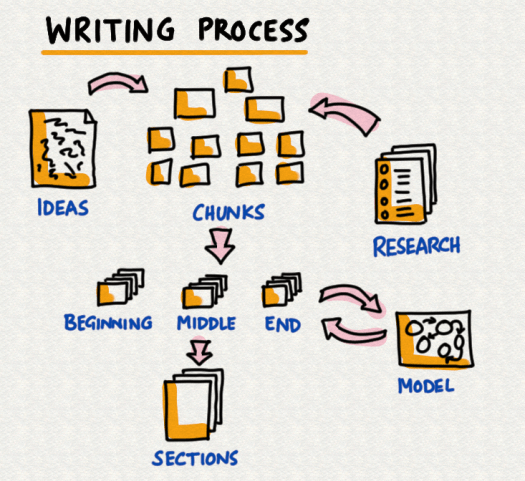
writing-process-2020.png

Tuesday, 8.00pm

Sheffield, U.K.

The heart and soul of good writing is research; you should write not what you know but what you can find out about. – Robert J. Sawyer

For those of you reading this for the first time I’m using this blog as a place to practice writing – a way to develop the skills and techniques needed to create long form work. I suppose it would be nice if the work was useful and readable and you liked it – but that’s not the aim of the project – to get you to like something. It’s a practice, an attempt to improve by intentionally working on the art of putting words one after the other and trying to get them to make sense.

I started writing a few years ago and quickly honed in on a formula that seemed to work for me. I’d start with an idea or a model, draw a representation, look for a quote that seemed relevant and then start writing. The first few years were mostly about exploring management theory and looking at models that people had put out there. A random walk down ideas lane. But really it was whatever I was thinking about or what caught my eye. There was no plan other than to sit down every day at around the same time and write something and hit publish.

There was, of course, no real reaction. The Internet wasn’t waiting to read my half-baked thoughts. I pushed things onto social media and I’m sure people who knew me wondered what I was doing but were too polite to say what they thought. And some friends liked stuff which gave me a bit of a boost. But I think I eventually figured out that just because you do something that doesn’t mean it’s worth sharing and shut down all the automatic posts – apart from one lonely Twitter account that has recent content on there.

But what I did start to learn, from that experience, was about the importance of showing up. It’s hard to get started – that first step to overcome inertia is quite often the hardest one you’ll take. But once you get moving it’s a lot easier to keep moving. Once you’ve written for a week it’s easier to know you can do another week. After a year, you know you can do another year. And the days go by, relentlessly, whether you do your thing or not. And now, 977 posts later, I’m pretty confident that, if I sit down and start tapping these keys, another one will pop out.

The second thing I’ve realised is that you’ll see benefits in places you didn’t expect to see them when you start a new habit. Writing for pleasure makes writing for work much easier. When you practice articulating ideas daily then it’s easier to do it under pressure. When you work with models day after day then coming up with one for a client is a simple thing to do. This thing that I do as a practice has had unexpected professional benefits – including helping me deepen my own understanding of Systems Thinking and Practice.

But writing about different things every day does not add up to a useful body of work. To do that, you have to start planning – something I resist doing with every fibre of my being – but I’ve discovered a way that works for me. With some caveats. The general model is shown in the picture above.

I start with an idea, a central theme – perhaps the title of a book. I’m only doing non-fiction at the moment – I don’t feel anywhere near being able to try my hand at storytelling. The first thing to do is get some ideas down on a sheet of paper – a sort of brainstorm that works through things that come to mind. Then I take a bunch of A6 slips of paper and write down an idea or question on each slip – just filling them in as I go along. Some of these slips are also informed by research – from the work I’ve done previously, although I had a problem on my most recent project and we’ll come back to that in a minute. We’ll end up with 30-50 slips of paper at the end of this process.

The next thing to do is sort the big set of slips into ones that seem like they should be in the beginning, middle or end. There’s no sorting within the piles yet – just dropping them into three stacks and one more for unsure. Then I pick up each stack and compare the slips, putting them in what seems like a logical order.

This last step is important to notice because of the mathematical optimisation involved. I can’t really be bothered to check the formulas so trust me on this. If you try and put 30 slips of paper in logical order then you’ll have to go through a lot more comparisons than if you first put those slips in 3 sets of 10 each and then sort the 10 in each set at a time. It’s a lot faster doing it the second way. This is, in fact, a standard team bonding exercise. Give people 15 steps and ask them to discuss them and put them in order. If they try and talk through all of them they’ll never get it done. If they chunk it into a start, middle and end, and then order the 5 steps in each one it will get done pretty quickly.

Okay, so now we have our slips – I then pick up the first one and draw a model – a picture, nodes and arrows – something that can hold the idea. and start writing. And when I’m writing – it’s just writing. I don’t stop and think – the keys sort of press themselves as the words flow through me. I’m just reading what’s appearing on the screen without really trying to make them get there. That’s when it works.

Oh yes.. before I start any writing session, I do three paragraphs of freewriting, just to get things moving before getting on to the actual topic.

So, this makes the writing sound quite easy, and I suppose it is. But that doesn’t mean what I create is any good. And I’ve had two main issues.

The first has to do with research. With my first couple of projects all that random writing over the years was actually research – many of the things I had read and written about resurfaced in the points and arguments I was making. By the third project, however, I had started to run out of material and that lack of research made it much harder to get a flow going. I didn’t know what I was talking about – I was trying to think through it and write about it at the same time. And that’s not easy. The research feeds you and if you stop reading and start watching TV instead you’ll find that you’ll start to run out of ideas.

The second thing had to do with editing. I wrote my first two projects in sentences rather than paragraphs – you know that blog habit where you press enter after every sentence because that’s what you do. Well, don’t do that. It’s a nightmare to edit because you have to collect your sentences together again. It’s the maths problem with the slips of paper again except this time you’re working with 18,000 lines rather than 50 slips. So that was a bad idea.

But in my most recent project I’ve managed to improve the paragraphing but failed on the research. And I don’t know what’s worse – well, anything that increases effort is worse so I’m going to have to say when you do your first draft do your research and write in paragraphs.

That seems obvious, doesn’t it? But it’s taken me 205,642 words to work that out. That’s ok though – I’m a slow learner. Give me time.

What else then… oh yes, word count. The number of words I come out with goes up and down but in a normal session an easy number is around 600-800. It takes some effort to put past a thousand. In 2020, with lockdown, I averaged 1,019 words per post but I think that was pushing it beyond the point that was sensible. It’s like driving in the red so this year I’m easing back down to the 800s. Not this post – it’s gone way beyond – but in principle anyway.

Okay – so I’ve tried to write three books and had different kinds of issues with each one. Do I try and fix them or do I throw that stuff away and move to the next one? Or do I spend 2021 doing some research. That’s probably the way things are going to go. I’m planning on starting a research programme so perhaps what I read is what I write about over the next 12 months.

Perhaps that’s the thing to look at in the next post.

Cheers,

Karthik Suresh
The Two Marketing Strategies You Need To Know To Compete Today

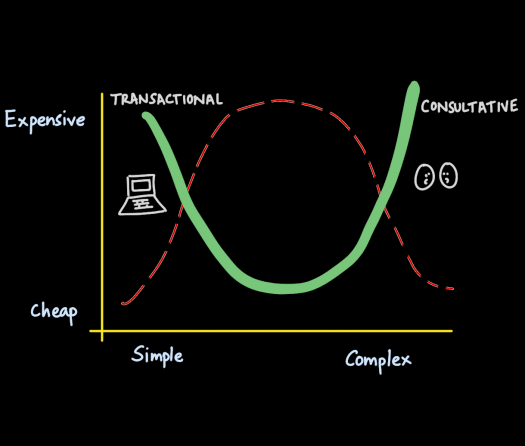
transactional-consultative-model.png

Monday, 8.05pm

Sheffield, U.K.

Let’s be honest here: Twitter, for me, is 90 per cent a marketing tool. – Ricky Gervais

The most useful marketing model I have come across in the last five years is the one above, by Neil Rackham, most famous as the author of Spin Selling. Neil’s work sparked a bit of a revolution in the art of selling – albeit one perhaps unnoticed by much of the world. Spin selling was about listening to the customer, understanding their situation, diagnosing their problem, understanding the implications of that problem and working out what they needed to solve it.

And then life moved on and the Internet appeared and started to change things. The thing with Spin selling is the implication that you as an expert add value – you’re the one that can come along and look at the situation, diagnosing a problem like a doctor prodding a lump and telling you what’s wrong with you. And being an expert in the days BI (Before Internet) had value – because you had knowledge and people trusted you to tell them what to do. As a car salesperson, for example, you could discuss the advantages and disadvantages of models with customers and if they trusted you and bought from you and found that you had told them the right things then they’d come back and buy from you again.

But in these AI (After Internet) days you know as much as any salesperson. I remember being a little surprised when using an agent to rent out our property that he came along with a printout of local listings – something I could have done myself. I expected him to add something extra – but what is there to add? Our doctor goes onto Google to check details like what a number should be. And why should that surprise us? No one is as expert on anything as the entire Internet – this hive mind that holds everything and that can be interrogated for answers.

And this has caught out a lot of people who have lived through the BI and AI transition and who depended on their status as experts to make a living. Everyone knows what they know now or can find it out with a search query. In the past, if a car salesperson helped you out with advice you were ok with paying a bit more for a car to cover that person’s commission. That’s the dashed line in the chart above – a little more service, a little higher the price. These days you double check what they say and then buy something wherever it’s cheapest. Expertise has lost its value. But what has replaced it?

It’s the other line in the chart. The middle of the market has been eviscerated and the pandemic has shown that more clearly than ever before. On the left hand side of the curve live transactional sales – where anything, whether cheap or expensive, can be described in a listing and put up for sale. The best listings get the most views and make the most sales. You need modern marketing skills – the ability to create content, craft ads, get attention, promote deals – all the things you had to do offline as well, but now even better online. If it can be understood and specified and described you’re going to go to a marketplace and pick it up. No humans needed in the delivery of the product – they’re all sat behind their computers crafting their listings.

On the other end of the chart is the world of consultative sales. This is where you don’t know what you need or want and need to work it through with someone. Not an “expert” – those are redundant – but someone who can work with you to figure out what needs to be done. A collaborator, a participant, a fellow traveller. On that side of the curve everyone is an expert at what they do. What you’re trying to do is work together to improve a situation. The difference is between asking a doctor to help you out and two colleagues working together on a particularly difficult case. It’s about working together to figure out what to do, not about “fixing” a problem.

I think that when you understand these two models you’ll start to see them everywhere. Transactional sales are what makes the Internet hum – and it’s going to steadily take over every product that relies on a description and listing. What’s left is collaborative problem solving – informed participants working together to make things better and sharing the value they create. And that’s it.

Right, now for something different. This particular group of posts started off as something around a book idea called “Community” and it has been hard and painful going. Mainly because, I think, I was trying to figure out what I was thinking as I was writing it. But that’s ok, that’s the nature of first drafts. The book’s probably somewhere in the last few tens of posts – there’s 70,000 words that must have something useful in there somewhere… But I think I’ve just run out of steam for this particular group.

Now, I think I might spend a few posts just reflecting on the writing process so far. I’ve learned a few things along the way that make things easier and I’m a fan of easy. I think hard work is pointless – you should make things so easy to do that there’s no point putting it off. If it’s hard the chances are it won’t get done. So let’s see where that takes us in the next post or few.

Cheers,

Karthik Suresh

What Are You Doing To Evangelize Your Product?

evangelist.png

Sunday, 9.23pm

Sheffield, U.K.

I think the only kind of acceptable evangelization is the evangelization of good example. – Andrew Greeley

You know the story of the person who built a better mousetrap and how the world beat a path to their door. You also know it probably would never happen that way. You’d build the better mousetrap and then spend ages trying to convince funders to give you the money to manufacture it and then ages persuading retailers to stock it and then more time appealing to shoppers to buy it. And then one day, you tip the balance and orders go through the roof and you’re hailed an overnight success and it only took two decades to get there.

If you do anything at all these days that doesn’t involve just working for someone else exchanging your time for money then you have to get used to the idea that you need to let people know about you. You need to do the equivalent of evangelizing – letting others know about the thing you believe in and care about and give them the opportunity to experience it for themselves. Or you need to find someone who believes in what you do enough to go out there and sound the message for you. But it’s better, if you can, to do it yourself.

But what’s the right way to do it? Do you rush out and get yourself on every channel there is? Do you shout very loudly, create lots of material, do crazy things to get attention? Do you try and sell yourself – persuade people to believe in what you say or do you create a message that you think they want to hear – manufacture a product that you think will sell or, easier still, manufacture a message you think they want to hear?

All that takes effort – too much effort – and while it probably works the question you need to ask is whether it’s worth doing. I remember meeting a person once – a person who worked in a different market and who described what he did in his business. What he was doing wasn’t right and I will always remember his thick lips – he licked them as he talked about what he was doing, with evident satisfaction, and it was repulsive. The wrong work with the wrong attitude. Don’t do that.

What works, in my opinion, is simply talking about what you do and showing your work – showing how you go about what you do. A thoughtful, reflective approach to your work, a critical appraisal of what’s working, what’s hard and what you’re trying to achieve will get you more credit in someone’s mind than any amount of hard selling. I think that’s what I think of when I think about you evangelizing your product – it’s being there, talking about what you do. Being discoverable by people who already know they’re interested in what you’re offering and those that aren’t sure but are willing to find out more. The others don’t matter – they aren’t your market.

So, assuming that you’re going to put yourself out there in the right way – in a way that is “authentic” – what are the elements of marketing that matter for you? I think I’ll look at that in the next post – what do we need to do to make ourselves discoverable?

Cheers,

Karthik Suresh

What Kind Of Risk Do You Take When You Try Something New?

old-tools-new-tools.png

Saturday, 7.18pm

Sheffield, U.K.

Make new friends, but keep the old; Those are silver, these are gold. – Joseph Parry

This is a bit of a reflective post – after a month of trying something different and wondering if I should stop – probably really thinking that I should stop. Or at least, do things a little differently.

At the start of the year I decided that I would try and spend more time drawing, working on getting my skill at making images up a little – given that it has barely improved in the last few years. It seemed to make sense to put images drawn on paper on my blog as a way to force that practice every day. For a month or so I’ve been sketching and taking photographs and scanning and fixing and uploading pictures and editing and cropping and getting them ready. And then I’ve been getting on with the writing.

I asked a question earlier this month as to whether the slowest way was really the fastest way. I was reading Lynda Barry who says this – she found it hard to write on a computer because it was so easy to delete the words and when she started writing with a brush, painting one letter after another, the words just flowed out and they were good. I tried to apply this to my drawings, slowing down and taking time and then doing the rest of the work to see if this might prove true for me as well. And I now have an answer.

The slowest way is the slowest way. I’m sorry, but there’s no way around that. It just takes longer to sketch with a blue pencil on paper, go over that with ink, scan it into the computer, trace the bitmap to get the dark lines and remove the background and then colour it in and get it ready for a post. That takes a very long time and I just don’t have that amount of time when I need to create a post in a set amount of time and then go and get dinner and help put the kids to bed.

The quality of the slow stuff may be better – but it’s not for the routine work of the everyday – for the thinking that helps to move things on. The slow is for when you need to reflect and create something that pulls everything else together. There are definitely cases when working slowly is the right thing to do for the situation you are in but for a daily blog post cadence it’s too slow, there are too many steps and too many points of failure – which means that more often than not you fail to get your product out of the door. And failing to ship is simply a fail.

The other thing that taking my eye off the fast way of doing things has done is that my old, trusty tools are gathering dust in the corner and when you don’t use them every day something goes wrong – you start to lose the feel you had for them. They no longer fit your hand, they feel a bit strange. The body of a digital stylus is unfamiliar and cumbersome after getting used to a pencil and pen again.

I suppose the point really is that the slow way is the slow way and the fast way is the fast way and what makes the difference is how you travel. Lynda Barry uses the delete key a lot. I hardly do. Her pencil makes sure and quick marks. Mine hesitates and trembles and makes weak scratches. Her way is fast for her and my way is fast for me. But I had to try her way to find out that my way is the one that works for me.

That doesn’t mean there isn’t a place for analog tools in my world. I’m the kind of person who has to get all the kit and try it out to test and break the process before I make up my mind. And the analog stuff does help in certain situations when the slow approach adds real value and I will try and use it when it is appropriate.

What this month has also done, I think, is clarify what I want to look at from a research point of view in this space. I read a paper by Colin Eden, written in 1988 on Cognitive Mapping, which describes the experiences I’ve been having over the last couple of years when it comes to trying to get better at thinking and sense-making in complex environments. Simple formulaic solutions are easy to sell but reality is harder to wrap your mind around. Or easier sometimes – it depends on whether you can let go of the idea that you need to make it complicated.

I’ll explain this later – I’m probably going to be thinking about it for the next six years or so.

So, back to the plan for writing.

I feel like I’ve broken my process a bit and it might take a bit of time to get back on the right track – but you know, there’s no hurry. It’s about the journey after all.

Cheers,

Karthik Suresh

Why Wanting What Someone Else Has Is Not An Advantage These Days

envy.png

Thursday, 8.06pm

Sheffield, U.K.

Envy is the art of counting the other fellow’s blessings instead of your own. – Harold Coffin

One of the things I realised pretty early on was that having a job came with all kinds of problems. The more senior you were, the higher your role in an organisation the more it seemed that people wanted you to fail, or wanted your job or had it in for you because of the decisions you made. Think of the leaders of any nation out there, free or not. Do you think they are happy, having reached the pinnacle of power. Or are they either harassed and overworked or insecure and cocooned away from people who might want to harm them.

Even if you’re not in the public eye – going after a “job” has other problems. Often people want you do to something that they know how to do but don’t have the time to do themselves. But they want you to do it the way they do it – and that’s really what training is. Following the agreed approach. Doing as you’re told. Sticking to the job description.

Except this isn’t really the case and when you see a “standard” approach being implemented what it should tell you is that the person doing the implementing doesn’t quite know what the right thing is to do. You can make machines work efficiently. You can line them up in the right way and sequence operations so that everything is ready when the next thing needs it. All that can be optimised and tweaked and tuned. And because it works so well with machines we think that we can use the same approach when working with people.

The problem with people, however, is that they have a mind of their own. They are “teleological” beings – with a sense of purpose about them – a purpose that often shifts based on how they feel. There really should be no such thing as a “job description”. Rather you should ask how a particular individual will go about working with others in your organisation to improve the way in which things are done. That might sound hopelessly woolly to us – but we need to realize that we have been conditioned to think of people like machines because our world has been so successful in using machines to make things better. But because machines do things well it does not follow that people should aim to be machines.

What this means is that these days you should really think about how you are going to create a job for yourself rather than what kind of job you are going to do. If you think of a role as being something that exists out there, independent of you, that anyone can fill – then you’re on the way to becoming a commodity – just the same as everyone else. You could have an amazing coat in the window but the fact is that there will be people who can wear that coat – more than one – probably quite a few. Individuality and character don’t come from what you do on the outside – those things can be copied. You just have to look at any subculture that makes a point of being different by taking the time to look the same. There’s no point looking enviously at what someone else has and thinking you’d be happy if you just had what they had.

Now, there are certain things that can be learned, that can be taught but you should think of those simply as hygiene factors, the cost of entry, the minimum standards needed. A long time ago I used to teach people how to teach dance – and we had a very structured approach to teaching them. You needed to know what to do, what to say, how to say it, when to intervene and correct something, how to only say as much as needed and only use your voice – all these little tips and techniques that helped you teach more effectively. But all that – everything we taught was simply to get you to the point where you could get in front of people and do a lesson. Making is a “good” lesson was up to you – and it depended on what you did with the time you had and how you came across and what your particular take on things was.

When you realise that you need to do something in your way – in the way only you can do it – then you’ll start to enjoy what you do because it flows from your centre, it is fully aligned with the way you do things. When you do things in the way someone else does – that’s ok when you’re learning but you have to eventually develop your own style, your signature, your way of doing this that is just you and no one else. That’s why I’m wary of systems that try to break things down and teach you exactly how to do something. What we should teach is methodology – the principles behind how something is done and we should teach technique – the skill of doing a particular activity. You need to work between those two extremes – between technique and methodology to create your own method – the way that works for you.

If you’ve seen the Mandalorian series you’ll remember the catchphrase, “This is the way.” What you need to get to is to the point when you can say, “This is my way.”

Cheers,

Karthik Suresh

How Do You Justify Learning Anything New?

visual-work-clean.png

Wednesday, 9.16pm

Sheffield, U.K.

Research is formalized curiosity. It is poking and prying with a purpose. – Zora Neale Hurston

When you first try learning something new everything slows down, you know nothing and each element seems to take forever to learn. I think that’s what stops most of us from even bothering to try – that initial learning curve that’s so steep it seems like we’ll never master it. Or even get decent at it. Or better.

At the moment, for example, I’m trying to figure out what the purpose of the research that I’m planning on doing might be. So that’s one question – how do I articulate this in a way that’s going to make sense when I don’t really know how to do research yet.

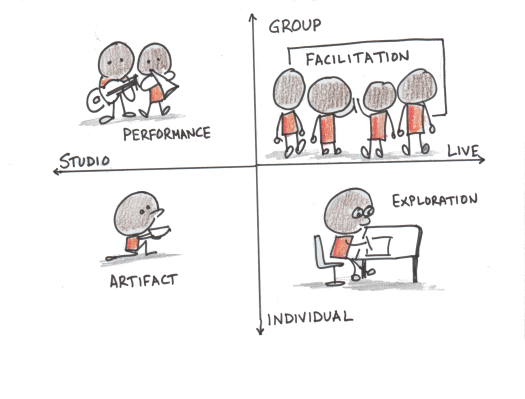
What I do know is that I’m interested in this space where drawings and text and speech bump into each other. The idea of bumping into things was something that I picked up from the YouTube videos of Christina Merkley. She has an approach to classifying work as studio work – which is the kind of thing you do in the privacy of your studio with time to get it right and live work which you do in real time. I think you could overlay this with another axis that’s about doing the work either as an individual or in a group setting, which has a resonance with the work of Brandy Agerbeck whose books The Graphic Facilitator’s Guide and The Idea Shapers I’m currently going through.

The thing that happens when you read something new is that you want to experiment with different methods and that creates a challenge – because you want to be good but the chances are that you’re going to be more than a little rubbish. For example, I’ve been quite relaxed about drawing on the computer because it’s a bit different and people don’t really notice it because most of what I’m trying to think through is in the words. The graphic helps me to think about what I’m going to write but it doesn’t have to do any heavy lifting of its own.

I’m shifting my interest this year, however, to seeing if the graphics can carry more of the load – rebalancing the text and image usage. So then the pictures I draw have to make sense, they have to stand alone in their frames and make something of themselves. And that gets hard quickly. For example, do you draw and colour something entirely in analog or do you sketch it on paper, get the lines right, then scan it and do the colouring on the computer? What’s the right workflow?

Well, the obvious answer is that there isn’t a “right” workflow – there is the right one for you and what you’re trying to do and the best feedback you’ll get is how your customers respond to you when you put your new thing in front of them. If you are your own customer then fine – there’s nothing to worry about but if you’re putting something into the world that you’re hoping other people will use then you have to get this working well.

The good news is that it comes down to time. If you spend enough time working on the problem you’ll start to figure out what to do. If you give up too early that’s okay too – it just means that this thing didn’t matter enough to you. It’s okay to want something but not to want to do the work to get it. There’s plenty of other work to do as well.

The reality is that there is only so much energy you have that you can give to your projects. So focus that energy on the projects that mean the most to you. Even better, choose your projects so that they all support each other and make it easier for you to build on the things you’re doing.

Here’s the thing. Learning anything is hard. If it’s new – that’s even harder. And the first time you have a go is the hardest it’s going to be – except for the next hardest bit. Anything (sensible) that makes your life easier is worth trying out.

Cheers,

Karthik Suresh

How To Create A Welcoming Environment For New Members

no-entry.png

Monday, 8.21pm

Sheffield, U.K.

Every movement, to stay alive – a very difficult thing to do historically – has to find a way to harness that initial surge of emotion and turn it to the hard, steady, un-sexy work of recruiting new members, strategizing, negotiating with those in power, keeping itself going. – George Packer

I’ve been thinking about what it means to be a member of a group – of a community or a business or of people that practise a hobby. It’s probably not something that many people have thought about since university but we do go through life being a part of circles and changing circles over time. As someone who went to boarding school I learned early about how groups form and how you can be inside or outside them. Ever since then I’ve seen the value of participating in groups but also been wary of them and their ability to draw you in and then keep you in, restricting your ability to move out again.

When you think about it those kinds of groups are everywhere. Religions use the methods of marking you as in or out. So do companies. Your country gets you to feel that way by stoking up feelings of nationalism. Sometimes these are good, as when people volunteer their time or donate their money to help the needy. Often they are bad as one community takes up a position and argues or fights against another.

I’ve been through a few groups in my time and I can think of quite a few that had a range of interesting problems. Perhaps you had a founder or leader who took everything personally. Perhaps you had differences of opinion and no way to resolve it other than the exercise of power, which you didn’t have. In such situations one group might leave and set up a competing group. I remember there being a cultural difference between people who preferred dancing in lines and those that danced in circles in one particular group. And now, of course, with online groups, you have a huge range of options – but what marks out the ones that seem to have a large and growing membership from the ones that struggle to get interest?

If we ignore the ones that are based around a celebrity – where the members are really there to follow what one or a few people do – then the thing that makes the biggest difference is how the group helps you to engage and participate in what’s going on. Most of us are lurkers and we just want to wait and watch and consume content. Some will create content. Others will engage with content, and perhaps curate it. I think curation is perhaps the hardest skill to develop – being able to critically but considerately bring together useful material that may help someone else.

In the olden days – when we used to meet face to face – what was important was having someone who would take on the responsibility for new members. These days it’s probably about content. We tend to follow individuals – either for their own work or for their community based work for a while before we try engage with them. Some of that content is going to be organic – the stuff you put out as you’re making everything else. But it probably makes sense for some of it to be meta content – stuff about you and what you do and guidance to how to get started interacting with your work.

The models of community that I think are important in this post-modern world are ones where communities can simply just get along – whether it’s a community of thousands or a community of one. We’re going to bump into each other and the question is whether that leads to conflict or not. Throughout history the default reaction has been one of conflict. What are the chances that things could be different now?

Cheers,

Karthik Suresh

Are You Finding It Hard To Get Everything Done?

making-good-time.png

Sunday, 8.16pm

Sheffield, U.K.

To know the right means of getting something done is virtually to have done it. – Mark Caine

Do you ever wonder what you would do if you weren’t able to do the things you take for granted that you can do? If you lost the use of your dominant hand, or couldn’t see – do you ever wonder how you would respond and what you would do?

We know from books like Daniel Gilbert’s Stumbling on happiness that people generally overestimate how much of an effect this will have on them in the long term. Human beings are surprisingly resilient at coping with the things an indifferent fate throws at them. But what it would be like if you were proactive – if you thought through what you might do if the worst came to be?

I don’t think this can be dismissed as morbidity or pessimism. The idea of facing one’s own fears can help put things in perspective and show you what is important and what is not. Some thing as simple as being concerned about repetitive strain injury, something that I, as someone who tries to write every day, am starting to experience myself. What should I do, stop writing – take a break? Go on medication, surgery even? Perhaps the answer is in strength training. But what if that doesn’t help – what if I can’t write at all?

I find that when you think such thoughts it’s worth starting to consider what the worst case might be and what you might do. And you might find inspiration in the life of John Callahan who was paralyzed after an accident at age 21 but eventually created a career as a cartoonist and was the subject of the film Don’t worry, he won’t get far on foot. And if you’ve ever come across the application Dasher it’s a very good example of what technology can do to support people that have special needs.

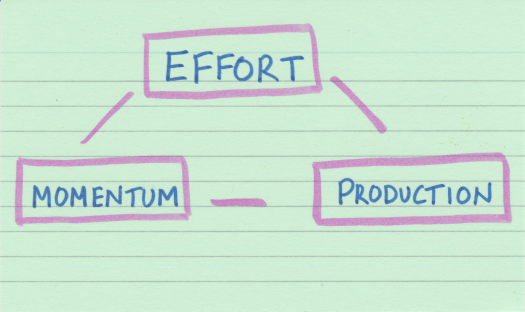
The challenge, for most of us, is finding the right balance between the effort it takes to learn how to do something, the amount we have to do every day to keep the momentum going and what we’re trying to produce as a result of the work that we do. It’s easy to end up wishing we could do what someone else does. I watched a YouTube video today of an artist painstakingly crafting a Chinese bow using mostly hand tools – and while it’s beautifully made and the artist is elegantly pictured throughout – there must have been some sweat and swearing involved as well. We like the results that we see – but not all of us are prepared to put in the work needed to replicate someone else’s results.

That’s why it’s important that we find the thing that works for us – the particular way in which we can contribute. It takes time and patience to do that but you have to put in the time to find your way. You can’t do it all so you do have to try and select and work and stick at something and eventually you’ll work it out. It probably helps to have the chance to do an apprenticeship or craft your own apprentice journey. But when you do find it you’ll find that it asks a lot of you – especially of your body. There’s a scene in the series Mozart in the jungle where musicians talk about how they devote years to their art, pushing their bodies to the limit, and how much strength it takes to do that day after day.

But sometimes just being strong isn’t enough and if you can’t keep doing what you love to do in the way you love to do it what options do you have left? There’s always teaching – help others to learn how to do the thing that you care about – create an apprenticeship, a learning experience for others.

When it comes down to it – working out the options is really not that hard. It’s the fear of the unknown that stops us. Once the thing has happened we deal with it – that’s what our brains evolved to do – to help us survive. To carry on. It’s not over until it’s over.

Cheers,

Karthik Suresh

What Does Product Development Mean To You?

cartoons.jpg

Slow parents understand that childrearing should not be a cross between a competitive sport and product-development. It is not a project; it’s a journey. Slow parenting is about giving kids lots of love and attention with no conditions attached. – Carl Honore

One of the best images I’ve seen about product design is the one about the skateboard, created by Henrik Kniberg. It’s a simple picture that gets across the idea of a minimum viable product really rather clearly. In essence, the idea is that a product is not about delivering a wheel or a chassis but delivering an experience to your customer. I’m not sure I agree entirely with Kniberg’s use of the metaphor but rather than critique his description I think I’ll focus on the what I take away from it, which really is about the idea of the whole.

The “whole” is a concept from systems thinking which relates to the idea of emergence. If you have a wheel, you can’t do very much. If you have four wheels attached to a board then you’ve created a skateboard and you can do something that you can’t do with just any one of those elements. You can stand on it and travel. That’s a product right there and it makes people who like skateboarding quite happy and you can develop it and make it better and faster. I had a classmate at university who built longboards and ordered light kits and had a nice business going. Then, if you add elements, like steering or an engine, or a chassis and seats you end up with different products that help you travel when you’re younger, travel faster, safer and so on.

This idea of product design as something more than a thing is really quite important to internalise. Your product is ready when someone finds that they can do something useful with it – the useful bit emerges as a result of the product existing but it’s not found in it. And sometimes people don’t really get this. They see their job as doing one bit and doing that really well. But what matters is getting the whole thing done and that is where customers find that they get let down. Everyone you talk to probably has stories of poor products and service – from hassles with building an extension to returning items ordered from a website. At the same time, people are getting much better at doing this well, and many market sectors will be changed by entrants and incumbents who change with the process.

I remember the first time we needed professional carpet cleaners. One was in the Yellow pages and I rang up, got through to his wife and was told he would ring back. The other had a website with prices on there and you could book it in then and there. Who do you think got the work? And these days, with the pandemic, who gets your business? Probably Amazon.

When I think about this in the context of writing I am constantly reminded just how efficient a product writing is. It’s easy to create and fast to read. But a word isn’t enough to create a product, and a sentence usually isn’t enough either. You need enough sentences to capture an idea, an idea that you can then send on to someone else. But just because a medium is efficient that doesn’t mean it’s used efficiently. Many books, for example, are really one idea stretched out as far as it can go and then some – but it’s something you can summarise in a few words. On the other hand, some academic papers pack in so many ideas that you could spend an age unpacking them.

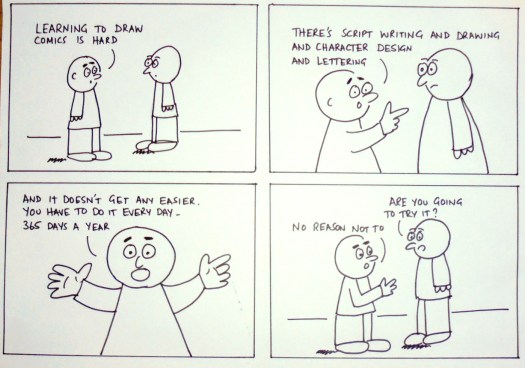
As you try and increase the number of elements in your product you run across the challenge of creating useful wholes. Take cartooning, for example. I draw simple images for my blog posts and for the last few years it’s something that’s done in a few minutes – a few lines that help to add some colour to the post. But when you try and create a cartoon you realize just how complicated a task it is to marry ink and paper when you’re trying to create more than words. What professional cartoonists do is make their lives easy – they create a few characters that live out a story. The characters often wear the same clothes and there are a limited number of backgrounds that are used again and again. Then again, you have cartoonists that create stunningly complex pieces like the work of graphic novelist Lars Martinson. It really depends on what you want to emerge from your creation.

What I’ve found challenging is finding a form of creation that words within the time that I have to work on stuff like this. Like most people that have a blog project this is not about followers or money or fame. It’s a place to practice an art – and for me that’s the art of letters and the art of sense-making with pictures. There are lots of things that I am naturally not – I’m not a natural artist or a writer or funny or insightful. What I’m good at is working on something day after day for a set amount of time and doing it without really caring too much about getting anything as a result of the doing. But there isn’t enough time so anything that uses the time better is helpful. With drawings, the fewer lines you need the better – and so cartoon like images are more achievable that realistic scenes. But cartoons are much harder to do than diagrams – which only need labels and not characters and dialogue and pacing.

And I’m not sure you start by knowing the shape and size of these pieces. You kind of have to start and then things start to make sense as you go about working on them. Going back to Kniberg’s skateboard – the point of his metaphor is to say that if you want to build a car you start with a skateboard as a minimum viable product and then you iterate towards the car. But the flaw is that quite often no one knows they need a car. When you had horse-drawn carriages, for example, do you think there were customers out there that knew they wanted an automobile? No, and they still don’t. Car, as you clearly know, is short for carriage and for a passenger it really doesn’t enter their heads that the horse in front could be replaced with a gas engine or a electric motor or a pack of huskies. It carries them and that’s the outcome. But, you build the horse-drawn one and then worry about the amount of dung and discover oil and things change. It’s the designer that makes the change possible.

Anyway, I do find cartooning hard and that’s why I think I’ll keep trying my hand at it and hopefully you will bear with me. Maybe we’ll both learn something.

Cheers,

Karthik Suresh