Why You Need To Take Time To Do Before You Can See

grounded-in-reality.png

Monday, 9.52pm

Sheffield, U.K.

We all have dreams. But in order to make dreams come into reality, it takes an awful lot of determination, dedication, self-discipline, and effort. – Jesse Owens

Have you ever wondered how some people got so good at doing what they do? Why it is that one box set on TV draws you in while another you abandon in minutes – just knowing that it isn’t worth your time. Do people just wake up knowing what to do – perfect at their art?

Well, you know the answer to that is no – but it’s not an easy lesson to learn or one that we’re particularly open to learning. It would be so much easier if we could just do things well without all that messy practice and repetition and trial and error.

When it comes to writing, for example, an essential first step is research. You can’t just will something into existence without first doing some of the background work. With non-fiction that’s the research, the study of existing material with lots of note-taking and sense-making. With fiction it’s the creation of your world and characters and then seeing what they do there and if it works as a story. All this is the hard grind, the labour, the work which then results in something that stands on its own, we hope.

So, after a year of frenetic writing I think this year is going to have to be about reading and note-taking in addition to working on the drawing skills I talked about earlier in the year. And that means perhaps reflecting on the things that I’m reading and learning about.

There are three things that are occupying me at the moment.

The first has to do with treating content as a construction task. so, for example, rather than writing something in Microsoft Word as one long document, you write things in markdown chunks and then stitch them together, like you would a computer program. That’s interesting and it works pretty well. You can even include images and scale them to the right size using a width attribute.

The second is continuing chatter in the Systems Thinking community and it’s throwing up a few useful concepts. This is an interesting, if complicated look at the complex systems world with an intricate map of Complexity science. I’m hoping someone isn’t maintaining that by hand because that would be hard…

I also came across the book The Innovation Delusion: How Our Obsession with the New Has Disrupted the Work That Matters Most which talks about the importance of maintenance and the right to repair rather than buying new all the time. That resonates with me – I’m keeping several computers going and have nursed a printer along for ten years rather than get a new one. The really important point here is that what we don’t need in our lives is new and innovative stuff. We need stuff we can rely on and that we can maintain easily.

The last one is a book called Visual Thinking: for Design by Colin Ware that takes a biologically based view of design which makes it very easy to see what kind of approaches help to make visual information easier to process. Just reading the first few chapters helped me improve my note-taking process, giving me ideas on how to structure information so it’s easier to comprehend. That fits in nicely with the book I’ve just finished called Algorithms to live by which ends with an ask to be computationally kind – make it easier for others to process what you’re asking them to do.

So, that’s that then.

Cheers,

Karthik Suresh

How Do You Make Sure You’re Doing Something Worth Doing?

what-to-do-with-something.png

Sunday, 6.30pm

Sheffield, U.K.

One thorn of experience is worth a whole wilderness of warning. – James Russell Lowell

I gave myself a break from writing of around ten days – school was done for the term, the kids were on holiday and was the end of a rather tough set of weeks. It’s been useful to have some time off if only to reflect on how things have gone so far and the differences between the way last year turned out and how this one is going. It doesn’t make it any easier, however, to figure out if anything you’re doing is right or not or what.

But, I’ve been reading and remembered a few things and observed others – and they might be worth considering as the rest of the year relentlessly moves on.

The first thing has to do with filing. Stuff just accumulates and if you like writing or drawing or using paper – the amount of material you have tends to grow over time and eventually the pile takes over and stops you from doing anything. What sort of approach should you take with material – what’s important to keep and not keep?

There’s a lesson here that children teach you. When children draw something they’re fully engaged in the process – standing there and drawing for as long as it takes. Once it’s done, however, they take off without a backwards glance. The work they do is practice work and you don’t need to keep practice work. Yes you could look at it and reminisce about all the work you’ve done but the real value is in your fingers and your brain – the muscle memory and learning you’ve taken with you. Practice work can be tossed once you’ve learned what you need to learn from doing it.

Then there’s work as an end in itself – finished work. That’s work you want to keep, work that goes in a file or is framed and stored and kept because you’re going to want to sell it or show it off later or do something with it. Finished work has value to you and preferably to someone else who’s willing to pay for it.

Then there’s a whole lot of work in progress – the stuff that you do while you’re trying to get from the practice stage to the finished stage. These you keep as long as they’re useful and then you get rid of them. Maybe you keep them for some time – old drafts, structures, things that helped you work through the problems you faced at the time. But in many cases you can get rid of them.

But sometimes you shouldn’t. And that’s usually when there’s value in being able to study the process you went through in getting from one stage to the next. The biggest problem we face is that people tell us to do and what has worked in the past for people who have created things are not always the same. There’s lot of advice and hot air out there but it isn’t always grounded in real-life experience. It’s a theory that hasn’t been tested – and sometimes you can’t test it but you can look at how it was tried out and what happened as a result. For example, agile methodologies are well known and popular but there are critics of the process who suggest that most implementations of the method have failed. How do you check something like that without studying what happened – while remembering that you can’t prove anything when it comes to the way people do things? You just have to make up your own mind.

This brings me to a challenge that I am going to have to face up to in the research and writing I do in the next few years. It would be nice to have general, magical solutions to general, all-consuming problems. But most situations are specific and what you need in the situation you are in right now will need a specific approach that balances being grounded in your reality with making sure you’re open to changes that may be necessary. So how do you think your way through all this?

Thinking.

That’s the project I’m going to be working on next.

Cheers,

Karthik Suresh

So Why Is This Blog Called Handcrafted Insight?

trained-to-see.png

Thursday, 9.17pm

Sheffield, U.K.

That’s the thing with handmade items. They still have the person’s mark on them, and when you hold them, you feel less alone. – Aimee Bender, The Color Master: Stories

I was watching a lesson on the Bikablo technique of drawing by Dr Jill Greenbaum – and she mentioned a few words that got me thinking about the theoretical basis of thinking – a sort of recursive journey. She talked about Alan Paivo’s dual coding theory – the idea that visual and verbal information can help you remember more than either on its own.

The important bit of that statement for me, however, has to do with coding. You hear that term a lot in research, “coding”, and I think it has a quite a lot more depth than might appear at first glance.

The reason we use words is that they are extremely efficient containers of meaning. It would be next to impossible to recreate the ideas I have written down so far using just drawings or interpretive dance techniques. Words are perfect vehicles to help you say what you’re thinking or what you mean most of the time. And that creates an issue for us. Because they’re perfect so much of the time we sometimes fall into the trap of thinking they are perfect all the time. This is a similar problem faced by people who are fans of the scientific method. Reductionism, the cornerstone of the scientific method, has helped shape the world around us – and its success makes some people think that the answer to everything can be found in science.

When we elect to work predominantly with words what we’re doing is choosing a coding mechanism. This idea of coding is quite fundamental to communication. Whatever you and others are thinking can only be shared by first taking the thoughts in your head and coding them using a system that works for you. The coded message is passed to someone else who then decodes it and interprets what they find to try and understand what you meant. In the case of this paragraph the thoughts I’m trying to express are coded using the English language. And perhaps you get what I mean – some of it anyway.

Now, if words are good but they aren’t everything then the reason this blog exists is because of a belief that you can enrich your coding system by using images as well as words, preferably hand-drawn ones. What I’m not saying is that images are better than words. That argument was settled when we stopped using hieroglyphics and phonemes and opted for graphemes – as I’ve learned while redoing primary school with my children.

The reason you might want to consider an enriched coding system is the same reason why you might want to learn how to use your native language well. The better you are the more you can say – and the more complex ideas you can hold in your head. It’s possible that your ability to think is directly related to your ability to use language. And if you can use words and images to explore ideas and concepts it follows that you can think about them more clearly and come up with better approaches and results.

I was going to focus on something called Grounded Theory in this post but I got a little distracted with the whole coding thing – but here’s a little of what I was thinking about.

Grounded Theory is a way of finding patterns in data – and was developed by Barney Glaser and Anselm Strauss in the 1960s. And from this point things get a little complicated. Grounded Theory is a form of inductive reasoning – you collect data and then you create theory – a generalization – from what you see in the data. The opposite is deductive reasoning, where you start with a hypothesis and then see if the data you collect confirms or disproves your hypothesis. With grounded theory your theory emerges as you interact with your data and is coded using Theoretical codes. See – coding has some relevance to this discussion. Theoretical codes try and hold the theory that emerges from the research you carry out.

So, what does this mean in practice? Say I want to study something – a TED talk, carry out an interview, review some qualitative data – all of that is simply data at the start. If I write and draw what I’m studying, trying to identify concepts and relationships between concepts I’ll start to find patterns emerging from that data. Those patterns are ones that I’ve seen – someone else might find different ones but as long as I stay with the data and create patterns based on them I’m staying grounded in that data. If I bring other ideas that were expressed elsewhere – then I’m straying from what I see to what I expect or hope to see.

And this is an important distinction. Imagine you’re a salesperson. If you go into a session with a presentation – all ready to pitch your product – then you’re going in with a preconceived idea – a hypothesis of how things will work and the reaction of the people during the meeting will give you data on whether you’re right or not. And if you do enough of these meetings the law of averages will mean you win some and lose some and get your commission or not. If, on the other hand, you go in without preconceptions, ready to listen and collect data, which you then try and structure into some kind of pattern – and then showing how you can help now that you understand what they need – well that’s going to give you an entirely different kind of reaction. And that’s because instead of looking for what you’re expecting to see, you see what is actually in front of you.

And I think the more coding tools you have, including visual and verbal ones, that help you see with that unbiased view the better you will be able to wrestle with the increasingly complex lives and work that we all have to do.

Cheers,

Karthik Suresh

Are You Really Trying To Get Better At Something?

better-than-a-year-ago.png

Wednesday, 9.30pm

Sheffield, U.K.

Good, better, best. Never let it rest. ‘Til your good is better and your better is best. – St. Jerome

Nothing comes easily, does it? However much we wish that things happened quickly, that obstacles didn’t exist, that we got there fast – reality seems to get in the way and one of the places where reality is really quite obdurate has to do when you’re trying to do something well.

I’m not a particularly pessimistic sort of person but I think anyone who creates anything probably has a sort of angst about what they’re doing. It’s never quite right and you could have always done it better if you had more time or had a chance to do it over. I suppose you have a choice every time. Do you let something less than perfect out into the world or do you hold back – perhaps not do anything at all because you’re not good at it?

It’s a little reassuring that others feel this way too. I was on a session today with someone who clearly knew what they were doing – but also felt that some of their work wasn’t quite as good as they would have wanted. It was still really quite good and they weren’t producing exceptional work and humble-bragging. They genuinely felt that they had room to improve.

It’s quite easy to get caught up in a cycle of self-doubt – of introspection and internal analysis. It may be a cultural thing that some of us are more prone to. I remember a phrase about Gandhi – possibly by V.S. Naipaul or Pico Iyer – I can’t quite remember the source, where the writer railed against how Gandhi seemed to focus entirely on how he felt inside, ignoring the way the world looked outside. I remember thinking about that criticism and a description of the protagonist in Zen and the art of motorcycle maintenance discovering the world around him, and noticing everything outside. This idea of inside and outside is interesting – and of course it’s pointless to ask which matters more. They both matter. Without an inside you have a husk. Without an outside you have no form.

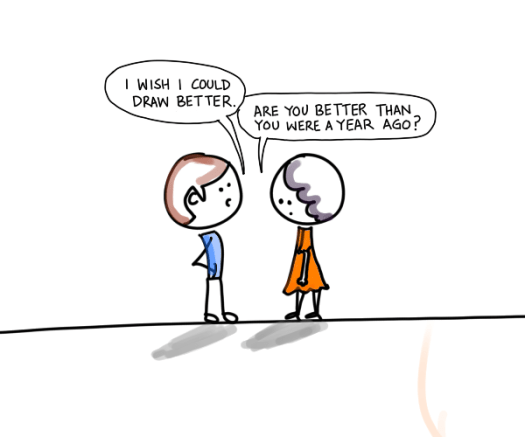
How do you balance an internal and external reality – something that is consistent and useful? Where what you say you want to do and what you are in sync with each other. The easiest way is to ask yourself what you did last month, last year. Is this thing you want to do now something you were working on a year ago? If not, then why do you think you’ll be working on it a year from now? It’s very hard to get worse at something that you work on every day. It’s slow and painful and every day of that year you’ll probably feel like you aren’t achieving anything but when you look back you’ll probably see that you are better than you were.

And even if you aren’t – does it really matter? It only matters if you think there is an end to it all and at some point you will have arrived and be as good as you ever will be. That’s not my view – and it’s not the view of anyone who does things because they enjoy the process rather than for the result. If you’re doing something that you hope you’re still doing in your eighties – then really no one else’s view makes much of a difference.

What matters is getting on with the work when another day comes around.

Cheers,

Karthik Suresh

When Do You Need To Talk Something Through With Someone Else?

talking-krita.png

Tuesday, 6.51pm

Sheffield, U.K.

I prefer drawing to talking. Drawing is faster, and leaves less room for lies. – Le Corbusier

One of the reasons I grew interested in visual thinking was because of how effective it was in reasoning with little children. If you have young kids you’ll know how close they are to an outburst when things don’t go their way. And I found that trying to talk them down was about as useful as whispering poetry to a bear that has come across you trespassing on his patch.

But, if you pick up a pen and start trying to draw the problem to talk about it – you find that they get involved, intrigued, interested. And quite quickly you’ll find that they’ll grab the pen and get involved in the narrative and then you’re on your way to being able to talk about what’s going on in a way you just couldn’t do if you tried to talk about it.

But getting that engagement is really only the first part. That’s about building trust in the process and trying to get a common point of view. The reason for the discussion, on the other hand, is to figure out what to do, what will work for everyone involved. It’s a negotiation – and in a good negotiation everyone walks away with something that they’re a little disappointed with.

If you’re ever in that situation how should you start with a drawing? I tend to start with faces and emotions – how are we feeling right now? Perhaps something that explains the context, the situation. And then I tend to follow up with options and alternatives.

When you have things laid out in front of you it’s a little easier to deal with the emotions and with the reality. I wonder if that has to do with the way we think about things. Feelings come out with sounds, don’t they. A child cries when he or she is unhappy – so the sound channel is essential to articulate how they feel. If you try and use the same channel to talk things through you’re essentially talking at the same time as a loud noise is blaring in the background. But if you draw, you’re going through a visual channel – something the child can process at the same time while they’re fully engaging their auditory channels in crying their hearts out.

There’s something here about being able to use all of our potential. Speech alone is a powerful tool but we need more than that to really connect with others sometimes and children teach us how to do this very effectively. If you want to reach a child you have to use every sense you have – visual, auditory, kinesthetic. They have an attention span that can be measured in tens of seconds. But, if you get them interested, they can spend minutes, hours, eons immersed in play – something that looks like deep work in adults.

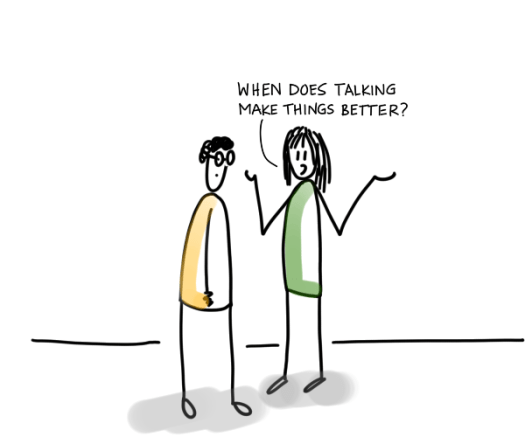
I suppose the thing to take away is that talking is good – but talking and drawing is better. And if you can combine talking and drawing and moving – you’re on your way to creating a truly successful interaction with someone else – the kind of interaction that tends to make things better.

Cheers,

Karthik Suresh

How Do You Make Something As Simple As It Needs To Be?

no-simpler.png

Monday, 7.17pm

Sheffield, U.K.

For every complex problem there is an answer that is clear, simple, and wrong. – H. L. Mencken

I have spent a lot of time doing customer interviews – the kind of thing where you are supposed to get out of the room and go and talk to real people. Fortunately, we can do this without leaving the room these days and that makes it a lot easier to get more of them done.

What I am always surprised by is how quickly a situation that appears simple on the surface turns out to be anything but as you unpack what’s going on and see all the links and connections and misunderstandings and wrong turns and hunches and insights and flashes of inspiration and brilliance. And this makes sense for one simple reason – there are few straight lines in nature.

The world around us is organic and complex and when you look at how it works there’s nothing planned and linear about it. We were in the woods the other day and I was struck by a particular arrangement of plants – something that started like a tree but which they wound itself around another, larger tree, like a vine. A strange combination but it happened in the way it did. You wouldn’t plan that – it just happened that way.

We are able to deal with the complexity and non-linearity of nature by taming it, by chopping down the disorder and building boxes in the spaces we’ve cleared. We don’t live in harmony with nature. Instead we live cocooned away from it with the only “natural” things we have consisting of carefully fashioned artifacts.

I’m less interested, however, in the outside world than the one inside our heads. That is a space where we construct a view of the world around us and we try and make sense of that world through the sense-making methods we learn over our lifetimes. And a lot of those tools are the same ones that were very successful at taming the natural world – putting things in boxes being one of the most important.

But our thoughts, like nature itself, are often organic and non-linear and rarely as simple as a box. They are complex shapes and we have to have mental tools that match the complexity of the situations we are thinking about. Things are as complex as they have to be. We can often make things more complicated but that doesn’t mean the same thing as dealing with a complex thing.

This is something that everyone has experience with. How often do you trust a complicated piece of analysis? If you can’t understand the reasoning you’re unlikely to place your trust in the results. This is why so much “analysis” is ignored by decision makers – they don’t know what it really means or if it’s riddled with errors so they ignore it and go with their guts.

But if the reasoning is transparent and clear and they can follow it then they are more likely to make the call you are recommending. But you have to do that by presenting the situation in its complexity – not making it simpler than it is. If you make the mistake of simplifying then you’ll be caught out and have to explain the things you ignored before a decision will be made by anyone.

Here’s the takeaway. When you talk to someone about their situation take the time to listen and then listen some more. And when you think you’re done, try and listen a little bit longer. That way you might get a chance of seeing what they’re facing in as much detail as possible and you can help them do the right thing next.

Cheers,

Karthik Suresh

Is Your First Thought On Seeing Something Negative Or Positive?

negative-reaction.png

Sunday, 8.26pm

Sheffield, U.K.

I don’t want to speak negativity into existence. – SZA

I was watching a TED talk today on a topic that I’ve been interested in for a while and when the speaker started talking someone else’s voice entered my head and I didn’t like it at all.

I’ve noticed a tendency for a certain group of people to attack others on this topic. Someone says something on social media and then you get a response – these comments and negativity pointing out that the person is wrong or doesn’t understand what they’re talking about.

I’m not a big fan of those voices and I need to stop myself becoming one of them. But it’s very easy, once you know something about something, to think you know all about it and everyone else must be wrong or stupid or incompetent or dumb. It’s like the people who come out and correct grammar and speling – quite often their responses contain errors of their own which sort of defeats the purpose. And yes, I do know how to spell spelling…

There’s also an age-stage thing going on with knowing things. Sometimes you aren’t ready for the more nuanced stuff until you’ve been through some time trying to make the obvious stuff work. I find myself thinking things like, “I went through that phase five years earlier.” And I need to remind myself that because I have had an experience and come to a conclusion doesn’t mean that others are at the same point. There’s this idea that life is like being on tracks and some people are coming up behind you and going through the stations you were at and that there are stations that you are heading towards that others have passed through before you. It can make your head hurt a bit when you think about it too much.

One of the best things you can do when faced with these situations is to look at the context – what is going on around the thing that you are looking at. When someone puts an approach forward for you to think about – a solution that they have come up with – what you need to remind yourself is to think of that solution in the context of the problem that it solves. It is very tempting to generalize a solution and feel like it should fit all circumstances. It sometimes can but you can often end up trying to put in a solution for a situation that doesn’t need that particular one.

Ernesto Sirolli has a story that helps to make this point. Imagine you go to a remote location to help a village and see that there is a very deep and fast flowing river that separates them from resources on the other side. They have to brave the water and ferry things across. What would you do to help them?

Sirolli says that everyone who goes there wonders why the villagers haven’t built a bridge. So, they apply for funding, get international donors to pitch in and start building their bridge. They do all the earthworks, drive in the pillars get everything built and get ready for the adulation of the villages. And then the rains come and the river changes course, running half a mile to the side leaving the bridge proudly spanning dry earth. And that’s why, the villagers tell them, we don’t build a bridge over this river.

What this should tell you is that you should probably be wary when someone gets up and promises to tell you how to fix all your problems. The problem is that what they tell you may have worked for them in their context but you need to figure out what will work for you in yours. Use other people’s solutions as a starting point to figure out what you need to do – not as a prescription to follow that will give you the results you want. At the same time you need to be careful not to discard what other people have done because they don’t do it like you do. You will still be able to learn something if you look at what they say critically – working to put it in context and seeing if that context has similarities to your context.

Of course, it does mean you find it harder to provide simple, easy, canned solutions and some people don’t have the patience to deal with all that complexity or, more charitably, they aren’t quite at that stage yet. And that’s ok. These things take time. What you don’t want to do is become such a know-it-all that you turn into a cantankerous grouch when you hear anyone say something that you don’t agree with.

Better, in those situations, to say nothing. Or smile and nod.

If it’s any good, it will still be around in ten years. If it’s not, it won’t. And you will have all that time to make up your own mind.

Cheers,

Karthik Suresh

What Is The Essence Of Planning?

plan.png

If you plan on being anything less than you are capable of being, you will probably be unhappy all the days of your life. – Abraham Maslow

Saturday, 7.37pm

Sheffield, U.K.

I am, on the one hand, quite resistant to planning, and on the other, rather fixated on time – and I wonder if those two things are related. For example, I find it hard to follow a recipe. But I also know how important it is to start cooking at the right time so food is ready when people are hungry.

That last point – about being ready when people are hungry is an idea that I don’t think everyone shares. Some people start to think about food when they are hungry – and then start looking for what they can make. And that’s a bad combination. Trying to make decisions when hungry rarely ends well.

Here’s the thing. You’re at home – so many of us are right now. It gets to 4pm. You want to work till five or six so what do you do? Do you keep working until you’re done and then make food? Or do you make food at four, feed the kids at five and then go back and do some more work if you have to?

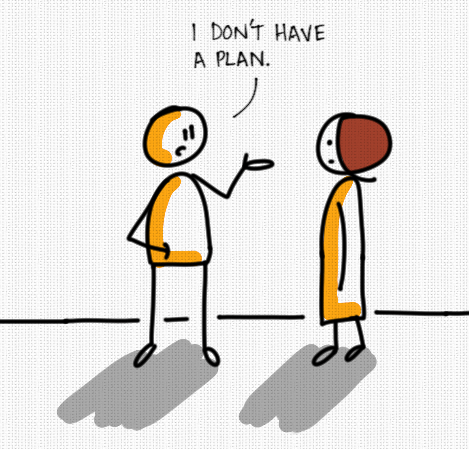
I tell my kids all the time that early is on time and on time is late. If you get where you need to get to early you don’t need to plan how to get there on time. Planning starts to be unnecessary if you focus on time instead.

I’m sure there are problems with this line of argument but let’s just meander down a world where you decide what to do with time rather than plan what to do.

What are you going to do first? The most important thing? That would make sense, especially if you want to start and maintain a new habit. When I started writing, for example, I always wrote early in the morning, first thing. And then it started to become a habit and when I started writing in the evening it didn’t take much time to adjust. But I think the thing that made it work wasn’t that I planned to write – but that I wrote at the same time, more or less, each day.

Now, you might argue that planning is necessary when you’re working with others because otherwise how would you know what everyone needed to do? But again that comes down to time, doesn’t it. Coordination is about time, about getting things done so that you meet at the right time with the right things done. Right now, for example, I’m racing through these words trying to get them down before the kid’s bedtime as I hear their not so gentle thumps heading upstairs.

Many choices and decisions seem to come down to questions of how much time you’re going to spend on what. Time with the kids, time on your relationship, time at work, time on the side hustle, time on a hobby. Time is all we have and how you spend it is what becomes your life.

There is a systems thinking quote from Stafford Beer that says the purpose of a system is what it does. I think that works for people too. Your purpose is what you do.

Spend your time wisely.

Cheers,

Karthik Suresh

Are You Trying To Give Or Teach In Your Business?

message-matters.png

Friday, 7pm

Sheffield, U.K.

A good teacher, like a good entertainer first must hold his audience’s attention, then he can teach his lesson. – John Henrik Clarke

There are consistent tensions that emerge when you create something that you think is new and valuable. While its an idea or a vision it’s just floating out there. But the minute you make it tangible, put it into the world in some kind of form you start to lose control – and so I suppose people try and exert control once again. If only to be able to exploit what they create – to monetise it. But in doing so you constrain the idea and it’s hard for it to adapt and expand until it stops, stuck where it is. At which point you have to go and start looking for another idea. You get a sense of this in the picture below.

protected-method.png

How do you find a balance between holding something so tightly that you crush it and so loosely that it flies away? I don’t know how to do that but I think it’s work changing the way we think from wanting to reach a goal to going through a process or a cycle. And there is just a small difference between the two things – but it has a big impact.

goal-vs-process.png

That small amount of circularity in the process mindset means you can think about things for longer. You can take a bit more time because you get another chance to do it better. But there are lots of things that you have to do perfectly – you have to sing that song right, hit that ball straight – and the kind of approach you take depends on the kind of thing you’re doing.

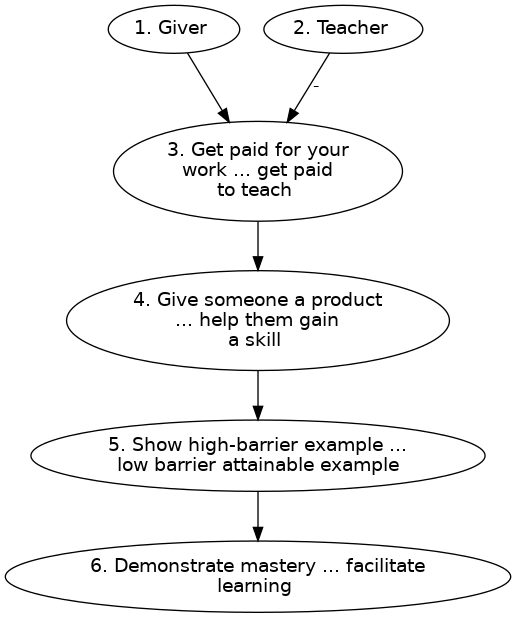
For example, we will all probably be in situations where we have to figure out how to market what we do – and there are really two big choices in this day and age. You can give people something or you can teach them something. You can be a giver or a teacher.

The model below is a cognitive map that is meant to be read in a particular way. It’s full of bipolar constructs – which means that each sentence has two opposite poles separated by three dots. The three dots. “…”, mean “rather than”. So, in the first oval you read the sentence as “Get paid for your work rather than get paid to teach”. The second thing is that the tiny minus sign on the line linking “Teacher” to the next oval means that the second statement applies to that point. So, as you read down the model the “Giver” relates to the first pole of each construct and the “Teacher” relates to the second pole.

give-teach.png

Yes it’s complicated – bear with me – I’m trying to wrap my head around this way of thinking too.

The way I took “real” sketchnotes is like the image below – paper in a clipboard and a pencil. And it helped me learn – and now, years later, those concepts still make sense. It’s not pretty, but it helped me with what I needed to do.

sketchnote.jpg

What this means really is that if you want to teach someone something like visual thinking – then making really lovely pictures that you need an art degree to be able to do is more likely to scare them off than help them. If you want to show your work and have people admire it – then do the best work you can. But that’s not teaching. Teaching is about showing people work that’s possible in the situation, in the heat of the moment. For example, if you google “Sketchnotes” you will see some amazing examples. But in practice most of us are not going to be able to create those works of art in a real classroom while learning.

So, the answer to the question of what matters – the message or how it looks is really to respond by saying that’s the wrong question. The right question is asking, “What are you trying to do – give or teach?” And the answer to that question will help you get the balance you need.

Cheers,

Karthik Suresh

Are You What You Wanted To Be When You Grew Up?

perceptions.png

Thursday, 8.20pm

Sheffield, U.K.

There are only two tragedies in life: one is not getting what one wants, and the other is getting it. – Oscar Wilde

I’ve been thinking about models this week – so this could be a technical sort of post. Or be quite short, we’ll see.

Here’s the thing. How do you know what to do with your life? What kind of thought process do you go through as you work this out?

The thing most people are familiar with is the power of positive thinking. Believe in yourself and the universe will give you what you want. Write a list, focus on your goal and it will happen.

Now, this is a way of thinking but how do we capture it? How do we set it down in a way that can be analysed?

One way of doing that is to put down the logic – the arguments that are being made in order and look at them. Just look. So, if you did that, you might see something like this.

focus.png

Now that you have a model in front of you, that’s something that can be analysed. so, you ask yourself, is this really a question about a beginning and an end. If you wanted to be a train driver when you were a kid and you are now a painter and decorator – does that make you a failure? I suppose it sort of depends on how you see the world.

Right, so how could you see the world?

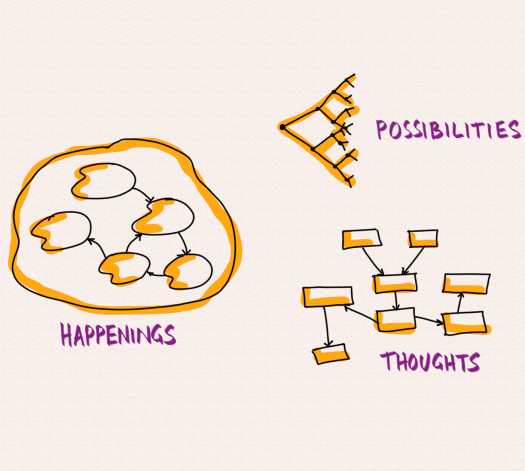
There’s a mathematical view which says there are lots of possibilities branching out in front of you and as you make decisions you travel along some branches and make other branches disappear. If you don’t take biology at school your chances of becoming a doctor start to fall as the branches leading to that career start to thin – until eventually you have no way to bridge the gap between where you are and that particular way of life.

If you were suggesting to your child what they should do in life you’d probably advise them to pick something that led to a safe and secure career. You’d have a number of thoughts that you’d arrange in order to make your point. These thoughts are what you believe and you’d try and get that across to your child – trying to help him or her make the “right” decision as you see it.

That might look something like this.

reality_simple.png

This pretty binary route is what seems to be the idea that most parents have in their heads as possible futures for their kids. And if you make decisions based on what you think – then you had better hope that you have the right thoughts in the first place. But how do you tell without living that life that you’ve thought about?

Well, most of us can probably relate to one of these branches but also know it’s not quite as simple as that. Reality is a little more messy and there are multiple routes that life could take. In a sense, there are happenings that result from the arrangement of our lives. In that sense what happens to us emerges from what is happening to us. And that doesn’t entirely make sense in words but it does when you think in terms of feedback loops. And that looks something like this.

reality.png

Now, I’ve thrown these models together in a few minutes and not really thought them through but that’s not the point. The point is that once the thinking is visible you can look at the arguments and see what might happen as a result of using any one of the thinking approaches that I’ve described – which loosely approximate making decisions based on a formula, a path of possibilities or based on thoughts, an argument for action or based on a systems model, a basis for emergence. These are a little technical, and you need some familiarity with the terminology to appreciate the differences, but the important point is that life is rather more complex than we sometimes make it out to be.

You are where you are because of all the choices you made over your lifetime and all the ideas you had, including the ideas about what you wanted to be when you grew up. If you aren’t happy with where you are – then you might benefit from thinking from all these vantage points. Is there a branching set of possibilities that could still give you what you want? Do you think there is a way to make it happen? Or could you arrange your life to have more of what you think is missing?

When I was young, I wanted to be a photographer and an artist. And I didn’t do those things for a career. But I draw a lot now, although not very well. And I think and write and do interesting work – and all in all – although I am not a National Geographic photographer – I have little to complain about.

Cheers,

And perhaps that is good too.

Karthik Suresh