Why We Keep Trying To Be Right Even When It Is Impossible

clarity.png

Wednesday, 7.20pm

Sheffield, U.K.

It is not our differences that divide us. It is our inability to recognize, accept, and celebrate those differences. – Audre Lorde

It’s extremely hard to watch someone else do something differently from how you would do it and resist the urge to jump in and tell them how to do it properly – your way. If you’re competent at what you do it’s hard to watch someone else bumbling their way through a task, using the wrong approach, and the wrong method.

Of course, there isn’t really anything “wrong” about it most of the time. It’s a different problem, and one that rests with you and with me.

For example, I remember the first time another student and I worked on a maths problem and encountered the European way of using dots and commas in large numbers. For example, I would write 2 million and 2 as 2,000,000.02 while they would write it as 2.000.000,00. The “fault” lies with Leibniz but when you first encounter this it’s a shock – seeing something that runs entirely counter to your established patterns of thought – a realization that the whole world does not think the way you do.

I have learned that this happens quite a lot since then. People are different, but it’s difficult to keep that in mind. We understand some people more easily not because they make good points but because we are more familiar with their ideas. We tend to assume that people who speak with an accent also think with an accent. We believe that because something worked for us that means it will also work for someone else.

But the opposite doesn’t hold true either. Not every exotic idea or mystic utterance makes sense. Believing that past experience is no guide to the future is a good way to learn nothing. I was listening to someone talk about coaching and the idea that a coach should not contribute expertise – that’s for the client to bring to the party. And that sounded like an abdication of responsibility – surely a coach needs to know how to do something well, even if they can’t execute it themselves?

I started to critique their position and then reminded myself that there was no point – no benefit to be gained from getting riled and worked up over an idea. It’s dots and commas, in one sense.

But the other thing I remind myself is the proof that we cannot prove that one method works – that any particular way is the “right” way and that others are wrong. The proof goes something like this.

If I tell you to do something and it works for you – then how do we know that you wouldn’t have had better results doing it another way? And if you do what I say and it doesn’t work – I can very reasonably say that you must have made a mistake in the way you did it. For example, I’m very interested in visual thinking. One kind of visual thinker focuses on the “visual” bit – using their artistic skills to create stunning images of ideas and concepts. My own approach is to focus more on the “thinking” bit. For example, the sentence that starts this post is visual – you can see it. It’s legible but not beautiful.

Asking whether it’s better or worse doesn’t really help. There is no right or wrong here. What matters is whether the method is useful, whether it works for you in your situation. An approach that works for you may be one that does not work for me. But how will I know unless I am open to the idea of trying it out? If you really believe that your method is useful – that it’s better – then you should be willing to try out other methods if only to test if that is actually still the case for you once you’ve done some tests.

People get very attached to ideas and methods. I have. I like the way I do things. But we have to always remind ourselves that it’s not the method that matters, it’s whether you find it useful for the situation in which you find yourself.

Cheers,

Karthik Suresh
What Is The Real Value Of Experience?

doing-what-isnt-needed.png

Tuesday, 8.47pm

Sheffield, U.K.

Anything not worth doing is worth not doing well. – Robert Fulghum

Have you ever had to do work that you once used to do but haven’t done for a while? The sort of thing that’s called the “coal face”, what you might have done when you started your career but hope other people do now well enough so that you don’t have to get involved.

I don’t know about you but I miss that kind of work sometimes – the real work of creation and problem solving. When you’re older you’re still creating and solving problems but they tend to be problems of what to do rather than how to do it and the how problems are often ones you can get on with on your own.

The problem, however, is that before you know how to solve something you need to know what you are solving and why it matters. And that’s something that comes with experience – by spending lots of time working on things that teach you skills but often make little or no difference at all.

A good example of this is certain kinds of analysis. Warren Buffett writes about the difference between being approximately right and precisely wrong. I took a long time to learn this difference, spending lots of time trying to be precise without asking whether it was right. That’s easy to do – you can build a bridge in the wrong place, write code that has no function and spend a life wasted in a job that gives you no happiness at all.

What you have to hope is that even though you’re doing something that isn’t really that important you’re building skills. After all, doctors practice on cadavers before they’re let loose on real patients. Artists use cheap printer paper before splurging on the expensive stuff. It’s okay to spend time working on these things as long as you’re building skills and learning how to do different things. That’s making up for inexperience.

But eventually you start to see the difference between what needs to be done and what doesn’t – why you need to do one thing and not another. Your skills can help you do the thing you decide to do but your growing experience helps you decide what’s important and what isn’t.

Ultimately what experience helps you do is decide what not to do. And that’s vital – because too many of the world’s problems are a result of people doing things they just shouldn’t do.

Cheers,

Karthik Suresh

Proofs For Two Kinds Of Gods

producer-product.png

Monday, 8.40pm

Sheffield, U.K.

Not only does God play dice, but… he sometimes throws them where they cannot be seen. – Stephen Hawking

E.A Singer Jr. was a professor at the University of Pennyslvania who taught West Churchman and Russell Ackoff, students who would go on to contribute significantly to the field of Systems Thinking. In one of Ackoff’s lectures he describes how Singer’s ideas can help you redefine your ideas of God.

For a long time people believed in cause and effect – in things happening because of other things happening first. This was a mechanical, clockwork view of the world where a thing moved something else, which in turn moved something else. The entire world worked this way, from the movements of the stars to how the world itself worked – or that’s what people believed anyway.

If you accept cause and effect then it follows that for every effect there is a cause. But each cause is also an effect and must have a cause of its own. And as you work back you end up with a never ending chain unless you stop and decide that there must have been a “first” cause – the cause of all things. And that must have been God. This is the form of the proof for the existence of a maker, for that being that created the universe as a machine. And many of the major monotheistic religions will notice their model of God having a basis in this way of thinking.

Singer, on the other hand, argued that cause and effect is not all there is. He believed that that it was more complex – you could have something that led to something else but wasn’t in itself sufficient. Ackoff described this as a seed along not being enough for a plant – you also need water and sunlight. He called this a producer-product relationship A cause-effect relationship often ignores everything else as irrelevant. A producer-product relationship, on the other hand, looks at the things that are important in the environment as well as the main driver.

So what, you say, isn’t that just a multiple cause and effect situation?

Well, there’s something else that happened which put a spanner in the works of the world as a machine theory. If things are machines then you can understand them. But work like Heisenberg’s uncertainly principle started to show that there were things that we couldn’t know – that could only be approached in a probabilistic way rather than a deterministic one. In fact, we started to consider the possibility that something could happen as a result of the environment itself – life could arise through the interaction of elements in the universe in a way that didn’t require a prime mover – just enough time and ingredients that had a chance of running into each other.

In that sense God didn’t make the machine but is in the machine – in the environment itself – all around. The maker, the mover, the creator is the environment itself and the fact that it enables the conditions for things to happen – and they may or may not happen. But something happened and that’s why we are here.

And that’s the second argument for a God – it’s everywhere – around us and in us. And this model of God is closer to the ones Eastern religions have.

You don’t really have to believe in God – that’s a useful shorthand for wondering about how we came to be – but it’s useful understanding the distinction between cause and effect based reasoning and producer-product based reasoning. After all, many people spend a lot of time arguing about what kind of God they believe in. Perhaps they should be more interested in the kind of world they want to live in.

Cheers,

Karthik Suresh

What Is Soft Operations Research (OR)

research-area.png

Sunday, 8.14pm

Sheffield, U.K.

My Ph.D. is in operations research. I was interested in making things work better and using mathematics to help do that. So operations research is what I studied as an undergraduate and graduate student. – Alvin E. Roth

I’m getting closer to starting a programme of research and I found out something interesting about it recently.

I was watching a series of video lectures by Russell Ackoff, which you can find at the Deming Cooperative channel. Ackoff did military service and, in one of the talks, described how the military functioned. It has four divisions, he said, administration, intelligence, operations and logistics.

Operations is the only part that comes into direct contact with the enemy. The nature of warfare has changed but back when you still had armies and set-piece battles, this structure made a lot of sense. The increasing mechanisation and sophistication of war also meant that it wasn’t enough just to bravely charge in. You needed help from technology and that’s when scientists started to be pulled in to help with the war effort. For example, work went into doing things like figuring out how to calculate ballistics trajectories for anti-aircraft guns. The point was to conduct more effective operations and research carried out to support this was termed Operations Research (OR).

OR, in its classical form, involves applying maths and science to improve operations and make your side more deadly. A large number of mathematical innovations resulted from this – including algorithms for scheduling and routing and queuing. Once the war was done researchers tried to apply these learnings to other parts of business and industry and society. And they didn’t do a great job after a while.

The thing is that when it comes to war there is a pretty clear thing you need to do. You don’t need to worry about the overall missions or objectives or purpose – you can call those things what you like but the thing you need to do is win. When it comes to life, however, what you need to do is much less obvious. Quite often you think what you need to do because of what was thought in the past and then reality comes along and smacks you in the face. And, of course, when it comes to war people don’t really play a big role. You train soldiers to follow orders and do what they’re told. Civilians aren’t always that compliant and some of them seem to have their own views and opinions on what the right thing is to do.

This whole area of real life is still operations, but one where there is no enemy but societies that are morphing and changing. Recent protests, for example, are seen by some as a dangerous threat to society and by others as a long-needed reformation of the way things work. Pick what you want – climate change, equality, opportunity – the problems are all around us and they are systemic ones and complex ones and whatever you do someone is going to end up unhappy.

This is the world of “soft” operations, a real-life world where you are trying to make things better, from the way you live your life, to the way you run your company to the way you treat others. And we’re still trying to figure out the models and approaches and ways of thinking that will help us make sense of what is going in. Research into this area is called Soft Operations Research, Soft OR, and that’s what I’m hoping to study. The nice thing that I’ve learned from Ackoff, is that the history of this field is not esoteric and ivory towerish. There is no enemy – there people and the world around us. And what we’re studying is how to be better.

Cheers,

Karthik Suresh

The Difference Between Efficient And Effective

effective-efficient.png

Friday, 6.04pm

Sheffield, U.K.

If you can’t describe what you are doing as a process, you don’t know what you’re doing. – W. Edwards Deming

Anything you do can be represented as a process. You take something that’s in one form, an input, and transform it into something else, an output. It’s easy to visualise this with real-world examples such as transforming rubber into tyres but it also applies to more abstract concepts such as transforming data into insight. You can think of a process as representative of real things – that machine, that conveyor, that material – or as representing mental models – ways of seeing the world.

There are two things that are important for a process. Objectives tell you what you’re trying to achieve with your process. Resources are what you have available to operate your process. The distinction between inputs and resources is because inputs are transformed into outputs and move on while resources stay or are exhausted in the transformation process, such as the use of energy.

And this brings us to the difference between an effective process and an efficient process. You might think that these must be the same thing, but the diagram above is a nice model of the difference between the two, which I first saw in in this webinar by Andrew Wright.

An effective process is one where the output meets the objectives that have been set. In other words, if the objective is to make a box you make a box and not a vase. An efficient process, on the other hand, is one that makes the best use of resources. You minimise the amount of time, effort and cost that goes into making that box. This is a simple and clear way to understand the difference. There’s no use efficiently doing the wrong thing. Doing the wrong thing better does not make it right.

What we should do is make sure that we clearly understand what the objective is and then go about achieving it in the most efficient way possible. If we do that, we will be effective.

Cheers,

Karthik Suresh

How To Think About Different Kinds Of Systems

types-of-systems.png

Thursday, 6.44pm

Sheffield, U.K.

The way to build a complex system that works is to build it from very simple systems that work. – Kevin Kelly

One of the amazing things about the Internet is that things that were lost are finding a new lease of life. The Open Library, for example, will introduce you to books that you won’t find in your library or on Amazon. And YouTube lets you see things like this lecture from Russell Ackoff which gives you a logical proof for the existence of God.

Then replaces one God with another.

One of the things he talks about is the concept of systems. Many people argue about this, especially on social media so it’s useful to reflect on Ackoff’s definitions of systems.

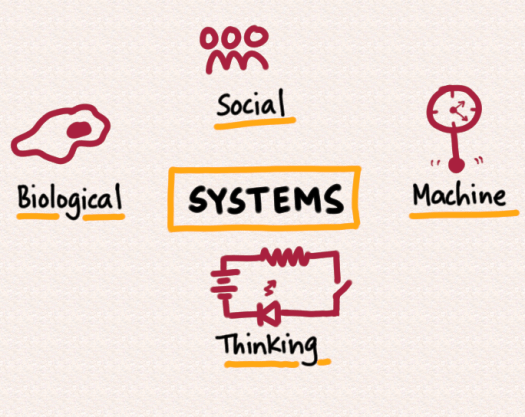
First there are machine systems, things like planes, trains and automobiles. These are mechanical and operate in known ways, what they will do is entirely predictable. A clock will tell the time, now and in the future, in the same way. In fact people thought of the universe as a machine for a long time and if there is a machine there must be a maker, therefore there is a God.

Then we have biological systems, of varying levels of complexity – amoebas to animals. These differ from machines in that their behaviour is not always predictable, they have a purpose, which in many cases is to survive and reproduce.

As creatures get more complex and get bigger brains, you get social systems that emerge from interactions and behaviour. Humans have very complex social systems, which include things like financial systems and healthcare systems, but we shouldn’t forget that bees have social systems as well.

Then Russell pointed out that we’ve been creating a new kind of system, Early machines did things, but then we added the ability for sensing and feedback and started making machines that responded to their environments. I don’t understand this concept entirely but heard the term “Thinking” machines. I think this refers to the ability for a machine to sense its environment and change its behaviour – imagine your automatic vacuum cleaner or a self-driving car. These are doing things that look like thinking, observing and changing behaviour after working out what to do.

Leave the last type of system for a bit, it probably needs more time to really understand. The mistake we make is that we confuse the way to think about one system with a way to think about the others. Machines are great for what they do. If you want to make things efficiently using machines you need to think in one kind of way. The same way, however, will not be useful if you think about social systems. For example, in Western societies, there are few people and so they use lots of machines. In poorer countries there are lots of people and using machines would put them out of work. Someone who believes that it’s more efficient to use a machine to make a road may not notice that it’s not efficient to put people into poverty at the same time.

We also make the mistake of thinking about biological systems as applicable to everything else. We see nature “red in tooth and claw” and imagine that competition is the way things are – we must compete in order to survive. But a social system is about more than that – it can be about cooperation and care rather than control and power.

But if we want to get better at living with the world we have we have to get better at thinking. We need more thinking machines, ones that tell us how the world is warming and how we can be more efficient in the way we use resources. Too many of us are still caught up in machine thinking or biological thinking. What we need to do is get better at Systems Thinking.

Cheers,

Karthik Suresh

What Does A Learning System Look Like For The 21st Century?

learning-system.png

Wednesday, 8.33pm

Sheffield, U.K.

Research is formalized curiosity. It is poking and prying with a purpose. – Zora Neale Hurston

What do you think knowledge is these days? Is it about a fixed thing that you get and keep? Or is it more complicated than that? In a world where what we know seems to keep changing, perhaps it’s us that change and find new things to know?

I think knowledge was once seen as fixed, as revealed, as a thing that was found and passed on. We now know that there are many problems with that kind of thinking, but we’ve not fully worked out what the replacement is. Some people find refuge in fixed thinking, because at least that provides stability rather than being tossed along as the world becomes ever more confusing. But we can make a start at trying to deal with this new knowledge world by thinking about how we learn instead.

Learning starts with selection – and people in charge know this. If you read the paper you’ll know that a certain large economy is making sure its textbooks say what the rulers want them to say. Learning can be a dangerous thing and you don’t want your children selecting what they learn from for themselves.

That’s perhaps not entirely fair because all governments do this, selecting a curriculum that serves what they want to say. So, more accurately, when you are old enough to think for yourself you have a choice – stick with what you’ve been told or go out into the world and select what you want to learn yourself.

But how do you know if what you’ve selected works? The problem with knowledge is that it’s sometimes hard to prove. If you do something and get it wrong, perhaps you did the wrong thing? And if you get it right, perhaps you were lucky? All you can do is try it out and see what happens.

But what matters is not the result but your views on what happened. You have to learn to reflect on what happened and think about what went well, what didn’t, why something might have gone wrong and what you could have done differently. Reflection allows you to think about what you decided to do, what happened, and how you explain, to yourself, what went on.

Then, with the benefit of reflection you can refine your process and carry on, selecting, trying, reflecting and refining – trying to be the best you can be at whatever you’re trying to do. And you measure this not by results, but by how you feel about what you’ve done.

Cheers,

Karthik Suresh

How To Think About Your Next Marketing Activity

basics-of-marketing.png

Tuesday, 8.21pm

Sheffield, U.K.

The aim of marketing is to know and understand the customer so well the product or service fits him and sells itself. – Peter Drucker

I thought I would go back to basics for a bit and think about the practical things that we have to do, with a view to taking out some of the confusion and replacing it with a process.

For example, in these days of online work we’re all thinking about webinars as a way to engage with prospects. I noticed LinkedIn suggesting online events – that’s a thing now – and there’s a bewildering array of options. The attendance numbers seem big as well, in some cases with thousands, tens of thousands of attendees. Being able to talk about what we do online in a way that’s effective and engaging is a skill we’re going to have to develop. That’s not a choice.

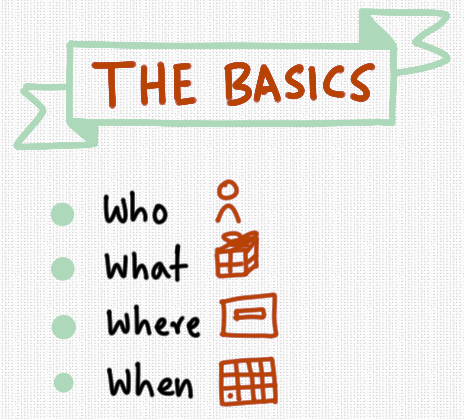
So, where do we start? I had that question today, thinking about how to plan a session and it seemed like a good idea to go back to basics, start with the essential elements that are needed with questions like:

  1. Who are we trying to engage with?
  2. What are we going to talk about?
  3. Where are we going to run the session?
  4. When is the best time?

The thing with using these questions is that you can come up with simple, surface level answers. The point is not, however, to just answer the questions. The questions are, instead, prompts to think about what you’re trying to do more deeply. All too often these sessions turn into a lecture where we talk about what’s important to us. But what matters is spending time talking about what’s important to the listener or viewer. We obsess about slide design and layout and colours, while what really matters is content. We hope that people will listen and then clamour to buy from us, while what we need to realise is that this is the very first step in building a relationship.

Questions are powerful, if used effectively to help with our thinking. We can make them more effective by using scaffolding, frameworks and rubrics that help us isolate and focus on elements but then step back and see the big picture. Something like this.

4-w.png

How do we know what we’re doing this well? I think I might look at that in the next post, with something I learned about the difference between effective and efficient.

Cheers,

Karthik Suresh

Do You Have A Good Product?

product-definition.png

Monday, 5.31pm

Sheffield, U.K.

Anyone can dream up great ideas, but an idea is nothing until it’s realized, be it as a website, a physical product, an app, or a user interface. – Jens Martin Skibsted

I had an email recently asking if I wanted to join a copywriting course. I read through the full email, because it was a good example of long-form copy. The kind of thing that you see being done well and done poorly all around the place. And somewhere in there was a comment, a point made by someone about having “a good product”.

This caught my eye for a simple reason – we really need to remember to check if what we’re selling is worth selling in the first place. Every YouTube advert you see appears at first glance to be a scam. Not all of them, actually, just the ones with a photogenic person promising to change your life if you join their course. You can spot the good ones because they talk about their product. You can spot the bad ones because they talk.

I’ve been watching teaching videos recently and noticed that teachers like to start with definitions. I never liked this as a student, it seemed mechanical and boring and I was instantly switched off. I’m starting to think differently about them because what happens in real life is that we all have different perspectives on the same thing, we see the world differently. A definition is a way to start from the same place, with a form of words that tries, not always successfully, to capture what we mean. Definitions are like axioms, they are statements that need to be accepted in order to develop successive logical statements. And, like axioms, you don’t try and prove them but accept they are true as long as they don’t lead to a nonsensical result.

I thought I’d start by looking for a definition of a product. Glen Urban and John Hauser, in their book “Design and marketing of new products”, talk about what success looks like for a new product. It’s something that has a set of benefits that address user needs. You can list out what it does – with a functional specification – and it’s something that can be given to someone else – it’s realized in some way.

So let’s look at a few products and see how they conform to this definition. A car, for example, is pretty easy to map to it. What about an online course in copywriting? Well, that could map to the definition as well. What about your idea for a new business? Do you understand what users need, what they are looking for? Can you articulate how your product will make their lives better? Can you list what your product actually contains or has or does? And what does the user actually get in exchange for their money – is it a thing or an experience or knowledge?

I suppose if I created a graphic to help cover this it would be a four-box matrix looking at user needs, product benefits, product specs and deliverables. Something like this.

product-assessment.png

The next time I come across an idea for a product I’ll try this out and see if it helps. What I’m hoping is that if this helps you create a good product, then the copywriting bit will be a whole lot easier.

Cheers,

Karthik Suresh

What Would It Be Like Going Back To School Now?

presenting-to-kids.png

Friday, 9.45pm

Sheffield, U.K.

Youth is wasted on the young. – George Bernard Shaw

I’ve been thinking about teaching quite a lot the last few days. It’s not because I want to be a teacher – I’m not sure I have what it takes to do that – but because I’m always interested in how to learn better. And it’s well known that the best way to learn anything is to teach it.

Teaching has come a long way since I was a child. In those days it came down to textbooks and chalkboards, taking notes and memorising stuff. I found school hard and didn’t really understand much. The first breakthrough I had was when someone taught me how to use flashcards and I realised I could write down everything in a text book, memorise it all, and do well on the test. This worked for all the important years in school and I left school with decent marks and very little real learning.

That pattern continued into university, where I learned how to capture information and memorise what I needed for the exams, again ending with a First and no useful knowledge.

Any real, useful learning has been messing around with computers, doing hands on work fixing things and trying to solve problems on the job. That makes you think, figure things out, go look for answers. You find information because it’s useful, because there is a point to doing so. You do it because when you know what you need to know you can make a difference, actually make something happen.

Teaching has come a long way since then and I think teachers, some of them anyway, try and help you get an education. And we can see some of this in action. For example, I recently came across the work of Jay Hall. You should have a look at his YouTube channel and two minute videos. They will blow you away. Jay mentions that his mother was an art teacher and perhaps that’s why his lessons are works of art in themselves – models of what you could do if you put some thought and effort into what you did.

One of the things about Jay’s work is that his material is designed to actually teach others, so it’s simple, clear and concise. I’ve been wondering for a while about the value of sketchnotes – especially ones that look great but hard to read.

There’s something here that I need to understand and articulate and a number of the words that matter seem to start with a “P”. Performance, product, process, practice. What are you trying to do when you work on something – is it to show off how good you are? Is it to create something that you can give someone else? Or is it a process you work through, or perhaps it’s a practice to make you better every day.

I think that if we really want to get better at what we do every day, we need to stop looking around the corporate world for models and start looking more into what happens in schools. Teachers have to engage and persuade a very tough audience. I worked out that I can hold my seven year old’s attention for around 15 to 20 seconds and that’s the time I have to get him hooked. We spend too long saying too little, while still expecting people to get it. If you want to communicate better, perhaps watch the way teachers do it, the way Jay does it on his channel. Because he makes it look easy and that should tell you a little bit about just how hard it is to do that well.

Cheers,

Karthik Suresh