How To Build A High Performing Organization Or Be A High Performing Individual

high-performing-organizations.png

Saturday, 8.20pm

Sheffield, U.K.

We must free ourselves of the hope that the sea will ever rest. We must learn to sail in high winds. – Aristotle Onassis

I’ve been reading the same paper again and again for the last week, trying to figure out how I should read. You would think I would know how to do that by now, but it’s harder than you think.

There is a passage in Robert Pirsig’s Zen and the art of motorcycle maintenance where the main character, Phaedrus, is wrestling with the writing of Kant, the great German philosopher. Phadreus approaches each sentence like a chess move, testing, probing, looking for flaws, looking for a weakness he can thrust through. Trying to see if what is said is true, if it is worth knowing.

The difficulty with words is that there are so many of them out there. And not all of them are good. If you are serious about the work you have to get better at telling the good ones from the bad. But why would you do that?

It turns out that high performing individuals are rare, and so are high performing organizations. And this is because the way we learn new things and apply them vary in how effective they are.

Most of the time we try and do what we’re doing better. This is called single-loop learning. If you make an omelette day after day then you’ll get better at making an omelette. That’s the same with form filling or doing a task at your work – you get better over time.

Getting even better starts with taking a step back and asking if the task you are doing is the right thing to do. Is it helping you achieve your goals? For example, a lot of people spend up working on tasks that customers don’t really care about. You might send out detailed emails that they don’t read, for example. If you find out what customers actually want and then send them that instead you’re starting to engage in double-loop learning – going from a task focus to figuring out the right thing to do.

From there, it gets harder to improve. Higher order thinking, or triple-loop learning is something that high performing individuals and high performing organizations do but it’s not easy to get your head around.

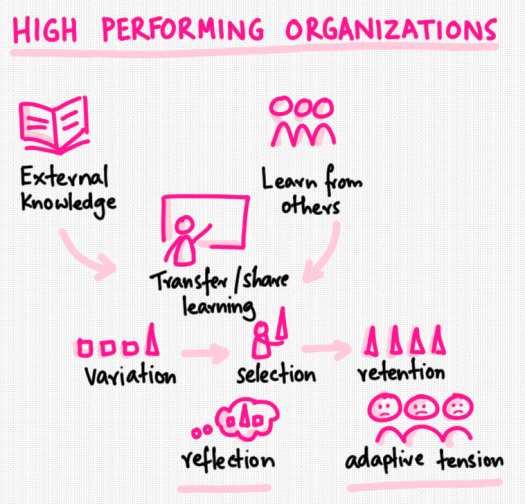
The model that starts this post is one way to think about it.

It starts with being open to learning new stuff, from books and other resources and from others in your network who know more than you might. How much new knowledge have you gained since your last degree?

You need to be able to take that knowledge and move it into your own space – whether it’s to help you work better or to help your organization work better. And you often start with figuring out where the gaps are when it comes to doing the best job you can.

Getting to that working better part is a little like evolving, hopefully to something that adapts better to the situation you’re in. The variation-selection-retention cycle explains how this happens. Now that you’ve learned something new you pick something to try, a kind of experiment. Then you learn from that, and keep what works, what is best for you. It sounds simple, but it’s not easy to do, for a couple of reasons.

The first has to do with taking the time to think about and reflect on what’s going on. What are you trying to achieve, how well did your experiment work and what did you learn. What would you change? What would you keep?

This kind of reflection on what went well, what went badly and what you are going to do next is important if you want to be able to make a sustained improvements in your practice.

But there is always a problem, especially when you work with others. People don’t like change, especially change that they haven’t asked for. This will make them unhappy. It’s called adaptive tension, and you need to manage that. If you don’t then people will go back to the old ways of doing things as soon as they can because all your new ideas are simply a pain in the rear for them.

This is a big reason why large change projects fail, because consultants or leaders bring in new stuff without thinking through how the people affected will think and feel and react.

But if you can do these things then you’re engaging in higher order thinking, and you have the pieces in place to be a high performing individual or build a high performing team.

Cheers,

Karthik Suresh

How Can We Make Sense Of What’s Going On

knowledge-graph.png

Friday, 6.10pm

Sheffield, U.K.

The number one benefit of information technology is that it empowers people to do what they want to do. It lets people be creative. It lets people be productive. It lets people learn things they didn’t think they could learn before, and so in a sense it is all about potential. – Steve Ballmer

I came across the idea of graphs a few days ago and have been quite interested in their possibilities since then.

Graphs in mathematics and graph theory give you a rather stark definition – a graph has nodes that are connected by edges. That’s it really. Nodes and edges.

Except there’s more to it than that.

One of the biggest issues we have when we think about things is that we’ve been trained to think in parts, to look at pieces of things.

For example, if you want to study a paper you start by reading all the sentences and taking notes – breaking the paper down into the points that are important, that you think you need to remember.

If you need to analyse a problem you start by breaking it into parts, and looking at how you can solve each of those parts.

We’re not really taught systematically about how to put things together again – you’re expected to pick that up with experience. And some people get it and some of us struggle and time passes on.

A knowledge graph is an application of graph theory to the problem of understanding and developing knowledge. The thing about learning something is that it usually only makes sense when it’s put in the context of something else. It’s hardly ever useful just by itself.

When I started reading my first paper for my research I started to get stuck at the point where I was thinking about what kind of notes I should take – what did I need to understand and remember.

The problem really wasn’t one of remembering – no one is going to have to take an exam on this stuff. It’s more a problem of relating, of figuring out what goes where.

I’ve been playing with developing my own knowledge graph for the research I’m reading. It’s still a work in progress but when you visualise the concepts you might come up with something like this.

kg-big.png

Now this is a little hard to understand but you can start to filter the graph and try to understand relationships – like the different names writers use for things that are really the same thing. Like this.

isSameAs.png

Now, you might ask yourself whether all this isn’t just making things more complicated.

And it sort of is, because when you look at the image it’s complicated and needs some work.

But, the important thing is that nothing makes sense without its connections – it’s the relationships that help you work out what’s going on and they are the way you build an understanding of what’s really there.

And if you have a sound graph that underpins your understanding then the work you create as a result will have solid foundations as well – whether it’s a strategy or a business plan or a book.

In theory anyway.

Cheers,

Karthik Suresh

Do You Want To Be Healthy, Wealthy Or Wise?

consumerism.png

Thursday, 6.44pm

Sheffield, U.K.

Early to bed and early to rise, makes a man healthy, wealthy, and wise – Benjamin Franklin

I grew up with this poem rolling around in my head. We were early risers – a cultural imperative for the community I grew up in.

I saw a post recently that talked about how people who ride bicycles are bad for the economy – because they’re healthy and don’t buy junk food and spend less on medicines. It’s better to have a nation of consumers who go out and spend a lot because that’s what keeps economies going.

I don’t quite know what to make of this. On the one hand, it’s more complicated than that. Some of the cyclists I know spend a lot of money on their machines. It’s a big business, the one that helps you move around.

There’s something in here about capitalism and consumerism and the fact that these approaches have very successfully helped to improve the standards of living of millions of people. Innovation in this space has changed all our lives, possibly for the better.

Then again, consumerism exists because many of the products in the world are made in a country that has a problematic relationship with freedom. But it’s doing well unlike the other well known union that fell apart.

I think it’s hard to know what the right thing to do is these days.

Should you work hard and save and try and live within your means?

When you do, people who stretch themselves and buy a bigger house will end up having a much larger asset than you have.

The website Monevator has covered this several times in the last decade or so and it really all does come down to mental models.

Let’s take money for example. How much do you have.

If you bought a house twenty years ago that’s now appreciated in value by several hundred thousand pounds – you don’t have any more money in your pocket. But you do have something.

If you sold up, you’d have cash to spend but the cash is also not worth very much – there’s too much of it around.

What does this mean in practice? The excess returns you make in property get eaten away by low interest rates if you make the switch to cash. If you never sell your property or borrow against it, however, you don’t get the benefit of the cash. You don’t have any more than you did at the start because the house itself doesn’t get any bigger.

The wise thing to do is to have a mix of options – some property, some shares, some cash. But if you’ve got cash you’re looking enviously at the returns on property. If you’ve got property you’re looking at crypto and wondering what you’d have if things had increased 119,000% for you. There’s always someone who has it better.

Knowing what you know now, would you have done anything differently?

I don’t know. The thing is that things change and it’s really hard to be right about anything.

Buffett talks about how it’s only when the tide goes out that you can see who’s been swimming naked.

These days the government rushes up to hand out towels and swimsuits which kind of makes it irrelevant what you’re actually doing. If you’re part of their gang, of course, everyone else is left to fend for themselves.

I think someone worked out that it was better to let the good times roll and then pay a little to pick up the mess rather than try and manage things sensibly from the start when it came to the economy.

Many of us have learned instinctively that we have to be careful, to hoard our resources in the event of a famine.

Is this the wrong approach to grow an economy? Is it better to consume and use as many resources as we can?

That seems wrong.

I am left with more questions than answers, I fear.

Cheers,

Karthik Suresh

The Infernal Logic Of Choice

roads-we-travel.png

Monday, 8.40pm

Sheffield, U.K.

I’m playing all the right notes, but not necessarily in the right order. – Eric Morecambe

One of the problems with reading Terry Pratchett is that certain phrases roll around in your mind, mocking you with their unblinking gaze.

Take, for example, that you have to learn to believe the little lies – the pot of gold at the end of the rainbow, wishing wells, and others that we do not speak of in front of children – so that you can believe the big ones: truth, justice, mercy.

“Stop!” you say, of course truth and justice and mercy exist. But they don’t. Grind up the universe, say Pratchett’s characters, sieve all that is in existence and you will not find a molecule of mercy, a grain of truth, a drop of justice. These are entirely human concepts that exist entirely in our heads and we choose to believe them.

So, if you need to do something is there a right way to do it and a wrong way? For example, if you want to achieve your goal should you go straight for it in the most direct way possible, even if there is a good chance you’ll stumble? Should you take the path that has the least risk? Or should you go big, swing for the fences and hope to hit a home run.

Take working life, for example, A direct approach might be to go for what you always wanted to be – a cellist, an actor – even though there is a chance that you might not make the cut. Or you could take a low risk route – apprentice to a trade, become a professional. Or you could strike our on your own, start a company, live the startup life and get rich quickly. Or fail fast and try something else.

And then of course you could just wander about and fall into something – maybe it works, maybe it doesn’t – but quite a few people end up decades later wondering how they got there and whether it could have worked out differently.

The point is that there is no “right” way. If you don’t mind the stress of the ups and downs you can make certain decisions. If you can live with skating on the edge of what is legal and what isn’t – you might find an edge. It’s a personality thing – I’m conservative, perhaps too much. But I can live with that.

In the end if there is no truth, there is only the truth according to you.

Cheers,

Karthik Suresh

Something New Is Sometimes Something Old With A New Name

mathematical-graphs.png

Sunday, 9.06pm

Sheffield, U.K.

My journey is where I’m at right? It’s the monopoly board of my life, and I’m making my rounds. – Saint Jhn

We used to go to France every summer for a camping holiday.

Before the pandemic hit, of course.

Before one of those summers, the winter before, we went to a farm for a Christmas market. As we wandered around the stalls we came across one that had handmade armour – a helmet, mail chain and a sword. So the small people started trying these out and I looked around the stall and noticed some game boards with a strange pattern I hadn’t seen before.

These were handmade by the stall owner, I think, and were an old style of board with locations where pieces could stop and lines along which they could move. I thought this was a very interesting idea but I didn’t buy one at the time. I should have. We spent much of the summer in France creating boards on the lines of the one we saw with cardboard and pens. By the way, one of the reasons you had lines on the boards rather than squares like a chessboard or passages like a maze is that these games were often carved into tables and it’s easier to just make a line with a knife.

Okay, it’s now three or four years later and I’m reading research and thinking about how to remember this stuff I’m reading. A few days ago I wrote about coming across the work of Vera F. Birkenbihl and thinking this was new and cool. As a reminder an ABC list is when you write down the letters of the alphabet vertically on a page and then write down words that capture the essence of what you’re reading.

Something like this.

ABC-list.jpg

The idea is that writing down these words will help you remember what you read better when you look back at the words. I still need to get my head around the theory behind that but if it’s a memory thing I thought why not create “123 lists”. This is for numbers and you put down figures that you want to remember. I have a 123 list that I’ll come back to in a few weeks to see if this works.

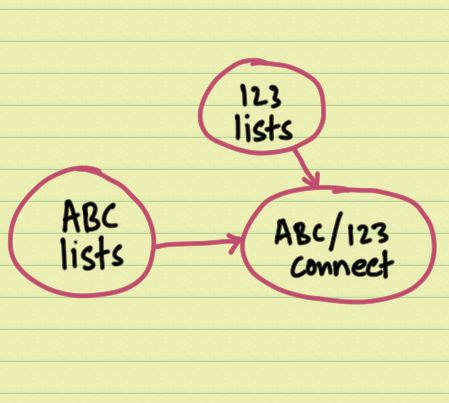
But, if you have ABC lists, then what happens if you connect related words – draw a word, circle it, draw a related word and connect the two? Something like the image above. I thought I could call that an “ABC Connect”. Pretty cool, yes?

Now, we can draw these diagrams but when they get bigger it’s probably easier to use software and my go to software for drawing words and connections is Graphviz. If I use that to create this kind of connection you’ll get something like this.

ABC-connect.png

I was on the Graphviz website and idly browsing through the theory of graphs when I came across a paper titled A Short Note on the History of Graph Drawing so of course I had to read that. The paper has a definition:

“A mathematical graph consists of a set of nodes and a set of edges. An edge connects to a pair of nodes.”

So… this is my “ABC Connect”. Ah well, it sounds good anyway and is a little less confusing than the word “graph” might be.

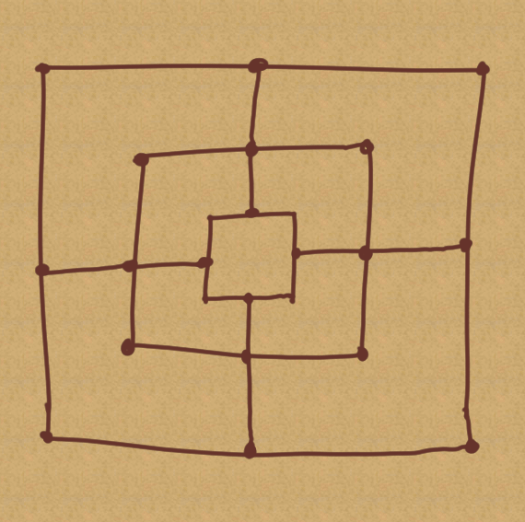
But, even better, the paper starts by talking about how nodes and edges can be seen in Morris gameboards from the thirteenth century.

If you drew one out, it might look like this.

nine-mans-morris.png

And these are the same boards we stumbled across in that market stall all those years ago.

Anyway, mathematical graphs help you see patterns in data – family trees in genealogy is one of the best known examples of applying these techniques. My own work uses these extensively but now I have a few names for what I do – old ones and new ones.

Cheers,

Karthik Suresh

What Is Single, Double And Triple Loop Learning?

learning-loops.png

Friday, 10.06pm

Sheffield, U.K.

Your mind will answer most questions if you learn to relax and wait for the answer. – William S. Burroughs

I have now started a programme of research that is going to take the next five or six years and I have to spend the first couple of years learning all that I can about the area that I want to study.

It’s worth getting clear, then, on what we mean by learning.

Let’s say you learn to do something, like bricklaying. There’s a process to it that I don’t know about at all. But I imagine it goes something like this.

You have to learn about lines, straight ones and curves. You need to know how to keep things level. And then you have to put down bricks, one after another, and glue them together with cement.

Something like that.

Single loop learning is about learning how to lay bricks well. Doing a good, clean job. It’s a skill, a trade.

I once saw an invention that helped people lay bricks and cement them in faster, but I don’t see that in practice.

Perhaps it’s a matter of pride that a good bricklayer can do it with their hands and they get better over time.

Double loop learning takes a step back and asks why we’re doing what we’re doing. What’s the difference between a brick wall and a brick arch and a brick fence?

Why would you use a single skin rather than a double and why would you lay bricks in a particular way, offset on each row rather than in a pile?

This kind of learning helps you ask why you’re doing something and if there are other options, or what’s the best option and what the reasons might be to do one thing or another.

Then there’s triple loop learning which is seeing this whole process of thinking and reflecting on it.

This is when you ask yourself why brick – why not straw or wood?

Why a house built in the open rather than one built in a factory and assembled on site?

In this day and age do we need brick – or should houses be 3-d printed instead?

But why would people change, what if they love their brick history and don’t want to see it disappear?

These kinds of questions are about more than brick and about more than a building – they are about hopes and dreams and fears and changes and need time to reflect and consider and try and experiment.

The thing with learning is that it provides a competitive advantage.

Knowledge is power – people who learn better earn better. Organizations that have people who learn better are run better and work out better.

That’s the theory anyway.

Now, my area of interest has always been around sense making and decision making.

Most decisions aren’t about numbers or money but about people doing things that they think are the right things for them to do.

But we don’t know a great deal about how to get people to think better together.

That’s what I’m going to be thinking about for the next half of this decade.

Cheers,

Karthik Suresh

What Do You Do When You Haven’t Got Any Ideas?

idea-lightbulb.png

Thursday, 6.53pm

Sheffield, U.K.

The best way to have a good idea is to have a lot of ideas. – Linus Pauling

I had an idea for a post as I was driving but now that I am at the keyboard it’s lost – and I don’t know what it was. Maybe it was good. Maybe it will return.

In the meantime let’s talk about something else, anything else.

I’ve been thinking a lot about slowing down, about taking time to do things over, learning a little more each time and making whatever you’re doing better. And then I think about speed and getting whatever it is done fast and moving on to the next thing.

The danger with slowing down is that you never get anything done so it helps to have an external deadline, one you can’t miss. If you have to write a talk by a certain date it needs to get done or you’ll be speechless when it matters.

But you can’t slow down for everything – so you have to be selective. Most things can be done fast but you have to take time and take care over what matters. To do that you need to know what matters.

Things that matter are all about art. I was reading somewhere that art is what appeals to your emotions. It’s music and painting and novels that tell your story, that tell all our stories.

Even when you have data, the story is what makes the data come alive.

I wonder if what drives successful people – ones that are successful at what they do and at who they are – is that they are working on their art when you strip it all away.

Perhaps engineers are sculptors – Elon Musk seems to see his projects as a mission – a calling. Warren Buffett has talked about his collection of businesses – like a collection of old masters at a gallery. Maybe that’s why they do what they do – because their work is really their art.

And creating good art takes time. It takes practice. It takes effort and reflection and frustration – and yet more work.

And you do it even if you don’t need to.

Cheers,

Karthik Suresh

How To Find A Focus

finding-the-point.png

Wednesday, 8.14pm

Sheffield, U.K.

If you just focus on the smallest details, you never get the big picture right. – Leroy Hood

There is stuff that is interesting.

And then there is stuff you get paid for.

What’s the difference between them?

I had a research induction today where I learned what happens over the three to five years you are going to experience.

It starts with excitement – there’s so much to learn and discover and do.

Then it turns into overwhelm and worry and a sense of being lost.

And then you find your thing, spurred on by a deadline, and focus on something specific and achievable.

Then you pass.

This pattern repeats again and again in life – first you experience a broad sweep across the canvas of your life and then you focus and focus until you are doing the thing you do.

Or, more precisely, the things you do.

Having the big picture, the wider knowledge, helps you do the small things better.

If you’re an accountant, for example, you will be a better accountant if you understand that some clients want to beat a competitor, while others want a comfortable life, and how they act will depend on what they want.

It’s not just about the numbers – it’s about them and what they want and need and if you get that you can help them more than if you just look at their numbers.

The mistake is thinking that you have to be one or the other, a generalist or a specialist.

That’s not the way to look at it.

Being a generalist is for you – it helps you be a better person because you see more and understand more.

Being a specialist is for others – you help someone who needs help with the specific thing they need help with.

And that’s why one pays and the other doesn’t.

Cheers,

Karthik Suresh

What Does It Take To Write Something Good?

reporting.png

Tuesday, 7.37pm

Sheffield, U.K.

If people in the media cannot decide whether they are in the business of reporting news or manufacturing propaganda, it is all the more important that the public understand that difference, and choose their news sources accordingly. – Thomas Sowell

There’s more and more non-physical stuff out there, floating around the universe, thoughts and ideas and memories and asides and intimate moments and insipid chatter. The stuff you could turn off and you don’t and the stuff that you’d never find in any other way. And I wonder, do we already know what we should do and don’t because we can’t or because the incentives are wrong or because it’s just too complicated or because some voices are loud and insistent.

Let me back up a little.

Writing is thinking. I use this blog as a place to think – to understand what I think about something and so what you are seeing and reading is thinking in progress. I’m not trying to persuade you or sell to you or convince you of anything. I’m just trying to work things out.

But if I were trying to sell to you I’d have to take the thoughts I think and repackage them in a way that was persuasive and convincing, that told you a story you could believe in and buy into.

But what if there was no point. Should I still do that? Perhaps because it could make money? Perhaps because I believed it was a good thing to do – perhaps because you needed it?

Let’s take an example – if I were to talk to you to try and convince you it would make sense to have a story – one that sounded authentic and natural – like the way people are on telly. Of course, you know that it’s all scripted – you really really know that in your heart of hearts but you don’t want to believe it. Because it’s more fun to believe that it’s all authentic and natural. If you want to see what happens when you don’t work off a script search for Grand Tour Series 2 Episode 4 Review “unscripted”. It’s educational.

Ok, so I’ve told you that you need a script to do a good job. Now should I also sell you a teleprompter? Do you need some software to help you out – that scrolls text while you’re reading to the camera?

Well, I wondered if I did and had a quick look. And then I remembered you can do everything on the command line in Linux. So if you want to go through a text file and scroll the lines you can use a one liner using the awk programming language that looks a bit like this:

awk '{print;system("sleep 0.75")}' file.txt

That’s it – that should work and you can change the number to make the scrolling slower or faster.

awk, in case you don’t know, was first written in 1977 by Alfred V. Aho, Brian W. Kernighan and Peter J. Weinberger and the version that we now, gawk, was written by Paul Rubin and Jay Fenlason.

I don’t know about you but I like the fact that a 40+ year old program can help you do something you want to do and you don’t need to buy anything else or do something new. You just need to be willing to learn and think and use what is already out there.

But I can’t sell you that idea and I won’t try. There’s no money in it, after all.

I’ve just poked a hole in a theory I was holding – one that suggested that a willingness to pay for something was an indication of value. Therefore if it’s free it has no value. And that’s not the case, not for almost everything that adds value to my own working practice.

If you’re wondering where I’m heading with all this then let’s just look at the picture at the start of this post.

I don’t think I’ve done anything that’s listed there – but I would if I weren’t trying to think things through.

This list comes from a BBC video on scriptwriting if you want to get some useful information.

For now, I think I’ll move on.

Cheers,

Karthik Suresh

The Living Heart Of A Research Project

notebooks.png

Sunday, 9.41pm

Sheffield, U.K.

‘Research,’ for me, is a big word that encompasses a lot of different activities, all of them based around curiosity. Research is traveling to places, or studying snowflakes with a magnifying glass, or excavating one’s memories. Research is walking around Hamburg with a notebook. – Anthony Doerr

I came across the work of Lynda Barry at the start of the year and got very excited. I ordered all of her books and started to try out the ideas in there. And then I got stuck.

One of the reasons that I got stuck is that she asks you to slow down, to spend time. Time is what you need when you’re creating something and you need even more time when you’re trying to find out what you are meant to create. That kind of knowledge doesn’t come fast, you have to work and work and work and if you keep working you’ll stumble across something and realise that it’s your thing.

I work fast. Computers work for me – it’s easier to create images digitally and type on a computer than it is to work things out by hand. But there’s a realness to physical creations and I could argue that the way I use computers is as close to the physical experience as possible – hand-drawn images and prose as poetry. But what makes it out on this blog is a fraction of what comes in, and that stuff piles up. I’m on my third notebook of the year and have a lever arch file full of notes. When you have that much stuff how can you process it all?

I suppose the only way you can do that is by becoming more selective about what you read and write and think about. Today, for example, I came up with the idea of post-Western thinking and found there are a few papers out there that use that term. It makes sense because the way we think has been shaped by the tools we had. In the West, the printing press was the way people got their ideas across. It’s easy to print words and so people started to use words. Now, if you look at an academic paper, you can see the results of “word” thinking – and it’s easy to assume that this is the best way to think rather than consider that perhaps it was the best way to think when your only option was to use a printing press.

Lynda Barry’s idea is that a notebook can be at the centre of your research, the thing that pulls in everything and lets you work with what you have. The heart of the work. You have freedom in a notebook – freedom to use words and draw and colour and frame and point. Freedom to make sense of things in whatever way works for you.

But once you think you have something that’s worth sharing you’re not limited to a printing press to publish your ideas any more. You can use a blog and mix drawings and words. And of course there’s audio and video and everything else. And what this lets you do is tell stories that are more than just words. But what does that mean?

I was thinking about using a journal as a place for research and remembered coming across art journals earlier in the year – the kind of thing that Lynda Barry’s students do. If you search for art journals and research you then come across videos on using art based methods for research like this one by Dr Helen Kara. Dr Kara also talks about indigenous research, which is summed up in the phrase “nothing about us without us”, and talks about how you can include more than just words in your thinking – using artifacts, stories, song, tattoos and so on. You’re not limited to the traditional approach any more – and this is what sparked the idea that there might be this thing called “post-Western” that seems to capture what’s going on here.

Now, of course, you’re not going to change the system – not in academia, not in teaching and not in any other ingrained system that has a purpose. You may not agree with its purpose but it is what it is. You can do all the arty stuff you want to do in your notebook but if you want to be published you have to do what the journal reviewers want you to do. That’s the system and you’re stuck with it.

A lot of people who want to change things get stuck at this point. They don’t like the system and want it to change – not realising that the system is a living thing – a giant that is perfectly capable of swiping back at you when you try and sting it. And it will make you retreat under the sheer power of its blows. There’s no point trying to fight it. Not if you want to make a difference.

I’m too new at the whole research thing to know what is the “right” thing to do – but I’m pretty sure that the world is divided into two kinds of people – those that think there is a right answer out there and those that are right that there isn’t. You will make life easier for yourself if you do what is convenient. But I’m also too old to conform to a way of thinking that’s now a couple of hundred years out of date.

Here’s the takeaway. Your notebook is your happy place – the place where you do what you want the way you want. Don’t fight the system – give it what it needs and try to change it from within. But remember that the system is always the old way – and what you’re working towards is the new way – the post-whatever-is-now future.

Cheers,

Karthik Suresh