The Connection Between Brain Effort And Note Taking

taking-note.png

Monday, 8.21pm

Sheffield, U.K.

For every complex problem there is an answer that is clear, simple, and wrong. – H. L. Mencken

If you are a fan of stationery and nice pens, as I am, you will have been pleased by the discovery by Mueller and Oppenheimer (2014) that taking notes by hand is better for you than taking notes using a laptop. Their conclusion is clear: “laptops may be doing more harm in classrooms than good.”

But unfortunately it’s not quite as simple as that. Like the often repeated but incorrect belief that 93% of communication is non-verbal you need to dig a little deeper to understand what’s going on.

A review of the literature by Jansen, Lakens and IJsselsteijn (2017) found that some studies show notetaking with laptops works better, while others prefer longhand. There are many factors to consider, such as the way information is presented, the way people take notes, differences in cognitive capability between people and the way in which understanding is tested.

They find, for example, some studies that show that taking notes worsens recall while other studies show the opposite. The link between taking notes and how much you remember varies with whether you’re reading or listening to the content, how fast it’s coming at you, whether you can go over it again and again or not, whether you copy it exactly or say it in your own words, whether you use an outline, or words or a diagram. Learning is complicated stuff.

Jansen et. al. suggest that we should look at cognitive load theory to understand what’s going on – the amount of effort your brain puts into the task and what it spends that effort on doing.

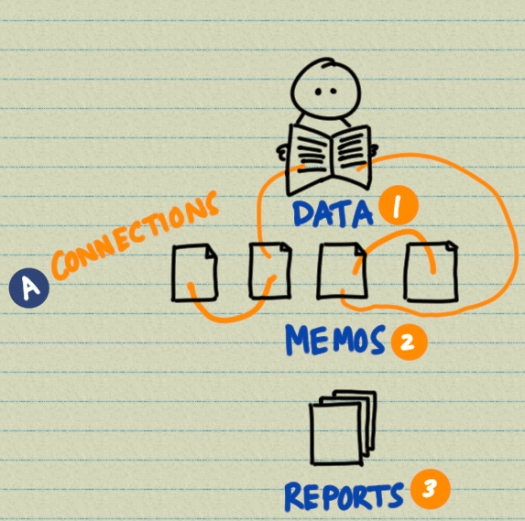
When you’re trying to learn something there are five main things you do. You need to understand the material, you need to pick the points that are important, you need to connect them with other ideas that you know and that are relevant, you need to restate the ideas in your own words and finally you need to write them down. That’s a lot of stuff that’s going on.

It’s not surprising that there isn’t one perfect system that will sort you out every time. What you need to do is figure out a way of learning that lets you engage at a deeper level with the material. Copying it out exactly or taking notes verbatim is a surface level of understanding. Picking out ideas and relating them to other ideas is a deeper level. Saying these ideas in your own words starts you on the path of making them your own which you finish by creating a piece of written work that is ready for the world.

We visited Ironbridge this weekend, a place known as a symbol of the Industrial Revolution. We saw a candle maker’s workshop where the owner and his children made candles all day, boiling down the fat from carcasses – a dangerous, difficult and smelly job. They were one of the richest families in the town, but carried the stench with them – and the term “stinking rich” originates with this kind of job.

These days what we’re aiming for is to be the “thinking rich” – and to do that we need the ability to boil down knowledge by taking good notes and creating something valuable.

Cheers,

Karthk Suresh

How To Spend Your Time

inverse.png

Sunday, 7.40pm

Sheffield, U.K.

In the commercial world, you have this problem that the amount of research you can do in a company is based on how well your current business is going, whereas there actually should be an inverse relationship: when things are going worse, you should do more research. – Alan Kay

I’m in the first few months of a PhD programme and trying to figure out what’s worth doing, what’s not and whether it matters. And the difficulty with these kinds of questions is that every answer you reach for is right.

For example – if you want to learn to write should you write every day? Yes. Should you only publish material when you know it’s ready? Yes. Should you show the world work in progress – a glimpse behind the workshop curtain? Yes. Should you make your research open so that others can examine your process? Yes.

You can’t produce good material in one sitting – that takes work and rework. But if you don’t produce something on a regular basis you won’t get the experience you need to be able to produce good work.

When you start looking into such questions there is no right answer. You have a mix of factors and no guarantee that you will get things right. Whatever choice you make, it’s very likely that there were better ones. But you’re stuck with the ones that you’ve chosen and the possibilities that open up because of those decisions. You learn in the world of decision making that there is no benefit in regret. You move on, leaving sunk costs behind.

In my research process I have challenges that look like these:

  • What to read
  • What to extract and keep
  • What to take notes on
  • What to think about
  • How to take notes and think – the medium, the method.
  • Balance traditional methods and newer, perhaps more creative ones
  • Try and see things from different perspectives
  • Consider how approaches work for me
  • Consider how approaches work in groups
  • Work out what the important questions might be

What role does this blog play in that process – and, as you’re reading this, is what you are going to find something that’s worth your time?

I’ve tried a few things so far. Writing about what’s on my mind, what I’ve learned, pulling together a book project. Sometimes there is a thread, sometimes there isn’t. Sometimes I write about specific methods, and sometimes it’s writing about process, about the experience of method.

The one constant is that I sit down at roughly the same time every day to work on something that will be published when I finish typing these words. There is a clear beginning and an end and a time limit – and that helps with producing words. Making the rules of operation less clear or subject to choice will make it harder to do. But, of course, that also makes it harder to be clear on what is being done – what’s the purpose of this blog?

I don’t think I need to answer that right now because it fits into an emerging programme of work that I am still working to define and design. Perhaps it’s a reflective journal, a place where I write about things that I’m working on. Perhaps it’s a place for work in progress, first drafts that are later reworked. Perhaps it’s Zettelkasten, a partner in research, but it’s going to be a few years before we can work together.

All I can say right now is that there is no right answer. What you have to do is trust in the process.

And wait.

Cheers,

Karthik Suresh

What Have You Made That Would Not Have Existed Without You?

hand.png

Thursday, 9.56pm

Sheffield, U.K.

The arts are not a way to make a living. They are a very human way of making life more bearable. Practicing an art, no matter how well or badly, is a way to make your soul grow, for heaven’s sake. – Kurt Vonnegut

Over the last few days and weeks I’ve been reading a lot of research and am finding it tricky to work out what’s worth remembering and why. I’m messing around with different approaches and trying to see what works and what doesn’t.

Some of the papers I read have interesting, exciting ideas captured in terse but powerful writing. These are words and sentences that have been thought about for a while, carefully constructed to express precisely what the author wants to convey. So why is it that these ideas are locked away in prisons of Times New Roman and don’t find their way out into the real world, the practical one – where they can make a difference?

It probably has a lot to do with the language. What we’re all trying to do is get to grips with this complex world around us. What relationship do we have with it? What kind of knowledge is going to be useful? How are we going to go about getting it?

These four components have big names: ontology, epistemology, axiology and methodology. They are important but they also create a barrier to understanding. We have to climb this complex language barrier every time we want to understand something.

Like everything else history plays a part. I suspect that the reason we use words in the way we do is because of printing. For centuries the only way to create books was to write them by hand and we had a certain kind of product – books with images and structure, the kinds of things you could create without constraints, other than the physical ones imposed by the paper you were working on.

Then along came type and the ability to print books. But type coped well only with words and so for a few centuries we relied on words to express everything, and those words became increasingly more complicated to cope with the complicated ideas we were trying to express. The constraint of type created a particular kind of expression of knowledge and that particular kind of expression was used by powerful people until it became the accepted way to do things. To this day if you want to be taken seriously you write a book or publish a paper.

I can’t remember the sources but the old handmade arts survived in the traditions of scrapbooking and creative journalling. But, this source said, because these were activities traditionally done by women they were discounted as less important – only suitable for the home and not “serious” enough for any real problem – like the ones faced in business, where men dominated what went on and were comfortable with papers and memos and notes and would have looked askance at anything “creative”.

The emergence of the Internet and the ability of people to find other interested people around the world is leading to a resurgence of mixed-media approaches to generating knowledge. We’re going from a world of papers to one where you can do anything – from painting your ideas to making videos about them. This is going to change the way we think and make it easier to discover new and useful ideas. As long as they are discoverable.

I’ve talked before about the work of Lynda Barry, who teaches about the value of writing and drawing by hand. She asks students to start their notebooks by drawing an outline of their hand – the “original digital device”. This leads to an interesting question posed by Ingrid Lill in her newsletter: What is out there in the world that wouldn’t exist if you hadn’t made it? You probably need to exclude your children from this – but what else is there?

Have you created something that makes your soul happy. And if not, should you?

Cheers,

Karthik Suresh

A Predictable Formula For Success That’s Hard To Stick To

belief-result-loop.png

Sunday, 8.32pm

Sheffield, U.K.

Victory has a thousand fathers, but defeat is an orphan. – John F. Kennedy

I was watching Nigel Topping’s TED talk 3 Rules for a Zero Carbon World and was surprised to see him put systems thinking principles at the core of his argument about what we need to do to take action on climate change.

A key principle is the one of loops. positive loops that reinforce each other. One thing leads to another thing which leads to more of the first thing and so on, in a virtuous circle that increases whatever the first thing was doing. Negative loops work the other way and balancing loops keep things the same.

But we want positive loops when it comes to climate action – more of the things that are good for the planet and less of the things that aren’t. But how do we go about doing that?

Well, it turns out that the basic principle is pretty simple. Start by doing something – taking a stand, making a point, making a change. And then work at doing that for a while.

At first people will ignore you, and then you’ll get your first follower, and then more will join and then early adopters will notice and then the mainstream will find out about you and then, all of a sudden, the thing will be an overnight success after thirty years of working on it.

You can see this pattern with the shift to renewables, the adoption of electric cars, the increasing focus many of us have in buying sustainable products. I watched another talk on heating homes with ground source heat pumps and it seems quite feasible now in a way it might not have been even a few years ago. We see the change in the last year or so but it’s taken decades to get to this point.

What’s happened during that time is the slow march of project after project, with successful ones increasingly leading to the belief of onlookers that this is something that is worth doing, leading to more projects which leads to more belief and so on, until the whole world believes that we have to do something.

But what’s also interesting about Topping’s talk is that you have to recognise that the change you will see is exponential. In the early period, you see little result from your time and effort. And then it starts to show up, as it takes you less and less time to double your impact. This means that you shouldn’t expect to see amazing results for a while – that doesn’t mean you are failing. It just means you need to give it enough time before you give up and walk away. How many people have walked away just before they hit that point where their results were about to explode?

If you put this in terms people understand these days you should think about likes and followers on social media. You can put out content for ten years without people noticing and then suddenly you reach a tipping point and the numbers go up and up, seemingly unstoppably. Or you give you because you don’t get the quick results you wanted and never find out.

Of course it’s hard to tell the difference between something that isn’t working and never will and something that will work one day but just isn’t showing results now. You have to believe in what you are doing and be willing to spend your life doing it anyway, regardless of how things turn out to be happy with this state of affairs.

So there are two things you have to do if you want to make a success of whatever you’re working on. You have to be willing to believe that your work will lead to success and that eventually the people around you will see that and support you. And you have to be willing to wait for the length of time it’s going to take.

Belief and time – those are the ingredients you mix for success.

Cheers,

Karthik Suresh

Value Creation Through Theory And Real-World Experience

real-world-value.png

Friday, 7.57pm

Sheffield, U.K.

Doing real world projects is, I think, the best way to learn and also to engage the world and find out what the world is all about. – Ray Kurzweil

If you were going to start a business tomorrow what would you do? For many people, the only model that comes to mind is possibly a technology startup – those are the ones that we see all the time. The kinds of businesses that get started in garages and go on to become huge businesses.

The trouble with basing your ideas on what you see around you is that you’re looking at a biased data set. The companies you see are the one that survived but what you don’t see is the failure rate, the ones that fell by the wayside.

It’s not hard to find opinions on why businesses fail. They don’t know what they’re doing, don’t know what business they’re in, can’t manage their money, don’t have the experience they need. And, perhaps most importantly, no one wants what they provide.

A business has to find a niche to survive. Or, more precisely, it has to adapt itself to fit into a niche to survive. The model that works is an evolutionary one – try something – make a change, cause a mutation – and see if that’s better. If it is, replicate and try again. If it’s not, let that version die away.

I’ve been watching Juran on Quality Improvement – a video series that is a masterclass by one of the pioneers of the quality movement. Quality is something that’s hard to define and easy to get. You know it when you see it. You can tell a good book from a bad one just by reading a few sentences. You can tell the difference between pieces of furniture.

But can you always trust yourself to know the difference? Probably not. Juran suggests that when there is little objective difference between products the consumer is influenced by the company with the better marketing. It’s hard to tell sometimes whether you have the better thing or whether you’ve been convinced that you have the better thing.

But is it possible that the best businesses are the ones that you don’t see, that you don’t hear about. If you started a software business tomorrow you’d be in good company – everyone else you know is probably also starting a software business. But it will probably take you a while to get your first client. If you started a plumbing business, on the other hand, you’d probably have a full diary in a week.

In Felix Dennis’ book How To Get Rich he talks about how people get wealthy doing quite ordinary things. One of the richest people he knows makes his money by digging holes. But that’s one of the things about money – you get it for doing things you don’t want to do. You get it for working. If it’s something you’d do without being paid then you shouldn’t call it work.

But how do you figure out whether you should dig holes or write software, join pipes or push paper? There’s probably something around wanting to work at a desk rather than outside whatever the weather. Some of us are softer than others. Then again, it doesn’t need to be one or the other, it can help if you can do more than one thing.

That’s where you really need to try and get theory and practice working for you – to learn from books and learn by practicing what you’ve learned from a book and trying to see if it really works. That’s the thing about the How to genre. Everyone is desperate to know how to do something and when there is a need it’s filled by something or the other. If you want a book, then a book you shall have. It’s up to you to work out whether what you’re getting is a quality product or not.

There’s that quality term again which brings us to what is perhaps an important point. If I were selecting someone to do something then these days I would want to know that they both understood the theory of what they were doing and they had also done it in real life and had learned from that as well. That’s actually a big ask – because in order to judge whether they’ve done those things you probably need to know enough to those things yourself. After all, how can you judge something you don’t know anything about?

This combination – theory intermingled with practice – the two informing each other seems the only real way to do something that can coexist in the real world and the mental world. Hands and brains together are clearly better than either on their own. For most things anyway. At the extremes – doing pure maths and running away from tigers, you don’t really want a debate about the balance of it all.

What’s my point here.

I think it’s this.

There are many ideas out there. Select ones that you think are promising. Try them out in real life. Do more of what works.

Cheers,

Karthik Suresh

What Do You Need To Do To Attract Great Employees?

employee-compensation.png

Wednesday, 7.53pm

Sheffield, U.K.

The employer generally gets the employees he deserves. – J. Paul Getty

In my last post I wondered what a business model should look like these days. I suggested we should replace capital and labour with the concepts of leadership and knowledge.

Now, let’s look at compensation. What do you need to provide to build a company – a group of people who work well together and create value for customers?

It’s easy to start by thinking that it’s all about money – that you have to pay more than anyone else. But a better way to think of the compensation package you provide is as a screen, a filter that gets you the people you want and filters out the people who aren’t a good fit for you.

For example, a lot of job adverts don’t provide salary information. Why is that? Is it because they think that some can lure away their staff by charging more? Or because it’s a negotiable thing that you might be able to drive down?

Now, if you’re the kind of person who pays different people different amounts for doing the same thing, then one might wonder whether you’re the kind of person that others would like working for.

But let’s leave that to one side – perhaps we should start by asking what employees are looking for in the first place.

In a paper titled Employee compensation and new venture performance: does benefit type matter? Christopher J. Boudreaux looks at how benefits to employees relate to firm performance. The conclusions of the paper are interesting because you can see how thinking about the question in terms of basic human motivation can help you create effective compensation packages.

If someone wants to work in a company as an employee the chances are that they are motivated by a need for stability, which is essentially the same as safety. This is the second level of Maslow’s hierarchy of needs, usually expressed as a pyramid, which ranges from physiological needs through to self-actualisation needs. They want, in Robert Kiyosaki’s words, a safe, secure job with benefits.

But benefits come in many shapes and sizes. Some benefits are associated with safety – like retirement plans and healthcare. Other benefits have to do with flexibility, the ability to work differently or receive performance related pay, like commission on sales. Some of these benefits are less to do with safety and more to do with love and belonging – one level up on the pyramid.

Boudreax’s research suggests that firms that provide stability based benefits to employees fail less often and have a better chance of making a profit. Firms that provide flexibility have a better chance of making a profit but do not seem to reduce their chances of failure. Stock options turn out to be a bad thing, depressing profits.

Now, this seems to make sense when you look at what motivates people – and for most of us it isn’t money. Money, it turns out, satisfies you only for a short while. When you get some you feel good. But you need more each time to get the same hit. If your compensation package is based entirely around money then you’ll get the kind of people who believe that money makes you feel good rather than people who believe that serving others makes you feel good.

What this suggests as a compensation policy is that you should keep it simple – a competitive salary and with good benefits that promote stability and security. This will attract employees to you that value stability. You might lose the ones that need high levels of variable compensation – like commission based salespeople, but you’ll also reduce your chances of failing which can happen quickly if commission hungry people decide that their need for money is greater than your need to maintain a reputation.

What I think this paper misses is that it is based on the idea that you have to pay to get the best people out there. I think you can also do well if you grow your own team – invest in teaching and training the team you work with, and invest in the way in which you teach and train. A well-trained team is a formidable force in the market.

A strategy to develop your company should therefore be founded around providing people with a good salary, benefits that promote stability and a good training experience. It’s so easy to say that and so hard to do in practice. Maybe that’s why so many people hope that they can just create an incentive package based around a share of winnings and let people loose.

Building a team is, hard and demanding work. But it’s worth doing if you want to build a company that has a good chance of going the distance.

Cheers,

Karthik Suresh

What Should A New Business Look Like Today?

business-model-revolution.png

Tuesday, 7.59pm

Sheffield, U.K.

The reason why it is so difficult for existing firms to capitalize on disruptive innovations is that their processes and their business model that make them good at the existing business actually make them bad at competing for the disruption. – Clayton M. Christensen

What kind of company would you really not want to work for?

Maybe it’s a company with a dictatorial owner who puts capital into setting up a business and then hires you for your labour. You get paid as little as possible while creating value for the owner, that makes its way back to them as profits. The company takes your time and your health and limits your opportunities until you are no longer necessary, at which point you are replaced.

That situation, one assumes, was how things used to be not that long ago. Working environments have improved, driven by health and safety legislation – making owners responsible for keeping workers safe has made a big difference in countries where laws have been brought in.

In today’s economy the value of capital and labour have fallen. Money is cheap – people everywhere are virtually begging you to borrow it off them at cheap rates. There is a shortage of good businesses that actually create value and that’s because so many businesses are not capital intensive in the way they once were. Simply taking money in advance, before you provide a product, has made it possible for companies to finance their operations without external capital. And working with your hands is less and less relevant in a world where you can automate processes – not to save money but because you can do things with better quality and faster.

What the labour force brings now is knowledge – it’s a knowledge force that you need to work for you, or is it with you? A company used to mean the group you did things with – and perhaps that’s how you should think of things again – how do you get a group of people to contribute their knowledge and expertise to help you create value?

If you’re the owner, the founder – what you need to bring now is leadership. While there are plenty of people with knowledge, there are fewer people who can provide the leadership needed to bring a company together and keep them together. Leadership is not management – and it’s not really the old idea of leadership either. It’s more to do with creating the conditions that enable value to be created through the contributions of others.

If we accept these two points, that what you need to bring as a founder is leadership and what you need to leverage is the knowledge of your company, that gives you a new way to think about a new business opportunity.

But is the end result still the same – payments to your employees and profits to you? Or do those models need to change as well?

I might spend a few posts exploring the nature of business models and what’s desirable and feasible these days.

Cheers,

Karthik Suresh

Building An Information System That Is Fit For Purpose

information-systems.png

Monday, 9.18pm

Sheffield, U.K.

We’re not in an information age anymore. We’re in the information management age. – Chris Hardwick

In my last post I said we would look at some principles of designing an information system. These ideas build on those set out in Peter Checkland and Sue Holwell’s book Information, systems and information systems.

I come across two, perhaps three main categories of information systems these days. There is a rapidly evolving world that’s based around e-commerce – finding you the product you want when you want it. The algorithmic challenges there are huge, from whittling down millions of items to the ones that match your search query to recommending what else you might like to buy. There’s a lot of money to be made in that part of the market and so there are a lot of companies chasing solutions in that space.

We’re not going to talk about those.

The next category of systems has to do with automated control. These are tools that try and do away with human intervention – where flows of information are processed and make things more efficient. Take pensions or banking for example. Not that long ago you had to go and talk to someone to make changes on your account. Now, when was the last time you entered a physical bank? The principle behind automating these services is that you will end up with something that works faster and is of better quality. It’s not really about cost, but if you get it right costs will fall as well.

We’re not really interested in that category of work either.

We’re interested in information and information only matters to people – to the people that are involved in a situation and need to think. An automated workflow doesn’t think in terms of meaning or sense, which are what we associated with the task of interpreting information. It just processes data and moves onto the next step. Information is necessary for people who need to work together and figure out what to do – it supports collaborative action.

It’s this task – helping people collaborate and make better decisions together that we’re interested in for this post.

Recent definitions of quality talk about something as “being fit for purpose”, a change from the previous definition of “being fit for use” according to Juran’s quality handbook. Only humans can talk about purpose, either individually or as a group – so the thing you have to figure out before you do anything is understand what purpose looks like for the group that’s involved. This is necessarily unique because each group is different and each situation they face is different – there are no universal solutions that will fit all people in all situations.

So, before you start doing any work on your system figure out what the purpose of the system is.

Once you have that you can work out what information is needed to support the group. There is always a variety of information that needs to be brought in. If you start with the information you’ll often end up discovering the things you left out are the most important, so you want an approach that is flexible and that can be extended as you realize you need more stuff.

The next thing that happens is that designers and managers make the mistake of thinking that all you have to do is provide people with data and they’ll take the right action. That’s never the case – you need to help people understand the data, get them to collaborate and work together to make meaning from the information they’ve been provided so that they can decide to take action that supports their purpose. How many systems are out there that truly support collaboration. What does that even mean really?

If you don’t already know then you’ll only learn by doing – by starting to talk about things with your team and looking to see if people understand or if there are gaps that need to be addressed. We won’t get this right the first time or the second which is why the whole process needs to be underpinned by a commitment to continuous learning, to an attitude that says, “We’ll work on this together till we figure out something that works.”

The difficulty teams face out there, in the real world, is that all this talk of information systems is too academic, locked away in research that is hard to read and access. In the real world we ask questions like “What app do you use?” rather than “What do we need to put in place so that we can work better together?” You can do it using tools you already have – if you put them together in the right way.

But things are changing, there are examples of how to do this well and the future is going to be built by small teams that work well together, helped rather than hindered by their technology. In particular, you’ll have people who need to get work done working with technical people who can create tools to make decisions that support purposeful action. And we need more of this because there are important challenges that we, as societies, need to deal with.

Cheers,

Karthik Suresh

How Should You Design An Information System?

information-provision.png

Sunday, 8.14pm

Sheffield, U.K.

We are drowning in information, while starving for wisdom. The world henceforth will be run by synthesizers, people able to put together the right information at the right time, think critically about it, and make important choices wisely. – E. O. Wilson

I’ve been thinking about information recently – how we use it, how we value it and how we need it. And what’s clear is that in a world where there is so much information we still need people who can figure out what to do with it.

There is a chapter in the book Information, Systems and Information Systems by Peter Checkland and Sue Holwell on the information system that won the war. They’re talking about the network of radar stations and observers that fed information into headquarters and controlled the movement of fighters during the Battle of Britain – crucial months that were pivotal in the Second World War.

Wartime focuses the mind and makes it very clear what the purpose of your work is – it’s to defeat the enemy. But in peacetime or in the normal course of business it’s much harder to work out what you’re doing with information. Quite often it’s treated, argue Checkland and Holwell, like just another service – you get stationery from there, electricity from there, and information from over there.

But information is critically different. Making the right or wrong decisions on the basis of the right or wrong information can save or sink your business. It’s not a question of artificial intelligence or real-time data that matters – it’s how you collect data, select from it those items that matter, understand what they say and then do the things that matter. This is not a technical task but a human one.

I want to explore these ideas, perhaps as another book project, but in this post let’s stick to why you might want to develop an information system that works.

Well, the first question you should ask yourself is why you would want information at all. What advantage would you gain from having one in place? As someone who has worked in markets I can tell you that understanding price movements is like seeing a person’s electrocardiogram – those wiggles tell the story of the health of an economy. But the past isn’t what matters, not when it comes to the future. So what would it be worth you knowing if you are making decisions for the long-term. No – you want to know what the future has in store for you.

To do this you don’t need fancy machine learning or complex algorithms. You need good enough technology. Stuff that’s been around for a while and is still useful. The newspaper, for example. I went through a phase a few months ago when I got a daily newspaper for the first time – a real, paper one. And it was illuminating, in a way that your phone or computer cannot match. Curated information on the things that matter to you written by professionals. No wonder they’re going out of business in a world that only values the new.

When you do have information what should you do? Take big bets – reach for the stars? Or do as little as possible – sit on your hands? Take your time?

All things that are hard to do for us – now that we’ve been trained to be frenetically active. But most of the time you’re best off doing less, doing nothing, stopping doing – than you are doing more. Do the minimum – don’t ask people to track everything, ask them to monitor what matters and just that. And you might be surprised at how those things improve.

Now, if you look around, you’ll find examples of these ideas in use everywhere. It’s the kind of thing Warren Buffett says about investing – and the sort of ideas you find in lean manufacturing. These ideas work and they’re simple to say – but really quite hard to do. And that’s because you have to put your trust in people to do the right thing – something that we are less and less willing to do.

But if that’s the case is there a space for organisations that can do this well – that can develop information systems that are built for the needs of people rather than self-contained technical marvels? Is it worth thinking through what that might look like?

Let’s look at a couple of principles in the next post.

Cheers,

Karthik Suresh

Where Would You Be The Most Use?

leverage-points.png

Saturday, 9.00pm

Sheffield, U.K.

Without reflection, we go blindly on our way, creating more unintended consequences, and failing to achieve anything useful. – Margaret J. Wheatley

It’s no surprise that affluent people use more of everything – your income is a good predictor of the emissions you create and the contribution you make to climate change.

We’re seeing more extreme weather patterns in the news and that’s what the climate models and systems dynamics models tell us to expect. A few years ago I sat through a presentation by Dennis Sherwood that showed me how this logic worked – and I started to see what the problem was, perhaps for the first time.

In a nutshell, as the world warms we get more storms, more flooding and more extreme temperatures. All of which have been in the news recently.

The people who have the least responsibility for what is happening might also be the ones that are worst affected. Then again, disaster isn’t democratic or fair. I found this article on climate migration by Jamie Beck Alexander eye opening, because people are moving now to where they think they might be safe, but Jamie also asks you to think where you might be of use.

For those who can’t move, how will they adapt? Do they need technology and money or do they need something else – perhaps draw on their history and lived experience to find solutions that will work for them?

In this TED talk Bunker Roy talks about the barefoot college, a sustainable development project centered around the capability of women to change their situations, creating and engineering their own solutions.

We have to find ways to make a difference where we are, identify points of leverage on which we can act and make change happen. This isn’t easy – in fact it may be harder in developed countries where there is infrastructure in place that locks in unsustainable practice.

I remember growing up in a place where we had a bucket of water and a jug to use for a shower. When it was done, you were done. Now, water keeps coming out of the shower, as if by magic, heated to an unimaginably wonderful temperature, and you never need to leave the cubicle unless you want to. Saving water becomes a choice rather than the default – and that’s the biggest problem for the affluent. They don’t need to turn off anything – so they have to choose to do so. They have to choose to have less, to use less, to do less – and that’s not easy.

There are ways to deal with these problems – ways to help some people live better lives and ways to help others live with less impact and we have to engineer these solutions and create the principles that will help us exert the leverage that’s needed for us to change. It’s not easy but it has to be done. And we have to work out where we can help.

Cheers,

Karthik Suresh