How fast can you grow?

rate-of-growth.png Everyone seems to be in a hurry these days.

Perhaps it’s the media and stories we see which give us that impression. Stories of companies that have shot to success, overnight celebrities and competition winners who leap the queue to create a personal brand in a very short period.

Many businesses that start up seem to have a growth mindset that believes in building a customer base fast, scaling themselves quickly and getting to a point where a larger player in the market will see them as a competitor or a source of innovation and snap them up, enabling the founders to exit with a nice payout.

This is the rocketship option.

The alternative is a business that starts out serving customers. It develops incrementally, adds capability and resources, reinvests in its core business and, as a result, grows over time.

This, perhaps, is the walking option.

If you want to reach the stars fast, the rocket is the way to go. Get in, strap on, start your engines and hold on for the ride.

At the same time, there are a few pre-requisites.

First, you need to build your rocket. You need the machine itself, the launching pad, the control centre and the army of people needed to keep everything going.

Then you need fuel, enough to get you first off the ground and then to keep you in the air.

All that takes money and resources up front – which you need to borrow or invest in the business.

The slower way is to get a backpack, fill it with the things you have or need and get walking. Every day you do a little bit more distance.

That needs less money up front, but you have to put in the daily effort required to move forward.

It might seem that the rocket is clearly the better way to get there. Time is money, after all, and why get somewhere slowly when you can get there faster?

Well, the one thing to remember about rockets is that you need enough fuel to escape the earth’s pull. Run out of fuel and things are going to end very badly. Startups use the term “burn-rate” for a reason.

As a six-year old will tell you, if you want to reach the stars and you have the two options open to you, the rocket will get you there fast, but the walk is safer.

How to work with other people

working-with-others.png

It’s easy doing things when you don’t need to work with anyone else.

There is no need to consult, persuade, argue, manipulate, coerce or flatter someone to get what you want.

But that’s what we need to do in real life – groups of people can produce more if they work well together than an individual toiling on his or her own.

So what is it that will make this process of working with others easier?

It might make sense to start with how you see yourself and your relationship with others. The Johari window is a technique that helps do this.

It’s a 2×2 matrix that looks at what you know or don’t know compared to what others know or don’t know.

The picture above is an adapted form to see what can be done rather than what is already in place, which was the purpose of the original work.

First, there are things that you and the person you need to work with know. This is a common space, where you can both discuss, agree or disagree based on common knowledge.

It is a collegial space where you can feel like equals.

Then, there are things that others know but you don’t know. These can be character flaws, research findings, inside knowedge about business politics and so on.

These are your blind spots, the things that will come back to bite you. For example, if someone knows you get angry in meetings, they can prod you to explode and undermine your credibility in a crucial setting.

After that come things that you know but others don’t know. This is where you get the opportunity to share, teach and perform.

Done well, people will appreciate your effort. Done badly, you will come across as superior or egotistical.

Finally, there are things that you don’t know and others don’t know. You’ll need to work together to explore the way ahead.

It seems like a good way to think about working with a new team or a new person is to work your way around the matrix.

Figure out the things you have in common, identify and eliminate blind spots on all sides, learn and share information with each other and work together to create new ideas, knowledge or capability.

Sounds simple.

But, is it easy to do?

What will make your change program succeed?

change-formula.png

Some people want to change the way things are done, some people like things the way they are, and some people aren’t really bothered and are just waiting for the working day to end.

Changing the way things are done is not just about saying that there is a better way and so obviously everyone should do it.

For example, if you want to try and be more energy efficient, you could just set the room temperature controls to 18 degrees C, lock the panel and leave.

You will, however, get complaints. Lots of them. From people that are too warm, too cold or liked having control. Some enterprising ones will work out how to hack your controls or subvert the temperature sensors.

When it comes to small or large programs, whether it is choosing to lose weight or changing your entire IT system, what are the factors that will make your program succeed or fail?

It turns out there is a formula. David Gleicher created the first version and Kathie Dannemiller made it easier to understand and use.

Kathie’s version says that three things must be in place for change to be possible. These are:

  • D: Dissatisfaction with how things are now
  • V: Vision of what is possible
  • F: First, concrete steps that can be taken towards the vision

Working against these factors is R: Resistance to change.

The formula says that D x V x F > R.

Or in words, the product of the three factors needs to be greater than the resistance to make change possible.

It’s a nice formula, but there are a couple of problems with it.

First, can it actually be used like a formula? What units do you use to measure D, V and F, and then what do you actually multiply?

Someone needs to do some dimensional analysis, or in simpler words, work out how to convert the factors to a common unit (like litres or centimetres).

But that would probably be a waste of time. Instead, a more useful representation may be to use a force field framework as shown in the image above. There are driving forces that move you towards a goal and hindering forces that block movement.

If you have more forward forces than backward forces, you are probably going to move towards your change goal.

The second problem with the formula is that it assumes you need to know where you are going and what you should start doing in order to change.

That is not necessarily the case. The only factor that is really necessary is Dissatisfaction with the status quo.

Instead of Vision and First steps you might have options and experiments. Jason Little has an interesting blog post about experiments here.

You might try a number of things out, see which ones face more or less resistance and work towards an approach that makes you happier (or less dissatisfied).

Perhaps we should keep in mind George Bernard Shaw, who wrote “The reasonable man adapts himself to the world; the unreasonable one persists in trying to adapt the world to himself. Therefore all progress depends on the unreasonable man.”

Can you explain what you do to a rubber duck?

rubber-duck.png

Many people have the experience of being stuck on a problem, or finding that they have to explain what they know or have done to someone else.

You might face this when trying to create some software, work on a business process, repair a leaky pipe or when you’re trying to explain what you do during a sale.

So how can you make this easier to do?

One approach explained in the book “The Pragmatic Programmer: From Journeyman to Master”, by Andrew Hunt and David Thomas is rubber duck debugging.

The method is simple:

  1. Get a rubber duck.
  2. Tell the rubber duck that you need a minute of its time.
  3. Explain to the duck what you’re trying to achieve and then go over your code or problem in detail, line by line.

Somewhere during this process, you’ll realize that what you’re explaining to the duck is not what you are actually doing – and this leads you in the direction of a solution.

Alternatively, as you explain the problem to the duck, the solution will pop into your mind and you will know what to do next to resolve the situation.

It’s quite important, it seems, to talk out loud to the duck. It’s the process of explanation and thinking out loud that gets your mind to loosen up and allows solutions to tumble out.

Of course, you could ask someone else. The only thing is that if it’s someone who knows what they are doing and you haven’t taken the time to formulate your question well, you’ll look stupid and they’ll feel like you’re wasting their time.

You could also ask a co-worker, but the main advantage of a duck is that it sits there, doesn’t talk back to you or judge you or suggest that it has a better solution and is much smarter than you are.

If this approach seems a little silly to you, perhaps you need to consider what it actually makes you do and how it helps you do better work.

  1. Your brain has to stop and switch tracks – from doing something to explaining what you are doing.
  2. You need to slow down – you can’t assume the duck already knows what you know and cannot take things for granted.
  3. You have to go line by line through your program or process, focusing on the details that you might be tempted to otherwise overlook.
  4. It forces you to try and work through and answer your problem or situation yourself, engaging your brain, before asking someone else.

Of course, the duck’s powers are limited. If you have talked to the duck and are still stuck, you should go and talk to a colleague or someone who might know more than you about the problem.

The chances are that you will come up with a much better question for them this time around.

How to create organic growth in your company

growing-organization.png

How do you grow your company organically in today’s competitive marketplace?

A McKinsey survey looked at approaches used by companies and found that high-performing firms used a combination of three strategies:

  1. They moved investment and money into high-growth activities.
  2. They created new things to sell and new ways of delivering value.
  3. Tney worked on making how they did things internally better.

It appears from the survey that the best performing approach is one where firms focus on creating new products, services and business models, but also ensure that they allocate resources effectively and work on optimizing their own operations.

That sounds easy enough, so what stops organizations from doing this and setting off on a growth track?

There are three reasons, according to another article from McKinsey:

1. Inflexible structures

Your organization needs to have the right structure to enable growth, with the right teams, leadership and strategy in place to effectively serve its target market.

Simply working within an existing structure can mean that ideas and innovation can get lost in the unending stream of existing priorities and concerns.

2. Unscalable processes

A related problem is when existing processes just cannot keep up with new opportunites and demand.

If you have a bottleneck in your organization – perhaps when it comes to pricing, turning proposals around, evaluating opportunities or in your manufacturing systems, that will become an increasingly large problem as you grow.

3. Unprepared people

A growth strategy can come as something of a surprise to people in organizations used to doing things in a certain way.

This can slow growth down considerably – not because people are being difficult, but just because by being cautious and adding what they feel are reasonable checks to the process, they can end up slowing and even derailing the entire initiative.

So, what does this mean for us?

An organic growth strategy takes time, focus and investment.

Like growing plants, you need to prepare the ground, seed it, provide them with resources and keep away predators.

And then you need to wait.

Do you have what it takes to be a great executive?

great-executive.png

You could argue that most of the momentum and drive that propels a business along comes from the work of a cadre of executives that are responsible for major parts of the organisation.

The way in which this group of people operate, make decisions and run their businesses has a huge impact on success or failure.

So, if you’re one of those people already, or want to become one of them, what skills do you need and can you learn them?

A 10-year study by Ron Carucci published in the Harvard Business Review set out to answer that.

It found four patterns that set apart great executives from good ones after analysing over 2,700 interviews with leaders.

The patterns are deceptively simple, which is why they are perhaps so hard to actually do.

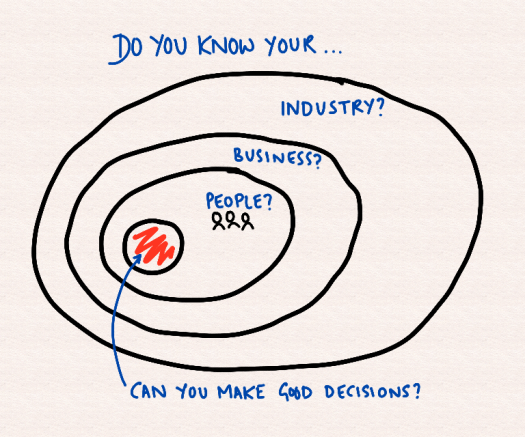
1. Great executives know their industry

Industries have different economics and drivers and the best executives understand this.

The kind of strategies that apply in a fast-moving consumer goods space cannot be applied directly to a moribund regulated business.

Your industry makes money in a particular way, by meeting demand with supply and competing with others.

If you are curious, able to spot possibilities and test and challenge assumptions then you will be able to focus your attention on doing things that make the most difference.

2. Great executives know their business

Most people arrive at a senior position after spending years in a particular function or business unit.

This means that they often view the whole business through the lens created by their experience – sales leaders think about pricing, operations about supply chains and accounting about finance.

Great leaders think about the system – how all the pieces fit together to create value. They focus on the interaction between parts of the business, remove bottlenecks and improve coordination to make it easier for the business to operate optimally.

3. Great executives know people

A great strategy developed in a locked room is of no use to anyone.

To actually make things happen, you need to interact with other people, show them your plans, take into account their objections and get them to work with you to make things happen.

You can only do this if people trust you and your judgements at all levels of the organisation. If you try and control, manipulate or steer people you’re probably going to be found out.

People aren’t stupid.

If you help other people get what they want and they can trust what you say, you have a good chance of moving in the right direction.

Great executives know how to make good decisions

If you know your industry, know your business and have good relationships, the last part of the puzzle is being able to make good decisions.

How do you take data and information and combine it with your gut instinct to create insight?

The key is having decision making processes that help you arrive at reasoned decisions that are free from bias – yet that incorporate the human element that comes from a deep understanding of your own circumstances.

As the article says, you can learn these skills if you don’t have them already.

It’s a simple enough list really.

But just because it’s simple, don’t make the mistake of assuming it’s easy.

How to get your timing right

timing.png

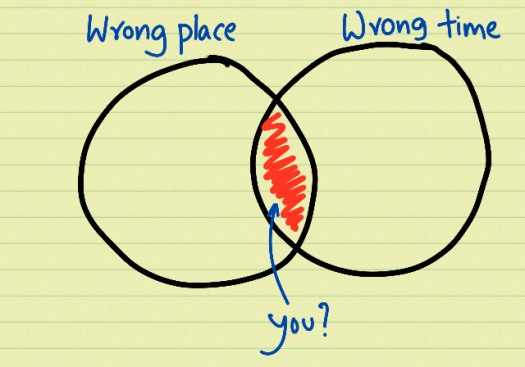
Why do some people succeed and others fail? Is it because the successful ones were just better? Or were they lucky?

This is a hard thing to take apart. All we have to go on is the evidence of success or failure – we don’t know what would have happened if the situation had been different.

“Luck is what happens when preparation meets opportunity”

This quote has been attributed to Seneca, the Roman philospher, but probably wasn’t said by him. It’s still good, however.

If you get yourself ready, then when you are able to react when the opportunity presents itself, you improve your chances of being lucky.

When it comes to timing investments in markets – this is a good strategy.

In investing – if you decide ahead of time what is good value, and the market comes close to that number – you should buy.

Much too often when prices fall people don’t buy, hoping they can get it cheaper. And when they rise they don’t buy either, hoping they will come down again. That doesn’t work.

Another way of thinking about this is with a surfing analogy. If you’re a surfer, you don’t just go to the beach, scan the waves for a big one and then head out towards it.

Instead, you get in position, and when the big wave comes along it lifts you up and you get going.

It’s all about getting in place before the opportunity starts. If you can see a trend, see the wave, see what is about to happen – then you are probably too late to do anything about it.

This is perhaps why people who take risks, start new ventures, try out new ideas are sometimes regarded with pity, sometimes with scorn by those around them.

Until they succeed. And then it looks like it was inevitable after all and anyone could do it. Except they didn’t.

Can you increase your chances of getting your timing right and being lucky?

A ten-year study by the psyschologist Richard Wiseman suggests there are four things lucky people do more than others:

  1. They create and notice chance opportunities
  2. They use their intuition to make lucky decisions
  3. They have positive expectations
  4. They are resilient – and that sometimes changes bad into good

This study suggests that how lucky you are may be related to how you think and behave.

Perhaps the approach to take is a combination of Oliver Cromwell’s maxim “Trust in God and keep your powder dry”.

In other words – think and act lucky, but also do everything you can to have the capability and tools needed to seize an opportunity when it comes along.

Would you stick your neck out?

stick-your-neck-out.png

What would you do when faced with a situation that poses a risk to you personally or professionally?

Are you risk averse – preferring to deal only with certainties or do you plough ahead and accept whatever happens as a result?

Neither approach is particularly effective.

At a talk at Sheffield University Sir Peter Middleton, a former Chancellor of the University and Group Chairman of Barclays, made the comment that outside of number theory, everything is probabilistic.

And that is something that is quite hard for us to get our heads around – it’s just not the way human brains are wired.

Take the army life, for example. That is a profession where sticking your neck out could quite literally result in a very unpleasant outcome.

If you were a risk averse soldier, would you ever go first around the corner?

The US military, which helpfully publishes a lot of its leadership training material, talks about the concept of prudent risk in its Mission Command Doctrine.

Prudent risk is defined as “deliberate exposure to potential injury or loss when the commander judges the outcome in terms of mission accomplishment as worth the cost”.

It’s not gambling, rushing in hoping to win big without thinking through what might happen to your team if you fail.

Instead, you weigh things up, in essence working out the probabilities involved, and make a prudent decision.

Take another field – investment management.

Risk is defined in rather arcane terms because it sounds better when you try and sell it to clients. Volatility or beta sounds much more knowledgable than saying some days prices go up and other days prices go down and most days there isn’t really a clear reason.

Warren Buffet talks about risk in simpler terms – he defines risk as the potential for loss.

If you buy a particular stock, or do a certain transaction, what are the chances that you will lose money on the deal?

If you only deal with certainties, and keep your money in cash under the bed, you returns will be low.

If you go for exotic and complex deals that you don’t understand but are assured are “no-brainers”, you may strike it rich, but in many cases you will not.

Remember the old saying – when a person with money meets a person with experience, the person with experience ends up with the money, and the person with the money ends up with the experience.

The key to succeeding in investment is taking prudent risk – taking action when the opportunity outweighs the cost and you have a greater probability of success than failure. And then doing that again and again.

When it comes to personal or business success, the same approach applies.

You can’t replace personal initiative, responsibility and cooperation in the workplace with automation. It’s hard to get a robot to do anything outside the limitations of its programming.

Instead, businesses succeed when the people in them assess situations clearly, weigh up the pros and cons and accept that any significant decision is going to involve risk – and take the crucial decisions where the opportunities outweigh the costs.

That does mean sometimes sticking your neck out.

Why we should spend more time thinking upside down

person-upside-down.png

How you look at a situation usually defines how you analyze it and the kinds of solutions you come up with as a result.

The problem is that quite often it is only after you have spent some time on the analysis that you find out that the way you were looking at the situation in the first place was wrong.

The maxim “Invert, always invert” was a favourite of the German mathematician Jacobi who believed you could solve many hard problems by thinking about them upside down.

Take a famous example from Edward de Bono about the problems of pollution. Factories along a river were taking in water, using it and putting their polluted water back into the river. The last factory received the most polluted water.

The question asked was how to ensure that factories cleaned their water first before putting it into the river. Did it need a legislative solution? A technical one?

de Bono’s simple idea was to invert the input and output and require all factories on the river to have their water intake pipe downstream of their output. This means that they would be the first to suffer from their own pollution and give them a strong incentive to clean up.

Charlie Munger, the Vice-Chairman of Berkshire Hathaway, has talked about the importance of inversion in making investment decisions.

The secret to being smart, he says, is to avoid doing dumb things.

If you avoid doing dumb things for long enough, like taking drugs and racing trains to the crossing, then eventually the decisions you do take will result in good outcomes, and you will look smart as a result.

Inversion, or upside down thinking, can be applied to many situations in life and business.

If you have a goal you want to reach, thinking about the things that will stop you achieving that goal can help you take the right decisions on what to do and what not to do.

If you are facing a business challenge, re-stating the problem may create new approaches that you hadn’t thought of before.

For example, if your car park is too full, you might consider how to increase its capacity – and that leads to solutions like buying more space, expanding and investing more money.

Instead, asking how you can reduce the number of cars in the car park may result in different solutions – encourage car sharing, moving to other locations or encouraging home working, getting to the same point but with less investment.

In investing, after you have come up with all the reasons why you should buy something, it is a good idea to list out the reasons why it is a bad idea to buy it as well.

Looking at things the wrong way round, or upside down, can expand the way in which we think about problems and create a richer set of solutions for us to pick from – increasing our chances of making good decisions time after time.

Should you get everything done?

person-loaded-with-things.png

You know the old saying – if you want to get something done, give it to a busy person.

But what if you are that busy person, how are things working out for you?

John Cutler takes an interesting approach to this issue, using the word “promise” instead of action to describe what we commit to doing every day.

You probably take down lots of actions every day. Even a few a day quickly mounts up. In a year, you might commit to 600-900 action items.

Even if you get 20% of them done, that still leaves hundreds left incomplete at the end of the year.

This is the problem with productivity systems such as David Allen’s Getting Things Done. You could collect everything that has your attention and get it onto a list and out of your mind. But very quickly, the overhead of collecting and listing and processing can get overwhelming.

When the difficulty of managing the list outweighs the benefit of having it, you have two options. Either abandon the system or get very tired.

This isn’t how things were meant to be.

John Maynard Keynes, writing in 1930, imagined a future where technology would be so advanced that people would have little to do. They might work just because they wanted to, and surely no one would want to work more than three hours a day – and so he projected a 15 hour work week for most of us.

Instead, we now work longer hours than ever. Why is this?

There are two reasons.

First, some jobs don’t pay enough to live. Some people are trapped in low wage jobs where they are paid by the hour and so they have to put in the hours to get enough to get by.

The second is that some jobs pay too much. For many people, being paid a lot per hour makes it hard to give up that hour of work and the associated money that comes with it.

For example, you could perhaps work two days less and live comfortably. If the lost day’s pay is high enough, however, you might be reluctant to lose it and so the amount of money creates a real disincentive to working less.

Going back to John Cutler, one way to manage life better is to be more choosy about the promises you agree to. Make less. Keep more.

A more radical solution is Rutger Bregman’s proposal to give everyone a minimum basic income and change the rules to a 15 hour working week and open borders and let anyone move anywhere.

You may instinctively shy away from such ideas, especially the part about open borders. But many people, including Elon Musk, support initiatives like a minimum basic income and it is being trialled in places.

The thing to notice is that the way we live and what we do is results from choices we make as individuals and societies.

You can choose what to get done.