Where are the opportunities in the Fourth Industrial Revolution?

idt-opportunities.png

Industry is rapidly adopting and adapting digital technology in modern manufacturing, in a trend sometimes called Industry 4.0 or the fourth industrial revolution.

This marks a change from “strong” machines to “smart” machines, as a network of connected devices with increasingly sophisticated technology add value and remove waste from manufacturing processes, supported by more monitoring and analysis capability for operators.

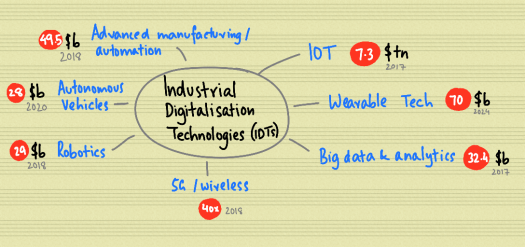
The Made Smarter Review looks at how UK manufacturing can benefit from using Industrial Digitalisation Technologies (IDTs) to boost manufacturing, growth and jobs.

The review argues that the prize is large. The global market for IDTs is already significant, in the region of trillons of dollars for Internet of Things (IOT) devices.

We are already seeing the increasingly widespread application of big data and analytics. A robust communications infrastructure, underpinned by 5G and wireless will make it easier for devices to talk to each other.

Advances in robotics, autonomous vehicles and advanced manufacturing are already being implemented and wearable technology is being seen as a huge growth area.

We will need more people with the skills and capabilities to implement IDTs.

In addition, the challenge with collecting increasing amounts of data is that you can end up with the same problem we have now with emails – humans have limited processing power and there is more coming at us than we can deal with.

There is little point in capturing lots of information if someone then has to look at it and intepret it before taking action. That simply creates a new bottleneck as human capability fails to keep up with the power of industrial systems.

The opportunities in these technologies will be unlocked when machines can work out when to take action based on the data they collect – from the “voice of the process”.

For example, a wearable tech heart monitor package may continuously monitor your heart and alert both you and your hospital if your readings go out of tolerance, and perhaps even check your diary and book an appointment for you.

A machine learning algorithm may be able to figure out a shift pattern at your facility based on your electricity or gas usage and calculate when to buy from the wholesale market in order to minimise total cost.

Digital competence is quickly becoming a “threshold” competence.

It’s something you have to have in order to compete and profit as the next industrial revolution gathers pace.

This review is a useful and comprehensive overview of what needs to happen in the UK to increase productivity, create new businesses, better jobs and make it more competitive globally.

How to pitch your idea

6-pitches.png

The author Dan Pink writes that we are all in the business of moving others now in his book To Sell is Human.

Whether it’s persuading others to back an idea or strategy to what people think of as traditional sales, all of us are increasingly required to pitch our ideas and get support in order to do anything.

The test for whether an idea was clear was the elevator pitch. Could you succinctly sum it up in 30 seconds or less as you went up an elevator with someone important.

But… we rarely share lifts with important people any more. What do you do when you don’t have an elevator available and you want to get their attention and spark interest?

Dan Pink describes six successors to the elevator pitch. It might help to remember them as you look at the symbols on your keyboard that match the ones in the picture.

1. ! The one word pitch

Can you describe your idea in one word?

Pink suggests starting with a short description, say 50 words. Cut it down to 25. Cut again to 10. One of those that is left is the one word that describes what you do.

For example, the website of Patek Philippe, the luxury watch brand, has the word Aesthetic scrolling on its homepage.

In an interesting twist, they have the one word that they feel describes the beauty of their product in several languages.

2. ? The question pitch

If you are sure of your facts and logic, then asking a question is a powerful way to get started.

WaterAid, a charity that helps bring clean water and toilets to people who lack basic sanitary provisons around the world, simply asks Are you ready? on their website.

Then they explain their goals and how you can get involved.

3. = The rhyme pitch

A rhyme sticks in your mind.

Pink says that if you are in competition with others, coming up with a rhyme that summarises what you do will help people remember your firm and potentially give you an advantage.

4. @ The tweet

Can you summarise what you do in less than 140 characters?

Apple is a company that mastered this approach with short, snappy lines under Steve Jobs.

“1,000 songs in your pocket” and “The world’s thinnest notebook” still probably bring to mind the iPod and the Mac Air.

5. _ The subject line

Email is still where most of us live, and where we get the most junk.

To stand out, your email must do at least one of two things, and preferably both, according to Pink.

It must have utility – a clear statement of whats in it for the reader.

It must spark curiosity – a desire to learn more.

6. ” “ The story pitch

The story pitch, also called the Pixar pitch, says that every Pixar pitch has the same formula:

  • Once upon a time…
  • Evey day…
  • One day …
  • Because of that, …
  • Because of that, …
  • Until finally, …

Pink’s site has a few videos that also explain these in more detail – and the book is a pretty good read as well.

The next time you’re stuck for a way to craft your pitch, just look down at your keyboard and remember the six new options you now have.

!?=@_” “

How do we change from one product to another?

ladder-vs-stack-models.png

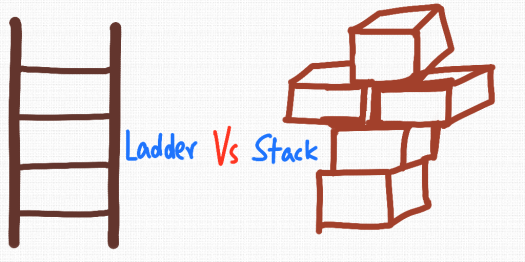
One way to think of change is like a ladder.

We move from rung to rung, stepping off the old one and committing to a new one.

For example, we used to burn firewood for cooking, and still do in some places. Then we moved to transition fuels, such as coal or kerosene. Then we might use cleaner fuels, such as electricity or natural gas.

This kind of transition seems straightforward, one way (upwards) and natural. You move from one choice to another and eventually stop doing the things at the bottom.

Another way to think of change, however, is like a stack.

In this model, you stack different choices on top of each other, perhaps continuing to use them all at different times.

You may try out two approaches at the same time, like two boxes stacked side by side, before moving on to try something else.

Continuing with the energy example, you may have gas-fired heating, but also install a wood-burner – going back to using firewood for heating.

Neither model is quantitative – but they provide different ways of looking at a situation.

Take software, for example. Let’s say you have a system that is a significant innovation on what is already there.

If you think of change like a ladder, then you need to persuade your market that they have to switch from what they are doing to your product in order to benefit.

If you think of change like a stack, then what you need to do is persuade your market that what you have builds on what they already have to create more benefits than they enjoy right now.

There is some evidence that the stacking model is a more accurate depiction of how people actually make choices than the ladder model.

The main difference is that the ladder assumes that people need to make a choice between one thing and another. This OR That.

The stack assumes that people want to hold on to what they already have and choose things that build on existing investments. This AND That.

Focusing on what people want will probably be more effective than telling them what they need.

What makes you special?

distinctive-capability.png

In the last few months of the year teams around the country are looking at the year ahead, setting budgets and targets and trying to work out what do do and where they should focus their time and energy.

Should you focus on where you want to go – your goals and the end result?

Do you need to know where you are going so that you know when you are there?

Will having the right vision and mission statement and doing lots of motivating, team building activity help you succeed?

Is getting the right people on the bus the secret?

One way to see through the euphoric fog of motivational management is to consider what makes you special.

What is it that is distinctive about your business – the qualities and attributes that mean you will do better than others in your space?

John Kay, a leading economist, came up with the concept of distinctive capabilities in the 1990s.

He argued that distinctive capabilities are what you have, not what you would like to have, or hope you have.

You might start with a number of capabilities when analysing what is distinctive about you. Are you cheaper than the competition? Do you have smarter people? Is your reputation better?

Key said that there were only a few types of distinctive capability – and they stemmed from how innovative you were, how you structured yourself and what people thought about you.

He termed these innovation, architecture and reputation.

So, what do distinctive capabilities such as these have in common? How can you score them and see whether you should focus on them or not?

There are four questions to ask yourself. Is what you do:

  1. Hard to make and build? Does it take a long time or is it difficult to get the ability to build and maintain your capability?
  2. Hard to do? Is it possible to turn your activities into a recipe – something that can be recreated or adapted elsewhere?
  3. Hard to copy? Is what you do protected – either by laws or by its nature – a trade secret for example. Can it not be replicated easily.
  4. Hard to buy? Is it possible to buy what you do on the open market or is it something unique to you?

If what you do is impossible for others to make, do, copy or buy from anyone other than you then congratulations – you are on your way to a monopoly.

For most organisations, however, you will be somewhere on a range.

A strategy that works will focus on those capabilities that fall on the right hand side of the range when answering those four questions.

Whether you looking at yourself as an individual, a business unit or a business group, the chances are that you will get better returns by building on the distinctive capabilities you already have, rather than what you want.

Why choice makes it harder to choose

paradox-of-choice.png

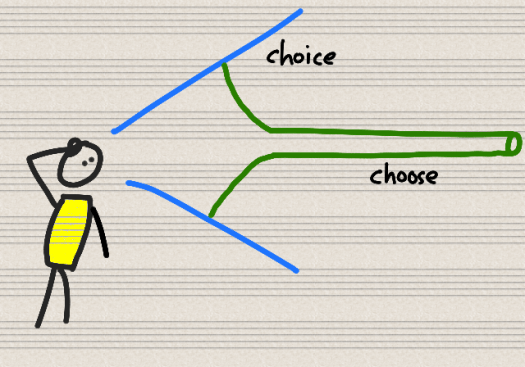
There are two kinds of people: those who choose quickly, and those who take time to choose.

In his book The Paradox of Choice, Professor Barry Schwartz argues that the amount of choice available to us now is making people unhappier and more dissatisfied.

The people who take time to consider their options fare worst here.

There are too many to look at, too many criteria to compare and it’s a struggle to find one that is perfect.

Just looking at more options makes you perceive something you already have as less valuable.

As a result, having choice just makes one afraid of making the wrong decision.

Fear of regret then drives decision making, paralysing people into doing nothing.

We’d be happier, according to Barry, if we:

  • Restricted the amount of choice we had voluntarily.
  • Aimed to be good enough rather than the best.
  • Had lower expectations.
  • Required that all decisions were final and could not be reversed.
  • Paid less attention to what other people do.

If you’re on the other side of the table and you want to improve your sales then instead of focusing on how best to meet what you think people need, make it easier for them to choose what you do.

If choice is paralyzing, simplifying and making it easier to choose will help more people make a decision.

This will help even more in four situations:

  1. When products are complex.
  2. When comparing options is difficult.
  3. When you’re not sure what you prefer.
  4. When you want to make a quick decision.

In summary, when you next need to decide between increasing choice, or making it easier to choose, try the latter.

What is data?

types-of-data.png

The information business is a complex one.

The chances are that virtually all the business intelligence you have now is stored and processed on a computer.

And that carries responsibilities and creates obligations.

So, what is data?

The long version is here but in short:

Data is information that is processed by a machine, recorded on something (including paper), filed somewhere or can be accessed later including information held by public bodies.

Basically… everything.

Data turns personal when you can identify a person from it. Even if you need it and something else to identify someone it’s still personal. If it contains an opinion about the person, it’s also personal.

An example of this from the ICO is that water meter data, even if addressed to the occupier, is personal because it could be used to tell the habits of that person and identify the address they live in and so is personal.

Personal data turns sensitive when it has something that the person would consider private, or that could be used to discriminate against them in some way.

It’s very broad, so that even something publically visible, but covers them. Even if the person makes the information about them public, it’s still personal and sensitive.

What this means is that almost anything you do in modern business that requires using a computer and working with other people is going to involve thinking about data.

When the UK leaves the EU, the rules are likely to stay the same.

Being clear about this definition will help you get started on what you do with the data – how you keep and use it.

Note: You may be one of those people that worries about the use of ‘data is’ versus ‘data are’. ‘Data is’ sounds better…

Happiness is just around the bend

happiness-u-curve.png

It’s true – your life is getting worse.

If you’re in the period between being an adult and heading towards middle age, that is.

The U-curve of happiness is a theory that says we are happiest when young, as children.

Happiness levels decline as we grow and turn into adults, reaching a low in middle age.

But what about children, you might ask. Surely parents are happy?

It turns out that they aren’t, not really.

The sleepless nights and physical exhaustion that comes from having children, and then the sleepless nights and mental exhaustion that comes when they turn into young adults means that people score low on happiness measures around that time.

But then, as you come to terms with life, things become better.

As you get older, happiness increases once again, as you get to do what you want to do once again, and get some of your time back.

The U-curve theory has its critics – many people do not have happy childhoods, many people have a difficult and lonely old age and many people don’t live in free and prosperous countries.

It may be something that only applies to rich and generally healthy population groups.

What this tells us, however, is that our expectations of the future are made up of socially constructed ideas.

You might think that parenthood might be the happiest time of your life. But the experience itself might not be, even though you wouldn’t change a thing.

It is easy to assume that older people have little to contribute – but today people are living and working longer than ever.

We are experiencing a time when three generations can work in the same organization together – all at different stages of happiness in their lives.

Even if the theory is wrong, the thing with a U-curve is that it’s pretty helpful when trying to come to terms with a situation.

After all, however bad things are, you know they could always be worse.

And when you’re at rock bottom, you know the only way is up.

How to tell a story that makes your point

6-story-plots.png

How do people in an organization get a sense of shared meaning and understanding?

They tell stories.

Stories and accounts of what happened in the past, stories of what could happen in the future, stories of what will happen if you do, or don’t do something all make up the organizational story book.

This collection of short stories helps a person understand the culture and essence of what an organisation is – which emerges out of the actions, behaviour and justification of its members.

So, what kind of stories work?

There are six basic plots that have survived over the ages.

1. The Quest

The quest is a story where an individual or group set off, face challenges and setbacks, and eventually succeed and find fame and fortune.

This is often the story of individual entrepreneurs – Branson, Zuckerberg and so on – they all started with ambition or an idea and then moved heaven and earth to make it happen.

2. The Contest

The contest is a struggle between two forces – often good and evil. Who is good and who is evil depends on your point of view.

This is often the story of takeovers and mergers and boardroom battles. Take Proctor and Gamble, for instance.

A battle has been waged between the activist investor Nelson Peltz and David Taylor, the CEO, who have different views on how the $235bn company should be organized.

The two sides may have spent over $60 million between them on the campaign and, for the time being, the CEO and Board may have won – supported by the large numbers of small shareholders.

But Peltz may be back – the institutions back him, after all.

3. The Conquest

The conquest is a story of winning through force and power – but then being seen as saving the day.

Take Jack Welch, for example.

He was given power at GE, at the time a moribund conglomerate with disparate interests. He instituted dramatic, even draconic measures.

He sold off business units in markets where GE wasn’t number 1 or number 2 and insisted that the entire organization be structured around performance and competitiveness.

The result was a re-energized, re-focused and more driven organization that is now once again a force in sectors ranging from turbines to finance.

4. The Downfall

The downfall plot is one where a successful person or organization slips from grace, primarily because of their own shortcomings.

This is the story of the financial crisis. Once proud financial institutions were sucked into the frenzy of lending money without underlying assets – greedy for commissions and growth.

In the UK, the government had to rescue institutions such as Lloyds, RBS and HBOS – banks with a hundred year operating history, and they are still recovering from that period.

5. The Disaster

The disaster story is different from downfall – because the events that cause failure are outside the person or organization’s control.

The classic story here is the impact of the internet.

Blockbuster, HMV, Staples – all the high street and big box stores that flourished in the late part of the last century and thought this dinky little computer toy thing called the internet would never catch on are now part of history.

6. The Scam

In the scam, the main characters turn out to be not what they seemed – they were either incompetent or foolish, or they were hiding something that then came out.

Bernie Madoff, a one time darling of Wall Street, was exposed as a fraudster after creating the largest ponzi scheme in history – nearly $65 billion.

Summary

Three of the plots are stories of success: quest, contest and conquest, while the other three are stories of failure: downfall, disaster and scam.

There is no shortage of stories around us – but the ones we pick and choose to tell and re-tell will create the common meaning and understanding that is shared by people in an organization.

Stories have more impact than almost any other form of communication – we seem hardwired to listen and learn from them, right from the time we are children.

Choose the ones you tell carefully.

How to see things afresh

navigation.png

Mark Twain said that once he had learned the analytic knowledge required to navigate the Mississippi, the river lost its beauty.

The problem with being an expert is that you know too much.

And that knowledge gets in the way of being able to see or experience what is in front of you.

A friend of mine, an editor, says that it’s difficult to watch a film now and just enjoy the story – because the urge to take it apart and dissect it is too much.

One answer, apparently, is to get drunk quickly, and that makes it easier to sit through the experience.

Then again, this is not a new problem.

Toys ‘R’ Us, for example, has 64,000 employees and 1,600 stores in the US but that didn’t stop it having to start bankruptcy proceedings, unable to compete against the likes of Amazon.

Organizations that were once brilliant at what they did, presumably staffed with experts, have simply become irrelevant as the world changed around them, but their maps did not.

So, what can you do to try and see the world as it rather than how you think it is?

It might help to start by avoiding meetings.

Too many meetings are too long and are spent waiting for someone else to stop talking so you can say what you think.

A better approach might be to try and stay in beginner’s mind.

The Zen teacher Shunryu Suzuki says in his book Zen Mind, Beginner’s Mind “In the beginner’s mind there are many possibilities, in the expert’s mind there are few.”

Instead of meetings, it may be better to engage in dialogue.

A formal version of this is Bohm Dialogue, a form of talking proposed by David Bohm, an American theoretical physicist, who suggested engaging in a free-flowing, non-judgemental group conversation that helps people to come to a common understanding of everyone’s point of view.

One technique for facilitating it is to borrow from Improv, the art of spontaneous theatre based around “Yes, and…”, where someone says something and you have to start your next sentence with “Yes, and…” and then make your point.

This suspends judgement, as you have to build on the previous statement rather than stopping to critique it.

Another approach is the Japanese method of seeking opinions from the most junior member present first.

This means that they can speak without having to say something that might contradict what their boss said if they went second – in which case they might not say anything at all instead.

The point is that becoming an expert takes time.

And then, perhaps frustratingly, it’s going to take even more time and practice to become a beginner again.

The future of working and leading

shared-leadership.png

Many things seem quite clear and simple – because that’s just the way they are right now.

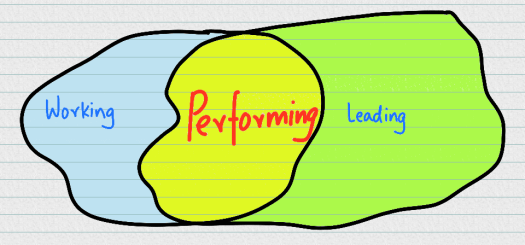
Take people in an organization, for example. You might think that there are two types: workers that do the work and leaders that decide what work needs to be done.

That approach to organizational structure comes out of the needs of an industrial, factory based society – where machines needed to be tended, things needed to be assembled and people had jobs that involved doing a few, repetitive tasks over and over again.

That world just doesn’t exist for many people any more.

The kinds of challenges organizations and societies face are more complex and nuanced now.

There may be an underlying trend, an upswell, a hint that our future economies will be based around more decentralized, democratic technologies than now.

At the moment, it feels like the world is controlled by a few giant corporations.

Take information, for example.

The four giants: Google, Amazon, Facebook and Apple dominate what we find, buy, share and see. They seem unassailable, billion dollar firms that are virtual monopolies in the current economy.

They may, however, be swept away in the future by shared, decentralized platforms that we all can own and operate using technologies such as blockchain.

People may prefer to deal with community owned businesses or social enterprises.

And that trend has an interesting application to organizational development.

Will organizations in the future stay hierarchical, controlled by a small number of leaders who make all the decisions?

Or will the organizations that perform in the future have more blurred lines between workers and leaders?

Despite an increasingly technological world, people will still choose to work with people much of the time for tasks that are complex, creative or need the application of thought.

There may not be much space in organizations for leaders who don’t contribute work. Conversely, workers who don’t learn how to lead and perform in teams may find themselves replaced by machines.

In this future, networks of committed and creative people may create the products and services we use every day.

It may be that the organizations of the future are going to be decentralized networks of individuals who share leadership and work – with performance in the market emerging out of their collective behaviour.

Do you know how you will fit in?