Which business model will catch the next wave?

surfing-model.png

Charlie Munger talked about competitive destruction – the process by which new businesses come along and destroy older ones – often built using new and different technology.

Being one of the first to market can be a good thing in this situation.

Using a surfing model, if a business can get up and catch the wave, they could ride it for a long time, making profits on the way.

Intel did it with microprocessors, Microsoft with desktop operating systems, Apple with smartphones and Google with search.

Products based on artificial intelligence (AI) and machine learning might seem good candidates for the next wave.

Take the way in which we use mobile phones, for instance.

Tools like predictive text have been around for a while – but phones are used for much more than talking or texting.

Navigation systems on them have gone from route planning to real time route optimisation, with suggestions on how to change routes in the middle of a journey based on travel patterns in the area.

Translation is another area being transformed by technology.

For gist translation – where what we need is an understanding of what a document says in a different language – the systems built into browsers and search engines do a remarkable job.

Machine learning may provide the solution to spam emails.

Microsoft Outlook’s clutter service means that virtually all spam type emails are filtered out and never hit the inbox.

Generic newsletter, marketing and sales emails simply can’t interrupt us any more.

Some of us don’t worry about scheduling or planning things – the entries turn up in our diaries and we can rely on our phones to tell us where we are going and when to set off.

These tiny changes to the way in which machines help to organise and optimise our days are happening in a barely recognizable way.

But they are becoming also becoming an inextricable part of how we go about our daily business.

These changes signal a groundswell that is expected to turn into a tidal wave as AI affects everything from law and medicine to transportation and sustainability.

The question that individuals and organisations need to consider is how they will fit into a world where work requires hybrid human-machine skills.


Should we go for the easy option?

one-foot-hurdles.png

Warren Buffett wrote that after many years he and his partner, Charlie Munger, had not learned to solve business problems.

What they had learned to do was to avoid them, by looking for one-foot hurdles they could step over rather than seven-foot ones they needed to clear.

But how can this approach be applied day to day?

Take the emerging field of product management.

Is it better to create a new product and then try and sell it to potential users or to first try and understand the needs of potential users and then try and design an offering around those?

One school of thought argues that customers don’t know what they need before they see the product – if you had asked people what they wanted before the car was invented, they might have said a faster horse.

If the business we’re in is more humdrum – more exposed to competition – what approach can we take?

Let’s say we owned a food business – what advantages would help us beat the competition? Would it be better ingredients, better signage, widespread advertising or more delivery options?

The late Gary Halbert used this example and said people could choose any combination of advantages they wanted and he would still beat them if he had a single advantage – A starving crowd.

The test for any product is not how good it is or how glowing the reviews are – it’s how well it’s doing on gaining market share.

The energy efficiency business, for example, should really be an easy one to operate in.

Who wouldn’t want to cut their energy costs – after all savings go straight to the bottom line and how much product would a company need to sell to get the same result?

But many projects fail to go ahead because they don’t meet a 2-year payback?

But, if project developers thought like product managers, they might think about what the CEO and FD of the company really want to achieve.

If they are like most CEOs and FDs, their focus is on earnings growth and increasing shareholder value.

Payback to them is less important than what the project will contribute to EBITDA during its lifetime.

A McKinsey article shows how a modern approach to a portfolio of projects might evaulate them all, rank them on a risk/reward basis and select the ones close to the efficient frontier – essentially the best ones.

Cherry-picking makes it more likely that investments will return value in the long term.

We are often programmed to believe that anything worth doing must be hard – taking effort and sacrifice.

By going after the easy things, however, we may actually make a difference and create value.

How understanding fractals can help us decide

fractals.png

A fractal is a curious thing.

It is most commonly shown as a pattern, often mathematical, that is similar at different scales.

The Koch snowflake, for instance, is drawn by starting with a line and creating an equilateral triangle by splitting it into three parts.

Then, each segment of the triangle – a line – is turned into another triangle. Then that is repeated again.

What we end up with is similarity at different levels – as we zoom in we see the same pattern repeating itself.

Another fractal that is easier to visualize is a fern, or a lighting bolt.

A mountain is a fractal.

Seen from a distance it has a certain shape. Zoom in and the bumps and ridges are replicated on the surface all the way down to individual rocks and pebbles that show similar shapes under a magnifying glass.

So, what does a fractal have to do with decisions?

There are two ways we often approach decision problems.

One is through fundamental analysis – we look at the long term features of the problem or situation and come up with an approach to deal with it.

In investing, for example, this may involve looking at the stock price, earnings, assets, market sector, historical performance, management team and so on.

Or, in a business, it might involve looking at the accounts or the number of billable hours and making choices on where to invest or how to spend time.

A different approach might be to learn how to recognize patterns.

A price chart often shows similariy at different levels.

Performance during the year, during a month and during a day all show signs of the continuing battle between supply and demand.

Understanding these patterns and working out a logical approach to dealing with them can make the difference between good investment decisions and shooting in the dark.

It might also help us with managing people.

For example, an individuals career often follows a series of ups and downs – starting, learning, growing, plateauing and ending.

A company does the same thing – following a lifecycle.

Whether you look at it over the 40 year life of a company or the 40 year career of an individual, we’ll see similar patterns emerging.

And the way to deal with patterns is to recognize that things happen again and again.

From a decision making point of view, it means that there are very rarely crucial decision points.

We can take it easy – if we miss one opportunity, another will come along in a while.

It’s that whole thing about another door opening when one closes.

The best time to start a new project, for example, is 10 years ago.

The second best time is now.

When should we change lenses?

choice-of-lenses.png

There are at least two problems with how we go about solving problems.

The first is we approach them from our perspective – using the set of strategies, models, expectations, biases, experience and tactics that we have built up over time.

The second is our first attempt to come up with a a solution tends to narrow our thinking very quickly, as we look for patterns, evidence and reasoning to support that solution while forgetting about the rest of the options out there.

It is very hard to stop doing either of these things – it’s an approach we’re comfortable with and when we are faced with a problem – whether it’s doing some DIY or fixing a failing healthcare programme – we tend to fall back on our default programming.

So, can we change this or are we stuck with the way things are?

One technique that may help is problem restatement.

We restate the problem by taking the time to write out the problem again in as many ways as we can think of.

For example, perhaps we have a difference of opinion with someone at work on an issue.

It’s easy to make the fundamental attribution error – saying the problem is that person is rubbish because of who they are as a person rather than the situation they are in at the moment.

But, what if we tried to look differently and restated the problem.

We might be able to use a selection of lenses.

The reverse lens tries to look at the situation from the other person’s point of view.

What would they say about us and the situation and how would they justify their approach – and is there any merit in what they are saying?

The long lens helps us look at things with a longer term perspective.

Will this issue matter in a week, a month or a year?

The wide lens looks that the situation in context.

How does this issue affect everything else?

If it went the wrong way would the consequences be significant or not, and so how important is it in the wider scheme of things?

Restating the problem is one way to increase our chances of getting a good outcome.

As Charles Kettering said – a problem well stated is a problem half solved.

Why we should do more things that give us energy

energy-audit.png

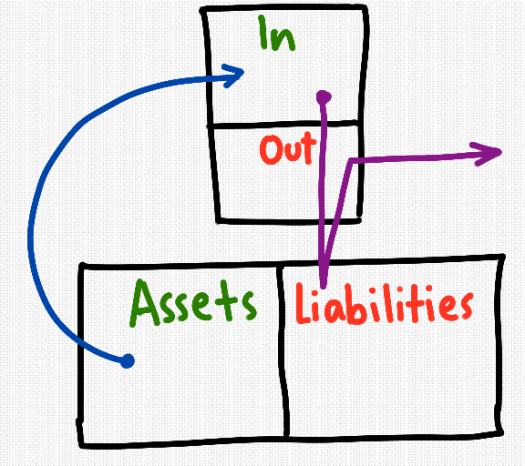
Robert Kiyosaki in his book Rich Dad Poor Dad has an elegant way to define assets and liabilities.

Assets put money in your pocket. Liabilities take money out of your pocket.

This isn’t the way accountants look at things – but it’s a good way for the rest of us to visualize where we should put our money.

Investing in a rental property that gives us income every month is good.

Buying a flash car that costs us hundreds in payments every month is bad.

It’s a clear and simple model that should increase how much money we have if followed.

We can tell what kind of financial health our life is in by looking at the pattern money takes as it flows through our hands.

If, when money comes in, we invest in assets and the money flows back into our pockets, that leaves us with more at the end of the day.

On the other hand if, when money comes in, we have liabilities, then the money flows out to pay for them and we are left with less when done.

And the same model, it turns out, can be used to think about activities that we do every day.

It’s a bit of a cliche – but even the Harvard Business Review is happy to use an article title like Manage your energy, not your time.

Our days are made up of rituals – things that we do from the time we wake up to the time we go to bed.

Some of these things are going to leave us with more energy than we started with.

Others are going to drain us of energy when done.

And, while it’s easy to fall into a victim mentality and argue that what we have to do is driven by the demands of other people like colleagues and bosses, recognizing the patterns that aren’t good for us is still the right starting point.

Like doing an audit.

There are a couple of ways to do this.

One approach is to log what we do over the day and then look back to see how our energy levels have increased or decreased.

Another is to make a simple list of things and give them a score.

Then it’s time to start making changes.

Usually this starts with creating new rituals.

For example, some people find their energy levels go up if they check email an hour after getting into work rather than first thing or in the afternoons.

Or we could do work sprints – 90-120 minutes of focused activity with a 5-minute break every 25 minutes followed by a longer break at the end.

We need to increase the number of rituals we have that are assets, which leave us feeling more energized when we are done doing them.

We might work on liabilities with high energy, but when we are done we’re drained – so we need to keep those to a minimum.

The last word on this goes to Scott Adams, the creator of Dilbert, who says –

Manage your creativity, not your time. People who manage their creativity get happy and rich. People who manage their time get tired.

Which path would you take?

small-steps.png

Edward de Bono wrote about a small but significant difference between the way we think about the physical and mental world.

Let’s imagine we had to build a staircase.

Would it look like the one on the left in the picture – or the one on the right?

Most people, in the real world, understand that small steps are the way to go.

But, when it comes to mental work, we try and take shortcuts.

Take investing, for example.

Tom Dorsey wrote about a colleague of his who said – Tom, ain’t but one way to make money in the stock market. Slowly.

Most of the people and businesses that survive compounded their value over time – they didn’t simply skyrocket to fame and fortune.

The recent falls in the value of cryptocurrencies, although there has been a rise again, have left some people feeling elated, and some despondent.

If you bought at $16,000 hoping to hold until it went up, $12,000 is going to keep you nervous for a while.

But, the prices simply reflect supply and demand – and someone who takes a position needs to be aware that buying a currency is not a one-way ticket to riches.

Over the last year, a fairly sensible trading strategy could have resulted in a 6x return on Litecoin. Around 6-7 trades would have turned $20,000 into $122,000.

If you knew how to do it, had the money, were willing to take the risk and had the discipline to monitor markets at least daily that is…

On the other hand, a much easier approach would have been to buy a selection of low cost index funds five years ago and then get on with life.

That would have gained almost 30%. That’s not a bad return either given where interest rates are.

The same principles – going step by step – apply to most of the knowledge work we do now.

People who create anything of value do so piece by piece over time.

It’s tempting to take a shortcut.

But a shortcut may turn out to be the harder path.

The story of Mr. Market

mr-market.png

Benjamin Graham, the father of value investing and Warren Buffet’s friend and teacher wrote about the kind of mental attitude that would be most useful for investment success.

Imagine that we own part of a business – a privately held one – and have a partner called Mr. Market.

Each day, Mr. Market comes into our office and names a price where he will sell his share of the business to us, or buy our shares of the business.

Our business might be in something quite normal – a restaurant, retailer, a professional services firm.

Mr Market, on the other hand, is anything but normal.

Some days he is euphoric, wildly optimistic, and the price he gives us is high because by selling to you he may lose out on future gains.

At other times he is down and depressed – unable to see anything but problems ahead – and names a very low price because he doesn’t want us to dump our shares on him.

The other thing about Mr. Market is that he comes back day after day.

He doesn’t take offence if we ignore him for a while – he’s always willing to offer a price to buy and to sell.

So, the question is would we sell to Mr Market at his prices? Should we be up when he is up and down when he is down?

That would seem very odd in a business we owned.

We would know the value of the business – how much it makes and is likely to make. We understand the costs and profits.

So, if we were to go through all the hassle of selling, we’d only do it when we felt like it.

We’d let the results of the business tell us how well we were doing rather than rely on Mr. Market’s opinion.

Mr. Market is there to serve us – to allow us to buy and sell when we want – and not to guide us and tell us when to do something.

Benjamin Graham also said – In the short run, the market is a voting machine but in the long run it’s a weighing machine.

The story of Mr. Market is a useful one to keep in mind when trying to make our own investment decisions.

Never send a human to do a computer’s job

human-computer-jobs.png

Why do we spend so much time doing things that could be automated?

Often, we’re too busy to spend the time to learn how to do things to save time.

And what doesn’t really help is the way in which software systems are evolving.

What is the single biggest problem many software vendors face?

It’s keeping us hooked – interested enough in their platform for us to come back to it again and again.

The apps that succeed are the ones that get and keep our attention – the more time we spend on them, the more addicted we are to using them – and the more reliable we are as a source of income to the owners of the software.

So, what does the current trend towards software as a service mean for us?

At one extreme there are some truly useful services – like Dropbox. That sits in the background and makes all our files available everywhere and really does increase productivity.

In the middle are a large number of so-so services.

Do we really need to store everything that we read in a cloud based notetaking system? Are platforms necessary for everything from bank accounts to electricity billing?

One argument is that it makes access easier – when everyone can sell on ebay then there is more choice and better value for consumers.

On the other hand, some services are designed to make it cheaper for the providers to do their thing and for users to do the hard work instead.

Service in this case really means self-service.

And that’s perhaps where some business models don’t work – where people want a service and are instead offered a self-service option.

The point is that they don’t want to do the work, they want it done by someone else or something else.

Most of us now probably have around 300 logins and passwords for various platforms but use a handful regularly.

The rest simply take up time and effort.

Perhaps the primary test for buying a new piece of software is not what it can do, but how much time it will save us.

A good starting point might be to select software that doesn’t have a login screen at all – no graphical interface to bother us – and which really does just sit in the background doing work that needs doing while we put our feet up.

How to value an Initial Coin Offering (ICO)

value-an-ico.png

For those of us overwhelmed with the hype and news around bitcoin, cryptocurrencies and initial coin offerings – where should we start, if at all, in this space?

A useful first step might be to go back a hundred or so years and think about the fundamentals of value.

If we were looking to invest in a company that did something – make tyres for example – we might look at the amount of money it throws off as profit every year.

Then the total value of the company is the sum of all that money over its lifetime, lets say 20 years to be conservative.

In that case, we should be willing to pay a percentage of that total (a discount) today in order to get that return over time.

And that, essentially, is the way businesses are valued in stock markets.

Currencies, on the other hand, are thought of as a way to exchange value. Instead of exchanging my rice for your beans, we exchange notes instead.

But really, a currency is a form of IOU – it represents a debt.

If you look at a £10 note from the Bank of England, it has the words I promise to pay the bearer on demand the sum of ten pounds.

This comes from the days when the pound was pegged to gold – if we took ten pounds to the bank, they would be required to give us its value in gold.

That doesn’t happen any more – the value that £10 now has is created by our belief in its value.

And what we believe is that the £10 will buy us something – a meal, a football, a cinema ticket.

So, what is important in a currency is that we are willing to give it away. We exchange it for something that we believe has the amount of value represented by the money we have.

A fundamental requirement for a currency, then, is that we are willing to use it as a medium of exchange.

If the value of the currency itself becomes too high relative to other thing we value, like bitcoin has in relation to the US dollar, then we are likely to hoard it.

This sounds like hyperinflation and has happened before. In 2008, one US dollar was worth $2,621,984,228 when converted to the Zimbabwe dollar.

The Zimbabwe dollar, unsurprisingly, no longer exists.

So, what’s the difference between a cryptocurrency coin and an initial coin offering (ICO)?

An ICO is a way to raise cryptocurrency money for a new business.

Instead of raising dollars like an Initial Public Offering (IPO), an ICO can create new currencies or raise funds in existing cryptocurrencies or even standard currencies.

The general idea is that the value of tokens exchanged for currency in an ICO represents a share of the value of the business.

Investors can gain from a rise in the value of the tokens as the underlying business grows.

Or lose everything…

This, however, sounds very similar to the way in which existing markets work.

The fundamental value of a token issued by a business will depend on the cashflows expected to be generated by the business.

In very early stage businesses, these may be almost impossible to predict. We may invest purely on the strength of the founding team, their experience and previous record of success.

As we understand the business more and where it makes its money, we may be able to make a more rational assessment of value.

At that point, the market price of the tokens can be compared to what we think intrinsic value might be, allowing long term investors to take a position.

The fundamental principle of investing is that the amount of money we give today should have a relationship to the amount of money we expect to be returned by the business over time.

That’s where value comes from.

Putting money into the market hoping to catch a wave – like housing markets in the mid 2000s or dot coms in 1999 – is betting on valuations and is essentially speculation and gambling.

Some people may get very rich…

But for the rest of us, the first step to valuing an ICO is to do the basics – look at the underlying company, the management team, the proposition and the expected cashflows and come up with a number that represents the value of the business.

Then, see how much of a premium over value we will have pay for a token in that business in order to make an investment decision.

How to create a thunder lizard

thunder-lizards.png

The silicon valley entrepreneur and venture capital investor Mike Maples came up with the term thunder lizard in the late ’90s to describe hyper-exceptional startups.

It’s a Godzilla metaphor – and the basic ideas is that thunder lizards come from radioactive atomic eggs – and startups like that, which have radioactivity at their core, are going to grow into big beasts.

They may start small, but they eat their competition and then soon after they attack the incumbents and end up disrupting the existing cosy ecosystem.

So, what is it that makes a thunder lizard?

Mike’s view is that there are two laws that will keep the tech industry (and now every industry is a tech industry) on it’s toes.

The first is Moore’s Law. This says that computing performance doubles every 18 months while the price stays fixed.

This is an insanely powerful law. What is means that any company – whether it’s Ford, or IBM or Google that is an incumbent right now cannot rest easy.

That’s because a new firm, starting without the existing investments and equipment of an incumbent, will be able to breach the incumbent’s advantage, given enough time.

For example, although Microsoft was dominant in desktop operating systems, it couldn’t stop Google dominating search.

The second law is Metcalfe’s Law, which says that the value of a network is the square of the number of nodes.

In other words, as the network gets larger and larger, the number of connections between its members gets larger and the amount of connections and activity increase exponentially.

So, Metcalfe’s Law effectively says that the largest network with the most activity will pull ahead and dominate everything else in its category.

Which is what has happened with facebook and LinkedIn. As social media networks they dominate their markets.

These two exponential laws create a tension and dynamism in the tech industry.

Moore’s Law says that given enough time any company can be disrupted. Metcalfe’s Law says that given enough time a company can have a moat that can’t be breached.

Thunder lizards operate in this space.

But… it’s hard to identify them in advance. In an ecosystem of 10,000 to 20,000 companies, around 10 will capture 97% of the value.

With that kind of distribution, it’s not possible to create a statistical analysis, or analyze cohorts or use maths to create an optimal portfolio.

So, Mike says, his style is to invest in people and projects that have “super high potential energy” and he urges innovators to only do things that have a chance to be legendary – because being mediocre takes just as much work.