Why Planning for When You’re Bigger May Be A Waste Of Time

scale.png

Monday, 9.19pm

Sheffield, U.K.

Do things that don’t scale. – Paul Graham (Y Combinator)

Why would you want to be bigger?

I suppose your size could be a measure of success?

I’ve read that some successful people say that they don’t really care about the money.

To them, it’s a way of keeping score.

So, if you were coming up with a goal for yourself or your business, should you aim to be big?

Should you want to be a millionaire? Or start a billion dollar company?

Or are these approaches looking at the wrong things altogether?

After all, money is presumably a byproduct of what you do.

This can be something that’s a little hard to talk about.

You tend to get very quickly into the differences between tails and dogs.

For example, if you’re looking for an education should you go for the one with the biggest salary prospects or the biggest probability of getting a job?

Many of us do.

So, one would assume, that the better your education the better the job you will get.

Although, why is it that the people who run companies are not usually the ones with the most degrees or letters after their names?

Why is it that so often in real life, as Robert Kiyosaki brutally puts it, A students work for C students, and B students work for the government?

Let’s look at another area that appears to be exploding.

Almost everyone has an idea for a killer app.

Something that, if they could only get it built, would take the market by storm.

The steps involved are pretty simple. Find a development shop, explain what you want, pay for their time and get your app.

How much would you bet that the shop would get things right?

If you’ve ever tried to get something like this done, you’ll know that at the end you now know exactly what you want and it isn’t what you’ve got.

Now, why did you go to the shop in the first place rather than making something yourself?

You could have picked up Excel or created something that worked in a paper planner?

But, by raising money and getting a team together you felt like you could get to scale faster.

It’s the rocketship model. Money is like fuel. If you can create customers before your money runs out you’ve achieved orbit. If not, you’re probably debris.

I was reading some advice on coding – procedural versus object oriented.

Use object oriented, an experienced programmer urged. It might mean you write more code but if you get successful it will be much easier to manage then.

All of these approaches say you should plan for what happens when you scale.

But, Paul Graham doesn’t.

And the experience of many others also suggests that scale can be a trap.

At the start of any process you need to do things manually.

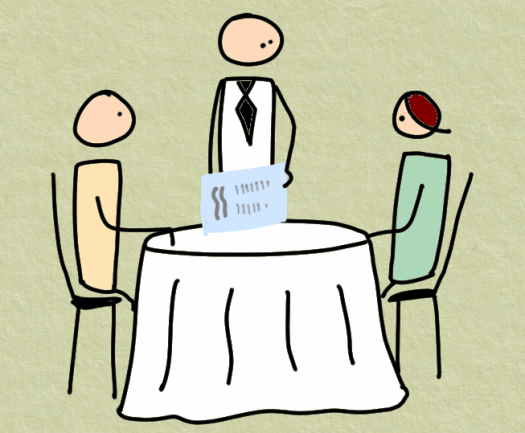
Recruit customers one at a time. Serve them, like you would as a waiter at a table. Get to know what they like and ask them how the food is.

Because, when you’re bigger you won’t have the time to do things like that.

And if right now, when you can talk to each prospect, you don’t, you’ll never know what they really want.

If you want to build something, build something you want.

If you’re building for someone else, like that shop you hired earlier, they’re less interested in giving you what you want than not being blamed when you realise that what you said you wanted wasn’t what you needed.

Building what you want is more than just building a product. It’s the same approach to building everything else – relationships, careers, interests.

The place where we go wrong is when we try to predict what will succeed rather than just working on what interests us.

And when we’re engrossed in our work we don’t think about money or size or scale.

We think about the work and if we’re lucky, those other things will turn up as well.

But it really wouldn’t matter either way.

Cheers,

Karthik Suresh

This Is Probably The Most Important Thing I’ve Learned In The Last Two Years

chunking.png

Sunday, 9.39pm

Sheffield, U.K.

Exercise everything every day — your body, your brain, your tear ducts. – John Carlton

Actually… it’s not exercise.

Although that’s an important point too. I might come back to that.

There’s a thing called “chunking” that goes back to a guy called Miller who wrote a paper in 1956 about how we could remember seven things, plus or minus two.

If you look into it, however, the applications of this insight seem to mostly be on training yourself to remember longer and longer sequences of numbers.

I read somewhere that’s because it’s easy to measure how your ability to remember numbers improves over time.

Which of course, should remind you of the famous story of the drunk looking for his keys under a street lamp.

A policeman stops to help and they search for a while. Then, the policeman asks if the drunk is sure he lost them here.

No, the drunk replies. I lost them in the bush across the road. So the policeman asks why are you searching here? Because that’s where the light is.

You probably use chunking all the time but just don’t call it that. And, when you find things hard it’s because you haven’t sorted the chunking out yet.

But, let me give you some examples of what this means when you go beyond the obvious ways of looking at this.

First, going back to 1983 is the Unix Documenter’s Workbench that has these lines about typing a document:

“First, when you do the purely mechanical operation of typing, type so that later editing will be easy. Start each sentence on a new line. Make lines short, and break lines at natural places, such as after commas and semicolons, rather than randomly. Since most people change documents by rewriting phrases and adding, deleting, and rearranging sentences, these precautions simplify any editing needed later.”

These lines and a variant of them find their way into many of the later guides on using the Unix platform and appear to be almost universally ignored.

Apart from around three people including Brandon Rhodes who wrote an article about Semantic Linefeeds.

He says that when you write in this way something magical happens. When you break lines at natural points your ability to rearrange thoughts and ideas suddenly becomes much better.

Okay… so what does this semantic linefeed stuff look like then?

Well, the paragraph in the Workbench that I typed out looks like this in my text:

chunk-example.png

What’s happening here, really, is that we’re chunking each line. Just naturally, each one has around seven words, plus or minus two. It’s much easier to see what’s going on – once you start to get used to it. It takes a while to break free from the way we’ve done it all our lives, after all.

A natural next step from this example is to look at programming where breaking a problem into chunks is often the only way you can possibly tackle it.

A big problem is usually too big to hold in your mind so you need to break it down.

You need to build a solution using smaller building blocks or chunks – which you make first.

When you start thinking of things in this way it’s clear that you can apply this approach to almost anything.

Want to create a new business process? Start thinking in terms of chunks.

Chunks are things you can build and test quickly. If you make them so they are mostly self contained you can discard them without breaking everything else.

Want to learn a language? Forget grammar at the start.

Begin by identifying chunks of language that say something useful. With enough chunks you’ll get a feel for how the language works and your capability will build. Inexorably.

This simple concept of chunking seems to me to be one of the most useful and least promoted ways of approaching life.

With chunks it doesn’t matter if your goals are clear as day or hazy and uncertain. As long as you work in chunks you’ll make progress day after day.

And, as so many times before, thinking about these subjects brings me back to Robert Pirsig and Zen And The Art Of Motorcycle Maintenance where Pirsig writes about a set of instructions that he says would improve technical writing no end. They start “Assembly of Japanese bicycle require great peace of mind.”

The thing is that anything that you do that grows bigger and bigger eventually gets so big that you can’t keep hold of all of it in your mind anymore.

And then, you spend your time panicking that you are no longer in control.

With chunks, however, you know that you can always change something without breaking everything and that way you suddenly have the ability to create big and complex things without losing yourself.

Because, actually, you only work on small and simple chunks that make sense.

Anything big emerges naturally from what you do.

So… then all you have to do if you want to build a body of work, live a long time, be a good parent and live a good life is exercise everything every day. In chunks.

Cheers,

Karthik Suresh

Why Being An Expert Can Be Dangerous For Your Mind

cup-of-tea.png

Saturday, 8.01pm

Sheffield, U.K.

Improve yourself: that is the only thing you can do to improve the world. Ludwig Wittgenstein

What should you do when you feel like you are an expert at something?

Probably be afraid.

I haven’t written for a week or so and after every such break I wonder if I can still come up with anything that makes sense.

Writers are plagued with such feelings.

Nothing you have done can guarantee the quality of anything that you will do in the future.

It’s like a having a trading strategy. Past performance is no guarantee of future results.

Just because value investing worked for Benjamin Graham, that doesn’t mean it would have worked for Warren Buffet.

As, in fact, it didn’t. Buffett and Munger made the first few hundred million buying overlooked companies on the cheap but their billions came from buying great businesses at fair prices.

Buffett’s ability to pick stocks is unlikely to help us today where we are probably better off putting most of our money in a cheap tracker and getting on with the day job.

But – the day job is also changing. There isn’t much room for people who talk about value instead of creating value any more.

What does that mean?

Well, we know that any business has two key functions: marketing and innovation.

Marketing, however, is more than just talking about what you do. It’s about showing that you understand what someone else needs.

Innovation, then, is about being able to fill that need.

Any person in a role is probably judged on those two functions as well, even if they don’t know it.

After all, you’re hired for what you say you can do and are kept because you do it well and get better over time.

If you don’t then there is a list somewhere with your name on it.

But then, where does value come from? Is it expertise you’ve built over time? The systems and processes you have? The investment in your infrastructure?

These days I cringe when someone says that their unique selling point is the capability of their people.

How do you measure that? How can you tell if your graduates are smarter than graduates in another company? Or for that matter, your engineers or MBAs or lawyers?

Any person or firm that thinks that they are at the top of their game or their league or their sector is in a dangerous position.

As they toast themselves someone, somewhere, is working to destroy their business. Someone who probably doesn’t even know they exist.

It’s like the old story of the learned person who went to a monk to learn Zen.

He talked of all the things he knew and went on and on.

The monk served tea, filled the visitor’s cup and went on filling.

Stop, said the visitor, it’s full, no more will go in.

That is like your mind, said the monk. Unless you first empty it how can you fill it with fresh thoughts?

When you go on a sales visit how can you learn what the prospect wants if you talk about yourself all the time?

Or, if you fill your days doing work the same way you have always done?

Or if you never try and learn a new approach, a new language or someone else’s method?

You are probably busy. But you’re probably not very happy.

Uncertainty, it seems to me, is a good thing.

It says that you’re still ready to learn and improve. To try and get better.

To enjoy different types of tea.

Cheers,

Karthik Suresh

How Can You Be Good At The Things That Are Important?

peace-of-mind.png

Sunday, 9.39pm

Sheffield, U.K.

The ultimate test’s always your own serenity – Robert Pirsig

I came across spider diagrams several years ago when doing consulting work.

That has always seemed like an odd description. They are web-like, I suppose, but they also create ugly images that don’t seem to really convey much that is useful.

You score better on some spokes than others. So what?

Then, when reading a book on neuro-linguistic programming, I saw the same diagram referred to as a wheel.

Now that made more sense. If you’re doing well on all counts then you have a circle. A wheel. Life rolls along nicely. But if you’re not scoring well on some of the axes you end up with a misshapen wheel that will bump and rattle along the road.

So what?

The wheel tells us that there are things that are equally important. There isn’t much point doing well at work if your family falls apart because they don’t see you enough. You could have lots of fun going out every night with friends but end up sick.

Still, you probably don’t need a diagram to tell you that. If you’re not doing well at the important things in life you probably already know that.

Perhaps you’re even choosing to focus on the things that are important to you, at the expense of the other things.

You can, after all, get to them later.

Or… can you?

There is a painted stone in front of me, on my desk. The colour has been splashed on, organic and natural and perfect.

It’s paint on a stone, green and pink and yellow, with a dash of black and a streak of blue, done unselfconsciously by a child.

The fact is the only thing that matters is what you are doing right now.

The only test of whether you are doing things right or doing the right things is how you feel.

Are you at peace? Or not?

The wheel that I’ve drawn is not a good wheel. It’s a blotch of dark pink on a backdrop of light pink. Because I’m not trying to draw a wheel. Because you and I already know that the wheel is not the point.

The point is whether you have peace of mind.

Robert Pirsig, in Zen and the Art of Motorcycle Maintenance writes about this state of mind.

People who are immersed in their work do it unselfconsciously like a child painting a stone.

They do it, not until closing time or until someone says they are done, but until they are done. Until they are satisfied with what they have done.

Pirsig writes: “Peace of mind produces right values, right values produce right thoughts. Right thoughts produce right actions and right actions produce work which will be a material reflection for others to see of the serenity at the center of it all.”

That is how you produce something that lasts, whether it is your work, family, health, relationships or having fun.

Sounds simple, but it’s not easy.

That’s what people across the ages have tried to achieve.

And we should also remember the words of Ram Dass who said “If you think you are enlightened, go and spend a week with your family.”

But what we can do is try.

Cheers,

Karthik Suresh

Why Thinking Long-Term Is The Only Thinking Worth Doing

forever.png

Saturday, 9.37pm

Sheffield, U.K.

In every deliberation, we must consider the impact on the seventh generation… even if it requires having skin as thick as the bark of a pine. – Derived from the Constitution of the Iroquois Nation

It’s not possible for long-term thinking to be in fashion. Ever.

Shortcuts, on the other hand, always are. Shortcuts or hacks or tips or timesavers – such things are always of interest.

A few years ago I did a study on change, talking to people involved in trying to make it happen.

And it was telling just how much focus there was on making everything line up with what was perceived as important.

For example, many in politics focus on jobs. Anything that increases jobs is a good thing. So everyone creates a pitch that talks up how many jobs their project will create.

Or take climate change. What we need is a more sustainable society and that is a hard thing to do. It’s easier to build new green power stations than to get people to use less energy.

But societies don’t make decisions.

People do.

So, what kind of decisions should we make?

For example, what should you do if you want to have a good life? What do you really want out of life?

When you’re young the chances are that you want to be rich or famous or both.

But the people who end up having a good life are not the ones with the most money or fame but the ones with good relationships.

Relationships with family and relationships with their community.

Which poses an interesting approach to doing business.

One of the big risks we face in a technological age is how dependent we are on technology we don’t own or control.

A writer, for example, writing with pen and paper is creating something that could live for decades, even centuries.

My grandfather memoirs, written over forty years ago, are still there on crumbling paper.

They have now been transcribed and the challenge is keeping them digitally for future generations.

If you’re a business, however, what sort of time frame should you use to think about what you do?

John McPhee in Draft No. 4: On the Writing Process writes about using the editor KEdit in 1984.

A friend, Howard J. Strauss, created scripts and programs that helped McPhee use KEdit in his writing process.

Howard died in 2005. In 2007, KEdit stopped being updated and its creator, Kevin Kearney, is semi-retired. There aren’t that many users left around.

I hadn’t really processed this message, this idea that a tool will die with its creator and those that use the tool will also slip away.

It only really struck me when I was browsing the website of the sqlite database and read these lines from Hipp, Wyrick & Company, Inc., (Hwaci), who support the software.

Hwaci intends to continue operating in its current form, and at roughly its current size until at least the year 2050. We expect to be here when you need us, even if that need is many years in the future.

Now, that’s long term thinking. Maybe the kind of thinking you should use in your business.

But is it long enough?

I’m writing this in Emacs, the editor created by Richard Stallman. This tool will never die, because Richard has given the world the source code. And it will outlive him as those who use it keep it alive.

But the editor doesn’t matter because the words themselves are in ascii text. Yes they make their way to a website where you can see them but they aren’t held prisoner by that website.

But, why think about all this? What’s the point?

The point is to think about the future. The future that your children and their children and the generations to come will live in.

I’d like future generations to know my grandfather’s experience. Especially because he took the time to write it down.

It’s my responsibility to pass it on. More importantly, it’s my responsibility to pass on that sense of responsibility to future generations.

I think that when you start to think of things that way, think of the long term, it seems obvious that shortcuts aren’t really worth taking.

You see, you’re not really trying to save ten minutes. You’re trying to create a future for children generations down the line.

Cheers,

Karthik Suresh

What’s The Most Important Question You Need To Ask Yourself?

shit.png

Friday, 8.35pm

Sheffield, U.K.

Okay, how do we sell this piece of shit?” – Steven Pressfield

I was listening to Steven Pressfield being interviewed on the Joanna Penn’s podcast, The Creative Penn.

You know Steven? The author of The War of Art, a writer of war books, and of the battles inside each of us.

It’s one thing knowing something and getting it. Really getting it…

Like realising that no one gives a shit about you.

It’s not that they’re unkind or self absorbed or nasty. It’s just that they are busy and have no reason to be interested in you or your stuff.

That makes it hard when you’re trying to do any kind of sales job.

Or… does it?

Yes it does. Really.

Which is why the question you need to ask is the one that’s near the top of this post.

The fact is that we’re all selling something. When we’re looking for a job we’re selling ourselves. When we’re working, we’re selling what we’ve done to the boss or to a client.

Selling matters. It’s the one thing that tells you whether what you’re doing is working or not.

If it isn’t selling, you’re doing it wrong.

Unless you are unfortunate enough to be an artist in the Soviet Union.

The New Yorker has a piece on the writer Sergei Dolatov who was one of many artists simply not allowed to publish their work behind the iron curtain.

What he had would have sold if it was allowed to sell and it did when it was, when he moved to America.

The thing that’s different now is that it’s harder to keep you silenced. You can say what you want, write what you want and publish what you want.

The problem is that no one is listening.

And the solution is simple. Simple, but not easy.

What you have to do is figure out how to make what you have interesting to someone else.

Which leads back to us sitting at a table looking at a steaming pile and asking ourselves how we can sell it.

There are two roads we can go down now. We can be “sales people” and try to sell. Or we can be human and try to help.

If you’re focused on selling then you’re focused on what you have and how you can get someone else to buy it.

That’s an attitude you see very often from people new to the job. I’ve got this thing. Now how can I tell everyone to come and listen to me?

Now you know that’s not going to work. What you’ve got to do is think like the person who might need what you have.

Or even better, listen to them. Not talk to them but listen.

Listen to what they have done, how they act and talk and frame their choices. People make decisions all the time.

If you can listen and learn how they make decisions then you can make it easier for them to see what you have, understand what you have and make a decision.

For example, I saw a LinkedIn profile recently that said “I’m a management consultant and entrepreneur”. The author then added that he hated those terms. He was actually a systems thinker. But saying that wouldn’t get him any jobs. That’s someone who has asked and answered the question.

A question that’s worth asking again and again about everything you do.

Cheers,

Karthik Suresh

How Do You Know What Kind Of An Impression You’re Making?

experienced.png

Wednesday, 8.52pm

Sheffield, U.K.

Even if the sun were to rise from the west, the Bodhisattva has only one way. – Shunryu Suzuki

It is difficult, sometimes, to know who you really are.

We lay down layers of personality over time, layers that we use to tell ourselves who we are. Layers that we use to show others what we think we are.

Take jobs, for example.

Most people don’t start off knowing exactly what they want to do. They’re steered by people they trust, when young, and gravitate towards things they are good at, when older.

The chances are that you are where you are right now because of certain choices. Ones you remember clearly, even now. Choices that could just have easily gone another way.

Let’s say you started as an intern, or someone looking for your first role and stumbled into an industry and stayed.

Did you choose the job? Or did the job choose you?

I wonder about things like this because I wonder what’s the point of it all.

There aren’t that many routes people take. Some move from job to job, rising quickly. Other stay in place for a long time, decaying quietly. Yet others stay, learning and growing and turn into bedrock, into people the organisation depends on.

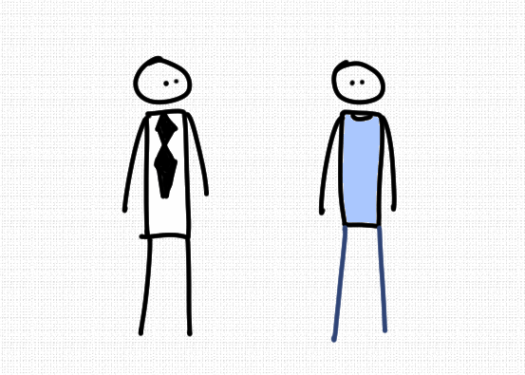
I read a line in a book, now 29 years old, about hiring people. Look around, it said, for people wearing brand new suits. More experienced people wear jeans.

You’ve heard many times, I’m sure, about how clothes matter. How people judge you by what you wear.

So, if you’re in a situation where you’re being judged what kind of position do you want to be in?

If you’re in a suit and you’re trying to impress the other person then they have the upper hand.

If you’re wearing jeans, however, perhaps you’re comfortable that you have something to offer that is more than the clothes you have on display. In that case. do you have the upper hand?

Or does it really have nothing to do with who has what hand at all?

In an ideal world you’ll work with people who value what you do. Not how you look or where you come from.

The thing is that experience will out.

You can tell when someone knows something regardless of what they’re wearing. Just because of the way they talk. The kind of questions they ask, and how quickly they come to a view on what your options are.

It just seems like it would be nice to get to a point where you can dig through those layers and find yourself.

Get to a point where you’re just comfortable in your own jeans.

And to a point where the impression you make is of just who you are.

Where your way is the way.

Cheers,

Karthik Suresh

Why Learning How To Let Go May Be The Most Important Thing You Do

relationships.png

Tuesday, 8.53pm.

Sheffield, U.K.

A thousand details add up to one impression. – John McPhee

I have just finished John McPhee’s Draft No. 4: On the Writing Process. It has had a tough life with me already. Its cover is stained with tea, what seems like an entire mug’s worth.

It’s a book that makes you think, that makes you wonder just how long it takes to get every word just right. To construct sentences and paragraphs that just flow.

A long time, McPhee says. It takes as long as it takes. He’s been lucky, never been in a hurry. He’s been able to take his time.

Then again, a piece of writing is never perfect. That’s the irony, the secret that no one tells us. Joyce Carol Oates, one of America’s literary icons, apparently said “No book is ever finished. It is abandoned.”

When we see something that seems perfect we forget to notice the word “seems”.

For example, think of Steve Jobs. We know of him as a perfectionist, someone who brought us the iPhone. But we shouldn’t forget that each phone that was released was a compromise. The best they could do but probably not as good as Steve wanted. Certainly not perfect.

When you start to see this concept of perfecting something versus abandoning it you start to see it everywhere.

Take any business process. Is it perfect? Or is it good enough?

Perfection takes too long, and costs too much, and probably can’t be achieved anyway.

Is that too defeatist? Or is it being realistic?

Facebook had signs on its walls saying “Move fast and break things” and writes that it wants to “ship early and ship twice as often.”

I learned recently that children that tend to do best at school are the ones that are not afraid of getting it wrong. They are willing to make mistakes, they aren’t scared of making mistakes, and so they learn more and learn faster.

The thing is to get somewhere, you have to get going. And it’s not a one-off thing either. You have to do something day after day.

Those little somethings add up. You might simply be working on what seem like disparate, disconnected dots.

But eventually, you can draw lines between them. Shapes emerge and an impression is made.

Impressions are about details.

That’s the thing with anything, a book, a process, a sale. The things that draw people in, that keep them interested, are the details.

And even with those, it’s best not to get too hung up on perfection.

Take the quote that starts this post, for example. McPhee has it in his book and attributes it to Cary Grant.

So, I started by writing that was so. But then, it felt like something that was worth checking and it’s easy to do that with the Internet.

Well, Cary Grant didn’t say that. It was close, but he talked about 500 details.

Enough of a difference to possibly make it a McPhee adaptation rather than a Grant quote.

So maybe even McPhee can get it wrong. Although it’s possible that he has a much better reference than a single search on the Internet.

The point is this. Whatever we do, whether it’s writing, or business or a profession, we agonise over getting it right.

And that’s a good thing. We don’t want to turn out rubbish.

But we also need to get comfortable at letting go.

Because, we don’t finish things.

We let go of them.

Cheers,

Karthik Suresh

What Should You Do If You Want To Be Free?

minimalism.png

Monday, 9.35pm

Sheffield, U.K.

There are two ways to be rich: One is by acquiring much, and the other is by desiring little. – Jackie French Collar

Sometimes a stray statement, a position taken by someone, can make you wonder whether we’re shackled by anything more than our own thoughts.

Not, of course, if you’re literally in chains but, assuming you live in a free and democratic society, when it comes to everyday living.

There is a famous photo of Steve Jobs taken in 1982 which shows him living in a sparse, unfurnished space despite already being rich.

Some people see that minimalist streak in Jobs brought to life through Apple products, with their emphasis on design, minimal interfaces and intuitive use.

So, when you hear of someone complaining that they don’t have a desk to work at, what do you think? What does that say about how free they are?

There is a story about Amazon, about when they started and needed desks. But desks were expensive and doors weren’t. So they bought some doors, fitted some legs and used them as desks.

Frugality is still a big thing at Amazon, as are desks made from doors, even though they are now one of the most valuable companies on the planet.

If you’re the kind of person that, when you don’t have a desk, can work anywhere else without complaining then you have what it takes to start and run a business.

If you can think of alternatives, come up with suggestions, sit and work on the floor if you need to, then no one can stop you from getting things done.

Because much of business is about being resourceful and inventive, about seeing opportunity where others see nothing. About solving problems, big ones and little ones, day after day.

And there are certain principles that are worth remembering when we try and deal with what comes at us every day.

When you’re selling, for example, after a while you’ll realise that most people you meet have pretty much the same questions about what you have to offer.

There’s also little excuse for not doing your homework before you meet someone. There’s so much information that people put out about themselves and their businesses that you can get a good idea of what they are all about before you meet them.

So, if you know what questions they have and have done some homework on who they are then, really, the main thing you need to do is to listen to what their problems are and see if you have a solution.

Your presentation becomes less about you and more about trying to get them to open up and engage with you. You know it’s working when they start asking questions, ideally ones to which you have the answer on the next slide.

There is a difference between this kind of approach and one that tries to tell your prospect everything about you.

It’s like a child with a box of toys, every one of which is special and important to him, so he wants to talk to you about each and every one.

You listen politely, but really, your mind is somewhere else.

But when that child wants something from you, his tactic changes. Now he is laser-focused on that one thing – that one toy and nothing will divert him from it.

What do these different concepts – minimalism, frugality, focus – have to do with anything?

Well, if you can craft a message that shows your prospect just what is important to them, shows them how you make it for them, at the lowest cost possible, and how it solves a problem that they are focused on, how do you think they will respond?

And I wonder whether if you want to be the kind of person that can pare down a message to just what is important, you also need to be the kind of person that can pare down what you have to just what is important.

Because, of the two ways to get rich quoted at the start, the second is the one more likely to set you free.

Cheers,

Karthik Suresh

Do You Realise How Much What You Do Shapes Who You Are?

tools.png

Sunday, 9.10pm

Sheffield, U.K.

We shape our tools, and thereafter our tools shape us. – Marshall McLuhan

I am not fond of gardening.

Gardens are nice to sit in when everything is tidy and the lawn is cut but, when it’s not, they remind you in silent reproach that it’s all your fault and you should do better.

There is a tree in front of our house, a large ash, and every autumn it deposits all its leaves with no apology on our garden.

Now, I would much rather be curled up with a book or stood at my computer reading or writing than almost anything else.

The keyboard is a tool I’m comfortable with. I know its parameters and its limitations. I learn more every day I write.

A rake, on the other hand, is much more problematic.

So, today I offered one of the small people that lives with us an opportunity to go to the cinema.

He said no.

I tried to bribe him, with popcorn and ice-cream and juice.

He still said no.

Exasperated, I said we couldn’t just sit in the house. If he didn’t want to do anything we’d just have to go out and rake leaves, expecting that the cinema would suddenly become more appealing.

Except it didn’t. He ran excitedly for his wellies and we then spent the next hour raking and sweeping leaves. You’d think it was the best thing he’d done all week.

And then he said ‘when I grow up daddy, I want to be a sweeper, just like you.’

The point, I suppose, is that whatever you do becomes your business.

I was at a networking event a few years ago and the keynote speaker was someone who had built her cleaning business from scratch into an operation now employing hundreds of people.

You could be forgiven for assuming that a rake is less complex than a computer and that one skill is worth more than the other but the fact is you can make money from both.

We know that work in the future that people do will be of two types: creative work, that needs imagination and insight; and dexterous work, making use of our hands to do things robots can’t.

The rest will be done by the machines. Unless, of course, you can’t afford one.

Then again, that might not happen at all.

William Gibson wrote: The future is already here — it’s just not evenly distributed. A quote much loved by the technocrats who’d like to shape us to fit their world.

What happens, however, is that whatever technology you choose then has an impact on what you do.

And, in many parts of the world, it feels like people are turning to technology that helps them be more human, like bicycles and cloth bags and recycling bins.

No one has ever had much luck predicting how the future is going to look.

It could be one where we’re all immersed in augmented reality and the majority of interaction is through a machine, or it could be one where we’re better informed, better connected and better people.

Who still probably have leaves to rake when we’d much rather be writing.

Cheers,

Karthik Suresh