How Do You Get A Large Group To Change Direction?

herds.png

Monday, 9.02pm

Sheffield, U.K.

Not everything that can be counted counts, and not everything that counts can be counted – William Bruce Cameron

Should we panic about the state of the world or not?

Take climate change, for example.

Are we doing enough about the problem or should everybody be doing more?

There’s a problem with the question in the first place – because it assumes that action takes place en masse.

It assumes that we collectively take action to change things.

But is that really the case?

After all, there are lots of schemes and rules and attempts to get people and organisations to reduce their impact on the environment.

Are they making a difference?

How can we tell?

The thing about social behaviour is that it’s can’t be easily reduced to an algorithm.

But maybe an algorithmic approach can help us understand what counts.

The problem of getting lots of people to change the way they act is like getting a large herd of cattle to change direction.

If you try to simulate such behaviour – the flocking, schooling and herding you see birds, fish and animals do – you find it’s possible to do it with quite simple rules.

The basic idea is that each member of the flock has to stay close to others in the flock without bumping into them or into obstacles in the environment.

When you program a herd of simulated creatures to act in this way the group moves together – wheeling and turning with no central control.

The movement emerges as those simple rules are followed by each member.

From that observation of physical movement it’s a small step to wonder if a change in hearts and minds is also an emergent property – something that happens when the rules individuals follow change, rather than the whole group learning new rules.

For example, when solar panels first came out they were expensive.

Few people had them and they needed subsidies to get installed – subsidies that are being phased out now.

Every new build these days, however, is going to have solar panels built in.

So what’s changed?

Is it the law, the business case or what people want?

And did they change at once or did the pressure to change build and build until the whole group changed direction?

The point, I suppose is that, if you want to have big change you first need to start with small ones.

That’s obvious, you say.

But what’s not obvious is whether or not we’re heading for disaster while we’re waiting for individual change to happen.

It’s tempting to assume that everything will go bad if we don’t try and change it in a big way.

But are all those large companies really trying their best to ruin the world we live in?

Or are they full of people who are trying to do the right thing but who are also looking around them trying to do what others are doing, worried about doing something too different in case they get left behind as the flock moves on?

I think if you assume that people are fundamentally good and try to do the right thing then the starting point is to focus on individual change rather than group change.

But we can’t change too much – so much that the group just sees us as outliers.

We have to move gradually in the direction we want – at a speed that matches what the herd is doing.

That’s the thing about changing direction – it doesn’t just happen all at once.

And it’s hard to escape the fact that it probably starts with you and with me.

Cheers,

Karthik Suresh

How To Find Focus When You’re Distracted By Lots Of Things

interesting-things.png

Saturday, 10.04pm

Sheffield, U.K.

The only thing that can grow is the thing you give energy to. – Ralph Waldo Emerson

There are far too many interesting things in this world.

Ideas, opportunities, developments and paradigm shifts.

And cat videos.

For example, I was listening to someone talk about what they do the other day and thinking – heck, I could totally do that.

In fact, I have done it.

And it’s got lots of potential for making money.

And then I remember that it’s also very, very boring.

We each have around 30,000 days that we can use, if we’re lucky and go the distance.

When you’re more than half-way through you start to wonder whether you’re using them well.

Should we be focusing on the really important things?

If so, what are they?

You’ve probably heard that life is like juggling balls – trying to keep them all in the air.

The balls have labels – work, money, family, friends, health.

Some of the balls are made of rubber. If they fall and hit the ground they’ll just bounce and you can always pick them up again.

Others are made of glass and if you let them drop they’ll get scratched, cracked and maybe even broken.

But then let’s think about what you do and how focus affects that.

Say you have a business – should you do one thing really well or be able to do a number of things?

The answer, probably, is going to be a variant of “It depends.”

For some businesses that do a lot of low-margin business it might seem sensible to ditch those and stick with the ones that make money.

But some of the low-margin things might be what brings in customers that eventually buy the other stuff you have.

As an individual should you try and become the best at whatever you’re doing or have a mix of skills and try to learn new ones when you can?

I was speaking with a builder who said that there are now robot bricklaying machines.

You could be the best bricklayer around but the machine is going to be better.

What happens then?

Maybe the idea of focus is less to do with state of mind and more to do with an act of convenience.

After all, where does the term come from?

The dictionary defines focus as “the centre of interest or activity – an act of focusing on something”.

Which makes it temporary.

You don’t need to focus on something permanently.

You just need to do it as long as you need to.

Which makes things a little easier.

Let’s say you are interested in a number of things – wood-working, renewable energy, writing fiction, drawing cartoons, among others.

And maybe you’re torn between a few of those as possible business ideas.

Perhaps you want to do woodworking and draw cartoons.

There’s nothing wrong with you wanting to do both and making plans to do both.

You might need to think about timing – do you do one before the other?

You need to think about your audience – pitch wood to interior designers and send your cartoons to newspapers.

You are still focusing – but first on one and then the other.

And that’s ok.

The point is that you only have so much energy to give.

But the good thing about working on things you love is that you seem to end up with more energy in the end.

When you’re working on things that drain you no amount of money can replace that lost energy.

The thing about distractions, then, is you need to find ways to handle them – to address them in order and be ok about dropping the ones that are less important.

And with what’s left, if you’re lucky, you’ll have some that you find interesting.

With the others – you just have to think about the money and get on with it.

Cheers,

Karthik Suresh

Imagine A World With More People Well Off But Fewer Millionaires

service-businesses.png

Friday, 10.11pm

Sheffield, U.K.

I suppose it is tempting, if the only tool you have is a hammer, to treat everything as if it were a nail. – Abraham Maslow, Toward a Psychology of Being

How many software programmers are there in the world today?

In 2019 – maybe around 26 million or so.

A post – I think on LinkedIn – suggested that was a small number.

It’s a small group of people that build and control a lot of the stuff that we depend on these days.

But all that stuff must be making our lives better, right?

Right?

One of the things you see is that people spend a lot of time solving the same problems again and again.

And that’s because there are lots of simple problems that need solving whenever you try and do something.

Take building an extension, for example.

You’ll need to manage a contact database, make calls, keep notes, follow up, put a project plan together, follow that plan, fill out paperwork, comply with health and safety rules and a whole lot of other things.

The chances are many people will manage with paper and notes.

Some will use a spreadsheet.

A few will use project management software.

There is an inverse relationship between complexity and the number of users here.

The more complex the tool the more complex the job has to be to justify learning and using it.

Now, one of the things about complexity is that it’s often a substitute for control.

Take Customer Relationship Management (CRM) Software, for example.

The standard reason for using a CRM is so you can keep better records of what you’re doing with customers and so serve them better.

The real reason you use a CRM is so you can keep an eye on what your employees are doing.

Or maybe that’s unfair.

You’re just tired of information being all over the place and a CRM looks like a way to bring everything into one place and manage it well.

How has that worked out for you?

If you’re the go-getting sales manager who believes in the power of CRM systems you’ll probably say it works great.

The chances are, however, it’s working because of you and your interest and sheer will power in getting everyone else to do things your way.

Left alone, things degenerate.

It’s the law of entropy.

If you didn’t check the CRM every day then pretty soon people start putting less in and it slowly goes out of date.

You’re probably wondering what the title of the post has to do with anything I’ve written so far.

Patience. It may make happen.

No promises, though.

There’s another line – I think from Clay Shirky – but I’m struggling to get the reference that says people who make encyclopedias have always known that trying to put structure around information is a thankless job.

The minute you try and create a form or a rule or a framework to hold information stuff starts to leak and get messy and not fit properly.

What you can do is make it easy to get information out and try to keep people honest with what information they put in.

So, the point is that software is not easy to use to make your business better.

And that’s because of this relationship between how hard the task is, how complex the software needs to be and how much control you want.

So that brings us to service businesses.

All businesses, some people say, are now service businesses.

I’m not sure how true that is.

There’s often a product hidden somewhere. As they say about social media, the reason that product is free is because the real product is not the software platform but you.

You’re the product and the thing they’re selling to others.

Service businesses, on the other hand, rely on people doing something.

Eric S. Raymond, an open source advocate, says that service firms can’t be made bigger by investing capital.

What happens is that money pays for people and stuff and makes fixed costs go up – and then they run out of money.

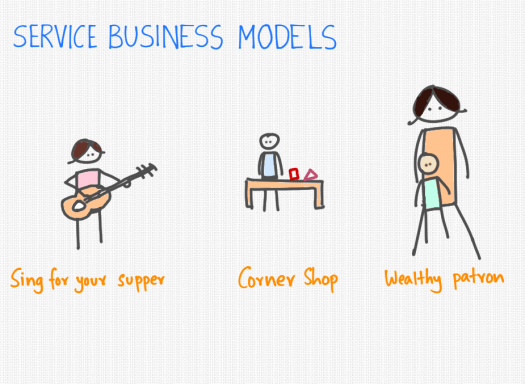
He says three models work:

  1. Singing for your supper: tip money
  2. A corner shop: stay small and keep overheads low
  3. A wealthy patron: find someone to support you

Raymond’s argument is that people won’t fund software startups because as service businesses they won’t scale.

He predicts you’ll end up with better off workers but fewer businesses owned by investors who take most of the money.

So… people with more money but fewer super rich folks.

That doesn’t seem to be putting people off.

People are funding software businesses.

And some are going on to become very large.

Of course, many more fail.

The thing is these days we are offered a very large selection of hammers.

There are lots of tools that help us do simple things well.

Some help us do things we want but, like Apple, demand our freedom in exchange.

You want an Apple product – you need to sign up to their ecosystem which is increasingly dictatorial – it seems.

You’ll need more than hammers in your toolbox to solve complex problems.

And those tools – it sometimes seems – are hidden in plain sight.

Tools that can help us solve complex business problems – but they are hard to learn and the people that learn them don’t always work in businesses.

So, until they get their act together, much of our time is still going to be spent wishing we weren’t wasting time in the ways we do now.

Cheers,

Karthik Suresh

Do You Really Need Money To Get Where You Want?

raising-money.png

Wednesday, 9.58pm

Sheffield, U.K.

When you’re that successful, things have a momentum, and at a certain point you can’t really tell whether you have created the momentum or it’s creating you. – Annie Lennox

Have you ever felt, when watching and listening to someone, that something isn’t quite right?

That there’s a flaw – there might be a flaw in the assumptions being made about cause and effect.

For example, a lot of startups emerge in the U.S – big ones that become huge businesses.

Startups are a good thing – apparently. The value of an economy seems related to the number of businesses that are created there.

So encouraging more startups will lead to rising economic value.

Also, startups that grow fast are better than slow ones – so you should try and bring in more tech startups – they’re the ones that grow fast after all.

And how do you grow a tech startup?

There’s a pattern to that – one signposted by flows of money.

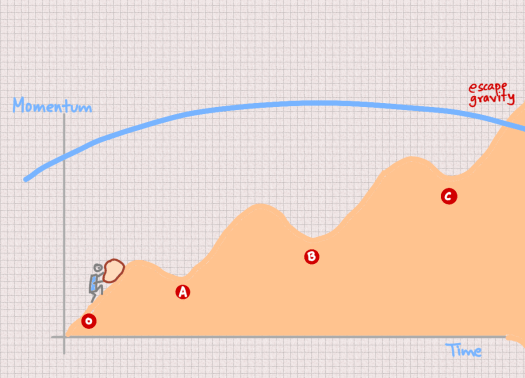
In the beginning it’s like pushing a boulder up hill.

You use your own money, try to make it go as far as possible and get to a point where you have something that you can show people – the top of that first hill.

Now it’s easier for a while as you go downhill and then you reach the next stage – the one where you need to hire people and build something for the market.

That’s the point where you bring in the first set of investors.

That money helps you climb the next hill and life becomes easier again – until you need funds for the next big push and the one after that.

Eventually what you’re hoping is that all these money inflows will get you to a point where you’re self sustaining, where you escape gravity.

Which I’m sure is a great result for those people who get there.

Some people say that the problem with places other than Silicon Valley is that people don’t try and climb these hills.

The money is out there but people do pesky things like try to grow with their own money – not realising how much further they would go if they took some money from others.

Now, this is the model – the one that everyone knows about.

And it probably works.

Climbing all those hills, however, does seem exhausting.

I’m probably not making this clear but I’m still not sure whether the money is vital or not.

Maybe because there’s a story that I can’t get out of my head.

It’s the probably made up one of the islanders who found themselves hosting the allies during the last world war.

The allies built airstrips and the planes came and landed bringing food and clothes and good stuff.

Then one day the war was over and the planes and people left.

The islanders wanted the planes back with the food and loot so they flattened the ground for an airstrip, built a control tower in the trees and lit torches to mark the runway and got ready to welcome the planes.

If you have an idea can you tell if what you have is real or if you’re an islander building dreams?

There probably are some critical success factors – old ones too.

Like if you’re building a product to scratch an itch – it’s something you need then there’s a good chance others need it too.

If you’re building it because you think a market exists for it – then you might also want to get really good at discount sales.

Then there are customers.

The test of whether you have something worth having is whether people are willing to pay for it.

No customers, no business.

It’s like a Professor of public philosophy once said about working for money and working for the love of the work.

If you work because you love the work you don’t need any other reason.

If you work for money then you need to first know what you want out of money before you can tell what you want out of work.

Maybe that’s one way to check if your startup has a future.

Would you work on it whether you made money or not?

If you would then having money would simply be a nice to have.

If you wouldn’t then the chances of anyone else giving you money is also pretty low.

After all, why would someone else invest in something that you don’t believe in enough to back yourself?

Cheers,

Karthik Suresh

Do You Know What Kind Of Problem You’re Solving?

types-of-problems.png

Tuesday, 9.34pm

Sheffield, U.K.

You know what the issue is with this world? Everyone wants some magical solution to their problem and everyone refuses to believe in magic. – Lewis Carroll

When I’m asked to describe what I do, I usually fumble for words and come out with something like “Um, I’m a sort of management consultant”.

Which, when it comes down to it, is not a very edifying explanation.

Not even to me, really…

I need something better.

What about “I’m a problem solver?”

That’s not much better either.

The issue here really is that we’re all trying to make a living being useful in some way.

And being useful usually means solving a problem someone else has.

But what exactly is a problem?

You know you’ve got one when you do… but is there anything more to it than that?

Now, one of the things I see often in the world of work is that there aren’t that many hard problems to work on.

That is, it might be hard work but it’s not a hard problem – in the sense of being difficult to solve.

For example, most people are hired to do something relatively simple.

Talking to clients, explaining products, maintaining spreadsheets and so on.

You probably need to be literate and numerate but not a huge amount more.

The professions are different – to be a doctor or lawyer you need years of experience and qualifications.

So is it possible to come up with a taxonomy – a classification of problem types?

Simple seems a good one to start with – like filing papers or administration.

Hard could be hard in the sense of physically or intellectually demanding – maybe something like labouring or being a drone pilot.

Complex could perhaps describe what a doctor does – diagnosing and fixing a problem.

And there are wicked problems – situations where we don’t know what the problem actually is or what we’re trying to do.

In business there are a surprising number of the last type of problem – wicked ones – where we don’t know what we don’t know.

Then again, what do we know?

How can we better approach problems, whatever type they are?

Maybe the Unix philosophy can help.

unix-philosophy.png

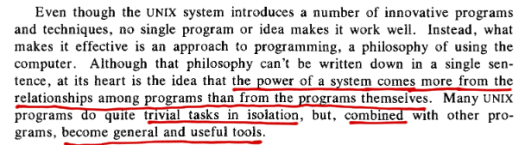
Trying to attack a big problem almost never succeeds.

Instead, we need to get smaller parts of the problem solved first.

If we have small, workable solutions we can combine them so solve larger, more complex problems.

And those problems can perhaps be classified in more general terms.

Then, as a management consultant with some expertise in building software solutions, we can look at the sorts of problems we can solve for clients.

For example, McKinsey mapped the kinds of problems that can be addressed with AI technology.

An adapted form of these is shown in the picture above and you can probably think of examples of each kind.

A classic problem is classification – is this image a tree, a car or a dog?

Or is this programmer good or bad?

Prediction is loved by many – which direction is a stock or index or fund going to go in next?

Segmenting and grouping is fundamental to any marketing we do – we want to find similar prospects.

And then there is finding the best or optimal solution to a problem – if there is one.

There’s a class of solutions that try to fix things before they go wrong by finding anomalies.

And ranking is all about figuring out what’s important and what to do first – like in project management.

Amazon tells you which books it thinks you’ll like based on what you’ve read already – it has a recommendation engine.

Which doesn’t always figure out what’s happening when you’ve got kid’s books and grown up books being bought through the same account.

And then, there is the ultimate problem – getting the computer to do being creative for you.

Like the programs that create books or write music by learning from what’s out there now.

Okay, so does any of this help us do anything better in the real world?

Got to be honest here – I don’t know.

But being aware of the kinds of problems you can work on is probably a good idea if “Problem Solver” is a term that describes what you do.

Cheers.

Karthik

What Hard Questions Should You Ask About Your Business Idea?

business-model-testing.png

Monday, 9.07pm

Sheffield, U.K.

If debugging is the process of removing bugs, then programming must be the process of putting them in. – Edsger Dijkstra

Someone I know describes herself as a completer-finisher.

This is one of the nine Belbin team roles – a detail oriented person who checks work and makes sure there are no mistakes.

That’s not me.

Checking stuff is dull. It’s much more interesting to think of a new product idea or throw something together that does something that might be useful.

When you do that, however, you might also end up with a pile of half-finished things – the detritus of your inability to stay on track.

Have you ever met one of those people that you just know are going to be successful?

It’s never the flashy ones, the sales stereotypes – the ones with the suits and the patter and the social media exposure.

No. It’s the ones that are quiet. The ones that have an expertise in something boring that you just have to get done if you want to get whatever it is you want.

The ones that have a focus and quiet intensity and know what has to be done to get a result.

Those are the people that you just know have a workable business model.

But how can you figure out if what you have is one of those?

Software developers have this concept of testing their code.

They try and figure out what the correct output would be from a program and then write test suites – code that checks if what comes out is right or not.

It’s too hard to make anything perfect – so this approach tries to check that what’s happening is as right as it can be.

And it’s an approach that we can use to test our product ideas as well.

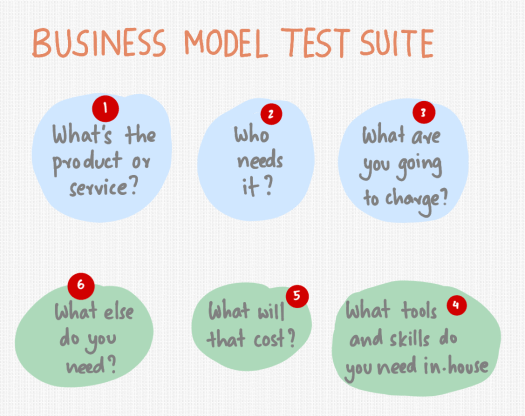
For example, BCG, The Boston Consulting Group, writes about Business Model Innovation – the idea that “when the game gets tough change the game”.

They argue that there are six components to a business model three of which relate to the value proposition and the others to the operating model.

You could have a go at creating a test suite by asking questions that test each component of the business model – as shown in the image above.

Let’s say you need to stand up and deliver a pitch to potential investors – tell them what you do.

Can you answer these questions?

  • What’s your product or service?
  • Who needs it?
  • What do you charge?
  • What tools and skills do you need in house?
  • What’s that going to cost?
  • And what else do you need?

For example, let’s say we were going to offer open source consulting services – we’ve got a product.

Now what?

we think everybody needs it, we’re going to charge $5,000 an hour, we’ve got a ten year old laptop. We’ll do all the work ourselves. There’s no other outlay – other than the mortgage and the kid’s private schools and we don’t know many people in this town.

Now, if those are your answers, you can probably also write down what good answers will look like.

And you could compare the two – test them – and see if your answers pass.

If they don’t – or worse – you haven’t got any answers at all then it’s time to debug your business.

Find out where the flaws are in your logic and thinking and fix them before you run the tests again.

Then again, maybe this is all too hard, and you’re just going to have a go and see what happens.

Well, in that case, it might be wise to keep an eye on those quiet folks with the boring business and the intense focus.

You’ll probably need to ask them for a job one day.

Cheers,

Karthik Suresh

The Surprising Reason Why Being Your Boss Is Hard Work

fame.png

Sunday, 8.41pm

Sheffield, U.K.

Life’s most persistent and urgent question is, ‘What are you doing for others?’ – Martin Luther King, Jr

I’m reading Here Comes Everybody: How change happens when people come together by Clay Shirky and looking at things from a new point of view.

As is often the case once you’re shown a new idea it seems obvious.

For example, the society that existed before the Internet is obviously different from the one that exists now.

Once upon a time it was hard to publish anything.

You needed money and machines and technology to print books, make films and reach people.

Now, it’s effortless and virtually costless for any of us to be publishers.

In such a world some things change and others remain resolutely the same.

Take fame, for example.

We think of famous people as a special breed – these sportspeople, actors and celebrities – who are in the public eye.

But what is it that makes them famous?

At one time you might have said it’s the media.

You’re famous when you’re on television or in the papers.

Shirky argues that fame is actually a matter of counting links.

In theory everyone can connect to everyone else on the Internet.

In practice we can only do so much each day.

We might know 10, 20, 200 people well.

We might be able to send a certain number of emails or tweets, or make calls.

Whether we’re famous or not, the number of connections we can make with someone else is limited by our own cognitive limits – what our brains can do without blowing up.

You can’t talk to 2,000 people a day – not real one-to-one conversations anyway.

So, two people can have only so many outgoing links – red arrows in the picture above.

But, any number of people can link to you – to your material or follow you on social media or send you emails.

You can’t stop a million people all sending you messages on every digital channel you have.

You also can’t respond to them. It’s out of your control to do it personally.

You will need help to even think about trying to do that.

Fame then, according to Shirky, happens when there is an imbalance in links – more coming in than you can possibly handle.

Not more in than out – the point is that we can all have the same number of links going out plus or minus a few because that has to do with our own cognitive limits.

It’s when we’re simply unable to deal with the links coming in.

That’s when you know you are famous.

Which gets us to your boss and why he or she is famous.

If your boss is the kind of person who likes to be informed then you’ll copy her into every email you send.

It’s just one email, after all.

But, if she’s working with 20 people and they all send her emails – just one at a time – they build up.

And she can’t answer them all, or has to work very hard trying to keep up.

And the load simply gets worse the more people you have.

The problem, once again, is that there are more inbound links than you can physically handle.

It’s the problem of being famous.

Everyone knows you as the boss and tries to keep you informed and you’re deluged with information as a result.

So here’s the funny thing about fame that I get from Shirky’s observations.

If you think that by becoming famous you’ll have deeper and more meaningful relationships with more people – you won’t.

As you climb your career ladder and become more well known you’ll find that you simply can’t know and talk to everyone.

Not because you don’t want to but because you’ll start to reach the human limits of what you can do.

So where does that leave us?

With just the human realisation that you can have a certain number of meaningful relationships and if you’ve got more inbound ones than that – well, you’re famous and just can’t do anything about it.

What’s left is your work.

So make sure you enjoy that.

Cheers,

Karthik Suresh

What Markets Can Tell You About How To Live Better

machines.png

Friday, 8.05pm

Sheffield, U.K.

Investing should be more like watching paint dry or watching grass grow. If you want excitement, take $800 and go to Las Vegas. – Paul Samuelson

I was listening to Tim Ferriss interview Howard Marks on his podcast.

It took a few days to get through the whole show because I kept restarting it and now have a napkin with notes in streaky bold purple felt tip.

And the first note has to do with Peter Bernstein who wrote “The capital markets are not accommodating machines”.

In other words they’re not wishing wells.

You can’t just want or need something and expect to have your wish come true.

People who have never done a trade or tried to manage their own portfolio don’t get this.

It’s actually very hard to explain this unless you already know how it feels.

The sick, clammy, gut-wrenching that comes from a trade going wrong.

Not knowing whether you’re wrong, or still right.

Seeing an investment go to zero.

It’s like saying travel broadens the mind.

You need to travel to know what that’s like for real.

Now, a lot of self-help and positive psychology stuff relies on life giving you what you want.

Focus on what you want and your reticular activating system will kick in and the universe will give you what you most want.

What if that’s not true?

What if, like a capital market, life is not an accommodating machine?

What is it then?

From Bernstein we move then to Benjamin Graham who said “In the short run, the market is a voting machine but in the long run, it is a weighing machine.”

In other words, what drives stocks now is news and noise and hustle.

In the long term what results in value is what the company earns.

You can achieve notoriety and fame quickly – but can you keep it?

The chances are that most people who have achieved anything did so over time.

Whether they’re public figures or successful in their own fields – they probably did it over time, little by little.

They learned and trained and worked.

And they were ready when opportunity came knocking – they knew how to recognise it and they knew how to let it in.

Lottery winners, on the other hand, have their big moment and then fade away.

It’s a simple lesson really.

Wishing isn’t enough.

Wanting isn’t enough.

Winning the lottery isn’t enough.

What matters is what you do over time.

Cheers,

Karthik Suresh

What Should You Do When You Don’t Feel Like Taking Another Step?

keep-going.png

Thursday, 9.11pm

Sheffield, U.K.

How we spend our days is, of course, how we spend our lives. – Annie Dillard

It’s wintry out there tonight.

Some of us have colds and headaches and don’t quite feel up to doing any work.

So what should you do when you feel like that?

Should you rest and recover or should you keep plodding on?

There are a few reasons for asking this – and they have little to do with the temperature.

The first reason has to do with sweatpants.

Writers like to talk about one of the perks of their jobs as being able to work in sweatpants.

No suits or jeans for them – instead it’s a comfy pair of stained sweatpants and they’re off to work.

And the reason they can do that – the reason why no one cares – is that they are judged entirely on what they produce.

Their output is what matters.

If you have a job where output is not the key measure – instead it’s stuff like work ethic or punctuality – then you need to be in the office well-dressed and groomed.

The key, however, is not about output or not.

It’s about power.

When you’re judged on what you make the buyer has the power to like or dislike and buy or not buy.

When you’re not, the person buying your services has to have control in some other way and the best way is to be able to watch you.

We digress…

Back to plodding.

The second reason has to do with practice versus passion.

What results in output?

What drives it?

If you’re in a job, a partnership, a business – what drives you to do something every day rather than slacking off?

It’s different for different people. Some like the competition. Some do it for the buzz.

What it really comes down to, however, is motivation – both intrinsic and extrinsic.

When you’re motivated to do something you’ll keep going.

Where does that motivation come from?

Some say it comes from passion for your work.

Because it’s the thing that you feel like doing the most.

So, you’ve got to manage that passion – manage that creativity and manage your energy.

If you’re tired and unwell, take some time to recover and recharge.

Rest.

Others say it’s about practice.

About showing up and doing what you set out to do.

Every day.

What should you do?

I don’t know.

Sometimes it seems like taking a rest is a good idea.

Sometimes not.

If you have been reading the odd post on this blog you’ll know that I try and write every day.

Yesterday I didn’t. I used an excuse.

Today, I could have used the same excuse.

I chose not to.

What was the right choice? Was one better than the other?

In a world where there are an infinite number of steps in front of you, stopping on one for a day or so is not the end of the world.

But you’ve got to start moving again to feel alive.

The days don’t wait for you to get your head around how you feel.

Cheers,

Karthik Suresh

What’s The Real Deal Behind The One On Paper?

psychological-contract.png

Tuesday, 9.24pm

Sheffield, U.K.

I’m not in this world to live up to your expectations and you’re not in this world to live up to mine. – Bruce Lee

I’m trying to understand several conflicting ideas about doing good work.

A friend of mine, a fount of aphorisms, said if you want to go fast go alone and if you want to go far go with company.

The difficulty lies in selecting the company you keep.

In an ideal world everyone would be equal and we’d all pitch in and work for the common good.

But the world isn’t ideal for one very simple reason – transaction costs.

If you’re sitting around a table with four or five others and you raise a toast, you can all clink your glasses together.

If you’re at a large gathering, like a wedding, you can only do it with those close to you.

It takes too much time to do it with everyone.

So, there is a natural need to organise into small groups – and those groups need managing – and the form they take is that of an organisation.

So the traditional way of working always creates hierarchies – of founders, employees, managers, investors…

And the traditional way of keeping these groups working is through contracts and salaries and stakes and incentives.

But, what causes one organisation to succeed and another to fail?

The key is not in the written contract but in the unwritten one in your head – the psychological contract.

There’s a whole bunch of fuzzy factors that go into this – the relationships between you and colleagues, between you and someone in a suit – a boss or an investor – and between teams of people.

It’s a cauldron, a bubbling mass of what you believe, what you expect to get, what you think is happening, what you think you should do and how each other person in the organisation thinks of all those things.

There is also the issue of power – who has it and how they use it.

The test to find out if the stuff in the cauldron is good enough to eat or bitter and putrid is that of fairness.

Do you think you are being fairly treated.

If there is fairness then that leads to trust.

A feeling that you are being treated unfairly leads to a breach.

And the breach shows up in the way you respond.

You can leave the company, hope things will sort themselves out, stop doing your job properly, go in fighting to try and get your way or try to compromise.

But… the breach has still happened. Life isn’t going to be the same again.

One strategy is to never expect anything from anybody – that way you’ll never be disappointed.

Another is to create a market.

Just post what needs doing and let people bid for work and let things sort themselves out.

The problem is that won’t work if the transaction costs are too high – which means if it’s too hard to figure out who to select and use and why.

A better way is to work out what fair looks like and try to work that into your working life.

This is increasingly important in a networked world – one where you come together in swarms to get stuff done.

How do you agree who does what and gets what with each other?

One approach is the idea of Sociocracy.

In this you work in small groups because small groups work well.

These are called circles.

The roles in the circle are created as needed and the people decide who should get which role.

How do they decide?

They use the principle of consent – which means that it’s decided when no one objects.

You don’t need to agree – you just need to agree not to object to the decision.

Addressing objections, it’s argued, makes for better decisions.

If you need more people then you create more circles and coordination happens with circles made up of nominated people from other circles.

But I want to go back to objections.

Maybe the place to start if you want to do something and want to work with someone else is to start by asking for 100% of the company.

What is everyone else’s objection to that?

Or, if you want more flexible working, ask to work from home 5 days a week.

What objections will your boss raise to that?

Maybe doing that – trying to be open and collaborative will help shine a light on what the deal really means for people.

And whether they think it’s fair.

Because in the end that’s all that matters.

Cheers,

Karthik Suresh