Why Would Someone Hire A Professional Like You

fit-for-purpose.png

Tuesday, 5.50am

Sheffield, U.K.

Quality means fitness for purpose. So no matter what you produce – a good or a service – it must be fit for its purpose. To be fit for purpose, every good and service must have the right features to satisfy customer needs and must be delivered with few failures. It must be effective to meet the customer requirements and efficient for superior business performance. – Juran’s Quality Handbook, 6th Edition

Thinking for too long can be a problem.

Sometimes you just have to get out there and find out what people need so that you can build something that they want.

Something that helps them achieve their purpose.

Building something fit for purpose

The idea of quality seems simple but it’s a word that can get complicated very quickly.

After all, what does quality mean to you?

For some of us quality is found in the aesthetics, the design, the look and feel.

I know people who are turned off instantly if what they see is ugly.

Other’s couldn’t care less about the surface impression – they’re interested in the numbers, the detail.

Other’s think about the philosophy, the values, the intent of the producers.

And it can get quite complicated to unravel very quickly.

Take the iPhone, for example.

The iPhone is designed to be beautiful, to be eye catching – to be the best phone, to be a symbol of prestige.

It’s certainly an indicator of wealth.

It turns out that you can map where the rich people are by mapping the density of iPhones – the more iPhones, the wealthier the neighbourhood.

Then again, if you just want a phone, some apps and a camera there are cheaper options, there are second-hand options.

It depends on whether you care about having the latest model.

And then, for me personally, I haven’t bought an iPhone for a while because the philosophy of Apple irritates me – the focus on keeping control and trying to imprison you in their ecosystem.

They make it hard to use their phones with any non-Apple systems and that lack of interoperability just makes it too hard to trust their machines – I’d rather use something else than deal with all that.

The point I’m making is that what is obviously a great quality product to one person may be seen very differently by someone else.

Your job as a professional is to work out what quality looks like to the person you’re trying to provide a product or service to.

And that starts by understanding their purpose – what are they trying to do and what are their constraints.

When you understand that you can build something that helps them achieve their purpose within their constraints.

Something that is fit for purpose.

But first you have to understand what all that looks like from their point of view.

Letting the prospect talk

A good sales process starts not with answers but with questions.

Why does the person need a professional like you, what are they trying to do in the first place?

You’re not going to think your way to the answer there, you need to start listening to what people have to say.

For example, let’s say you have a software development firm and a prospect comes to you – most people will launch into a pitch about what they do and the features and benefits of their product.

Not many will let the prospect talk about their situation, their problems and the reasons why they are looking for a solution.

But that’s where you really should start – by understanding the situation they are in, the problems they are facing and what that means for them – the impact that it has.

And you can’t find out any of that without letting them talk and asking questions that illuminate their situation.

When you do that you start to get a feel for why they are in the market for a product of service.

Are they looking at the value of time – they haven’t got time internally or their time is busy doing other work – so they’re looking to buy some time from someone who can do the work.

Do they realise that they haven’t got the skills they need so they’re looking for someone who can provide those complementary capabilities.

Or perhaps what they need is a restricted capability – something only a lawyer or accountant can provide – or they have to do it in order to comply with a rule or regulation.

Perhaps they don’t know what they’re looking for exactly – but they do know they’re trying to solve a problem that’s been around for a while.

It’s only when they recognise the unique shape and size of what they want and see that there is a need for it that they’re going to take the next step of working with someone like you.

Think of it like a puzzle – one with a strange shape that they don’t yet recognise.

They just know there is a hole.

If you can help them understand and articulate the shape that will fill that space, that’s a start – now they know what they need.

If you can show them that you can do it with quality – build something that’s fit for purpose then you’re in with a good chance of getting that project – now they know they can get it from you.

If you can show them that going with you is the best alternative – because you both now know what needs to be done you can do it at the best possible quality and the lowest possible cost – they now know you’re the best choice.

Bringing it all together

Once you’ve listened to what the prospect has to say and asked questions and helped them to understand what they need and how you can help you now need to put it all together in a proposal they can approve.

That actually becomes quite a simple task.

Because you know what they want you can simply list out what you’re going to do to give them what they want.

One of the things I’ve learned is that short proposals work if you put in the time to understand what people need.

When you don’t know you throw in everything you have – you try and explain everything you do hoping that something will stick and attract their attention and interest.

But if you know what they need you can cut out everything that isn’t relevant – you can create something short and to the point.

Just add costs, preferably costs that you’ve already established work within their budgets and you’re done.

Now, what’s the value you’re brought here?

It’s showing the difference between doing it yourself and hiring a professional.

A professional can help you do a quality job – quality in the sense of doing what’s needed to the standard needed, free of failures.

And you can only be a professional if you can provide a quality service – something which you have spent time developing and which is the best use of your time.

That’s something to explore next.

Cheers,

Karthik Suresh

Why You Need To Find Your Happy Zone And Play Just There

first-rule-of-hitting-get-a-good-ball-to-hit.png

Monday, 5.44am

Sheffield, U.K.

The hardest thing to do in baseball is to hit a round baseball with a round bat, squarely – Ted Williams

Baseball is a game of statistics, one of which is a player’s batting average.

The batting average is the ratio of times a batter hits the ball and gets to at least first base to the number of turns they take batting against a pitcher.

Getting .400 or hitting the ball 40% of the time is considered a standard of excellence and was last reached in 1941 by Ted Williams of the Boston Red Sox who also wrote a book called “The Science of Hitting”.

Warren Buffett is a fan of the book and talks about an image from the book helps him think about investing strategy and the importance of knowing your sweet spot – and how it can work for anything else you do as well.

The science of hitting

Ted Williams writes in his book that his “first rule of hitting was to get a good ball to hit.”

A strike zone is around 7 balls wide and 11 balls tall, giving you a grid of 77 locations.

Some of those locations sit in a happy zone, a sweet spot – a place where you know you can swing and bat .400.

Outside that you’re going to do less well, perhaps hit the ball 30% of the time.

And then there will be an area where your hit rate drops, where you only get a .230 average.

The difference between getting a high average and a low one is knowing when to hit.

Do you swing at everything?

How often have you heard someone try and chase a trend?

They’ve heard about an opportunity that someone else has capitalised on and want some of that for themselves.

It might be a stock, it might be cryptocurrency or it might be a new manufacturing project.

Should you get involved?

Warren Buffett talks about how the problem with baseball is that you do have to swing at something eventually.

You don’t have that problem with business.

You never get sent off for not swinging.

You can wait, pitch after pitch, until the right ball comes along, right in your happy zone, for you to take a swing at.

For example, let’s say you’re a building contractor and have been pretty successful at that, should you diversify into media production?

After all, everyone is making money on YouTube, aren’t they?

It isn’t a yes or no answer – you need to define your own strike zone and see if you’re playing in your happy zone or not.

For example, I’ve seen this done well where a contractor uses YouTube to create content that shows how they work, give a prospective customer a glimpse behind the scenes.

People love this.

Others have created entirely new channels, completely different from their main work and have had thousands of views.

As individuals, they have decided whether they go into an opportunity or not – and know whether the result is good or not – given the standards they have for themselves.

And you do have to try things to see if they work or not, you have to experiment or risk being left behind.

But most of the time you should probably wait to get a good ball to hit.

Learning to say No

Years ago I went to a shop that I used to go to a decade before that – the owner was a friend of the family and his children were now in charge as shop managers.

They were in the clothing business in a small shop in a small town.

I lived in a city and while I Was in the shop my parents asked the managers, jokingly, if they would like to expand and sell their cloth in the city and if I could help.

The manager smiled and nodded yes and said “no.”

That was a little confusing so we asked again and got the same “no.”

No explanation, just a smile and a flat decline.

And looking back at that, it seems like a sensible thing to do – the kind of thing experienced people do who have learned from a young age how to run a business.

Many of us are afraid of coming across as unhelpful, unwilling.

We’re not comfortable saying no to people, but if you want to be successful, if you want to be rich, that’s precisely what you need to learn to do.

You need to say no to everything that isn’t in your happy zone, in that place where you know you can hit hard and hit well.

Most of us would be better off if we stuck to a few things and did them really well rather than dissipating our energy doing lots of things just fine.

It’s good to say yes to the things that you know you can do well, it’s ok to say yes to the things that you can do, or would like to try out.

It’s okay to say no to the things you know you can’t do that well and it’s just fine to turn down everything that’s outside your strike zone.

The wider your zone, the less successful you’ll be – the more chances you give a pitcher to get a bad one past you.

But when you say no to everything except the stuff that you’re good at, then you’re going to be one of the best out there.

And when you’re the best you’re giving people a reason to work with you.

Let’s look at how that works in the next post.

Cheers,

Karthik Suresh

Why You Should Make The Drafts Process Work For You

making-drafts-work-for-you.png

Sunday, 7.43am

Sheffield, U.K.

Fiction, like sculpture or painting, begins with a rough sketch. One gets down the characters and their behavior any way one can, knowing the sentences will have to be revised,knowing the characters’ actions may change. – John Gardner, On Becoming a Novelist

It’s easy to look at a finished piece of work and imagine that it sprang to life, fully formed, in an instant.

But nothing has.

Everything that grows takes time, time before a seed finds fertile soil, time to push through the ground and emerge into sunlight and then more time to fix its roots and grow tall.

I can look out of my window and see three potato plants that went into the ground a few months ago.

One towers over the others, one is a medium size and the last one is struggling to grow at all.

They are within a few feet of each other, in the same ground, but they are growing very differently.

You cannot control the outcome

There are things you can control and things you can not – and wisdom comes from knowing the difference between the two.

If you create a work of art you have control over the material, the subject, the execution, the lines, the colours.

You cannot control how people react to it, whether they like it or not.

If you want them to like it then you may have to first discover what they like and then build that for them.

But even if you build something that’s based on exactly what they said you can’t control how they react.

Sometimes, when people get what they’ve asked for they find that it’s not what they wanted at all.

You can’t control that.

You can control your process

What you can do is work on your art – whatever that art is.

If you treat your career, your business, your product as an art project how would you go about getting started?

It’s too hard to get perfect lines the first time.

Instead, you rough it out – starting with blocks that position the main elements you want, go over it with a light pencil sketching out the lines and then pressing down creating the detail.

Finally, you add colour, ink – finishing it off.

Along the way you might use tools – guide lines, layout principles.

None of the approaches you take or the methods you use are visible to the person who sees the finished product, but without them the product would not exist at all.

And if you want to make something what you have to get control over is that invisible work, the work that makes it possible for your finished work to exist.

Think of it like doing multiple drafts

The romantic idea of a startup founder is that they come up with a new concept – something different.

They raise money, build a product, get a following, make a huge amount of sales and get very rich.

And repeat.

And perhaps that happens sometimes – but more often you find that the path an entrepreneur took was never quite that straightforward.

Take Steve Jobs and the iPad, for example.

When the iPad first came out it seemed like a bold and visionary creation that just emerged from the brilliant minds at Apple.

The idea, however, was something that Jobs had talked about decades ago and which perhaps built on ideas first articulated a decade or more before that.

Many successful businesses have been built over generations as the founders passed on their skills and creations to their children or to successors who went on to develop the business further.

It’s hard to see how anyone could start a project and on their first try create something that’s finished and ready.

It’s more likely that we all need to give ourselves time – time to try and learn and refine and improve.

And over time, we’ll create something that has value.

The challenge is focusing on the right things

When you first get started it’s possible that you have no idea how your project is going to go.

For example, when I first started this blog I didn’t really know what I was going to write about – I just knew I wanted to write and this was a routine I could follow.

When you do that it’s like throwing stones in the dark – you scrabble about find something then launch it.

Not quite sure what will happen.

After a while you start to get a sense of what’s around you – you get a feel for the surroundings.

Then, perhaps there is a glimmer of light on the horizon – the sun starts to come up.

You can see faintly now, there are shapes and shadows and the faintest outline of a target.

Something you can now aim towards, something you can hit.

In my case, that’s something like this Getting Started book project, which takes three years of writing practice and uses structuring methods I’ve learned and rediscovered along the way and has helped me work on a first draft relatively painlessly.

It’s a few months in the writing but years in the making.

And it’s probably the same with your project, with your business.

You work on gathering the capability and skills and connections for years.

And then, when you’re ready, you explode into action – you build and test and refine and improve.

You go from draft to draft until you’re finished.

Well, that’s the theory anyway.

That works if you’re operating in an area you are competent at – something you know, something you’ve taken the time to learn.

When you’re in the zone you can do stuff that looks like magic to others.

But outside that space you’re just as bad as everyone else.

Let’s look at that next before we move on.

Cheers,

Karthik Suresh

How To Make Something Work By Focusing On Flow

give-the-next-person-clean-output.png

Monday, 5.46am

Sheffield, U.K.

Life is a series of natural and spontaneous changes. Don’t resist them – that only creates sorrow. Let reality be reality. Let things flow naturally forward in whatever way they like. – Lao Tzu

As you build your business there is one question you should ask over and over again.

What happens next?

I once came across a concept called the velocity of money, something that people who really understood business seemed to understand instinctively, understand deep inside.

One way to think about this concept is to imagine a stream,

Imagine clear, sparkling water dancing its way along, moving, changing, shimmering.

It’s clean and crisp and refreshing and inviting.

Now, imagine a pool filled with stagnant water, unmoving.

That’s not so inviting, is it? It’s old, stale, dirty, polluted.

Rot starts to set in when something stops moving, when you stop being active and renewing yourself every day.

Staying still atrophies the mind and dulls the senses, just like metal rusts and tools lose their edge, when left alone and untouched.

It’s the same with work as you do it in your business.

Everything you do needs to move your business and your customer’s business on – it needs to work in a flow and it’s when that doesn’t happen that you start to struggle.

When something is finished and is now only fit to be preserved, kept pristine and untouched, we call it art.

Everything else is work in progress – something that fits into a greater purpose – and your job is to figure out how to keep things moving in the service of that purpose.

Which you can do by repeatedly asking, “What happens next?”

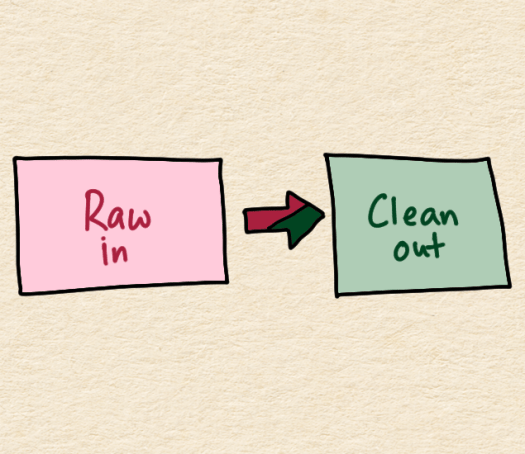
Raw in, clean out

Imagine you run a business that helps other businesses – like a management consultancy.

When you describe what you do to someone who has used consultants before you’ll often notice them wince.

They’ll probably ask you if you do something like come in, have a look around and write a report.

This is a common sales approach that many such consultancy organisations take – they carry out an audit examining the current situation and identify issues and recommend changes.

When this is done well they show the prospective client what needs to be fixed and they talk about how they (the supplier) can fix the issues.

This can lead to a sale.

The problem happen when the report tells the client what they (the client) has to do next – when it’s a prescription rather than a cure.

That kind of report tends to gather dust on a shelf.

And that’s because most people are too busy doing what they need to do.

They haven’t got time to do what you want to do.

If you want to be useful to them you have to fit into their flow – figure out how to insert yourself into their way of working and add value.

And you can do that by showing them what they will get from you that they can use in the next step of their own process.

For example, we recently visited a maze that the farmer creates every year using maize.

She described how she comes up with a design and then an experienced tractor driver plants the crop in rows.

She then plucks out plants to create the design.

When it’s ready she gets a drone operator to take an aerial image which then goes into the marketing literature and the maze is now open for business.

The farmer has a flow – a number of things she has to do over a few months to get this attraction ready for visitors.

Everything she buys in as a service has to help her move towards this outcome – help her achieve this goal.

If you can help her, then you might have an opportunity.

But you have to provide something that is clean, something that she can use in the next step of her process.

For example, that image from the drone operator is clearly useful for marketing – the picture itself, maybe some video footage, can be used for branding and publicity.

It’s not just a work of art, even if it looks good – it also has purpose and function and fits into a larger whole.

It’s useful.

Get rid of waste in your process

A useful side effect of asking what happens next is that you can identify things that don’t help.

In most cases, trying to track what’s doing on and create reports doesn’t help.

That creates busywork that you don’t really need to do.

Sometimes you have to monitor things to understand what is going on, but it’s not something you have to, or should do all the time.

What matters more is getting what needs to be done done.

Anything that doesn’t contribute to moving you own, to keeping the flow going, should be considered for elimination.

You can’t get things wrong that you don’t do at all.

The best way to improve quality is not to do what you do better – but to do less of everything you do and focus more on the things that matter.

When you stop thinking in terms of time or tasks and focus on flow – on what happens next – you’ll start to develop a feel for the velocity of your business.

The smoother, faster the flow, the more you keep things moving, the cleaner and more efficient you will be.

You’ll also be more effective.

As you design your business keep this principle in mind.

At each stage, provide clean output – something you or your client can use without modification.

Something that fits cleanly into the next step in the process.

But you won’t get this right on your first attempt – you’ll need to work at it to get to that point.

Which is what we’ll cover next.

Cheers,

Karthik Suresh

How To Learn Anything You Need To Know For Your Business

learning-through-modelling.png

Sunday, 7.11am

Sheffield, U.K.

The more that you read, the more things you will know. The more that you learn, the more places you’ll go. – Dr. Seuss, I Can Read With My Eyes Shut!

What do you do when you realise you don’t know something?

All study is self-study

There is an Indian story of a forest hunter called Ekalavya.

He wanted to study archery but the best teacher in the land, Dronacharya, who taught the royal princes, refused to take him as a student.

So Ekalavya built a mud statue of Dronacharya, literally modelling him out of clay, and taught himself, practising every day in front of his teacher until he became a great archer.

The story doesn’t end well for Ekalavya – but that’s in another time and place.

The main lesson – that you can teach yourself anything you want – is one we should take to heart.

Once upon a time you needed to be apprenticed, you needed a teacher.

And then we had books that distilled the knowledge of experienced people into packages that anyone could take up and learn from.

And now we have YouTube, where we can see how others do it and learn anything we want, from how to teach better to how to replace a broken door frame.

You have everything you need to learn anything you want – we all have access to more opportunity than anyone before in history.

But how do we go about using it successfully, rather than drowning in a flood of knowledge.

Focus on relevant, useful information

When information is everywhere you no longer need to absorb it all.

You can access it on a just-in-time basis rather than a just-in-case basis.

Rather than trying to learn everything about a subject, focus on the outcome you want and identify the things you need to know to make that outcome happen.

That list of things becomes what you need to know.

For example, to build your personal brand, you need to be clear about what you want to get across – what is it that you want to be seen as an expert on?

How will you showcase that content – will you write, create a podcast, create video, or do all three and more?

Will you do it yourself or get someone else to do it and manage the process?

How will you get people to come and look at your material – how will you get the word out?

When you are clear that the outcome is a enhanced personal brand, what you need to do will become obvious very quickly.

You have to ask yourself how you will do these things and how much it will cost you and how you can do them well.

And if you don’t already know how you are going to do this you should spend some time watching you other people do it well.

Learning through modelling

On my Twitter feed one of the posts said that you shouldn’t pay people to tell you how to get rich.

After all, if they were already rich, they wouldn’t need your money.

Paul Graham, the founder of YCombinator, responded by saying that they would often tell you how to do that for free.

Now, being rich isn’t the only outcome that matters – and you will find examples of all kinds of people who have created outcomes that are relevant and useful to you.

Some of them will share their story and what they’ve learned and when you come across them you have an amazing opportunity to learn because they are modelling how to do something and giving you the opportunity to watch and learn.

But you have to be careful.

With every person you watch, read or listen to, ask yourself how they make their money.

Most of the ads you see on YouTube for people who are offering you a course on how to be successful have no useful content.

You will often find a detailed breakdown of the flaws with their programmes if you do a search, but what most of them boil down to is that you make money by selling their programme.

It’s a network marketing strategy, where you create something that has little intrinsic value, but you persuade other people to join you in selling it and make money off the membership fees they pay.

You should ignore all these entirely.

Then you have a category of “personalities” who have strong opinions and are entertaining.

Many of the big names in self-help will fall into this category – they are inspiring, articulate performers who can make you think you can do anything if you have the will and the grit and the ability to outwork everyone else.

You should be careful with these people. Some of what they say is useful but most of it is entertainment.

If they make most of their money through speeches, courses, books, conferences – then you know that it’s the performance and the thrills they’re selling rather than the content.

Most of the content is folk-lore – common sense repackaged for your viewing pleasure.

But their main measure of success is eyeballs watching their content – eyeballs they can monetise.

And then you have people who show you how they do things – in an authentic and transparent way.

What you’re looking for here are real people – the ones that show it as it is.

Perhaps the best example here is Warren Buffett and his shareholder letters.

They articulate what he has thought and learned over decades of investing and if you’re interested in that field they are required reading.

People like this use their ability to create content as a way to showcase what they are interested in, what they do and the products and services they have to offer.

They make money either through the businesses and assets they have which they’re talking to you about, or they have created products that you can buy from them – but the products are how they make their money not by monetising you as their audience.

But, there aren’t that many examples of people doing this intentionally, but what’s interesting is that you can find better examples as you look into the early days of what people did.

When I come across someone on YouTube whose channel I like and find useful I often view their earliest videos – because that gives me a sense of where they started, and how their approach and message has changed over time.

Many develop their craft and ability to tell a story over time and it’s fascinating to see how they balance content and presentation.

For example, some focus on enhancing their content and teaching style while others improve their lighting, camera setup and on-screen presence with hair and makeup.

And when you come to their latest content you can tell whether they have a product to sell you or whether you are the product that they’re trying to sell to advertisers.

You also need to appreciate that you can learn different things from different people at different times in your career – and the best thing you can do is be intentional in who you follow and why.

Modelling over time

Different people will show you different approaches and you can learn different things from them.

The test is how relevant they are to you and what you want to get out of things.

If you want to learn about developing your screen presence, your ability to speak into a camera and be persuasive – then the big personalities of the Internet are where you go looking.

If you want to build a sustainable business then you might want to look elsewhere, to people who have found a niche and developed their business to fit into and dominate that little patch of cyberspace.

That’s certainly how I progressed over time – starting with persuasive speakers who told you to do things like write affirmations.

I still have books filled with daily writing somewhere – based on people saying that if you just wrote down what you wanted every day the universe would come along and give it to you.

The thing that changed the way I looked at these things was when I was introduced to the idea of thinking critically.

Critical thinking is not a negative thing – it’s not about criticising.

It is, instead, about taking in information and sifting it, evaluating it, and looking beyond the rhetoric, questioning tradition, not accepting authority unthinkingly and always being conscious of the objectivity of the people involved.

People will say things for many reasons.

You need to be careful to learn things for the right reasons, as best as you can given the situation you are in.

The test of knowledge for you is whether it is useful, whether it can help you take the next step you need to take.

And taking a series of steps will get you to where you want to be.

We’ll talk about that next.

Cheers,

Karthik Suresh

What Are The Things You Need To Do?

system-holon-model.png

Saturday, 7.00am

Sheffield, U.K.

The basic managerial idea introduced by systems thinking, is that to manage a system effectively, you might focus on the interactions of the parts rather than their behavior taken separately. – Russell Ackoff

We have a tendency to focus on things – try and identify the one thing we can understand and improve.

That has been a very successful approach – taking something and deconstructing it, figuring out how it works.

It’s the basis of the scientific method and rational thinking and has created the modern world.

But the process of deconstruction always loses something – and it’s not always obvious what that is.

Because you won’t find it in the pieces that you’re left with.

So what is this thing and how can you be intentional about the way you go after it?

Understanding emergence

Imagine you’re running a large business with lots of departments that do different functions.

Which function do you think is the most important one?

Your sales people will argue that it’s what they do – without the customers they bring in you have no business.

The operations people will counter, saying that if they don’t make things people want the sales people will not have anything to sell.

Finance will weigh in now, pointing out that without their ability to keep money flowing in the business no one would have the space and time to do what they need to do.

When you think about it you realise that you need all the departments to function – or at least you need the essential ones to deliver your capability and you need the others to do superior work.

The performance of the business as a whole depends less on whether you have an amazing sales director or the most qualified finance person in the country than on whether they work well together as a team.

If you go and look for “performance” in the business you won’t find it in sales or operations or finance.

You might see performance in the shape of satisfied customers as a result of their interaction with your business at the various points at which they connect with each other.

Performance or customer satisfaction are “emergent” properties – they happen as a result of everything you do not from any one thing.

Making the best car in the world

This is why you cannot make things better just by improving one thing – and it’s the reason why improvement efforts focused on a particular function or department don’t deliver results as a whole.

The management thinking Russell Ackoff used to use an example with cars.

Imagine you want to build the best car in the world.

You start by getting a collection of the best cars in the world right now, one of each type.

You get the fastest one, the best looking, the biggest, the best seller,

Now that you have the best cars in the world you take them all apart.

You compare the pieces and select the best ones from each – the best suspension, chassis, engine, exhaust, seats.

And then you put them all together and now you have the best car in the world.

After all, it’s made from the best parts in the world, so it must be the best, right?

You know that isn’t the case – you’ll be lucky if the car even starts and moves.

It’s not the parts that make the difference, it’s how they work together.

Each of those “best” cars had components that fitted together and worked together to deliver that performance you rated as “best”.

Another way to think about this is the idea of “dream teams”.

There are individuals who play brilliantly in their teams – perhaps for various clubs with players from different countries.

Then, when you have a national game you get your best players together from these clubs – the superstars of the game and put them into a team.

Isn’t it odd how they seem to find it very hard to win – these are the best players at their clubs but together they don’t seem to be able to deliver a result?

Again, it’s because being the best isn’t enough – you need to be able to play well with the others in your team.

It’s a simple concept but one that many people just don’t see – because we’re so caught up in the approach that says you have to focus and have a target and be single minded to achieve something.

We fail to see that it’s about more than that one thing.

Seeing the things that matter

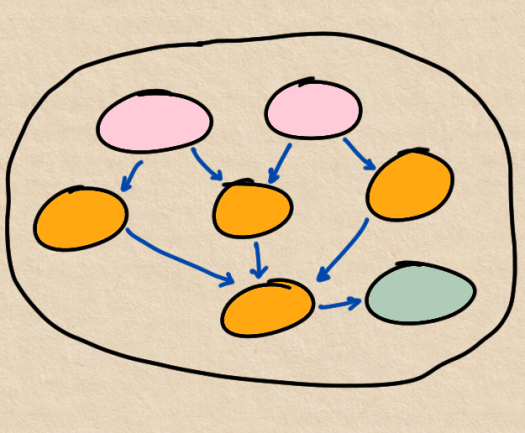
One way of seeing everything rather than one thing is to create a simple model.

Think of the things that matter – the things you need to do.

Write each one and draw a circle around it.

Then, draw arrows from each one to the others to indicate dependencies.

Finally, draw a circle around all of them.

This model has a number of properties.

It has a boundary – the things inside the big circle are the main things you need to do.

In our business example, there are things that you might think of like marketing, sales, operations, finance, logistics, strategy.

Some of those things are things you can do – things that go inside the big circle as little circles.

I’d probably include things like marketing, operations, sales,

But what about strategy?

Well, if you need to write a strategy document, perhaps it goes inside the circle but strategy could also be the whole picture itself – the strategy emerges from being able to clearly see everything that needs to be done.

And that happens because once you have the small circles of things to do you draw arrows that show what happens first and what happens next and if there are feedback loops where something that happens affects how you look at something that happens earlier.

Feedback from prospects, for example, may lead you to change your marketing message or tweak your product in operations.

Now you’re probably used to making a list of everything you do but the main thing that happens when you do it in this way is that you intentionally look at the relationships and dependencies between things.

This simple approach shows you everything you need to do and also tells you what you need to do first.

You start with the areas that have arrows pointing away from them but none pointing to them.

That’s the beginning.

Then you have the ones in the middle that have arrows pointing to them and have arrows pointing away from them.

And you end with the ones that only have arrows pointing to them.

This shows you everything you need to do and the order in which you need to do them – a strategy in one simple image.

Keep this high level – with only 5 to 9 nodes.

More than that gets complicated and you rarely need them.

If you want to expand on a node create a separate diagram for it.

What happens when you do this?

When you look at this map of nodes and relationships explicitly you can see you need them all to operate together for your business or project to succeed.

Imagine that the nodes are logs and the connections are strings.

Like in the image below, you need to choose logs that float and string that holds them together.

raft.png

Lead logs and spaghetti won’t work – you need wood and cord and the thing you build needs to be sound and strong and fulfil its purpose if you are to stand on it and stay afloat.

But that’s what you’re doing when you’re building your business or starting your project – doing something with purpose and making it work.

So, how do you do it well?

You start by learning how others do it well – which is what we’ll look at next.

Cheers,

Karthik Suresh

Why You Should Plan In Ten-Year Chunks Of Time

ten-year-chunks.png

Friday, 5.35am

Sheffield, U.K.

People tend to overestimate what can be done in one year and to underestimate what can be done in five or ten years. – J. C. R. Licklider

Is there a good time to start anything?

As an old saying goes, the best time was ten years ago. The second best time is now.

Can you last the distance?

When you start your project you should ask yourself whether this is something you can commit to for ten years.

If you’re starting a new business, can you do what it takes – hustle, work all the hours you can, raise money, hire people, build product, get customers, create cashflow – all while maintaining a relationship and being there for your kids?

Maybe that’s not what you want – you want a lifestyle business that allows you to pursue your dream and give you enough time to enjoy life – so is your dream enough to keep you occupied for ten years?

A ten-year period is a significant chunk of time – it’s a serious part of your life to set aside pursuing something that may or may not work out.

So, how can you maximise the changes that you will make it and create something worth having.

Have a clear outcome you want from each decade

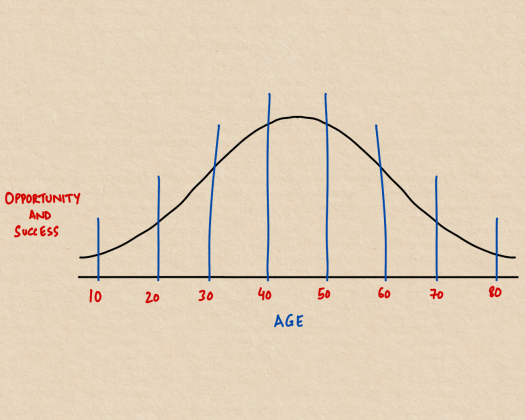
When we look back at the lives many of us lead, they probably follow a pattern something like this.

Until we get to ten, there isn’t much pressure on us, we play and get socialised – become part of the culture we live in.

From 10 to 20 we learn how to learn.

From 20 to 30 we start making our own money, get our first job; we go from depending on parents or the state to becoming cashflow positive, bringing in more than we spend on our own.

From 30 to 40 we develop in a profession, find our own place and start to find a niche that we can call our own. A niche that we can dominate and where we can do competent work when others ask us to.

From 40 to 50 we start becoming responsible, for others, for bringing in business. We operate increasingly independently, as the ones who take decisions rather than the ones who implement them.

From 50 to 60 we’re in charge – we are responsible for the future as well, so we spend more time training and developing others.

From 60 to 70, we wind down, easing our way out and letting others take over.

And after 70, we have the time to do what we want, with few responsibilities and obligations – and hopefully with the health and mental ability to use the time well.

Now, your chances of making it, of succeeding are greatest in that period from 30 to 60 but you can do it at any stage of your life.

It’s just that the chances are less of you being a child prodigy or being a 17-year old millionaire or an 80-year old startup founder.

But it happens.

Don’t let age hold you back.

Just recognise the reality of where you are and decide what you’re going to do in the next ten-year chunk.

But how do you do that – decide what to do?

Say yes until you have to say no

At the beginning of a period, when you’re just starting out, you have to take every opportunity you’re given.

For example, let’s say you want to build your consultancy practice but you’re at the start of your journey – then don’t worry about money.

Just take every chance you can to practise your craft.

For example, you may have spent the last decade working with top brands – but now you want to go independent.

Don’t just target the top brands that you used to work with.

Instead, book sessions with everyone, with individuals, small businesses, medium sized ones, large ones, charities, non-profits, startups – anyone who will take the time to talk to you.

Don’t make those sessions about money or value or exchange – just listen as hard as you can and give as much as you can.

Sometimes you will get paid, and sometimes you won’t.

But, if you do that for a while, pretty soon you will know what people need and are desperate to have and how much it costs them to do it the old way but they’re stuck because they can’t find someone who can solve that problem.

That will tell you what you need to make and how much you can charge and how big the market is and whether you have a viable business.

And once you match what you do to what people need you’ll start getting interest and once you have proof that it works – social proof, in the sense that others have used it and it worked – it will be easier to show others and get them to say yes.

As more people say yes you will have more work and so you start to have a problem as you haven’t got enough time and you’re working all the hours in the day to get everything done.

Which is the point at which you start putting in filters – things that reduce the amount you have to do – so that you can focus on what you do best.

You start by raising prices, then by reducing availability – and you fine-tune that until you can once again match supply and demand – your ability to create and your market’s desire for what you do.

Eventually, you will find yourself saying no to everything that doesn’t help move you towards that outcome you want.

Maybe you over-correct, stop doing too many things, and find you have to say yes again.

That’s ok – you don’t have to feel like you’re committed to anything other than making your customers happy.

If a process doesn’t work, abandon it. If a book isn’t engaging, stop reading.

Say yes, but don’t be afraid to stop if it’s wasting your time – abandon stuff without guilt – books, projects, opportunities.

Don’t put down an anchor until you’re certain you’re in the right place and this is going to work for you.

But once you do, commit, do it every day and make it a routine – get used to the idea that you’re going to do this for ten years.

Make fewer, better decisions

Warren Buffett has talked about how the ability to do more investments doesn’t do anything other than making the people who help you do transactions rich.

If you could pick only twenty stocks in your lifetime you’d be much more careful about which ones you chose.

If you could do only one thing in the next ten years, you might be much more careful about what you chose to do.

The thing to realise is that your success doesn’t depend on your age – there are advantages and disadvantages at every stage of life.

When you’re young, you have time but lack knowledge.

When you’re older you know what needs to be done but you have responsibilities that take up your time.

Success depends on making it easy to do what’s important for as long as it takes, being ready to commit for at least a decade to make what you want come true.

Ten years where you will build something – put together the pieces in a way that only you can to create something that didn’t exist before that people want and are willing to pay for.

And you have to work through what that looks like, which is what we’ll get to next.

Cheers,

Karthik Suresh

Exploring Your Prospect’s Mind And Planting An Idea Flag

plant-an-idea-flag.png

Thursday, 5.25am

Sheffield, U.K.

Skillful conversationalists can explore disagreements and make points in ways that feel constructive and positive rather than combative or corrective. – Gretchen Rubin

What is your project?

In the last couple of posts we looked at making sure you were heading in the right direction and that you had taken a good look at the obstacles in your way.

Now, as you set off, let’s ask the question; what is your project?

Is it to start a business, write a book, create a portfolio, make a course, produce a product?

Now, what do you do with that idea?

Exploring your prospect’s mind

The world has been thoroughly mapped and explored, there are few places you can go to on the surface and plant a flag to claim that you found it first.

That’s not the case with the territory of the mind.

You have a vast, uncharted space to work with, a space where you can create territories rather than find them if you choose to do so.

Apple are an example of a company that’s great at doing this.

The products they have come out with have redefined what the world looks like for their customers, changing how they live and act.

You and I, we’re not Apple, but we can still have a go at exploring this territory of the mind and planting a flag in a patch that we believe we’ve found for the first time.

And this is important because why should anyone listen to you if you have nothing different to say to everyone else?

In marketing speak this idea of finding a space that’s your own is referred to as your USP – your unique service proposition.

That’s not entirely right.

It’s not what you do that needs to be unique.

It’s the way you position yourself in the mind of your prospect that needs to be different.

For example, if you’ve recently started as an estate agent, what are you going to do to win customers?

Are you going to act exactly the same way as the company you’ve just left, the one that trained you?

Or is there going to be something different, something unique about your message, your brand, your approach?

Now, in order to set yourself apart, you need to know what normal looks like to your prospect.

That means having conversations, enough of them to be able to map out what’s going on.

What does your prospect think, feel, believe about the world around them.

What are they happy with, what doesn’t work, what’s frustrating, what do they really want to fix?

All these questions help you explore the minds of your prospects and, as you wander around, you may come across a piece of mental real estate that’s unclaimed, something that you can make your own.

Somewhere you can plant a flag and stake a claim.

Planting your flag

The act of putting your flag in the ground is a decisive one – it means you now have an intent, an end goal, a place to call your own.

And there is a power to doing this – you can now look at every option you have and discard the ones that do not directly contribute to achieving your goal.

For example, I have been writing this blog for a few years now – writing every day.

I had no real plan for the blog at first, I wanted to write, but I wasn’t sure what to write about and I wanted to give myself time to work that out, work on developing a voice and a style.

I used the blog to help me read and learn, finding out what interested me and what didn’t, discovering which ideas were useful and which weren’t.

So far, I was wandering the territory of the mind, looking around – just exploring.

On the 26th of May 2020 I decided that I would start a project to write a book and planted an idea flag.

I briefly described my plan in a post and came up with a working title for the book.

And the act of doing that has made subsequent decisions extremely simple.

Especially when it comes to getting started.

I have a box filled with paper slips that set out the structure of the book and every day I take out the next slip and write that section.

That’s it.

But you have to be kind to yourself.

Everything is a work in progress

You have to realise that just because you’ve planted your flag that doesn’t mean that you’re done and can rest now.

That’s just the beginning, you now need to cultivate, to build on, to develop that patch of intellectual territory you’ve staked a claim to.

In my case these posts are a first draft, fleshing out the ideas on those slips, creating a form and argument with words.

I have to give myself permission to create – badly if necessary – but to create.

I need the words on the page, however badly written, however inadequate, because it’s only when these words are down that I can go back and edit and rearrange and trim and improve.

Until the words are down the book is just an idea.

Just like any project you may have.

So, be kind to yourself, and allow yourself to be rubbish – it’s okay to create stuff that you aren’t proud of.

It’s more important to create, to make a start, to get going – because once you have something you can make it better.

You can’t improve something that doesn’t exist in the first place.

Planting an idea flag gives you a place to call your own, a patch of mental territory you can now work.

But you’ll need to give yourself time – time to till the land, get rid of the rocks, create a fertile soil for your ideas and plans.

And that’s what we’ll look at next.

Cheers,

Karthik Suresh

What Would You Do If You Could Magically Remove All The Obstacles In Your Way?

no-fear.png

Wednesday, 5.31am

Sheffield, U.K.

Nothing in life is to be feared, it is only to be understood. Now is the time to understand more, so that we may fear less. – Marie Curie

Once you know where you are heading how will you make sure you get there?

What are the obstacles in your way?

Most of us, as we go through life, pick up responsibilities and cares and worries.

We need to earn money, pay the mortgage, pay for tuition for the kids.

The obligations pile up, silently, one at a time, until one day we find that we’re stuck, we can’t move for all the things blocking our path.

For example, you might have started a job as a temp, just to earn some money for a while and then a decade later you’re stuck in a well-paying but ultimately meaningless role that you never thought you’d be doing at this stage of your life.

But you can’t leave because you’ve gotten used to the money and the lifestyle and the holidays and it’s too hard to give all that up, so you might as well grind it out.

Or, on the other hand, you could have loads of ideas for things to do but be short on resources – time, money, expertise to do what you want to do.

You’re stuck, unable to act because you don’t have the things you need to get the job done.

So what, if anything, can you do about it?

Introducing magical thinking

Make a list of the things in your way, the things holding you back.

Write them down – the obligations, the responsibilities, the relationships, the things you own.

We enter and create and develop and buy all these things, which then end up wrapping themselves around us, gently but firmly holding us in place.

Now, look at that list of obstacles and imagine what your life would look like if you could magically remove each one.

If you need the money to come in to pay for the mortgage and your lifestyle – what would it look like if you had all the money in the world?

Or what would it look like if you didn’t have the mortgage and a different lifestyle?

Let’s say, for example, that you’re putting off starting your business because you need your salary to pay for the new house you want to buy.

What would life look like if you could magically remove the need for money – if you had more would you buy the house you’re looking at now, or perhaps an even bigger one?

What would it look like if you didn’t need to own the house – if you could rent where you wanted to live?

Go through the things on your list – what about relationships.

Are there ones that are negative, toxic, ones that are holding you back?

What would happen if you crossed them off, stopped associating with those people.

You don’t need to spend much time on this – just look at the things that are holding you back and magically wish them away.

They don’t exist any more, you have no constraints, no restrictions, no past obligations, no present responsibilities.

What will you do now?

A life without constraints

If you had nothing holding you back would you take a leap off the edge into a more exciting future?

Or would you hang back, staying away from the prospect of change, hobbled by fear?

If there was nothing stopping you from pursuing your business idea right now, what would you do?

For example, many people have restrictive clauses in their employment contracts that stop them from working for competitors or doing the same work on their own behalf.

That’s to protect the interests of your employer.

But if that wasn’t in place, would you do the same thing you’re doing now or is there something different, something better, something that’s more you, that you would do?

For example, is the reason you’re not promoting yourself more on social media because you’re afraid of what people will think and say – perhaps they’ll feel like you’re trying to get ahead of them, publicise yourself at their expense?

Or maybe you just think they won’t approve?

You need to take a long, hard look at these things – these obstacles in your way.

Then look past them, magically make them vanish in your mind, and ask yourself what you would do next.

If you could, would you start doing practical things, like registering a business, starting to create promotional content, a website, getting in touch with a few people to pitch your idea and ask for feedback?

Is there stuff you’re doing already, stuff you’ve done but not shared with the world because you’re afraid of how people will react?

What would happen if you magically removed that fear and started to put that stuff into the world?

Get out of your own way

If you want to build a better tomorrow for yourself, you have to start by clarifying if what you think you want is really what you want.

Once you know that, you need to look at the things holding you back – and if you’ve done this exercise you will start to realise that that’s a little more complicated than it first seems.

Some things are fundamental – like having enough money to live.

Some things you wouldn’t change – you want to spend time with your kids, however long it takes.

Some things you can control, like how much you spend on things that you could do without if you needed the money.

We’ve all got constraints, some more than others.

But if you can see what you would do next if you magically removed those constraints, then you can see the beginnings of the path you need to tread.

This exercise is like hacking through the foliage covering it up, taking a machete and cutting through to the point where you can see that there is something beyond.

And eventually that path may lead to a place where you can dive into your future.

But, for right now, it’s enough to see it – that’s a start.

Because here’s the thing.

If you don’t know what you will do when there is nothing in your way, how can you do anything with all the things that are in your way right now.

Your constraints define you, they hobble you, they surround you.

And you can’t do anything about some of them.

But the ones you can do something about are the ones that will let you slip your bonds and wriggle free.

Free enough to move forward.

Which is what we’ll look at doing next.

Cheers,

Karthik Suresh

How To Do The Perfect Day Exercise To Clarify Your Goals

perfect-day.png

Tuesday, 5.42am

Sheffield, U.K.

The perfect day is going to bed with a dream and waking up with a purpose. – A. J. McLean

It’s been 43 posts into this Getting Started book project and we’re in the final section of the first draft that I’m writing in these blog posts.

The first section started by looking at where you are right now.

The second looked back at where you had come from, and what you had gathered during your journey.

And now we’re ready to go into the future – shaping it to suit us and what we want.

So we have to start with that.

What do you want? Really, really want?

It’s time to do the perfect day exercise, which is described in Barbara Sher’s book Wishcraft.

Find a piece of paper and a pen.

I’ll wait.

Ready? Let’s begin.

What you have to do in this exercise is picture your perfect day and write it down.

Start from the very first moment in the morning.

How do you wake up, when do you wake up, where do you wake up?

This is your perfect day so it can be anything you want – there is nothing in your way apart from the laws of physics.

You could be in Australia or the Caribbean. You could be in London or Lhasa.

You could have a mansion or a beach hut.

What happens next after you wake up?

Where do you go, what do you eat, who are you with?

Picture the day unfolding in your mind, minute by minute, hour by hour.

What happens next each time?

Write down how it goes, what do you do or not do in the morning, how and where and when do you have lunch?

What happens in the afternoon, how does the evening pan out, what do you do late into the night before you finally get back into bed – at the end of a perfect day?

When you’re done you should have a page or two filled with notes.

Have a look and make sure that this day is about you – not about someone else.

Be selfish – write about what you want in detail.

Be honest – this is about what you want and no one else need ever see your notes.

Also, don’t settle for vague descriptions, such as getting a particular job – dig into exactly what you do in that job and how you spend your time – not what label you have.

Before you read on, this exercise will be most useful if you have done this first.

Looking back at your perfect day

Say you’re a photographer and your perfect day goes something like this.

You wake up at your mansion in rural England.

Breakfast is served at a long table; you have your own chef and butler.

After that the Bentley whisks you off to a private gathering of some of the most influential people around – who are here to listen to you speak about branding and marketing.

After that you go to an exclusive restaurant, which has been reserved for just your party – and you have a fabulous afternoon talking to your tribe.

In the evening you go to the best nightclub around, to your own private section with just the people you choose to have.

Eventually, your personal helicopter picks you up from the roof and drop you back home where you sink into bed.

Now that you have this down what does it mean?

Last chance to write your own now!

Looking back at your perfect day

Now, what does your perfect day tell you about what you want?

Let’s take our photographer friend above and look at his perfect day.

There’s a lot in there about what money and fame can get you – the luxury lifestyle, the adoration of others, anything you crave.

Does your perfect day have many of those in there as well?

Now look at it again and see how big a part the project you want to start has in it?

Our photographer, for example, has not left much time in that day to do actual photography.

If you want to start on a serious project – starting a business, changing a career, committing to a product – then how much time would you spend doing that project if you didn’t have to?

If you could have and do anything you wanted – would you still do that project?

If the answer is yes – and you can find it in your perfect day notes – then it looks like you’re planning to do something you’re truly passionate about, something that’s important to you and you would do whether you were successful or not.

If it’s not in there, you might need to take some time to consider whether it’s really what you want.

If you’re trying to decide what career path to go down and you choose to be a lawyer because your parents think it’s a good idea – then this exercise will help you clarify if that’s in line with what you really want.

Do you like reading, discussing, arguing a point of view?

Or do you dislike confrontation and prefer creating, playing and recording your music?

Now the point of the perfect day exercise is not to put you off pursuing your idea.

But it is to question what you want as a consequence of pursuing that idea.

For example, if you want to write a book so that you can become rich and famous but your perfect day doesn’t involve spending any time writing the book – then perhaps writing isn’t your thing.

You don’t enjoy the hours of research and drafting and redrafting that go into the creation of a book – word after word after word.

But you’d like the feeling of being a published author – so maybe instead of spending time writing you should hire a ghostwriter and work with them instead.

Or if you want to be famous – perhaps there are other ways that suit you better based on what your perfect day is telling you.

Either way the benefit of this exercise is to give you some insight into whether the project you’re starting is one you really want to do.

If so, you’re ready to move to the next step.

Which is what we’ll talk about in the next post.

Cheers,

Karthik Suresh