How To Make Differences In Status Work For You

status.png

Tuesday, 8.06pm

Sheffield, U.K.

Satori has no beginning; practice has not end! – Kodo Sawaki

The first chapter of Keith Johnstone’s book, Impro: Improvisation and the theatre deals with the issue of status.

Why is this important?

Status transactions, according to Johnstone, happen all the time.

The way we speak to each other shows the use of status and its ability to put someone down, big them up or agree with them.

Status is not something you have but something that emerges from what you do.

For example, when I was younger and going for interviews I remember reading about how where you sit affects how you act in a situation.

For example, during a one-on-one interview it’s common for the interviewer to sit behind a desk and the interviewee to sit in front, their back to the door.

This is an exposed position and results in the setting creating a status difference right from the beginning.

You might think that’s something that happens just from the relative roles played by the two participants – surely an interviewer has a higher status role than an interviewee?

Well, on one particular interview, I was shown to a conference room with a desk and two chairs, one facing the door and the other with its back to it.

The room was empty and the chairs were the same – so I took advantage of being the first one there to sit in the chair facing the door.

When the interviewer walked in he had a distinct look of surprise at seeing me sat in his chair.

He shrugged it off and sat down and we had the interview – but it was clear that the relative status had changed and it felt like a situation where the status had been reversed.

That particular situation worked out but I have been in other situations where an individual walks into a room, sizes up the seating and then quite deliberately walks over to the dominant seats.

It doesn’t work quite as well then because you know they’re playing a game because they walked past more convenient seats to get to the one that had more perceived power and people who see that will want to bring them down a peg or two.

The point Johnstone makes is that status transactions emerge when you’re near someone else – it’s like the space around you, the auras spread out until they collide with someone else and then the status between the two of you governs what happens next.

In a business context many people teach that you should be the dominant one in this situation – brash sales trainers and alpha males talk about the prospect as weak and submissive and you, as the sales person, as the one who must seize and dominate, taking the prospect all the way through the sales process until it’s closed – overcoming objections along the way.

I have seen no one successfully sell anything significant this way.

I am not sure it works for pots and pans, or cars or consulting services.

The only thing the people selling such approaches seem to be doing is selling such approaches.

It’s like Internet commerce – lots of people want to take your money to tell you how to make money on the Internet.

The point to note is that status is something that helps you to build a relationship.

Johnstone writes that “acquaintances become friends when they agree to play status games together.”

If you want to develop a relationship with a prospect the key is being able to shift from status level to status level until you’re both working together.

What you need to do when you’re handing out leaflets in the street is very different to the way in which you would engage with someone at a trade show.

The skilful handling of status during a consultancy engagement will mean the difference between getting a client for life or an unhappy separation.

Starting to become aware of status is hard – because we’re so focused on being ourselves and being in control.

But if you have children you’ll find that often trying to impose your views on them is not a very effective strategy.

The expected, default or preferred status is simply something that holds you in place, like a mammoth stuck in tar.

The fluid, elegant use of status lets you adjust and flow to society – to prospects and customers.

Because what you really want is not to be in a position where you are given orders or have to give them.

What you want is to do work you enjoy for people you like, admire and trust.

Cheers,

Karthik Suresh

How To Avoid Making Fundamental Errors When Reasoning

fallacies.png

Saturday, 9.13pm

Sheffield, U.K.

It is just as easy to indoctrinate with fallacies as with facts. – Aldo Leopold

I am still working through Wanda Teays’ textbook Second thoughts: Critical thinking for a diverse society, trying to extract bits that might be useful on a day-to-day basis.

Chapter four is on fallacies – what happens when there is a fault in the way you have reasoned your way to a conclusion.

Teays writes that there are four big categories of fallacies.

Rather than repeating the academic version here I’m going to paraphrase and see if I can find examples so I can better understand each category – which, fyi, has a number of subcategories – but we’re not going to go into all of them.

Each category leads to a conclusion – the thing you choose to believe.

The first category has to do with the premise of the argument.

A premise is a previous statement that you use to get to your next statement.

The classic example of this is attacking a person instead of the argument they are making.

This is the equivalent of a hammer in the tool chest of the modern politician – absolutely essential to deal with opponents.

You don’t need to look far for examples of this – just search for Brexit on Twitter.

The second category has to do with the assumptions you are relying on to be correct.

The bad use of statistics, generalising from one case or applying a general rule to a specific situation where it doesn’t fit, and creating false either/or options are all examples of this kind of approach.

One particular one is arguing that because something has happened something else must now happen – even if there is nothing to show why there is a cause and effect relationship existing there.

Okay, I can’t resist going back to twitter and Brexit.

Here’s an example.

“PM @BorisJohnson has negotiated a new deal – Now it’s time for MPs to come together to back it today.”

Is it really?

The next category has to do with the wording that is put in front of people.

We have to ask whether the chain of words actually work together, or whether there is something that breaks it.

For example,

“Property prices have always gone up – you’ll never lose money investing in the property market.”

It’s true that property prices have gone up on average over time, but it’s been a roller coaster ride along the way – and you definitely can lose money depending on when you enter and exit the market.

The final category of error has to do with structural and logical flaws.

These are boring – and you’re not that likely have to use them.

Spot the flaw in the last sentence?

Anyway, the first couple of fallacies are the ones that we come across all the time.

At some other time I think it might be interesting to look more closely at specific examples of these fallacies.

But there are more important things to look at first.

If you come to a conclusion and people disagree with you, what should you do?

And, if you disagree with someone else’s conclusion, what should you do?

Should you try and change their minds – by pointing out the flaws in their arguments and educating them about the fallacies they hold?

Not if you don’t want to waste your time.

The only thing to do is talk to people who already think the same way you do.

And to those who haven’t made up their mind yet.

Thinking critically is hard and complicated.

I’m not sure we have the ability to do it in real time.

So we must take action based on conclusions we have already come to, hopefully based on sound reasoning.

Most of the time, however, we should probably switch off the telly and Internet and pick up a book.

Cheers,

Karthik Suresh

When And How Should You Break The Rules?

different.png

Wednesday, 8.59pm

Sheffield, U.K.

All rules of construction hold good only for novels which are copies of other novels. – D.H. Lawrence

The other day a friend and I were talking about the nature of jobs.

He is a successful business person and says that he can’t imagine having to go into an office where he does the same thing all day.

In this age of knowledge work many of us will probably agree – what engages us in the workplace is the variety of projects and tasks we get to work on.

At the same time we only get better by spending the time doing the same thing again and again and learning from the resulting work.

We all start by imitating others – often a central figure acts as the model for that which we aspire to become.

It might be a parent, a teacher, a leader, someone you’ve read about in books, but that person seems to sit at the centre of a world they’ve created, in control and at peace.

Imagine then, at the centre of it all, there is this model person – someone who has attained a deep shade of blue.

Surely if you do things the way they did, if you follow their teachings, you will too become blue?

But the irony is that there is usually only room for one person that is truly blue – the rest are washed out copies, pale imitations.

They look like the real thing – but they will never be the real thing.

This is the kind of thing the quote by Lawrence is getting at – copying other people’s works or trying to behave the way they did will only get you so far.

So, some people opt out of the system – they throw their arms up in disgust and go away to pursue a career as green jelly.

They’re as different as different can be.

They are monks and artists and wastrels – but some of them are invested in being unique for the sake of being unique.

And how do you tell the difference between someone who is unique and someone trying to be unique?

Often you can’t – the surface appearance is the same.

What matters is what happens over time – what happens underneath the surface.

In Edgar Willis and Camille d’Arienzo’s book, Writing scripts for television, radio and film, the authors write that “one of the things beginning writers must do is undertake a voyage of exploration to discover the nature of their own resources.”

This is good advice in every endeavour – when you first start doing something look at how others have done it and try to copy what they’ve done.

You could start completely fresh – with no reliance on what has come before – but don’t be surprised if the world ignores you.

By building on the past you’re at least on solid ground when you start.

But the thing to remember is that you won’t get to where they are by doing what they did.

And it’s not really what you should want anyway.

If you apply yourself for long enough then, over time, you can’t avoid learning the rules – realising what works and what doesn’t and why thing are done in a certain way.

If you’re alive and alert and interested and hungry to learn, that is.

And then, when you know the rules, you can try our what happens when you change a shade.

Perhaps even an entire colour.

And now you have something unique, built on what worked before but customised to you and your future.

The right time, then, to break the rules is when you understand them inside out – and know what you can and can’t do.

And then you go ahead and do what you must do.

Create new rules.

Cheers,

Karthik Suresh

What Should You Do As Soon As Possible In A Presentation?

get-to-the-point-fast.png

Monday, 8.58pm

Sheffield, U.K.

Don’t stand out to be different. Stand out to make a point. – Anthony T. Hincks

I’m currently reading about the art of producing film and radio content and slowly realising just how useful the skills story tellers have learned over time could be in business.

And perhaps the most useful advice is to get to the point fast.

How many times have you watched people struggle to get their point across?

You might have experienced that too – I certainly have.

When you’ve worked on a project for a while there is so much in your head – so much you’ve learned and worked on that it’s hard to know what to talk about first.

Experienced sales people know not to spill their chocolates in the lobby.

Many of us want to please others – we genuinely want to help and do things that others will find helpful.

And so, when we’re asked about something we rush to talk about everything we know – come up with every way we can possibly help.

But the chances are that because we don’t really understand the nature of the problem what we’re doing isn’t really answering the real questions being asked.

At the core of every message there should be a point.

You can meander, circle, perhaps eventually spiral your way to the centre.

That’s what most people do.

The standard report format of introduction, methods, results, discussion and conclusion are almost never useful in real-life situations.

They are essential when it comes to actually doing work.

But they are less than useless when it comes to presenting your work.

If you’ve ever spoken to a “real” business person – the kind of person that lives and breathes business you’ll know that they have two defining characteristics.

One is that they are usually too stubborn and single minded to realise that what they are doing is completely wrong and doomed to fail – and so they don’t.

Fail, that is.

And the second is that they have the attention span of a gnat.

A gnat with ADHD.

I know a few people like that and when I try and describe almost any of the things that I write about in these posts – things which you read with great patience – their eyes glaze over almost instantly.

It just doesn’t work for them.

They would never bother to read these long passages.

They just want to know – what’s the point, what does it mean for me, what do I need to do?

They trust that you know what to do – after all you’ve done the work and all the boring stuff.

They want the ten second version.

Which is – get to the point as soon as you can in your presentation.

Rather than working your way from the outside to the centre, start at the middle and work your way out.

Make your point – then back up a little and explain your reasoning, and then back up and present your evidence.

It’s natural to do the work outside in – to go from looking at the big picture to working out exactly what is the right approach.

It’s tempting to present things the same way – but that would be a mistake.

The natural way to present is inside out – start from the precise, specific benefit that the person listening to you will get and then explain why it’s going to work.

Because the one thing you can be certain of is that the people who make the decisions didn’t get there by wasting their time.

Don’t waste it now.

Cheers,

Karthik Suresh

How To Understand The Relationship Between Audience, Media And Content

audience-media-content.png

Sunday, 7.39pm

Sheffield, U.K.

readers … could use their time for the things that were important to them: grimly ploughing through American box sets, failing their children and betraying the Jungian injunction to raise human consciousness. – Richard Ayoade (Ayoade on Ayoade)

What I have to say here is probably obvious to any first year media studies student but it’s dawning on me for the first time.

Which is perhaps the first point that should be made.

What do you think it means to be literate?

Too many people assume that it means that you should be able to read.

If you are reading this you must be literate.

But, there’s a rider or, technically, a few more words.

Literacy is the ability to read and write.

But, of course, you protest, it means that – what’s your point?

It is this.

For the first time in history people like you and me have the ability to work in a variety of media forms without having to scale barriers.

Not that long ago if you wanted to write and publish a book you needed a publisher and a contract.

Radio needed a studio and permission to access airwaves.

TV required money and equipment and actors.

Programming needed expensive computers and software licenses.

All things out of the reach of ordinary people.

And yes, I’m including operating computers as part of media because they are really quite similar.

We are now all able to write, record, film and program.

But we don’t.

And that is because most of us are actually functionally illiterate when it comes to these media.

It doesn’t seem that way – we can all turn on computers and work on spreadsheets, watch Netflix and listen to the radio.

That’s the equivalent of being able to read.

But we can’t write.

And this is something that technology developers, in particular, seem unable to understand.

They think that the perfect solution is something that does it all for you.

A voice controlled AI, for example, that does what you tell it to do is seen as the pinnacle of technological achievement.

It’s all very one sided – and simply thinks of people as “users”.

In American terms think of this like a form of gun control, where the gun is fired for you by people you pay as long as you keep paying but you aren’t allowed to have one yourself.

Would you want to live in a technological ecosystem that does the equivalent of banning your right to have your own firearm?

In intellectual terms that’s what you’re signing up to when you don’t make the effort to write, record, film and program in this day and age.

What I’ve learned is that when you do start trying to learn about these things a few things stand out.

Some time back I listened to three speakers.

Two read out long and complex speeches and the third opted for an off the cuff, straight from the heart speech.

The audience loved the third speaker, because the speech felt authentic, one that simply expressed what the speaker felt.

The speaker was, however, also an aspiring actor.

So what is it that made the difference – was it the speaker’s heart or something else?

Spoiler alert – it was something else.

First, never make the mistake of addressing an “audience”.

Your audience is actually just one person.

One person like you – reading this right now.

Anything you create is eventually processed by one person – the text, audio, video and user interface make their way into the mind of an individual and make a difference.

So, address your content to one person – and if they understand what you have to say then you’re doing ok.

But you have to say it in a way that works with the media they’re using.

With text you can write quite a lot, you can ramble and use big words – because the reader can go back and look at things again.

If they don’t understand a particularly complex and unnecessarily elongated semantic construction that appears to be created purely to elaborate on the point the writer is making they can always go back and read it again if they can be bothered to do so.

With audio, on the other hand, the words fly past at literally the speed of sound.

So, it’s hard for your listener to go back over what they’ve heard – it’s gone, things have moved on.

Which is why when you’re recording something you should use small words, short words, easy words – words that can be heard and understood.

You also have to spend more time explaining the context of what is going on – where you are, what you’re doing and what’s happening now.

That speaker who everyone liked was liked because he was the only one who could be understood at the speed of sound.

And that made all the difference – nothing to do with heart.

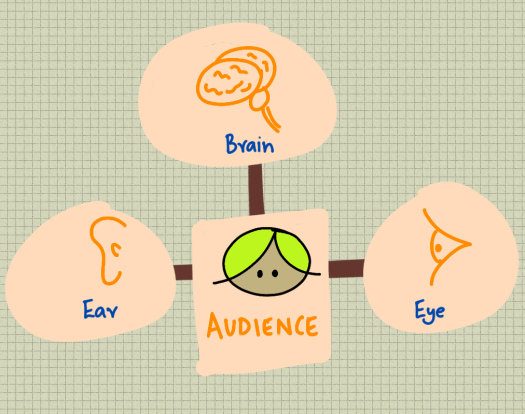
On paper, you write so that the audience’s brain can process your content.

With audio you speak so that they can hear you clearly.

With film, according to Alexander Mackendrick in his book, On film-making, you need to think about what the audience sees before any talking happens at all.

He talks of film as being pre-verbal – how the context and background and the feelings portrayed by the actors are all seen and processed before any words sink in.

Light is faster than sound, after all, and you see everything faster than the words can get to you.

So you create film for the eye – and words build on what is seen already.

These media require different approaches – different skills – and it takes time to become literate in them – just like it takes time to learn a new language.

So, if radio is for the ear, film is for the eye and text is for the brain, what is programming for?

It’s probably for the brain as well – but instead of being passive it’s interactive.

When you write what you write stays where it is – it forms itself in ink of paper or pixels on a screen and then sits there – looking at you as you look back at it.

With programming, the text comes alive – fed through a machine as a set of instructions that makes things happen.

It makes it possible for you and me to write and record and film.

And now that we can maybe we should try and listen to Jung.

Although I plan to to carry on with the box set I put to one side while I ignored the children and wrote this piece for you.

Cheers,

Karthik Suresh

Why Do You Do The Work You Do?

what-we-want-from-work.png

Saturday, 8.54pm

Sheffield, U.K

Profits, like sausages… are esteemed most by those who know least about what goes into them. – Alvin Toffler

Every so often do you ever wonder what’s the point of it all – why is it you do what you do?

It’s easy to feel disenchanted with whatever job you have – even if it’s one of the “good ones” – the ones that protect people or help them or make a difference.

It’s generally accepted that money is a bad reason to do anything – but that doesn’t stop us from using it to rationalise quite a lot of things.

For example, you might sometimes hear that what all businesses are trying to do is put more on the bottom line – profit is what drives us to work and produce.

That always seemed an empty approach to me – it lacked any sense of purpose.

So, what other options might we have?

These questions have clearly been tackled before and the first few pages of Alexander Mackendrick’s book, On Film-Making, gives us an insight into how this looks for people in a field with which many of us have little familiarity.

The problems they face, however, are much the same – I guess because they are human ones.

Before you can really have the space and time to think about purpose you need a basic level of income security – enough to eat and cover your responsibilities.

Clearly you need less when you’re young and more later.

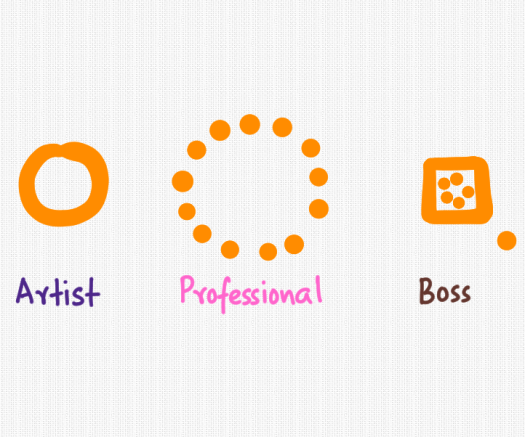
But when you have that you can start to wonder whether you’re an artist or a professional.

An artist is driven to create – to work on something that is individual and original – but most importantly they don’t have to answer to anyone else.

As an artist, you’re in control of what you do – there’s just one circle and it’s all yours.

An artist, ideally, is independent.

Getting paid for their art is a hoped for bonus.

A professional, on the other hand, is interdependent.

As a professional you create work and work with others to create a product that is of value to a paying customer.

This is really what you hope to have when you work in a company – a community of colleagues with different levels of ability and achievement but brought together with a common purpose to create and deliver value to a customer.

Lots of individual circles that come together, and from which emerges a larger pattern.

The place where many people imagine they want to be is the position of being the boss or ideally, being a rentier – someone who gets the profits without the work.

The kind of people who want passive income.

These people, if they take that role too seriously, put themselves outside the box where all the work happens.

They have money but little creative work – and so one assumes they spend their time trying to amuse themselves.

Good luck to them.

Assuming, however, that you are the kind of person that wants to do work that has some kind of purpose, how do you go about being creative?

That is answered in a paragraph that is worth quoting in its entirety:

‘Creativity’ will always look after itself if you are prolific in production, which means starting off by turning out masses of work that is relatively unoriginal, derivative and imitative. When productivity has become second nature, you will find you have acquired a freedom in which your particular and personal individuality emerges of its own accord.”

That philosophy is the reason why I try and write a blog post every day – because the process matters.

In a few short pages the introduction also reminds us that the basics matter.

Structure is important – it underpins everything you do.

You learn only by doing, not by reading or thinking.

“Work”, it says, “is the only real training.”

And when you learn, or when you train your colleagues, train them “so that they can cope with anything that might happen.”

A point with echoes of systems theory.

You may have no interest in film-making.

But if you get a chance read and re-read the introduction because it may help you think about why you do what you do.

Cheers.

Karthik Suresh

How To Get Your Team To Improve The Quality Of Their Work

dangerous-rocks.png

Friday, 9.46pm

Sheffield, U.K.

Standard checklist philosophy requires that pilots read to each other the actions they perform every flight, and recite from memory those they need every three years. – Anonymous

I may not be looking in the right places but there seems to be a severe shortage of literature on improving service design.

Or, it could be argued, there is too much of it – it’s just that it’s wrong.

The most useful material I’ve found so far is in the work of John Seddon.

For example, he provides perhaps the best explanation of the difference between a product business and a service business that I have come across so far.

From a manager’s point of view, that is.

Imagine you are in charge of a factory that makes a Thing.

A light bulb, a car, a software package.

The main characteristic of your Thing is that each item you create must be the same.

You need to create the same light bulb again and again – and the main job is to ensure that you minimise variation in the process.

No one is going to thank you if they pick up your LED bulb and find you’ve left out the glowing thing that makes light happen.

All stuff you read about manufacturing improvement has to do with understanding variation – as explained in Donald Wheeler’s marvellous little book.

So, we’re clear – with a product business you want to understand the things that cause variation and eliminate them.

Now, what if you’re delivering a service?

One way of looking at services is that what you’re delivering is an activity – not a thing – which involves people on both sides of the transaction.

With products, you hand over a Thing to the customer.

With a service, you Serve the customer

And the one thing you should know about the service business is that customers feel like they can ask for changes.

This clearly irks some people – such as the owners of a restaurant I was at recently who felt it necessary to have the words “Please do not embarrass staff or yourselves by asking for unrealistic changes to this set menu” on said menu.

Service businesses feel they have no option but to act like product businesses – after all McDonalds got big through a ruthless product based approach to delivering a fast food service – so it must be the model to follow?

Not if you’re doing anything more complicated than making a burger…

Seddon says that while a product business tries to eliminate variation a service business should design itself to cope with variety.

That means instead of having staff that do just one thing you should train them to sort things out for customers.

That’s the difference between taking a customer’s query on the phone and routing it to a team because you’re the call centre person, and getting the customer’s broken boiler fixed.

In the first case you’ve done your job, you believe, when you’ve transferred the call.

In the second case the job is done when the customer has a warm house again.

There is a difference.

There’s more on service design here but the point of this post wasn’t really about all this.

It was to ask how you could help your team improve.

And one way to do that is to make things visible.

The biggest problem we have at work is not enough time – and so we might have a one to one for an hour a week and let people get on with the job the rest of the time.

That means the person working with you gets feeback around forty times a year.

That means things often go wrong, but you don’t realise it – just like you don’t see rocks when you’re in the deeper parts of the sea.

Just because you don’t see danger doesn’t mean it’s not there.

This metaphor is used in the book Japanese manufacturing techniques: Nine hidden lessons in simplicity to describe how, in a product business, making too many Things can hide problems with them.

If you have a few Things then you find out quickly if they’re defective or not when you use them.

And people don’t want to make bad things – but they need feedback to know that something is wrong and needs fixing.

Making small batches is like the shallow end, where you can see the rocks that are going to sink you and take action to avoid them.

In service design the analogy is giving feedback – in helping your team learn how to do their job better.

And that takes time – because you might not know yourself – and so part of the job is trying to study the situation and try ways of improving it with your team, rather than just directing them to do it by magic.

Or, as Xun Kuang wrote, “Tell me and I forget, teach me and I may remember, involve me and I learn.”

Cheers,

Karthik Suresh

How To Understand The Right Way To Control A Situation

control.png

Thursday, 8.52pm

Sheffield, U.K.

Wisdom consists of knowing how to distinguish the nature of trouble, and in choosing the lesser evil. – Niccolò Machiavelli, The Prince

I was reading the book Creative warriors walk alone: The business of art when I came across a section on what the changing corporate environment means for us.

In a nutshell, the book argues that smaller companies can offer work but big companies have the money and opportunities to do big, interesting projects.

But, on the other hand, a small firm has the flexibility to do things that people in large organisations can’t do.

In essence, the hierarchy of a big company means that all those levels of managers and subordinates trying to work together often results in confusion and delay.

An alternative is a customer/vendor relationship. If you hire me to do some marketing work then I’ll bring my best work, which should be better than the stuff your intern can do.

This approach, the book says, is called “interactive decentralization”.

And that led me to search for more information in those two words and I came across a very readable paper by Michael Kometer titled The strategy of control: Centralized vs decentralized control of US Airpower with some rather interesting ideas.

Ones that we might use to look at what’s going on in the world around us.

First, consider the spectrum that makes up influence.

This is the x-axis in the matrix above.

Influence is an attempt to try and get someone else to do something.

It ranges from deterrence, where you try to stop them doing something to force, where you use brute force to make them do something.

Between these extremes are degrees of compulsion, from diplomatic pressure to financial sanctions and legal action.

On the other axis consider the issues of control.

Control can range from centralised, where one or a few people make all the decisions to decentralised, where decision making is delegated to people closest to the issue.

So, what should you do in different situations?

Well, it really depends on what level you’re operating at.

Although the image above is a two dimensional matrix you should really try and see it as a three-dimensional space.

What does that mean?

Think of the matrix like a battlefield.

At the highest level strategy is about working out what you’re trying to make happen – how you’re trying to influence the situation.

The strategy element is something is always centralised – and one or a few people make the decision on whether they want to deter, compel or force an outcome.

For example, let’s look at the UK’s strategy with respect to Brexit.

The UK cannot compel or force the EU to accept its demands.

All it can do is deter the EU from doing things that are harmful.

Which is why the negotiations have foundered, historians will probably argue, on a fundamental disonnect between the anglo-saxon and Germanic mindset.

One wants to throw everything up in the air and see where things land. The other wants to proceed step by step and will not move from one issue until it has been settled and once an agreement has been reached, will not backtrack.

You may remember at the outset of negotiations that precisely this happened.

What the UK should have done was get the main prime ministers together over a pot of tea and try to deter them from behaving in a way that would result in a mess – in other words deter them – and that should have come from the very top.

On the other hand, in other parts of the world, notably where there are superpowers, a strategy of compulsion is very much the order of the day.

The next level down is the operations level, which is all about getting resources in place.

Operations is about getting the pieces set up – and in that sense it is informed by strategy and delegated to those responsible for the pieces.

And finally, you have the tactics level, where the hammer hits the nail and things break and blow up.

Now, typically as you get closer to tactical decision making it often needs to be decentralised because people on the ground know more about what’s happening in front of them than people far away.

Then again, the nature of modern information systems means that people far away may have much more information than people on the ground.

The thing that makes the difference is technology and communication – the two things that mean you can be extremely effective if you decentralise tactical decision making and also be extremely effective if you centralise it.

So what should you do?

It goes back to the influence axis.

If you want to keep control of the story – manage expectations in line with a grand strategy then keep control centralised.

For example, if you have a project that you need to steer through the complex hierarchy of your organisation then use your own team and inside people.

But, if you want to go hell for leather – if you want to create a new product or enter a new market then you need to move fast.

It’s a bit like a brute force strategy – succeed by any means possible – then you need the best team working for you, preferably one that will do their best without needing to be prodded and pushed.

The thing to take away is that it’s not as simple as centralised equals bad and decentralised equals good.

It depends on what you’re trying to do.

Then the how starts to become clearer.

But no simpler.

Cheers,

Karthik Suresh

How To Figure Out Where To Spend Your Time To Be Effective

priority.png

Tuesday, 9.14pm

Sheffield, U.K.

The only thing a cat worries about is what’s happening right now. As we tell the kittens, you can only wash one paw at a time. – Lloyd Alexander, Time Cat

We all know people who are very busy managing a huge number of commitments.

They’re busy with work, family, finances and the myriad other things that come with modern life.

And if you look at just one of those areas they’re juggling things all the time – keeping all those balls in the air.

The intention here is to keep things going, to make sure nothing falls and smashes on the ground – all this effort to keep things the same.

But is this model really the one we should be using?

Or is there a different approach that should be considered?

Imagine, for example, that you are a leader in an agency – one that provides services to clients.

Perhaps its management or marketing or finance – something on those lines.

What are the main things you need to do?

Well, there’s marketing – getting out there and being visible so that people are aware that you exist and know how to get in touch.

There’s sales, where you figure out how to add more value to a client than you take from them.

There’s the service itself, which you need to deliver to a high standard while continually looking for ways to improve and innovate.

And then there’s the team of employees and associates you work with, who all need to play nicely together to deliver what the customer needs.

One way you could split your time is by doing a little every day – making sure you balance things out between these core areas.

In practice, what you probably do is spend time on the area that interests you the most – perhaps service delivery if you like doing the work or sales if you prefer to work your network and talk to people.

These sorts of approaches still carry the idea of balance and control with them – an underlying sense that things should be “manageable”.

In Gary Keller’s book The one thing he talks about this idea of balance and says that perhaps that’s a myth.

Instead, what you do is focus intensely on one thing and then switch to the next thing and focus intensely on that one.

You don’t share time or give it just enough – you give it your all for a very focused period and then move on to the next item.

In this kind of world priorities don’t exist.

There is only the priority.

The one thing that matters most right now.

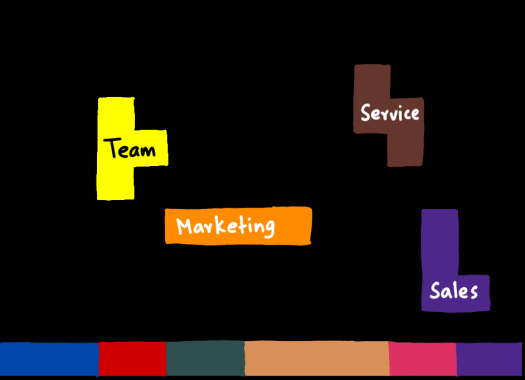
The image I have that tries to express this is a game of Tetris.

You have different blocks, labelled with the things you need to manage.

If you’ve played the game you know that switching between blocks is a bad idea.

You need to pick one, focus, get it into place and then move to the next one.

You spend some time, hours, days, weeks on say service.

You spend that time getting things done, making sure it works until you’re happy you can leave it for a while.

Then you shift to the team, building up your colleagues and making sure they have the training and understanding to do the right thing right.

Now you can shift to marketing, spending more time getting out there and being visible, starting to bring in the leads.

And then you shift to sales, moving conversations on, writing proposals and getting the work booked in.

The point of this approach is that some things matter more than others at some time.

The blocks closest to the bottom matter most if they’re not aligned right.

Once they are, another one needs your attention.

The thing to remember at the end, though, is that it’s still a game.

Something you need to do at Work might be a priority.

But it’s not always the most important thing.

But you know that already.

Cheers,

Karthik Suresh

What Is The One Thing You Must Do To Succeed?

low-hurdle.png

Friday, 7.57pm

Sheffield, U.K.

To the extent we have been successful, it is because we concentrated on identifying one-foot hurdles that we could step over rather than because we acquired any ability to clear seven-footers. – Warren Buffett, 1989 shareholder letter

Every once in a while I have to remind myself of the basics – the things that I should have learned along the way.

Or, at least, have learned from other people.

The kind of thing you find, for example, in Warren Buffett’s shareholder letters.

The 1989 letter has a section titled Mistakes of the First Twenty-Five Years (A Condensed Version), which is where you will find the quote that starts this post.

Now, actually, the whole letter is filled with gems, so it’s probably worth just picking out a few.

..marrying for money – [is] a mistake under most circumstances, [but] insanity if one is already rich.

If you have a job or work with people you know then why would you throw everything away to start afresh somewhere else?

It’s one thing if nothing is working and you’re out of options – but in most cases, when you’ve invested time and effort building relationships you should think very carefully about changing them.

we simply don’t care what earnings we report quarterly, or even annually, just as long as the decisions leading to those earnings (or losses) were reached intelligently.

This sentence demolishes the target based approach that almost all managements use, especially those constantly watching what stock market analysts are going to say.

Targets are a waste of time.

Thinking hard and trying to make good decisions isn’t.

We only want to link up with people whom we like, admire, and trust.

The only sentence you need to remember when deciding to partner or work with someone.

what the wise do in the beginning, fools do in the end

Often a new product starts with a good idea.

Mortgage backed securities, for example, were all about giving investors exposure to the mortgage business – to the steady stream of payments and interest made by people buying houses.

That made sense and increased the number of mortgages available so more people could buy.

Until the market got out of control, issuing mortgages to anyone and selling the securities to everyone – ending with the financial crisis of 2008.

Another example – email in the beginning, spam now.

Promoters, after all, have throughout time exercised the same judgement and restraint in accepting money that alcoholics have exercised in accepting liquor.

When someone is selling something they will often say anything to get the deal through.

Very few deals are actually no-brainers.

Most of the time what’s happening is the time between the sale and the result is being stretched out – and people are hoping to make as much as possible in fees before the deals of the past catch up with them.

It’s a bit of a hollow existence, but I suppose the money they get fills the hole inside.

Time is the friend of the wonderful business, the enemy of the mediocre.

This is the antidote to the get-rich-quick potion, if you’re offered that sometime.

A business with good economics will grow over time, accumulating customers, profits and a reputation like a snowball getting larger as it rolls down a slope.

As will you, an individual, taking the time to be work on yourself and your career or business.

I suppose the example here is of the apprentice who learns a trade and then hones it over time – and in the end just cannot help becoming a master.

… in both business and investments it is usually far more profitable to simply stick with the easy and obvious than it is to resolve the difficult.

And this brings us round to the quote that starts and illustrates this post.

One kind of success is the big one – the gold medal at the Olympics or the stunning win at whatever television talent show there is on the box right now.

But, in those events there is only one winner – and they are feted because they cleared the biggest hurdles out there.

But everyone else is simply a loser.

And for those of us that will most likely end up in the latter category it’s much easier to the easy things.

The secret to success, it turns out, is not in overcoming obstacles but in getting rid of them altogether.

Take away the barriers and you will find it much easier to move forward.

And once you’re doing that, find a way to leverage the power of compounding.

That’s the final lesson of the letter – it all comes down to the rate of return you get from your investment.

Over time a series of small returns can deliver the same result as one big return – with the added bonus that the small return could very well carry on forever, while your one big chance may be the only one you have.

Perhaps the one thing to take away from this post is this sentence:

If your actions are sensible, you are certain to get good results

Cheers,

Karthik Suresh